
Microsoft Build 2026, held in early June in San Francisco, put Microsoft’s enterprise AI strategy into sharper focus by pairing a governed agent stack with a new family of first-party MAI models designed to run inside Azure and Microsoft’s productivity ecosystem. The headline is not that Microsoft launched more AI features. The headline is that Microsoft is trying to make the platform, the model, the identity layer, and the workflow data feel like one decision. For Windows shops, Azure tenants, and Microsoft 365-heavy enterprises, that could turn the next AI stack choice into a much stickier commitment than the last cloud procurement cycle.
The most important sentence around Build 2026 did not sound like a product announcement. It was the argument that the model itself is not the durable differentiator; the system around the model is. That is Microsoft’s new enterprise AI pitch in miniature.
For the last two years, most organizations have treated model choice as the dramatic part of the AI decision. GPT, Claude, Gemini, Llama, Mistral, and specialized domain models were compared like CPUs in a benchmark chart. Microsoft’s Build message shifts the center of gravity away from the model and toward the operating environment: where the agent is built, what data grounds it, what permissions it inherits, how it is monitored, and how it improves over time.
That is a much more Microsoft-shaped argument. The company’s strongest enterprise assets have never been single products in isolation. They have been control planes: Active Directory, Windows Server, Office, Exchange, System Center, Azure, Entra, Intune, Defender, Purview, and Microsoft 365. Build 2026 recasts AI agents as the next class of enterprise workload that will need exactly that kind of control plane.
The risk for customers is that the same control plane that makes AI manageable can also make it hard to leave. Microsoft is not merely asking enterprises to use its models. It is asking them to let Microsoft’s platform become the place where agents are created, grounded, governed, deployed, observed, and retrained.
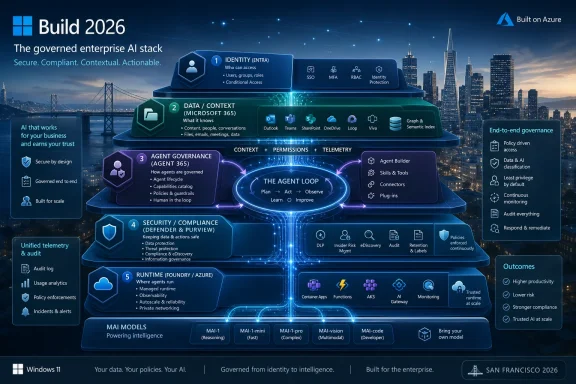
GitHub gives Microsoft the developer entry point. Microsoft 365 and Fabric give it the data context. Foundry gives it the runtime and model marketplace. Agent 365 gives IT a registry and governance surface. Entra gives the whole thing identity. Defender and Purview bring security and compliance into the pitch before the CISO can object.
That combination matters because enterprises do not buy AI agents the way consumers try a chatbot. They need logging, auditability, data boundaries, identity mapping, role-based access, retention policies, eDiscovery, and incident response. Every impressive demo becomes a procurement headache the moment an agent touches customer records, source code, financial projections, or regulated data.
Microsoft’s advantage is that it can claim much of that governance already exists in the customer’s estate. A company using Microsoft 365, Entra ID, Defender, Purview, Azure, and GitHub Enterprise does not have to imagine a new trust fabric from scratch. Microsoft can say: your users, data, devices, permissions, repositories, and compliance controls are already here. Why bolt AI governance onto the side when it can live inside the same administrative spine?
That is the heart of the platform trap. It is not a trap because the products are bad. It is a trap because the integration is useful.
A chatbot that summarizes a document is one thing. An agent that can open tickets, query databases, write code, change records, send emails, invoke APIs, or coordinate with other agents is another. The governance problem is no longer just whether a model leaks data. It is whether a semi-autonomous software actor has the wrong permissions, poor instructions, weak logging, or no responsible owner.
Microsoft’s identity-first answer is powerful because identity is where real enterprise control often lives. If an agent has an identity, it can be assigned permissions, monitored, limited, revoked, and audited. If it does not, it becomes another opaque automation script hiding behind a shared credential, a service account, or a human user’s delegated authority.
But this is also where the story needs skepticism. Entra is mature for humans, devices, groups, apps, and service principals. AI agents are a messier category. They may call tools dynamically, spawn subtasks, delegate work, switch models, invoke external services, and act through chains of authorization that are difficult to explain after the fact.
Agent identity will not be solved by giving every bot a badge. The hard problem is understanding what the agent intended, what it was allowed to do, what it actually did, which data influenced it, and whether any of that changed after a model update or tuning cycle. Microsoft is closer than most vendors to having the infrastructure for that problem, but the industry is still early in proving it at multi-vendor, multi-agent production scale.
That matters because the model race is becoming less useful as a buying guide. If several models are “good enough” for many enterprise tasks, the differentiator becomes the quality of context and the reliability of execution. A brilliant model with no access to company policy, contract language, customer history, internal terminology, or workflow state is still a well-spoken outsider.
Microsoft wants to make the model feel replaceable and the context layer feel permanent. That is a subtle but consequential shift. If Microsoft IQ becomes the place where enterprise meaning is assembled, normalized, permissioned, and delivered to agents, then the specific model underneath becomes just one component in a larger Microsoft-governed system.
That framing also protects Microsoft from the volatility of the model market. OpenAI may lead one quarter, Anthropic another, Google another, and a specialized open model may win a particular workload. Microsoft can support many of them in Foundry while still owning the layers above and around them.
For customers, this can be a blessing. It may reduce the need to chase every model leaderboard. It can also become the place where lock-in quietly moves from model weights to organizational context. The more a company relies on Microsoft IQ to structure what its agents know, the more expensive it becomes to recreate that same context fabric somewhere else.
MAI-Thinking-1 is the symbolic center of that claim. Microsoft describes it as a 35-billion-active-parameter reasoning model trained from scratch without distillation from third-party models. The company has positioned it as competitive with Claude Sonnet 4.6 on certain software engineering and preference benchmarks, while being cheaper to run.
That does not mean Microsoft has suddenly beaten the frontier labs. Benchmarks are selective, temporary, and workload-dependent. A model that looks efficient and capable on coding tests may be less compelling in legal analysis, scientific reasoning, multimodal planning, or long-horizon agent work. Anthropic, OpenAI, Google, and others will keep moving.
But Microsoft does not need MAI-Thinking-1 to be the best model in the world. It needs the MAI family to be good enough, cheap enough, clean enough from an IP standpoint, and native enough to make third-party models optional. Optionality is leverage.
That leverage cuts in several directions. It gives Microsoft leverage over model vendors. It gives procurement teams a native Azure option. It gives regulated customers a model story that does not depend entirely on another lab’s roadmap. And it lets Microsoft optimize models for GitHub Copilot, Microsoft 365, Foundry, Windows, and enterprise agent workflows without waiting for a partner to prioritize the same scenarios.
That is an appealing proposition. Generic models know language, code, and broad patterns. Tuned models can learn how a specific consulting firm writes deliverables, how a manufacturer handles exceptions, how a bank escalates risk, or how an IT department resolves incidents. If Microsoft can make that process repeatable, the value is obvious.
The lock-in is equally obvious. Microsoft can accurately say that the tuned model stays in the customer’s tenant and that the customer owns the resulting artifact. That is better than sending sensitive operational data into a black-box SaaS system with unclear retention boundaries. But ownership of a tuned model does not automatically equal portability of the surrounding system.
A model trained on Microsoft-hosted traces, evaluated in Microsoft tooling, invoked by Microsoft agents, governed by Microsoft identity, grounded through Microsoft IQ, and deployed through Foundry is not easily moved just because its weights are theoretically yours. Migration would mean reconstructing the data pipelines, evaluations, permissions, agent tools, telemetry, and reinforcement environments that made the tuned model valuable in the first place.
That is not necessarily sinister. Enterprise software has always rewarded depth of integration. The real issue is whether buyers understand that specialization is a commitment. A generic model can be swapped. A model that has learned the muscle memory of your business is harder to replace.
Salesforce’s strength is interface momentum and customer data, especially in sales, service, and marketing workflows. Agentforce gives Salesforce a clear story for organizations that already live in CRM and want agents close to customer interactions. Its challenge is that Salesforce does not own the developer platform, productivity suite, or identity layer at Microsoft’s scale.
ServiceNow has perhaps the cleanest governance counterargument. Its AI Control Tower pitch is explicitly vendor-neutral: manage agents, models, actions, and policies across heterogeneous enterprise systems. That resonates with IT leaders who do not want Microsoft, Salesforce, SAP, or any single vendor to become the default air traffic controller for every AI action.
ServiceNow also has credibility in IT workflows, service management, and operational process automation. If the agent world becomes a governance-first market, ServiceNow has a strong hand. But Microsoft’s identity-native argument is a direct threat because many organizations already treat Entra as the practical source of access truth.
SAP is playing a different game. It is not trying to be the universal identity layer. It is trying to be the system of authoritative business context for finance, procurement, supply chain, HR, and enterprise operations. Joule and SAP’s agent strategy are strongest where process semantics matter more than generic productivity integration.
The result is not a simple winner-take-all contest. Enterprises may run Microsoft for productivity and identity, ServiceNow for IT operations governance, Salesforce for customer workflows, and SAP for core business processes. The danger is that each platform wants to be the place where agents coordinate work across the others. There are only so many orchestration layers an enterprise can tolerate before “agentic” becomes another word for integration debt.
If agents become a new class of enterprise actor, they need identity as much as users and devices do. They need lifecycle management. They need least privilege. They need conditional access. They need logging. They need owners. They need to be decommissioned when a project ends. They need to be blocked when behavior changes.
Microsoft can bring those requirements into existing administrative habits. That matters enormously for sysadmins who do not want a separate governance console for every AI pilot. A security team that already uses Defender, Purview, Entra, Sentinel, and Intune will naturally prefer AI governance that appears in familiar places.
The catch is that agent behavior is not the same as user behavior. A human employee usually has a comprehensible role, a manager, a work pattern, and an intent that can be investigated. An agent may be a compound system: a prompt, a model, a tool registry, a memory store, an execution policy, a workflow engine, and a set of delegated credentials.
That makes accountability harder. If an agent makes a bad decision, was the cause the model, the prompt, the retrieval layer, stale enterprise data, a permissions error, a malicious instruction, a tool bug, or an evaluation failure? Identity is necessary, but it is not sufficient. Microsoft will have to prove that Agent 365 and the broader stack can explain agent behavior, not just register agent existence.
That is strategically important. Microsoft does not need every agent to run entirely on the PC. It needs Windows to remain the trusted endpoint where users invoke agents, approve actions, handle sensitive files, and interact with local apps. The more agentic work touches the desktop, the more endpoint security and local policy enforcement matter.
This is where Windows administrators should pay attention. AI agents will blur the line between user activity and automation. An agent may read a document, summarize a meeting, modify a spreadsheet, generate code, query a local file, or trigger a cloud workflow. From a security standpoint, those actions need to be distinguishable from both normal user behavior and malware.
Microsoft’s broader security stack gives it a natural story here. Defender can watch behavior, Entra can enforce access, Purview can classify data, and Windows can provide local isolation and policy surfaces. But agentic desktop automation will create weird edge cases. If a user authorizes an agent to manipulate files, when does helpful automation become data exfiltration? If an agent clicks through an internal web app, should that be logged as the user or the agent? If Copilot generates and runs a script, who owns the blast radius?
These are not abstract governance puzzles. They are the next help desk tickets, incident reviews, and audit findings. Microsoft’s platform approach could make them manageable. It could also concentrate risk if organizations allow agents to inherit too much trust simply because they arrive through familiar Microsoft channels.
That matters because Microsoft’s original AI advantage came from privileged access to OpenAI models and an aggressive integration strategy across Azure, GitHub, Bing, Windows, and Microsoft 365. But dependence on a partner is not the same as platform control. As the AI market matures, Microsoft wants the economics and roadmap flexibility that come from owning more of the stack.
The MAI models are part of that rebalancing. So is Foundry’s role as a place where multiple models can be offered. So is Frontier Tuning, which gives Microsoft a way to make Azure-native models more attractive for customers with specific workflow needs. OpenAI can remain important while becoming less central to the enterprise buying motion.
For customers, this may be healthy. A Microsoft stack that supports OpenAI, Anthropic, Meta-derived open models, Microsoft’s own MAI models, and specialized vendors is better than a monoculture. The problem is whether that model diversity remains real once governance, tuning, context, billing, and operational tooling pull customers toward the native option.
The phrase to watch is not “model choice.” Every vendor now says it supports choice. The real test is switching cost. If changing models breaks evaluations, tuning investments, agent behavior, security assumptions, or compliance evidence, then the choice exists mostly on a slide.
The next generation will not be so forgiving. Once an organization lets agents operate across ticketing systems, code repositories, documents, CRM records, ERP processes, and messaging platforms, the AI stack becomes part of the operating model. The system does not merely answer questions. It changes how work is routed, performed, reviewed, and improved.
That is why Microsoft’s Build 2026 announcements feel larger than the sum of their product names. The company is not just launching models and agent tools. It is proposing an enterprise AI architecture in which the most valuable data is not the static content in a repository, but the trace of work itself: decisions, sequences, exceptions, approvals, edits, escalations, and outcomes.
That trace data is gold. It is also sensitive, messy, and deeply specific to each company. Whoever helps collect it, structure it, evaluate it, and use it for model improvement will occupy a powerful position. Frontier Tuning is Microsoft’s bid for that role.
The buyer’s dilemma is straightforward. The more you let the platform learn your business, the more useful it becomes. The more useful it becomes, the harder it is to leave. This is the old enterprise software bargain, updated for models that can absorb operational behavior rather than merely store records.
But the solution to uncontrolled sprawl is not automatically a single-vendor control plane. Enterprises spent the last decade learning that cloud convenience can become cloud concentration. The AI era may repeat that lesson faster because agent systems touch identity, data, workflow, code, and compliance all at once.
A sober AI stack decision should separate three questions that vendors prefer to bundle. Which models are best for the workload? Which platform is best for building and running agents? Which governance layer should have authority over agents across the enterprise? Microsoft’s Build strategy encourages customers to answer all three with Microsoft.
Sometimes that will be the right answer. A Microsoft-first enterprise with Azure commitments, GitHub workflows, Microsoft 365 data, Entra identity, and Defender tooling may gain real speed and safety by consolidating. But a heterogeneous enterprise with major SAP, Salesforce, ServiceNow, AWS, Google Cloud, Oracle, or industry-specific platforms should be wary of letting one vendor define the control plane by default.
The right posture is not anti-Microsoft. It is anti-sleepwalking. The platform trap is most dangerous when it looks like operational efficiency.
 Microsoft Is No Longer Selling AI as a Feature
The most important sentence around Build 2026 did not sound like a product announcement. It was the argument that the model itself is not the durable differentiator; the system around the model is. That is Microsoft’s new enterprise AI pitch in miniature.For the last two years, most organizations have treated model choice as the dramatic part of the AI decision. GPT, Claude, Gemini, Llama, Mistral, and specialized domain models were compared like CPUs in a benchmark chart. Microsoft’s Build message shifts the center of gravity away from the model and toward the operating environment: where the agent is built, what data grounds it, what permissions it inherits, how it is monitored, and how it improves over time.
That is a much more Microsoft-shaped argument. The company’s strongest enterprise assets have never been single products in isolation. They have been control planes: Active Directory, Windows Server, Office, Exchange, System Center, Azure, Entra, Intune, Defender, Purview, and Microsoft 365. Build 2026 recasts AI agents as the next class of enterprise workload that will need exactly that kind of control plane.
The risk for customers is that the same control plane that makes AI manageable can also make it hard to leave. Microsoft is not merely asking enterprises to use its models. It is asking them to let Microsoft’s platform become the place where agents are created, grounded, governed, deployed, observed, and retrained.
The Six-Step Loop Is Microsoft’s Real Product
The CustomerThink analysis rightly focuses on Microsoft’s six-step loop: build agents in GitHub, ground them through Microsoft IQ, run them in Foundry, govern them with Agent 365, secure them through Entra, Purview, and Defender, and improve them through a continuous optimization cycle. That sounds like a launch slide, but it is really a map of Microsoft’s desired enterprise AI dependency chain.GitHub gives Microsoft the developer entry point. Microsoft 365 and Fabric give it the data context. Foundry gives it the runtime and model marketplace. Agent 365 gives IT a registry and governance surface. Entra gives the whole thing identity. Defender and Purview bring security and compliance into the pitch before the CISO can object.
That combination matters because enterprises do not buy AI agents the way consumers try a chatbot. They need logging, auditability, data boundaries, identity mapping, role-based access, retention policies, eDiscovery, and incident response. Every impressive demo becomes a procurement headache the moment an agent touches customer records, source code, financial projections, or regulated data.
Microsoft’s advantage is that it can claim much of that governance already exists in the customer’s estate. A company using Microsoft 365, Entra ID, Defender, Purview, Azure, and GitHub Enterprise does not have to imagine a new trust fabric from scratch. Microsoft can say: your users, data, devices, permissions, repositories, and compliance controls are already here. Why bolt AI governance onto the side when it can live inside the same administrative spine?
That is the heart of the platform trap. It is not a trap because the products are bad. It is a trap because the integration is useful.
Agent 365 Turns Shadow AI Into an Inventory Problem
Agent 365 is Microsoft’s attempt to make AI agents legible to IT. In theory, it catalogs agents across the enterprise, including agents not built directly in Microsoft tools, and gives administrators a way to apply policies across them. That framing is aimed directly at a problem every large organization is beginning to recognize: shadow AI is becoming shadow IT with tool access.A chatbot that summarizes a document is one thing. An agent that can open tickets, query databases, write code, change records, send emails, invoke APIs, or coordinate with other agents is another. The governance problem is no longer just whether a model leaks data. It is whether a semi-autonomous software actor has the wrong permissions, poor instructions, weak logging, or no responsible owner.
Microsoft’s identity-first answer is powerful because identity is where real enterprise control often lives. If an agent has an identity, it can be assigned permissions, monitored, limited, revoked, and audited. If it does not, it becomes another opaque automation script hiding behind a shared credential, a service account, or a human user’s delegated authority.
But this is also where the story needs skepticism. Entra is mature for humans, devices, groups, apps, and service principals. AI agents are a messier category. They may call tools dynamically, spawn subtasks, delegate work, switch models, invoke external services, and act through chains of authorization that are difficult to explain after the fact.
Agent identity will not be solved by giving every bot a badge. The hard problem is understanding what the agent intended, what it was allowed to do, what it actually did, which data influenced it, and whether any of that changed after a model update or tuning cycle. Microsoft is closer than most vendors to having the infrastructure for that problem, but the industry is still early in proving it at multi-vendor, multi-agent production scale.
Microsoft IQ Is the Context Layer That Could Make Models Interchangeable
Microsoft IQ may be the least flashy and most strategic piece of the stack. Its job is to connect agents to enterprise context: Microsoft 365 content, business systems, knowledge bases, operational data, organizational relationships, and web grounding. In plain English, it is the layer that tells an agent what the company knows and how the company works.That matters because the model race is becoming less useful as a buying guide. If several models are “good enough” for many enterprise tasks, the differentiator becomes the quality of context and the reliability of execution. A brilliant model with no access to company policy, contract language, customer history, internal terminology, or workflow state is still a well-spoken outsider.
Microsoft wants to make the model feel replaceable and the context layer feel permanent. That is a subtle but consequential shift. If Microsoft IQ becomes the place where enterprise meaning is assembled, normalized, permissioned, and delivered to agents, then the specific model underneath becomes just one component in a larger Microsoft-governed system.
That framing also protects Microsoft from the volatility of the model market. OpenAI may lead one quarter, Anthropic another, Google another, and a specialized open model may win a particular workload. Microsoft can support many of them in Foundry while still owning the layers above and around them.
For customers, this can be a blessing. It may reduce the need to chase every model leaderboard. It can also become the place where lock-in quietly moves from model weights to organizational context. The more a company relies on Microsoft IQ to structure what its agents know, the more expensive it becomes to recreate that same context fabric somewhere else.
The MAI Models Are a Strategic Insurance Policy
Microsoft’s seven MAI models are not just about technical pride. They are about bargaining power, cost control, and enterprise confidence. After years of being defined in AI by its OpenAI partnership, Microsoft is making a public case that it can ship serious first-party models of its own.MAI-Thinking-1 is the symbolic center of that claim. Microsoft describes it as a 35-billion-active-parameter reasoning model trained from scratch without distillation from third-party models. The company has positioned it as competitive with Claude Sonnet 4.6 on certain software engineering and preference benchmarks, while being cheaper to run.
That does not mean Microsoft has suddenly beaten the frontier labs. Benchmarks are selective, temporary, and workload-dependent. A model that looks efficient and capable on coding tests may be less compelling in legal analysis, scientific reasoning, multimodal planning, or long-horizon agent work. Anthropic, OpenAI, Google, and others will keep moving.
But Microsoft does not need MAI-Thinking-1 to be the best model in the world. It needs the MAI family to be good enough, cheap enough, clean enough from an IP standpoint, and native enough to make third-party models optional. Optionality is leverage.
That leverage cuts in several directions. It gives Microsoft leverage over model vendors. It gives procurement teams a native Azure option. It gives regulated customers a model story that does not depend entirely on another lab’s roadmap. And it lets Microsoft optimize models for GitHub Copilot, Microsoft 365, Foundry, Windows, and enterprise agent workflows without waiting for a partner to prioritize the same scenarios.
Frontier Tuning Is Where the Lock-In Gets Personal
Frontier Tuning is the part of the announcement that deserves the closest attention from CIOs. Microsoft’s pitch is straightforward: enterprises can tune MAI models inside their own Azure tenant using their workflow data, reinforcement learning environments, operational traces, and internal standards. The model learns how the business actually works without sending that private context outside the customer’s compliance boundary.That is an appealing proposition. Generic models know language, code, and broad patterns. Tuned models can learn how a specific consulting firm writes deliverables, how a manufacturer handles exceptions, how a bank escalates risk, or how an IT department resolves incidents. If Microsoft can make that process repeatable, the value is obvious.
The lock-in is equally obvious. Microsoft can accurately say that the tuned model stays in the customer’s tenant and that the customer owns the resulting artifact. That is better than sending sensitive operational data into a black-box SaaS system with unclear retention boundaries. But ownership of a tuned model does not automatically equal portability of the surrounding system.
A model trained on Microsoft-hosted traces, evaluated in Microsoft tooling, invoked by Microsoft agents, governed by Microsoft identity, grounded through Microsoft IQ, and deployed through Foundry is not easily moved just because its weights are theoretically yours. Migration would mean reconstructing the data pipelines, evaluations, permissions, agent tools, telemetry, and reinforcement environments that made the tuned model valuable in the first place.
That is not necessarily sinister. Enterprise software has always rewarded depth of integration. The real issue is whether buyers understand that specialization is a commitment. A generic model can be swapped. A model that has learned the muscle memory of your business is harder to replace.
ServiceNow, Salesforce, and SAP Are Fighting Different Wars
Microsoft’s Build 2026 strategy lands in a market where every major enterprise vendor is trying to become the agent orchestration layer. The CustomerThink piece places Microsoft alongside Salesforce, ServiceNow, and SAP, and that is the right competitive frame. These are not merely AI feature races. They are attempts to control the layer where work is coordinated.Salesforce’s strength is interface momentum and customer data, especially in sales, service, and marketing workflows. Agentforce gives Salesforce a clear story for organizations that already live in CRM and want agents close to customer interactions. Its challenge is that Salesforce does not own the developer platform, productivity suite, or identity layer at Microsoft’s scale.
ServiceNow has perhaps the cleanest governance counterargument. Its AI Control Tower pitch is explicitly vendor-neutral: manage agents, models, actions, and policies across heterogeneous enterprise systems. That resonates with IT leaders who do not want Microsoft, Salesforce, SAP, or any single vendor to become the default air traffic controller for every AI action.
ServiceNow also has credibility in IT workflows, service management, and operational process automation. If the agent world becomes a governance-first market, ServiceNow has a strong hand. But Microsoft’s identity-native argument is a direct threat because many organizations already treat Entra as the practical source of access truth.
SAP is playing a different game. It is not trying to be the universal identity layer. It is trying to be the system of authoritative business context for finance, procurement, supply chain, HR, and enterprise operations. Joule and SAP’s agent strategy are strongest where process semantics matter more than generic productivity integration.
The result is not a simple winner-take-all contest. Enterprises may run Microsoft for productivity and identity, ServiceNow for IT operations governance, Salesforce for customer workflows, and SAP for core business processes. The danger is that each platform wants to be the place where agents coordinate work across the others. There are only so many orchestration layers an enterprise can tolerate before “agentic” becomes another word for integration debt.
Identity Is Microsoft’s Sharpest Weapon and Its Biggest Test
Microsoft’s most credible claim is that governance works best when it starts with identity. For WindowsForum readers, this should sound familiar. The history of enterprise Windows is partly the history of identity becoming infrastructure: domains, Group Policy, Active Directory, Azure AD, and now Entra ID.If agents become a new class of enterprise actor, they need identity as much as users and devices do. They need lifecycle management. They need least privilege. They need conditional access. They need logging. They need owners. They need to be decommissioned when a project ends. They need to be blocked when behavior changes.
Microsoft can bring those requirements into existing administrative habits. That matters enormously for sysadmins who do not want a separate governance console for every AI pilot. A security team that already uses Defender, Purview, Entra, Sentinel, and Intune will naturally prefer AI governance that appears in familiar places.
The catch is that agent behavior is not the same as user behavior. A human employee usually has a comprehensible role, a manager, a work pattern, and an intent that can be investigated. An agent may be a compound system: a prompt, a model, a tool registry, a memory store, an execution policy, a workflow engine, and a set of delegated credentials.
That makes accountability harder. If an agent makes a bad decision, was the cause the model, the prompt, the retrieval layer, stale enterprise data, a permissions error, a malicious instruction, a tool bug, or an evaluation failure? Identity is necessary, but it is not sufficient. Microsoft will have to prove that Agent 365 and the broader stack can explain agent behavior, not just register agent existence.
Windows Becomes the Edge of the Agent Estate
Build’s enterprise AI story is not only about Azure. It also has implications for Windows itself. As agents move from chat windows into applications, browsers, terminals, IDEs, and desktop workflows, Windows becomes a local execution surface for AI actions.That is strategically important. Microsoft does not need every agent to run entirely on the PC. It needs Windows to remain the trusted endpoint where users invoke agents, approve actions, handle sensitive files, and interact with local apps. The more agentic work touches the desktop, the more endpoint security and local policy enforcement matter.
This is where Windows administrators should pay attention. AI agents will blur the line between user activity and automation. An agent may read a document, summarize a meeting, modify a spreadsheet, generate code, query a local file, or trigger a cloud workflow. From a security standpoint, those actions need to be distinguishable from both normal user behavior and malware.
Microsoft’s broader security stack gives it a natural story here. Defender can watch behavior, Entra can enforce access, Purview can classify data, and Windows can provide local isolation and policy surfaces. But agentic desktop automation will create weird edge cases. If a user authorizes an agent to manipulate files, when does helpful automation become data exfiltration? If an agent clicks through an internal web app, should that be logged as the user or the agent? If Copilot generates and runs a script, who owns the blast radius?
These are not abstract governance puzzles. They are the next help desk tickets, incident reviews, and audit findings. Microsoft’s platform approach could make them manageable. It could also concentrate risk if organizations allow agents to inherit too much trust simply because they arrive through familiar Microsoft channels.
The OpenAI Relationship Quietly Changes Shape
Microsoft is not breaking with OpenAI. It does not need to. The more interesting shift is that Microsoft is reducing the sense that OpenAI is the indispensable center of its enterprise AI strategy.That matters because Microsoft’s original AI advantage came from privileged access to OpenAI models and an aggressive integration strategy across Azure, GitHub, Bing, Windows, and Microsoft 365. But dependence on a partner is not the same as platform control. As the AI market matures, Microsoft wants the economics and roadmap flexibility that come from owning more of the stack.
The MAI models are part of that rebalancing. So is Foundry’s role as a place where multiple models can be offered. So is Frontier Tuning, which gives Microsoft a way to make Azure-native models more attractive for customers with specific workflow needs. OpenAI can remain important while becoming less central to the enterprise buying motion.
For customers, this may be healthy. A Microsoft stack that supports OpenAI, Anthropic, Meta-derived open models, Microsoft’s own MAI models, and specialized vendors is better than a monoculture. The problem is whether that model diversity remains real once governance, tuning, context, billing, and operational tooling pull customers toward the native option.
The phrase to watch is not “model choice.” Every vendor now says it supports choice. The real test is switching cost. If changing models breaks evaluations, tuning investments, agent behavior, security assumptions, or compliance evidence, then the choice exists mostly on a slide.
The Next AI Stack Decision Will Be Harder to Undo
The first generation of enterprise AI pilots was often reversible. A team tried a chatbot, tested a coding assistant, experimented with retrieval-augmented generation, or built a departmental copilot. If it failed, the sunk cost was limited.The next generation will not be so forgiving. Once an organization lets agents operate across ticketing systems, code repositories, documents, CRM records, ERP processes, and messaging platforms, the AI stack becomes part of the operating model. The system does not merely answer questions. It changes how work is routed, performed, reviewed, and improved.
That is why Microsoft’s Build 2026 announcements feel larger than the sum of their product names. The company is not just launching models and agent tools. It is proposing an enterprise AI architecture in which the most valuable data is not the static content in a repository, but the trace of work itself: decisions, sequences, exceptions, approvals, edits, escalations, and outcomes.
That trace data is gold. It is also sensitive, messy, and deeply specific to each company. Whoever helps collect it, structure it, evaluate it, and use it for model improvement will occupy a powerful position. Frontier Tuning is Microsoft’s bid for that role.
The buyer’s dilemma is straightforward. The more you let the platform learn your business, the more useful it becomes. The more useful it becomes, the harder it is to leave. This is the old enterprise software bargain, updated for models that can absorb operational behavior rather than merely store records.
Microsoft’s Strongest Argument Is Also the Reason to Be Cautious
Microsoft’s strongest argument is that enterprises need integrated governance before they scale agents. That argument is correct. Nobody wants thousands of unregistered agents with unclear permissions, inconsistent logging, and direct access to sensitive systems.But the solution to uncontrolled sprawl is not automatically a single-vendor control plane. Enterprises spent the last decade learning that cloud convenience can become cloud concentration. The AI era may repeat that lesson faster because agent systems touch identity, data, workflow, code, and compliance all at once.
A sober AI stack decision should separate three questions that vendors prefer to bundle. Which models are best for the workload? Which platform is best for building and running agents? Which governance layer should have authority over agents across the enterprise? Microsoft’s Build strategy encourages customers to answer all three with Microsoft.
Sometimes that will be the right answer. A Microsoft-first enterprise with Azure commitments, GitHub workflows, Microsoft 365 data, Entra identity, and Defender tooling may gain real speed and safety by consolidating. But a heterogeneous enterprise with major SAP, Salesforce, ServiceNow, AWS, Google Cloud, Oracle, or industry-specific platforms should be wary of letting one vendor define the control plane by default.
The right posture is not anti-Microsoft. It is anti-sleepwalking. The platform trap is most dangerous when it looks like operational efficiency.
The Build 2026 Buyer’s Memo Writes Itself
Enterprises do not need to reject Microsoft’s AI stack to negotiate with it intelligently. They need to understand which decisions are reversible, which are expensive to unwind, and which create durable dependencies that will shape the next five years of architecture.- Enterprises should treat agent governance as a first-class architecture decision, not as a compliance feature to be added after deployment.
- Microsoft’s identity-native approach is compelling, but agent identity and human identity are different enough that production evidence matters more than launch language.
- Frontier Tuning may produce valuable institutional specialization, but that value will likely increase switching costs even when model artifacts remain inside the customer tenant.
- MAI models give Microsoft strategic independence from OpenAI and Anthropic, but benchmark parity should be tested against real internal workloads before procurement teams assume equivalence.
- Organizations with major investments in ServiceNow, Salesforce, SAP, AWS, Google Cloud, or on-premises systems should demand proof that Microsoft’s agent governance works across the estate rather than only inside the Microsoft comfort zone.
- The most important contract terms may concern telemetry, tuning data, evaluation artifacts, portability, audit evidence, and exit rights rather than headline model pricing.
References
- Primary source: CustomerThink
Published: Tue, 23 Jun 2026 15:20:13 GMT
- Official source: azure.microsoft.com
Microsoft Build 2026: Building agentic apps with Microsoft Fabric and Microsoft Databases | Microsoft Azure Blog
Microsoft Build 2026 highlights advancements in app development with Microsoft Fabric and Microsoft Databases, emphasizing a unified data and AI platform.azure.microsoft.com - Official source: devblogs.microsoft.com
Foundry IQ: Build smarter agents faster with unified knowledge and serverless retrieval | Microsoft Foundry Blog
Learn how Foundry IQ helps developers ground agents with unified enterprise knowledge, serverless retrieval, improved agentic retrieval quality, and production-ready security.devblogs.microsoft.com - Official source: blogs.microsoft.com
Microsoft Build 2026: Be yourself at work - The Official Microsoft Blog
Platforms shift when developers build. We explore, choose tools, dream, create. This platform shift comes with more information than ever, ready at your fingertips. This shift, it’s about building fast AND THEN: it’s about building, operating, optimizing and observing. Securing your...blogs.microsoft.com - Official source: partner.microsoft.com
Microsoft Build 2026: Turning innovation into partner growth
Microsoft Build 2026 highlights AI, agents, and platform updates that create new opportunities for partners to build, scale, and deliver customer solutions.partner.microsoft.com
- Related coverage: tomsguide.com
Biggest Microsoft Build 2026 announcements — agentic AI, RTX Spark Dev Box, GitHub Copilot app, new MAI models, and more | Tom's Guide
All the big news from Microsoft's AI-focused eventwww.tomsguide.com
- Official source: microsoft.ai
- Related coverage: techtimes.com
Microsoft Build 2026: MAI-Thinking-1 Is First In-House Reasoning Model, Trained Without OpenAI Data
Microsoft Build 2026 launched MAI-Thinking-1, the company’s first in-house reasoning model, trained without OpenAI data. MAI-Code-1-Flash rolls out to all GitHub Copilot plans today. Independentwww.techtimes.com - Related coverage: windowscentral.com
Build 2026 only makes sense if you remember Build 2025: a look back at the groundwork of the "age of AI agents" | Windows Central
Microsoft’s latest announcements build directly on the architecture it introduced a year ago.www.windowscentral.com - Related coverage: arcade.dev
Microsoft Build 2026: MCP and the Agent Stack
Microsoft Build 2026 made MCP the default layer across Foundry, Agent 365, IQ, Copilot, local agent compute, and enterprise governance. www.arcade.dev
- Official source: techcommunity.microsoft.com
Claude Sonnet 4.6 in Microsoft Foundry-Frontier Performance for Scale | Microsoft Community Hub
Last week, we took a major step forward with the availability of Claude Opus 4.6 in Microsoft Foundry, bringing frontier AI capable of deep reasoning,... techcommunity.microsoft.com
- Related coverage: techtarget.com
Microsoft Foundry ties in with Agent 365 | TechTarget
Microsoft Foundry updates flesh out AI agent data context, security and MCP tools access under the Agent 365 control plane umbrella.www.techtarget.com - Related coverage: axios.com
Microsoft debuts Scout agent, homegrown reasoning model
Microsoft is seeking to show it is a serious player in AI.www.axios.com
- Related coverage: techradar.com
From Quantum to Containers - 4 big things you might have missed at Microsoft Build 2026 | TechRadar
We round up some of the other major news from Microsoft Build 2026www.techradar.com - Related coverage: isg.sitefinity.cloud
MSFT Blueprint 2026
Business people join puzzle pieces in office. Concept of teamwork and partnership. double exposure with light effectsisg.sitefinity.cloud
