
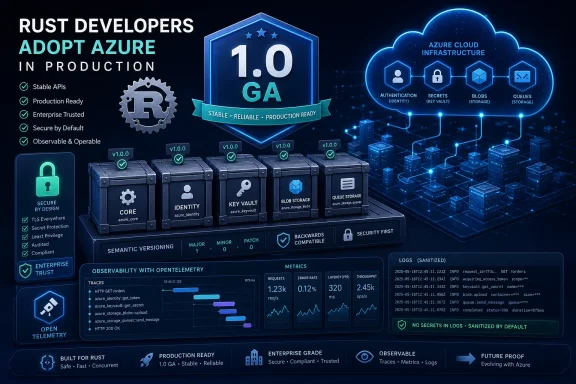
Microsoft made the Azure SDK for Rust generally available in May 2026, shipping stable 1.0.0 crates for Core, Identity, Key Vault, Blob Storage, and Queue Storage so Rust applications can use production-supported Azure client libraries. The practical significance is not that Rust suddenly works on Azure; it already did. The significance is that Microsoft has turned an experiment-friendly SDK into a dependency a cautious engineering organization can approve. In cloud infrastructure, the words “general availability” are less a marketing flourish than a procurement, security, and platform-architecture event.
Rust has never lacked enthusiasm among systems developers. It has lacked, in many enterprise cloud shops, the last layer of institutional permission: stable vendor SDKs, predictable versioning, and enough surface area to build real services without stitching together preview libraries and hand-rolled REST calls.
That is why Microsoft’s Azure SDK for Rust reaching general availability matters. The headline is not simply that developers can now talk to Key Vault or Storage from Rust. The headline is that Microsoft is offering Rust developers the same kind of SDK contract Azure users already expect in .NET, Java, JavaScript, Python, Go, and C++.
For platform teams, that contract is the difference between “a promising language” and “an approved production option.” A beta client library can be tolerated in a lab, a sidecar, or a low-risk internal tool. It is much harder to justify in a payment path, a signing workflow, a regulated workload, or a service that wakes someone up when it breaks at 3 a.m.
Microsoft says the GA release includes stable APIs, semantic versioning guarantees, and a surface that has been reviewed against Azure SDK design guidelines. That sounds dry because it is dry. It is also exactly the kind of dryness enterprise software runs on.
Mitch Ashley of The Futurum Group put it well when he called the milestone a stability contract. Rust’s memory-safety pitch is powerful, but enterprises do not deploy languages; they deploy stacks. A memory-safe, low-overhead runtime only becomes a production candidate when the surrounding libraries stop shifting under developers’ feet.
Those workloads tend to be performance-sensitive, resource-conscious, and operationally unforgiving. They live in containers, edge environments, event-processing systems, network services, and back-end components where cold starts, memory use, and concurrency bugs are not academic concerns. Rust’s appeal is that it gives developers C-like control without accepting the traditional C and C++ bargain of memory hazards as the price of speed.
Microsoft’s own framing points in that direction. The company emphasizes small binaries, low memory overhead, fast cold starts, compile-time protection against categories of runtime bugs, and native async support built on Tokio. This is not the language pitch of a scripting ecosystem trying to win developer convenience. It is the pitch of infrastructure software trying to waste less and fail less.
That makes the Azure angle more interesting. Azure is already deeply invested in managed runtimes, especially .NET, and it has mature SDKs for the languages that dominate enterprise application development. Rust does not need to displace those languages to matter. It only needs to become the language teams reach for when the performance, safety, and deployment envelope is tight enough to justify it.
In that sense, the SDK is less about developer mindshare and more about workload eligibility. Microsoft is effectively saying: if you are going to write this class of service in Rust, Azure should not be the platform that makes that choice harder.
Ronnie Geraghty, product manager for the Azure SDK, described a simple Rust service that signs in with Microsoft Entra ID, retrieves a signing key from Key Vault, pulls work items from a Storage Queue, and writes results to Blob Storage. That scenario is deliberately modest. It is also the kind of workflow that appears everywhere in real back-end systems.
A stable SDK does not need to launch with every Azure service to be useful. It needs to cover enough of the base layer that developers can build a credible production path without stepping outside supported libraries at every turn. Identity, Key Vault, and Storage are exactly that kind of base layer.
The omission of Event Hubs and Cosmos DB from the stable set is still worth noting. Event Hubs is particularly relevant to Rust’s high-throughput story, and Cosmos DB is a common persistence target for cloud-native applications. Microsoft says Event Hubs support is close and that Cosmos DB support is in active development, with a stable release expected later in 2026.
That roadmap matters because Rust’s Azure story will remain incomplete until it extends beyond foundation services. The current release opens the door. The next wave determines how many production workloads can actually walk through it.
Rust complicates that work because it has its own idioms. Ownership, borrowing, lifetimes, traits, async execution, and error handling are not cosmetic language features. A Rust SDK that merely translated Azure’s REST APIs into Rust-shaped function names would be a weak result. A useful Rust SDK has to feel native enough that developers are not constantly fighting the language.
Microsoft appears to have used the beta period to sand down some of those rough edges. The redesigned Pager now yields items directly instead of forcing developers to manually handle pages. The Poller can be awaited for long-running operations. These changes are not flashy, but they matter because cloud APIs are full of pagination and long-running operations.
The best SDK design removes ceremony around the boring parts of cloud development. Developers should care about the workload, not the pagination token dance. They should be able to express “wait for this operation” without building a private abstraction on top of the vendor’s abstraction.
This is where general availability becomes more than a version number. A 1.0 SDK tells developers the shape is supposed to hold. If Microsoft had shipped a stable version with awkward beta-era APIs, Rust developers would have been stuck with those choices or forced through future breaking changes. The beta feedback cycle gave Microsoft a chance to make the SDK more Rust-like before freezing the contract.
The Rust SDK’s authentication changes show Microsoft trying to reduce that friction. A single ManagedIdentityCredential now works across Azure hosting environments. Locally, a DeveloperToolsCredential can fall through installed tools such as the Azure CLI until one returns a token.
That matters because Azure authentication often spans two worlds. In production, developers want managed identity and no secrets in code. On a laptop, they want something that works with the tools they already use. The more different those experiences are, the more likely teams are to litter applications with conditional logic, environment variables, and secret-handling exceptions.
The ManagedIdentityCredential change is especially important for platform teams. Managed identity is one of Azure’s better answers to credential sprawl, but only if the SDKs make it consistent across hosts. If each runtime or service environment requires a slightly different authentication path, the security model becomes harder to standardize.
DeveloperToolsCredential addresses a different but related problem: local development should not become an argument for weakening production identity. If the SDK can authenticate cleanly using installed developer tools, teams have less reason to smuggle shared secrets into
Challenge-based authentication is another. It helps the SDK work in sovereign and private cloud environments, where endpoints and authentication details may differ from the public Azure cloud assumptions baked into simpler clients. That is not a niche concern for governments, regulated industries, or multinational organizations with data-sovereignty constraints.
Observability may be the most telling piece. The SDK includes distributed tracing through a new Azure Core OpenTelemetry crate, along with HTTP logging that sanitizes secrets by default. In 2026, a cloud SDK that cannot participate in tracing is not merely inconvenient; it is incomplete.
Rust services are often adopted precisely where efficiency and concurrency matter. Those systems can be difficult to debug when something goes sideways under load. Tracing support gives operators a way to connect a Rust component’s behavior to the wider distributed system instead of treating it as a black box at the edge of the telemetry graph.
The default sanitization of secrets in logs is a small decision with large implications. Logging is one of the easiest ways for credentials to leak inside an organization. A secure default does not eliminate that risk, but it changes the baseline from “remember not to do the dangerous thing” to “the SDK tries not to do the dangerous thing unless you override it.”
Many Windows-heavy shops are also Azure-heavy shops. Their admins may manage Entra identities, Key Vault access, Storage accounts, Windows Server workloads, Azure Arc resources, and CI/CD pipelines from the same operational universe. If Rust becomes a more acceptable language for Azure workloads, it changes the menu of options available to those teams.
This is particularly relevant for organizations modernizing older Windows services. Not every legacy service becomes a .NET application. Some become containers. Some become event processors. Some become small services that sit between queues, files, signing keys, and APIs. Rust is a plausible choice for that refactoring work when teams want tight resource use and strong safety guarantees.
The SDK does not make Rust easier than C# for the average Windows developer. It does not need to. C# and .NET remain the obvious path for a vast amount of Microsoft-platform development. What the Rust SDK does is make Rust less alien inside the Microsoft cloud estate.
That has downstream consequences for tooling and hiring. A platform team can now allow Rust in more Azure contexts without accepting a preview SDK. A security team can evaluate a supported Microsoft client library rather than a patchwork of community crates. A development team can standardize authentication and tracing in a way that fits the broader Azure model.
What GA changes is the risk calculation. Before GA, every upgrade carried the possibility of breaking API changes as Microsoft refined the SDK. That is normal for beta software, but it is poison for teams trying to commit to long-lived production systems. Nobody wants an internal platform dependency whose shape can change just as a service is moving from pilot to production.
Semantic versioning is therefore not a nicety. It is a planning tool. It lets teams distinguish ordinary updates from breaking ones, and it gives dependency-management systems a predictable contract. For organizations with formal change control, that predictability can determine whether a library is approved at all.
This is also why Ashley’s comment about the SDK “holding its shape” lands. Rust’s language-level stability is only one part of the story. The cloud SDK must also be stable enough that abstractions built around it are not constantly rewritten.
The release should not be oversold. General availability does not mean bug-free, complete, or universally suitable. It means Microsoft is now willing to tell customers that these libraries are production-ready and that breaking changes will be governed by the rules expected of stable packages. For enterprise adoption, that is often the decisive step.
A stable Microsoft-supported Azure SDK for Rust gives organizations a cleaner answer when reviewing cloud dependencies. The crates are part of Microsoft’s Azure SDK program rather than a loosely related community effort. That matters when security teams ask who maintains the package, how breaking changes are handled, whether design guidelines apply, and how vulnerabilities will be addressed.
Rust’s own ecosystem has strong package-management ergonomics through Cargo, but enterprise trust is not automatic. Many organizations still draw a line between community crates and vendor-supported SDKs. For Azure integration, Microsoft has now moved Rust closer to the supported side of that line.
This does not eliminate normal dependency risk. Teams still need to track versions, monitor advisories, review transitive dependencies, and test upgrades. But it changes the starting point from “can we justify this unofficial path?” to “can we adopt Microsoft’s stable Rust SDK under our normal approval process?”
That is a meaningful shift for regulated or security-sensitive environments. The more official the integration path, the easier it becomes to document, audit, and standardize.
That distinction matters because cloud platforms are increasingly polyglot by necessity. A single organization may use C# for business services, TypeScript for front ends and automation, Python for data workflows, Go for infrastructure components, and Rust for performance-critical services. The winning cloud platform is not the one that forces all of those teams into one language. It is the one that gives each language a first-class path to identity, storage, secrets, telemetry, and deployment.
Azure has long had strong SDK coverage in mainstream enterprise languages. Rust’s GA support fills a gap at the systems end of the spectrum. It tells developers building high-performance or low-overhead components that they do not have to leave Microsoft’s supported ecosystem to use the language they want.
The phrase “first-class” should still be used carefully. Rust is not yet at parity with .NET or Java across Azure services, and it may not be for some time. Coverage depth matters. Documentation depth matters. Samples, troubleshooting guidance, community experience, and integration with adjacent tools all matter.
But first-class citizenship often begins with the foundation services. Identity, Key Vault, Blob Storage, and Queue Storage are foundational enough that the Rust SDK can now support real architectures, not just demos. The next test is whether Microsoft can expand the stable surface without losing the coherence it gained during the beta.
Microsoft says Event Hubs is slated for the next stable wave and Cosmos DB is expected later in 2026. If those arrive on schedule, the Rust SDK becomes far more compelling for event-driven and data-intensive systems. If they slip, teams may continue to hesitate or rely on beta packages for important parts of the stack.
There is also the long tail of Azure services to consider. Service Bus, App Configuration, Azure SQL, Azure Monitor ingestion, Azure AI services, and management-plane libraries all represent different adoption paths. Microsoft is asking developers to vote on GitHub for which services should be prioritized next, which is sensible but also revealing. The Rust SDK is stable, but its roadmap is still demand-shaped.
That demand signal will matter. If Rust adoption on Azure is concentrated in storage, queues, and secrets, Microsoft may expand cautiously. If customers push hard for messaging, databases, observability, and management libraries, the SDK could grow quickly into a broader cloud-native toolkit.
For now, the safest conclusion is that Microsoft has made Rust viable for a meaningful subset of Azure workloads. It has not yet made Rust comprehensive across Azure.
That answer can now change in some cases. If the workload depends on Microsoft Entra ID authentication, Key Vault, Blob Storage, or Queue Storage, the SDK no longer carries the beta caveat. That does not mean automatic approval. It means the conversation moves from vendor-support risk to normal engineering evaluation.
Teams will still need to answer practical questions. Does the organization have enough Rust expertise to maintain the service? Are build, scanning, debugging, and deployment pipelines ready for Rust? Does the operations team understand how the service exposes metrics, traces, logs, and health signals? Is the performance benefit worth the talent and tooling cost?
Those are healthy questions. They are also different from “is the Azure SDK stable enough?” Microsoft has taken that particular blocker off the table for the initial service set.
For organizations already using Rust in production outside Azure, this release lowers the cost of bringing those workloads into Azure-native patterns. For Azure-first organizations curious about Rust, it makes pilots easier to justify. For Windows-centric shops slowly moving more infrastructure into cloud-native architectures, it adds another supported tool to the Microsoft ecosystem without requiring a break from Azure identity and storage conventions.
Microsoft’s GA release supplies part of that ecosystem. It gives Rust developers stable Azure primitives for authentication, secrets, keys, certificates, blobs, and queues. It wraps those primitives in design patterns consistent with the broader Azure SDK family. It adds the operational features — retries, tracing, secure logging defaults, challenge-based authentication — that make a library feel production-aware rather than demo-ready.
That is why this release is more consequential than its package list suggests. It is a signal that Rust is no longer being treated as an interesting edge case in Azure’s developer story. It is being treated as a serious option for certain production workloads.
The timing also fits the broader software industry’s mood. Memory safety has become a board-level and government-level concern in ways that would have seemed unlikely a decade ago. Cloud costs have made efficient runtimes attractive again. Distributed systems have made predictable concurrency behavior more than a theoretical benefit. Rust sits at the intersection of those pressures.
Microsoft does not have to make Rust mainstream for this to matter. It only has to make Rust boring enough for serious Azure work. General availability is how a vendor makes something boring on purpose.
The strongest Rust-on-Azure candidates are the ones where the language’s advantages line up with the workload. That means services where startup time, memory footprint, concurrency, safety, and predictable performance have real operational value. It also means teams that are prepared to own the learning curve.
The Azure SDK for Rust reaching GA changes the equation because it removes one of the weakest links in that argument. A team can now say, with more credibility, that Rust is not just technically attractive but operationally supportable on Azure for a defined set of services. That is a narrower claim than “everyone should use Rust,” but it is a much more useful one.
The next year will show whether Microsoft’s Rust investment remains a carefully bounded SDK effort or becomes a larger pillar of Azure’s cloud-native developer strategy. The answer will depend less on celebratory blog posts than on service coverage, documentation quality, production feedback, and whether the SDK remains stable while growing quickly.
 Rust Gets the Boring Contract It Needed
Rust has never lacked enthusiasm among systems developers. It has lacked, in many enterprise cloud shops, the last layer of institutional permission: stable vendor SDKs, predictable versioning, and enough surface area to build real services without stitching together preview libraries and hand-rolled REST calls.That is why Microsoft’s Azure SDK for Rust reaching general availability matters. The headline is not simply that developers can now talk to Key Vault or Storage from Rust. The headline is that Microsoft is offering Rust developers the same kind of SDK contract Azure users already expect in .NET, Java, JavaScript, Python, Go, and C++.
For platform teams, that contract is the difference between “a promising language” and “an approved production option.” A beta client library can be tolerated in a lab, a sidecar, or a low-risk internal tool. It is much harder to justify in a payment path, a signing workflow, a regulated workload, or a service that wakes someone up when it breaks at 3 a.m.
Microsoft says the GA release includes stable APIs, semantic versioning guarantees, and a surface that has been reviewed against Azure SDK design guidelines. That sounds dry because it is dry. It is also exactly the kind of dryness enterprise software runs on.
Mitch Ashley of The Futurum Group put it well when he called the milestone a stability contract. Rust’s memory-safety pitch is powerful, but enterprises do not deploy languages; they deploy stacks. A memory-safe, low-overhead runtime only becomes a production candidate when the surrounding libraries stop shifting under developers’ feet.
Microsoft Is Not Selling Rust as Fashion
There is an easy way to misread this release: as Microsoft chasing Rust because Rust is fashionable. That interpretation misses the bigger pattern. Microsoft is not trying to make Rust the default Azure language; it is acknowledging that Rust has become an increasingly credible answer for a specific class of cloud workloads.Those workloads tend to be performance-sensitive, resource-conscious, and operationally unforgiving. They live in containers, edge environments, event-processing systems, network services, and back-end components where cold starts, memory use, and concurrency bugs are not academic concerns. Rust’s appeal is that it gives developers C-like control without accepting the traditional C and C++ bargain of memory hazards as the price of speed.
Microsoft’s own framing points in that direction. The company emphasizes small binaries, low memory overhead, fast cold starts, compile-time protection against categories of runtime bugs, and native async support built on Tokio. This is not the language pitch of a scripting ecosystem trying to win developer convenience. It is the pitch of infrastructure software trying to waste less and fail less.
That makes the Azure angle more interesting. Azure is already deeply invested in managed runtimes, especially .NET, and it has mature SDKs for the languages that dominate enterprise application development. Rust does not need to displace those languages to matter. It only needs to become the language teams reach for when the performance, safety, and deployment envelope is tight enough to justify it.
In that sense, the SDK is less about developer mindshare and more about workload eligibility. Microsoft is effectively saying: if you are going to write this class of service in Rust, Azure should not be the platform that makes that choice harder.
The First Stable Surface Is Narrow, but Not Toy-Sized
The GA release covers Core, Identity, Key Vault Secrets, Key Vault Keys, Key Vault Certificates, Storage Blobs, and Storage Queues. That is not the entire Azure universe, but it is a meaningful starting set. It covers authentication, secrets, cryptographic material, object storage, and queue-based work distribution — the plumbing many cloud services touch before they do anything more specialized.Ronnie Geraghty, product manager for the Azure SDK, described a simple Rust service that signs in with Microsoft Entra ID, retrieves a signing key from Key Vault, pulls work items from a Storage Queue, and writes results to Blob Storage. That scenario is deliberately modest. It is also the kind of workflow that appears everywhere in real back-end systems.
A stable SDK does not need to launch with every Azure service to be useful. It needs to cover enough of the base layer that developers can build a credible production path without stepping outside supported libraries at every turn. Identity, Key Vault, and Storage are exactly that kind of base layer.
The omission of Event Hubs and Cosmos DB from the stable set is still worth noting. Event Hubs is particularly relevant to Rust’s high-throughput story, and Cosmos DB is a common persistence target for cloud-native applications. Microsoft says Event Hubs support is close and that Cosmos DB support is in active development, with a stable release expected later in 2026.
That roadmap matters because Rust’s Azure story will remain incomplete until it extends beyond foundation services. The current release opens the door. The next wave determines how many production workloads can actually walk through it.
The API Shape Is the Real Product
SDK stories often get flattened into lists of packages, but the more important issue is whether the SDK feels coherent once developers start using it. Microsoft has spent years imposing common design patterns across Azure SDKs so that, for example, a Python or Java developer does not have to relearn Azure from scratch with every service. Bringing Rust into that model is a strategic choice.Rust complicates that work because it has its own idioms. Ownership, borrowing, lifetimes, traits, async execution, and error handling are not cosmetic language features. A Rust SDK that merely translated Azure’s REST APIs into Rust-shaped function names would be a weak result. A useful Rust SDK has to feel native enough that developers are not constantly fighting the language.
Microsoft appears to have used the beta period to sand down some of those rough edges. The redesigned Pager now yields items directly instead of forcing developers to manually handle pages. The Poller can be awaited for long-running operations. These changes are not flashy, but they matter because cloud APIs are full of pagination and long-running operations.
The best SDK design removes ceremony around the boring parts of cloud development. Developers should care about the workload, not the pagination token dance. They should be able to express “wait for this operation” without building a private abstraction on top of the vendor’s abstraction.
This is where general availability becomes more than a version number. A 1.0 SDK tells developers the shape is supposed to hold. If Microsoft had shipped a stable version with awkward beta-era APIs, Rust developers would have been stuck with those choices or forced through future breaking changes. The beta feedback cycle gave Microsoft a chance to make the SDK more Rust-like before freezing the contract.
Identity Is Where Cloud SDKs Usually Reveal Their Priorities
Authentication is often treated as setup work, but in enterprise cloud systems it is one of the defining developer experiences. A cloud SDK that makes authentication messy creates insecure shortcuts, brittle local-development flows, and environment-specific code that survives long after it should have been deleted.The Rust SDK’s authentication changes show Microsoft trying to reduce that friction. A single ManagedIdentityCredential now works across Azure hosting environments. Locally, a DeveloperToolsCredential can fall through installed tools such as the Azure CLI until one returns a token.
That matters because Azure authentication often spans two worlds. In production, developers want managed identity and no secrets in code. On a laptop, they want something that works with the tools they already use. The more different those experiences are, the more likely teams are to litter applications with conditional logic, environment variables, and secret-handling exceptions.
The ManagedIdentityCredential change is especially important for platform teams. Managed identity is one of Azure’s better answers to credential sprawl, but only if the SDKs make it consistent across hosts. If each runtime or service environment requires a slightly different authentication path, the security model becomes harder to standardize.
DeveloperToolsCredential addresses a different but related problem: local development should not become an argument for weakening production identity. If the SDK can authenticate cleanly using installed developer tools, teams have less reason to smuggle shared secrets into
.env files or documentation snippets.Resilience and Observability Are Not Add-Ons Anymore
The GA SDK also includes production-grade features that rarely drive headlines but often determine whether an SDK survives contact with operations. Automatic retries on transient failures are one example. Cloud services fail in small, temporary ways all the time; a client library that does not understand that reality pushes too much complexity into application code.Challenge-based authentication is another. It helps the SDK work in sovereign and private cloud environments, where endpoints and authentication details may differ from the public Azure cloud assumptions baked into simpler clients. That is not a niche concern for governments, regulated industries, or multinational organizations with data-sovereignty constraints.
Observability may be the most telling piece. The SDK includes distributed tracing through a new Azure Core OpenTelemetry crate, along with HTTP logging that sanitizes secrets by default. In 2026, a cloud SDK that cannot participate in tracing is not merely inconvenient; it is incomplete.
Rust services are often adopted precisely where efficiency and concurrency matter. Those systems can be difficult to debug when something goes sideways under load. Tracing support gives operators a way to connect a Rust component’s behavior to the wider distributed system instead of treating it as a black box at the edge of the telemetry graph.
The default sanitization of secrets in logs is a small decision with large implications. Logging is one of the easiest ways for credentials to leak inside an organization. A secure default does not eliminate that risk, but it changes the baseline from “remember not to do the dangerous thing” to “the SDK tries not to do the dangerous thing unless you override it.”
The Windows Angle Is Bigger Than Windows
For WindowsForum readers, the Rust SDK may seem at first like an Azure developer story rather than a Windows story. That distinction is increasingly artificial. Windows, Azure, Microsoft Entra ID, GitHub, Visual Studio Code, Windows Subsystem for Linux, and cloud-native deployment pipelines are now parts of the same developer and operations fabric.Many Windows-heavy shops are also Azure-heavy shops. Their admins may manage Entra identities, Key Vault access, Storage accounts, Windows Server workloads, Azure Arc resources, and CI/CD pipelines from the same operational universe. If Rust becomes a more acceptable language for Azure workloads, it changes the menu of options available to those teams.
This is particularly relevant for organizations modernizing older Windows services. Not every legacy service becomes a .NET application. Some become containers. Some become event processors. Some become small services that sit between queues, files, signing keys, and APIs. Rust is a plausible choice for that refactoring work when teams want tight resource use and strong safety guarantees.
The SDK does not make Rust easier than C# for the average Windows developer. It does not need to. C# and .NET remain the obvious path for a vast amount of Microsoft-platform development. What the Rust SDK does is make Rust less alien inside the Microsoft cloud estate.
That has downstream consequences for tooling and hiring. A platform team can now allow Rust in more Azure contexts without accepting a preview SDK. A security team can evaluate a supported Microsoft client library rather than a patchwork of community crates. A development team can standardize authentication and tracing in a way that fits the broader Azure model.
The Beta-to-GA Shift Mostly Removes Risk
One of the more interesting things about this release is that it does not necessarily add dramatic new capability for teams already using the beta. Those teams could already call Azure services from Rust. They could already test workloads, experiment with identity flows, and build proof-of-concept services.What GA changes is the risk calculation. Before GA, every upgrade carried the possibility of breaking API changes as Microsoft refined the SDK. That is normal for beta software, but it is poison for teams trying to commit to long-lived production systems. Nobody wants an internal platform dependency whose shape can change just as a service is moving from pilot to production.
Semantic versioning is therefore not a nicety. It is a planning tool. It lets teams distinguish ordinary updates from breaking ones, and it gives dependency-management systems a predictable contract. For organizations with formal change control, that predictability can determine whether a library is approved at all.
This is also why Ashley’s comment about the SDK “holding its shape” lands. Rust’s language-level stability is only one part of the story. The cloud SDK must also be stable enough that abstractions built around it are not constantly rewritten.
The release should not be oversold. General availability does not mean bug-free, complete, or universally suitable. It means Microsoft is now willing to tell customers that these libraries are production-ready and that breaking changes will be governed by the rules expected of stable packages. For enterprise adoption, that is often the decisive step.
Microsoft’s Rust Bet Is Also a Supply Chain Bet
There is another layer here that deserves attention: software supply chain governance. Modern enterprises increasingly care not just about what code they write, but about the dependencies they import, the provenance of those packages, and the maintenance posture behind them.A stable Microsoft-supported Azure SDK for Rust gives organizations a cleaner answer when reviewing cloud dependencies. The crates are part of Microsoft’s Azure SDK program rather than a loosely related community effort. That matters when security teams ask who maintains the package, how breaking changes are handled, whether design guidelines apply, and how vulnerabilities will be addressed.
Rust’s own ecosystem has strong package-management ergonomics through Cargo, but enterprise trust is not automatic. Many organizations still draw a line between community crates and vendor-supported SDKs. For Azure integration, Microsoft has now moved Rust closer to the supported side of that line.
This does not eliminate normal dependency risk. Teams still need to track versions, monitor advisories, review transitive dependencies, and test upgrades. But it changes the starting point from “can we justify this unofficial path?” to “can we adopt Microsoft’s stable Rust SDK under our normal approval process?”
That is a meaningful shift for regulated or security-sensitive environments. The more official the integration path, the easier it becomes to document, audit, and standardize.
Rust Is Becoming a First-Class Cloud Citizen, Not a Default One
It is tempting to turn every SDK release into a language-war scoreboard. That would be the wrong read. Microsoft is not declaring Rust the future of Azure application development. It is making sure Azure is credible for developers who have already decided Rust is the right tool for part of their system.That distinction matters because cloud platforms are increasingly polyglot by necessity. A single organization may use C# for business services, TypeScript for front ends and automation, Python for data workflows, Go for infrastructure components, and Rust for performance-critical services. The winning cloud platform is not the one that forces all of those teams into one language. It is the one that gives each language a first-class path to identity, storage, secrets, telemetry, and deployment.
Azure has long had strong SDK coverage in mainstream enterprise languages. Rust’s GA support fills a gap at the systems end of the spectrum. It tells developers building high-performance or low-overhead components that they do not have to leave Microsoft’s supported ecosystem to use the language they want.
The phrase “first-class” should still be used carefully. Rust is not yet at parity with .NET or Java across Azure services, and it may not be for some time. Coverage depth matters. Documentation depth matters. Samples, troubleshooting guidance, community experience, and integration with adjacent tools all matter.
But first-class citizenship often begins with the foundation services. Identity, Key Vault, Blob Storage, and Queue Storage are foundational enough that the Rust SDK can now support real architectures, not just demos. The next test is whether Microsoft can expand the stable surface without losing the coherence it gained during the beta.
The Services Still Missing Will Define the Ceiling
Event Hubs and Cosmos DB are the obvious next milestones because they map directly to the kinds of workloads where Rust has a strong argument. Event streaming and high-throughput data processing are natural Rust territory. Globally distributed application data is a common Azure pattern. Without stable SDKs for those services, Rust’s Azure role remains powerful but bounded.Microsoft says Event Hubs is slated for the next stable wave and Cosmos DB is expected later in 2026. If those arrive on schedule, the Rust SDK becomes far more compelling for event-driven and data-intensive systems. If they slip, teams may continue to hesitate or rely on beta packages for important parts of the stack.
There is also the long tail of Azure services to consider. Service Bus, App Configuration, Azure SQL, Azure Monitor ingestion, Azure AI services, and management-plane libraries all represent different adoption paths. Microsoft is asking developers to vote on GitHub for which services should be prioritized next, which is sensible but also revealing. The Rust SDK is stable, but its roadmap is still demand-shaped.
That demand signal will matter. If Rust adoption on Azure is concentrated in storage, queues, and secrets, Microsoft may expand cautiously. If customers push hard for messaging, databases, observability, and management libraries, the SDK could grow quickly into a broader cloud-native toolkit.
For now, the safest conclusion is that Microsoft has made Rust viable for a meaningful subset of Azure workloads. It has not yet made Rust comprehensive across Azure.
The Dependency Gate Just Moved
The immediate audience for this release is not every developer who likes Rust. It is the platform engineer, security architect, staff developer, or engineering manager who previously had to say, “Not yet,” when someone proposed Rust for an Azure-hosted production service.That answer can now change in some cases. If the workload depends on Microsoft Entra ID authentication, Key Vault, Blob Storage, or Queue Storage, the SDK no longer carries the beta caveat. That does not mean automatic approval. It means the conversation moves from vendor-support risk to normal engineering evaluation.
Teams will still need to answer practical questions. Does the organization have enough Rust expertise to maintain the service? Are build, scanning, debugging, and deployment pipelines ready for Rust? Does the operations team understand how the service exposes metrics, traces, logs, and health signals? Is the performance benefit worth the talent and tooling cost?
Those are healthy questions. They are also different from “is the Azure SDK stable enough?” Microsoft has taken that particular blocker off the table for the initial service set.
For organizations already using Rust in production outside Azure, this release lowers the cost of bringing those workloads into Azure-native patterns. For Azure-first organizations curious about Rust, it makes pilots easier to justify. For Windows-centric shops slowly moving more infrastructure into cloud-native architectures, it adds another supported tool to the Microsoft ecosystem without requiring a break from Azure identity and storage conventions.
Microsoft’s Rust Moment Is Really About Trust
The core lesson of this release is that language adoption in the enterprise is rarely about syntax alone. Rust’s ownership model, safety guarantees, and performance profile have been impressive for years. But enterprises adopt ecosystems, not just compilers.Microsoft’s GA release supplies part of that ecosystem. It gives Rust developers stable Azure primitives for authentication, secrets, keys, certificates, blobs, and queues. It wraps those primitives in design patterns consistent with the broader Azure SDK family. It adds the operational features — retries, tracing, secure logging defaults, challenge-based authentication — that make a library feel production-aware rather than demo-ready.
That is why this release is more consequential than its package list suggests. It is a signal that Rust is no longer being treated as an interesting edge case in Azure’s developer story. It is being treated as a serious option for certain production workloads.
The timing also fits the broader software industry’s mood. Memory safety has become a board-level and government-level concern in ways that would have seemed unlikely a decade ago. Cloud costs have made efficient runtimes attractive again. Distributed systems have made predictable concurrency behavior more than a theoretical benefit. Rust sits at the intersection of those pressures.
Microsoft does not have to make Rust mainstream for this to matter. It only has to make Rust boring enough for serious Azure work. General availability is how a vendor makes something boring on purpose.
The Door Opens, but the Architecture Still Has to Make Sense
This release should encourage experimentation, but not cargo-cult adoption. Rust is a powerful tool, not a universal solvent. A team that lacks Rust experience can still build a fragile system in a memory-safe language. A service with ordinary business logic and moderate scale may still be better served by .NET, Java, or Python simply because the organization can maintain it more easily.The strongest Rust-on-Azure candidates are the ones where the language’s advantages line up with the workload. That means services where startup time, memory footprint, concurrency, safety, and predictable performance have real operational value. It also means teams that are prepared to own the learning curve.
The Azure SDK for Rust reaching GA changes the equation because it removes one of the weakest links in that argument. A team can now say, with more credibility, that Rust is not just technically attractive but operationally supportable on Azure for a defined set of services. That is a narrower claim than “everyone should use Rust,” but it is a much more useful one.
The next year will show whether Microsoft’s Rust investment remains a carefully bounded SDK effort or becomes a larger pillar of Azure’s cloud-native developer strategy. The answer will depend less on celebratory blog posts than on service coverage, documentation quality, production feedback, and whether the SDK remains stable while growing quickly.
The Crates That Matter Now Have a Production Badge
Microsoft’s GA release gives Azure-focused Rust teams a clearer starting point, but the practical readout is still specific rather than sweeping.- The Azure SDK for Rust is now generally available for Core, Identity, Key Vault Secrets, Key Vault Keys, Key Vault Certificates, Storage Blobs, and Storage Queues.
- The GA contract matters because public APIs now carry semantic versioning expectations instead of beta-era instability.
- The most immediate production scenarios are services that use Microsoft Entra ID, managed identity, Key Vault, Blob Storage, and Queue Storage.
- The redesigned Pager and awaitable Poller show Microsoft used the beta period to make common Azure patterns feel less awkward in Rust.
- Event Hubs and Cosmos DB remain the most important upcoming tests of whether Rust becomes broadly useful for Azure event-driven and data-intensive systems.
- Windows and Azure shops should treat Rust as a newly safer option for selected infrastructure workloads, not as a replacement for their existing .NET and scripting investments.
References
- Primary source: devops.com
Published: 2026-06-23T21:30:39.290979
Microsoft Brings the Azure SDK for Rust to General Availability - DevOps.com
The release covers Core, Identity, Key Vault (Secrets, Keys, and Certificates), and Storage (Blobs and Queues).devops.com - Official source: devblogs.microsoft.com
Azure SDK Release (May 2026) - Azure SDK Blog
Azure SDK releases every month. In this post, you'll find this month's highlights and release notes.devblogs.microsoft.com - Related coverage: azure.github.io

Azure SDK for Rust (February 2026) | Azure SDKs
azure.github.io
- Official source: learn.microsoft.com
Azure SDK for Rust Crates - Rust on Azure | Microsoft Learn
Listing of the package names, crates links, docs links, and source code links for all libraries in the Azure SDK for Rust.learn.microsoft.com - Official source: opensource.microsoft.com
From open source to agentic systems: Microsoft at Open Source Summit North America 2026 | Microsoft Open Source Blog
Discover how Azure Linux 4.0 and Azure Container Linux deliver a secure, scalable Linux foundation for cloud native apps, containers, and AI workloads. opensource.microsoft.com
- Related coverage: stackfeed.io
Generally Available: Azure Blob Storage SDK for Rust | StackFeed
The Azure Blob Storage SDK for Rust is now generally available. The Rust SDK allows you to connect to an Azure Blob Storage account and perform operations on containers and blobs, including uploading, downloading, listing, and managing blobs. This release stackfeed.io
- Related coverage: byteiota.com
- Related coverage: msendpoint.com
Azure Blob Storage SDK for Rust Now Generally Available — MSEndpoint
The Azure Blob Storage SDK for Rust has reached general availability, enabling production-ready access to Blob Storage for Rust developers. Learn deployment requirements, authentication patterns, and critical gotchas.msendpoint.com - Related coverage: azure.r-universe.dev
- Related coverage: cirt.gy
- Official source: techcommunity.microsoft.com
