
Apple’s iPhone 18 Pro, expected in September 2026, is already being framed by Apple-focused outlets as a three-part upgrade built around an A20 Pro chip, major camera hardware changes, and Apple’s second-generation C2 cellular modem. The rumors are still rumors, but the pattern is harder to dismiss than the individual claims. Apple appears to be preparing a phone whose most important changes are not the visible ones, but the silicon, optics, and radios that define how much of the device Apple truly controls.
For WindowsForum readers, that matters even if you have no intention of buying the next Pro iPhone. The iPhone remains the gravitational center of the modern endpoint market, and Apple’s hardware roadmap has a way of setting expectations that eventually wash over PCs, tablets, enterprise fleets, app development, and carrier strategy. The iPhone 18 Pro rumor cycle is not just about another shiny slab from Cupertino; it is about whether Apple can turn vertical integration into a sharper competitive weapon just as Microsoft, Qualcomm, Intel, AMD, and the broader Windows ecosystem are still trying to make local AI, efficient connectivity, and premium mobile hardware feel coherent.
The headline rumor is the A20 Pro, reportedly built on a 2nm-class process and paired with more advanced packaging. In a normal iPhone year, that would sound like the expected chip bump dressed up in foundry marketing. Apple has trained buyers to expect annual performance gains so consistently that the processor rarely feels like the emotional center of the upgrade.
This time, the chip rumor lands differently because the software story has changed. Apple Intelligence has turned the iPhone’s processor from an abstract benchmark engine into a gatekeeper for features. If iOS 27 brings more on-device AI functions, a faster Neural Engine, more memory bandwidth, and better thermal efficiency are no longer just spec-sheet advantages; they become the difference between a feature that feels instantaneous and one that feels like a demo running through a straw.
That is the subtle shift Apple has been engineering for years. The iPhone is no longer merely a client device that talks to cloud services. It is increasingly a local inference machine, privacy appliance, camera computer, and communications endpoint wrapped in a consumer object. The more Apple pushes intelligence onto the device, the more every new chip generation becomes a software compatibility boundary.
Windows users have seen this movie in a messier form. Microsoft’s Copilot+ PC push tried to create a similar dividing line by tying marquee AI features to neural processing unit performance. The difference is that Apple controls the device, the operating system, the silicon schedule, and the marketing message. Microsoft has to coordinate across silicon vendors, OEM designs, Windows releases, driver maturity, and enterprise deployment caution.
That does not mean Apple’s approach is automatically better. It does mean Apple can make the A20 Pro feel inevitable in a way that PC vendors often cannot. If the iPhone 18 Pro arrives with AI features that run best or only on the newest Pro hardware, Apple will have transformed chip fabrication into a consumer-facing reason to upgrade.
That is where process improvements and packaging matter. Better efficiency gives Apple more choices. It can spend the gains on longer battery life, more local AI, brighter displays, heavier camera pipelines, or thinner designs. Given the iPhone 18 Pro rumors include a thicker camera plateau, Apple may be choosing capability over minimalism this time.
The phrase “2nm” also carries a marketing danger. Consumers hear it as a simple measure of size, while semiconductor people know process names have become branding shorthand rather than literal geometry. Still, the industry direction is real: more transistors, better energy characteristics, and more aggressive integration. Apple’s advantage is not that it alone gets access to these improvements, but that it is unusually good at turning them into a story users understand.
The Windows PC industry has spent the last two years trying to explain NPUs, TOPS ratings, hybrid cores, efficiency cores, and local AI acceleration. Some of that messaging is necessary, but much of it feels like the supply chain speaking directly to the consumer. Apple tends to hide the machinery and sell the outcome. “This iPhone runs the newest Apple Intelligence features better” is a cleaner pitch than a matrix of NPU thresholds and OEM-specific feature availability.
The A20 Pro, if the rumors hold, will therefore be judged less by Geekbench screenshots than by how invisible it makes the work. If Siri becomes more capable, if photo editing feels local and immediate, if battery life does not collapse under AI workloads, the chip will have done its job. If Apple Intelligence still feels tentative, delayed, or uneven, then 2nm will sound like the most expensive excuse in the room.
This is where Apple’s elegant integration starts to look a little like a velvet rope. Users who bought expensive iPhones only a year or two earlier may discover that the most interesting software features require the latest chip. Apple can defend that as quality control, and sometimes that defense will be technically honest. But the practical effect is still an accelerated premium upgrade cycle.
For enterprises, this is not a philosophical issue. It is a deployment issue. If iPhones become AI endpoints with meaningful feature differences across chip generations, mobile device management policies will need to account for more than iOS version and security patch level. Fleet planners may need to ask whether a given device can run the sanctioned on-device model, support the required privacy mode, or handle the local transcription and summarization workloads employees expect.
That mirrors the problem now emerging in Windows fleets. Not every Windows 11 machine is a Copilot+ PC, and not every Copilot+ PC will age the same way as Microsoft adds features. IT departments are being pulled into a new compatibility era where operating system support is necessary but not sufficient. The question is no longer “Can this device run the OS?” It is “Can this device run the OS experience the vendor is actually advertising?”
Apple’s advantage is that it can collapse that complexity into a smaller number of SKUs. Its disadvantage is that the boundaries can feel arbitrary to customers who do not care whether the limitation is RAM, NPU throughput, or product segmentation. The iPhone 18 Pro may become the cleanest example yet of Apple’s new implicit contract: buy the newest silicon if you want the fullest version of the software.
Variable aperture would be a meaningful change for the iPhone. Smartphone cameras have spent years compensating for tiny lenses and sensors through computational photography. Apple has become exceptionally good at that compensation, but it remains compensation. A variable aperture would give the camera system more physical control over light and depth of field before software begins its cleanup operation.
The thicker camera plateau matters because it admits the obvious. Better optics take space. Larger modules take space. More ambitious imaging hardware cannot always be hidden behind design language and algorithmic bravado. If the iPhone 18 Pro is thicker around the camera because the main module needs it, Apple is choosing photographic headroom over the illusion of seamless thinness.
That choice will annoy some users and delight others. The iPhone’s camera bump has already become less a blemish than an identity marker, a visible declaration that the camera is the phone’s most important subsystem after the display. A larger plateau may be ugly in isolation, but consumers have repeatedly shown that they will tolerate awkward geometry if the photos and video improve enough.
There is an enterprise angle here too, though it is easy to miss. Phones have replaced dedicated cameras for field documentation, inspections, support workflows, insurance claims, construction updates, medical-adjacent documentation, and remote troubleshooting. Better low-light telephoto performance is not just for concerts and pets. It affects whether a technician can capture a readable label in a dim server closet or document equipment without carrying another device.
A variable aperture could give Apple a more nuanced starting point. In bright conditions, the camera can prioritize sharpness and manage exposure differently. In lower light, it can open up and gather more light before the image pipeline starts inventing detail. For portraits, it may give Apple another lever to reduce the artificial look that sometimes accompanies software blur.
The telephoto rumor is equally important. Telephoto cameras on phones are often the first to fall apart in poor light, forcing the system to crop from a main sensor or produce noisy, soft images. A larger aperture would help the iPhone’s zoom camera behave less like a daylight-only luxury and more like a dependable tool. That matters because users increasingly compose with multiple focal lengths, not just the default wide camera.
Still, Apple has to be careful. More camera hardware can produce more complexity, and complexity can produce inconsistency. A phone camera needs to be predictable when the user taps the shutter. If variable aperture becomes another invisible decision that sometimes helps and sometimes produces odd transitions, Apple will have traded one kind of limitation for another.
This is where Apple’s restraint has historically helped it. The company tends to adopt camera hardware changes when it believes it can hide the operational complexity from the user. The iPhone 18 Pro rumor is exciting precisely because Apple would not be adding variable aperture for a spec-sheet flourish alone. If it ships, it likely becomes part of a tightly managed imaging pipeline rather than a manual control gimmick buried in a camera menu.
Modems are unforgiving. A processor can be a little slower than expected and still feel fine. A camera can be tuned after launch. A modem that drops calls, burns battery, struggles with fringe coverage, or underperforms on carrier networks becomes a daily irritant. Apple’s move into modems is therefore not merely another act of vertical integration; it is a high-risk attempt to own one of the hardest parts of the phone.
The upside is obvious. A successful C2 modem gives Apple more control over power management, privacy features, satellite integration, carrier behavior, and product timing. It also weakens Qualcomm’s leverage over one of the most lucrative phone lines in the world. Apple does not like renting strategic components forever, and the modem has been one of the last major pieces outside its silicon empire.
For users, the benefits may be subtle at first. Better standby power, more efficient network handoff, improved thermal behavior, and tighter integration with iOS are not the kind of features that make good billboards. But they are the features that make a phone feel less annoying over two or three years. Connectivity is noticed most when it fails.
For IT departments, modem behavior is not trivia. Mobile reliability affects authentication, remote management, app performance, field work, hotspot use, emergency communication, and support tickets. If Apple’s C2 modem performs well across carriers, it will strengthen the case for iPhones as managed enterprise endpoints. If it stumbles, no amount of silicon independence will comfort the help desk.
This is the kind of feature that invites overstatement. Satellite 5G does not mean your phone suddenly becomes a Star Trek communicator with full-speed broadband anywhere on Earth. Capacity, spectrum, carrier agreements, satellite constellations, regional regulation, antenna constraints, and pricing will shape the actual experience. The first version may be limited, expensive, slow, or available only in specific scenarios.
Even so, the direction is important. If Apple builds satellite-aware capabilities into its own modem, it can design the user experience from the radio layer up through iOS. That could make satellite connectivity feel less like an emergency exception and more like a fallback state. The phone might not offer full normal service everywhere, but it could keep essential messaging, location sharing, authentication, or low-bandwidth data alive in places where the terrestrial network disappears.
That has implications beyond hikers and road-trippers. Disaster response, rural work, logistics, utilities, oil and gas, agriculture, maritime operations, and remote healthcare all care about resilient connectivity. Many of those sectors already use specialized satellite equipment, but the arrival of basic satellite functions in consumer phones changes expectations. Employees will ask why the device in their pocket cannot do what a dedicated gadget used to do.
The Windows ecosystem should pay attention because connectivity is becoming part of the AI endpoint story. A device that can process locally and maintain fallback communication has a different risk profile than one that depends entirely on cloud reachability. Microsoft’s world is full of laptops that are powerful on Wi-Fi and helpless off-network unless tethered. Apple may be inching toward a phone that is both a local AI device and a more resilient communications node.
Qualcomm’s modems have earned their place in premium phones because radio engineering is brutally difficult. They support sprawling band combinations, carrier aggregation, international roaming requirements, and endless network edge cases. Replacing that capability is not like swapping a commodity part. It requires years of testing, carrier certification, and painful iteration.
Apple’s confidence may come from its ability to optimize around its own devices rather than serve the entire Android market. Qualcomm has to build broadly. Apple can build narrowly and deeply. That narrower target could allow tighter integration with iOS power management, Apple’s wireless stack, satellite features, and privacy controls.
But the narrower target does not eliminate the global complexity of cellular networks. A Pro iPhone has to work in Manhattan, rural Montana, London, Seoul, Tokyo, Berlin, Mumbai, and everywhere business travelers expect a premium phone to behave like a premium phone. Apple can control the hardware, but it cannot control every tower, carrier configuration, roaming agreement, or regulatory environment.
That is why the C2 modem will be watched so closely. If it works well, Apple’s vertical integration thesis gets a major victory. If it works unevenly, critics will argue that Apple replaced a mature supplier with an internal component before it was ready. Either way, the iPhone 18 Pro would turn modem performance into a front-page feature rather than a line item only radio engineers cared about.
Apple’s rumored iPhone 18 Pro strategy reflects the endpoint race every major platform is now running. The next premium device is not defined by one headline feature. It is defined by the integration of local AI silicon, camera intelligence, network resilience, privacy positioning, and battery efficiency. The device that wins is the one that makes those systems feel like one product rather than five vendor partnerships.
Windows has strengths Apple does not. It has unmatched enterprise application depth, hardware diversity, gaming reach, workstation scalability, and a vast management ecosystem. But diversity can make coordination hard. The Copilot+ PC launch showed how difficult it is to align silicon readiness, OS features, developer support, OEM design, and user trust at the same time.
Apple’s iPhone approach is the opposite: fewer devices, tighter control, clearer marketing, harsher upgrade boundaries. That can be frustrating, expensive, and restrictive. It can also be effective. When Apple decides that a new feature needs a new chip, it can say so bluntly and move the market with it.
Microsoft and its partners should not copy Apple wholesale. The Windows ecosystem would lose much of its value if it became a sealed appliance market. But it does need to learn from Apple’s ability to connect hardware capability to user-facing outcomes. “This PC has an NPU” is not enough. “This PC can privately summarize your day, transcribe your meetings locally, preserve battery life, and keep your workflow intact when connectivity drops” is closer to the point.
That uncertainty does not make the story meaningless. Rumors around Apple’s supply chain often reveal direction before they reveal final execution. The precise aperture value, modem branding, or packaging terminology may change, but the strategic arc is visible: Apple wants more compute on device, more control over imaging hardware, and less dependence on external radio silicon.
The danger is treating every rumor as destiny. Apple prototypes features that do not ship, delays technologies that appear imminent, and sometimes changes product segmentation late enough to embarrass confident forecasters. The iPhone 18 Pro may arrive with fewer surprises than expected, or with a completely different emphasis on stage. Apple’s marketing team, not the rumor mill, will decide which features become the story.
Still, the convergence of reports around the same broad themes is notable. A 2nm-class chip fits the foundry roadmap. A camera hardware push fits the iPhone’s competitive pressures. A C2 modem fits Apple’s long-running effort to own more of its silicon stack. Satellite expansion fits Apple’s existing emergency connectivity investments. The rumors rhyme because the strategy is coherent.
That coherence is why the iPhone 18 Pro deserves attention now. Not because every leak should be believed, but because the likely direction of travel is already useful. Apple is building toward a phone where the most important upgrades live below the surface, and where those buried components unlock the features users actually notice.
The practical read is straightforward.
That is a harder story to tell. Consumers understand a better camera, but not necessarily a variable aperture. They understand longer battery life, but not modem power efficiency. They understand smarter Siri features, but not neural accelerators, memory bandwidth, or packaging technology. Apple’s job will be to translate engineering control into everyday confidence.
For Windows users and IT pros, the lesson is not that Apple is unbeatable. It is that endpoint competition is moving below the surface. The devices that matter over the next several years will be judged by how gracefully they combine local AI, privacy, cameras, connectivity, battery life, and manageability. Apple may be preparing to make that argument with the iPhone 18 Pro, and the rest of the industry should treat it less like a phone rumor and more like an early warning about where premium computing is headed.
For WindowsForum readers, that matters even if you have no intention of buying the next Pro iPhone. The iPhone remains the gravitational center of the modern endpoint market, and Apple’s hardware roadmap has a way of setting expectations that eventually wash over PCs, tablets, enterprise fleets, app development, and carrier strategy. The iPhone 18 Pro rumor cycle is not just about another shiny slab from Cupertino; it is about whether Apple can turn vertical integration into a sharper competitive weapon just as Microsoft, Qualcomm, Intel, AMD, and the broader Windows ecosystem are still trying to make local AI, efficient connectivity, and premium mobile hardware feel coherent.
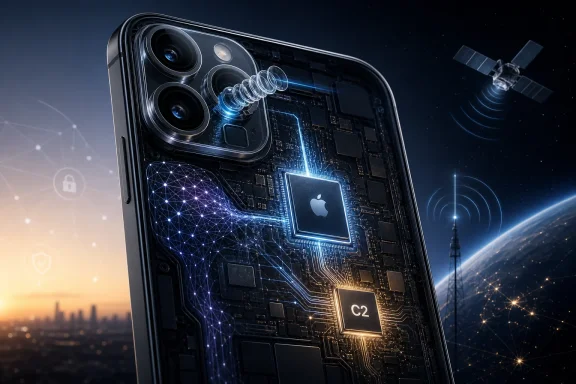 Apple’s Next iPhone Story Is Really a Silicon Story
The headline rumor is the A20 Pro, reportedly built on a 2nm-class process and paired with more advanced packaging. In a normal iPhone year, that would sound like the expected chip bump dressed up in foundry marketing. Apple has trained buyers to expect annual performance gains so consistently that the processor rarely feels like the emotional center of the upgrade.This time, the chip rumor lands differently because the software story has changed. Apple Intelligence has turned the iPhone’s processor from an abstract benchmark engine into a gatekeeper for features. If iOS 27 brings more on-device AI functions, a faster Neural Engine, more memory bandwidth, and better thermal efficiency are no longer just spec-sheet advantages; they become the difference between a feature that feels instantaneous and one that feels like a demo running through a straw.
That is the subtle shift Apple has been engineering for years. The iPhone is no longer merely a client device that talks to cloud services. It is increasingly a local inference machine, privacy appliance, camera computer, and communications endpoint wrapped in a consumer object. The more Apple pushes intelligence onto the device, the more every new chip generation becomes a software compatibility boundary.
Windows users have seen this movie in a messier form. Microsoft’s Copilot+ PC push tried to create a similar dividing line by tying marquee AI features to neural processing unit performance. The difference is that Apple controls the device, the operating system, the silicon schedule, and the marketing message. Microsoft has to coordinate across silicon vendors, OEM designs, Windows releases, driver maturity, and enterprise deployment caution.
That does not mean Apple’s approach is automatically better. It does mean Apple can make the A20 Pro feel inevitable in a way that PC vendors often cannot. If the iPhone 18 Pro arrives with AI features that run best or only on the newest Pro hardware, Apple will have transformed chip fabrication into a consumer-facing reason to upgrade.
The 2nm Promise Is Less About Speed Than Headroom
The rumored move to a 2nm process will invite the usual performance chatter, but raw speed is probably the least interesting part of the story. Modern smartphones are already fast enough for most human-scale tasks. The real constraint is sustained performance inside a thin device that has no fan, limited battery volume, and a camera system that may be doing computational photography, video processing, machine learning, and connectivity work at the same time.That is where process improvements and packaging matter. Better efficiency gives Apple more choices. It can spend the gains on longer battery life, more local AI, brighter displays, heavier camera pipelines, or thinner designs. Given the iPhone 18 Pro rumors include a thicker camera plateau, Apple may be choosing capability over minimalism this time.
The phrase “2nm” also carries a marketing danger. Consumers hear it as a simple measure of size, while semiconductor people know process names have become branding shorthand rather than literal geometry. Still, the industry direction is real: more transistors, better energy characteristics, and more aggressive integration. Apple’s advantage is not that it alone gets access to these improvements, but that it is unusually good at turning them into a story users understand.
The Windows PC industry has spent the last two years trying to explain NPUs, TOPS ratings, hybrid cores, efficiency cores, and local AI acceleration. Some of that messaging is necessary, but much of it feels like the supply chain speaking directly to the consumer. Apple tends to hide the machinery and sell the outcome. “This iPhone runs the newest Apple Intelligence features better” is a cleaner pitch than a matrix of NPU thresholds and OEM-specific feature availability.
The A20 Pro, if the rumors hold, will therefore be judged less by Geekbench screenshots than by how invisible it makes the work. If Siri becomes more capable, if photo editing feels local and immediate, if battery life does not collapse under AI workloads, the chip will have done its job. If Apple Intelligence still feels tentative, delayed, or uneven, then 2nm will sound like the most expensive excuse in the room.
Apple Intelligence Turns the Upgrade Cycle Into a Compatibility Ladder
The most consequential part of this rumor cycle is the suggestion that iOS 27’s Apple Intelligence features may lean heavily on the newest Pro-class silicon. That would not be surprising. AI features are hungry for memory, bandwidth, and specialized compute, and Apple has already shown a willingness to restrict features to newer devices when it believes the experience will suffer elsewhere.This is where Apple’s elegant integration starts to look a little like a velvet rope. Users who bought expensive iPhones only a year or two earlier may discover that the most interesting software features require the latest chip. Apple can defend that as quality control, and sometimes that defense will be technically honest. But the practical effect is still an accelerated premium upgrade cycle.
For enterprises, this is not a philosophical issue. It is a deployment issue. If iPhones become AI endpoints with meaningful feature differences across chip generations, mobile device management policies will need to account for more than iOS version and security patch level. Fleet planners may need to ask whether a given device can run the sanctioned on-device model, support the required privacy mode, or handle the local transcription and summarization workloads employees expect.
That mirrors the problem now emerging in Windows fleets. Not every Windows 11 machine is a Copilot+ PC, and not every Copilot+ PC will age the same way as Microsoft adds features. IT departments are being pulled into a new compatibility era where operating system support is necessary but not sufficient. The question is no longer “Can this device run the OS?” It is “Can this device run the OS experience the vendor is actually advertising?”
Apple’s advantage is that it can collapse that complexity into a smaller number of SKUs. Its disadvantage is that the boundaries can feel arbitrary to customers who do not care whether the limitation is RAM, NPU throughput, or product segmentation. The iPhone 18 Pro may become the cleanest example yet of Apple’s new implicit contract: buy the newest silicon if you want the fullest version of the software.
The Camera Plateau Is a Physical Confession
The second major rumor cluster centers on the camera system: a variable aperture main camera, a larger aperture telephoto lens, and a noticeably thicker camera plateau driven by a larger main camera module. That is a lot of mechanical reality in an era when phone makers prefer to talk as if software can bend physics indefinitely.Variable aperture would be a meaningful change for the iPhone. Smartphone cameras have spent years compensating for tiny lenses and sensors through computational photography. Apple has become exceptionally good at that compensation, but it remains compensation. A variable aperture would give the camera system more physical control over light and depth of field before software begins its cleanup operation.
The thicker camera plateau matters because it admits the obvious. Better optics take space. Larger modules take space. More ambitious imaging hardware cannot always be hidden behind design language and algorithmic bravado. If the iPhone 18 Pro is thicker around the camera because the main module needs it, Apple is choosing photographic headroom over the illusion of seamless thinness.
That choice will annoy some users and delight others. The iPhone’s camera bump has already become less a blemish than an identity marker, a visible declaration that the camera is the phone’s most important subsystem after the display. A larger plateau may be ugly in isolation, but consumers have repeatedly shown that they will tolerate awkward geometry if the photos and video improve enough.
There is an enterprise angle here too, though it is easy to miss. Phones have replaced dedicated cameras for field documentation, inspections, support workflows, insurance claims, construction updates, medical-adjacent documentation, and remote troubleshooting. Better low-light telephoto performance is not just for concerts and pets. It affects whether a technician can capture a readable label in a dim server closet or document equipment without carrying another device.
Computational Photography Has Run Into the Laws of Glass
Apple’s rumored camera upgrades also say something about the limits of the computational photography era. For years, phone makers have implied that software can paper over nearly everything: small sensors, fixed apertures, limited optical zoom, motion, noise, dynamic range, and shaky hands. The results have been remarkable, but the best phone cameras are now so heavily processed that users often notice the processing as much as the image.A variable aperture could give Apple a more nuanced starting point. In bright conditions, the camera can prioritize sharpness and manage exposure differently. In lower light, it can open up and gather more light before the image pipeline starts inventing detail. For portraits, it may give Apple another lever to reduce the artificial look that sometimes accompanies software blur.
The telephoto rumor is equally important. Telephoto cameras on phones are often the first to fall apart in poor light, forcing the system to crop from a main sensor or produce noisy, soft images. A larger aperture would help the iPhone’s zoom camera behave less like a daylight-only luxury and more like a dependable tool. That matters because users increasingly compose with multiple focal lengths, not just the default wide camera.
Still, Apple has to be careful. More camera hardware can produce more complexity, and complexity can produce inconsistency. A phone camera needs to be predictable when the user taps the shutter. If variable aperture becomes another invisible decision that sometimes helps and sometimes produces odd transitions, Apple will have traded one kind of limitation for another.
This is where Apple’s restraint has historically helped it. The company tends to adopt camera hardware changes when it believes it can hide the operational complexity from the user. The iPhone 18 Pro rumor is exciting precisely because Apple would not be adding variable aperture for a spec-sheet flourish alone. If it ships, it likely becomes part of a tightly managed imaging pipeline rather than a manual control gimmick buried in a camera menu.
The C2 Modem Is Apple’s Quietest Power Move
The rumored C2 modem may be the least glamorous iPhone 18 Pro feature and the most strategically important. Apple has spent years trying to reduce its dependence on Qualcomm. The first Apple modem appeared in a lower-stakes iPhone model, but the Pro lineup is where the real test begins. If Apple puts C2 into the iPhone 18 Pro, it is saying its radio silicon is ready for the main stage.Modems are unforgiving. A processor can be a little slower than expected and still feel fine. A camera can be tuned after launch. A modem that drops calls, burns battery, struggles with fringe coverage, or underperforms on carrier networks becomes a daily irritant. Apple’s move into modems is therefore not merely another act of vertical integration; it is a high-risk attempt to own one of the hardest parts of the phone.
The upside is obvious. A successful C2 modem gives Apple more control over power management, privacy features, satellite integration, carrier behavior, and product timing. It also weakens Qualcomm’s leverage over one of the most lucrative phone lines in the world. Apple does not like renting strategic components forever, and the modem has been one of the last major pieces outside its silicon empire.
For users, the benefits may be subtle at first. Better standby power, more efficient network handoff, improved thermal behavior, and tighter integration with iOS are not the kind of features that make good billboards. But they are the features that make a phone feel less annoying over two or three years. Connectivity is noticed most when it fails.
For IT departments, modem behavior is not trivia. Mobile reliability affects authentication, remote management, app performance, field work, hotspot use, emergency communication, and support tickets. If Apple’s C2 modem performs well across carriers, it will strengthen the case for iPhones as managed enterprise endpoints. If it stumbles, no amount of silicon independence will comfort the help desk.
Satellite 5G Is the Rumor That Could Outgrow the Phone
The C2 rumor becomes more interesting when paired with reports of 5G satellite support through non-terrestrial network standards. Apple already offers satellite features for emergency messaging and related services, but broader 5G satellite support would move the iPhone closer to a world where “no service” becomes a less permanent condition.This is the kind of feature that invites overstatement. Satellite 5G does not mean your phone suddenly becomes a Star Trek communicator with full-speed broadband anywhere on Earth. Capacity, spectrum, carrier agreements, satellite constellations, regional regulation, antenna constraints, and pricing will shape the actual experience. The first version may be limited, expensive, slow, or available only in specific scenarios.
Even so, the direction is important. If Apple builds satellite-aware capabilities into its own modem, it can design the user experience from the radio layer up through iOS. That could make satellite connectivity feel less like an emergency exception and more like a fallback state. The phone might not offer full normal service everywhere, but it could keep essential messaging, location sharing, authentication, or low-bandwidth data alive in places where the terrestrial network disappears.
That has implications beyond hikers and road-trippers. Disaster response, rural work, logistics, utilities, oil and gas, agriculture, maritime operations, and remote healthcare all care about resilient connectivity. Many of those sectors already use specialized satellite equipment, but the arrival of basic satellite functions in consumer phones changes expectations. Employees will ask why the device in their pocket cannot do what a dedicated gadget used to do.
The Windows ecosystem should pay attention because connectivity is becoming part of the AI endpoint story. A device that can process locally and maintain fallback communication has a different risk profile than one that depends entirely on cloud reachability. Microsoft’s world is full of laptops that are powerful on Wi-Fi and helpless off-network unless tethered. Apple may be inching toward a phone that is both a local AI device and a more resilient communications node.
The Qualcomm Exit Is a Supply Chain Story With User Consequences
Apple’s desire to phase out Qualcomm is not new, but the iPhone 18 Pro could be where the strategy becomes visible to mainstream buyers. Component independence sounds abstract until it changes battery life, pricing, feature availability, or repair economics. Apple’s modem ambitions sit at the intersection of all four.Qualcomm’s modems have earned their place in premium phones because radio engineering is brutally difficult. They support sprawling band combinations, carrier aggregation, international roaming requirements, and endless network edge cases. Replacing that capability is not like swapping a commodity part. It requires years of testing, carrier certification, and painful iteration.
Apple’s confidence may come from its ability to optimize around its own devices rather than serve the entire Android market. Qualcomm has to build broadly. Apple can build narrowly and deeply. That narrower target could allow tighter integration with iOS power management, Apple’s wireless stack, satellite features, and privacy controls.
But the narrower target does not eliminate the global complexity of cellular networks. A Pro iPhone has to work in Manhattan, rural Montana, London, Seoul, Tokyo, Berlin, Mumbai, and everywhere business travelers expect a premium phone to behave like a premium phone. Apple can control the hardware, but it cannot control every tower, carrier configuration, roaming agreement, or regulatory environment.
That is why the C2 modem will be watched so closely. If it works well, Apple’s vertical integration thesis gets a major victory. If it works unevenly, critics will argue that Apple replaced a mature supplier with an internal component before it was ready. Either way, the iPhone 18 Pro would turn modem performance into a front-page feature rather than a line item only radio engineers cared about.
The Windows World Should Read This as a Warning
It is tempting for Windows enthusiasts to treat iPhone rumors as a separate universe. Apple has its phones, Microsoft has Windows, and the two overlap mostly through Office apps, iCloud utilities, device management, and the occasional user complaint about photos syncing incorrectly. That view is too narrow.Apple’s rumored iPhone 18 Pro strategy reflects the endpoint race every major platform is now running. The next premium device is not defined by one headline feature. It is defined by the integration of local AI silicon, camera intelligence, network resilience, privacy positioning, and battery efficiency. The device that wins is the one that makes those systems feel like one product rather than five vendor partnerships.
Windows has strengths Apple does not. It has unmatched enterprise application depth, hardware diversity, gaming reach, workstation scalability, and a vast management ecosystem. But diversity can make coordination hard. The Copilot+ PC launch showed how difficult it is to align silicon readiness, OS features, developer support, OEM design, and user trust at the same time.
Apple’s iPhone approach is the opposite: fewer devices, tighter control, clearer marketing, harsher upgrade boundaries. That can be frustrating, expensive, and restrictive. It can also be effective. When Apple decides that a new feature needs a new chip, it can say so bluntly and move the market with it.
Microsoft and its partners should not copy Apple wholesale. The Windows ecosystem would lose much of its value if it became a sealed appliance market. But it does need to learn from Apple’s ability to connect hardware capability to user-facing outcomes. “This PC has an NPU” is not enough. “This PC can privately summarize your day, transcribe your meetings locally, preserve battery life, and keep your workflow intact when connectivity drops” is closer to the point.
The Rumor Mill Is No Substitute for a Launch Event
There is a discipline required when writing about an unreleased iPhone months before launch. The A20 Pro, camera upgrades, and C2 modem all sit in the familiar Apple rumor zone: plausible, widely discussed, and still unconfirmed. Some details may be wrong. Some may be reserved for the Pro Max. Some may ship later, arrive regionally, or appear in a less dramatic form than the rumor cycle suggests.That uncertainty does not make the story meaningless. Rumors around Apple’s supply chain often reveal direction before they reveal final execution. The precise aperture value, modem branding, or packaging terminology may change, but the strategic arc is visible: Apple wants more compute on device, more control over imaging hardware, and less dependence on external radio silicon.
The danger is treating every rumor as destiny. Apple prototypes features that do not ship, delays technologies that appear imminent, and sometimes changes product segmentation late enough to embarrass confident forecasters. The iPhone 18 Pro may arrive with fewer surprises than expected, or with a completely different emphasis on stage. Apple’s marketing team, not the rumor mill, will decide which features become the story.
Still, the convergence of reports around the same broad themes is notable. A 2nm-class chip fits the foundry roadmap. A camera hardware push fits the iPhone’s competitive pressures. A C2 modem fits Apple’s long-running effort to own more of its silicon stack. Satellite expansion fits Apple’s existing emergency connectivity investments. The rumors rhyme because the strategy is coherent.
That coherence is why the iPhone 18 Pro deserves attention now. Not because every leak should be believed, but because the likely direction of travel is already useful. Apple is building toward a phone where the most important upgrades live below the surface, and where those buried components unlock the features users actually notice.
The Upgrade Case Apple Is Quietly Assembling
If the iPhone 18 Pro rumors hold, Apple’s pitch will not be that the phone looks dramatically different. It will be that the device can do more of the hard work itself: think locally, shoot more flexibly, connect more reliably, and last longer while doing it. That is a more mature kind of flagship upgrade, and it is harder for competitors to answer with a single spec.The practical read is straightforward.
- The A20 Pro matters because AI features are turning processor upgrades into software access decisions, not just performance bragging rights.
- The rumored 2nm-class process matters most if Apple spends the efficiency gains on sustained AI, camera processing, and battery life rather than thinness alone.
- The camera rumors matter because Apple appears willing to add physical complexity, including a thicker camera plateau, to keep improving image quality.
- The C2 modem matters because Apple’s push away from Qualcomm could affect battery life, privacy features, satellite support, and cellular reliability.
- The satellite rumor matters because resilient low-bandwidth connectivity could become a mainstream expectation rather than a niche emergency feature.
- The Windows ecosystem should care because Apple is turning vertical integration into a cleaner AI endpoint story while PC makers are still trying to align silicon, software, and messaging.
Apple’s Real Bet Is That Invisible Hardware Still Sells
The smartphone market is mature enough that visible redesigns no longer carry the whole upgrade argument. A smaller cutout, a new color, or a slightly reshaped camera island may help, but they do not define the device. The iPhone 18 Pro rumors suggest Apple knows the next convincing flagship story has to be built from invisible hardware that produces visible consequences.That is a harder story to tell. Consumers understand a better camera, but not necessarily a variable aperture. They understand longer battery life, but not modem power efficiency. They understand smarter Siri features, but not neural accelerators, memory bandwidth, or packaging technology. Apple’s job will be to translate engineering control into everyday confidence.
For Windows users and IT pros, the lesson is not that Apple is unbeatable. It is that endpoint competition is moving below the surface. The devices that matter over the next several years will be judged by how gracefully they combine local AI, privacy, cameras, connectivity, battery life, and manageability. Apple may be preparing to make that argument with the iPhone 18 Pro, and the rest of the industry should treat it less like a phone rumor and more like an early warning about where premium computing is headed.
References
- Primary source: 9to5Mac
Published: 2026-06-23T19:20:10.985448
iPhone 18 Pro: Three new features that already have me excited - 9to5Mac
iPhone 18 Pro is still a few months away, but out of the rumored new features so far, there are three upgrades I’m especially excited about.9to5mac.com - Independent coverage: TechRepublic
Published: Tue, 23 Jun 2026 08:55:46 GMT
Apple’s iPhone 18 Pro Features: Everything We Know So Far
iPhone 18 Pro rumors point to AI upgrades, a 2nm A20 Pro chip, camera changes, a smaller Dynamic Island, and possible pricing shifts.www.techrepublic.com
- Related coverage: digitalcameraworld.com
The iPhone 18 Pro could have “the biggest leap in camera hardware” in some time | Digital Camera World
If you believe the rumorswww.digitalcameraworld.com - Related coverage: macrumors.com
iPhone 18 Pro: Apple's C2 Modem to Support 5G Satellite Connectivity
Apple's next-generation C2 modem will bring support for 5G satellite connectivity to this year's iPhone 18 Pro models, based on claims made by a Chinese leaker. In a post on Weibo, the account "Fixed Focus Digital" said that Apple's C2 baseband modem – expected to debut in iPhone 18 Pro models –...www.macrumors.com - Related coverage: phonearena.com
Apple's C2 modem leak reveals the iPhone 18 Pro's plan to end dead zones forever - PhoneArena
Forget simple SOS. The C2 modem might give the iPhone 18 Pro full satellite 5G.www.phonearena.com - Related coverage: telefonino.net
iPhone 18 Pro avrà un nuovo modem: cambia tutto per la connettività satellitare
iPhone 18 Pro dovrebbe supportare il 5G satellitare grazie al modem C2 e allo standard NR-NTN, con connettività diretta ai satelliti. www.telefonino.net
- Related coverage: macworld.com
iPhone 18 Pro & Pro Max Rumors: Release Date, A20 Chip, Dynamic Island Changes and more | Macworld
The latest iPhone 18 Pro and Pro Max rumors suggest a smaller Dynamic Island, A20 2nm chip, camera upgrades, Apple’s C2 modem.www.macworld.com - Related coverage: applesfera.com
Apple ha avanzado mucho con sus módems 5G. Tanto como para estrenar una capacidad inédita en los iPhone 18 Pro
Apple está cada vez más cerca de completar una de las transiciones más ambiciosas de su historia reciente. Dejará atrás a Qualcomm y controlará todos los...www.applesfera.com - Related coverage: gadgets.beebom.com
iPhone 18 Pro Tipped to Feature Apple C2 Modem with Full Satellite Connectivity | Beebom Gadgets
Apple will reportedly house the iPhone 18 Pro with in-house C2 5G modem to unlock satellite connectivity.gadgets.beebom.com - Related coverage: apple.gadgethacks.com
iPhone 18 Pro satellite messaging: what the C2 modem could change << Apple :: Gadget Hacks
Apple's satellite feature started as a lifeline for people genuinely stranded, no signal, no road, no one nearby. Three years on, it lives inside the... apple.gadgethacks.com
- Related coverage: tomsguide.com
iPhone 18 Pro could support full 5G satellite internet — but is that actually a good thing to have? | Tom's Guide
iPhone 18 Pro just tipped to get a major upgrade to its satellite connectivity. But there are some downsides to having 5G available everywhere you go.www.tomsguide.com - Related coverage: cincodias.elpais.com
El iPhone 18 Pro acabará con las zonas sin cobertura gracias al módem Apple C2 | Smartphones | Smartlife | Cinco Días
Todo indica que la firma de Cupertino logrará ofrecer a los usuarios acceso a 5G por satélite en la mencionada generación de sus teléfonos.cincodias.elpais.com - Related coverage: techradar.com
Apple could be working on a batch of new iPhone satellite features, and I'm cautious but optimistic | TechRadar
Satellite features could soon be the star of the showwww.techradar.com
