
Geotab launched its Model Context Protocol Connector on June 17, 2026, giving fleet operators secure access to live MyGeotab data and Geotab Ace from ChatGPT, Claude, Microsoft Copilot, and other approved MCP-compatible AI platforms. The announcement matters less because another enterprise vendor has attached “AI” to a dashboard and more because Geotab is trying to make fleet telemetry actionable inside the tools where managers already work. If it succeeds, the next phase of fleet software will not be another portal. It will be a governed conversation with production systems.
For years, fleet management software has sold the same promise in different packaging: more visibility, better utilization, safer driving, lower fuel costs, and fewer maintenance surprises. The practical problem has always been that visibility tends to arrive as yet another dashboard, another export, another workflow, and another specialist skill set inside the operations team.
Geotab’s new MCP Connector is an attempt to collapse that distance. Instead of logging into MyGeotab, building reports, filtering assets, exporting spreadsheets, and handing the analysis to a manager, a user can ask an AI assistant a plain-English operational question against live fleet data. The point is not merely that the assistant can summarize what happened. Geotab says the connector can also support actions such as creating alerts, scheduling maintenance, generating reports, changing settings, organizing groups, and building applications.
That distinction is the story. A read-only AI assistant is a reporting convenience. An AI assistant that can touch fleet systems is infrastructure.
The company is framing the connector as an “industry-first” bridge between live commercial fleet data and the AI environments many enterprises are already standardizing around. That is a big claim, and like most “firsts” in enterprise technology, it deserves a raised eyebrow. But the underlying move is real: Geotab is taking the open Model Context Protocol and applying it to a business domain where real-time context, role-based permissions, and operational consequences matter.
That is why MCP has become one of the more important plumbing layers in the current AI cycle. Large language models are powerful pattern engines, but by themselves they do not know the current location of a refrigerated trailer, whether a vehicle fault code is urgent, which driver belongs to which terminal, or whether a route deviation is normal. They need context, and in business settings, context lives in systems of record.
Geotab’s pitch is that fleets should not have to wait for every AI platform to build a bespoke integration into MyGeotab. Nor should Geotab force customers into a proprietary assistant if those customers have already chosen Copilot, Claude, ChatGPT, or another approved environment. MCP is the compromise: Geotab exposes fleet capabilities through a standard connector, and the customer’s AI platform becomes the user interface.
That matters for WindowsForum readers because Microsoft Copilot is now the default AI conversation in many Windows and Microsoft 365 estates. IT departments that are already debating Copilot governance, tenant controls, data boundaries, and plugin strategy will recognize the pattern immediately. The AI assistant is becoming less of an app and more of a broker between employees and enterprise systems.
That is the line between a productivity feature and an enterprise control problem. If a dispatcher can ask, “Which vehicles are overdue for inspection?” the risk profile is modest. If that same dispatcher can ask the assistant to create alerts, modify groups, or schedule maintenance, the system now needs strong authentication, auditability, authorization, and policy boundaries.
Geotab says the connector uses existing MyGeotab user permissions, which is exactly the right design principle. AI should not become a magic bypass around enterprise access control. If a junior manager could not see a driver’s data in MyGeotab yesterday, they should not be able to extract it through Claude today simply because the query is wrapped in natural language.
This is where many AI integrations will either earn trust or lose it. The worst version of enterprise AI is a superuser with a friendly tone. The best version is a policy-aware operator that can only see and do what the authenticated user is allowed to see and do.
A model that confuses engine hours with drive hours could lead to bad maintenance planning. A model that treats an old cached location as live could mislead a dispatcher. A model that misunderstands a diagnostic code could understate a safety issue or trigger needless downtime. In consumer AI, a hallucinated answer is embarrassing. In fleet operations, it can cost money, compliance exposure, or worse.
That is why Geotab’s data argument is central to the announcement. The company says it processes more than 37 trillion data points annually from over 6 million vehicles across 160 countries. Those numbers are not just marketing scale. They are the foundation for a claim that Geotab can translate messy operational telemetry into the kind of structured, permissioned context an AI assistant can actually use.
The phrase “AI is only as good as the data” has become a cliché because it is true and because vendors use it to avoid harder questions. In this case, the harder question is whether the assistant understands the operational semantics of fleet data. Geotab is betting that its 25 years in telematics give it an advantage over a generic model connected to a generic database.
A fleet manager may prefer Claude for analysis, a developer may prefer ChatGPT for building a small workflow, and an enterprise CIO may insist that Copilot is the sanctioned assistant for company data. Geotab’s open-standard positioning is designed for exactly that tension. It tells customers they do not have to make Geotab’s assistant the center of their AI universe.
That is strategically sensible. The enterprise AI market is not going to settle into one assistant any time soon. Different departments will use different models, different copilots, and different agent frameworks. Vendors that insist customers move into a closed AI environment may win some accounts, but they will also create friction with IT governance teams that are already trying to rationalize the sprawl.
For Windows-heavy organizations, the practical appeal is obvious. If a fleet operation can expose MyGeotab capabilities to Copilot under enterprise controls, the assistant becomes another managed interface rather than a rogue browser tab. The challenge is that “approved AI platform” must mean something concrete: tenant-level controls, identity integration, logging, data retention rules, and administrative review.
Geotab’s connector is partly a productivity play, but it is also a containment play. By creating an approved path from fleet data into sanctioned AI environments, Geotab gives IT departments a better answer than “don’t do that.” It offers a governed alternative to manual exports, screenshots, spreadsheets, and informal analysis.
This is the same pattern we have seen in other enterprise categories. Security teams do not stop analysts from using AI by banning AI; they create controlled connectors into SIEMs and incident systems. Finance teams do not stop spreadsheet analysis by forbidding spreadsheets; they connect models to governed data sources. Fleet teams will face the same dynamic.
The best governance strategy is rarely pure restriction. It is to make the safe path easier than the unsafe path. If Geotab’s connector works as advertised, the safe path becomes asking an approved assistant for live, permissioned insight instead of dragging operational data through unmanaged files.
That is the future vendors are selling. It is also the future administrators need to interrogate.
An AI agent with access to fleet systems can accelerate routine work. It can also make mistakes at machine speed. If the assistant creates too many alerts, changes the wrong rule, or applies a maintenance workflow to the wrong vehicle group, the cost is no longer confined to a bad paragraph of text. It lands in operations.
The answer is not to reject agentic systems. It is to design them with friction in the right places. Low-risk read operations can be fast. Higher-risk changes should require confirmation, scoped permissions, reversible actions, and audit trails. Some operations should remain human-approved no matter how confident the model sounds.
Geotab’s announcement leans into action, and that is the right ambition. But action is where enterprise AI becomes a systems-administration problem, not a demo problem.
That is exactly the kind of quote every enterprise AI vendor wants because it captures the move from software as database to software as collaborator. It also captures the pressure this puts on organizations. If one maintenance department can compress weeks of analysis into minutes, competitors will ask why their own processes still depend on manual reporting cycles.
But there is a trap in extrapolating from early adopters. The first customers using these tools tend to have motivated teams, strong vendor relationships, and specific pain points. Their success does not automatically mean every fleet can plug in an AI assistant and produce reliable operational intelligence overnight.
The more useful lesson is narrower and more practical. When an organization has clean fleet data, a clear operational question, a controlled AI environment, and a user who understands the domain, MCP-style integration can remove a lot of manual glue work. That is not magic. It is workflow compression.
That argument will resonate with IT leaders who have lived through earlier platform lock-in cycles. Every enterprise stack begins with convenience and ends with migration cost. AI raises the stakes because the assistant may become the front door to multiple business systems. Once workflows, prompts, permissions, and automations accumulate around a single platform, switching costs grow quickly.
MCP does not eliminate lock-in. Standards can be implemented unevenly, vendors can add proprietary extensions, and customers can still become dependent on one assistant’s user experience or model behavior. But it creates a healthier starting point than a closed integration that only works in one vendor’s cloud.
For Geotab, the open-standard strategy also widens the addressable market. A fleet that has standardized on Claude can use Claude. A Microsoft-first enterprise can pursue Copilot. A developer team experimenting with ChatGPT can build against an approved connector. That flexibility is not merely customer-friendly; it is defensive. Geotab does not have to guess which AI assistant will dominate the enterprise in 2027.
That changes what administrators have to manage. The old question was whether a user had access to an application. The new question is whether an AI assistant, acting on behalf of that user, can retrieve data, summarize it, transform it, and execute changes through connected tools. The identity may still be the user’s identity, but the interaction pattern is different.
Admins will need to think about least privilege in more granular terms. They will need to understand which actions the connector exposes, how approvals work, where logs live, and how prompts map to API calls. They will need to decide whether a role that made sense in a point-and-click dashboard still makes sense when expressed through natural language.
This is not unique to Geotab. It is the emerging administrative burden of enterprise AI. Every connector turns a system into part of an agentic surface area. That surface area needs inventory, policy, monitoring, and incident response.
AI connectors invert that pattern. The user sees the integration directly as a conversation. They ask for an explanation, a comparison, a report, or an action, and the assistant decides which tools to call. That is powerful because it removes the rigid front end. It is risky because the system becomes harder to reason about.
A dashboard constrains the user. A well-designed report shows the same fields in the same way every time. A conversational assistant is more flexible, but flexibility means more paths through the system. The same business intent can be phrased many ways, and the assistant may choose different tool calls depending on context.
That is why observability matters. Enterprises will need to know not just what the final answer said, but what data the assistant accessed, what operations it attempted, what permissions were applied, and whether the user confirmed any changes. Without that, AI-driven operations become difficult to audit after the fact.
Geotab’s connector is entering this landscape at an important moment. The industry is moving from AI as a writing tool to AI as an integration layer. Fleet management may become one of the more concrete demonstrations of what that shift looks like in the real world.
That list is not meant to pour cold water on the launch. It is the work that makes the launch meaningful. Any vendor can produce a chatbot that summarizes exported data. The serious vendors will be judged by how well they handle governance when the chatbot is connected to live systems.
Fleet data can include sensitive operational information. Vehicle locations, driver behavior, routes, maintenance patterns, and utilization metrics can reveal business strategy, employee performance, customer relationships, and security-sensitive movements. A casual AI integration could expose more than a company realizes.
The connector’s value will therefore depend on how confidently organizations can keep data inside approved boundaries. That means the assistant platform matters as much as the fleet platform. A well-governed Copilot deployment and an unmanaged personal AI account are not equivalent destinations just because both can speak MCP.
The signs to watch are practical. How well does the connector handle ambiguous prompts? How clearly does it distinguish between answering and acting? Can administrators restrict write actions while allowing read access? Are tool calls logged in a way that security and operations teams can actually review? Can organizations test the connector in a pilot without exposing too much data too quickly?
The support documentation suggests Geotab is treating this as a real integration rather than a press-release abstraction. The MCP server supports data retrieval, data modification, specialized fleet methods, and dozens of entity types, with pilot guidance that initially emphasizes Claude as a primary supported interface while noting broader MCP compatibility. That kind of staged rollout is sensible. Enterprise AI features should not arrive as a big-bang switch.
The best adoption path will likely be incremental. Start with reporting and diagnostics. Move to alert creation and workflow suggestions. Add write actions only where roles, approvals, and rollback processes are clear. The organizations that get the most from AI connectors will not be the ones that automate everything first. They will be the ones that decide carefully which work should become conversational.
What will change is the work around the dashboard. The assistant will help explain anomalies, generate report variations, compare time periods, identify outliers, and create next-step workflows. It will reduce the need to know exactly where a feature lives in the UI. It will also make advanced analysis available to managers who do not know the reporting system deeply.
That shift is familiar to anyone who has watched Windows administration evolve. Graphical consoles did not disappear when PowerShell arrived. Instead, serious administrators learned when to use each interface. AI may create a similar layering: dashboards for situational awareness, APIs for deterministic automation, and assistants for exploratory analysis and guided action.
The danger is overtrust. A good assistant can make a weak user feel powerful. That is both the value proposition and the risk. Fleet operators will need training not only in what prompts to ask, but in how to validate answers, recognize uncertainty, and know when a model-assisted recommendation needs human review.
That means the differentiator will move below the assistant layer. The winning fleet AI platforms will be the ones with the best data quality, domain modeling, permission design, and operational reliability. A generic assistant can write a pretty answer. It cannot compensate indefinitely for stale telemetry, inconsistent asset records, sloppy user roles, or unclear maintenance workflows.
This is where Geotab’s scale claim becomes strategically important. Six million connected vehicles and tens of trillions of annual data points give the company a large foundation for benchmarking, pattern recognition, and domain-specific intelligence. But scale alone is not enough. The data has to be clean, timely, normalized, and mapped to customer-specific operations.
The same lesson applies to customers. AI will expose the quality of internal data practices. Fleets with disciplined asset management, consistent driver assignments, well-maintained groups, and clean maintenance records will get better answers. Fleets with messy databases will get faster confusion.
A maintenance team is a natural starting point because the workflows are measurable. If AI-assisted reporting can identify overdue service, summarize fault trends, or compress recurring analysis, the value can be tracked. Safety and compliance use cases may follow, but they require tighter controls because driver data and regulatory exposure raise the stakes.
IT should also decide early which AI environments are approved. “Works with ChatGPT, Claude, and Copilot” is a flexibility statement, not an invitation to connect everything. An organization may choose one primary assistant for production use and keep others in development or evaluation. That is not anti-innovation. It is basic governance.
The other early decision is whether the connector will be allowed to write changes or only read data. Read-only pilots are easier to approve and still useful. Write-enabled pilots should be narrow, logged, and reversible. If the assistant can create an alert or schedule maintenance, someone should know who authorized it and why.
That is where agentic AI will have to prove itself. Not in grand claims about replacing roles, but in hundreds of small reductions in friction. The manager who no longer waits weeks for a maintenance analysis. The dispatcher who can ask for an exception summary without building a custom report. The analyst who can turn a recurring operational question into a governed workflow.
The risk is that AI becomes another abstraction layer that hides complexity until it fails. Fleet operations are full of edge cases. Vehicles lose connectivity. Devices misreport. Human behavior is messy. Regulations differ by region. AI systems need to surface uncertainty rather than smooth it away.
If Geotab can keep that balance — making complexity more manageable without pretending it does not exist — the connector could become more than an integration feature. It could become a new operating model for fleet intelligence.
The most concrete lessons are already clear:
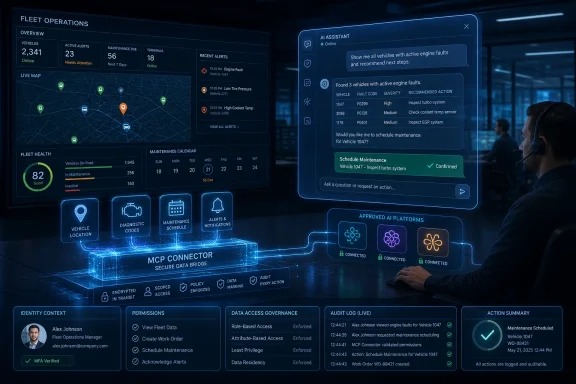 Geotab Turns the Fleet Dashboard Into an AI Endpoint
For years, fleet management software has sold the same promise in different packaging: more visibility, better utilization, safer driving, lower fuel costs, and fewer maintenance surprises. The practical problem has always been that visibility tends to arrive as yet another dashboard, another export, another workflow, and another specialist skill set inside the operations team.Geotab’s new MCP Connector is an attempt to collapse that distance. Instead of logging into MyGeotab, building reports, filtering assets, exporting spreadsheets, and handing the analysis to a manager, a user can ask an AI assistant a plain-English operational question against live fleet data. The point is not merely that the assistant can summarize what happened. Geotab says the connector can also support actions such as creating alerts, scheduling maintenance, generating reports, changing settings, organizing groups, and building applications.
That distinction is the story. A read-only AI assistant is a reporting convenience. An AI assistant that can touch fleet systems is infrastructure.
The company is framing the connector as an “industry-first” bridge between live commercial fleet data and the AI environments many enterprises are already standardizing around. That is a big claim, and like most “firsts” in enterprise technology, it deserves a raised eyebrow. But the underlying move is real: Geotab is taking the open Model Context Protocol and applying it to a business domain where real-time context, role-based permissions, and operational consequences matter.
MCP Is the Unsexy Standard Behind the Flashy Demo
Model Context Protocol, or MCP, is not another chatbot. It is a way for AI systems to connect to tools, data sources, and business systems through a common interface. In plain terms, it gives an assistant a governed way to ask, “What tools are available, what data can I access, and what am I allowed to do?”That is why MCP has become one of the more important plumbing layers in the current AI cycle. Large language models are powerful pattern engines, but by themselves they do not know the current location of a refrigerated trailer, whether a vehicle fault code is urgent, which driver belongs to which terminal, or whether a route deviation is normal. They need context, and in business settings, context lives in systems of record.
Geotab’s pitch is that fleets should not have to wait for every AI platform to build a bespoke integration into MyGeotab. Nor should Geotab force customers into a proprietary assistant if those customers have already chosen Copilot, Claude, ChatGPT, or another approved environment. MCP is the compromise: Geotab exposes fleet capabilities through a standard connector, and the customer’s AI platform becomes the user interface.
That matters for WindowsForum readers because Microsoft Copilot is now the default AI conversation in many Windows and Microsoft 365 estates. IT departments that are already debating Copilot governance, tenant controls, data boundaries, and plugin strategy will recognize the pattern immediately. The AI assistant is becoming less of an app and more of a broker between employees and enterprise systems.
The Real Product Is Not the Connector, It Is Permissioned Action
The easiest way to misunderstand Geotab’s announcement is to treat it as a search box for fleet data. That would be useful, but not transformational. The more consequential claim is that the connector enforces existing MyGeotab permissions while allowing AI-assisted action.That is the line between a productivity feature and an enterprise control problem. If a dispatcher can ask, “Which vehicles are overdue for inspection?” the risk profile is modest. If that same dispatcher can ask the assistant to create alerts, modify groups, or schedule maintenance, the system now needs strong authentication, auditability, authorization, and policy boundaries.
Geotab says the connector uses existing MyGeotab user permissions, which is exactly the right design principle. AI should not become a magic bypass around enterprise access control. If a junior manager could not see a driver’s data in MyGeotab yesterday, they should not be able to extract it through Claude today simply because the query is wrapped in natural language.
This is where many AI integrations will either earn trust or lose it. The worst version of enterprise AI is a superuser with a friendly tone. The best version is a policy-aware operator that can only see and do what the authenticated user is allowed to see and do.
Fleet Data Is a Brutal Test Case for Enterprise AI
Fleet management is a tougher AI use case than it may look from the outside. It combines streaming telemetry, geospatial data, driver behavior, regulatory obligations, maintenance schedules, fuel economics, asset utilization, and safety events. It is not enough for an AI system to produce a plausible answer. The answer has to be timely, grounded, and operationally meaningful.A model that confuses engine hours with drive hours could lead to bad maintenance planning. A model that treats an old cached location as live could mislead a dispatcher. A model that misunderstands a diagnostic code could understate a safety issue or trigger needless downtime. In consumer AI, a hallucinated answer is embarrassing. In fleet operations, it can cost money, compliance exposure, or worse.
That is why Geotab’s data argument is central to the announcement. The company says it processes more than 37 trillion data points annually from over 6 million vehicles across 160 countries. Those numbers are not just marketing scale. They are the foundation for a claim that Geotab can translate messy operational telemetry into the kind of structured, permissioned context an AI assistant can actually use.
The phrase “AI is only as good as the data” has become a cliché because it is true and because vendors use it to avoid harder questions. In this case, the harder question is whether the assistant understands the operational semantics of fleet data. Geotab is betting that its 25 years in telematics give it an advantage over a generic model connected to a generic database.
The Copilot Angle Is Bigger Than a Logo on a Slide
The inclusion of Microsoft Copilot in Geotab’s list of supported AI environments is not incidental. Many enterprises are standardizing their AI strategy around Microsoft because their identity, productivity, device management, security, and compliance stacks already run through Microsoft’s cloud. For those organizations, the question is not whether AI will touch operational systems. It is whether IT can make that happen without creating a shadow-AI disaster.A fleet manager may prefer Claude for analysis, a developer may prefer ChatGPT for building a small workflow, and an enterprise CIO may insist that Copilot is the sanctioned assistant for company data. Geotab’s open-standard positioning is designed for exactly that tension. It tells customers they do not have to make Geotab’s assistant the center of their AI universe.
That is strategically sensible. The enterprise AI market is not going to settle into one assistant any time soon. Different departments will use different models, different copilots, and different agent frameworks. Vendors that insist customers move into a closed AI environment may win some accounts, but they will also create friction with IT governance teams that are already trying to rationalize the sprawl.
For Windows-heavy organizations, the practical appeal is obvious. If a fleet operation can expose MyGeotab capabilities to Copilot under enterprise controls, the assistant becomes another managed interface rather than a rogue browser tab. The challenge is that “approved AI platform” must mean something concrete: tenant-level controls, identity integration, logging, data retention rules, and administrative review.
This Is Also a Shadow-IT Containment Strategy
The uncomfortable truth for enterprise software vendors is that employees are already pasting business data into AI tools. They do it because the tools are useful, the official workflows are slow, and the pressure to produce answers is immediate. Fleet operations are no exception. If a manager needs a quick explanation of fuel anomalies or route inefficiencies, the temptation to export a CSV and ask a public AI assistant for help is obvious.Geotab’s connector is partly a productivity play, but it is also a containment play. By creating an approved path from fleet data into sanctioned AI environments, Geotab gives IT departments a better answer than “don’t do that.” It offers a governed alternative to manual exports, screenshots, spreadsheets, and informal analysis.
This is the same pattern we have seen in other enterprise categories. Security teams do not stop analysts from using AI by banning AI; they create controlled connectors into SIEMs and incident systems. Finance teams do not stop spreadsheet analysis by forbidding spreadsheets; they connect models to governed data sources. Fleet teams will face the same dynamic.
The best governance strategy is rarely pure restriction. It is to make the safe path easier than the unsafe path. If Geotab’s connector works as advertised, the safe path becomes asking an approved assistant for live, permissioned insight instead of dragging operational data through unmanaged files.
Agentic Fleet Management Sounds Powerful Because It Is Risky
The word agentic is now everywhere in AI marketing, but Geotab’s use of it deserves attention. An agentic system does not merely answer; it plans, calls tools, executes steps, and adapts based on results. In a fleet context, that could mean identifying vehicles due for service, checking utilization patterns, generating a maintenance plan, creating alerts, and notifying managers.That is the future vendors are selling. It is also the future administrators need to interrogate.
An AI agent with access to fleet systems can accelerate routine work. It can also make mistakes at machine speed. If the assistant creates too many alerts, changes the wrong rule, or applies a maintenance workflow to the wrong vehicle group, the cost is no longer confined to a bad paragraph of text. It lands in operations.
The answer is not to reject agentic systems. It is to design them with friction in the right places. Low-risk read operations can be fast. Higher-risk changes should require confirmation, scoped permissions, reversible actions, and audit trails. Some operations should remain human-approved no matter how confident the model sounds.
Geotab’s announcement leans into action, and that is the right ambition. But action is where enterprise AI becomes a systems-administration problem, not a demo problem.
The Central Transport Quote Shows the Promise and the Pressure
Geotab highlighted Central Transport as an early customer seeing real operational value from the connector. Jon Hanvey, the company’s Director of Tractor Maintenance, said the integration with Claude transformed complex fleet data into real-time, actionable intelligence and replaced weeks of manual analysis with instant, deeper reporting. His most striking phrase was that Geotab had evolved from a system the company queries into a system it “thinks with.”That is exactly the kind of quote every enterprise AI vendor wants because it captures the move from software as database to software as collaborator. It also captures the pressure this puts on organizations. If one maintenance department can compress weeks of analysis into minutes, competitors will ask why their own processes still depend on manual reporting cycles.
But there is a trap in extrapolating from early adopters. The first customers using these tools tend to have motivated teams, strong vendor relationships, and specific pain points. Their success does not automatically mean every fleet can plug in an AI assistant and produce reliable operational intelligence overnight.
The more useful lesson is narrower and more practical. When an organization has clean fleet data, a clear operational question, a controlled AI environment, and a user who understands the domain, MCP-style integration can remove a lot of manual glue work. That is not magic. It is workflow compression.
Open Standards Are a Wedge Against AI Lock-In
Geotab’s insistence that the MCP Connector is built on an open standard is not just technical positioning. It is a strategic shot at proprietary AI ecosystems. The company is telling customers: your fleet intelligence should not be trapped inside one assistant, one vendor’s UI, or one model provider’s roadmap.That argument will resonate with IT leaders who have lived through earlier platform lock-in cycles. Every enterprise stack begins with convenience and ends with migration cost. AI raises the stakes because the assistant may become the front door to multiple business systems. Once workflows, prompts, permissions, and automations accumulate around a single platform, switching costs grow quickly.
MCP does not eliminate lock-in. Standards can be implemented unevenly, vendors can add proprietary extensions, and customers can still become dependent on one assistant’s user experience or model behavior. But it creates a healthier starting point than a closed integration that only works in one vendor’s cloud.
For Geotab, the open-standard strategy also widens the addressable market. A fleet that has standardized on Claude can use Claude. A Microsoft-first enterprise can pursue Copilot. A developer team experimenting with ChatGPT can build against an approved connector. That flexibility is not merely customer-friendly; it is defensive. Geotab does not have to guess which AI assistant will dominate the enterprise in 2027.
The Windows Admin’s Job Just Got More Interesting
For WindowsForum’s core audience, this announcement belongs in the same mental bucket as Copilot extensions, Microsoft Graph connectors, Sentinel MCP integrations, and the broader shift toward AI-enabled administration. The common theme is that AI assistants are becoming operational clients for enterprise systems.That changes what administrators have to manage. The old question was whether a user had access to an application. The new question is whether an AI assistant, acting on behalf of that user, can retrieve data, summarize it, transform it, and execute changes through connected tools. The identity may still be the user’s identity, but the interaction pattern is different.
Admins will need to think about least privilege in more granular terms. They will need to understand which actions the connector exposes, how approvals work, where logs live, and how prompts map to API calls. They will need to decide whether a role that made sense in a point-and-click dashboard still makes sense when expressed through natural language.
This is not unique to Geotab. It is the emerging administrative burden of enterprise AI. Every connector turns a system into part of an agentic surface area. That surface area needs inventory, policy, monitoring, and incident response.
The AI Assistant Becomes a New Kind of Integration Layer
Traditional enterprise integration is usually invisible to business users. APIs move data between systems. ETL jobs feed warehouses. Middleware syncs records. Dashboards expose selected views. Users experience the result as reports, alerts, and workflows.AI connectors invert that pattern. The user sees the integration directly as a conversation. They ask for an explanation, a comparison, a report, or an action, and the assistant decides which tools to call. That is powerful because it removes the rigid front end. It is risky because the system becomes harder to reason about.
A dashboard constrains the user. A well-designed report shows the same fields in the same way every time. A conversational assistant is more flexible, but flexibility means more paths through the system. The same business intent can be phrased many ways, and the assistant may choose different tool calls depending on context.
That is why observability matters. Enterprises will need to know not just what the final answer said, but what data the assistant accessed, what operations it attempted, what permissions were applied, and whether the user confirmed any changes. Without that, AI-driven operations become difficult to audit after the fact.
Geotab’s connector is entering this landscape at an important moment. The industry is moving from AI as a writing tool to AI as an integration layer. Fleet management may become one of the more concrete demonstrations of what that shift looks like in the real world.
The Demo Is Easy; the Governance Model Is the Product
The polished version of this announcement is simple: ask your fleet a question, get an answer, take action. The enterprise version is more complicated: authenticate the user, enforce permissions, protect sensitive data, prevent prompt injection, handle model errors, log tool calls, manage retention, and ensure that operational changes are intentional.That list is not meant to pour cold water on the launch. It is the work that makes the launch meaningful. Any vendor can produce a chatbot that summarizes exported data. The serious vendors will be judged by how well they handle governance when the chatbot is connected to live systems.
Fleet data can include sensitive operational information. Vehicle locations, driver behavior, routes, maintenance patterns, and utilization metrics can reveal business strategy, employee performance, customer relationships, and security-sensitive movements. A casual AI integration could expose more than a company realizes.
The connector’s value will therefore depend on how confidently organizations can keep data inside approved boundaries. That means the assistant platform matters as much as the fleet platform. A well-governed Copilot deployment and an unmanaged personal AI account are not equivalent destinations just because both can speak MCP.
“Industry-First” Is Less Important Than “Production-Ready”
Geotab’s “industry-first” framing is useful marketing, but customers should care more about maturity than novelty. First movers get attention. Production-ready systems get trusted.The signs to watch are practical. How well does the connector handle ambiguous prompts? How clearly does it distinguish between answering and acting? Can administrators restrict write actions while allowing read access? Are tool calls logged in a way that security and operations teams can actually review? Can organizations test the connector in a pilot without exposing too much data too quickly?
The support documentation suggests Geotab is treating this as a real integration rather than a press-release abstraction. The MCP server supports data retrieval, data modification, specialized fleet methods, and dozens of entity types, with pilot guidance that initially emphasizes Claude as a primary supported interface while noting broader MCP compatibility. That kind of staged rollout is sensible. Enterprise AI features should not arrive as a big-bang switch.
The best adoption path will likely be incremental. Start with reporting and diagnostics. Move to alert creation and workflow suggestions. Add write actions only where roles, approvals, and rollback processes are clear. The organizations that get the most from AI connectors will not be the ones that automate everything first. They will be the ones that decide carefully which work should become conversational.
The Fleet Portal Will Not Disappear, But Its Center of Gravity Will Shift
It is tempting to declare that AI will replace dashboards. It will not, at least not soon. Dashboards remain valuable because they are stable, visual, repeatable, and easy to scan. A dispatcher watching live assets on a map does not need a paragraph from a model. A compliance manager may still need structured reports and formal exports.What will change is the work around the dashboard. The assistant will help explain anomalies, generate report variations, compare time periods, identify outliers, and create next-step workflows. It will reduce the need to know exactly where a feature lives in the UI. It will also make advanced analysis available to managers who do not know the reporting system deeply.
That shift is familiar to anyone who has watched Windows administration evolve. Graphical consoles did not disappear when PowerShell arrived. Instead, serious administrators learned when to use each interface. AI may create a similar layering: dashboards for situational awareness, APIs for deterministic automation, and assistants for exploratory analysis and guided action.
The danger is overtrust. A good assistant can make a weak user feel powerful. That is both the value proposition and the risk. Fleet operators will need training not only in what prompts to ask, but in how to validate answers, recognize uncertainty, and know when a model-assisted recommendation needs human review.
The Competitive Pressure Now Moves to Data Quality
If Geotab’s connector gains traction, competitors will respond. Some will build MCP servers. Some will deepen integrations with a single AI platform. Some will market proprietary assistants as safer or more specialized. The AI feature checklist will converge quickly.That means the differentiator will move below the assistant layer. The winning fleet AI platforms will be the ones with the best data quality, domain modeling, permission design, and operational reliability. A generic assistant can write a pretty answer. It cannot compensate indefinitely for stale telemetry, inconsistent asset records, sloppy user roles, or unclear maintenance workflows.
This is where Geotab’s scale claim becomes strategically important. Six million connected vehicles and tens of trillions of annual data points give the company a large foundation for benchmarking, pattern recognition, and domain-specific intelligence. But scale alone is not enough. The data has to be clean, timely, normalized, and mapped to customer-specific operations.
The same lesson applies to customers. AI will expose the quality of internal data practices. Fleets with disciplined asset management, consistent driver assignments, well-maintained groups, and clean maintenance records will get better answers. Fleets with messy databases will get faster confusion.
The Practical Shape of a Fleet AI Rollout
The smartest organizations will treat Geotab’s MCP Connector as an enterprise integration project, not a toy for curious managers. That does not mean months of bureaucracy. It means a short, disciplined pilot with clear boundaries.A maintenance team is a natural starting point because the workflows are measurable. If AI-assisted reporting can identify overdue service, summarize fault trends, or compress recurring analysis, the value can be tracked. Safety and compliance use cases may follow, but they require tighter controls because driver data and regulatory exposure raise the stakes.
IT should also decide early which AI environments are approved. “Works with ChatGPT, Claude, and Copilot” is a flexibility statement, not an invitation to connect everything. An organization may choose one primary assistant for production use and keep others in development or evaluation. That is not anti-innovation. It is basic governance.
The other early decision is whether the connector will be allowed to write changes or only read data. Read-only pilots are easier to approve and still useful. Write-enabled pilots should be narrow, logged, and reversible. If the assistant can create an alert or schedule maintenance, someone should know who authorized it and why.
The Connector Makes AI Strategy Tangible for Operations Teams
Enterprise AI strategy often sounds abstract because it lives in board decks and productivity demos. Geotab’s announcement is interesting because it pulls AI into a gritty operational domain. Vehicles move, drivers change routes, engines throw faults, fuel prices bite, and maintenance windows close. The output is not a nicer email. It is a better decision made sooner.That is where agentic AI will have to prove itself. Not in grand claims about replacing roles, but in hundreds of small reductions in friction. The manager who no longer waits weeks for a maintenance analysis. The dispatcher who can ask for an exception summary without building a custom report. The analyst who can turn a recurring operational question into a governed workflow.
The risk is that AI becomes another abstraction layer that hides complexity until it fails. Fleet operations are full of edge cases. Vehicles lose connectivity. Devices misreport. Human behavior is messy. Regulations differ by region. AI systems need to surface uncertainty rather than smooth it away.
If Geotab can keep that balance — making complexity more manageable without pretending it does not exist — the connector could become more than an integration feature. It could become a new operating model for fleet intelligence.
The Hard Lessons Are Already Visible
Geotab’s MCP Connector lands at the intersection of three trends that are reshaping enterprise IT: assistants are becoming interfaces, open protocols are challenging closed AI platforms, and operational data is becoming the fuel for agentic workflows. The launch is not just about fleets talking to ChatGPT or Copilot. It is about whether companies can let AI touch live systems without losing control.The most concrete lessons are already clear:
- Geotab’s MCP Connector is designed to connect live MyGeotab data and Geotab Ace to approved AI platforms rather than forcing customers into one proprietary assistant.
- The most important capability is not natural-language querying, but permissioned action inside operational fleet workflows.
- Microsoft Copilot support matters because many enterprises will want fleet AI to sit inside existing identity, compliance, and Windows-centered management environments.
- Fleet operators should begin with narrow, auditable pilots before allowing broad write access or high-impact automated actions.
- The quality of AI outcomes will depend heavily on clean fleet data, disciplined user permissions, and clear operational ownership.
- MCP reduces integration lock-in, but it does not remove the need for governance, logging, testing, and human approval around sensitive actions.
References
- Primary source: Van Fleet World
Published: 2026-06-24T10:25:08.110947
Geotab launches industry-first AI Connector for fleets
Geotab has launched a new AI Connector that enables secure access to live MyGeotab data and its Ace agentic platform directly within ChatGPT, Claude, Microsoft Copilot and other MCP-compatible and approved AI platforms.vanfleetworld.co.uk - Related coverage: geotab.com
Geotab MCP Connector | Geotab
Connect your live fleet data to ChatGPT, Claude, or Copilot with the Geotab MCP Connector. Get instant answers about vehicles, trips, drivers, and more — no coding required.www.geotab.com
- Related coverage: prnewswire.com
Geotab Launches Industry-First AI Connector for Fleets
/PRNewswire/ - Geotab Inc. ("Geotab"), a global leader in connected transportation, video and asset tracking solutions, today announced the launch of its new... www.prnewswire.com
- Related coverage: support.geotab.com

Getting started with MyGeotab MCP
Set up the MyGeotab MCP integration, connect your AI assistant, and explore the capabilities and use cases available to your fleet.
support.geotab.com
- Related coverage: government-fleet.com
Geotab Launches AI Connector for Fleets | Government Fleet
New Geotab MCP Connector enables organizations to securely access live fleet data, automate workflows and take action from within the AI platforms they already use.www.government-fleet.com - Related coverage: dailyaibrief.com
Geotab Launches MCP Connector for AI Fleet Integration - Daily AI Brief
Geotab has introduced the Model Context Protocol (MCP) Connector, allowing organizations to securely connect live fleet data to AI tools such as ChatGPT, Claude, and Microsoft Copilot. The solution enables real-time access to MyGeotab data and supports automated workflows within existing AI... dailyaibrief.com
- Official source: learn.microsoft.com
Use the Microsoft Sentinel MCP connector in ChatGPT or Claude - Microsoft Security | Microsoft Learn
Learn how to turn on and use a custom Microsoft Sentinel's Model Context Protocol (MCP) connector in ChatGPT or Claudelearn.microsoft.com