
Microsoft Azure certification in 2026 remains a role-based credential system spanning Fundamentals, Associate, Expert, and Specialty tracks, with exams delivered through Pearson VUE, annual renewal for most role-based certifications, and training costs ranging from free Microsoft Learn paths to multi-thousand-dollar bootcamps. The headline is not that Azure certificates exist; it is that Microsoft has turned them into a labor-market sorting mechanism. For Windows admins, cloud engineers, security practitioners, and career-switchers, the question is no longer whether Azure belongs on the résumé. It is how much time, money, and credibility a certification path is actually worth.
The old certification world rewarded trivia. Memorize enough product names, ports, acronyms, and administrative screens, and you could collect a badge that looked impressive until the first production outage. Microsoft’s modern Azure certification program is built around a different premise: cloud jobs are now specialized enough that a generic “cloud certified” label does not tell employers much.
That is why Azure credentials are organized around roles. Administrator, developer, security engineer, network engineer, data engineer, AI engineer, and solutions architect are not just exam categories. They are job descriptions translated into test objectives.
This matters because Azure has become less of a product and more of an operating environment. A Windows Server admin moving into Azure no longer learns one management console; they learn identity, governance, storage, networking, monitoring, cost controls, disaster recovery, and increasingly security posture management across hybrid estates. A developer targeting Azure has to understand deployment models, managed services, event-driven architecture, containers, and identity integration. A security engineer has to live in Microsoft Entra ID, Defender for Cloud, Sentinel, Key Vault, policy, and regulatory controls.
The certification program is Microsoft’s attempt to impose order on that sprawl. It is also a commercial training ecosystem, a hiring filter, and a signal to partners that Microsoft wants skills aligned to the platform’s current direction rather than yesterday’s admin habits.
Fundamentals certifications, such as Azure Fundamentals, are designed for beginners, adjacent professionals, sales teams, managers, students, and technical workers who need a shared vocabulary. AZ-900 is not meant to prove that someone can run a cloud estate. It proves that they understand cloud concepts, Azure architecture and services, and the management and governance model well enough to have an informed conversation.
Associate certifications are where Azure becomes operational. Azure Administrator Associate, Azure Developer Associate, Azure Security Engineer Associate, Azure Network Engineer Associate, and related tracks test the working knowledge expected from people who touch real environments. This is the level where most IT professionals should expect to spend serious lab time rather than merely watch videos.
Expert certifications raise the stakes. Azure Solutions Architect Expert, for example, is not primarily about clicking through portal settings. It is about designing infrastructure, governance, identity, networking, storage, business continuity, migration, and application architecture choices that survive contact with enterprise complexity.
Specialty certifications sit beside that ladder rather than neatly above or below it. Azure Virtual Desktop Specialty is a good example: narrow, technical, and highly relevant to organizations with a specific deployment model. Specialty credentials can be powerful in the right market, but they are usually a poor first Azure badge unless the candidate already knows exactly why they need one.
But the industry sometimes oversells fundamentals exams as career changers. Passing AZ-900 can help a candidate speak the language of Azure, but it does not prove that they can administer a tenant, diagnose routing problems, secure privileged accounts, or design a resilient workload. Hiring managers know this.
That does not make AZ-900 useless. It makes it contextual. For a junior IT worker, it can be a confidence builder and a signal of intent. For a manager, it can reduce the gap between business planning and technical execution. For a sysadmin eyeing cloud operations, it can provide a structured on-ramp before AZ-104.
The danger is stopping there. In 2026, a fundamentals badge alone is increasingly like saying you have read the map. Useful, yes. But nobody hands over the keys to the data center because you know where the roads are.
That is why AZ-104 has earned a reputation as more than a “next step” after AZ-900. It is broad, practical, and unforgiving for candidates who have only studied screenshots. The exam expects comfort with Azure’s operational model, and that model is different from the old world of managing a handful of servers by name.
In Azure, the administrative unit is often not a server but a policy, identity boundary, resource group, subscription, or deployment template. Permissions are not simply local administrators versus standard users. Networking is not merely a subnet mask and a default gateway. Monitoring is not just watching Event Viewer until something screams.
AZ-104 is valuable because it forces Windows admins to confront that shift. It teaches that Azure administration is as much about governance and repeatability as it is about provisioning resources. The best candidates come out not merely knowing where Microsoft placed a button, but understanding why cloud operations punish improvisation.
The Azure Security Engineer Associate track covers identity and access, networking, compute, storage, databases, Defender for Cloud, and Sentinel. That breadth reflects Microsoft’s own view of cloud security: it is not a perimeter product. It is a posture that runs through identity, policy, monitoring, workload configuration, and incident response.
For Windows professionals, this is a significant cultural change. On-prem security often revolved around domain boundaries, endpoint tooling, firewall rules, patching, and backup discipline. Those still matter, but Azure shifts a great deal of risk into identity and configuration. A poorly governed subscription, an overprivileged service principal, a public storage endpoint, or a missing conditional access policy can be as consequential as an unpatched server.
That is why security-focused Azure certification may deliver a stronger career payoff than a purely administrative path for some candidates. Every organization moving into cloud needs people who can say not only “I can build this” but also “I can keep this from becoming an incident report.”
The AZ-305 exam focuses on designing Azure infrastructure solutions rather than simply operating them. That means candidates need to think in tradeoffs. When should a workload use platform services rather than virtual machines? How should an organization structure subscriptions and management groups? What identity design supports least privilege without paralyzing operations? Which storage option fits the data, performance, resiliency, and compliance requirements?
This is where certification becomes less about memorization and more about professional judgment. The architect’s job is not to know every Azure service in isolation. It is to choose among them under pressure, with incomplete information, while explaining the consequences to stakeholders who may care more about budget, risk, and delivery dates than technical elegance.
Microsoft’s requirement that candidates satisfy both administrative and architectural expectations for the Solutions Architect Expert designation reinforces that point. Architecture without operational grounding is slideware. Operations without architecture becomes firefighting. The expert badge tries, imperfectly but usefully, to bridge the two.
That is the pitch behind Azure certification bootcamps. They compress preparation into one day, one week, or two intense weeks of structured instruction, labs, review, and practice exams. For candidates with employer funding, a deadline, or a clear promotion target, that structure can be worth the money.
But bootcamps are not magic. A one-week course can sharpen and organize existing knowledge; it cannot manufacture months of production experience. Candidates who arrive with basic Azure familiarity, some PowerShell or CLI comfort, and real lab practice tend to benefit far more than those hoping to be transformed from zero to engineer by Friday afternoon.
The best bootcamps are practical. They provide lab environments, force students through configuration and troubleshooting, include current exam objectives, and make room for instructor explanation when Microsoft’s documentation feels too abstract. The weaker ones become expensive cram sessions with prettier slide decks.
For employers, the calculation is similar. A bootcamp is useful when it accelerates someone already doing related work. It is a poor substitute for a training plan if the organization has not given staff time, sandbox access, mentorship, and permission to learn by breaking non-production systems.
The larger price is preparation. A self-study candidate might spend little beyond the exam fee, using Microsoft Learn, documentation, free videos, practice assessments, and a personal Azure subscription kept carefully within budget. A bootcamp candidate might spend hundreds for a fundamentals class or several thousand dollars for an intensive associate, security, administrator, or architect program.
That spread can look absurd until you factor in time. For a working professional, a bootcamp is not just buying content. It is buying compression, accountability, instructor access, lab scaffolding, and sometimes an exam voucher or retake option. Whether that is worth $4,000 or $6,000 depends less on the brand and more on the candidate’s circumstances.
There is also an opportunity cost. Spending three months preparing for the wrong exam is expensive even if the course materials were free. A help desk technician aiming for cloud operations probably gets more practical value from AZ-104 than from jumping straight to architecture. A security analyst in a Microsoft-heavy enterprise may get more leverage from AZ-500 or SC-series credentials than from another general-purpose badge.
The cheapest certification path is not always the least expensive. The most expensive path is the one that does not match the job you are trying to get.
This renewal model is both sensible and annoying, which is usually a sign that Microsoft is solving a real problem. Azure changes constantly. Services are renamed, identity features evolve, security baselines shift, portal workflows move, and best practices harden as customers learn expensive lessons. A cloud certification that never expires would eventually become a museum label.
The good news is that renewal is not the same as retaking the original exam. Microsoft’s renewal assessments are shorter, unproctored, free, and focused on recent changes. That makes the system less punitive than the old model of forcing professionals to schedule another full exam every few years.
The bad news is that annual renewal turns certification into a maintenance habit. If you ignore the window and let the credential expire, you may have to re-earn it. For busy admins and consultants, that means certification management becomes part of professional hygiene, like renewing vendor partner requirements or keeping security training current.
In practice, this may be one of the program’s strongest features. A person who renews an Azure security or administrator credential year after year is signaling not just that they once passed a test, but that they have stayed close enough to the platform to keep the badge alive.
But certification is not a salary vending machine. Employers pay for demonstrated capability, not laminated ambition. The biggest payoff usually comes when a certification confirms skills the candidate can already discuss, demonstrate, and apply.
For entry-level candidates, an Azure badge can help create an interview opportunity. For mid-career professionals, it can validate a transition from on-premises infrastructure into cloud administration or security. For senior engineers, expert-level credentials can strengthen the case for architecture, consulting, or leadership roles.
The market also values combinations. Azure plus Windows Server experience is useful. Azure plus identity and security is stronger. Azure plus automation, Terraform, Bicep, PowerShell, GitHub Actions, or Kubernetes can move a candidate from “certified” to “deployable.” Azure plus business communication is what turns an engineer into an architect.
That is the uncomfortable truth behind certification ROI. The badge may open the door, but the conversation after that still belongs to the candidate.
The problem is not merely ethical. It is practical. A candidate who passes by memorizing leaked questions may earn a badge but enters the job market with a liability: they have trained for recall rather than work. In Azure, that gap becomes visible quickly. Real environments do not present themselves as multiple-choice prompts with four tidy answers.
There is also a broader reputational risk. Certifications retain value only when employers believe they correlate with competence. If too many candidates treat them as puzzles to be gamed, hiring managers discount them, and the credential becomes less useful for everyone.
The better strategy is slower but sturdier. Read the official objectives. Build labs. Break things. Fix them. Use Microsoft Learn, official documentation, practice assessments, and reputable training, but do not confuse exam readiness with operational readiness. The goal is not to pass Azure once. The goal is to become the person a team trusts when Azure breaks at 2 a.m.
This route-planning mindset is important because Microsoft’s catalog is large enough to become a distraction. More than 30 Azure-related credentials and adjacent Microsoft certifications can make candidates feel as if they are always one badge behind. That is not a career strategy; it is credential collecting.
The better plan is to pair each certification with a practical artifact. If you study AZ-104, build a small governed Azure environment with networking, monitoring, backup, and role-based access control. If you study AZ-500, harden identities, configure Defender for Cloud, work with Sentinel scenarios, and document your security choices. If you study AZ-305, write architecture decision records and explain why you chose one design over another.
Employers respond to evidence. A certification plus a lab portfolio, GitHub repo, internal project, migration story, or incident-response experience is much stronger than a certification alone. The badge says you studied the map. The work proves you can drive.
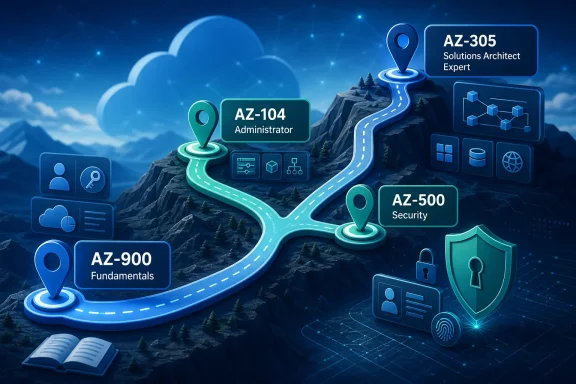 Microsoft Has Turned Azure Certification Into a Career Map
The old certification world rewarded trivia. Memorize enough product names, ports, acronyms, and administrative screens, and you could collect a badge that looked impressive until the first production outage. Microsoft’s modern Azure certification program is built around a different premise: cloud jobs are now specialized enough that a generic “cloud certified” label does not tell employers much.That is why Azure credentials are organized around roles. Administrator, developer, security engineer, network engineer, data engineer, AI engineer, and solutions architect are not just exam categories. They are job descriptions translated into test objectives.
This matters because Azure has become less of a product and more of an operating environment. A Windows Server admin moving into Azure no longer learns one management console; they learn identity, governance, storage, networking, monitoring, cost controls, disaster recovery, and increasingly security posture management across hybrid estates. A developer targeting Azure has to understand deployment models, managed services, event-driven architecture, containers, and identity integration. A security engineer has to live in Microsoft Entra ID, Defender for Cloud, Sentinel, Key Vault, policy, and regulatory controls.
The certification program is Microsoft’s attempt to impose order on that sprawl. It is also a commercial training ecosystem, a hiring filter, and a signal to partners that Microsoft wants skills aligned to the platform’s current direction rather than yesterday’s admin habits.
The Four Levels Are Simple; Choosing the Right One Is Not
Azure certification is usually described as having four levels: Fundamentals, Associate, Expert, and Specialty. That taxonomy is useful, but it hides the real decision candidates face. The question is not “which level is hardest?” It is “which credential maps to the work I want to be trusted with?”Fundamentals certifications, such as Azure Fundamentals, are designed for beginners, adjacent professionals, sales teams, managers, students, and technical workers who need a shared vocabulary. AZ-900 is not meant to prove that someone can run a cloud estate. It proves that they understand cloud concepts, Azure architecture and services, and the management and governance model well enough to have an informed conversation.
Associate certifications are where Azure becomes operational. Azure Administrator Associate, Azure Developer Associate, Azure Security Engineer Associate, Azure Network Engineer Associate, and related tracks test the working knowledge expected from people who touch real environments. This is the level where most IT professionals should expect to spend serious lab time rather than merely watch videos.
Expert certifications raise the stakes. Azure Solutions Architect Expert, for example, is not primarily about clicking through portal settings. It is about designing infrastructure, governance, identity, networking, storage, business continuity, migration, and application architecture choices that survive contact with enterprise complexity.
Specialty certifications sit beside that ladder rather than neatly above or below it. Azure Virtual Desktop Specialty is a good example: narrow, technical, and highly relevant to organizations with a specific deployment model. Specialty credentials can be powerful in the right market, but they are usually a poor first Azure badge unless the candidate already knows exactly why they need one.
AZ-900 Is a Starting Line, Not a Cloud Career
Azure Fundamentals is popular because it is approachable, relatively inexpensive, and legible to non-specialists. For someone coming from help desk, desktop support, sales engineering, project management, procurement, or compliance, AZ-900 can be the first step toward understanding what Azure actually is. It gives beginners a controlled introduction to cloud models, core services, identity, pricing concepts, governance, and shared responsibility.But the industry sometimes oversells fundamentals exams as career changers. Passing AZ-900 can help a candidate speak the language of Azure, but it does not prove that they can administer a tenant, diagnose routing problems, secure privileged accounts, or design a resilient workload. Hiring managers know this.
That does not make AZ-900 useless. It makes it contextual. For a junior IT worker, it can be a confidence builder and a signal of intent. For a manager, it can reduce the gap between business planning and technical execution. For a sysadmin eyeing cloud operations, it can provide a structured on-ramp before AZ-104.
The danger is stopping there. In 2026, a fundamentals badge alone is increasingly like saying you have read the map. Useful, yes. But nobody hands over the keys to the data center because you know where the roads are.
AZ-104 Remains the Workhorse Credential for Windows Admins
For many WindowsForum readers, Azure Administrator Associate is the certification that matters most. AZ-104 aligns closely with the work that traditional Windows and infrastructure admins are being asked to absorb: subscriptions, identities, governance, storage, compute, virtual networks, monitoring, backup, and resource management.That is why AZ-104 has earned a reputation as more than a “next step” after AZ-900. It is broad, practical, and unforgiving for candidates who have only studied screenshots. The exam expects comfort with Azure’s operational model, and that model is different from the old world of managing a handful of servers by name.
In Azure, the administrative unit is often not a server but a policy, identity boundary, resource group, subscription, or deployment template. Permissions are not simply local administrators versus standard users. Networking is not merely a subnet mask and a default gateway. Monitoring is not just watching Event Viewer until something screams.
AZ-104 is valuable because it forces Windows admins to confront that shift. It teaches that Azure administration is as much about governance and repeatability as it is about provisioning resources. The best candidates come out not merely knowing where Microsoft placed a button, but understanding why cloud operations punish improvisation.
Security Certifications Have Become the New Center of Gravity
Azure security credentials are no longer niche add-ons for people with “security” in their title. Cloud breaches, identity attacks, ransomware recovery planning, compliance demands, and hybrid complexity have made security competence part of every infrastructure role. In that environment, AZ-500 has become one of the most strategically useful Azure certifications.The Azure Security Engineer Associate track covers identity and access, networking, compute, storage, databases, Defender for Cloud, and Sentinel. That breadth reflects Microsoft’s own view of cloud security: it is not a perimeter product. It is a posture that runs through identity, policy, monitoring, workload configuration, and incident response.
For Windows professionals, this is a significant cultural change. On-prem security often revolved around domain boundaries, endpoint tooling, firewall rules, patching, and backup discipline. Those still matter, but Azure shifts a great deal of risk into identity and configuration. A poorly governed subscription, an overprivileged service principal, a public storage endpoint, or a missing conditional access policy can be as consequential as an unpatched server.
That is why security-focused Azure certification may deliver a stronger career payoff than a purely administrative path for some candidates. Every organization moving into cloud needs people who can say not only “I can build this” but also “I can keep this from becoming an incident report.”
The Architect Badge Is Powerful Because It Is Hard to Fake
Azure Solutions Architect Expert occupies a different place in the certification hierarchy. It is not the best first Azure credential, and it is not the most efficient badge for every engineer. Its value comes from the fact that architecture is where technical depth, business constraints, cost, governance, availability, and security collide.The AZ-305 exam focuses on designing Azure infrastructure solutions rather than simply operating them. That means candidates need to think in tradeoffs. When should a workload use platform services rather than virtual machines? How should an organization structure subscriptions and management groups? What identity design supports least privilege without paralyzing operations? Which storage option fits the data, performance, resiliency, and compliance requirements?
This is where certification becomes less about memorization and more about professional judgment. The architect’s job is not to know every Azure service in isolation. It is to choose among them under pressure, with incomplete information, while explaining the consequences to stakeholders who may care more about budget, risk, and delivery dates than technical elegance.
Microsoft’s requirement that candidates satisfy both administrative and architectural expectations for the Solutions Architect Expert designation reinforces that point. Architecture without operational grounding is slideware. Operations without architecture becomes firefighting. The expert badge tries, imperfectly but usefully, to bridge the two.
Bootcamps Sell Speed, but Labs Sell Competence
The bootcamp market exists because self-study is hard. Microsoft Learn is free, comprehensive, and often the best official starting point, but it does not provide urgency. It will not clear your calendar, force you into labs, answer questions in real time, or simulate the fatigue of exam day.That is the pitch behind Azure certification bootcamps. They compress preparation into one day, one week, or two intense weeks of structured instruction, labs, review, and practice exams. For candidates with employer funding, a deadline, or a clear promotion target, that structure can be worth the money.
But bootcamps are not magic. A one-week course can sharpen and organize existing knowledge; it cannot manufacture months of production experience. Candidates who arrive with basic Azure familiarity, some PowerShell or CLI comfort, and real lab practice tend to benefit far more than those hoping to be transformed from zero to engineer by Friday afternoon.
The best bootcamps are practical. They provide lab environments, force students through configuration and troubleshooting, include current exam objectives, and make room for instructor explanation when Microsoft’s documentation feels too abstract. The weaker ones become expensive cram sessions with prettier slide decks.
For employers, the calculation is similar. A bootcamp is useful when it accelerates someone already doing related work. It is a poor substitute for a training plan if the organization has not given staff time, sandbox access, mentorship, and permission to learn by breaking non-production systems.
The Price of Azure Certification Is Really Two Prices
The visible price is the exam fee. In the United States, fundamentals exams have historically sat around the low end of the Microsoft exam range, while associate and expert paths cost more, especially when multiple exams are required. Prices vary by country or region, and Microsoft can adjust them, so candidates should always verify current pricing when scheduling.The larger price is preparation. A self-study candidate might spend little beyond the exam fee, using Microsoft Learn, documentation, free videos, practice assessments, and a personal Azure subscription kept carefully within budget. A bootcamp candidate might spend hundreds for a fundamentals class or several thousand dollars for an intensive associate, security, administrator, or architect program.
That spread can look absurd until you factor in time. For a working professional, a bootcamp is not just buying content. It is buying compression, accountability, instructor access, lab scaffolding, and sometimes an exam voucher or retake option. Whether that is worth $4,000 or $6,000 depends less on the brand and more on the candidate’s circumstances.
There is also an opportunity cost. Spending three months preparing for the wrong exam is expensive even if the course materials were free. A help desk technician aiming for cloud operations probably gets more practical value from AZ-104 than from jumping straight to architecture. A security analyst in a Microsoft-heavy enterprise may get more leverage from AZ-500 or SC-series credentials than from another general-purpose badge.
The cheapest certification path is not always the least expensive. The most expensive path is the one that does not match the job you are trying to get.
Annual Renewal Is Microsoft’s Quiet Quality Control
One of the most important details in Microsoft certification is easy to miss: Fundamentals certifications do not expire, but role-based and specialty certifications generally do. Associate, Expert, and Specialty credentials are valid for one year and can be renewed through a free online Microsoft Learn assessment during the eligibility window before expiration.This renewal model is both sensible and annoying, which is usually a sign that Microsoft is solving a real problem. Azure changes constantly. Services are renamed, identity features evolve, security baselines shift, portal workflows move, and best practices harden as customers learn expensive lessons. A cloud certification that never expires would eventually become a museum label.
The good news is that renewal is not the same as retaking the original exam. Microsoft’s renewal assessments are shorter, unproctored, free, and focused on recent changes. That makes the system less punitive than the old model of forcing professionals to schedule another full exam every few years.
The bad news is that annual renewal turns certification into a maintenance habit. If you ignore the window and let the credential expire, you may have to re-earn it. For busy admins and consultants, that means certification management becomes part of professional hygiene, like renewing vendor partner requirements or keeping security training current.
In practice, this may be one of the program’s strongest features. A person who renews an Azure security or administrator credential year after year is signaling not just that they once passed a test, but that they have stayed close enough to the platform to keep the badge alive.
Salary Payoff Is Real, but It Is Not Automatic
The strongest argument for Azure certification is economic. Cloud skills remain in demand, Microsoft remains deeply embedded in enterprise IT, and organizations continue to need people who can migrate, secure, govern, and optimize Azure environments. A credible certification can help a candidate pass résumé screens, justify a promotion, support consulting rates, or move from general IT into cloud operations.But certification is not a salary vending machine. Employers pay for demonstrated capability, not laminated ambition. The biggest payoff usually comes when a certification confirms skills the candidate can already discuss, demonstrate, and apply.
For entry-level candidates, an Azure badge can help create an interview opportunity. For mid-career professionals, it can validate a transition from on-premises infrastructure into cloud administration or security. For senior engineers, expert-level credentials can strengthen the case for architecture, consulting, or leadership roles.
The market also values combinations. Azure plus Windows Server experience is useful. Azure plus identity and security is stronger. Azure plus automation, Terraform, Bicep, PowerShell, GitHub Actions, or Kubernetes can move a candidate from “certified” to “deployable.” Azure plus business communication is what turns an engineer into an architect.
That is the uncomfortable truth behind certification ROI. The badge may open the door, but the conversation after that still belongs to the candidate.
Dumps, Shortcuts, and the Slow Collapse of Trust
Any certification market attracts shortcuts. Exam dumps, recycled questions, dubious “guaranteed pass” packages, and low-quality practice tests are common across the industry. They are especially tempting in cloud certification because the objective lists are broad and the exam fees are not trivial.The problem is not merely ethical. It is practical. A candidate who passes by memorizing leaked questions may earn a badge but enters the job market with a liability: they have trained for recall rather than work. In Azure, that gap becomes visible quickly. Real environments do not present themselves as multiple-choice prompts with four tidy answers.
There is also a broader reputational risk. Certifications retain value only when employers believe they correlate with competence. If too many candidates treat them as puzzles to be gamed, hiring managers discount them, and the credential becomes less useful for everyone.
The better strategy is slower but sturdier. Read the official objectives. Build labs. Break things. Fix them. Use Microsoft Learn, official documentation, practice assessments, and reputable training, but do not confuse exam readiness with operational readiness. The goal is not to pass Azure once. The goal is to become the person a team trusts when Azure breaks at 2 a.m.
A Practical Path for 2026 Looks Less Like a Ladder Than a Route Plan
The smartest Azure certification path in 2026 starts with the job target. A beginner who wants cloud literacy should consider AZ-900. A Windows admin moving into cloud operations should look hard at AZ-104. A security-minded engineer should weigh AZ-500, especially in Microsoft-heavy organizations. A senior professional aiming at design authority should plan for the architect track only after building operational grounding.This route-planning mindset is important because Microsoft’s catalog is large enough to become a distraction. More than 30 Azure-related credentials and adjacent Microsoft certifications can make candidates feel as if they are always one badge behind. That is not a career strategy; it is credential collecting.
The better plan is to pair each certification with a practical artifact. If you study AZ-104, build a small governed Azure environment with networking, monitoring, backup, and role-based access control. If you study AZ-500, harden identities, configure Defender for Cloud, work with Sentinel scenarios, and document your security choices. If you study AZ-305, write architecture decision records and explain why you chose one design over another.
Employers respond to evidence. A certification plus a lab portfolio, GitHub repo, internal project, migration story, or incident-response experience is much stronger than a certification alone. The badge says you studied the map. The work proves you can drive.
The Azure Credential That Pays Off Is the One You Can Defend
The practical story for 2026 is not that everyone needs the same Azure certification. It is that Azure skills have become too central to enterprise IT for professionals to rely on vague familiarity. The best credential is the one that aligns with the work you want, the experience you can show, and the next responsibility you are trying to earn.- Azure Fundamentals is a useful entry point, but it should be treated as a foundation rather than a destination.
- Azure Administrator Associate remains the most practical next step for many Windows admins moving into cloud operations.
- Azure Security Engineer Associate is increasingly valuable because identity, posture management, and threat detection now sit at the center of cloud risk.
- Azure Solutions Architect Expert carries weight when it is backed by operational experience and the ability to explain tradeoffs.
- Bootcamps can accelerate preparation, but they work best for candidates who already have context and can reinforce the material with labs.
- Renewal matters because Azure changes quickly, and an active credential signals ongoing engagement rather than one-time exam success.
References
- Primary source: kobaran.com
Published: 2026-06-24T08:30:41.559510
Azure Certification Guide 2026: Levels, Bootcamps, Costs, and Career Payoff
The cloud computing talent shortage is real, and companies are paying a premium to fix it. Microsoft Azure now powers a significant share of global enterprisewww.kobaran.com - Official source: learn.microsoft.com
Microsoft Certification Renewal | Microsoft Learn
learn.microsoft.com - Related coverage: open-exam-prep.com
AZ-900 Exam Guide 2026: Pass Azure Fundamentals FREE | OpenExamPrep
FREE AZ-900 Azure Fundamentals guide for 2026. Official outline, $99 exam cost, 85-min format, 3-6 week study plan, practice questions. Start free today.open-exam-prep.com - Related coverage: onlinecerthub.com
Azure Fundamentals AZ-900 2026: Best Exam Guide
Azure fundamentals AZ-900 exam guide for 2026: cost, study plan, practice resources, and how to pass in two weeks. onlinecerthub.com
- Related coverage: rn-dev.com
- Related coverage: techexamlexicon.com
Azure AZ-900 FAQ: Exam Format and Prep
Azure AZ-900 FAQ for exam format, topics, prep strategy, practice, and common candidate traps. techexamlexicon.com
- Related coverage: robustittraining.com
- Related coverage: leva.org
- Related coverage: in.gov
Microsoft Certified Azure Fundamentals
Credential Summary Candidates for this certification generally demonstrate foundational knowledge of cloud concepts in general and Azure in particular. This certification is a starting point in the journey for a career in Azure. Prerequisites include skills and experience with infrastructure...www.in.gov
- Related coverage: search.anima.dk
- Related coverage: fulldumps.com
AZ-500 Certification 2026: How to Pass the Azure Security Engineer Exam
Pass the AZ-500 exam in 2026 with proven study plans, labs, pitfalls to avoid, and real-world Azure security advice from a certified expert.www.fulldumps.com - Related coverage: sailor.sh
AZ-500 Exam Guide 2026: Microsoft Azure Security Engineer Associate Certification - Sailor.sh Blog
Complete AZ-500 exam guide: four security domains, prerequisites, hands-on skills, study plan, and how to prepare for the Microsoft Azure Security Engineer exam. sailor.sh
- Related coverage: unihackers.com
Azure AZ-500 Security Guide 2026 | Unihackers
Complete AZ-500 certification guide. Exam $165, 150 min, 700 to pass. Azure AD, Sentinel, Defender expertise. +31% salary boost to $118K avg.unihackers.com - Related coverage: arch-center.azureedge.net
AZ-305 Exam Study Guide
Exam AZ-305: Designing Microsoft Azure Infrastructure Solutionsarch-center.azureedge.net