
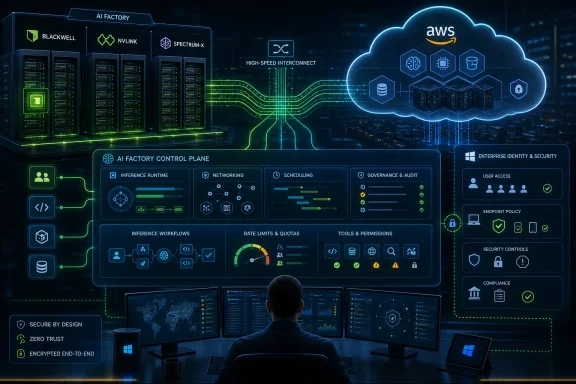
Nvidia and Amazon Web Services used GTC 2026 in March to expand a 15-year AI infrastructure partnership, tying Nvidia’s latest GPUs, networking, inference software, and enterprise AI stack more tightly into AWS cloud services for companies moving generative AI from experiments into production. That is the plain version of the news. The more important version is that the AI boom is no longer being sold as a model story, a chatbot story, or even a GPU story. It is becoming a control-plane story, and AWS and Nvidia both want to own as much of that plane as enterprises will tolerate.
For the last two years, enterprise AI has been easy to demo and hard to operationalize. A developer could wire a retrieval system to a model endpoint, impress a business unit, and discover three weeks later that latency, cost, compliance, data residency, and governance had all been hand-waved into the backlog. The distance between “we built a prototype” and “we can run this every day for thousands of employees or millions of customers” remains the gap into which many AI budgets quietly disappear.
The Nvidia-AWS announcement is aimed squarely at that gap. AWS is not merely renting more Nvidia chips, and Nvidia is not merely looking for another place to park its accelerators. The two companies are presenting a stack: silicon, interconnects, virtualized cloud infrastructure, managed services, model tooling, inference frameworks, and enterprise software positioned as a production path rather than a shopping list.
That matters because enterprises do not buy “AI” in the abstract. They buy uptime, throughput, auditability, and a way to explain to finance why an inference workload suddenly costs more than the app it supports. Nvidia’s pitch is that AI factories need a full-stack architecture. AWS’s pitch is that enterprises would rather consume that architecture through a cloud platform than assemble it from scratch.
The uncomfortable truth for customers is that both companies are probably right. The equally uncomfortable truth is that the more right they are, the harder it becomes to pretend enterprise AI infrastructure is modular in any simple sense.
That is why Nvidia’s recent emphasis on platforms such as Blackwell, Rubin, NVLink, Spectrum-X, Dynamo, NIM, and AI Enterprise should be read together rather than as separate product blurbs. Each piece addresses a different part of the production problem. The chip is only useful if the rack can scale, the network can keep up, the software can schedule work efficiently, and developers can deploy models without becoming distributed systems specialists overnight.
AWS gives Nvidia the distribution layer that enterprise buyers already understand. Procurement teams know EC2 instance families. Security teams know IAM, VPCs, CloudTrail, and GuardDuty. Developers know SageMaker, Bedrock, EKS, and the familiar AWS pattern of turning infrastructure into an API. By embedding Nvidia’s stack deeper into those surfaces, AWS lowers the friction for enterprises that want Nvidia performance without building their own data center religion around it.
But the strategic direction runs both ways. Nvidia benefits when the cloud normalizes its software as part of the production AI stack, not just its hardware as the premium accelerator option. A GPU is a component. An inference operating system, a model microservice layer, and a validated enterprise runtime are much stickier.
That is the tension inside the Nvidia partnership. AWS has its own silicon ambitions with Trainium and Inferentia, and it has every reason to reduce dependence on any single chip supplier. Nvidia, meanwhile, has every reason to make the surrounding ecosystem so compelling that even custom silicon has to integrate with Nvidia’s networking and rack-scale designs. The collaboration around NVLink Fusion and future AWS AI infrastructure shows how competition and cooperation are now happening inside the same machine room.
For customers, this is not a philosophical issue. It is a capacity and cost issue. If AWS can blend Nvidia’s accelerators, Nvidia’s interconnect approach, AWS Nitro virtualization, Elastic Fabric Adapter networking, and AWS’s own silicon roadmap into a coherent platform, customers get more ways to run large workloads. If that blend creates hidden dependencies, customers may discover later that moving an AI workload is far harder than moving a conventional web app.
The old cloud lock-in debate was about databases, storage APIs, and serverless runtimes. The new version is about model serving stacks, GPU topologies, proprietary acceleration libraries, scheduler behavior, and whether an AI application’s economics only work on the platform where it was born. That is a much deeper lock-in because performance itself becomes part of the application architecture.
Windows remains the front door for a huge share of enterprise work. The AI agent that summarizes tickets, drafts documents, queries internal data, or automates a business process will often be invoked from a Windows endpoint, authenticated through Microsoft identity systems, governed by enterprise data-loss policies, and monitored by security teams that already live in Microsoft portals. Even if the model runs on AWS using Nvidia infrastructure, the user and the risk surface may be sitting on a Windows laptop.
That creates a practical challenge for IT departments: the AI stack is becoming cross-cloud and cross-vendor by default. A company may use Microsoft 365 Copilot for productivity, Azure OpenAI for some internal workloads, AWS Bedrock or SageMaker for others, Nvidia AI Enterprise for portability claims, and local Windows-based development environments for engineering teams. The result is not one AI platform but a federation of them, each with its own logs, cost model, permissions, and failure modes.
This is where the AWS-Nvidia announcement becomes more than a cloud infrastructure story. It signals that production AI will be packaged as integrated vertical stacks by the largest vendors, and IT will be asked to make those stacks coexist. The winning administrator will not be the one who memorizes every product name. It will be the one who can map data movement, identity boundaries, endpoint exposure, and operational ownership across them.
AWS and Nvidia are effectively promising that optimized infrastructure can reduce that tax. Better networking, faster GPUs, more efficient inference software, and managed deployment patterns should improve utilization. If Dynamo-style distributed inference can keep accelerators busier and reduce waste, that matters. If NIM-style model packaging shortens deployment time, that matters too.
Still, efficiency gains do not automatically mean lower total spending. In cloud computing, cheaper units often produce more units. A team that cuts per-token cost may decide to add more agents, longer context windows, richer retrieval, multimodal inputs, and more automated workflows. The bill can rise even as the platform becomes more efficient.
This is why the production AI conversation is shifting from “can we make this work?” to “can we govern how often it works?” Rate limits, caching, prompt discipline, model selection, workload placement, and chargeback are becoming first-class IT controls. The enterprises that treat AI as a magical capability will be surprised by the invoice. The enterprises that treat it as a metered utility with adversarial demand patterns will have a fighting chance.
The AWS-Nvidia stack does not remove those risks. It may make some risks easier to manage by giving enterprises validated deployment patterns, supported software, and cloud-native monitoring hooks. But the deeper the integration, the more security teams must understand which component is responsible for which guarantee. A secure GPU instance is not the same thing as a secure AI application.
Agentic AI sharpens the problem. An agent that can reason, call tools, retrieve files, submit tickets, or trigger workflows is not merely generating text. It is operating inside the business. That means least privilege, audit trails, human approval gates, and rollback procedures become AI infrastructure concerns rather than application-layer niceties.
Windows administrators have seen this movie before with macros, PowerShell, remote management tools, and endpoint scripting. Capabilities introduced for productivity become attractive to attackers because they sit close to real business authority. AI agents will follow the same path unless organizations treat them as privileged automation from day one.
AWS brings scale and operational discipline to that chain. Nvidia brings the accelerator roadmap and a software ecosystem designed to make its hardware the default target for high-performance AI. Together, they can offer enterprises something that looks simple from the top: an API, an instance type, a managed service, a deployment pattern. Underneath sits one of the most complex industrial systems the technology sector has ever built.
That complexity creates resilience in some places and fragility in others. Customers benefit when AWS absorbs procurement, deployment, and operations problems they could never solve alone. They become exposed when capacity constraints, regional availability, service quotas, or vendor roadmap shifts determine what their AI systems can do.
The cloud abstraction has always been a bargain: users give up some control in exchange for speed and scale. AI makes that bargain more consequential because the scarce resource is not just compute. It is a particular kind of compute, attached to a particular network, running a particular software stack, in regions with enough power and cooling to support it.
That does not make the announcement empty. On the contrary, it makes it more useful. AWS and Nvidia are telling the market where they believe the friction is: scaling inference, integrating networking and accelerators, simplifying deployment, supporting agentic workloads, and convincing enterprises that cloud AI can be both powerful and governable.
The question for buyers is not whether those problems are real. They are. The question is whether the solution should be consumed as a tightly integrated vendor stack, assembled from portable layers, or split across clouds and on-premises systems according to workload sensitivity. There is no universal answer, which is precisely why the marketing should not be mistaken for a strategy.
For regulated industries, the calculus may tilt toward validated stacks and contractual assurances. For software companies chasing latency and scale, performance may dominate. For public-sector buyers, sovereignty and auditability may matter more than peak throughput. For Windows-heavy enterprises, identity integration, endpoint controls, and data governance may decide whether the cloud AI platform is usable at all.
That is why the Nvidia-AWS push matters competitively. AWS needs a compelling enterprise AI story that is not merely “we have models too.” It must convince customers that serious AI workloads belong on AWS because the infrastructure is deeper, the choices are broader, and the production path is more mature. Nvidia helps make that claim credible.
Microsoft, meanwhile, has a different advantage: it can pull AI demand through Windows, Office, Teams, GitHub, Power Platform, Dynamics, Defender, and Azure. That means some AI decisions will be made not by infrastructure architects but by departments adopting AI where they already work. AWS must win workloads that are explicitly architected. Microsoft can win some workloads by embedding AI into existing behavior.
For IT pros, this rivalry is not academic. It will shape procurement pressure, governance sprawl, and the number of overlapping AI services administrators must secure. The likely future is not AWS or Microsoft or Google or private infrastructure. It is all of them, with business units making overlapping choices faster than central IT can standardize them.
Those patterns will reward teams that understand workload placement. Training, fine-tuning, retrieval, batch inference, real-time inference, and agent orchestration have different requirements. Some need massive accelerator clusters. Some need low latency near users. Some need access to sensitive data that cannot casually leave a controlled environment. Some should not use the largest model available, no matter how impressive the demo looks.
They will also reward teams that understand failure. AI systems fail differently from traditional applications. They can return plausible nonsense, invoke the wrong tool, leak sensitive context, exhaust a budget, or degrade silently when a retrieval index goes stale. Infrastructure can help, but only if the application design assumes that AI output is probabilistic and that automation requires boundaries.
The phrase production-ready AI should therefore be treated as a claim to interrogate, not a label to accept. Production-ready for whom? Under what compliance regime? At what latency? With what logging? With what rollback? With what cost ceiling? The answers matter more than the logo on the accelerator.
 The AI Pilot Era Is Giving Way to the Infrastructure Reckoning
For the last two years, enterprise AI has been easy to demo and hard to operationalize. A developer could wire a retrieval system to a model endpoint, impress a business unit, and discover three weeks later that latency, cost, compliance, data residency, and governance had all been hand-waved into the backlog. The distance between “we built a prototype” and “we can run this every day for thousands of employees or millions of customers” remains the gap into which many AI budgets quietly disappear.The Nvidia-AWS announcement is aimed squarely at that gap. AWS is not merely renting more Nvidia chips, and Nvidia is not merely looking for another place to park its accelerators. The two companies are presenting a stack: silicon, interconnects, virtualized cloud infrastructure, managed services, model tooling, inference frameworks, and enterprise software positioned as a production path rather than a shopping list.
That matters because enterprises do not buy “AI” in the abstract. They buy uptime, throughput, auditability, and a way to explain to finance why an inference workload suddenly costs more than the app it supports. Nvidia’s pitch is that AI factories need a full-stack architecture. AWS’s pitch is that enterprises would rather consume that architecture through a cloud platform than assemble it from scratch.
The uncomfortable truth for customers is that both companies are probably right. The equally uncomfortable truth is that the more right they are, the harder it becomes to pretend enterprise AI infrastructure is modular in any simple sense.
Nvidia Is Selling the Factory, Not Just the Furnace
Nvidia’s language around “AI factories” is easy to dismiss as branding, but it captures a real shift in workload design. Training massive models remains expensive and prestigious, but production AI increasingly lives in inference: routing requests, retrieving context, generating responses, invoking tools, checking outputs, and doing it all fast enough that users do not abandon the workflow. The bottleneck is no longer just raw FLOPS. It is the orchestration of a system that can keep costly accelerators fed while surviving the messiness of real demand.That is why Nvidia’s recent emphasis on platforms such as Blackwell, Rubin, NVLink, Spectrum-X, Dynamo, NIM, and AI Enterprise should be read together rather than as separate product blurbs. Each piece addresses a different part of the production problem. The chip is only useful if the rack can scale, the network can keep up, the software can schedule work efficiently, and developers can deploy models without becoming distributed systems specialists overnight.
AWS gives Nvidia the distribution layer that enterprise buyers already understand. Procurement teams know EC2 instance families. Security teams know IAM, VPCs, CloudTrail, and GuardDuty. Developers know SageMaker, Bedrock, EKS, and the familiar AWS pattern of turning infrastructure into an API. By embedding Nvidia’s stack deeper into those surfaces, AWS lowers the friction for enterprises that want Nvidia performance without building their own data center religion around it.
But the strategic direction runs both ways. Nvidia benefits when the cloud normalizes its software as part of the production AI stack, not just its hardware as the premium accelerator option. A GPU is a component. An inference operating system, a model microservice layer, and a validated enterprise runtime are much stickier.
AWS Wants to Be the Neutral Platform While Co-Designing the Rails
AWS has always been careful to portray itself as the place where customers can choose. That message remains central in AI: use first-party AWS silicon, use Nvidia GPUs, use managed foundation models, bring your own model, train, tune, deploy, scale. In theory, the menu is wide. In practice, the menu is increasingly shaped by deep co-engineering among a small number of infrastructure giants.That is the tension inside the Nvidia partnership. AWS has its own silicon ambitions with Trainium and Inferentia, and it has every reason to reduce dependence on any single chip supplier. Nvidia, meanwhile, has every reason to make the surrounding ecosystem so compelling that even custom silicon has to integrate with Nvidia’s networking and rack-scale designs. The collaboration around NVLink Fusion and future AWS AI infrastructure shows how competition and cooperation are now happening inside the same machine room.
For customers, this is not a philosophical issue. It is a capacity and cost issue. If AWS can blend Nvidia’s accelerators, Nvidia’s interconnect approach, AWS Nitro virtualization, Elastic Fabric Adapter networking, and AWS’s own silicon roadmap into a coherent platform, customers get more ways to run large workloads. If that blend creates hidden dependencies, customers may discover later that moving an AI workload is far harder than moving a conventional web app.
The old cloud lock-in debate was about databases, storage APIs, and serverless runtimes. The new version is about model serving stacks, GPU topologies, proprietary acceleration libraries, scheduler behavior, and whether an AI application’s economics only work on the platform where it was born. That is a much deeper lock-in because performance itself becomes part of the application architecture.
Production AI Is a Windows Problem, Even When the GPUs Live Elsewhere
WindowsForum readers may reasonably ask what a hyperscale AWS-Nvidia infrastructure story has to do with Windows desktops, Windows Server estates, or Microsoft-centric IT shops. The answer is that enterprise AI rarely stays confined to the cloud team. Once an AI system becomes production infrastructure, it touches identity, endpoint policy, data governance, developer workstations, security monitoring, and user workflows.Windows remains the front door for a huge share of enterprise work. The AI agent that summarizes tickets, drafts documents, queries internal data, or automates a business process will often be invoked from a Windows endpoint, authenticated through Microsoft identity systems, governed by enterprise data-loss policies, and monitored by security teams that already live in Microsoft portals. Even if the model runs on AWS using Nvidia infrastructure, the user and the risk surface may be sitting on a Windows laptop.
That creates a practical challenge for IT departments: the AI stack is becoming cross-cloud and cross-vendor by default. A company may use Microsoft 365 Copilot for productivity, Azure OpenAI for some internal workloads, AWS Bedrock or SageMaker for others, Nvidia AI Enterprise for portability claims, and local Windows-based development environments for engineering teams. The result is not one AI platform but a federation of them, each with its own logs, cost model, permissions, and failure modes.
This is where the AWS-Nvidia announcement becomes more than a cloud infrastructure story. It signals that production AI will be packaged as integrated vertical stacks by the largest vendors, and IT will be asked to make those stacks coexist. The winning administrator will not be the one who memorizes every product name. It will be the one who can map data movement, identity boundaries, endpoint exposure, and operational ownership across them.
The Economics Are Moving From CapEx Shock to Metered Anxiety
Nvidia’s rise has made the cost of AI hardware impossible to ignore, but cloud consumption can make the same cost easier to hide. Buying racks of accelerators creates a capital expense that executives can see. Renting accelerator-backed services creates a usage curve that may look manageable until a product team’s successful launch turns inference into a daily tax.AWS and Nvidia are effectively promising that optimized infrastructure can reduce that tax. Better networking, faster GPUs, more efficient inference software, and managed deployment patterns should improve utilization. If Dynamo-style distributed inference can keep accelerators busier and reduce waste, that matters. If NIM-style model packaging shortens deployment time, that matters too.
Still, efficiency gains do not automatically mean lower total spending. In cloud computing, cheaper units often produce more units. A team that cuts per-token cost may decide to add more agents, longer context windows, richer retrieval, multimodal inputs, and more automated workflows. The bill can rise even as the platform becomes more efficient.
This is why the production AI conversation is shifting from “can we make this work?” to “can we govern how often it works?” Rate limits, caching, prompt discipline, model selection, workload placement, and chargeback are becoming first-class IT controls. The enterprises that treat AI as a magical capability will be surprised by the invoice. The enterprises that treat it as a metered utility with adversarial demand patterns will have a fighting chance.
Security Teams Inherit the Blast Radius
Every new infrastructure layer expands the attack surface, and AI infrastructure does so in unfamiliar ways. Traditional cloud security focuses on identities, networks, storage, secrets, and workloads. AI adds prompts, embeddings, model artifacts, vector databases, tool permissions, synthetic outputs, and data pipelines that may cross boundaries no one documented clearly enough.The AWS-Nvidia stack does not remove those risks. It may make some risks easier to manage by giving enterprises validated deployment patterns, supported software, and cloud-native monitoring hooks. But the deeper the integration, the more security teams must understand which component is responsible for which guarantee. A secure GPU instance is not the same thing as a secure AI application.
Agentic AI sharpens the problem. An agent that can reason, call tools, retrieve files, submit tickets, or trigger workflows is not merely generating text. It is operating inside the business. That means least privilege, audit trails, human approval gates, and rollback procedures become AI infrastructure concerns rather than application-layer niceties.
Windows administrators have seen this movie before with macros, PowerShell, remote management tools, and endpoint scripting. Capabilities introduced for productivity become attractive to attackers because they sit close to real business authority. AI agents will follow the same path unless organizations treat them as privileged automation from day one.
The Cloud Giants Are Turning AI Into a Supply Chain
The most interesting part of the Nvidia-AWS relationship is not that two major companies are partnering. It is that AI infrastructure now resembles a supply chain more than a product category. Chips depend on advanced packaging, high-bandwidth memory, networking, power, cooling, data center capacity, virtualization, orchestration, and software distribution. Any weak link can become the limiting factor.AWS brings scale and operational discipline to that chain. Nvidia brings the accelerator roadmap and a software ecosystem designed to make its hardware the default target for high-performance AI. Together, they can offer enterprises something that looks simple from the top: an API, an instance type, a managed service, a deployment pattern. Underneath sits one of the most complex industrial systems the technology sector has ever built.
That complexity creates resilience in some places and fragility in others. Customers benefit when AWS absorbs procurement, deployment, and operations problems they could never solve alone. They become exposed when capacity constraints, regional availability, service quotas, or vendor roadmap shifts determine what their AI systems can do.
The cloud abstraction has always been a bargain: users give up some control in exchange for speed and scale. AI makes that bargain more consequential because the scarce resource is not just compute. It is a particular kind of compute, attached to a particular network, running a particular software stack, in regions with enough power and cooling to support it.
Enterprise Buyers Should Read the Marketing Backward
The safest way to read any AI infrastructure announcement is backward from the customer pain it claims to solve. When vendors talk about moving from pilot to production, they are acknowledging that pilots have stalled. When they talk about full-stack optimization, they are acknowledging that piecemeal infrastructure is underperforming. When they talk about enterprise readiness, they are acknowledging that governance, support, and integration remain barriers.That does not make the announcement empty. On the contrary, it makes it more useful. AWS and Nvidia are telling the market where they believe the friction is: scaling inference, integrating networking and accelerators, simplifying deployment, supporting agentic workloads, and convincing enterprises that cloud AI can be both powerful and governable.
The question for buyers is not whether those problems are real. They are. The question is whether the solution should be consumed as a tightly integrated vendor stack, assembled from portable layers, or split across clouds and on-premises systems according to workload sensitivity. There is no universal answer, which is precisely why the marketing should not be mistaken for a strategy.
For regulated industries, the calculus may tilt toward validated stacks and contractual assurances. For software companies chasing latency and scale, performance may dominate. For public-sector buyers, sovereignty and auditability may matter more than peak throughput. For Windows-heavy enterprises, identity integration, endpoint controls, and data governance may decide whether the cloud AI platform is usable at all.
Microsoft Is the Unspoken Rival in the Room
Any discussion of AWS, Nvidia, and enterprise AI inevitably casts a shadow toward Microsoft. Azure is a major Nvidia customer and partner, Microsoft has made enormous AI infrastructure commitments, and Copilot has placed AI directly inside the productivity suite that many enterprises already use daily. AWS may lead broadly in cloud infrastructure, but Microsoft owns a privileged layer of enterprise workflow.That is why the Nvidia-AWS push matters competitively. AWS needs a compelling enterprise AI story that is not merely “we have models too.” It must convince customers that serious AI workloads belong on AWS because the infrastructure is deeper, the choices are broader, and the production path is more mature. Nvidia helps make that claim credible.
Microsoft, meanwhile, has a different advantage: it can pull AI demand through Windows, Office, Teams, GitHub, Power Platform, Dynamics, Defender, and Azure. That means some AI decisions will be made not by infrastructure architects but by departments adopting AI where they already work. AWS must win workloads that are explicitly architected. Microsoft can win some workloads by embedding AI into existing behavior.
For IT pros, this rivalry is not academic. It will shape procurement pressure, governance sprawl, and the number of overlapping AI services administrators must secure. The likely future is not AWS or Microsoft or Google or private infrastructure. It is all of them, with business units making overlapping choices faster than central IT can standardize them.
The New Stack Rewards Architects, Not Tourists
Enterprise AI is entering the phase where casual experimentation gives way to architecture. That does not mean experimentation ends; it means successful experiments must be designed with production constraints in mind from the beginning. The AWS-Nvidia partnership is important because it is one of the clearest signs that the infrastructure layer is hardening around repeatable patterns.Those patterns will reward teams that understand workload placement. Training, fine-tuning, retrieval, batch inference, real-time inference, and agent orchestration have different requirements. Some need massive accelerator clusters. Some need low latency near users. Some need access to sensitive data that cannot casually leave a controlled environment. Some should not use the largest model available, no matter how impressive the demo looks.
They will also reward teams that understand failure. AI systems fail differently from traditional applications. They can return plausible nonsense, invoke the wrong tool, leak sensitive context, exhaust a budget, or degrade silently when a retrieval index goes stale. Infrastructure can help, but only if the application design assumes that AI output is probabilistic and that automation requires boundaries.
The phrase production-ready AI should therefore be treated as a claim to interrogate, not a label to accept. Production-ready for whom? Under what compliance regime? At what latency? With what logging? With what rollback? With what cost ceiling? The answers matter more than the logo on the accelerator.
The Real Purchase Is Operational Leverage
The concrete story is that Nvidia and AWS are deepening the infrastructure path for enterprise AI at scale. The practical story is that customers are being offered a way to buy operational leverage rather than assemble every layer themselves. That leverage can be valuable, but it is not free of strategic cost.- Enterprises should treat the Nvidia-AWS collaboration as a production AI infrastructure play, not just another GPU availability announcement.
- AWS gains a stronger high-performance AI story while Nvidia gains a larger cloud distribution channel for its full software-and-hardware stack.
- Windows-centric IT teams should expect AI workloads on AWS to intersect with Microsoft identity, endpoint management, compliance, and user workflows.
- The biggest near-term risks are likely to be cost governance, data control, workload portability, and security visibility across overlapping AI platforms.
- Buyers should evaluate AI infrastructure by workload behavior, audit requirements, and operational ownership rather than by benchmark claims alone.
References
- Primary source: The Tech Buzz
Published: Wed, 24 Jun 2026 01:23:00 GMT
Nvidia and AWS Team Up on Enterprise AI Infrastructure | The Tech Buzz
Nvidia partners with AWS to scale production AI with GPU-powered inference and vector searchwww.techbuzz.ai - Independent coverage: NVIDIA Blog
Published: Wed, 24 Jun 2026 00:08:51 GMT
NVIDIA and AWS Collaborate to Bring AI to Production at Scale | NVIDIA Blog
Across Amazon OpenSearch and Amazon EC2, NVIDIA AI infrastructure is giving enterprises more practical paths to deploy AI at production scale.blogs.nvidia.com - Related coverage: investor.nvidia.com
NVIDIA Corporation - NVIDIA Enters Production With Dynamo, the Broadly Adopted Inference Operating System for AI Factories
News Summary: NVIDIA Dynamo 1.0 provides a production-grade, open source foundation for inference at scale. Dynamo and NVIDIA TensorRT-LLM optimizations integrate natively into open source frameworks such as LangChain, llm-d, LMCache, SGLang and vLLM to boost inference performance. Dynamo boosts...investor.nvidia.com - Related coverage: developer.nvidia.com
AWS Integrates AI Infrastructure with NVIDIA NVLink Fusion for Trainium4 Deployment | NVIDIA Technical Blog
As demand for AI continues to grow, hyperscalers are looking for ways to accelerate deployment of specialized AI infrastructure with the highest performance.developer.nvidia.com
- Related coverage: newsroom.ibm.com
IBM Announces Expanded Collaboration with NVIDIA to Advance AI for the Enterprise
IBM announced at GTC 2026 an expanded collaboration with NVIDIA to help enterprises operationalize AI at scale. Advancing efforts across GPU-native data analytics, intelligent document processing, on-premises and regulated infrastructure deployments, cloud, and consulting, the collaboration aims...newsroom.ibm.com
- Related coverage: aws.amazon.com
AWS and NVIDIA deepen strategic collaboration to accelerate AI from pilot to production | Artificial Intelligence
Today at NVIDIA GTC 2026, AWS and NVIDIA announced an expanded collaboration with new technology integrations to support growing AI compute demand and help you build and run AI solutions that are production-ready.aws.amazon.com
- Related coverage: tomshardware.com
Nvidia launches BlueField-4 STX storage architecture for agentic AI at GTC 2026 | Tom's Hardware
Eight cloud providers have committed to early adoption.www.tomshardware.com - Related coverage: techradar.com
Nvidia doubles down on CoreWeave as early Vera Rubin access and billions fuel massive AI factory expansion plans | TechRadar
Vera CPUs introduce a standalone server option within Nvidia’s infrastructure stackwww.techradar.com - Related coverage: docs.nvidia.com
- Related coverage: lemonde.fr
At VivaTech, Macron hails 'historic' partnership between Mistral AI and Nvidia
The French start-up specializing in artificial intelligence models announced Wednesday at the technology trade fair the launch of a computing infrastructure equipped with chips from the American industry leader.www.lemonde.fr - Related coverage: nvidianews.nvidia.com
- Related coverage: images.nvidia.com
- Related coverage: newsroom.trendmicro.ca
Trend Micro to Deliver AI Factory with Dell and NVIDIA for Secure Infrastructure at Scale - Jun 18, 2025
PDF documentnewsroom.trendmicro.ca
- Related coverage: s205.q4cdn.com
- Related coverage: windowscentral.com
Microsoft drops $9.7B on AI cloud power to keep up with demand | Windows Central
The $9.7B deal highlights how AI demand is outpacing compute supply — and why Microsoft keeps signing billion‑dollar contracts.www.windowscentral.com
