
NVIDIA published a June 24, 2026 technical deep dive showing that BEVPoolV3 can cut bird’s-eye-view pooling latency on RTX GPUs by reorganizing scatter-heavy camera perception workloads around cache fit, precomputed indices, interval ownership, and FP8-aware kernel specialization. The important part is not merely that a benchmark got faster. It is that NVIDIA is spelling out a deployment lesson for physical AI: the same model operator can behave like two different problems on two different GPUs. For autonomous vehicles, robots, and spatial AI systems, that distinction is moving from compiler trivia to product architecture.
Bird’s-eye-view perception is one of those ideas that sounds almost too clean when described at the model level. Multiple cameras observe the world from different angles, their features are projected into a common top-down grid, and downstream systems reason over lanes, vehicles, pedestrians, obstacles, and free space in one shared coordinate frame. For robotics and autonomous driving, that shared map is often far more useful than a pile of camera-specific tensors.
The catch is that the clean representation depends on a messy middle step. BEV pooling gathers image features, weights them by depth, and scatter-reduces them into BEV grid cells. In other words, it asks the GPU to chase irregular indices, read and reuse depth values, move feature vectors around, and write accumulated results into a spatial tensor quickly enough for real-time perception.
That is exactly the kind of operation that modern GPUs can make either embarrassingly fast or surprisingly stubborn. Dense matrix multiplication maps beautifully onto Tensor Cores. Scatter-reduce kernels do not enjoy the same natural hardware alignment. They live in the world of memory locality, cache pressure, atomics, index layout, and launch geometry.
NVIDIA’s BEVPoolV3 post is therefore more interesting than a single optimization note. It is a window into how perception workloads are being bent to fit the hardware realities of physical AI, where the difference between a 274-microsecond operator and a 16-microsecond operator can reshape an inference pipeline.
The operation can be summarized simply: take a depth-weighted image feature and add it to the BEV cell identified by a scatter map. But the simple formula masks several hardware-hostile behaviors. The GPU must repeatedly read indices, gather feature rows that may not be contiguous, multiply by depth, and accumulate into output cells that are determined by scene geometry rather than by a tidy tensor layout.
BEVPoolV2 already attacked part of this problem by making BEV pooling more deployment-friendly for BEVDet-style models. CUDA-BEVFusion then demonstrated a depth-outer traversal approach that removed much of the repeated index loading. BEVPoolV3 continues that progression, but the new post makes the optimization philosophy more explicit: first understand the memory regime, then decide what kind of kernel the hardware actually wants.
That distinction matters because “GPU acceleration” is not a single thing. A kernel can be starved by DRAM bandwidth on one device and limited by instruction issue on another. If developers treat those as the same problem, they may optimize the wrong part of the code and wonder why the result does not travel well.
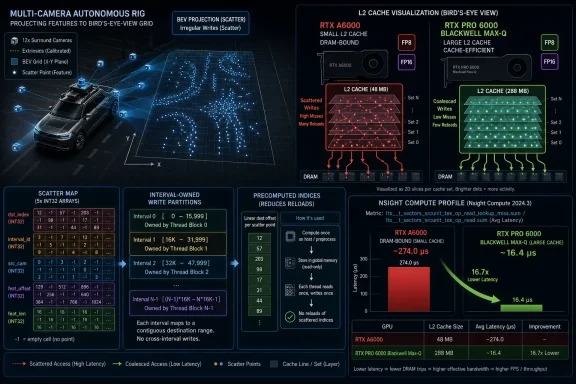
The canonical BEV pooling configuration in the post uses roughly 209,000 scatter points, 80 feature channels, and a working set of about 49 MB. That number is the pivot. It is far larger than the RTX A6000’s L2 cache, but well within the Blackwell workstation GPU’s 128 MB L2 cache.
This turns one algorithm into two practical problems. On the RTX A6000, the working set spills past L2, so the kernel behaves as a DRAM-bound random-gather workload. On the Blackwell card, the same working set can become largely L2-resident after the initial fill, which shifts the pressure toward instruction overhead, occupancy, dependency latency, and data type specialization.
That is the core systems lesson. The model operator has not changed, but the optimization target has. On one GPU, the developer fights bytes moving to and from memory. On another, the developer fights unnecessary instructions and missed parallelism inside a cache-rich environment.
That is not a subtle inefficiency. It is the kind of redundancy that can dominate a kernel whose arithmetic is not the limiting factor. BEVPoolV3’s direction is to make the scatter map explicit, reduce duplicate depth loads, remove runtime integer division through precomputed indices, and assign ownership of output intervals so that writes happen once after local accumulation.
The five-array scatter map is a small but telling design choice. Instead of packing related fields into an awkward 12-byte record, BEVPoolV3 uses separate INT32 arrays for ranks_depth, ranks_feat, ranks_bev, interval_starts, and interval_lengths. That makes the memory access pattern cleaner for aligned loads and avoids forcing the instruction stream to unpack coupled fields.
This is not the kind of change that shows up in a model diagram. It is the kind that shows up in an Nsight Compute profile. And in production inference, the profiler often has more authority than the whiteboard.
That structure also removes runtime decoding work. The kernel no longer has to reconstruct indices in the inner loop from a packed layout or perform integer division that could have been handled ahead of time. It reads explicit arrays, gathers depth and feature data, accumulates, and writes.
The point is not that every workload should copy this exact kernel. The point is that irregular perception operators often benefit from turning runtime ambiguity into precomputed structure. A sparse or scatter-heavy operator becomes less painful when the kernel can answer three questions cheaply: where does this interval begin, how long is it, and who owns the final write?
This is where BEVPoolV3 becomes relevant beyond autonomous vehicles. Sparse embeddings, voxelization, histograms, segmented reductions, and other irregular kernels all face similar tradeoffs. The general pattern is to remove redundant traffic, make the indexing explicit, and align the launch strategy with the memory hierarchy of the target GPU.
It would be tempting to describe this as an FP8 win. That would be incomplete. The FP8 path is fastest, but the larger story is that the working set fits in the Blackwell card’s large L2 cache, allowing the kernel to benefit from instruction cleanup, vectorized loads, occupancy tuning, and narrower feature and output data.
The post’s broader benchmark table reinforces this. On the Blackwell workstation GPU, V3 FP8 is fastest across the tested shapes, reaching about 11x to 42x speedups over V2 FP16 depending on point count and channel width. Wider channel counts and larger point sets show especially large gains, which makes sense: once the operator is mostly cache-resident, reducing bytes and streamlining inner-loop instructions can pay off repeatedly.
But NVIDIA is careful not to claim that smaller formats automatically solve all scatter-reduce problems. The post’s NVFP4 discussion is particularly useful because it complicates the usual “fewer bits equals faster” narrative. In this workload, an NVFP4 path reportedly ran slower than FP8 because the extra decode work, nibble extraction, and microblock scale handling added inner-loop overhead that the FP8 path avoided.
That is an important warning for anyone building inference pipelines around the latest precision format. Low precision shines when the hardware and workload can exploit it cleanly. In dense Tensor Core matrix multiplication, NVFP4 may be a powerful fit. In an L2-resident scatter-reduce kernel, the extra decoding can turn theoretical bandwidth savings into practical latency loss.
Those gains come from a different playbook. Because the 49 MB working set does not fit into the RTX A6000’s 6 MB L2 cache, the kernel must treat DRAM traffic as the enemy. The optimizations prioritize byte reduction, FP16 half2 accumulation, larger channel tiles to reduce repeated scalar work, and cache-streaming output stores so the output tensor does not evict useful index data.
This is the part developers should not skip. If a workload is DRAM-bound, an optimization that improves instruction issue may barely register. If a workload is L2-resident, an optimization that only shaves external memory traffic may be less important than occupancy and inner-loop instruction count.
The same BEVPoolV3 algorithmic principles apply across both GPUs, but the production kernel changes its tactics. That is the right mental model for deployment: portable invariants, architecture-specific implementation.
The plugin accepts the five-array scatter map plus depth and feature inputs, then dispatches an appropriate kernel for the GPU class and data type. NVIDIA’s benchmark path used ONNX-to-TensorRT builds and CUDA Graph replay with trtexec, which places the measurement closer to a deployment path than a standalone microbenchmark would.
Validation also gets attention. NVIDIA says the RTX A6000 DRAM-adapted kernel passed all tested output elements across six configurations at an absolute tolerance of 1e-2, with a maximum observed error of 0.0065. On the Blackwell card, V2 and V3 reportedly produced identical outputs for the tested configurations.
That validation language is important because scatter-reduce optimizations can easily blur the line between “faster” and “not quite the same.” Reordering reductions, changing precision, or altering ownership semantics can introduce numerical differences. For perception systems that feed planning or control, those differences deserve more than a shrug.
A scatter-heavy operator can look slow for several reasons. It may be waiting on DRAM. It may have poor L2 locality. It may be issuing too many integer instructions. It may be limited by occupancy, register pressure, dependency chains, or a bad launch shape. Those diagnoses lead to different fixes.
This is why the BEVPoolV3 story is useful for WindowsForum’s technically inclined audience even if most readers are not deploying autonomous driving stacks tomorrow. The same hardware logic applies to AI workloads on Windows workstations, robotics development boxes, edge inference systems, and simulation rigs. Modern NVIDIA GPUs are not merely faster versions of the same abstraction; their cache sizes, precision support, and instruction behavior increasingly determine which optimization is worth doing.
The old habit of asking “how many TFLOPS does the GPU have?” is insufficient here. BEV pooling is not a dense GEMM contest. It is a reminder that AI performance often lives in the unglamorous parts of the graph, where memory access patterns and operator implementation decide whether the expensive accelerator is being fed or stalled.
A few hundred microseconds may sound small in isolation. In a multi-stage perception stack, however, small operators add up. Camera backbones, depth estimation, BEV pooling, detection heads, occupancy prediction, tracking, mapping, and planning all compete for the same frame budget. A bottleneck in the middle of the graph can force teams to lower resolution, reduce camera count, simplify downstream models, or accept higher latency.
The BEVPoolV3 numbers should be read in that context. Moving a canonical Blackwell TensorRT plugin path from 274.0 microseconds to 16.4 microseconds does not single-handedly make a vehicle autonomous. But it can free budget for a richer model, a higher update rate, or more conservative scheduling headroom.
That is the systems bargain at the heart of physical AI. Better kernels do not just make benchmarks prettier. They change what model designers and deployment engineers can afford to do in real time.
The FP16 BEVPoolV3 path should carry over more naturally because its core improvements are architecture-independent: remove redundant scatter traffic, avoid runtime index decoding, and use interval-owned writes. FP8, by contrast, depends more heavily on the hardware’s conversion costs, cache behavior, register pressure, and workload shape.
That distinction is likely to matter for robotics developers and AV teams that prototype on powerful desktop GPUs before deploying to embedded platforms. A kernel strategy that looks ideal on a Blackwell workstation card may require retuning on an edge SoC. The correct question is not whether FP8 is “supported,” but whether the operator’s active bottleneck actually benefits from FP8 on that target.
This is where NVIDIA’s article reads less like a marketing note and more like a deployment playbook. It does not simply say “use the new precision format.” It says to measure the working set, inspect the bottleneck, and choose the implementation accordingly. That is the advice developers need, even when it complicates the sales pitch.
That workflow is likely to become more important as AI models move deeper into real-time systems. Dense neural network layers are increasingly well served by compilers, libraries, and Tensor Core paths. The remaining pain often hides in glue operators, custom plugins, sparse transformations, and sensor-specific reductions.
For Windows workstation users and IT pros, this also hints at why two GPUs with similar headline AI branding can behave very differently in a real application. L2 cache size, native precision support, and plugin implementation can matter as much as peak compute. A workstation selected for physical AI development should be evaluated against the actual operator mix, not just against synthetic throughput charts.
The BEVPoolV3 case study is therefore a useful correction to generic accelerator talk. Hardware matters, but not as a monolith. It matters through the shape of the workload.
 BEV Perception Has Become a Systems Problem, Not Just a Model Design
Bird’s-eye-view perception is one of those ideas that sounds almost too clean when described at the model level. Multiple cameras observe the world from different angles, their features are projected into a common top-down grid, and downstream systems reason over lanes, vehicles, pedestrians, obstacles, and free space in one shared coordinate frame. For robotics and autonomous driving, that shared map is often far more useful than a pile of camera-specific tensors.The catch is that the clean representation depends on a messy middle step. BEV pooling gathers image features, weights them by depth, and scatter-reduces them into BEV grid cells. In other words, it asks the GPU to chase irregular indices, read and reuse depth values, move feature vectors around, and write accumulated results into a spatial tensor quickly enough for real-time perception.
That is exactly the kind of operation that modern GPUs can make either embarrassingly fast or surprisingly stubborn. Dense matrix multiplication maps beautifully onto Tensor Cores. Scatter-reduce kernels do not enjoy the same natural hardware alignment. They live in the world of memory locality, cache pressure, atomics, index layout, and launch geometry.
NVIDIA’s BEVPoolV3 post is therefore more interesting than a single optimization note. It is a window into how perception workloads are being bent to fit the hardware realities of physical AI, where the difference between a 274-microsecond operator and a 16-microsecond operator can reshape an inference pipeline.
The Bottleneck Was Hiding Between the Cameras and the Planner
In a BEV pipeline, the glamorous components are usually the neural network backbone, the detection head, or the planning module. BEV pooling sits between them, performing the bookkeeping that lets the rest of the system pretend the world is neatly arranged from above. That bookkeeping can become a latency tax.The operation can be summarized simply: take a depth-weighted image feature and add it to the BEV cell identified by a scatter map. But the simple formula masks several hardware-hostile behaviors. The GPU must repeatedly read indices, gather feature rows that may not be contiguous, multiply by depth, and accumulate into output cells that are determined by scene geometry rather than by a tidy tensor layout.
BEVPoolV2 already attacked part of this problem by making BEV pooling more deployment-friendly for BEVDet-style models. CUDA-BEVFusion then demonstrated a depth-outer traversal approach that removed much of the repeated index loading. BEVPoolV3 continues that progression, but the new post makes the optimization philosophy more explicit: first understand the memory regime, then decide what kind of kernel the hardware actually wants.
That distinction matters because “GPU acceleration” is not a single thing. A kernel can be starved by DRAM bandwidth on one device and limited by instruction issue on another. If developers treat those as the same problem, they may optimize the wrong part of the code and wonder why the result does not travel well.
The Cache Decides Which Optimization Story You Are In
NVIDIA’s test case is deliberately framed around two workstation GPUs with very different cache behavior. The RTX A6000, an Ampere-generation SM86 GPU, has a 6 MB L2 cache and no native FP8 instruction set support. The RTX PRO 6000 Blackwell Max-Q Workstation Edition, a Blackwell SM120 GPU, has a 128 MB L2 cache and native FP8 support.The canonical BEV pooling configuration in the post uses roughly 209,000 scatter points, 80 feature channels, and a working set of about 49 MB. That number is the pivot. It is far larger than the RTX A6000’s L2 cache, but well within the Blackwell workstation GPU’s 128 MB L2 cache.
This turns one algorithm into two practical problems. On the RTX A6000, the working set spills past L2, so the kernel behaves as a DRAM-bound random-gather workload. On the Blackwell card, the same working set can become largely L2-resident after the initial fill, which shifts the pressure toward instruction overhead, occupancy, dependency latency, and data type specialization.
That is the core systems lesson. The model operator has not changed, but the optimization target has. On one GPU, the developer fights bytes moving to and from memory. On another, the developer fights unnecessary instructions and missed parallelism inside a cache-rich environment.
BEVPoolV3 Wins by Refusing to Reload the Same Truth Ten Times
One of the most revealing details in NVIDIA’s write-up is the repeated index traffic in earlier BEV pooling approaches. For a channel count of 80 and an 8-channel tile, a V2-style channel-tile outer loop can load the same scatter indices 10 times. The post estimates that this creates roughly 25.1 MB of index traffic for information that only needs about 2.51 MB when read once.That is not a subtle inefficiency. It is the kind of redundancy that can dominate a kernel whose arithmetic is not the limiting factor. BEVPoolV3’s direction is to make the scatter map explicit, reduce duplicate depth loads, remove runtime integer division through precomputed indices, and assign ownership of output intervals so that writes happen once after local accumulation.
The five-array scatter map is a small but telling design choice. Instead of packing related fields into an awkward 12-byte record, BEVPoolV3 uses separate INT32 arrays for ranks_depth, ranks_feat, ranks_bev, interval_starts, and interval_lengths. That makes the memory access pattern cleaner for aligned loads and avoids forcing the instruction stream to unpack coupled fields.
This is not the kind of change that shows up in a model diagram. It is the kind that shows up in an Nsight Compute profile. And in production inference, the profiler often has more authority than the whiteboard.
Interval Ownership Is the Quiet Replacement for Scatter Chaos
The phrase “interval-owned output writes” may sound like implementation furniture, but it is central to the argument. If one owner is responsible for a BEV interval, that owner can walk the relevant points, accumulate the channel tile locally, and write the output cell once. This reduces the need for atomic-style contention relative to a more naive scatter path.That structure also removes runtime decoding work. The kernel no longer has to reconstruct indices in the inner loop from a packed layout or perform integer division that could have been handled ahead of time. It reads explicit arrays, gathers depth and feature data, accumulates, and writes.
The point is not that every workload should copy this exact kernel. The point is that irregular perception operators often benefit from turning runtime ambiguity into precomputed structure. A sparse or scatter-heavy operator becomes less painful when the kernel can answer three questions cheaply: where does this interval begin, how long is it, and who owns the final write?
This is where BEVPoolV3 becomes relevant beyond autonomous vehicles. Sparse embeddings, voxelization, histograms, segmented reductions, and other irregular kernels all face similar tradeoffs. The general pattern is to remove redundant traffic, make the indexing explicit, and align the launch strategy with the memory hierarchy of the target GPU.
The Blackwell Result Is a Cache Story Disguised as an FP8 Story
The headline number on the RTX PRO 6000 Blackwell Max-Q is dramatic. In NVIDIA’s canonical configuration, the V2-style TensorRT plugin path takes 274.0 microseconds. BEVPoolV3 brings that down to 17.3 microseconds in FP16 and 16.4 microseconds in FP8.It would be tempting to describe this as an FP8 win. That would be incomplete. The FP8 path is fastest, but the larger story is that the working set fits in the Blackwell card’s large L2 cache, allowing the kernel to benefit from instruction cleanup, vectorized loads, occupancy tuning, and narrower feature and output data.
The post’s broader benchmark table reinforces this. On the Blackwell workstation GPU, V3 FP8 is fastest across the tested shapes, reaching about 11x to 42x speedups over V2 FP16 depending on point count and channel width. Wider channel counts and larger point sets show especially large gains, which makes sense: once the operator is mostly cache-resident, reducing bytes and streamlining inner-loop instructions can pay off repeatedly.
But NVIDIA is careful not to claim that smaller formats automatically solve all scatter-reduce problems. The post’s NVFP4 discussion is particularly useful because it complicates the usual “fewer bits equals faster” narrative. In this workload, an NVFP4 path reportedly ran slower than FP8 because the extra decode work, nibble extraction, and microblock scale handling added inner-loop overhead that the FP8 path avoided.
That is an important warning for anyone building inference pipelines around the latest precision format. Low precision shines when the hardware and workload can exploit it cleanly. In dense Tensor Core matrix multiplication, NVFP4 may be a powerful fit. In an L2-resident scatter-reduce kernel, the extra decoding can turn theoretical bandwidth savings into practical latency loss.
The Ampere Result Is the More Portable Warning
The RTX A6000 result is less flashy than the Blackwell FP8 path, but it may be more instructive for teams running a mixed fleet of GPUs. On the canonical configuration, NVIDIA reports that the DRAM-adapted V3 FP16 path reaches 90.0 microseconds, compared with 1,738.0 microseconds for V2 FP16. Across tested configurations, the RTX A6000 V3 FP16 path reaches roughly 11x to 22x speedups over the V2 baseline.Those gains come from a different playbook. Because the 49 MB working set does not fit into the RTX A6000’s 6 MB L2 cache, the kernel must treat DRAM traffic as the enemy. The optimizations prioritize byte reduction, FP16 half2 accumulation, larger channel tiles to reduce repeated scalar work, and cache-streaming output stores so the output tensor does not evict useful index data.
This is the part developers should not skip. If a workload is DRAM-bound, an optimization that improves instruction issue may barely register. If a workload is L2-resident, an optimization that only shaves external memory traffic may be less important than occupancy and inner-loop instruction count.
The same BEVPoolV3 algorithmic principles apply across both GPUs, but the production kernel changes its tactics. That is the right mental model for deployment: portable invariants, architecture-specific implementation.
TensorRT Integration Makes This a Deployment Argument
NVIDIA exposes BEVPoolV3 as a TensorRT IPluginV3 operator. That matters because real perception stacks are not benchmark notebooks. They are inference engines, graph captures, plugin boundaries, validation harnesses, and deployment targets.The plugin accepts the five-array scatter map plus depth and feature inputs, then dispatches an appropriate kernel for the GPU class and data type. NVIDIA’s benchmark path used ONNX-to-TensorRT builds and CUDA Graph replay with trtexec, which places the measurement closer to a deployment path than a standalone microbenchmark would.
Validation also gets attention. NVIDIA says the RTX A6000 DRAM-adapted kernel passed all tested output elements across six configurations at an absolute tolerance of 1e-2, with a maximum observed error of 0.0065. On the Blackwell card, V2 and V3 reportedly produced identical outputs for the tested configurations.
That validation language is important because scatter-reduce optimizations can easily blur the line between “faster” and “not quite the same.” Reordering reductions, changing precision, or altering ownership semantics can introduce numerical differences. For perception systems that feed planning or control, those differences deserve more than a shrug.
Nsight Compute Is the Referee, Not the Decoration
The post’s practical workflow is blunt: classify the memory regime, remove redundant scatter traffic, map the kernel to the target GPU, and validate the active bottleneck with Nsight Compute. That last step is not optional. Without profiling, developers are guessing which ceiling they hit.A scatter-heavy operator can look slow for several reasons. It may be waiting on DRAM. It may have poor L2 locality. It may be issuing too many integer instructions. It may be limited by occupancy, register pressure, dependency chains, or a bad launch shape. Those diagnoses lead to different fixes.
This is why the BEVPoolV3 story is useful for WindowsForum’s technically inclined audience even if most readers are not deploying autonomous driving stacks tomorrow. The same hardware logic applies to AI workloads on Windows workstations, robotics development boxes, edge inference systems, and simulation rigs. Modern NVIDIA GPUs are not merely faster versions of the same abstraction; their cache sizes, precision support, and instruction behavior increasingly determine which optimization is worth doing.
The old habit of asking “how many TFLOPS does the GPU have?” is insufficient here. BEV pooling is not a dense GEMM contest. It is a reminder that AI performance often lives in the unglamorous parts of the graph, where memory access patterns and operator implementation decide whether the expensive accelerator is being fed or stalled.
Physical AI Is Making Latency Budgets Less Forgiving
NVIDIA’s use of the term physical AI is not accidental. Robotics, autonomous vehicles, embodied agents, and spatial intelligence workloads have a different tolerance profile from offline generative AI jobs. They care about frame time, sensor fusion cadence, control loops, thermal envelopes, and deterministic enough behavior under deployment constraints.A few hundred microseconds may sound small in isolation. In a multi-stage perception stack, however, small operators add up. Camera backbones, depth estimation, BEV pooling, detection heads, occupancy prediction, tracking, mapping, and planning all compete for the same frame budget. A bottleneck in the middle of the graph can force teams to lower resolution, reduce camera count, simplify downstream models, or accept higher latency.
The BEVPoolV3 numbers should be read in that context. Moving a canonical Blackwell TensorRT plugin path from 274.0 microseconds to 16.4 microseconds does not single-handedly make a vehicle autonomous. But it can free budget for a richer model, a higher update rate, or more conservative scheduling headroom.
That is the systems bargain at the heart of physical AI. Better kernels do not just make benchmarks prettier. They change what model designers and deployment engineers can afford to do in real time.
Edge Platforms Will Not Get the Same Win for Free
NVIDIA also points toward edge-class platforms, including DRIVE AGX Thor, while cautioning that FP8 speedup is not automatic. That caveat deserves emphasis. Edge devices often have different memory hierarchies, power constraints, problem sizes, and scheduling pressures than workstation GPUs.The FP16 BEVPoolV3 path should carry over more naturally because its core improvements are architecture-independent: remove redundant scatter traffic, avoid runtime index decoding, and use interval-owned writes. FP8, by contrast, depends more heavily on the hardware’s conversion costs, cache behavior, register pressure, and workload shape.
That distinction is likely to matter for robotics developers and AV teams that prototype on powerful desktop GPUs before deploying to embedded platforms. A kernel strategy that looks ideal on a Blackwell workstation card may require retuning on an edge SoC. The correct question is not whether FP8 is “supported,” but whether the operator’s active bottleneck actually benefits from FP8 on that target.
This is where NVIDIA’s article reads less like a marketing note and more like a deployment playbook. It does not simply say “use the new precision format.” It says to measure the working set, inspect the bottleneck, and choose the implementation accordingly. That is the advice developers need, even when it complicates the sales pitch.
The Real Product Is the Optimization Workflow
The strongest argument in NVIDIA’s post is not that BEVPoolV3 is faster than BEVPoolV2. It is that scatter-heavy operators require a methodical, hardware-aware workflow. Developers should first compute the working set, compare it with L2 capacity, inspect memory traffic, and then decide whether they are fighting DRAM, instruction issue, occupancy, or dependency latency.That workflow is likely to become more important as AI models move deeper into real-time systems. Dense neural network layers are increasingly well served by compilers, libraries, and Tensor Core paths. The remaining pain often hides in glue operators, custom plugins, sparse transformations, and sensor-specific reductions.
For Windows workstation users and IT pros, this also hints at why two GPUs with similar headline AI branding can behave very differently in a real application. L2 cache size, native precision support, and plugin implementation can matter as much as peak compute. A workstation selected for physical AI development should be evaluated against the actual operator mix, not just against synthetic throughput charts.
The BEVPoolV3 case study is therefore a useful correction to generic accelerator talk. Hardware matters, but not as a monolith. It matters through the shape of the workload.
What BEVPoolV3 Teaches Beyond Autonomous Driving
NVIDIA’s BEVPoolV3 post gives developers a concrete example of how to turn an irregular perception bottleneck into a hardware-matched TensorRT plugin. The specifics are about BEV pooling, but the lesson applies to any workload where scatter maps, gathers, sparse updates, and cache fit dominate the runtime.- BEVPoolV3 reduces latency by cutting redundant scatter traffic, using explicit precomputed index arrays, assigning ownership of output intervals, and specializing kernels for the target GPU’s memory regime.
- The same canonical BEV pooling workload is DRAM-bound on the RTX A6000 because its roughly 49 MB working set exceeds the GPU’s 6 MB L2 cache.
- The workload is largely L2-resident on the RTX PRO 6000 Blackwell Max-Q because the same working set fits inside the GPU’s 128 MB L2 cache.
- FP8 delivers the best reported Blackwell results for this operator, but NVIDIA’s NVFP4 discussion shows that smaller formats can lose when decode overhead outweighs byte savings.
- TensorRT plugin integration matters because these optimizations only become operationally useful when they survive graph build, replay, validation, and deployment constraints.
- Developers should profile scatter-heavy operators in isolation before assuming that a precision change, a larger GPU, or a compiler pass will solve the bottleneck.
References
- Primary source: NVIDIA Developer
Published: Wed, 24 Jun 2026 17:43:23 GMT
Accelerating BEV Pooling on NVIDIA GPUs for Physical AI Applications | NVIDIA Technical Blog
An increasingly common design pattern for autonomous vehicles (AVs), robotics, and spatial AI systems is bird’s-eye-view (BEV) perception.developer.nvidia.com