
TRUE-See Systems said on June 25, 2026, that it has been selected for Microsoft for Startups, receiving access to Azure AI tools and $350,000 in non-dilutive Azure credits to accelerate medical photography research and commercialization. The announcement is small in the scale of Microsoft’s cloud business, but revealing in the direction of travel. Microsoft is not merely courting chatbots and coding assistants; it is trying to make Azure the default substrate for specialized AI systems where data quality, auditability, and enterprise sales matter as much as model size. TRUE-See’s bet is that the humble clinical photograph can become a trusted medical data object, and Microsoft’s bet is that those objects will increasingly be born, stored, validated, and analyzed in its cloud.
Microsoft for Startups has always been partly a generosity program and partly a land-grab. Cloud credits are not cash, and they are not charity. They are a way to pull promising companies into Azure before architecture, compliance, procurement, and customer expectations harden around a rival platform.
That matters more in healthcare than in most startup categories. Once a medical software company builds its image storage, identity controls, audit trails, model-development pipelines, and customer integrations around a particular cloud, migration becomes painful. A few hundred thousand dollars in credits can become years of technical gravity.
TRUE-See’s announcement fits neatly into this strategy. The company says the program will support AI-ready datasets, enterprise scalability, workflow integration, authenticity tooling, and commercial growth. Those are not random startup chores; they are exactly the points where healthcare AI either becomes a deployable product or remains a promising demo.
The more interesting part is the domain. TRUE-See is not pitching another generalized AI scribe or patient chatbot. It is trying to standardize medical photography, a category that sits awkwardly between consumer imaging and formal radiology. That awkwardness is precisely why Microsoft’s involvement is worth watching.
A smartphone picture of a wound, lesion, surgical site, or vascular condition can be clinically useful. It can also be misleading. Lighting changes color. Camera settings distort contrast. Compression alters detail. Technique varies from nurse to nurse, clinic to clinic, and phone to phone. The image may be taken quickly during a busy visit, uploaded through a workaround, and later treated as if it were an objective record.
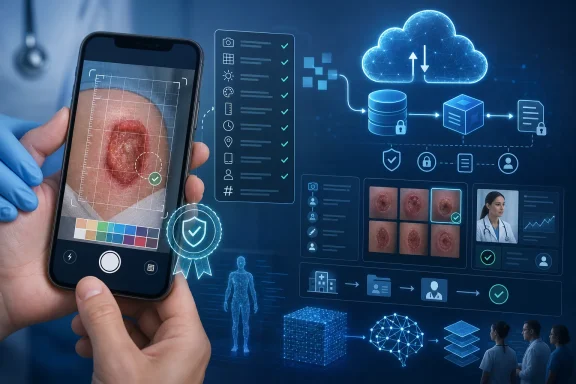
TRUE-See’s central claim is that this gap can be closed. The company describes its system as a way to capture smartphone-based medical photos that are color and quality calibrated, certified as authentic, traceable, securely stored, and easier to integrate into existing clinical systems. In other words, it wants to turn the medical photo from a convenient attachment into a reliable instrument.
That ambition is bigger than photography. If clinical images are to feed AI models, support reimbursement, inform legal records, or guide longitudinal care, the provenance of the image becomes part of the medicine. A model trained on inconsistent photos may learn camera quirks as eagerly as clinical signals. A clinician comparing today’s wound image with last month’s may mistake lighting drift for biological change.
TRUE-See says it has a growing library of more than 2 million calibrated medical photographs. If that figure reflects images captured under consistent technical standards, it could be a meaningful asset for model development and validation. Healthcare AI companies routinely struggle not only to get data, but to get data whose quality, permissions, labels, and provenance are strong enough for real deployment.
This is where Microsoft’s cloud infrastructure becomes more than rented compute. Azure can provide storage, access controls, data governance, machine-learning tooling, and deployment paths into enterprise healthcare environments. The credits help TRUE-See run the expensive parts of AI development, but the ecosystem helps the company tell hospitals that it is building on familiar enterprise rails.
That distinction matters. In regulated industries, the best model rarely wins by model quality alone. It wins because it can be governed, audited, integrated, supported, and purchased. Microsoft understands that procurement path better than most startup infrastructure providers.
But the more durable value for Microsoft is not the spend it subsidizes. It is the architecture it influences. Azure credits encourage founders to make early choices about identity, storage, databases, AI services, monitoring, and deployment. Those choices later become defaults, and defaults have a way of becoming strategy.
For TRUE-See, the benefit is similarly practical. A medical imaging startup does not merely need technology; it needs credibility. Association with Microsoft does not validate a clinical claim, and it does not substitute for regulatory discipline, peer-reviewed evidence, or customer adoption. But it can help a startup appear less risky to enterprise buyers who already know Azure, Microsoft identity, and Microsoft’s security posture.
This is the real bargain behind the announcement. TRUE-See gets infrastructure and ecosystem leverage without giving up equity. Microsoft gets a promising healthcare AI workload pointed toward Azure at a moment when every major cloud provider is fighting to become the operating system for applied AI.
If the image is going to do all that work, it needs more structure than a timestamp and a filename. It needs confidence that the colors are meaningful, the image has not been manipulated, the capture process was standardized, and the photo can be connected to the right patient, encounter, device, user, and clinical context. That is the difference between an image repository and an image system.
TRUE-See’s emphasis on traceability is therefore important. The generative AI era has made image authenticity a mainstream concern, but medicine has its own version of the problem. A wound photo does not need to be synthetically generated to be misleading. It can be poorly lit, cropped differently, over-sharpened, compressed, mislabeled, or detached from the workflow that gives it meaning.
The company’s pitch is that standardization can improve assessment, monitoring, treatment planning, fraud prevention, AI development, and reimbursement. That is a broad claim set. Some of those benefits will require clinical evidence, operational proof, and payer acceptance before they become more than plausible. Still, the connective tissue is coherent: better capture produces better records, and better records produce better downstream decisions.
A successful medical photography system has to meet clinicians where they are. If capture requires a cumbersome device, a specialist technician, or a workflow that breaks the rhythm of care, adoption will suffer. The winning approach is likely to make standardized capture feel as simple as ordinary photography while quietly enforcing calibration, security, and documentation behind the scenes.
That is a classic enterprise software trick: hide the bureaucracy without removing the controls. Microsoft has built much of its healthcare and enterprise business around that idea. TRUE-See is applying a similar logic to image capture, and Azure gives it a backend that can scale from specialty practices to larger health systems.
The challenge is that clinical workflows are not abstract diagrams. They are messy, time-constrained, and politically complex. Nurses, physicians, wound care teams, dermatologists, surgeons, compliance officers, EHR administrators, and billing departments may all care about the same photo for different reasons. A product that improves image integrity but adds friction could still lose to the path of least resistance.
That is a subtler and perhaps more durable healthcare story. Much of the public AI debate obsesses over model intelligence, hallucination, and automation. In clinical settings, however, the bottleneck is often not raw intelligence. It is whether the inputs are trustworthy, whether the system fits existing practice, and whether the output can be justified.
A calibrated medical photo library is not glamorous compared with a large language model, but it may be more defensible. It creates a foundation for narrow, measurable AI tasks: wound progression, lesion comparison, documentation quality, reimbursement support, and clinical research. These are areas where the path to value may be clearer than asking a general model to reason across an entire patient chart.
Microsoft’s role is to supply the rails. Azure AI tools, storage, security services, and partner channels can help a company like TRUE-See move from technical concept to deployed system. The company still has to prove clinical utility, but the cloud layer can reduce the distance between prototype and institutional adoption.
Healthcare buyers are skeptical for good reason. They have seen tools promise efficiency while adding clicks, AI systems promise insight while requiring oversight, and platforms promise integration while leaving administrators to manage the plumbing. A better photo is valuable, but a better photo system must prove that value in the clinical and financial environments where it will be used.
The reimbursement claim is especially consequential. If standardized imagery can support clearer documentation and reduce disputes, that is a strong business case. But payers, providers, and regulators will care about evidence, not architecture diagrams. TRUE-See will need to show that its calibrated and authenticated photos change outcomes, reduce ambiguity, or improve process reliability in ways that customers can measure.
The same is true of AI. A large calibrated image library is promising, but model performance depends on labels, population diversity, capture conditions, validation methods, bias analysis, and deployment context. The phrase AI-ready should be treated as an aspiration until the evidence shows how ready the data actually is.
In each case, the cloud provider that helps standardize the data pipeline can become more than infrastructure. It becomes part of the trust model. That is why Microsoft’s startup programs matter even when the individual announcements look modest. They seed Azure into categories where the cloud is not just hosting an app, but shaping how evidence is captured and processed.
TRUE-See’s category is particularly sensitive because healthcare data is both valuable and hard to move. If the company succeeds, its customers may accumulate years of calibrated clinical images and associated metadata. That archive could support AI tools, longitudinal patient care, research collaborations, and payer workflows. It could also deepen dependence on the underlying platform.
This is the cloud provider’s dream: workloads that grow as customers use them, data assets that become more valuable over time, and compliance requirements that discourage casual migration. Microsoft’s credits are the opening bid for that future.
 Microsoft’s Startup Machine Moves Deeper Into Regulated AI
Microsoft for Startups has always been partly a generosity program and partly a land-grab. Cloud credits are not cash, and they are not charity. They are a way to pull promising companies into Azure before architecture, compliance, procurement, and customer expectations harden around a rival platform.That matters more in healthcare than in most startup categories. Once a medical software company builds its image storage, identity controls, audit trails, model-development pipelines, and customer integrations around a particular cloud, migration becomes painful. A few hundred thousand dollars in credits can become years of technical gravity.
TRUE-See’s announcement fits neatly into this strategy. The company says the program will support AI-ready datasets, enterprise scalability, workflow integration, authenticity tooling, and commercial growth. Those are not random startup chores; they are exactly the points where healthcare AI either becomes a deployable product or remains a promising demo.
The more interesting part is the domain. TRUE-See is not pitching another generalized AI scribe or patient chatbot. It is trying to standardize medical photography, a category that sits awkwardly between consumer imaging and formal radiology. That awkwardness is precisely why Microsoft’s involvement is worth watching.
The Clinical Photo Has Been Treated Like Evidence, but Captured Like a Snapshot
Modern medicine already depends on images. Radiology, pathology, ophthalmology, and dermatology all rely on visual evidence, and the more structured the imaging workflow, the easier it becomes to measure, compare, reimburse, and defend clinical decisions. But medical photography has often lagged behind that standardization.A smartphone picture of a wound, lesion, surgical site, or vascular condition can be clinically useful. It can also be misleading. Lighting changes color. Camera settings distort contrast. Compression alters detail. Technique varies from nurse to nurse, clinic to clinic, and phone to phone. The image may be taken quickly during a busy visit, uploaded through a workaround, and later treated as if it were an objective record.
TRUE-See’s central claim is that this gap can be closed. The company describes its system as a way to capture smartphone-based medical photos that are color and quality calibrated, certified as authentic, traceable, securely stored, and easier to integrate into existing clinical systems. In other words, it wants to turn the medical photo from a convenient attachment into a reliable instrument.
That ambition is bigger than photography. If clinical images are to feed AI models, support reimbursement, inform legal records, or guide longitudinal care, the provenance of the image becomes part of the medicine. A model trained on inconsistent photos may learn camera quirks as eagerly as clinical signals. A clinician comparing today’s wound image with last month’s may mistake lighting drift for biological change.
AI Makes the Old Photography Problem Harder to Ignore
The AI angle in TRUE-See’s announcement is not just a marketing garnish. It is the reason the problem has become urgent. AI systems are exquisitely sensitive to the conditions under which their training data is produced, labeled, and maintained. In healthcare, where mistakes can carry clinical, financial, and legal consequences, the phrase garbage in, garbage out is not a cliché; it is an operating risk.TRUE-See says it has a growing library of more than 2 million calibrated medical photographs. If that figure reflects images captured under consistent technical standards, it could be a meaningful asset for model development and validation. Healthcare AI companies routinely struggle not only to get data, but to get data whose quality, permissions, labels, and provenance are strong enough for real deployment.
This is where Microsoft’s cloud infrastructure becomes more than rented compute. Azure can provide storage, access controls, data governance, machine-learning tooling, and deployment paths into enterprise healthcare environments. The credits help TRUE-See run the expensive parts of AI development, but the ecosystem helps the company tell hospitals that it is building on familiar enterprise rails.
That distinction matters. In regulated industries, the best model rarely wins by model quality alone. It wins because it can be governed, audited, integrated, supported, and purchased. Microsoft understands that procurement path better than most startup infrastructure providers.
The $350,000 Number Is Less Important Than the Lock-In
The headline figure — $350,000 in non-dilutive Azure AI credits — is eye-catching, and for a startup doing image-heavy AI work, it is not trivial. Training, validating, storing, and serving image models can burn infrastructure budgets quickly. Even if a company is not training foundation-scale models, image pipelines, annotation workflows, GPU experimentation, and compliance-grade storage are costly.But the more durable value for Microsoft is not the spend it subsidizes. It is the architecture it influences. Azure credits encourage founders to make early choices about identity, storage, databases, AI services, monitoring, and deployment. Those choices later become defaults, and defaults have a way of becoming strategy.
For TRUE-See, the benefit is similarly practical. A medical imaging startup does not merely need technology; it needs credibility. Association with Microsoft does not validate a clinical claim, and it does not substitute for regulatory discipline, peer-reviewed evidence, or customer adoption. But it can help a startup appear less risky to enterprise buyers who already know Azure, Microsoft identity, and Microsoft’s security posture.
This is the real bargain behind the announcement. TRUE-See gets infrastructure and ecosystem leverage without giving up equity. Microsoft gets a promising healthcare AI workload pointed toward Azure at a moment when every major cloud provider is fighting to become the operating system for applied AI.
Medical Photography Is Becoming a Data Supply Chain
The press release frames TRUE-See’s technology around accuracy, authenticity, and workflow. Those words sound ordinary until they are viewed as a data supply chain. A medical photo is not just a file; it is a captured measurement, a patient record, a possible training sample, a reimbursement artifact, and perhaps evidence in a dispute.If the image is going to do all that work, it needs more structure than a timestamp and a filename. It needs confidence that the colors are meaningful, the image has not been manipulated, the capture process was standardized, and the photo can be connected to the right patient, encounter, device, user, and clinical context. That is the difference between an image repository and an image system.
TRUE-See’s emphasis on traceability is therefore important. The generative AI era has made image authenticity a mainstream concern, but medicine has its own version of the problem. A wound photo does not need to be synthetically generated to be misleading. It can be poorly lit, cropped differently, over-sharpened, compressed, mislabeled, or detached from the workflow that gives it meaning.
The company’s pitch is that standardization can improve assessment, monitoring, treatment planning, fraud prevention, AI development, and reimbursement. That is a broad claim set. Some of those benefits will require clinical evidence, operational proof, and payer acceptance before they become more than plausible. Still, the connective tissue is coherent: better capture produces better records, and better records produce better downstream decisions.
The Smartphone Is the Trojan Horse for Enterprise Imaging
One reason TRUE-See’s approach is intriguing is that it does not appear to reject the smartphone. It tries to discipline it. That is the right instinct. Healthcare workers already use mobile devices because they are convenient, ubiquitous, and good enough for many tasks. The problem is not that smartphones take pictures; the problem is that clinical workflows often ask consumer hardware to perform institutional work without institutional safeguards.A successful medical photography system has to meet clinicians where they are. If capture requires a cumbersome device, a specialist technician, or a workflow that breaks the rhythm of care, adoption will suffer. The winning approach is likely to make standardized capture feel as simple as ordinary photography while quietly enforcing calibration, security, and documentation behind the scenes.
That is a classic enterprise software trick: hide the bureaucracy without removing the controls. Microsoft has built much of its healthcare and enterprise business around that idea. TRUE-See is applying a similar logic to image capture, and Azure gives it a backend that can scale from specialty practices to larger health systems.
The challenge is that clinical workflows are not abstract diagrams. They are messy, time-constrained, and politically complex. Nurses, physicians, wound care teams, dermatologists, surgeons, compliance officers, EHR administrators, and billing departments may all care about the same photo for different reasons. A product that improves image integrity but adds friction could still lose to the path of least resistance.
Azure AI Gives Microsoft a Healthcare Story Beyond the Hospital Back Office
Microsoft has spent years positioning itself as the safe enterprise choice for AI. That story usually centers on productivity software, security, compliance, developer tools, and cloud infrastructure. TRUE-See gives Microsoft another kind of narrative: AI that improves the quality of domain-specific data before the algorithm ever renders a judgment.That is a subtler and perhaps more durable healthcare story. Much of the public AI debate obsesses over model intelligence, hallucination, and automation. In clinical settings, however, the bottleneck is often not raw intelligence. It is whether the inputs are trustworthy, whether the system fits existing practice, and whether the output can be justified.
A calibrated medical photo library is not glamorous compared with a large language model, but it may be more defensible. It creates a foundation for narrow, measurable AI tasks: wound progression, lesion comparison, documentation quality, reimbursement support, and clinical research. These are areas where the path to value may be clearer than asking a general model to reason across an entire patient chart.
Microsoft’s role is to supply the rails. Azure AI tools, storage, security services, and partner channels can help a company like TRUE-See move from technical concept to deployed system. The company still has to prove clinical utility, but the cloud layer can reduce the distance between prototype and institutional adoption.
The Press Release Overreaches Where the Market Will Demand Proof
As with many health-tech announcements, the language around TRUE-See’s potential benefits is expansive. The release references diagnostic accuracy, reimbursement outcomes, legal admissibility, fraud prevention, workflow efficiency, AI development, and enterprise standardization. Each is plausible. None should be treated as automatically solved by joining a startup program.Healthcare buyers are skeptical for good reason. They have seen tools promise efficiency while adding clicks, AI systems promise insight while requiring oversight, and platforms promise integration while leaving administrators to manage the plumbing. A better photo is valuable, but a better photo system must prove that value in the clinical and financial environments where it will be used.
The reimbursement claim is especially consequential. If standardized imagery can support clearer documentation and reduce disputes, that is a strong business case. But payers, providers, and regulators will care about evidence, not architecture diagrams. TRUE-See will need to show that its calibrated and authenticated photos change outcomes, reduce ambiguity, or improve process reliability in ways that customers can measure.
The same is true of AI. A large calibrated image library is promising, but model performance depends on labels, population diversity, capture conditions, validation methods, bias analysis, and deployment context. The phrase AI-ready should be treated as an aspiration until the evidence shows how ready the data actually is.
The Competitive Cloud War Is Now a Data Quality War
The most important cloud battles of the next few years may not be fought over generic compute prices. They will be fought over specialized workflows where cloud providers can attach themselves to valuable data creation. Medical photography is one example. Industrial inspection, legal records, scientific imaging, geospatial sensing, and insurance documentation are others.In each case, the cloud provider that helps standardize the data pipeline can become more than infrastructure. It becomes part of the trust model. That is why Microsoft’s startup programs matter even when the individual announcements look modest. They seed Azure into categories where the cloud is not just hosting an app, but shaping how evidence is captured and processed.
TRUE-See’s category is particularly sensitive because healthcare data is both valuable and hard to move. If the company succeeds, its customers may accumulate years of calibrated clinical images and associated metadata. That archive could support AI tools, longitudinal patient care, research collaborations, and payer workflows. It could also deepen dependence on the underlying platform.
This is the cloud provider’s dream: workloads that grow as customers use them, data assets that become more valuable over time, and compliance requirements that discourage casual migration. Microsoft’s credits are the opening bid for that future.
The Real Contest Is Over Trust Before Diagnosis
The near-term lesson from TRUE-See’s Microsoft announcement is not that Azure AI has transformed medical photography overnight. It is that the next phase of healthcare AI may depend less on spectacular model demos and more on making ordinary clinical data trustworthy enough to automate against. TRUE-See is trying to solve the problem at the point of capture, and Microsoft is giving it the cloud runway to test whether that approach can scale.- TRUE-See says its Microsoft for Startups participation includes $350,000 in non-dilutive Azure AI credits for research and development.
- The company’s core pitch is that smartphone medical photos can be made color-calibrated, quality-controlled, authenticated, traceable, and easier to integrate into clinical systems.
- Microsoft’s strategic interest is clear: healthcare AI startups that build early on Azure may bring durable storage, AI, governance, and enterprise sales workloads with them.
- The technical promise depends on whether calibrated image datasets improve model development, validation, and clinical reliability in measurable ways.
- The commercial challenge is not only to capture better images, but to prove that better images reduce clinician burden, support reimbursement, and improve patient care.
- The announcement shows how cloud competition is moving from raw AI capacity toward control of specialized, high-trust data pipelines.
References
- Primary source: GlobeNewswire
Published: Thu, 25 Jun 2026 12:00:00 GMT
Loading…
www.globenewswire.com - Official source: learn.microsoft.com
Loading…
learn.microsoft.com - Official source: microsoft.com
Loading…
www.microsoft.com - Related coverage: techcrunch.com
Microsoft launches Pegasus program for startups, awarding up to $350,000 in credits | TechCrunch
Microsoft's new program for startups, Pegasus, will award up to $350,000 in tech credits across GitHub, Azure and LinkedIn.techcrunch.com - Official source: news.microsoft.com
Loading…
news.microsoft.com - Related coverage: spendbase.co
Loading…
www.spendbase.co
- Related coverage: cloudcredits.io
Up to $150,000 Azure Credits and AI Enablement for Startups
Microsoft for Startups (Founders Hub) helps companies build and scale on Azure with credits ranging from $1,000 to $150,000 USD across four levels. The program provides development tools like GitHub Enterprise and Visual Studio, unlimited 1:1 technical advisory, and AI capabilities including...cloudcredits.io
- Related coverage: linkedin.com
Loading…
www.linkedin.com - Related coverage: evolveetfs.com
Loading…
evolveetfs.com - Related coverage: getaiperks.com
Loading…
www.getaiperks.com - Related coverage: windowscentral.com
Microsoft and NVIDIA launch UK hub to fuel the next wave of autonomous AI startups | Windows Central
The new Agentic Launchpad program offers UK startups Azure credits, NVIDIA tools, and direct engineering support to scale autonomous AI systems.www.windowscentral.com - Official source: startups.microsoft.com
- Related coverage: 0e190a550a8c4c8c4b93-fcd009c875a5577fd4fe2f5b7e3bf4eb.ssl.cf2.rackcdn.com
Loading…
0e190a550a8c4c8c4b93-fcd009c875a5577fd4fe2f5b7e3bf4eb.ssl.cf2.rackcdn.com - Official source: download.microsoft.com
Loading…
download.microsoft.com