
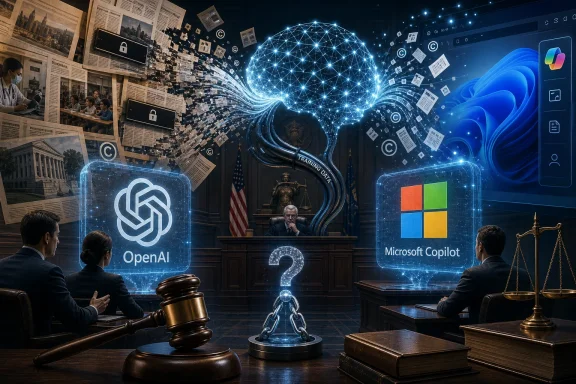
Microsoft and OpenAI were sued on June 24, 2026, in the U.S. District Court for the Southern District of New York by publishers that collectively own nearly 400 local and regional newspapers. The complaint accuses the companies of copying millions of news articles without permission to train and operate products including ChatGPT and Microsoft Copilot. It is not the first AI copyright suit against the two companies, but it may be the clearest test yet of whether local journalism can survive the economics of machine learning. The case asks a blunt question that the AI industry has spent years trying to make abstract: when software learns from the web, who is allowed to turn reporting into infrastructure?
For much of the AI copyright fight, local newspapers have been discussed as victims in the background. The front-page combatants were larger: The New York Times, book authors, stock image companies, artists, and major media brands with the money and institutional muscle to litigate against the richest software companies on earth. This new suit changes the optics because it puts local and regional publishers at the center of the argument.
That matters because local journalism is not merely a smaller version of national journalism. It is more fragile, more labor-intensive relative to revenue, and less able to absorb platform shocks. A national paper can build a subscription bundle, a cooking app, a podcast studio, and a litigation war chest. A county paper covering school boards, police departments, zoning fights, courts, and hospital closures does not usually have that luxury.
The publishers’ claim is familiar in legal form but sharper in moral framing. They argue that Microsoft and OpenAI copied their work, removed or ignored copyright management information, and used that material to build commercial AI products without licenses or compensation. In the complaint’s telling, generative AI is not just another reader of the news. It is a machine that digests the news business and then competes with it.
OpenAI’s response, according to reporting on the lawsuit, is the line it has used repeatedly: its models are trained on publicly available data and grounded in fair use. Microsoft had not publicly commented at the time of the initial reports. That asymmetry is revealing. OpenAI wants this debate to be about legal doctrine and innovation; publishers want it to be about extraction.
That makes the training data fight a Windows story, not just a media story. If Copilot can summarize, answer, draft, search, and synthesize because it has been trained on enormous amounts of human-produced text, then the provenance of that text becomes part of the product’s risk profile. Enterprises already ask where their data goes when employees use AI tools. Now they also have to ask where the AI came from.
The complaint reportedly alleges that Microsoft and OpenAI copied publisher content onto their servers and used it in model development. It also alleges that both freely accessible and restricted content were swept into the process. Those details will be contested, but they go to the heart of the AI industry’s defense. “Publicly available” sounds simple until the web is treated less like a reading room and more like a quarry.
Microsoft’s exposure is particularly interesting because the company has positioned itself as the adult in the AI room: enterprise-grade, security-conscious, compliance-aware, and deeply integrated with regulated customers. That positioning becomes harder if the most visible AI products are tied to unresolved copyright claims from hundreds of newspapers. Even if Microsoft ultimately prevails, the case complicates the sales pitch.
Both sides can point to truths. Search engines also indexed the web and were once accused of freeloading on publishers. But search, at its best, created a bargain: snippets in exchange for traffic. Generative AI changes the shape of that bargain because the answer can replace the visit. The value moves from the publication page to the chat interface.
Paywalls sharpen the dispute. If the complaint’s allegations about restricted content hold up, the case becomes less about the open web and more about access control. A newspaper can publish some stories freely, reserve others for subscribers, and attach copyright notices to both. If AI developers can still ingest the material at scale and claim the output is sufficiently transformed, publishers will see copyright as functionally hollow.
That is why the DMCA claim matters. The allegation that copyright management information was removed or stripped is not just a procedural add-on. It is an attempt to show that the copying was not an incidental byproduct of web-scale indexing but part of a process that separated works from the signals identifying ownership, authorship, and rights.
This sequencing has strategic value. Once a technology becomes widely used, courts and regulators face a harder choice. A ruling that forces major licensing changes could reshape products already embedded in workplaces, schools, software development, and consumer devices. AI companies can then argue, implicitly or explicitly, that too much social and economic value now depends on their systems to unwind the original bargain.
Publishers see that as a hostage dynamic. They spent years building archives, subscription systems, SEO strategies, newsletters, and local reporting networks. Then AI companies allegedly harvested the resulting corpus, converted it into model capability, and presented the finished product as inevitable progress. By the time lawsuits arrive, the defendants are not scrappy startups. They are trillion-dollar platform companies.
The courts will not decide whether AI is useful. That question is already settled. The courts will decide whether usefulness excuses uncompensated ingestion at commercial scale. That distinction is where the case will either become a milestone or just another entry in the growing docket of AI copyright litigation.
That does not mean Windows users should expect Copilot to vanish because of this lawsuit. Copyright cases move slowly, and injunctions that would immediately disrupt widely deployed software are difficult to obtain. But the litigation adds to a risk stack that Microsoft cannot ignore. Customers may ask whether Copilot outputs can expose them to copyright claims, whether training data provenance is documented, and whether enterprise contracts meaningfully indemnify customers.
For administrators, this is not an abstract media feud. Many organizations are still deciding whether to enable Copilot broadly, restrict it to certain departments, or block consumer AI tools entirely. Legal uncertainty around training data does not automatically make Copilot unsafe, but it does make governance more important. The question shifts from “Is AI allowed?” to “Which AI, under which terms, with which data protections, and with what contractual guarantees?”
Microsoft has an advantage here because it knows how to sell compliance. It can wrap Copilot in enterprise controls, audit logs, tenant boundaries, admin policies, and procurement language. But legal claims about the material used to build the model are harder to solve with a dashboard. You cannot toggle away the origin story.
The fear is not only that chatbots may quote or summarize local stories. It is that AI systems could become the default interface for community information while the institutions that gather that information lose the remaining incentives to produce it. If a reporter attends a school board meeting, obtains records, verifies claims, and publishes a story, an AI answer engine can later compress that work into a few sentences. The reader gets convenience; the newsroom gets no subscription, no ad impression, and no brand relationship.
Local journalism also produces a kind of information that is easy to undervalue until it disappears. National politics is overcovered; local accountability is not. Court filings, municipal budgets, environmental permits, hospital mergers, sheriff misconduct, and development disputes rarely become viral content, but they are the raw material of civic knowledge. If AI companies treat that work as free feedstock, publishers argue, the model rewards the aggregator and punishes the reporter.
That is the deeper reason this case is different from a narrow fight over snippets. It asks whether AI can be built on a web whose most expensive information producers are already financially strained. If the answer is yes without licensing, then the next generation of local news may be thinner, more centralized, and more dependent on institutions with their own public relations machinery.
The modern web blurred these lines because indexing, caching, scraping, archiving, and quoting all became normal technical operations. Robots.txt files, paywalls, metatags, API terms, and copyright notices became a patchwork governance system. AI training strained that patchwork because the scale and purpose changed. Scraping a page to show a link is not the same as scraping millions of pages to train a product that answers users directly.
The courts will have to decide how much that difference matters. If training is deemed broadly transformative and fair, publishers may be forced toward technical blocking and private licensing deals with the largest AI companies. If training is deemed infringing without permission, the AI industry may need a licensing framework closer to music, stock photography, or database rights. Neither path is clean.
There is also a middle path: courts could distinguish between types of sources, models, outputs, access controls, and evidence of memorization. That would produce a messy but realistic doctrine. It might also favor the companies that can afford compliance teams and licensing departments, which again points toward Microsoft and OpenAI surviving while smaller competitors struggle.
The problem is price. AI companies want broad rights at scalable cost. Publishers want payment that reflects both past use and future market substitution. Local publishers, especially, worry that if they negotiate individually they will be underpaid or ignored. A coalition lawsuit creates leverage that a single regional paper could never exercise on its own.
Microsoft understands licensing markets. It pays for software patents, cloud capacity, security research, enterprise data, media rights, and developer ecosystems. If AI content licensing becomes a cost of doing business, Microsoft can absorb it more easily than most. The danger for Microsoft is not that licensing is impossible. It is that years of unlicensed training could generate damages, restrictions, or discovery that exposes uncomfortable details about how model datasets were assembled.
For OpenAI, the stakes are more existential. The company’s value depends on model capability, and model capability depends partly on data. If courts narrow what can be used without permission, future models may require more expensive curated datasets, more synthetic training, more licensing, and more careful provenance tracking. That could favor incumbents with capital while undercutting the mythology of open-ended AI acceleration.
There is also a quality issue. Local reporting is not interchangeable with generic web text. If AI companies lose access to fresh, reliable, professionally edited local news, models may become worse at answering questions about communities, public institutions, and regional events. AI can synthesize what exists, but it cannot attend a city council meeting unless someone first gathers the facts.
For sysadmins and IT decision-makers, the immediate action is not panic but policy. Organizations deploying Copilot should understand the distinction between their own tenant data, web grounding, model training, and generated outputs. They should review Microsoft’s contractual terms, data protection commitments, and available controls. They should also be honest with users that AI answers are not neutral magic; they are built from contested inputs.
The lawsuit may also influence procurement culture. Enterprises increasingly ask vendors for software bills of materials. A similar demand may emerge for AI: not a full disclosure of every training document, but a credible account of licensing, source categories, opt-out practices, and risk controls. The phrase data provenance is about to become less academic.
The Southern District of New York is especially important because several major AI copyright disputes are already clustered there. That concentration increases the chance of doctrinal momentum. Judges do not write technology policy in the way Congress does, but their rulings can set boundaries that product teams must respect. In the absence of comprehensive AI legislation, litigation becomes regulation by other means.
That is not ideal. Courts work case by case, slowly, with records shaped by the parties before them. Copyright law was not designed as the sole governance mechanism for machine learning. But when Congress stalls and regulators move cautiously, plaintiffs use the tools available. For publishers, copyright is not just a legal theory; it is one of the few remaining levers that can force trillion-dollar platforms to negotiate.
The irony is that both sides claim to defend the public interest. AI companies say broad training rights fuel innovation, productivity, accessibility, and new forms of knowledge work. Publishers say uncompensated training hollows out the institutions that produce trustworthy information in the first place. The court does not have to decide which story is nobler. It has to decide which acts copyright law permits.
The most concrete lessons are already visible:
 Local Newspapers Move From Collateral Damage to Lead Plaintiff
For much of the AI copyright fight, local newspapers have been discussed as victims in the background. The front-page combatants were larger: The New York Times, book authors, stock image companies, artists, and major media brands with the money and institutional muscle to litigate against the richest software companies on earth. This new suit changes the optics because it puts local and regional publishers at the center of the argument.That matters because local journalism is not merely a smaller version of national journalism. It is more fragile, more labor-intensive relative to revenue, and less able to absorb platform shocks. A national paper can build a subscription bundle, a cooking app, a podcast studio, and a litigation war chest. A county paper covering school boards, police departments, zoning fights, courts, and hospital closures does not usually have that luxury.
The publishers’ claim is familiar in legal form but sharper in moral framing. They argue that Microsoft and OpenAI copied their work, removed or ignored copyright management information, and used that material to build commercial AI products without licenses or compensation. In the complaint’s telling, generative AI is not just another reader of the news. It is a machine that digests the news business and then competes with it.
OpenAI’s response, according to reporting on the lawsuit, is the line it has used repeatedly: its models are trained on publicly available data and grounded in fair use. Microsoft had not publicly commented at the time of the initial reports. That asymmetry is revealing. OpenAI wants this debate to be about legal doctrine and innovation; publishers want it to be about extraction.
The Lawsuit Targets the Supply Chain Behind Copilot
For Windows users, the Microsoft angle is not incidental. Copilot is no longer a science project bolted onto Bing. It is a brand woven through Windows, Microsoft 365, Edge, GitHub, Azure, and enterprise workflows. Microsoft has spent the last several years presenting AI as the next operating layer of productivity, and Copilot is the consumer-friendly face of that bet.That makes the training data fight a Windows story, not just a media story. If Copilot can summarize, answer, draft, search, and synthesize because it has been trained on enormous amounts of human-produced text, then the provenance of that text becomes part of the product’s risk profile. Enterprises already ask where their data goes when employees use AI tools. Now they also have to ask where the AI came from.
The complaint reportedly alleges that Microsoft and OpenAI copied publisher content onto their servers and used it in model development. It also alleges that both freely accessible and restricted content were swept into the process. Those details will be contested, but they go to the heart of the AI industry’s defense. “Publicly available” sounds simple until the web is treated less like a reading room and more like a quarry.
Microsoft’s exposure is particularly interesting because the company has positioned itself as the adult in the AI room: enterprise-grade, security-conscious, compliance-aware, and deeply integrated with regulated customers. That positioning becomes harder if the most visible AI products are tied to unresolved copyright claims from hundreds of newspapers. Even if Microsoft ultimately prevails, the case complicates the sales pitch.
Fair Use Was Always Going to Meet a Paywall
The legal center of gravity is fair use, but the practical center is substitution. AI companies argue that training a model on text is transformative: the model does not simply republish articles, it learns statistical relationships from them and produces new outputs. Publishers argue that the models can reproduce excerpts, summarize articles, answer news queries without sending traffic back, and weaken the market for the underlying work.Both sides can point to truths. Search engines also indexed the web and were once accused of freeloading on publishers. But search, at its best, created a bargain: snippets in exchange for traffic. Generative AI changes the shape of that bargain because the answer can replace the visit. The value moves from the publication page to the chat interface.
Paywalls sharpen the dispute. If the complaint’s allegations about restricted content hold up, the case becomes less about the open web and more about access control. A newspaper can publish some stories freely, reserve others for subscribers, and attach copyright notices to both. If AI developers can still ingest the material at scale and claim the output is sufficiently transformed, publishers will see copyright as functionally hollow.
That is why the DMCA claim matters. The allegation that copyright management information was removed or stripped is not just a procedural add-on. It is an attempt to show that the copying was not an incidental byproduct of web-scale indexing but part of a process that separated works from the signals identifying ownership, authorship, and rights.
The AI Industry Built First and Litigated Later
The lawsuit lands in a pattern that has become impossible to ignore. Generative AI companies trained massive models first, released products second, and are now asking courts to bless the data practices after the market has already moved. That is not unusual in Silicon Valley, but the scale is unusual. The industry did not merely launch a ride-hailing app before taxi regulators caught up. It absorbed vast sections of the cultural, technical, journalistic, and artistic record.This sequencing has strategic value. Once a technology becomes widely used, courts and regulators face a harder choice. A ruling that forces major licensing changes could reshape products already embedded in workplaces, schools, software development, and consumer devices. AI companies can then argue, implicitly or explicitly, that too much social and economic value now depends on their systems to unwind the original bargain.
Publishers see that as a hostage dynamic. They spent years building archives, subscription systems, SEO strategies, newsletters, and local reporting networks. Then AI companies allegedly harvested the resulting corpus, converted it into model capability, and presented the finished product as inevitable progress. By the time lawsuits arrive, the defendants are not scrappy startups. They are trillion-dollar platform companies.
The courts will not decide whether AI is useful. That question is already settled. The courts will decide whether usefulness excuses uncompensated ingestion at commercial scale. That distinction is where the case will either become a milestone or just another entry in the growing docket of AI copyright litigation.
Microsoft’s Copilot Ambition Now Carries Publisher Risk
Microsoft has done more than invest in OpenAI. It has turned OpenAI’s technology into a platform strategy. Copilot is presented as a companion for writing documents, managing email, coding software, searching the web, summarizing meetings, navigating Windows, and eventually acting on behalf of users. The more Microsoft inserts Copilot into daily computing, the more any unresolved training-data issue becomes a mainstream software issue.That does not mean Windows users should expect Copilot to vanish because of this lawsuit. Copyright cases move slowly, and injunctions that would immediately disrupt widely deployed software are difficult to obtain. But the litigation adds to a risk stack that Microsoft cannot ignore. Customers may ask whether Copilot outputs can expose them to copyright claims, whether training data provenance is documented, and whether enterprise contracts meaningfully indemnify customers.
For administrators, this is not an abstract media feud. Many organizations are still deciding whether to enable Copilot broadly, restrict it to certain departments, or block consumer AI tools entirely. Legal uncertainty around training data does not automatically make Copilot unsafe, but it does make governance more important. The question shifts from “Is AI allowed?” to “Which AI, under which terms, with which data protections, and with what contractual guarantees?”
Microsoft has an advantage here because it knows how to sell compliance. It can wrap Copilot in enterprise controls, audit logs, tenant boundaries, admin policies, and procurement language. But legal claims about the material used to build the model are harder to solve with a dashboard. You cannot toggle away the origin story.
Local Journalism Is Fighting Platform History
The publishers’ “death knell” argument will sound dramatic to some technologists, but it is rooted in two decades of platform history. Local newspapers lost classified advertising to online marketplaces, display advertising to social networks and ad exchanges, audience relationships to search and social feeds, and pricing power to a digital market that trained readers to expect news for free. AI arrives after that damage, not before it.The fear is not only that chatbots may quote or summarize local stories. It is that AI systems could become the default interface for community information while the institutions that gather that information lose the remaining incentives to produce it. If a reporter attends a school board meeting, obtains records, verifies claims, and publishes a story, an AI answer engine can later compress that work into a few sentences. The reader gets convenience; the newsroom gets no subscription, no ad impression, and no brand relationship.
Local journalism also produces a kind of information that is easy to undervalue until it disappears. National politics is overcovered; local accountability is not. Court filings, municipal budgets, environmental permits, hospital mergers, sheriff misconduct, and development disputes rarely become viral content, but they are the raw material of civic knowledge. If AI companies treat that work as free feedstock, publishers argue, the model rewards the aggregator and punishes the reporter.
That is the deeper reason this case is different from a narrow fight over snippets. It asks whether AI can be built on a web whose most expensive information producers are already financially strained. If the answer is yes without licensing, then the next generation of local news may be thinner, more centralized, and more dependent on institutions with their own public relations machinery.
The Complaint Also Tests the Meaning of “Public”
OpenAI’s public-data defense relies on an intuition many internet users share: if something is visible on the web, computers can read it. But copyright law has never been that simple. A book in a library is publicly accessible, but copying the entire collection to build a commercial product is a different act from reading it. A news article available without a login may still carry enforceable rights.The modern web blurred these lines because indexing, caching, scraping, archiving, and quoting all became normal technical operations. Robots.txt files, paywalls, metatags, API terms, and copyright notices became a patchwork governance system. AI training strained that patchwork because the scale and purpose changed. Scraping a page to show a link is not the same as scraping millions of pages to train a product that answers users directly.
The courts will have to decide how much that difference matters. If training is deemed broadly transformative and fair, publishers may be forced toward technical blocking and private licensing deals with the largest AI companies. If training is deemed infringing without permission, the AI industry may need a licensing framework closer to music, stock photography, or database rights. Neither path is clean.
There is also a middle path: courts could distinguish between types of sources, models, outputs, access controls, and evidence of memorization. That would produce a messy but realistic doctrine. It might also favor the companies that can afford compliance teams and licensing departments, which again points toward Microsoft and OpenAI surviving while smaller competitors struggle.
Licensing Is the Settlement the Industry Keeps Avoiding
The obvious business solution is licensing. Some publishers have already signed deals with AI companies, trading access to archives or current content for compensation, attribution, traffic arrangements, or product integration. Licensing does not solve every philosophical objection, but it acknowledges that news content has economic value and that AI developers benefit from it.The problem is price. AI companies want broad rights at scalable cost. Publishers want payment that reflects both past use and future market substitution. Local publishers, especially, worry that if they negotiate individually they will be underpaid or ignored. A coalition lawsuit creates leverage that a single regional paper could never exercise on its own.
Microsoft understands licensing markets. It pays for software patents, cloud capacity, security research, enterprise data, media rights, and developer ecosystems. If AI content licensing becomes a cost of doing business, Microsoft can absorb it more easily than most. The danger for Microsoft is not that licensing is impossible. It is that years of unlicensed training could generate damages, restrictions, or discovery that exposes uncomfortable details about how model datasets were assembled.
For OpenAI, the stakes are more existential. The company’s value depends on model capability, and model capability depends partly on data. If courts narrow what can be used without permission, future models may require more expensive curated datasets, more synthetic training, more licensing, and more careful provenance tracking. That could favor incumbents with capital while undercutting the mythology of open-ended AI acceleration.
Windows Users Will Feel the Outcome Indirectly
Most Windows users will not follow the docket, but they may feel the consequences in product design. If publishers win meaningful concessions, AI assistants could become more cautious about news summaries, more likely to cite and route users to publisher sites, or more dependent on licensed content partnerships. If Microsoft and OpenAI win decisively, Copilot-style answers may become even more central to how users consume information.There is also a quality issue. Local reporting is not interchangeable with generic web text. If AI companies lose access to fresh, reliable, professionally edited local news, models may become worse at answering questions about communities, public institutions, and regional events. AI can synthesize what exists, but it cannot attend a city council meeting unless someone first gathers the facts.
For sysadmins and IT decision-makers, the immediate action is not panic but policy. Organizations deploying Copilot should understand the distinction between their own tenant data, web grounding, model training, and generated outputs. They should review Microsoft’s contractual terms, data protection commitments, and available controls. They should also be honest with users that AI answers are not neutral magic; they are built from contested inputs.
The lawsuit may also influence procurement culture. Enterprises increasingly ask vendors for software bills of materials. A similar demand may emerge for AI: not a full disclosure of every training document, but a credible account of licensing, source categories, opt-out practices, and risk controls. The phrase data provenance is about to become less academic.
The Courts Are Becoming AI’s Real Product Managers
The AI boom has been narrated as a race among labs, chips, clouds, and models. But copyright courts may end up shaping the consumer experience as much as any product roadmap. A ruling on fair use could determine whether AI assistants freely summarize news, whether they must pay for premium sources, whether they can retain old training data, and whether outputs that resemble articles create separate liability.The Southern District of New York is especially important because several major AI copyright disputes are already clustered there. That concentration increases the chance of doctrinal momentum. Judges do not write technology policy in the way Congress does, but their rulings can set boundaries that product teams must respect. In the absence of comprehensive AI legislation, litigation becomes regulation by other means.
That is not ideal. Courts work case by case, slowly, with records shaped by the parties before them. Copyright law was not designed as the sole governance mechanism for machine learning. But when Congress stalls and regulators move cautiously, plaintiffs use the tools available. For publishers, copyright is not just a legal theory; it is one of the few remaining levers that can force trillion-dollar platforms to negotiate.
The irony is that both sides claim to defend the public interest. AI companies say broad training rights fuel innovation, productivity, accessibility, and new forms of knowledge work. Publishers say uncompensated training hollows out the institutions that produce trustworthy information in the first place. The court does not have to decide which story is nobler. It has to decide which acts copyright law permits.
The Copilot Era Needs a Cleaner Chain of Custody
The new lawsuit does not prove that Microsoft or OpenAI broke the law. It does prove that the AI industry’s chain-of-custody problem is no longer a niche complaint from artists and authors. When nearly 400 newspapers become part of a single legal action, the dispute graduates from copyright edge case to infrastructure risk.The most concrete lessons are already visible:
- The lawsuit was filed on June 24, 2026, in the Southern District of New York and targets both OpenAI and Microsoft over alleged use of newspaper content in AI training and products.
- The publishers collectively own or operate nearly 400 local and regional newspapers, making the case unusually important for the local news sector.
- The complaint reportedly seeks statutory damages and an injunction, while also alleging violations tied to removal of copyright management information.
- OpenAI has defended its practices by pointing to publicly available data and fair use, while Microsoft had not publicly commented in the initial reporting.
- The outcome could influence how Copilot and other AI assistants summarize news, attribute sources, license content, and manage legal risk for enterprise customers.
References
- Primary source: Windows Report
Published: 2026-06-25T14:50:31.763178
Loading…
windowsreport.com - Independent coverage: Mezha
Published: 2026-06-25T09:50:31.758548
Loading…
mezha.ua - Related coverage: news.bloomberglaw.com
OpenAI, Microsoft Sued by Publishers for Scraping Articles (1)
Publishers that collectively own and operate nearly 400 newspapers are suing OpenAI Inc. and Microsoft Corp. for scraping their content to build products like ChatGPT and Microsoft Copilot without permission or compensation.news.bloomberglaw.com
- Related coverage: glitched.online
Loading…
www.glitched.online - Related coverage: bloomberg.com
Musk Seeks Up to $134 Billion Damages From OpenAI, Microsoft - Bloomberg
Elon Musk wants OpenAI Inc. and Microsoft to pay him damages in the range of $79 billion to $134 billion over his claims that the generative AI company defrauded him by abandoning its nonprofit roots and partnering with the software giant. www.bloomberg.com
- Related coverage: newsbytesapp.com
Publishers sue Microsoft, OpenAI over alleged content scraping
Publishers owning 400 newspapers have filed a lawsuit against OpenAI and Microsoft, alleging unauthorized use of their articles to develop AI tools like ChatGPT and Copilot.www.newsbytesapp.com
- Related coverage: chatgptiseatingtheworld.com
35 Local & Regional Newspapers sue OpenAI, Microsoft for alleged copyright infringement. 26th suit v. OpenAI and 11th v. Microsoft. – Chat GPT Is Eating the World
35 local and regional newspaper publishers just sued OpenAI and Microsoft for alleged copyright infringement in the training of their AI models with content of plaintiffs scraped from the web. The Complaint alleges: (1) direct infringement, (2) vicarious infringement, and (3) DMCA CMI removal...chatgptiseatingtheworld.com - Related coverage: securitydone.com
Eight newspaper publishers sue Microsoft and OpenAI over copyright infringement
Eight newspaper publishers sue Microsoft and OpenAI over copyright infringementsecuritydone.com - Related coverage: geekwire.com
Jury finds Musk waited too long to sue OpenAI and Microsoft, clearing defendants in landmark AI case – GeekWire
A jury ruled unanimously Monday that Elon Musk waited too long to file his lawsuit against OpenAI, Sam Altman, and Microsoft, finding the defendants not liable on all claims after less than two hours of deliberation.www.geekwire.com - Related coverage: rothwellfigg.com
Microsoft, OpenAI Call Papers' Suit A 'Copycat' Of NYT's Case - Law360
PDF documentwww.rothwellfigg.com
- Related coverage: techxplore.com
Loading…
techxplore.com