
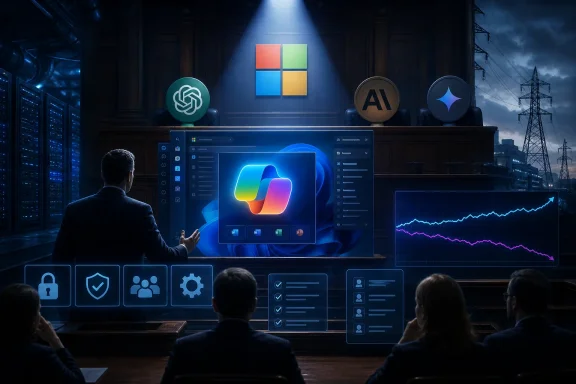
Microsoft’s 2026 stumble is not simply a bad tape for one megacap stock: as of June 25, 2026, Microsoft has badly lagged the broader U.S. market while investors reassess whether its OpenAI-era AI strategy still gives it a durable edge. The bear case is easy to understand and too neat to accept without qualification. Microsoft is not being left out of AI so much as being forced to prove that owning the enterprise workflow is as valuable as owning the most glamorous chatbot. That is a harder, slower, and more expensive argument than Wall Street wanted to hear.
For the first year of the generative AI boom, Microsoft enjoyed the cleanest story in technology. It had the cloud, the office suite, the developer platform, the Windows install base, and a privileged relationship with the company that had made ChatGPT a household name. Investors did not need a complicated thesis; Microsoft looked like the enterprise toll road for the AI age.
That story has become messier. OpenAI is still a partner, but no longer reads like a captive supplier. Anthropic has become the preferred answer in many enterprise conversations about coding, long-context reasoning, and agentic workflows. Google has recovered from its early Bard-era embarrassment and turned Gemini into a serious model, cloud, search, Android, and productivity-suite strategy.
The market’s discomfort is not that Microsoft missed AI. It is that Microsoft may have overpaid for the appearance of an unbeatable position before the industry had settled on what the moat actually was. The company bought speed, credibility, and model access. What it did not buy was permanent exclusivity over user attention, developer preference, or frontier-model economics.
That distinction matters because Microsoft’s core strength has always been distribution. Windows, Office, Active Directory, Exchange, Teams, GitHub, Azure, Visual Studio, and SQL Server do not win because they are always the prettiest products. They win because they sit where work already happens. AI challenges that model by making the interface itself contestable.
OpenAI’s goal is to become a platform company in its own right. That means selling models, apps, agents, developer tools, and perhaps eventually devices or operating environments across as many surfaces as possible. Microsoft’s goal is to make AI increase the value of Azure, Microsoft 365, Windows, GitHub, and Dynamics. Those aims can coexist, but only until distribution becomes the product.
The latest evolution of the partnership makes that tension explicit. Microsoft remains deeply tied to OpenAI, and Azure remains central to the arrangement, but the sense of a one-way dependency has weakened. OpenAI has more strategic room. Microsoft has more reason to hedge. Customers have more leverage.
This is not a divorce. It is more uncomfortable than that: it is a marriage in which both parties are now openly preparing for a world where they also compete at work. OpenAI wants ChatGPT to be the front door to productivity. Microsoft wants Copilot to be the front door to productivity. There is no way to make both of those ambitions harmless.
That ubiquity creates a paradox. Copilot is Microsoft’s great advantage because it can be placed directly in front of hundreds of millions of workers. It is also Microsoft’s great burden because every mediocre interaction teaches users that the AI layer is optional, confusing, or not worth the licensing uplift.
The comparison with ChatGPT, Claude, and Gemini is brutal because those products are judged first as destinations. Users go there to get something done. Copilot is often encountered as an insertion into software they already understand, which means it has to improve the workflow without slowing it down, startling the user, or creating governance headaches for IT.
That is a much higher bar than shipping a chatbot. A mediocre consumer AI can still be charming. A mediocre enterprise AI becomes a procurement dispute, a security review, a training burden, and a line item that finance wants justified before renewal.
But scale no longer reads only as strength. It also reads as capital intensity. GPUs, networking gear, power contracts, data center construction, custom silicon, and cooling capacity have turned AI cloud growth into a very expensive race. The market is no longer asking whether Microsoft can spend. It is asking whether the spending converts into defensible margins before the next generation of models changes the economics again.
That question is especially sharp because cloud capacity is not fungible in the way investors once imagined. Capacity allocated to internal AI services, OpenAI workloads, Copilot, GitHub, and enterprise customers can produce different margins and strategic benefits. The more Microsoft talks about huge AI demand, the more analysts want to know who gets the scarce capacity and at what return.
This is where the bear case finds oxygen. If Microsoft spends heavily to keep OpenAI happy, subsidize Copilot adoption, and chase Google and Anthropic in model performance, shareholders may see revenue growth without the operating leverage they expected. In the old cloud story, scale improved margins. In the AI cloud story, scale can demand another spending cycle before the last one has paid off.
That matters because Microsoft’s early AI lead was partly a story about Google’s failure to respond. If Google was trapped by the economics of search and culturally unable to ship fast, Microsoft could use OpenAI to pry open the market. But if Google can defend search while pushing Gemini across consumer and enterprise surfaces, the Microsoft narrative becomes less heroic.
Alphabet’s stock performance reflects that shift in sentiment. Investors who once worried that generative AI would eat Google’s core business now see the company as one of the few players with the infrastructure, models, chips, products, and distribution to compete across the stack. That does not mean Google has won. It means Microsoft no longer gets credit for being the only adult in the AI room.
For Windows users and IT departments, Google’s resurgence is not abstract. Workspace customers get Gemini-native productivity features. Android gives Google an enormous mobile deployment base. Chrome and search remain daily habits. Microsoft can still dominate the corporate desktop, but the AI assistant market is not confined to the desktop.
Anthropic has benefited from positioning that sounds tailor-made for cautious organizations. It talks about safety, controllability, reasoning, and enterprise use cases in a register that procurement teams can understand. Whether every claim survives scrutiny is less important than the fact that many customers now see Claude as a first-tier option rather than an exotic alternative.
Microsoft’s response has been telling. Instead of pretending OpenAI alone can power every AI experience, Microsoft has increasingly embraced a multi-model posture. That is strategically sensible, but it weakens the original simplicity of the Copilot pitch. If Copilot is best understood as an orchestration layer over OpenAI, Anthropic, Microsoft’s own models, and possibly other systems, then the magic moves from model exclusivity to workflow integration.
That may be the right long-term answer. It is also less glamorous. Investors loved the idea that Microsoft had locked up the brain of the AI revolution. They are less excited by the idea that Microsoft is building the enterprise middleware through which many brains may be rented, governed, monitored, and billed.
Microsoft once owned the personal computing surface in a comparable way. It still owns much of the business PC world, but the center of personal computing has shifted toward phones, wearables, and services that follow users across contexts. Windows remains important; it is no longer the whole map.
This creates a strategic squeeze. Microsoft can integrate Copilot into Windows, but Windows is not where many users begin their digital day. It can improve Office, but Office is a work environment rather than a universal personal assistant. It can push Edge and Bing, but neither has the default behavioral power of Safari, Chrome, Google Search, iOS, or Android.
That does not doom Microsoft. Enterprise computing is still a vast and lucrative kingdom. But it does mean Microsoft’s AI ambitions depend heavily on convincing organizations, not just individuals, that Copilot belongs in the daily loop. Apple gets to make AI feel like a device feature. Microsoft has to make AI feel like a productivity return on investment.
That explains why some of Microsoft’s AI moves have felt oddly bolted-on to the PC experience. Copilot in Windows has shifted forms, placements, and capabilities as Microsoft tries to discover what an operating-system assistant should actually do. Users have seen buttons, sidebars, app experiences, recall-style memory concepts, and settings integrations arrive with varying degrees of clarity.
The operating system is a difficult place to experiment because trust is thinner there. A chatbot can hallucinate and be forgiven. An OS feature that watches, indexes, summarizes, or acts across local activity triggers a different reaction. Security-minded users and administrators want to know what is captured, where it is processed, how it is retained, and who can audit it.
Microsoft understands this, but its AI urgency has sometimes run ahead of its Windows communication discipline. Features that might be useful in a narrow enterprise context can sound alarming when described as broad consumer defaults. The company’s challenge is not just engineering. It is consent, control, and confidence.
Yet Office is also where the hype meets the calendar. Many workers do not need AI to create more text; they need fewer meetings, cleaner data, better decisions, and less software sprawl. A Copilot-generated document that still requires careful review may save time, or it may simply move effort from drafting to verification.
That is why adoption metrics can be slippery. Seat counts, activations, and usage events are not the same as durable productivity gains. Enterprises will pilot almost anything that promises efficiency. They renew what survives contact with budgets, compliance teams, skeptical employees, and line-of-business managers.
Microsoft’s advantage is that it can keep improving Copilot inside the tools people already use. Its danger is that users may compare those embedded features with standalone AI products that feel faster, sharper, or more flexible. If employees quietly prefer ChatGPT, Claude, or Gemini while the company pays for Copilot, Microsoft has a usage problem disguised as an account-control victory.
Even there, the market is moving fast. Coding agents from OpenAI, Anthropic, Google, Cognition, and others are competing to become not just autocomplete engines but autonomous collaborators. The developer workflow is becoming a battleground for repositories, terminals, issue trackers, CI/CD systems, cloud environments, and model routing.
Microsoft’s ownership of GitHub gives it a privileged position in that fight. But it also faces the same pattern seen elsewhere: the best model or agent may not always be Microsoft’s, and developers are allergic to artificial constraints. If Microsoft turns GitHub into a neutral command center for multiple coding agents, it can win as the workflow owner. If it tries to force a single house preference, developers will route around it.
That is the broader lesson for the company. Microsoft is strongest when it owns the system of work and lets customers choose components. It is weakest when it tries to convince users that branding alone makes the AI better.
That is a very different diagnosis from “Microsoft has lost AI.” The company still has one of the strongest enterprise franchises in the world. It still has Azure. It still has Microsoft 365. It still has GitHub. It still has security, identity, database, developer, and management assets that competitors would love to own.
What has changed is the burden of proof. Microsoft can no longer rely on OpenAI adjacency as a substitute for product evidence. Copilot must become indispensable, not merely available. Azure AI must produce attractive economics, not just impressive demand. Windows AI must feel trustworthy, not intrusive. Microsoft’s own models and multi-model routing must strengthen the ecosystem without making the strategy look derivative.
The stock market is reacting to that ambiguity. It is also reacting to opportunity cost. If Alphabet, Nvidia, Anthropic-linked infrastructure plays, or other AI beneficiaries appear to offer cleaner exposure to the boom, Microsoft’s diversified strength can look like a drag. The company that once seemed like the safest AI bet now looks like the most complicated one.
That world favors Microsoft. It is the company already inside the tenant, already connected to the directory, already managing the endpoint, already hosting the files, already protecting the inbox, and already billing the organization. If AI becomes a governed enterprise layer rather than a consumer app free-for-all, Microsoft has enormous structural advantages.
This is why the “Copilot is behind ChatGPT” critique can be both true and incomplete. A standalone chatbot can feel better in a direct comparison and still lose budget to an integrated enterprise platform. Conversely, Microsoft can win the contract and still fail the user if the experience is not good enough to become habitual.
The enterprise buyer may give Microsoft time. It will not give Microsoft infinite patience. By 2026, most organizations have moved beyond curiosity. They want evidence: reduced ticket volume, faster sales cycles, better software delivery, shorter reporting processes, stronger security operations, and fewer hours lost to administrative sludge.
That future could be excellent for Microsoft if Copilot is the assistant performing the orchestration across Microsoft 365 and Azure. It could be dangerous if the assistant belongs to someone else and Microsoft’s products become backend tools invoked through another company’s interface. The history of platforms is full of companies that kept the system of record but lost the system of engagement.
Microsoft knows this. That is why Copilot is not a side project. It is an attempt to keep Microsoft at the front of the workflow as the front end changes from menus and files to prompts and agents. The urgency is rational.
But urgency can also produce clutter. Users do not want five Copilots, three overlapping agent concepts, and a licensing matrix that requires a consultant to decode. They want a reliable assistant that knows what it is allowed to know, does what it is asked to do, explains what it changed, and backs off when it is not useful.
For Windows users, the result will be a more aggressive AI layer across the operating system, but also more controls as Microsoft tries to avoid triggering privacy and security backlash. For administrators, the next phase will be less about whether AI exists in the stack and more about whether it can be governed like the rest of the stack. For developers, GitHub and Azure will become increasingly multi-agent, multi-model environments. For investors, the question is whether the revenue attached to all of this justifies the capital being poured into it.
The bearish narrative is useful because it punctures complacency. Microsoft cannot simply declare victory because it put Copilot buttons everywhere. The bullish narrative is useful because it remembers how enterprise markets actually work. Microsoft does not need to win every chatbot benchmark to remain one of the central companies in AI.
The decisive test will be whether Microsoft can turn AI from a feature surcharge into a workflow dependency. That is a product test, not a press-release test. It will be measured in renewals, usage depth, admin trust, developer loyalty, Azure margins, and the quiet moment when workers stop thinking of Copilot as an experiment and start treating it as infrastructure.
 Microsoft’s AI Premium Has Turned Into an AI Cross-Examination
For the first year of the generative AI boom, Microsoft enjoyed the cleanest story in technology. It had the cloud, the office suite, the developer platform, the Windows install base, and a privileged relationship with the company that had made ChatGPT a household name. Investors did not need a complicated thesis; Microsoft looked like the enterprise toll road for the AI age.That story has become messier. OpenAI is still a partner, but no longer reads like a captive supplier. Anthropic has become the preferred answer in many enterprise conversations about coding, long-context reasoning, and agentic workflows. Google has recovered from its early Bard-era embarrassment and turned Gemini into a serious model, cloud, search, Android, and productivity-suite strategy.
The market’s discomfort is not that Microsoft missed AI. It is that Microsoft may have overpaid for the appearance of an unbeatable position before the industry had settled on what the moat actually was. The company bought speed, credibility, and model access. What it did not buy was permanent exclusivity over user attention, developer preference, or frontier-model economics.
That distinction matters because Microsoft’s core strength has always been distribution. Windows, Office, Active Directory, Exchange, Teams, GitHub, Azure, Visual Studio, and SQL Server do not win because they are always the prettiest products. They win because they sit where work already happens. AI challenges that model by making the interface itself contestable.
OpenAI Was Never Going to Stay Inside Microsoft’s Walls
The Microsoft-OpenAI relationship was often described as if it were a merger by other means. That was always too simple. Microsoft supplied capital, Azure capacity, product distribution, and enterprise legitimacy; OpenAI supplied model leadership, consumer attention, and the cultural gravity of ChatGPT. The incentives overlapped, but they were never identical.OpenAI’s goal is to become a platform company in its own right. That means selling models, apps, agents, developer tools, and perhaps eventually devices or operating environments across as many surfaces as possible. Microsoft’s goal is to make AI increase the value of Azure, Microsoft 365, Windows, GitHub, and Dynamics. Those aims can coexist, but only until distribution becomes the product.
The latest evolution of the partnership makes that tension explicit. Microsoft remains deeply tied to OpenAI, and Azure remains central to the arrangement, but the sense of a one-way dependency has weakened. OpenAI has more strategic room. Microsoft has more reason to hedge. Customers have more leverage.
This is not a divorce. It is more uncomfortable than that: it is a marriage in which both parties are now openly preparing for a world where they also compete at work. OpenAI wants ChatGPT to be the front door to productivity. Microsoft wants Copilot to be the front door to productivity. There is no way to make both of those ambitions harmless.
Copilot Has Distribution, but Distribution Is Not Delight
Microsoft’s biggest AI product problem is not that Copilot is invisible. It is everywhere. It is in Windows, Edge, Bing, Microsoft 365, GitHub, Teams, security products, and admin tooling. The branding has become so pervasive that “Copilot” now functions less like a product name and more like Microsoft’s house style for AI features.That ubiquity creates a paradox. Copilot is Microsoft’s great advantage because it can be placed directly in front of hundreds of millions of workers. It is also Microsoft’s great burden because every mediocre interaction teaches users that the AI layer is optional, confusing, or not worth the licensing uplift.
The comparison with ChatGPT, Claude, and Gemini is brutal because those products are judged first as destinations. Users go there to get something done. Copilot is often encountered as an insertion into software they already understand, which means it has to improve the workflow without slowing it down, startling the user, or creating governance headaches for IT.
That is a much higher bar than shipping a chatbot. A mediocre consumer AI can still be charming. A mediocre enterprise AI becomes a procurement dispute, a security review, a training burden, and a line item that finance wants justified before renewal.
Azure Is Growing, but the Cost of Growth Has Changed
The cloud story is equally complicated. Microsoft’s Azure business remains enormous and strategically central. AI demand has helped drive cloud consumption, and Microsoft can credibly argue that it is one of the few companies capable of deploying AI infrastructure at global scale.But scale no longer reads only as strength. It also reads as capital intensity. GPUs, networking gear, power contracts, data center construction, custom silicon, and cooling capacity have turned AI cloud growth into a very expensive race. The market is no longer asking whether Microsoft can spend. It is asking whether the spending converts into defensible margins before the next generation of models changes the economics again.
That question is especially sharp because cloud capacity is not fungible in the way investors once imagined. Capacity allocated to internal AI services, OpenAI workloads, Copilot, GitHub, and enterprise customers can produce different margins and strategic benefits. The more Microsoft talks about huge AI demand, the more analysts want to know who gets the scarce capacity and at what return.
This is where the bear case finds oxygen. If Microsoft spends heavily to keep OpenAI happy, subsidize Copilot adoption, and chase Google and Anthropic in model performance, shareholders may see revenue growth without the operating leverage they expected. In the old cloud story, scale improved margins. In the AI cloud story, scale can demand another spending cycle before the last one has paid off.
Google’s Recovery Has Made Microsoft’s Lead Look Less Inevitable
The biggest change in the competitive landscape is not merely that rivals exist. It is that Google no longer looks strategically paralyzed. After a shaky start in consumer generative AI, Google has reassembled the pieces that always made it dangerous: research depth, custom AI chips, search distribution, Android, YouTube, Workspace, Google Cloud, and control over massive user data surfaces.That matters because Microsoft’s early AI lead was partly a story about Google’s failure to respond. If Google was trapped by the economics of search and culturally unable to ship fast, Microsoft could use OpenAI to pry open the market. But if Google can defend search while pushing Gemini across consumer and enterprise surfaces, the Microsoft narrative becomes less heroic.
Alphabet’s stock performance reflects that shift in sentiment. Investors who once worried that generative AI would eat Google’s core business now see the company as one of the few players with the infrastructure, models, chips, products, and distribution to compete across the stack. That does not mean Google has won. It means Microsoft no longer gets credit for being the only adult in the AI room.
For Windows users and IT departments, Google’s resurgence is not abstract. Workspace customers get Gemini-native productivity features. Android gives Google an enormous mobile deployment base. Chrome and search remain daily habits. Microsoft can still dominate the corporate desktop, but the AI assistant market is not confined to the desktop.
Anthropic Has Turned Enterprise Caution Into a Product Strategy
Anthropic’s rise has exposed a different Microsoft vulnerability. Claude is not simply a chatbot competitor; it is a symbol of how quickly enterprise AI preference can form outside Microsoft’s ecosystem. For some developers, analysts, lawyers, writers, and operations teams, model behavior matters more than the logo on the suite.Anthropic has benefited from positioning that sounds tailor-made for cautious organizations. It talks about safety, controllability, reasoning, and enterprise use cases in a register that procurement teams can understand. Whether every claim survives scrutiny is less important than the fact that many customers now see Claude as a first-tier option rather than an exotic alternative.
Microsoft’s response has been telling. Instead of pretending OpenAI alone can power every AI experience, Microsoft has increasingly embraced a multi-model posture. That is strategically sensible, but it weakens the original simplicity of the Copilot pitch. If Copilot is best understood as an orchestration layer over OpenAI, Anthropic, Microsoft’s own models, and possibly other systems, then the magic moves from model exclusivity to workflow integration.
That may be the right long-term answer. It is also less glamorous. Investors loved the idea that Microsoft had locked up the brain of the AI revolution. They are less excited by the idea that Microsoft is building the enterprise middleware through which many brains may be rented, governed, monitored, and billed.
Apple’s Device Base Is the Platform Threat Microsoft Cannot Copy
Apple’s AI position is frequently judged by model spectacle, which misses the point. Apple’s advantage is hardware intimacy. More than two billion active devices give it a distribution surface Microsoft cannot replicate, especially in the consumer market. If useful AI becomes ambient, local, privacy-preserving, and deeply tied to the phone, Apple has a structural advantage.Microsoft once owned the personal computing surface in a comparable way. It still owns much of the business PC world, but the center of personal computing has shifted toward phones, wearables, and services that follow users across contexts. Windows remains important; it is no longer the whole map.
This creates a strategic squeeze. Microsoft can integrate Copilot into Windows, but Windows is not where many users begin their digital day. It can improve Office, but Office is a work environment rather than a universal personal assistant. It can push Edge and Bing, but neither has the default behavioral power of Safari, Chrome, Google Search, iOS, or Android.
That does not doom Microsoft. Enterprise computing is still a vast and lucrative kingdom. But it does mean Microsoft’s AI ambitions depend heavily on convincing organizations, not just individuals, that Copilot belongs in the daily loop. Apple gets to make AI feel like a device feature. Microsoft has to make AI feel like a productivity return on investment.
Windows Is No Longer the Center of Microsoft’s AI Story, and That Is Awkward
For WindowsForum readers, the most immediate question is what all this means for Windows. The uncomfortable answer is that Windows is important to Microsoft’s AI strategy, but it is not the decisive battlefield. The decisive battlefield is the identity, data, and workflow layer that spans devices.That explains why some of Microsoft’s AI moves have felt oddly bolted-on to the PC experience. Copilot in Windows has shifted forms, placements, and capabilities as Microsoft tries to discover what an operating-system assistant should actually do. Users have seen buttons, sidebars, app experiences, recall-style memory concepts, and settings integrations arrive with varying degrees of clarity.
The operating system is a difficult place to experiment because trust is thinner there. A chatbot can hallucinate and be forgiven. An OS feature that watches, indexes, summarizes, or acts across local activity triggers a different reaction. Security-minded users and administrators want to know what is captured, where it is processed, how it is retained, and who can audit it.
Microsoft understands this, but its AI urgency has sometimes run ahead of its Windows communication discipline. Features that might be useful in a narrow enterprise context can sound alarming when described as broad consumer defaults. The company’s challenge is not just engineering. It is consent, control, and confidence.
Office Is the Real Copilot Battlefield
If Windows is the symbolic battlefield, Office is the economic one. Microsoft 365 is where Copilot can justify itself most clearly: drafting documents, summarizing meetings, analyzing spreadsheets, preparing presentations, triaging email, and searching across corporate knowledge. These are real workflows with measurable time costs.Yet Office is also where the hype meets the calendar. Many workers do not need AI to create more text; they need fewer meetings, cleaner data, better decisions, and less software sprawl. A Copilot-generated document that still requires careful review may save time, or it may simply move effort from drafting to verification.
That is why adoption metrics can be slippery. Seat counts, activations, and usage events are not the same as durable productivity gains. Enterprises will pilot almost anything that promises efficiency. They renew what survives contact with budgets, compliance teams, skeptical employees, and line-of-business managers.
Microsoft’s advantage is that it can keep improving Copilot inside the tools people already use. Its danger is that users may compare those embedded features with standalone AI products that feel faster, sharper, or more flexible. If employees quietly prefer ChatGPT, Claude, or Gemini while the company pays for Copilot, Microsoft has a usage problem disguised as an account-control victory.
GitHub Shows the Microsoft Strategy at Its Best
The strongest version of Microsoft’s AI strategy may be GitHub, not Windows or Office. Developers are unusually willing to change habits when a tool saves time, and coding assistants produce outputs that can often be tested quickly. GitHub Copilot also had a clearer early use case than many office-worker AI features: help me write, complete, explain, refactor, or test code.Even there, the market is moving fast. Coding agents from OpenAI, Anthropic, Google, Cognition, and others are competing to become not just autocomplete engines but autonomous collaborators. The developer workflow is becoming a battleground for repositories, terminals, issue trackers, CI/CD systems, cloud environments, and model routing.
Microsoft’s ownership of GitHub gives it a privileged position in that fight. But it also faces the same pattern seen elsewhere: the best model or agent may not always be Microsoft’s, and developers are allergic to artificial constraints. If Microsoft turns GitHub into a neutral command center for multiple coding agents, it can win as the workflow owner. If it tries to force a single house preference, developers will route around it.
That is the broader lesson for the company. Microsoft is strongest when it owns the system of work and lets customers choose components. It is weakest when it tries to convince users that branding alone makes the AI better.
Wall Street Is Punishing Uncertainty, Not Irrelevance
The grim Wall Street reading of Microsoft’s year should be taken seriously, but not literally. A stock decline does not prove strategic failure. It proves that expectations changed. Microsoft came into the AI cycle priced like a company with unusually clear leverage to the next computing platform. Investors are now discounting the possibility that the leverage is real but slower, more contested, and more expensive.That is a very different diagnosis from “Microsoft has lost AI.” The company still has one of the strongest enterprise franchises in the world. It still has Azure. It still has Microsoft 365. It still has GitHub. It still has security, identity, database, developer, and management assets that competitors would love to own.
What has changed is the burden of proof. Microsoft can no longer rely on OpenAI adjacency as a substitute for product evidence. Copilot must become indispensable, not merely available. Azure AI must produce attractive economics, not just impressive demand. Windows AI must feel trustworthy, not intrusive. Microsoft’s own models and multi-model routing must strengthen the ecosystem without making the strategy look derivative.
The stock market is reacting to that ambiguity. It is also reacting to opportunity cost. If Alphabet, Nvidia, Anthropic-linked infrastructure plays, or other AI beneficiaries appear to offer cleaner exposure to the boom, Microsoft’s diversified strength can look like a drag. The company that once seemed like the safest AI bet now looks like the most complicated one.
The Enterprise Buyer May Save Microsoft From the Chatbot Horse Race
The strongest counterargument to the Microsoft panic is that enterprise technology markets rarely crown winners based on consumer excitement alone. CIOs and CISOs do not buy only the cleverest demo. They buy identity integration, audit logs, data boundaries, admin controls, compliance posture, procurement simplicity, support contracts, and predictable roadmaps.That world favors Microsoft. It is the company already inside the tenant, already connected to the directory, already managing the endpoint, already hosting the files, already protecting the inbox, and already billing the organization. If AI becomes a governed enterprise layer rather than a consumer app free-for-all, Microsoft has enormous structural advantages.
This is why the “Copilot is behind ChatGPT” critique can be both true and incomplete. A standalone chatbot can feel better in a direct comparison and still lose budget to an integrated enterprise platform. Conversely, Microsoft can win the contract and still fail the user if the experience is not good enough to become habitual.
The enterprise buyer may give Microsoft time. It will not give Microsoft infinite patience. By 2026, most organizations have moved beyond curiosity. They want evidence: reduced ticket volume, faster sales cycles, better software delivery, shorter reporting processes, stronger security operations, and fewer hours lost to administrative sludge.
The Real Risk Is That AI Commoditizes Microsoft’s Interfaces
The deeper threat is not that Google or Anthropic builds a better bot. It is that AI changes how users interact with software so profoundly that Microsoft’s traditional interfaces lose some of their power. If a user can ask an assistant to create a report, query a database, schedule follow-ups, summarize customer history, and generate a slide deck, the application boundaries matter less.That future could be excellent for Microsoft if Copilot is the assistant performing the orchestration across Microsoft 365 and Azure. It could be dangerous if the assistant belongs to someone else and Microsoft’s products become backend tools invoked through another company’s interface. The history of platforms is full of companies that kept the system of record but lost the system of engagement.
Microsoft knows this. That is why Copilot is not a side project. It is an attempt to keep Microsoft at the front of the workflow as the front end changes from menus and files to prompts and agents. The urgency is rational.
But urgency can also produce clutter. Users do not want five Copilots, three overlapping agent concepts, and a licensing matrix that requires a consultant to decode. They want a reliable assistant that knows what it is allowed to know, does what it is asked to do, explains what it changed, and backs off when it is not useful.
The Crossroads Is Real, but the Obituary Is Premature
The most concrete reading of Microsoft’s position is neither triumphalist nor apocalyptic. The company is at a strategic crossroads because the assumptions behind its first AI wave have changed. OpenAI is more independent. Google is stronger. Anthropic is more credible. Apple has a device advantage. AI infrastructure is more expensive. Enterprise customers are more demanding.For Windows users, the result will be a more aggressive AI layer across the operating system, but also more controls as Microsoft tries to avoid triggering privacy and security backlash. For administrators, the next phase will be less about whether AI exists in the stack and more about whether it can be governed like the rest of the stack. For developers, GitHub and Azure will become increasingly multi-agent, multi-model environments. For investors, the question is whether the revenue attached to all of this justifies the capital being poured into it.
The bearish narrative is useful because it punctures complacency. Microsoft cannot simply declare victory because it put Copilot buttons everywhere. The bullish narrative is useful because it remembers how enterprise markets actually work. Microsoft does not need to win every chatbot benchmark to remain one of the central companies in AI.
The decisive test will be whether Microsoft can turn AI from a feature surcharge into a workflow dependency. That is a product test, not a press-release test. It will be measured in renewals, usage depth, admin trust, developer loyalty, Azure margins, and the quiet moment when workers stop thinking of Copilot as an experiment and start treating it as infrastructure.
Microsoft’s AI Reckoning Comes Down to Five Hard Tests
Microsoft’s year looks ugly because the company is being judged against the enormous expectations created by its own early AI success. The useful question is not whether Microsoft is doomed, but where the proof now has to appear.- Microsoft must show that Copilot can become a daily work habit rather than a bundled curiosity inside Windows and Microsoft 365.
- Azure must prove that AI demand can produce durable margins after the costs of GPUs, data centers, networking, energy, and model partnerships are counted.
- The OpenAI partnership must evolve into an advantage Microsoft can still explain clearly to customers, developers, and investors.
- Microsoft’s multi-model strategy must feel like customer choice rather than evidence that the company is chasing whichever rival model is strongest this quarter.
- Windows AI features must earn trust through transparency, local control, and administrative manageability instead of relying on default placement.
- GitHub may become Microsoft’s clearest AI success if it remains the place where competing agents meet real developer workflows.
References
- Primary source: SSBCrack
Published: 2026-06-25T16:30:10.159571
Loading…
news.ssbcrack.com - Related coverage: windowscentral.com
Microsoft’s AI strategy feels like a beta test — at the expense of Windows and Office | Windows Central
The future of Windows and Office potentially hangs in the balance as Microsoft pivots to AI.www.windowscentral.com - Related coverage: techradar.com
Microsoft's AI spending spree is now facing a shareholder revolt after billions were poured into Copilot and cloud infrastructure | TechRadar
Microsoft's biggest AI bet yet has landed in courtwww.techradar.com - Official source: openai.com
The next phase of the Microsoft OpenAI partnership
OpenAI and Microsoft announce an amended agreement that simplifies the partnership, adds long-term clarity, and supports continued AI innovation at scale.openai.com
- Official source: blogs.microsoft.com
Microsoft and OpenAI evolve partnership to drive the next phase of AI - The Official Microsoft Blog
We are thrilled to continue our strategic partnership with OpenAI and to partner on Stargate. Today’s announcement is complementary to what our two companies have been working on together since 2019. The key elements of our partnership remain in place for the duration of our contract through...blogs.microsoft.com - Official source: microsoft.com
Microsoft Fiscal Year 2026 First Quarter Earnings Conference Call
www.microsoft.com
- Related coverage: axios.com
Microsoft launches AI tool that competes with Anthropic
Anthropic's product threatened to kill Microsoft's software business, then Microsoft took the name and made it a Copilot feature.www.axios.com
- Related coverage: vaasblock.com
Microsoft Paid $13B for OpenAI Exclusivity. OpenAI Sold the Same Models to Amazon the Next Day. | VaaSBlock
On April 27 2026 Microsoft and OpenAI ended their exclusivity deal. On April 28 GPT-5.5 appeared on AWS Bedrock. Here is what the restructuring means for Copilot's competitive position — and what the 3.3% penetration rate says about the window that just closed.www.vaasblock.com - Related coverage: elpais.com
Sacudida en la industria de la IA: Microsoft y OpenAI reformulan su alianza y recortan relaciones
El fabricante de Windows renuncia al derecho exclusivo para vender los modelos de inteligencia artificial de la ‘start-up’elpais.com
- Related coverage: geekwire.com
Microsoft beats expectations, cloud tops $50B as OpenAI and Anthropic deals reshape its business – GeekWire
The entrance to "Experience Center One" on Microsoft's Redmond campus. (GeekWire File Photo) Microsoft's big financial bet on artificial intelligence gotwww.geekwire.com - Related coverage: techcrunch.com
Loading…
techcrunch.com - Related coverage: techxplore.com
Loading…
techxplore.com