
Sony announced on June 25, 2026, that it is cutting a significant number of Bungie jobs, including most of the Destiny team, some Marathon developers, and Sony support staff, weeks after Destiny 2 received its final content update on June 9. The timing makes the message hard to miss: PlayStation’s live-service bet has moved from expansion mode to triage. Bungie was supposed to teach Sony how to build persistent online worlds; instead, Sony is now deciding which pieces of Bungie are still worth carrying.
This is not just another sad entry in the games industry’s long layoff ledger. It is the clearest sign yet that the economics of forever-games have turned against even the studios that helped define them. Destiny did not fail because players stopped caring overnight. It failed, or at least fell short of corporate expectations, because the machinery required to keep a premium live-service shooter alive became too expensive, too brittle, and too dependent on growth that was no longer there.
When Sony bought Bungie for $3.6 billion in 2022, the strategic logic was obvious enough. PlayStation had world-class single-player studios, prestige franchises, and hardware leverage, but it did not have deep institutional experience running a global live-service machine at the scale of Destiny. Bungie had battle scars, backend knowledge, seasonal-content discipline, and a community that had endured years of reinvention.
That was the theory. The reality has been much harsher.
Bungie entered the Sony era with Destiny 2 still commercially meaningful but no longer culturally ascendant in the way it had been during its best expansions. It also carried the cost structure of a studio trying to support an aging live game, develop Marathon, incubate other projects, and justify a valuation that assumed Bungie’s expertise would radiate across PlayStation Studios.
The layoffs show how quickly that promise can curdle. Sony’s statement frames the move as alignment with “current priorities and long-term goals,” the language companies use when the spreadsheet has already won the argument. Bungie’s own statement was blunter in one important respect: Destiny 2 fell short of expectations in recent years, and the studio could not continue operating at its previous size.
That sentence is devastating because it turns Destiny from a triumph into a liability without quite saying so. A game can be beloved, influential, and still not support the headcount, road map, and acquisition math built around it. That is the trap of the modern live-service business: success creates infrastructure, infrastructure creates expectations, and expectations become the thing that crushes you when growth slows.
A live game is not a box on a shelf. It is a factory. Designers, engineers, artists, narrative teams, QA staff, community managers, monetization specialists, platform experts, analytics groups, security teams, and support staff all feed a calendar that must never stop moving.
Once that calendar stops, the brutal corporate question becomes unavoidable: what are all those people assigned to now?
That is why the phrase “most of the Destiny team” matters more than the absence of a specific layoff number. Sony is not merely trimming around the edges. It is dismantling the production apparatus behind one of the most important live-service shooters of the last decade.
Fans who hoped Destiny 3 might rise from the ashes will read that as an ominous sign, and they should. A sequel to Destiny would not be a modest project spun up by a handful of veterans in a conference room. It would require years of planning, hundreds of developers, a major engine and content pipeline strategy, and a business case strong enough to persuade Sony that the audience will return in sufficient numbers.
Right now, Sony’s message is the opposite. It is not adding capacity for the next Destiny. It is cutting capacity after the last one.
Some Marathon team members are also affected. That means even Sony’s declared near-term Bungie priority is not immune from the cuts.
Marathon was always a complicated bet. Reviving Bungie’s pre-Halo name as a PvP extraction shooter made strategic sense on paper: recognizable studio heritage, a genre with hardcore appeal, and a structure built for ongoing content. But extraction shooters are not easy money. They demand fierce balancing, strong anti-cheat, clear identity, reliable matchmaking, and enough player density to make every session feel alive.
The problem for Sony is that Marathon now has to do more than become a good game. It has to justify Bungie’s future.
That is a heavy burden for any new live-service title, especially in a market that has grown allergic to corporate attempts to manufacture the next forever-game. Players can smell obligation. They know when a game exists not because a studio had one irresistible idea, but because a publisher needs a recurring-revenue pillar.
Marathon may yet find its audience. Extraction games can build loyal communities over time, and Bungie’s gunfeel remains one of the studio’s most durable advantages. But the layoffs make one thing clear: Marathon is no longer the bold second pillar beside Destiny. It is the remaining pillar after the roof has already started to cave in.
But turning that investor slide into a portfolio has been messy.
PlayStation’s strength has long been curation, polish, and narrative spectacle. Its studios are very good at shipping premium experiences that dominate a release window and then become part of the platform’s prestige. Live-service development is a different discipline. It is less like releasing a film and more like running a city.
That difference has humbled many companies. A live game is judged weekly, sometimes daily. Every balance patch is a referendum. Every content delay becomes a community crisis. Every monetization change is treated as a moral statement. Even successful live games spend much of their existence being accused of dying.
Bungie was supposed to help Sony navigate that terrain. Instead, Sony has learned that even the expert can be trapped by the same forces it was hired to master.
This should force a rethink across PlayStation. The lesson is not that live-service games are impossible. Fortnite, Roblox, Warframe, Final Fantasy XIV, Genshin Impact, and others prove otherwise in different ways. The lesson is that live-service development is not a genre checkbox. It is an operating model, and it only works when the product, audience, technology, cadence, and company culture are aligned.
Sony tried to buy that alignment. Bungie’s layoffs suggest it bought something more fragile.
Behind them are developers whose work defined millions of players’ social lives. Destiny raids became friendships. Trials weekends became rituals. Campaign reveals became annual traditions. Entire communities formed around spreadsheets, builds, lore channels, clan nights, sherpa runs, and arguments about whether the game was finally good again or doomed forever.
The people who made that possible are now being told the business no longer has room for them.
It is tempting to treat this as a morality play with a single villain. Sony overpaid. Bungie leadership mismanaged. Players churned. Marathon underperformed. Destiny got old. Each of those explanations may contain some truth, but none is sufficient alone.
The more uncomfortable answer is that the industry built a staffing model around perpetual expansion and then discovered that perpetual expansion was not guaranteed. When the curve bent, the workers who built the worlds absorbed the shock first.
That pattern is now familiar across games and tech. Companies hire for growth, reorganize for efficiency, and describe the distance between those two decisions as unfortunate necessity. The executives who approved the strategy usually remain to explain why the strategy required fewer people.
It also taught the industry the dangers of making every game a lifestyle. Destiny’s best moments were communal and strange: six-player puzzle solving, operatic boss fights, secret missions, exotic weapon hunts, and lore that made players feel like archaeologists. Its worst moments were the tax collectors of live-service design: grind inflation, vault anxiety, FOMO, monetization sprawl, and the sense that the game was always asking for just a little more time.
That contradiction is why Destiny inspired such loyalty and such exhaustion. Players did not simply consume it. They negotiated with it.
Bungie’s genius was making combat feel good enough that players forgave nearly everything else at least once. Its problem was that forgiveness is not a durable revenue model. Eventually, every returning player asks whether the next season, expansion, or reset is worth the emotional overhead.
Sony’s decision says enough players answered no, or not often enough, for the old structure to continue.
If Bungie is being reduced after Destiny’s wind-down and Marathon’s uneven start, what exactly remains of the acquisition thesis?
There are still answers Sony can give. Bungie’s technology, institutional knowledge, and remaining teams may support Marathon, advise other PlayStation projects, or incubate smaller ideas. The Destiny IP still has value, even if no sequel is greenlit. Bungie’s name still means something, even after years of turbulence.
But the grand version of the thesis has been punctured. Bungie is no longer the obvious engine of PlayStation’s live-service future. It is a studio being narrowed to fit a more limited set of bets.
That matters beyond Bungie. Every publisher that spent the last several years chasing recurring engagement should pay attention. Live-service games are not portfolio insurance if too many of them require blockbuster-scale teams and blockbuster-scale retention. They become portfolio risk concentrated under a different label.
The irony is that Sony’s traditional PlayStation model now looks comparatively disciplined. A great single-player game may take years and cost a fortune, but it does not always require a permanent content treadmill after launch. It can succeed, end, sell again on PC, and make room for the next thing. Live service promises endless life, but endless life can become endless obligation.
The PC side of Destiny has always been a crucial part of its modern identity. High refresh rates, build-crafting tools, third-party inventory managers, Discord fireteams, and community overlays made Windows players central to the game’s culture. Destiny was not merely ported to PC; it became a PC hobby in all the ways that matter.
Layoffs at this scale raise practical questions for players. Server support can continue with a smaller team, but the quality of maintenance, security response, bug fixing, and community communication often depends on institutional knowledge. When experienced developers leave, the game does not instantly break, but its memory thins.
That matters for a persistent online game. Anti-cheat work is ongoing. Platform compatibility evolves. GPU drivers change. Windows updates introduce edge cases. Backend dependencies age. A live game in maintenance mode still needs care, especially one with years of accumulated systems.
Marathon’s PC prospects are equally important. Extraction shooters tend to live or die on PC credibility: input feel, performance, matchmaking integrity, cheating control, streaming visibility, and competitive trust. If Bungie is smaller and morale is damaged, the path to building that credibility gets narrower.
The broader PC gaming lesson is familiar: no launcher icon guarantees permanence. The games that occupy our drives and communities are ultimately dependent on corporate priorities that can shift faster than player attachment.
The foundation matters more.
A successful live-service game usually has a natural loop that players want to repeat before monetization touches it. It has a cadence that matches the team’s ability to produce without burning out. It has tools that let developers respond quickly. It has a community strategy that treats players as stakeholders without making them de facto product managers.
Destiny had many of those ingredients, but it also had years of accumulated complexity. New players bounced off it. Returning players needed briefings. Veterans were often divided between nostalgia for the game they remembered and frustration with the game in front of them. Every expansion had to serve too many masters.
That is not a creative failure so much as a lifecycle problem. Long-running games become museums of their own design decisions. Systems added to solve one era’s problem become another era’s burden. Eventually, maintenance becomes archaeology.
Publishers rarely account for that in the growth phase. They see a game with millions of players and imagine a platform that can be extended indefinitely. Developers know better. They know every season adds debt, every shortcut becomes a future meeting, and every promise to support the game forever narrows the studio’s ability to build something new.
Bungie’s cuts are what happens when the bill comes due.
Destiny survived that skepticism longer than most because Bungie could still deliver moments nobody else could quite replicate. The raids, weapons, art direction, music, and tactile shooting gave the game a soul beyond its engagement systems. That soul is why the end of active development feels like a cultural loss rather than just a product sunset.
But the same players who loved Destiny also learned to distrust the model it helped popularize. They watched content get vaulted. They watched expansions vary wildly in quality. They watched monetization creep. They watched the game ask for loyalty while often seeming unsure how to reward it.
So when Sony says Marathon remains important, the audience hears both a promise and a warning. Another live-service game is asking for time in a market where time is the scarcest currency. Bungie’s name buys attention, but it no longer buys endless patience.
That is the reputational damage layoffs cannot be separated from. Cutting staff after ending Destiny 2 does not merely reduce production capacity. It tells players that emotional investment can outlast corporate commitment.
A smaller Bungie could become sharper. Constraint sometimes clarifies. The studio might focus Marathon, preserve essential Destiny operations, and incubate future projects without the sprawl that reportedly weighed it down. A leaner Bungie might rediscover the decisiveness that made its best work feel bold.
But that optimistic version depends on leadership earning trust it has repeatedly strained. Layoffs do not automatically create focus; they often create fear. The people who remain must absorb lost work, lost colleagues, and the knowledge that the next strategic pivot could land on them too.
Sony also has to decide whether Bungie is a studio or a capability. If Bungie becomes primarily a live-service support organ for PlayStation, its identity will fade. If it remains a creative studio with enough autonomy to make risky games, Sony must accept that risk includes failure, delay, and investment that cannot be instantly rationalized.
The worst outcome would be the middle: too small to sustain Destiny, too pressured to let Marathon breathe, too constrained to invent the next thing, and too valuable on paper to be left alone.
That is the danger facing Bungie now. The studio that once defined the console shooter and then helped define the live-service shooter could become a cautionary department inside a larger portfolio.
For players and IT-minded observers who track platforms, services, and long-term software support, the lesson is not sentimental. It is operational. Persistent products require persistent economics, and when those economics fail, even beloved systems are put into maintenance mode.
This is not just another sad entry in the games industry’s long layoff ledger. It is the clearest sign yet that the economics of forever-games have turned against even the studios that helped define them. Destiny did not fail because players stopped caring overnight. It failed, or at least fell short of corporate expectations, because the machinery required to keep a premium live-service shooter alive became too expensive, too brittle, and too dependent on growth that was no longer there.
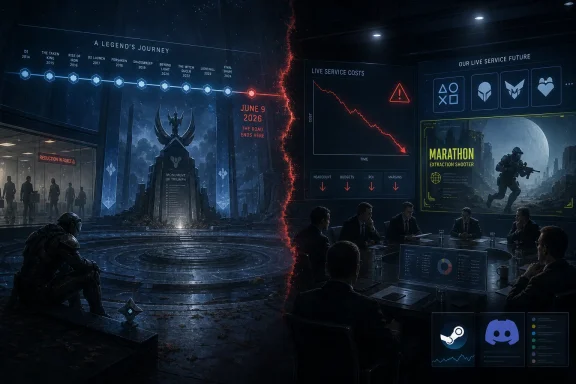 Sony’s Bungie Deal Has Become a Lesson in Live-Service Gravity
When Sony bought Bungie for $3.6 billion in 2022, the strategic logic was obvious enough. PlayStation had world-class single-player studios, prestige franchises, and hardware leverage, but it did not have deep institutional experience running a global live-service machine at the scale of Destiny. Bungie had battle scars, backend knowledge, seasonal-content discipline, and a community that had endured years of reinvention.That was the theory. The reality has been much harsher.
Bungie entered the Sony era with Destiny 2 still commercially meaningful but no longer culturally ascendant in the way it had been during its best expansions. It also carried the cost structure of a studio trying to support an aging live game, develop Marathon, incubate other projects, and justify a valuation that assumed Bungie’s expertise would radiate across PlayStation Studios.
The layoffs show how quickly that promise can curdle. Sony’s statement frames the move as alignment with “current priorities and long-term goals,” the language companies use when the spreadsheet has already won the argument. Bungie’s own statement was blunter in one important respect: Destiny 2 fell short of expectations in recent years, and the studio could not continue operating at its previous size.
That sentence is devastating because it turns Destiny from a triumph into a liability without quite saying so. A game can be beloved, influential, and still not support the headcount, road map, and acquisition math built around it. That is the trap of the modern live-service business: success creates infrastructure, infrastructure creates expectations, and expectations become the thing that crushes you when growth slows.
Destiny 2 Did Not End So Much as Exhaust Its Business Model
Destiny 2’s final content update, Monument of Triumph, arrived on June 9 as a capstone to a nine-year run. The servers remain online, the memories remain real, and the game’s influence on loot shooters, raids, seasonal storytelling, and cross-platform communities is impossible to dismiss. But active development ending changed the studio’s labor equation immediately.A live game is not a box on a shelf. It is a factory. Designers, engineers, artists, narrative teams, QA staff, community managers, monetization specialists, platform experts, analytics groups, security teams, and support staff all feed a calendar that must never stop moving.
Once that calendar stops, the brutal corporate question becomes unavoidable: what are all those people assigned to now?
That is why the phrase “most of the Destiny team” matters more than the absence of a specific layoff number. Sony is not merely trimming around the edges. It is dismantling the production apparatus behind one of the most important live-service shooters of the last decade.
Fans who hoped Destiny 3 might rise from the ashes will read that as an ominous sign, and they should. A sequel to Destiny would not be a modest project spun up by a handful of veterans in a conference room. It would require years of planning, hundreds of developers, a major engine and content pipeline strategy, and a business case strong enough to persuade Sony that the audience will return in sufficient numbers.
Right now, Sony’s message is the opposite. It is not adding capacity for the next Destiny. It is cutting capacity after the last one.
Marathon Survives, but Survival Is Not Momentum
Sony and Bungie are not walking away from Marathon. Hulst’s letter explicitly says the extraction shooter remains an important part of the PlayStation portfolio and will continue to receive support as the team builds on its early seasons. That sounds reassuring until it is placed next to the rest of the announcement.Some Marathon team members are also affected. That means even Sony’s declared near-term Bungie priority is not immune from the cuts.
Marathon was always a complicated bet. Reviving Bungie’s pre-Halo name as a PvP extraction shooter made strategic sense on paper: recognizable studio heritage, a genre with hardcore appeal, and a structure built for ongoing content. But extraction shooters are not easy money. They demand fierce balancing, strong anti-cheat, clear identity, reliable matchmaking, and enough player density to make every session feel alive.
The problem for Sony is that Marathon now has to do more than become a good game. It has to justify Bungie’s future.
That is a heavy burden for any new live-service title, especially in a market that has grown allergic to corporate attempts to manufacture the next forever-game. Players can smell obligation. They know when a game exists not because a studio had one irresistible idea, but because a publisher needs a recurring-revenue pillar.
Marathon may yet find its audience. Extraction games can build loyal communities over time, and Bungie’s gunfeel remains one of the studio’s most durable advantages. But the layoffs make one thing clear: Marathon is no longer the bold second pillar beside Destiny. It is the remaining pillar after the roof has already started to cave in.
PlayStation’s Live-Service Ambitions Keep Meeting Reality
Sony spent the early 2020s telling investors it wanted a broader live-service portfolio. The logic was not mysterious. Console blockbusters are expensive, slow, and episodic; live-service games promise recurring revenue, player retention, and platform engagement between tentpole releases.But turning that investor slide into a portfolio has been messy.
PlayStation’s strength has long been curation, polish, and narrative spectacle. Its studios are very good at shipping premium experiences that dominate a release window and then become part of the platform’s prestige. Live-service development is a different discipline. It is less like releasing a film and more like running a city.
That difference has humbled many companies. A live game is judged weekly, sometimes daily. Every balance patch is a referendum. Every content delay becomes a community crisis. Every monetization change is treated as a moral statement. Even successful live games spend much of their existence being accused of dying.
Bungie was supposed to help Sony navigate that terrain. Instead, Sony has learned that even the expert can be trapped by the same forces it was hired to master.
This should force a rethink across PlayStation. The lesson is not that live-service games are impossible. Fortnite, Roblox, Warframe, Final Fantasy XIV, Genshin Impact, and others prove otherwise in different ways. The lesson is that live-service development is not a genre checkbox. It is an operating model, and it only works when the product, audience, technology, cadence, and company culture are aligned.
Sony tried to buy that alignment. Bungie’s layoffs suggest it bought something more fragile.
The Human Cost Is Hidden Behind Corporate Grammar
The language of layoff announcements is designed to absorb pain without admitting fault. “Difficult decision.” “Careful consideration.” “Long-term goals.” “Transition support.” These phrases are not meaningless, exactly, but they are engineered to make a human rupture sound like a governance process.Behind them are developers whose work defined millions of players’ social lives. Destiny raids became friendships. Trials weekends became rituals. Campaign reveals became annual traditions. Entire communities formed around spreadsheets, builds, lore channels, clan nights, sherpa runs, and arguments about whether the game was finally good again or doomed forever.
The people who made that possible are now being told the business no longer has room for them.
It is tempting to treat this as a morality play with a single villain. Sony overpaid. Bungie leadership mismanaged. Players churned. Marathon underperformed. Destiny got old. Each of those explanations may contain some truth, but none is sufficient alone.
The more uncomfortable answer is that the industry built a staffing model around perpetual expansion and then discovered that perpetual expansion was not guaranteed. When the curve bent, the workers who built the worlds absorbed the shock first.
That pattern is now familiar across games and tech. Companies hire for growth, reorganize for efficiency, and describe the distance between those two decisions as unfortunate necessity. The executives who approved the strategy usually remain to explain why the strategy required fewer people.
Destiny’s Legacy Is Bigger Than Its Balance Sheet
It would be a mistake to let the layoff story reduce Destiny to a failed asset. Destiny changed the shape of console shooters. It helped normalize cross-platform progression, long-tail endgames, seasonal storytelling, raid spectacle, and the idea that a shooter could be a hobby rather than a sequence of matches.It also taught the industry the dangers of making every game a lifestyle. Destiny’s best moments were communal and strange: six-player puzzle solving, operatic boss fights, secret missions, exotic weapon hunts, and lore that made players feel like archaeologists. Its worst moments were the tax collectors of live-service design: grind inflation, vault anxiety, FOMO, monetization sprawl, and the sense that the game was always asking for just a little more time.
That contradiction is why Destiny inspired such loyalty and such exhaustion. Players did not simply consume it. They negotiated with it.
Bungie’s genius was making combat feel good enough that players forgave nearly everything else at least once. Its problem was that forgiveness is not a durable revenue model. Eventually, every returning player asks whether the next season, expansion, or reset is worth the emotional overhead.
Sony’s decision says enough players answered no, or not often enough, for the old structure to continue.
The Acquisition Was Never Just About Bungie
Sony did not buy Bungie only for Destiny revenue. It bought expertise, infrastructure, and credibility in a category where PlayStation wanted to grow. That is what makes the layoffs strategically awkward.If Bungie is being reduced after Destiny’s wind-down and Marathon’s uneven start, what exactly remains of the acquisition thesis?
There are still answers Sony can give. Bungie’s technology, institutional knowledge, and remaining teams may support Marathon, advise other PlayStation projects, or incubate smaller ideas. The Destiny IP still has value, even if no sequel is greenlit. Bungie’s name still means something, even after years of turbulence.
But the grand version of the thesis has been punctured. Bungie is no longer the obvious engine of PlayStation’s live-service future. It is a studio being narrowed to fit a more limited set of bets.
That matters beyond Bungie. Every publisher that spent the last several years chasing recurring engagement should pay attention. Live-service games are not portfolio insurance if too many of them require blockbuster-scale teams and blockbuster-scale retention. They become portfolio risk concentrated under a different label.
The irony is that Sony’s traditional PlayStation model now looks comparatively disciplined. A great single-player game may take years and cost a fortune, but it does not always require a permanent content treadmill after launch. It can succeed, end, sell again on PC, and make room for the next thing. Live service promises endless life, but endless life can become endless obligation.
Windows Gamers Will Feel the Shock Even Outside PlayStation
For WindowsForum readers, this story is not just console industry drama. Destiny 2 and Marathon are PC games too, and the health of Bungie affects communities that live on Steam, Discord, Reddit, YouTube, and Windows gaming rigs as much as on PlayStation hardware.The PC side of Destiny has always been a crucial part of its modern identity. High refresh rates, build-crafting tools, third-party inventory managers, Discord fireteams, and community overlays made Windows players central to the game’s culture. Destiny was not merely ported to PC; it became a PC hobby in all the ways that matter.
Layoffs at this scale raise practical questions for players. Server support can continue with a smaller team, but the quality of maintenance, security response, bug fixing, and community communication often depends on institutional knowledge. When experienced developers leave, the game does not instantly break, but its memory thins.
That matters for a persistent online game. Anti-cheat work is ongoing. Platform compatibility evolves. GPU drivers change. Windows updates introduce edge cases. Backend dependencies age. A live game in maintenance mode still needs care, especially one with years of accumulated systems.
Marathon’s PC prospects are equally important. Extraction shooters tend to live or die on PC credibility: input feel, performance, matchmaking integrity, cheating control, streaming visibility, and competitive trust. If Bungie is smaller and morale is damaged, the path to building that credibility gets narrower.
The broader PC gaming lesson is familiar: no launcher icon guarantees permanence. The games that occupy our drives and communities are ultimately dependent on corporate priorities that can shift faster than player attachment.
The Industry Has Overlearned the Wrong Lesson From Success
The live-service gold rush was built on a selective reading of success. Publishers looked at the biggest games in the world and concluded that persistence, monetization, and community engagement were the formula. But that was like looking at the tallest skyscrapers and concluding that height is what keeps buildings standing.The foundation matters more.
A successful live-service game usually has a natural loop that players want to repeat before monetization touches it. It has a cadence that matches the team’s ability to produce without burning out. It has tools that let developers respond quickly. It has a community strategy that treats players as stakeholders without making them de facto product managers.
Destiny had many of those ingredients, but it also had years of accumulated complexity. New players bounced off it. Returning players needed briefings. Veterans were often divided between nostalgia for the game they remembered and frustration with the game in front of them. Every expansion had to serve too many masters.
That is not a creative failure so much as a lifecycle problem. Long-running games become museums of their own design decisions. Systems added to solve one era’s problem become another era’s burden. Eventually, maintenance becomes archaeology.
Publishers rarely account for that in the growth phase. They see a game with millions of players and imagine a platform that can be extended indefinitely. Developers know better. They know every season adds debt, every shortcut becomes a future meeting, and every promise to support the game forever narrows the studio’s ability to build something new.
Bungie’s cuts are what happens when the bill comes due.
Players Were Right to Be Suspicious of the Forever-Game Pitch
Players have become more skeptical of live-service launches, and for good reason. Too many games arrive asking for long-term commitment before proving they deserve short-term attention. Too many road maps are treated as substitutes for launch quality. Too many battle passes turn entertainment into homework.Destiny survived that skepticism longer than most because Bungie could still deliver moments nobody else could quite replicate. The raids, weapons, art direction, music, and tactile shooting gave the game a soul beyond its engagement systems. That soul is why the end of active development feels like a cultural loss rather than just a product sunset.
But the same players who loved Destiny also learned to distrust the model it helped popularize. They watched content get vaulted. They watched expansions vary wildly in quality. They watched monetization creep. They watched the game ask for loyalty while often seeming unsure how to reward it.
So when Sony says Marathon remains important, the audience hears both a promise and a warning. Another live-service game is asking for time in a market where time is the scarcest currency. Bungie’s name buys attention, but it no longer buys endless patience.
That is the reputational damage layoffs cannot be separated from. Cutting staff after ending Destiny 2 does not merely reduce production capacity. It tells players that emotional investment can outlast corporate commitment.
Bungie’s Next Shape Will Define the Value of the Studio
The hard question now is what Bungie becomes. Not what it was, not what Sony bought, and not what fans wish it could be, but what the remaining organization can realistically make.A smaller Bungie could become sharper. Constraint sometimes clarifies. The studio might focus Marathon, preserve essential Destiny operations, and incubate future projects without the sprawl that reportedly weighed it down. A leaner Bungie might rediscover the decisiveness that made its best work feel bold.
But that optimistic version depends on leadership earning trust it has repeatedly strained. Layoffs do not automatically create focus; they often create fear. The people who remain must absorb lost work, lost colleagues, and the knowledge that the next strategic pivot could land on them too.
Sony also has to decide whether Bungie is a studio or a capability. If Bungie becomes primarily a live-service support organ for PlayStation, its identity will fade. If it remains a creative studio with enough autonomy to make risky games, Sony must accept that risk includes failure, delay, and investment that cannot be instantly rationalized.
The worst outcome would be the middle: too small to sustain Destiny, too pressured to let Marathon breathe, too constrained to invent the next thing, and too valuable on paper to be left alone.
That is the danger facing Bungie now. The studio that once defined the console shooter and then helped define the live-service shooter could become a cautionary department inside a larger portfolio.
The June 25 Cuts Turn Destiny’s Ending Into an Industry Warning
The concrete facts are now stark enough that the usual corporate fog cannot hide the shape of the story. Sony bought Bungie at the height of live-service optimism, Destiny 2 has now ended active development, Marathon remains the remaining bet, and a major portion of the workforce is gone.For players and IT-minded observers who track platforms, services, and long-term software support, the lesson is not sentimental. It is operational. Persistent products require persistent economics, and when those economics fail, even beloved systems are put into maintenance mode.
- Sony announced the Bungie layoffs on June 25, 2026, affecting a significant number of employees across Bungie and related Sony support teams.
- The cuts include most of the Destiny team, which strongly suggests that Destiny 2’s active development apparatus has been dismantled rather than merely reassigned.
- Destiny 2 received its final content update, Monument of Triumph, on June 9, 2026, ending a nine-year live-service run while leaving the game playable.
- Marathon remains part of Sony’s portfolio, but the layoffs also affected some Marathon developers, making its future more pressured rather than more secure.
- The Bungie acquisition now looks less like a clean strategic win for PlayStation and more like a costly attempt to buy live-service expertise during a market peak.
- PC players should expect the practical consequences to show up in maintenance quality, community confidence, anti-cheat pressure, and the long-term credibility of Marathon on Windows.
References
- Primary source: Windows Central
Published: 2026-06-25T16:20:10.531606
"We have made the decision to reduce Bungie’s workforce": Destiny 2 dev Bungie hit with major layoffs across "most of the Destiny team" and Marathon, says Sony CEO | Windows Central
Sony has initiated a large wave of layoffs at Bungie, "affecting a significant number of employees."www.windowscentral.com - Related coverage: gamespot.com
Bungie Confirms Layoffs, "Most" Of Destiny Team Let Go - GameSpot
Bungie recognized that Destiny 2 "fell short" of expectations and, as a result, is reducing its workforce because the company "could not continue operating" at…www.gamespot.com - Related coverage: engadget.com
Sony Announces Major Layoffs At Bungie, Including Most Of The Destiny Team
Some devs working on Marathon have also been laid off and studio head Justin Truman has stepped down.www.engadget.com - Related coverage: gamepro.de
Sony bestätigt umfassende Entlassungen bei Bungie - Großteil des Destiny-Teams und Teile des Marathon-Teams betroffen
In einem offiziellen PlayStation Studios-Update hat Hermen Hulst das bestätigt, was viele schon befürchtet hatten.www.gamepro.de
- Related coverage: videogameschronicle.com
Sony confirms it’s laying off ‘most of the Destiny team’ and ‘some’ Marathon devs | VGC
UPDATE: Bungie’s studio head has also departed…www.videogameschronicle.com - Related coverage: en.softonic.com
Bungie announces major layoffs: broad cuts follow Destiny 2 slowdown - Softonic
Bungie, the studio behind Destiny 2, said on June 25, 2026, that it’s making deep cuts and reshaping the company, only a few weeks after Destiny 2 goten.softonic.com
- Related coverage: thefpsreview.com
Most Bungie Employees Didn't Know Destiny 2 Was Being Ended Until It Was Announced Publicly
Bungie announced earlier this month that Destiny 2 would receive one final update, Monument of Triumph, on June 9, 2026, after which active development ends. The game will remain playable in maintenance mode, mirroring how the original Destiny has lingered on since its own support sunset. What...www.thefpsreview.com - Related coverage: theouterhaven.net
PlayStation Studios Reducing Bungie Workforce | The Outerhaven
Bungie is getting hit by a wave of layoffs at Sony Interactive Entertainment. Herman Hult refers to it as a reduction of the workforce.www.theouterhaven.net - Related coverage: wccftech.com
Bungie Announces Layoffs in the Wake of Destiny 2's Final Update as it "Could Not Continue Operating at our Previous Size"
A little more than two weeks after Destiny 2's final update, Bungie has announced its latest round of layoffs.wccftech.com
- Related coverage: pushsquare.com
- Related coverage: tech4gamers.com
Bungie Cuts Nearly Half Its Workforce, Laying Off Around 400 Employees After Marathon's Failure
Bungie has laid off nearly half of its workforce following the disappointing launch of Marathon, which accounts for 400 workers. tech4gamers.com
- Related coverage: secnews.gr
Major layoffs at Bungie after the end of Destiny 2
Bungie announces major layoffs after the end of Destiny 2, affecting the Destiny team and Marathon.www.secnews.gr - Related coverage: gamesradar.com
Sony reports $765 million impairment loss on Marathon and Destiny 2 studio Bungie for the last financial year, after paying $3.6 billion for it in 2022 | GamesRadar+
Bungie's returns haven't been high of latewww.gamesradar.com - Related coverage: pcgamer.com
Former Destiny 2 CM claims Bungie was 'very close to shutting its doors' before the buyout | PC Gamer
It was an emergency acquisition.www.pcgamer.com - Related coverage: notebookcheck.net
Destiny 2's finale follows $764M in impairment losses amid Bungie layoffs - Notebookcheck News
Bungie will end Destiny 2’s live-service updates on June 9, 2026, with “The Moment of Triumph,” while keeping servers online and the game playable. The decision follows The Final Shape’s underperformance, $764 million in impairment losses, and wider turmoil at Bungie as the studio shifts... www.notebookcheck.net
- Related coverage: gamingbolt.com
Bungie Announces Layoffs and Reorganization After Destiny 2 “Fell Short” in the Past Several Years
These layoffs and changes aregamingbolt.com - Related coverage: allthings.how
Bungie Reportedly Set for 50% Summer Layoffs After Destiny 2 Ends
A French journalist says half of Bungie's permanent and contract staff could be cut, though Sony has not confirmed it.allthings.how
