
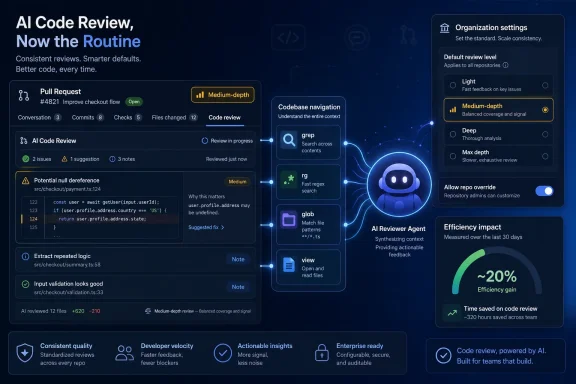
GitHub updated Copilot code review on June 25, 2026, adding organization-level defaults and clearer Medium-depth labeling while replacing custom file-exploration plumbing with Copilot CLI and SDK tools such as grep, rg, glob, and view to cut review costs by about 20%. The change sounds small because it does not alter the pull request workflow developers see every day. That is precisely why it matters: GitHub is trying to make AI review feel less like a premium experiment and more like routine development infrastructure.
The public story of AI coding tools has been dominated by model capability: which model reasons better, which one writes cleaner tests, which one can survive a gnarly refactor without hallucinating an API that does not exist. GitHub’s latest Copilot code review update points in a less glamorous but more consequential direction. The next phase of AI-assisted development is about cost, control, and observability.
Copilot code review already sits in a sensitive place in the software lifecycle. It comments on pull requests, suggests fixes, and can be configured to run automatically. That makes it less like an autocomplete toy and more like a junior reviewer that happens to be awake at all hours.
But automated review has a basic scaling problem. The more organizations route every pull request through an AI reviewer, the more they run into the arithmetic of tokens, compute, GitHub Actions minutes, and administrative sprawl. A tool that is charming when invoked manually becomes a budget line when attached to every repository.
GitHub’s 20% cost-efficiency claim should be read in that context. The company is not merely saying Copilot got cheaper to operate behind the scenes. It is saying that the machinery of code review is being standardized so that deeper AI review can be deployed more predictably across teams.
That may sound like a plumbing swap, but code review quality depends heavily on whether the reviewer can find the relevant code in the first place. A large pull request rarely lives inside the diff alone. The important answer may be in a neighboring utility, a configuration file, a test fixture, a shared interface, or the one service boundary the submitter forgot to mention.
This is where many AI review systems become either superficial or expensive. If the tool looks only at the patch, it can miss context. If it ingests too much of the repository, it burns cost and may still drown in irrelevant files. The craft is in narrowing the search without blinding the reviewer.
By standardizing on familiar file-exploration primitives, GitHub is acknowledging that retrieval is part of code intelligence. The model is only one component. The surrounding agent needs disciplined ways to search, inspect, and move through a repository before it can produce useful review comments.
There is also a developer-culture angle here. Tools such as
That second point is the more important one. Review depth is not merely a personal preference; it is a governance setting. A payment service, identity library, kernel-adjacent driver, or cross-service migration deserves a different review posture than a documentation tweak or a small UI copy change.
GitHub’s docs frame Medium as a deeper analysis mode aimed at complex logic, security-sensitive code, and cross-service changes. It uses more AI credits and GitHub Actions minutes than the default Low setting. That tradeoff is exactly why organization-level defaults matter.
Without centralized defaults, every repository becomes its own little policy island. Some teams will turn Medium on everywhere and discover the bill later. Others will leave it off for critical systems because no one owns the configuration. Organization-level control gives platform teams a way to make review depth part of software delivery policy rather than tribal knowledge.
The pull request label matters for the same reason. If Copilot leaves a comment, developers need to know what kind of automated reviewer they are looking at. A Medium label will not magically make the review trustworthy, but it creates a visible audit trail for how much automated scrutiny the change received.
The company says the efficiency gains maintained the same standard of review quality in both offline and online evaluation. That wording is careful. It does not promise that Copilot catches every bug, nor does it claim that Medium analysis is a replacement for senior engineers. It says GitHub found a cheaper way to preserve the quality bar it was already measuring.
For customers, the practical implication is mixed but mostly positive. Lower platform cost can make automatic review more sustainable, especially for organizations experimenting with broad rollout. But “cost efficiency” for GitHub does not automatically mean a lower invoice for every customer. Depending on plan, usage, Actions consumption, AI credits, and administrative policy, the savings may show up as capacity, margin, or headroom rather than a clean price reduction.
Still, efficiency changes are important because they determine which features become defaults. Expensive AI features tend to remain opt-in, metered, and politically fragile inside enterprises. Cheaper AI features get pushed closer to the center of the workflow.
That is the real bet: GitHub wants Copilot code review to be normal enough that teams stop asking whether an AI should look at a pull request and start asking what depth it should use.
That shift is already visible in GitHub’s broader Copilot direction. Code review is available across GitHub surfaces and supported in several developer environments. Automatic review can be configured at user, repository, and organization levels. Agent skills and custom instructions can shape how Copilot interprets repository conventions.
The June 25 update fits that trajectory. If Copilot’s review agent can explore files using shared CLI and SDK capabilities, GitHub can make the behavior more consistent across surfaces. The same conceptual toolchain can support command-line workflows, SDK integrations, and web-based pull request review.
This is not merely a convenience feature. Consistency is what allows enterprises to standardize AI behavior. A reviewer that behaves differently depending on whether it was triggered from the web UI, a CLI, or an IDE is hard to trust and harder to govern.
The danger, of course, is that teams may confuse consistency with correctness. An agent can be reliably wrong, consistently shallow, or confidently distracted by irrelevant context. Standardizing the tooling improves the foundation, but it does not remove the need for human accountability.
For Windows developers, the immediate relevance is workflow consolidation. A team building .NET services, WinUI apps, PowerShell modules, or Azure-connected desktop software may already use GitHub pull requests, GitHub Actions, and Copilot in the IDE. Automated review brings another step of the lifecycle into the same platform.
For sysadmins and IT pros, the relevance is governance. Organization-level defaults are the sort of feature that turns a developer convenience into an administrative control surface. If a company is going to allow AI-generated or AI-reviewed code into production, it needs policies that can be expressed centrally and overridden deliberately.
There is also a security-adjacent angle. Medium review depth is pitched for security-sensitive code and complex cross-service changes. That does not make it a substitute for static analysis, threat modeling, dependency scanning, or human security review. But it does create another layer in the review pipeline, and layered defenses are familiar territory for Windows administrators.
The best comparison may be code scanning rather than pair programming. Nobody sensible treats a scanner finding as gospel, but teams still value scanners because they catch patterns humans miss and create repeatable pressure toward better hygiene. AI code review is trying to occupy a similar niche, with the added complication that its reasoning can be probabilistic and its comments can sound more authoritative than they deserve.
Labeling Medium analysis depth in the pull request overview comment is a modest but necessary correction. It tells reviewers that this was not the default level of scrutiny. It also helps teams reconstruct what happened later when a regression slips through or a contentious comment blocks a merge.
This matters because review is not just a technical process; it is a social one. A human reviewer’s credibility comes from identity, expertise, and track record. A bot needs a different kind of credibility: clear configuration, visible scope, predictable limits, and logs that make sense after the fact.
GitHub’s move does not fully solve that problem. Developers still need to know what files Copilot inspected, what assumptions it made, and why it chose one issue over another. But visible review depth is a step toward treating AI review output as part of the engineering record rather than as a mysterious comment dropped into the thread.
Over time, expect teams to demand more of this. They will want review-depth metadata, model metadata, policy metadata, and maybe even repository-context metadata. In regulated environments, “Copilot said so” will not be a sufficient explanation.
That is why GitHub’s efficiency announcement should not be read as a claim that automated review is solved. Better file exploration can help Copilot find relevant context faster. It cannot guarantee that the model understands the business invariant, the customer promise, or the operational failure mode embedded in a change.
Human review remains strongest where intent, architecture, and organizational memory matter. An experienced maintainer may know that a “small” change touches a customer migration, violates an undocumented support contract, or reopens a bug that took months to diagnose. Those are not always discoverable by searching files.
AI review is strongest where repetition, pattern recognition, and tireless first-pass scrutiny matter. It can notice missing error handling, suspicious edge cases, inconsistent naming, risky null assumptions, or tests that do not match the changed behavior. It can make the first review pass less lonely and less dependent on a teammate being available at exactly the right moment.
The right mental model is not replacement but redistribution. Copilot can take some of the mechanical load. Humans should spend the saved attention on design, risk, ownership, and whether the change should exist at all.
If Medium review is enabled too broadly, teams may burn credits and Actions minutes on low-risk changes. If it is enabled too narrowly, high-risk repositories may continue receiving shallow review because nobody configured them. If labels are ignored, developers may treat all Copilot comments as equal regardless of review depth.
This is where platform engineering becomes policy engineering. Organizations will need to decide which repositories get deeper review by default, who can override the setting, how costs are monitored, and how Copilot output interacts with branch protection and human approval rules.
The most mature teams will probably avoid a single global posture. They will classify repositories by risk, set defaults accordingly, and revisit the policy as Copilot’s capabilities and pricing evolve. They will also keep AI review advisory unless and until they have enough evidence to make it part of a hard gate.
That last point matters. Automated review can improve quality without becoming a mandatory merge blocker. In many environments, the best initial use is to surface comments early, before a human reviewer spends time on the PR. If Copilot is wrong, the team can dismiss it. If it is right, the author can fix the issue before the review meeting ever starts.
File exploration is a good example. A standalone AI review service can build clever repository search. But GitHub controls the pull request object, the repository metadata, the Actions environment, and the administrative settings around review. Its agent does not have to be merely smart; it can be native.
That native position is powerful but not invincible. Developers are pragmatic. If third-party review bots produce better findings, cheaper analysis, or clearer explanations, teams will use them. But GitHub can win many default decisions by making Copilot review easy to enable, easy to govern, and good enough most of the time.
The 20% cost reduction is therefore a competitive move as much as an engineering improvement. It makes room for broader adoption and potentially more aggressive default behavior. It also gives GitHub a better story for administrators who worry that every AI feature is another open-ended meter.
The most interesting competition may not be between GitHub and another code-review bot. It may be between centralized platform AI and developer-local agents running through CLIs, IDEs, or self-hosted infrastructure. GitHub’s use of Copilot CLI and SDK tools hints that the boundary between those worlds is getting thinner.
A common failure pattern with AI tools is policy by enthusiasm. A team turns the feature on, celebrates the first few useful comments, then slowly accumulates confusion: Which comments must be fixed? Who resolves incorrect suggestions? Does a Copilot review reduce the burden on human reviewers? Is Medium required for security-sensitive work, or merely recommended?
GitHub’s organization-level defaults help with one slice of that problem, but they do not answer the cultural questions. Teams still need review norms. They need to decide whether Copilot comments are treated like linter findings, peer review comments, or advisory notes.
They also need to watch for review fatigue. If Copilot produces too many low-value comments, developers will learn to skim past it. If it produces rare but high-signal comments, it becomes a useful early-warning system. Cost efficiency helps GitHub; signal efficiency helps developers.
The irony is that AI review will require more human process design, not less. The teams that benefit most will be the ones that deliberately assign the bot a role instead of letting it wander into the workflow and define its own importance.
For day-to-day developers, the visible change may be limited to clearer Medium attribution on pull request overview comments. For repository administrators, the more meaningful change is the ability to inherit an organization-level default for review depth while still overriding it per repository. For GitHub, the real gain is a more efficient review engine built on shared Copilot CLI and SDK file tools.
That combination matters because AI features become durable when they are governable. A flashy assistant can win attention. A configurable, observable, and cost-conscious assistant can win budget.
The update also reflects a maturing understanding of code review itself. Reviewing code is not just reading a diff; it is navigating a codebase, finding context, judging risk, and deciding whether a change fits the system. GitHub’s tooling change is an admission that navigation is part of reasoning.
GitHub’s latest Copilot code review update is therefore less about a smarter bot than about a more deployable one, and that may be the more important milestone. The future of AI-assisted development will not be decided only by which model writes the cleverest patch; it will be decided by which platforms can turn probabilistic helpers into manageable parts of the software supply chain.
 GitHub Moves the Fight From Model Magic to Workflow Economics
The public story of AI coding tools has been dominated by model capability: which model reasons better, which one writes cleaner tests, which one can survive a gnarly refactor without hallucinating an API that does not exist. GitHub’s latest Copilot code review update points in a less glamorous but more consequential direction. The next phase of AI-assisted development is about cost, control, and observability.Copilot code review already sits in a sensitive place in the software lifecycle. It comments on pull requests, suggests fixes, and can be configured to run automatically. That makes it less like an autocomplete toy and more like a junior reviewer that happens to be awake at all hours.
But automated review has a basic scaling problem. The more organizations route every pull request through an AI reviewer, the more they run into the arithmetic of tokens, compute, GitHub Actions minutes, and administrative sprawl. A tool that is charming when invoked manually becomes a budget line when attached to every repository.
GitHub’s 20% cost-efficiency claim should be read in that context. The company is not merely saying Copilot got cheaper to operate behind the scenes. It is saying that the machinery of code review is being standardized so that deeper AI review can be deployed more predictably across teams.
The New File Tools Are the Real Product Change
The most technical part of the announcement is also the most revealing. Copilot code review now uses the built-in file exploration tools available in the Copilot CLI and SDK, includinggrep, rg, glob, and view, instead of custom tools previously used for exploring source code during review.That may sound like a plumbing swap, but code review quality depends heavily on whether the reviewer can find the relevant code in the first place. A large pull request rarely lives inside the diff alone. The important answer may be in a neighboring utility, a configuration file, a test fixture, a shared interface, or the one service boundary the submitter forgot to mention.
This is where many AI review systems become either superficial or expensive. If the tool looks only at the patch, it can miss context. If it ingests too much of the repository, it burns cost and may still drown in irrelevant files. The craft is in narrowing the search without blinding the reviewer.
By standardizing on familiar file-exploration primitives, GitHub is acknowledging that retrieval is part of code intelligence. The model is only one component. The surrounding agent needs disciplined ways to search, inspect, and move through a repository before it can produce useful review comments.
There is also a developer-culture angle here. Tools such as
grep and ripgrep are not exotic abstractions; they are the daily instruments of programmers and sysadmins. GitHub’s move suggests that Copilot code review is becoming less of a black-box chatbot bolted onto pull requests and more of an agent that uses recognizable developer tools under the hood.Medium Depth Becomes an Admin Problem, Not Just a Developer Choice
The Medium analysis depth public preview receives two visible changes: pull request overview comments now label Medium-depth runs, and organizations can set a default review level for repositories that have not configured their own setting. Repositories can still override the organization default.That second point is the more important one. Review depth is not merely a personal preference; it is a governance setting. A payment service, identity library, kernel-adjacent driver, or cross-service migration deserves a different review posture than a documentation tweak or a small UI copy change.
GitHub’s docs frame Medium as a deeper analysis mode aimed at complex logic, security-sensitive code, and cross-service changes. It uses more AI credits and GitHub Actions minutes than the default Low setting. That tradeoff is exactly why organization-level defaults matter.
Without centralized defaults, every repository becomes its own little policy island. Some teams will turn Medium on everywhere and discover the bill later. Others will leave it off for critical systems because no one owns the configuration. Organization-level control gives platform teams a way to make review depth part of software delivery policy rather than tribal knowledge.
The pull request label matters for the same reason. If Copilot leaves a comment, developers need to know what kind of automated reviewer they are looking at. A Medium label will not magically make the review trustworthy, but it creates a visible audit trail for how much automated scrutiny the change received.
The 20% Cost Cut Is a Strategy Signal
A 20% reduction in Copilot code review costs is not just an operational brag. It is a signal that GitHub expects automated review volume to grow substantially. You do not optimize review-path file exploration unless review-path file exploration has become a material part of your compute bill.The company says the efficiency gains maintained the same standard of review quality in both offline and online evaluation. That wording is careful. It does not promise that Copilot catches every bug, nor does it claim that Medium analysis is a replacement for senior engineers. It says GitHub found a cheaper way to preserve the quality bar it was already measuring.
For customers, the practical implication is mixed but mostly positive. Lower platform cost can make automatic review more sustainable, especially for organizations experimenting with broad rollout. But “cost efficiency” for GitHub does not automatically mean a lower invoice for every customer. Depending on plan, usage, Actions consumption, AI credits, and administrative policy, the savings may show up as capacity, margin, or headroom rather than a clean price reduction.
Still, efficiency changes are important because they determine which features become defaults. Expensive AI features tend to remain opt-in, metered, and politically fragile inside enterprises. Cheaper AI features get pushed closer to the center of the workflow.
That is the real bet: GitHub wants Copilot code review to be normal enough that teams stop asking whether an AI should look at a pull request and start asking what depth it should use.
The Pull Request Is Becoming an Agent Runtime
For years, the pull request has been treated as a collaboration artifact: a diff, a thread, a checklist, a CI result board, and a gate for human approval. Copilot code review turns it into something more active. The PR is becoming a small agent runtime, where automated systems inspect the code, reason over context, suggest changes, and sometimes hand work to another tool.That shift is already visible in GitHub’s broader Copilot direction. Code review is available across GitHub surfaces and supported in several developer environments. Automatic review can be configured at user, repository, and organization levels. Agent skills and custom instructions can shape how Copilot interprets repository conventions.
The June 25 update fits that trajectory. If Copilot’s review agent can explore files using shared CLI and SDK capabilities, GitHub can make the behavior more consistent across surfaces. The same conceptual toolchain can support command-line workflows, SDK integrations, and web-based pull request review.
This is not merely a convenience feature. Consistency is what allows enterprises to standardize AI behavior. A reviewer that behaves differently depending on whether it was triggered from the web UI, a CLI, or an IDE is hard to trust and harder to govern.
The danger, of course, is that teams may confuse consistency with correctness. An agent can be reliably wrong, consistently shallow, or confidently distracted by irrelevant context. Standardizing the tooling improves the foundation, but it does not remove the need for human accountability.
Windows Developers Should Care Even If They Never Touch GitHub.com
WindowsForum readers are used to thinking about Microsoft’s developer ecosystem as a stack: Windows, Visual Studio, VS Code, GitHub, Azure, PowerShell, and now Copilot stitched through the seams. Copilot code review sits squarely in that stack even when the code being reviewed is not Windows-specific.For Windows developers, the immediate relevance is workflow consolidation. A team building .NET services, WinUI apps, PowerShell modules, or Azure-connected desktop software may already use GitHub pull requests, GitHub Actions, and Copilot in the IDE. Automated review brings another step of the lifecycle into the same platform.
For sysadmins and IT pros, the relevance is governance. Organization-level defaults are the sort of feature that turns a developer convenience into an administrative control surface. If a company is going to allow AI-generated or AI-reviewed code into production, it needs policies that can be expressed centrally and overridden deliberately.
There is also a security-adjacent angle. Medium review depth is pitched for security-sensitive code and complex cross-service changes. That does not make it a substitute for static analysis, threat modeling, dependency scanning, or human security review. But it does create another layer in the review pipeline, and layered defenses are familiar territory for Windows administrators.
The best comparison may be code scanning rather than pair programming. Nobody sensible treats a scanner finding as gospel, but teams still value scanners because they catch patterns humans miss and create repeatable pressure toward better hygiene. AI code review is trying to occupy a similar niche, with the added complication that its reasoning can be probabilistic and its comments can sound more authoritative than they deserve.
The Medium Label Is Small UX With Big Trust Implications
Trust in automated review often fails at the interface. Developers see a comment from a bot and have to infer whether it came from a quick heuristic pass, a deeper reasoning model, a repository-aware agent, or some opaque blend of all three. That ambiguity encourages both over-trust and under-trust.Labeling Medium analysis depth in the pull request overview comment is a modest but necessary correction. It tells reviewers that this was not the default level of scrutiny. It also helps teams reconstruct what happened later when a regression slips through or a contentious comment blocks a merge.
This matters because review is not just a technical process; it is a social one. A human reviewer’s credibility comes from identity, expertise, and track record. A bot needs a different kind of credibility: clear configuration, visible scope, predictable limits, and logs that make sense after the fact.
GitHub’s move does not fully solve that problem. Developers still need to know what files Copilot inspected, what assumptions it made, and why it chose one issue over another. But visible review depth is a step toward treating AI review output as part of the engineering record rather than as a mysterious comment dropped into the thread.
Over time, expect teams to demand more of this. They will want review-depth metadata, model metadata, policy metadata, and maybe even repository-context metadata. In regulated environments, “Copilot said so” will not be a sufficient explanation.
AI Review Still Has a False-Confidence Problem
The awkward truth about AI code review is that its failures can be harder to see than its successes. A good comment is visible. A missed bug is invisible until it becomes someone’s incident. A shallow review can still look polished because language models are very good at sounding like they performed a careful analysis.That is why GitHub’s efficiency announcement should not be read as a claim that automated review is solved. Better file exploration can help Copilot find relevant context faster. It cannot guarantee that the model understands the business invariant, the customer promise, or the operational failure mode embedded in a change.
Human review remains strongest where intent, architecture, and organizational memory matter. An experienced maintainer may know that a “small” change touches a customer migration, violates an undocumented support contract, or reopens a bug that took months to diagnose. Those are not always discoverable by searching files.
AI review is strongest where repetition, pattern recognition, and tireless first-pass scrutiny matter. It can notice missing error handling, suspicious edge cases, inconsistent naming, risky null assumptions, or tests that do not match the changed behavior. It can make the first review pass less lonely and less dependent on a teammate being available at exactly the right moment.
The right mental model is not replacement but redistribution. Copilot can take some of the mechanical load. Humans should spend the saved attention on design, risk, ownership, and whether the change should exist at all.
Enterprise IT Will Measure the Feature by Its Failure Modes
For enterprise administrators, the promise of organization-level defaults is only half the story. The other half is what happens when the defaults are wrong.If Medium review is enabled too broadly, teams may burn credits and Actions minutes on low-risk changes. If it is enabled too narrowly, high-risk repositories may continue receiving shallow review because nobody configured them. If labels are ignored, developers may treat all Copilot comments as equal regardless of review depth.
This is where platform engineering becomes policy engineering. Organizations will need to decide which repositories get deeper review by default, who can override the setting, how costs are monitored, and how Copilot output interacts with branch protection and human approval rules.
The most mature teams will probably avoid a single global posture. They will classify repositories by risk, set defaults accordingly, and revisit the policy as Copilot’s capabilities and pricing evolve. They will also keep AI review advisory unless and until they have enough evidence to make it part of a hard gate.
That last point matters. Automated review can improve quality without becoming a mandatory merge blocker. In many environments, the best initial use is to surface comments early, before a human reviewer spends time on the PR. If Copilot is wrong, the team can dismiss it. If it is right, the author can fix the issue before the review meeting ever starts.
The Competitive Pressure Is Coming From the Boring Layer
The AI coding market often looks like a race among models, but GitHub’s advantage is increasingly about distribution. Copilot lives where developers already work: in repositories, pull requests, IDEs, command lines, and increasingly enterprise policy panels. That placement lets GitHub improve the boring layer that competitors must integrate with from the outside.File exploration is a good example. A standalone AI review service can build clever repository search. But GitHub controls the pull request object, the repository metadata, the Actions environment, and the administrative settings around review. Its agent does not have to be merely smart; it can be native.
That native position is powerful but not invincible. Developers are pragmatic. If third-party review bots produce better findings, cheaper analysis, or clearer explanations, teams will use them. But GitHub can win many default decisions by making Copilot review easy to enable, easy to govern, and good enough most of the time.
The 20% cost reduction is therefore a competitive move as much as an engineering improvement. It makes room for broader adoption and potentially more aggressive default behavior. It also gives GitHub a better story for administrators who worry that every AI feature is another open-ended meter.
The most interesting competition may not be between GitHub and another code-review bot. It may be between centralized platform AI and developer-local agents running through CLIs, IDEs, or self-hosted infrastructure. GitHub’s use of Copilot CLI and SDK tools hints that the boundary between those worlds is getting thinner.
The Review Bot Needs a Manager
The deeper Copilot gets into the pull request process, the more teams need to manage it like a participant rather than a feature toggle. That means setting expectations for what it reviews, when it reviews, and how developers should respond.A common failure pattern with AI tools is policy by enthusiasm. A team turns the feature on, celebrates the first few useful comments, then slowly accumulates confusion: Which comments must be fixed? Who resolves incorrect suggestions? Does a Copilot review reduce the burden on human reviewers? Is Medium required for security-sensitive work, or merely recommended?
GitHub’s organization-level defaults help with one slice of that problem, but they do not answer the cultural questions. Teams still need review norms. They need to decide whether Copilot comments are treated like linter findings, peer review comments, or advisory notes.
They also need to watch for review fatigue. If Copilot produces too many low-value comments, developers will learn to skim past it. If it produces rare but high-signal comments, it becomes a useful early-warning system. Cost efficiency helps GitHub; signal efficiency helps developers.
The irony is that AI review will require more human process design, not less. The teams that benefit most will be the ones that deliberately assign the bot a role instead of letting it wander into the workflow and define its own importance.
The Practical Shape of This Update Is Smaller, Cheaper, and More Governable
The June 25 update is not the kind of Copilot news that demos well on stage. There is no dazzling new chat interface, no promise that the bot will understand your entire monorepo, and no dramatic claim that human reviewers can pack up and go home. It is a maintenance release with strategic consequences.For day-to-day developers, the visible change may be limited to clearer Medium attribution on pull request overview comments. For repository administrators, the more meaningful change is the ability to inherit an organization-level default for review depth while still overriding it per repository. For GitHub, the real gain is a more efficient review engine built on shared Copilot CLI and SDK file tools.
That combination matters because AI features become durable when they are governable. A flashy assistant can win attention. A configurable, observable, and cost-conscious assistant can win budget.
The update also reflects a maturing understanding of code review itself. Reviewing code is not just reading a diff; it is navigating a codebase, finding context, judging risk, and deciding whether a change fits the system. GitHub’s tooling change is an admission that navigation is part of reasoning.
The Signal Hidden in GitHub’s 20% Claim
Here is the concrete read for teams deciding what to do next:- Copilot code review now uses shared Copilot CLI and SDK file-exploration tools instead of GitHub’s previous custom tooling for that part of the review path.
- GitHub says the change reduced Copilot code review costs by about 20% while maintaining review quality in its evaluations.
- Medium analysis depth remains a public preview feature and is aimed at more complex, security-sensitive, or cross-service pull requests.
- Organizations can now set a default review depth for repositories that have not configured their own level.
- Pull request overview comments now identify when a review was generated with Medium analysis depth.
- Teams should treat the update as a governance and efficiency improvement, not as proof that AI review can replace experienced human maintainers.
GitHub’s latest Copilot code review update is therefore less about a smarter bot than about a more deployable one, and that may be the more important milestone. The future of AI-assisted development will not be decided only by which model writes the cleverest patch; it will be decided by which platforms can turn probabilistic helpers into manageable parts of the software supply chain.
References
- Primary source: The GitHub Blog
Published: Thu, 25 Jun 2026 21:41:18 GMT
Copilot code review: Analysis depth and efficiency updates - GitHub Changelog
Copilot code review now uses the built-in file exploration tools available in the Copilot CLI and SDK, significantly improving review cost efficiency with no change to your existing workflow. If…github.blog
- Official source: docs.github.com
About GitHub Copilot code review - GitHub Docs
Copilot reviews your pull requests, identifies issues, and suggests fixes you can apply in a couple of clicks. docs.github.com
- Official source: github.com
GitHub Code Review · GitHub
GitHub is where people build software. More than 150 million people use GitHub to discover, fork, and contribute to over 420 million projects. github.com
- Related coverage: copilot-academy.github.io
Code Review | GitHub Copilot
Speed up code reviews with the Code Review Agentcopilot-academy.github.io - Official source: learn.microsoft.com
Leveling Up Code Reviews and Pull Requests with GitHub Copilot - Training | Microsoft Learn
This module shows how GitHub Copilot supports code reviews with actionable suggestions, auto-fixes, and custom guidelines, while Premium Request Units (PRUs) unlock advanced review capabilities.learn.microsoft.com - Related coverage: aidevstack.dev
- Related coverage: gitclear-public.s3.us-west-2.amazonaws.com
AI Copilot Code Quality: Evaluating 2024's Increased Defect Rate with Data - Google Docs
PDF documentgitclear-public.s3.us-west-2.amazonaws.com
- Related coverage: featbit.co
- Related coverage: treasure.fractumseraph.net
Champagne Piracy Wiki
Your comprehensive guide to smart piracy and savings.treasure.fractumseraph.net