
GitHub Copilot usage reportedly hit an internal record in June 2026 after GitHub moved the AI coding assistant to usage-based billing on June 1, with CTO Vladimir Fedorov telling employees that the month was “by far” its best on record. The milestone is not just a victory lap for Microsoft’s developer platform. It is a stress test for the economics of AI coding, where every extra prompt can mean both more revenue and more infrastructure pressure. GitHub has proved that developers will use more AI when the meter changes; now it has to prove that the platform can remain predictable, affordable, and reliable when that meter keeps running.
The easiest interpretation of GitHub’s June surge is that Copilot is winning because developers want AI coding tools. That is true, but incomplete. Developers already wanted AI coding tools before June; what changed was the commercial wrapper around that demand.
GitHub’s move away from premium request units and toward AI Credits turned Copilot into something closer to a cloud service than a conventional software subscription. The old model gave users a plan, a ceiling, and a somewhat abstract sense of how many expensive interactions they had left. The new model maps Copilot use more directly to token consumption, model choice, and agentic workload.
That matters because modern AI coding is no longer just autocomplete with better marketing. Copilot now spans chat, command-line interactions, code review, repository-aware agent sessions, and increasingly autonomous workflows that can touch many files at once. A short inline suggestion and a sprawling multi-step refactor are not remotely equivalent from a compute-cost standpoint, and GitHub’s pricing change is an admission that the old subscription framing could not absorb that difference forever.
The reported internal reaction from Fedorov, cautious but upbeat, fits that reality. GitHub can celebrate record usage, but it cannot casually disclose the underlying numbers or promise the pricing will remain benign. A quarter-end close sharpens that caution. Usage is the good news; the margin profile is the part everyone in Redmond will be watching.
AI coding breaks that assumption. Every chat session, agent run, and repository-scale analysis consumes inference capacity. The more ambitious the tool becomes, the less plausible it is to sell it as an all-you-can-eat utility at a fixed monthly price.
GitHub’s June 1 transition formalized this shift. Copilot plans still have familiar headline prices, but the substance has changed: users receive monthly AI Credit allowances, and heavier usage can require more budget. Code completions remain included on paid plans, which preserves the original Copilot habit loop, but the more strategically important features — chat, agents, CLI workflows, code review, Spaces, Spark, and third-party agent integrations — live in the metered world.
That distinction is subtle enough to confuse casual users and consequential enough to reshape enterprise procurement. A developer who uses Copilot mostly for suggestions may see little difference. A team experimenting with long-running agents against large repositories may discover that “Copilot usage” is now a budget line with operational variance.
The industry should not pretend this is unique to GitHub. Cursor, Claude Code, OpenAI Codex-style workflows, and other AI-native coding environments all face the same arithmetic. The only real choices are to cap usage, degrade models, raise prices, meter consumption, or subsidize losses in pursuit of market share. GitHub has chosen metering, and June suggests the market did not immediately reject it.
That distinction is crucial. The AI coding market is increasingly fluid because the switching cost is not the same as switching version-control platforms. GitHub’s repository network effects remain enormous, but Copilot’s competitive arena extends into IDEs, terminals, browser-based development, pull request review, cloud agents, and model routers. Developers can keep their code on GitHub while sending their AI attention elsewhere.
This is where Cursor, Anthropic’s Claude Code, and OpenAI’s coding tools matter. They are not merely “features” competing with one GitHub feature. They are attempts to own the developer’s working loop. If an AI assistant becomes the place where the developer plans, edits, tests, reviews, and reasons about code, the repository host risks becoming infrastructure beneath somebody else’s interface.
GitHub still has a formidable advantage because it sits at the center of collaboration. Pull requests, issues, Actions, packages, security alerts, and enterprise policy all create natural places to insert Copilot. But that advantage is only durable if the assistant feels native, fast, reliable, and economically sane.
The reported record usage after metered billing therefore cuts both ways. It shows GitHub has enough distribution to drive immediate consumption at scale. It also shows just how aggressively users will burn through AI capacity when the tool is embedded in daily work.
GitHub has reportedly experienced numerous major outages this year as AI demand climbed, and Microsoft has reportedly leaned on Amazon Web Services capacity even as it continues its broader effort to move GitHub more fully onto Azure. That is an awkward headline for Microsoft, but it is also a brutally practical one. If developers are going to hand more work to AI agents, latency and availability become part of the product’s core value proposition.
This is a new pressure point for developer platforms. Traditional Git hosting outages were already painful, but they tended to interrupt collaboration, builds, or deployment pipelines. AI coding outages interrupt the act of producing code itself. When the assistant is woven into the editor, terminal, review process, and task planning, downtime does not feel like a missing add-on. It feels like a productivity limb going numb.
The infrastructure problem is also not just about raw compute. Agentic coding workloads can be bursty, context-heavy, and model-dependent. A single developer asking for a quick explanation is one thing; thousands of teams asking agents to reason across repositories, run tests, generate patches, and revise them repeatedly is another. The capacity planning resembles cloud infrastructure more than software licensing.
Microsoft can afford a massive capital expenditure race, but money alone does not instantly create usable AI serving capacity in the right regions, with the right accelerators, reliability posture, data controls, and enterprise assurances. GitHub’s challenge is to make the multi-cloud scramble invisible to developers. If users can feel the seams, rivals will exploit them.
GitHub Copilot is one of the clearest tests of that promise because developers are unforgiving users. They notice latency, hallucinated commands, broken context, unreliable extensions, cost ambiguity, and degraded workflows immediately. If Microsoft cannot make Copilot feel dependable for developers, it will struggle to persuade admins and knowledge workers that Copilot everywhere else deserves deep operational trust.
There is also a direct endpoint angle. Much of Copilot’s value is experienced through IDEs such as Visual Studio Code and Visual Studio, terminals, browsers, and increasingly remote or cloud-based development environments. Windows remains a primary workstation OS for many enterprise developers, especially in Microsoft-heavy shops. If AI coding becomes standard workflow, Windows development machines, corporate proxies, identity policies, endpoint security products, and network controls all become part of the Copilot experience.
That creates familiar IT questions in a new package. Which models are allowed? Which repositories can be indexed? What data leaves the tenant? Who can enable paid usage? How are budgets enforced? What happens when an agent-generated patch introduces a vulnerable dependency? AI coding does not eliminate governance; it gives governance a faster-moving target.
Under the new structure, GitHub gives organizations more explicit budget mechanisms and administrative decisions around paid overages. If a Business or Enterprise customer does not allow additional paid usage, Copilot can pause when included allowances are exhausted. If paid usage is enabled, admins need to define budgets, alerts, and internal expectations.
That is the right architecture for enterprise procurement, but it also changes the internal politics of developer tooling. Previously, a Copilot seat could be justified as a predictable productivity subscription. Now, heavy agent usage may need to compete with cloud spend, CI minutes, security tooling, and SaaS budgets.
The result will be uneven adoption. Some engineering organizations will encourage aggressive Copilot use because the productivity upside outweighs the bill. Others will restrict model access, cap budgets, or steer developers toward cheaper models for routine tasks. A few will decide that direct API use, model-routing tools, or rival coding agents offer better cost transparency.
GitHub’s strategic goal is obvious: make Copilot the default place where those choices happen. The risk is that metering trains sophisticated customers to scrutinize every layer of the AI coding stack, including GitHub’s markup, model selection, and workflow lock-in.
For small teams, this may be a manageable annoyance. For large organizations with high pull request volume, automated review can become a meaningful recurring cost, especially if enabled broadly. GitHub’s pitch is that Copilot can extend review coverage, including to pull requests from users who may not have Copilot licenses, but that benefit depends on careful policy configuration.
The underlying trade-off is familiar. Automated review can catch routine problems, explain code paths, and reduce reviewer fatigue. It can also generate noise, miss architectural context, or create a false sense of assurance if teams treat AI comments as equivalent to human judgment.
Metered review makes that trade-off explicit. Every automated pass has a cost, so teams will need to decide where Copilot review is worth invoking. Security-sensitive repositories, high-churn services, and junior-heavy teams may benefit most. Low-risk repos and trivial changes may not justify the spend.
That is not a reason to avoid AI review. It is a reason to treat it like CI/CD: powerful, automatable, measurable, and capable of becoming wasteful when nobody owns the pipeline.
GitHub cannot ignore that narrative. Copilot began as an uncanny autocomplete tool, but the market has moved toward agents that modify projects, run commands, inspect errors, and iterate. GitHub’s own messaging now leans heavily into agentic workflows because the competitive center of gravity has shifted.
This creates a delicate product problem. GitHub must modernize Copilot quickly enough to keep developers from drifting away, but every agentic feature increases infrastructure demand and billing complexity. The better the product gets at doing large tasks, the more expensive it becomes to operate. The more GitHub exposes those costs to users, the more users compare it against alternatives.
That is the paradox of the June record. A usage surge is exactly what GitHub wanted, but it accelerates the hard questions. Can Copilot remain the convenient default while rivals compete on model quality, interface design, autonomy, and perceived value? Can GitHub use its platform integration to beat AI-native startups without making customers feel trapped inside a tollbooth?
The answer will depend less on press releases than on daily developer sentiment. Developers are willing to pay for tools that save real time. They are much less forgiving when a tool becomes expensive, flaky, or administratively burdensome.
But moats are not walls; they are systems of delay. GitHub’s platform advantage slows defection, but it does not prevent developers from adopting a better AI coding loop if one emerges. The market has already shown that developers will install new editors, route through new agents, and pay for multiple AI subscriptions if the productivity payoff is obvious.
GitHub’s task is to turn platform context into product quality. If Copilot understands the repository, respects enterprise policy, integrates with Actions, participates usefully in review, and keeps costs visible, it can be more than another chat box. It can become the control plane for AI-assisted software development.
If it fails, the same integrations could become liabilities. A metered assistant tied into code review, CI minutes, and enterprise billing can feel comprehensive or claustrophobic depending on reliability and trust. Microsoft knows this from Windows itself: integration is beloved when it reduces friction and resented when it removes choice.
The June usage record suggests GitHub still has the drawbridge lowered. Developers are coming in. The question is whether they will stay once the bills, limits, and outages become part of the lived experience.
Engineering leaders need to know not just whether Copilot can write useful code, but how to budget it, govern it, audit it, and recover when it fails. That means AI coding tools are moving from individual preference to managed infrastructure. The same admins who already think about GitHub permissions, secret scanning, Actions runners, branch protections, and dependency risk now have to think about model access and token burn.
This will change how organizations evaluate success. A team may find that Copilot increases throughput but also increases review load because more code is generated. Another may find that agents help with maintenance work but are too expensive for broad experimentation on frontier models. A third may discover that AI assistance is most valuable not in greenfield coding, but in understanding legacy systems and reducing onboarding time.
None of those outcomes can be captured by a single “usage is up” metric. Usage is an input. The business question is whether the extra usage produces maintainable code, faster delivery, fewer defects, and happier developers.
GitHub’s challenge is to supply the observability layer for that conversation. If admins can see usage without understanding value, they will cut budgets. If developers can feel productivity without understanding cost, they will overspend. The winning AI coding platform will bridge that gap.
The economics are still moving. Model costs can fall with efficiency improvements, competition, caching, and specialized infrastructure. They can also rise when users shift from simple completions to long-context agentic sessions on premium models. GitHub’s introduction of flex allotments hints at this uncertainty: included usage can adapt as AI economics change.
For customers, that means the current pricing regime should be treated as a live system, not a permanent settlement. Admins should assume model pricing, allowances, multipliers, and plan design will keep evolving. Developers should assume that “which model should I use?” is becoming a cost-performance decision, not just a quality preference.
This is uncomfortable, but not unprecedented. Cloud computing normalized the idea that architecture and cost are intertwined. AI coding is bringing that same discipline into the developer workstation.
The difference is emotional. Developers do not experience cloud bills the same way they experience an assistant interrupting their flow with limits, prompts, or budget warnings. GitHub has to make the economics visible without making the tool feel like a parking meter.
For Windows shops and Microsoft-centric enterprises, Copilot remains one of the most strategically important AI tools to watch. It sits close to developers, close to source code, and close to the systems that ship business software. If it succeeds, it will help normalize metered AI workflows across Microsoft’s ecosystem. If it stumbles, it will become a cautionary tale about turning productivity software into consumption infrastructure too quickly.
The immediate lessons are concrete:
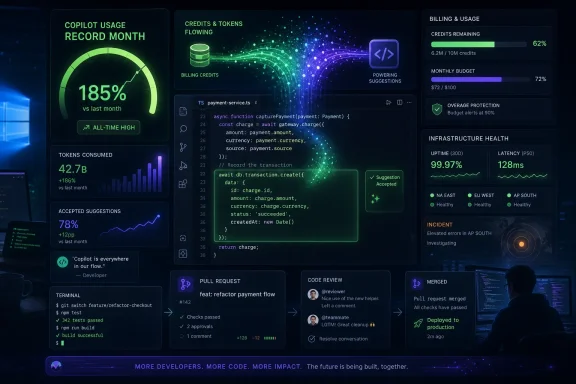 GitHub’s Record Month Was a Pricing Story Before It Was a Product Story
The easiest interpretation of GitHub’s June surge is that Copilot is winning because developers want AI coding tools. That is true, but incomplete. Developers already wanted AI coding tools before June; what changed was the commercial wrapper around that demand.GitHub’s move away from premium request units and toward AI Credits turned Copilot into something closer to a cloud service than a conventional software subscription. The old model gave users a plan, a ceiling, and a somewhat abstract sense of how many expensive interactions they had left. The new model maps Copilot use more directly to token consumption, model choice, and agentic workload.
That matters because modern AI coding is no longer just autocomplete with better marketing. Copilot now spans chat, command-line interactions, code review, repository-aware agent sessions, and increasingly autonomous workflows that can touch many files at once. A short inline suggestion and a sprawling multi-step refactor are not remotely equivalent from a compute-cost standpoint, and GitHub’s pricing change is an admission that the old subscription framing could not absorb that difference forever.
The reported internal reaction from Fedorov, cautious but upbeat, fits that reality. GitHub can celebrate record usage, but it cannot casually disclose the underlying numbers or promise the pricing will remain benign. A quarter-end close sharpens that caution. Usage is the good news; the margin profile is the part everyone in Redmond will be watching.
The Flat-Rate Illusion Finally Broke
For years, developer tools trained users to think in seats. You paid per developer per month, sometimes with tiers for enterprise governance, security, or support. That model works neatly when the marginal cost of one more action is near zero.AI coding breaks that assumption. Every chat session, agent run, and repository-scale analysis consumes inference capacity. The more ambitious the tool becomes, the less plausible it is to sell it as an all-you-can-eat utility at a fixed monthly price.
GitHub’s June 1 transition formalized this shift. Copilot plans still have familiar headline prices, but the substance has changed: users receive monthly AI Credit allowances, and heavier usage can require more budget. Code completions remain included on paid plans, which preserves the original Copilot habit loop, but the more strategically important features — chat, agents, CLI workflows, code review, Spaces, Spark, and third-party agent integrations — live in the metered world.
That distinction is subtle enough to confuse casual users and consequential enough to reshape enterprise procurement. A developer who uses Copilot mostly for suggestions may see little difference. A team experimenting with long-running agents against large repositories may discover that “Copilot usage” is now a budget line with operational variance.
The industry should not pretend this is unique to GitHub. Cursor, Claude Code, OpenAI Codex-style workflows, and other AI-native coding environments all face the same arithmetic. The only real choices are to cap usage, degrade models, raise prices, meter consumption, or subsidize losses in pursuit of market share. GitHub has chosen metering, and June suggests the market did not immediately reject it.
The Surge Validates Demand, Not Yet Loyalty
A record June tells us developers are using Copilot more. It does not, by itself, prove that developers are becoming more loyal to GitHub.That distinction is crucial. The AI coding market is increasingly fluid because the switching cost is not the same as switching version-control platforms. GitHub’s repository network effects remain enormous, but Copilot’s competitive arena extends into IDEs, terminals, browser-based development, pull request review, cloud agents, and model routers. Developers can keep their code on GitHub while sending their AI attention elsewhere.
This is where Cursor, Anthropic’s Claude Code, and OpenAI’s coding tools matter. They are not merely “features” competing with one GitHub feature. They are attempts to own the developer’s working loop. If an AI assistant becomes the place where the developer plans, edits, tests, reviews, and reasons about code, the repository host risks becoming infrastructure beneath somebody else’s interface.
GitHub still has a formidable advantage because it sits at the center of collaboration. Pull requests, issues, Actions, packages, security alerts, and enterprise policy all create natural places to insert Copilot. But that advantage is only durable if the assistant feels native, fast, reliable, and economically sane.
The reported record usage after metered billing therefore cuts both ways. It shows GitHub has enough distribution to drive immediate consumption at scale. It also shows just how aggressively users will burn through AI capacity when the tool is embedded in daily work.
Agentic Coding Turns Infrastructure Into Product Strategy
The most revealing detail around GitHub’s AI boom is not the pricing change. It is the reported infrastructure strain.GitHub has reportedly experienced numerous major outages this year as AI demand climbed, and Microsoft has reportedly leaned on Amazon Web Services capacity even as it continues its broader effort to move GitHub more fully onto Azure. That is an awkward headline for Microsoft, but it is also a brutally practical one. If developers are going to hand more work to AI agents, latency and availability become part of the product’s core value proposition.
This is a new pressure point for developer platforms. Traditional Git hosting outages were already painful, but they tended to interrupt collaboration, builds, or deployment pipelines. AI coding outages interrupt the act of producing code itself. When the assistant is woven into the editor, terminal, review process, and task planning, downtime does not feel like a missing add-on. It feels like a productivity limb going numb.
The infrastructure problem is also not just about raw compute. Agentic coding workloads can be bursty, context-heavy, and model-dependent. A single developer asking for a quick explanation is one thing; thousands of teams asking agents to reason across repositories, run tests, generate patches, and revise them repeatedly is another. The capacity planning resembles cloud infrastructure more than software licensing.
Microsoft can afford a massive capital expenditure race, but money alone does not instantly create usable AI serving capacity in the right regions, with the right accelerators, reliability posture, data controls, and enterprise assurances. GitHub’s challenge is to make the multi-cloud scramble invisible to developers. If users can feel the seams, rivals will exploit them.
Microsoft’s GitHub Problem Is Also Microsoft’s Windows Problem
For WindowsForum readers, this may look at first like a developer-platform story with little bearing on Windows. That would be a mistake. Microsoft’s broader AI strategy depends on convincing professionals that Copilot-branded assistants are not novelty overlays but working infrastructure.GitHub Copilot is one of the clearest tests of that promise because developers are unforgiving users. They notice latency, hallucinated commands, broken context, unreliable extensions, cost ambiguity, and degraded workflows immediately. If Microsoft cannot make Copilot feel dependable for developers, it will struggle to persuade admins and knowledge workers that Copilot everywhere else deserves deep operational trust.
There is also a direct endpoint angle. Much of Copilot’s value is experienced through IDEs such as Visual Studio Code and Visual Studio, terminals, browsers, and increasingly remote or cloud-based development environments. Windows remains a primary workstation OS for many enterprise developers, especially in Microsoft-heavy shops. If AI coding becomes standard workflow, Windows development machines, corporate proxies, identity policies, endpoint security products, and network controls all become part of the Copilot experience.
That creates familiar IT questions in a new package. Which models are allowed? Which repositories can be indexed? What data leaves the tenant? Who can enable paid usage? How are budgets enforced? What happens when an agent-generated patch introduces a vulnerable dependency? AI coding does not eliminate governance; it gives governance a faster-moving target.
Usage-Based Billing Moves Power Toward Admins
The consumer story around metered AI billing is usually “bill shock.” That is real, especially for individual developers who became accustomed to a monthly subscription hiding the true cost of frontier-model experimentation. But in enterprises, the more important story is control.Under the new structure, GitHub gives organizations more explicit budget mechanisms and administrative decisions around paid overages. If a Business or Enterprise customer does not allow additional paid usage, Copilot can pause when included allowances are exhausted. If paid usage is enabled, admins need to define budgets, alerts, and internal expectations.
That is the right architecture for enterprise procurement, but it also changes the internal politics of developer tooling. Previously, a Copilot seat could be justified as a predictable productivity subscription. Now, heavy agent usage may need to compete with cloud spend, CI minutes, security tooling, and SaaS budgets.
The result will be uneven adoption. Some engineering organizations will encourage aggressive Copilot use because the productivity upside outweighs the bill. Others will restrict model access, cap budgets, or steer developers toward cheaper models for routine tasks. A few will decide that direct API use, model-routing tools, or rival coding agents offer better cost transparency.
GitHub’s strategic goal is obvious: make Copilot the default place where those choices happen. The risk is that metering trains sophisticated customers to scrutinize every layer of the AI coding stack, including GitHub’s markup, model selection, and workflow lock-in.
The Code Review Meter Is the Canary in the Pull Request
One of the most consequential parts of the pricing shift is easy to overlook: Copilot code review can consume both AI Credits and GitHub Actions minutes. That places AI directly inside an already-metered DevOps workflow.For small teams, this may be a manageable annoyance. For large organizations with high pull request volume, automated review can become a meaningful recurring cost, especially if enabled broadly. GitHub’s pitch is that Copilot can extend review coverage, including to pull requests from users who may not have Copilot licenses, but that benefit depends on careful policy configuration.
The underlying trade-off is familiar. Automated review can catch routine problems, explain code paths, and reduce reviewer fatigue. It can also generate noise, miss architectural context, or create a false sense of assurance if teams treat AI comments as equivalent to human judgment.
Metered review makes that trade-off explicit. Every automated pass has a cost, so teams will need to decide where Copilot review is worth invoking. Security-sensitive repositories, high-churn services, and junior-heavy teams may benefit most. Low-risk repos and trivial changes may not justify the spend.
That is not a reason to avoid AI review. It is a reason to treat it like CI/CD: powerful, automatable, measurable, and capable of becoming wasteful when nobody owns the pipeline.
GitHub’s Rivals Are Selling Escape Velocity
Cursor and Claude Code have gained attention because they present themselves less as assistants and more as new work environments. Their implicit promise is escape velocity: stop treating AI as a sidebar and let it drive the coding session.GitHub cannot ignore that narrative. Copilot began as an uncanny autocomplete tool, but the market has moved toward agents that modify projects, run commands, inspect errors, and iterate. GitHub’s own messaging now leans heavily into agentic workflows because the competitive center of gravity has shifted.
This creates a delicate product problem. GitHub must modernize Copilot quickly enough to keep developers from drifting away, but every agentic feature increases infrastructure demand and billing complexity. The better the product gets at doing large tasks, the more expensive it becomes to operate. The more GitHub exposes those costs to users, the more users compare it against alternatives.
That is the paradox of the June record. A usage surge is exactly what GitHub wanted, but it accelerates the hard questions. Can Copilot remain the convenient default while rivals compete on model quality, interface design, autonomy, and perceived value? Can GitHub use its platform integration to beat AI-native startups without making customers feel trapped inside a tollbooth?
The answer will depend less on press releases than on daily developer sentiment. Developers are willing to pay for tools that save real time. They are much less forgiving when a tool becomes expensive, flaky, or administratively burdensome.
The Old GitHub Moat Is Still Wide, But It Has a New Drawbridge
GitHub’s greatest asset remains its position in the software supply chain. Repositories, issues, pull requests, Actions, security scanning, packages, organizations, and enterprise policies create a dense web of workflow gravity. Copilot can draw on that context in ways standalone tools must work harder to replicate.But moats are not walls; they are systems of delay. GitHub’s platform advantage slows defection, but it does not prevent developers from adopting a better AI coding loop if one emerges. The market has already shown that developers will install new editors, route through new agents, and pay for multiple AI subscriptions if the productivity payoff is obvious.
GitHub’s task is to turn platform context into product quality. If Copilot understands the repository, respects enterprise policy, integrates with Actions, participates usefully in review, and keeps costs visible, it can be more than another chat box. It can become the control plane for AI-assisted software development.
If it fails, the same integrations could become liabilities. A metered assistant tied into code review, CI minutes, and enterprise billing can feel comprehensive or claustrophobic depending on reliability and trust. Microsoft knows this from Windows itself: integration is beloved when it reduces friction and resented when it removes choice.
The June usage record suggests GitHub still has the drawbridge lowered. Developers are coming in. The question is whether they will stay once the bills, limits, and outages become part of the lived experience.
The AI Coding Boom Is Becoming an Operations Problem
The first phase of AI coding was about amazement. The second was about productivity. The third, now arriving, is about operations.Engineering leaders need to know not just whether Copilot can write useful code, but how to budget it, govern it, audit it, and recover when it fails. That means AI coding tools are moving from individual preference to managed infrastructure. The same admins who already think about GitHub permissions, secret scanning, Actions runners, branch protections, and dependency risk now have to think about model access and token burn.
This will change how organizations evaluate success. A team may find that Copilot increases throughput but also increases review load because more code is generated. Another may find that agents help with maintenance work but are too expensive for broad experimentation on frontier models. A third may discover that AI assistance is most valuable not in greenfield coding, but in understanding legacy systems and reducing onboarding time.
None of those outcomes can be captured by a single “usage is up” metric. Usage is an input. The business question is whether the extra usage produces maintainable code, faster delivery, fewer defects, and happier developers.
GitHub’s challenge is to supply the observability layer for that conversation. If admins can see usage without understanding value, they will cut budgets. If developers can feel productivity without understanding cost, they will overspend. The winning AI coding platform will bridge that gap.
A Record Month Does Not Settle the Price Debate
Fedorov’s reported caution on pricing is notable. He reportedly said that rising usage alone did not make him personally feel a need for significant price increases, while avoiding specifics about future policy. That is the sort of statement executives make when the company wants to calm customers without locking itself into a future margin promise.The economics are still moving. Model costs can fall with efficiency improvements, competition, caching, and specialized infrastructure. They can also rise when users shift from simple completions to long-context agentic sessions on premium models. GitHub’s introduction of flex allotments hints at this uncertainty: included usage can adapt as AI economics change.
For customers, that means the current pricing regime should be treated as a live system, not a permanent settlement. Admins should assume model pricing, allowances, multipliers, and plan design will keep evolving. Developers should assume that “which model should I use?” is becoming a cost-performance decision, not just a quality preference.
This is uncomfortable, but not unprecedented. Cloud computing normalized the idea that architecture and cost are intertwined. AI coding is bringing that same discipline into the developer workstation.
The difference is emotional. Developers do not experience cloud bills the same way they experience an assistant interrupting their flow with limits, prompts, or budget warnings. GitHub has to make the economics visible without making the tool feel like a parking meter.
The Practical Shape of GitHub’s June Signal
The June record is best read as a market signal with operational consequences, not a simple victory banner. GitHub has demand, distribution, and Microsoft’s backing. It also has reliability pressure, sharper competition, and customers who are learning to read AI bills.For Windows shops and Microsoft-centric enterprises, Copilot remains one of the most strategically important AI tools to watch. It sits close to developers, close to source code, and close to the systems that ship business software. If it succeeds, it will help normalize metered AI workflows across Microsoft’s ecosystem. If it stumbles, it will become a cautionary tale about turning productivity software into consumption infrastructure too quickly.
The immediate lessons are concrete:
- GitHub’s June 2026 usage surge suggests that demand for AI coding remains strong even after the move to usage-based billing.
- Copilot’s new AI Credit model makes model choice, token consumption, and agentic workflow design part of cost management.
- Code completions remain included in paid plans, but higher-value features such as chat, agents, CLI workflows, Spaces, Spark, and code review are where metering matters most.
- Enterprise admins should set budgets, alerts, and policies before broad agentic usage becomes normal developer behavior.
- Reliability is now a competitive feature because AI coding outages can interrupt the act of writing and reviewing code, not just the surrounding collaboration workflow.
- GitHub’s platform advantage is real, but rivals such as Cursor, OpenAI, and Anthropic are competing to own the developer’s daily working loop.
References
- Primary source: 디지털투데이
Published: 2026-06-25T02:02:51.648763
GitHub Copilot usage surges after shift to pay-as-you-go, June results hit record high
GitHub has posted its highest-ever June performance for its AI coding tool Copilot after switching its billing system to a usage-based model, the report said. GitHub CTO Vladimir Fedorov (블라디미르 페도로프) said June was the best month on record but did not disclose figures. GitHub introduced...www.digitaltoday.co.kr - Related coverage: github.blog
GitHub Copilot is moving to usage-based billing - The GitHub Blog
Starting June 1, your Copilot usage will consume GitHub AI Credits.github.blog
- Related coverage: pondero.ai
GitHub Copilot switches to AI Credits billing on June 1 as individual sign-ups stay paused and a Max plan joins the lineup
Starting June 1, 2026, GitHub is replacing premium request units with token-based AI Credits across all Copilot plans, introducing a new $100/month Max tier and keeping base prices flat.pondero.ai
- Related coverage: unerr.dev
GitHub Copilot pricing explained: premium requests, AI Credits, and the agentic bill shock — unerr | unerr
Copilot moved to usage-based AI Credits on June 1, 2026 — and power users saw agentic bills jump 10–50×. What changed, which features are still unlimited, and how to keep agent workflows from draining a month of credits in a day.www.unerr.dev
- Related coverage: rollbrains.github.io
GitHub Copilot AI Credits: Pricing & June 2026 Changes
What Copilot's AI credits really cost, how the new credit system bills you, and exactly what changed in June 2026 — CLI credit limits in plain numbers. rollbrains.github.io
- Related coverage: bighatgroup.com
Copilot Weekly: Usage-Based Billing Lands June 1, 2026 | Big Hat Group Inc.
GitHub Copilot moves to usage-based billing on June 1 with AI Credits replacing premium request units. Plus GPT-5.5 GA, BYOK in VS Code, Visual Studio 18.5 Debugger Agent, faster cloud agent, and a 30× capacity plan.www.bighatgroup.com
- Related coverage: bitsminds.com
- Official source: github.com
GitHub Copilot · Plans & pricing · GitHub
GitHub Copilot works alongside you directly in your editor, suggesting whole lines or entire functions for you. github.com
- Official source: docs.github.com
Usage-based billing for individuals - GitHub Docs
Your Copilot plan includes a monthly allowance of GitHub AI Credits. If you exhaust your AI credits, you can pay extra to keep working. docs.github.com
- Related coverage: brandrums.com
GitHub Copilot Token Billing Shift: June 2026 Playbook
GitHub Copilot moved to token-based AI Credits on June 1, 2026. What changed, why bills are spiking, and how engineering teams should respond.www.brandrums.com - Related coverage: findskill.ai
GitHub Copilot's New AI Credits Billing: What Changes June 1
GitHub Copilot switches to usage-based AI Credits on June 1, 2026. What each plan includes, how overage works, and the $0 cap that stops surprise bills.findskill.ai
- Related coverage: therouter.ai
GitHub Copilot AI Credits, June 2026: Token Billing Explained and Fallback Removed — TheRouter.ai
GitHub Copilot AI Credits launched June 2026, replacing Premium Request Units with token-based billing. The old model fallback that let you keep working on a cheaper model is gone—agentic sessions now stop when credits run out. Here's what changed and how to manage it.therouter.ai
- Related coverage: techradar.com
Microsoft forced to turn to AWS to boost GitHub cloud capacity following AI demand surge | TechRadar
GitHub is growing too aggressively for Azurewww.techradar.com - Related coverage: itpro.com
Everything you need to know about the GitHub Copilot pricing changes | IT Pro
GitHub Copilot pricing changes mean users will be charged based on consumption, rather than a set number of credits.www.itpro.com - Related coverage: tomshardware.com
Github Copilot customers report up to 100-fold price hikes — AI sticker shock bites as Microsoft switches to usage-based pricing | Tom's Hardware
The AI investment chickens have come home to roost.www.tomshardware.com