
Microsoft’s latest Microsoft 365 roadmap update says Azure AI Search will ingest Microsoft Purview sensitivity labels and enforce matching protection policies through built-in indexers, with preview planned for November 2025 and general availability targeted for October 2026 in worldwide multi-tenant cloud environments. The move sounds narrow, almost plumbing-level, but it lands in the middle of the enterprise AI problem Microsoft has been circling for two years: retrieval is now a security boundary. If the search layer feeds the model, then the search layer has to understand the same rules that govern the documents. Otherwise, “secure AI” is just a prompt away from becoming an oversharing engine.
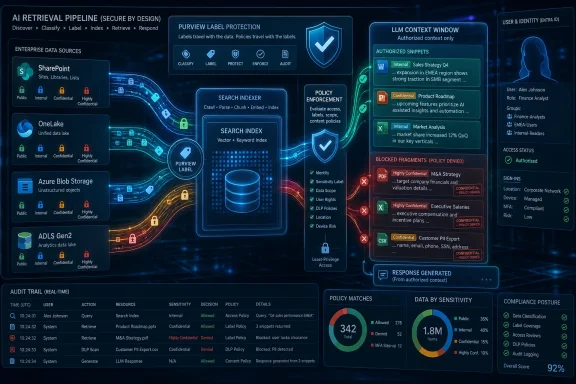
The important word in this roadmap item is not AI. It is honors. Azure AI Search is not merely being positioned as a faster way to index corporate data; Microsoft is saying it will honor Purview labels and the policies attached to them when data is pulled into indexes from SharePoint, OneLake, Azure Blob Storage, and ADLS Gen2.
That matters because retrieval-augmented generation has quietly become the enterprise workaround for every limitation of general-purpose copilots. If a model does not know your business, point it at your documents. If a chatbot cannot answer employee questions, wire it to a search index. If an agent needs “context,” give it a knowledge source.
The catch is that search indexes are copies, and copies have a way of becoming less governed than the source systems they came from. A file that is carefully labeled as confidential in Microsoft 365 can become just another chunk of text if a custom ingestion pipeline strips away classification metadata. Once that chunk is embedded, ranked, retrieved, and handed to a large language model, the organization may have technically preserved access controls in the original repository while functionally bypassing them in the AI workflow.
Microsoft’s answer is to make Purview’s information protection model visible to Azure AI Search itself. That is not glamorous, but it is the sort of architectural change that separates a demo chatbot from something a bank, hospital, law firm, defense contractor, or multinational manufacturer can plausibly approve.
In a conventional search deployment, the main security question was whether the user could open the source document. In an AI deployment, the question becomes more complicated: can the user retrieve a passage, can the app display a generated summary, can the model use the content as hidden context, and can an autonomous agent act on what it has learned? Each step creates a new opportunity to leak more than the user should see.
Sensitivity labels help express business intent in a way that raw access control lists rarely do. A document may be accessible to many people but still marked confidential, restricted, or governed by rules about encryption, external sharing, downloads, printing, or downstream use. If Azure AI Search can ingest those labels and apply corresponding policies at query time, the index stops being a neutral bag of tokens and starts acting like part of the compliance fabric.
That is a big shift for developers. It means the search tier is no longer just a performance component. It becomes a policy enforcement point, and in AI systems, policy enforcement points are where trust either survives or dies.
The weakness in many early RAG systems was not that they produced bad answers. It was that they produced good answers from documents the user should not have been able to exploit in that context. A polished summary of a confidential compensation spreadsheet is still a leak, even if the spreadsheet itself never appears on screen.
This is where Purview integration becomes more than a checkbox. Microsoft is trying to align the RAG pipeline with the same classification and protection machinery that enterprises already use for email, Office documents, SharePoint sites, and compliance workflows. The promise is straightforward: only authorized documents should be returned by search or sent to an LLM.
That phrase — sent to an LLM — is the real tell. In classic enterprise search, the index returned a link or a snippet. In AI search, retrieval often becomes invisible context. Users may never know which documents were consulted, and administrators may struggle to prove which sensitive facts influenced an answer unless the system preserves labels, permissions, and auditability across the pipeline.
Microsoft is effectively acknowledging that AI governance cannot be bolted onto the model alone. It has to begin before the prompt, at the moment enterprise content is discovered, indexed, filtered, and ranked.
Enterprises do not have one knowledge base. They have SharePoint sites full of Office documents, data lakes full of exports and parquet files, blob containers full of PDFs and logs, and OneLake environments tied to analytics and Fabric workloads. AI projects tend to draw from all of them, often under deadline pressure and with security review arriving late.
Built-in indexers matter because they reduce the temptation to build brittle, custom ingestion scripts that treat labels as optional metadata. If the official path carries Purview sensitivity labels into the index and enforces policy during retrieval, Microsoft can tell customers that the secure path is also the default path. That is the only approach that scales, because most organizations will not successfully retrofit governance into every AI proof of concept after the fact.
There is a practical catch, though. The quality of this feature will depend on the maturity of the tenant’s labeling strategy. If labels are inconsistently applied, too broad, too narrow, or politically negotiated into meaninglessness, Azure AI Search cannot magically infer a better governance model. It can honor the policy structure it is given; it cannot compensate for an organization that never agreed what “confidential” means.
That is where many sysadmins and compliance teams will feel the work. The roadmap item may be about Azure AI Search, but the preparation sits in Purview, identity, SharePoint governance, storage permissions, and data classification. Microsoft is adding machinery. Customers still have to supply discipline.
A conventional chatbot leak is bad. An agent that reads sensitive data and then drafts an email, updates a ticket, triggers a workflow, or calls an API based on that data is worse. The agent may not expose the original document directly, but it can still operationalize the sensitive information.
For Microsoft, this is also a platform-control move. If Azure AI Search becomes the governed retrieval layer for enterprise agents, then Purview becomes a central policy engine for Microsoft’s AI ecosystem. That reinforces Microsoft’s argument that the safest AI path is not a random vector database and a pile of glue code, but a stack where identity, labels, audit, DLP, storage, search, and model orchestration all understand each other.
That argument will appeal to regulated enterprises, but it also increases dependency on Microsoft’s cloud architecture. The deeper Purview policies reach into AI Search and agent workflows, the more attractive the integrated Microsoft route becomes — and the harder it may be for organizations to mix and match best-of-breed components without rebuilding governance themselves.
This is the familiar Microsoft bargain: tighter integration in exchange for deeper platform gravity. For many IT departments, that will be a fair trade. For others, especially those pursuing multi-cloud AI architectures, it will be another reason to scrutinize where policy decisions are enforced and how portable those controls really are.
Policy enforcement at query time is only as good as the identity context supplied to the query. If an application queries Azure AI Search using a broad service principal instead of a delegated user identity, administrators need to understand exactly how label enforcement maps to the user on whose behalf the agent is acting. If a workflow retrieves documents for a group, service account, or automated process, the governance model must be explicit.
There is also the problem of derived content. If a document is labeled confidential and the model generates a summary, does the summary inherit the label? If an agent extracts facts from multiple labeled documents, what policy governs the resulting output? If a retrieved passage is never shown to the user but influences a decision, how does audit reconstruct that chain?
Purview has pieces of this broader story, and Microsoft has been expanding its compliance tooling around generative AI, Copilot, and data security posture management. But no single roadmap item can eliminate the messy middle between source document, index, prompt, answer, and action. The strongest reading of this feature is not that it completes the AI governance stack, but that it makes the retrieval layer less of a blind spot.
Administrators should also expect edge cases around encrypted files, unsupported formats, legacy labels, custom policies, and third-party ingestion patterns. The supported built-in indexers are the safe lane. Anything outside that lane will still require careful validation.
For early adopters, the preview is a chance to test whether labels survive ingestion the way security teams expect. It is also a chance to build reference patterns before business units ship their own AI retrieval systems around less governed data stores. Waiting until general availability may be safer for conservative environments, but it risks letting shadow AI architectures harden first.
The right move is to use the preview period as a governance rehearsal. Inventory where AI Search is already indexing enterprise content. Identify which projects use SharePoint, Blob, ADLS Gen2, or OneLake as retrieval sources. Compare those systems against current Purview label policies and ask whether the AI application’s answers would pass the same access review as the source documents.
This is not just a Microsoft 365 admin task. It belongs to the intersection of security engineering, platform engineering, data governance, legal, compliance, and application development. If those groups are not already talking about RAG, this roadmap item is a good excuse to start.
Many organizations have labels that were created for human-facing Office workflows, not machine-scale AI retrieval. A label taxonomy that works for employees choosing between “Public,” “Internal,” and “Confidential” may be too blunt for an agent that can retrieve thousands of chunks across departments. Conversely, an over-engineered taxonomy can become so complex that users apply labels incorrectly or avoid them entirely.
Azure AI Search honoring labels raises the value of getting that taxonomy right. A mislabeled document may now affect not only email forwarding or download restrictions, but also whether AI systems can retrieve and reason over its contents. That makes classification errors more consequential.
The governance burden will fall unevenly. Large enterprises with mature Purview deployments may see this as overdue infrastructure. Smaller organizations that adopted Microsoft 365 labels casually may discover that AI forces them to revisit decisions they made years ago. Developers who previously treated labels as compliance metadata may need to treat them as live authorization signals.
That is not a bad thing. It is, in fact, the point. AI has a way of exposing whether enterprise data governance was real or decorative.
That gives Azure AI Search a sharper role. It is not just “search with vectors.” It is Microsoft’s governed retrieval service for organizations that have already standardized on Entra ID, Purview, Microsoft 365, Azure storage, and increasingly Microsoft’s AI stack. The feature helps Microsoft argue that retrieval security is not an add-on, but a reason to choose the platform.
Competitors can respond, and some already integrate with identity providers, document permissions, and security metadata. But Microsoft has the advantage of owning both the productivity estate where much sensitive content is born and the cloud platform where many AI workloads run. Purview labels are a bridge between those worlds.
The risk for customers is assuming that native integration equals universal coverage. Many enterprise knowledge estates include Google Drive, Box, Salesforce, ServiceNow, file shares, databases, SaaS exports, and homegrown systems. If Azure AI Search only honors Purview labels for certain built-in indexers, organizations still need a strategy for everything else. The Microsoft path may cover the center of gravity, but it will not automatically cover the entire enterprise.
That is the right instinct. Prompts can tell a model not to reveal confidential information, but prompts are weak controls compared with not retrieving that information in the first place. User education can reduce mistakes, but it cannot enforce policy at machine speed. Audit can explain what happened after the fact, but it cannot always prevent the leak.
The best security control is still the boring one: do not put unauthorized data into the context window. By making Azure AI Search aware of Purview labels and policies, Microsoft is trying to move that control earlier in the chain, where it has a better chance of working.
For WindowsForum’s IT pro audience, the practical lesson is clear. The AI conversation is moving out of the model picker and into the governance stack. The winners will not be the teams with the cleverest chatbot demo; they will be the teams that can prove their retrieval layer respects the same boundaries as the rest of the enterprise.
 Microsoft Moves the Guardrail Into the Retrieval Layer
The important word in this roadmap item is not AI. It is honors. Azure AI Search is not merely being positioned as a faster way to index corporate data; Microsoft is saying it will honor Purview labels and the policies attached to them when data is pulled into indexes from SharePoint, OneLake, Azure Blob Storage, and ADLS Gen2.That matters because retrieval-augmented generation has quietly become the enterprise workaround for every limitation of general-purpose copilots. If a model does not know your business, point it at your documents. If a chatbot cannot answer employee questions, wire it to a search index. If an agent needs “context,” give it a knowledge source.
The catch is that search indexes are copies, and copies have a way of becoming less governed than the source systems they came from. A file that is carefully labeled as confidential in Microsoft 365 can become just another chunk of text if a custom ingestion pipeline strips away classification metadata. Once that chunk is embedded, ranked, retrieved, and handed to a large language model, the organization may have technically preserved access controls in the original repository while functionally bypassing them in the AI workflow.
Microsoft’s answer is to make Purview’s information protection model visible to Azure AI Search itself. That is not glamorous, but it is the sort of architectural change that separates a demo chatbot from something a bank, hospital, law firm, defense contractor, or multinational manufacturer can plausibly approve.
The AI Search Index Is Becoming a Compliance System
Azure AI Search has traditionally sat in the infrastructure bucket: indexers, analyzers, vector search, semantic ranking, query processing, and connectors. Purview sits in a different mental bucket: labels, DLP, retention, compliance, audit, and data governance. This roadmap item collapses that distinction.In a conventional search deployment, the main security question was whether the user could open the source document. In an AI deployment, the question becomes more complicated: can the user retrieve a passage, can the app display a generated summary, can the model use the content as hidden context, and can an autonomous agent act on what it has learned? Each step creates a new opportunity to leak more than the user should see.
Sensitivity labels help express business intent in a way that raw access control lists rarely do. A document may be accessible to many people but still marked confidential, restricted, or governed by rules about encryption, external sharing, downloads, printing, or downstream use. If Azure AI Search can ingest those labels and apply corresponding policies at query time, the index stops being a neutral bag of tokens and starts acting like part of the compliance fabric.
That is a big shift for developers. It means the search tier is no longer just a performance component. It becomes a policy enforcement point, and in AI systems, policy enforcement points are where trust either survives or dies.
RAG Was Always a Data Governance Problem Wearing an AI Costume
The industry sold retrieval-augmented generation, or RAG, as a way to reduce hallucinations and ground models in trusted enterprise knowledge. That pitch was directionally correct, but incomplete. RAG does not only decide what the model knows; it decides what the model is allowed to know on behalf of a particular user.The weakness in many early RAG systems was not that they produced bad answers. It was that they produced good answers from documents the user should not have been able to exploit in that context. A polished summary of a confidential compensation spreadsheet is still a leak, even if the spreadsheet itself never appears on screen.
This is where Purview integration becomes more than a checkbox. Microsoft is trying to align the RAG pipeline with the same classification and protection machinery that enterprises already use for email, Office documents, SharePoint sites, and compliance workflows. The promise is straightforward: only authorized documents should be returned by search or sent to an LLM.
That phrase — sent to an LLM — is the real tell. In classic enterprise search, the index returned a link or a snippet. In AI search, retrieval often becomes invisible context. Users may never know which documents were consulted, and administrators may struggle to prove which sensitive facts influenced an answer unless the system preserves labels, permissions, and auditability across the pipeline.
Microsoft is effectively acknowledging that AI governance cannot be bolted onto the model alone. It has to begin before the prompt, at the moment enterprise content is discovered, indexed, filtered, and ranked.
Built-In Indexers Are the Difference Between Policy and Hope
The supported sources listed in the roadmap are telling: SharePoint, OneLake, Azure Blob Storage, and Azure Data Lake Storage Gen2. That covers both the Microsoft 365 collaboration estate and the Azure data estate where many AI projects actually live. It also hints at the operational reality Microsoft is trying to solve.Enterprises do not have one knowledge base. They have SharePoint sites full of Office documents, data lakes full of exports and parquet files, blob containers full of PDFs and logs, and OneLake environments tied to analytics and Fabric workloads. AI projects tend to draw from all of them, often under deadline pressure and with security review arriving late.
Built-in indexers matter because they reduce the temptation to build brittle, custom ingestion scripts that treat labels as optional metadata. If the official path carries Purview sensitivity labels into the index and enforces policy during retrieval, Microsoft can tell customers that the secure path is also the default path. That is the only approach that scales, because most organizations will not successfully retrofit governance into every AI proof of concept after the fact.
There is a practical catch, though. The quality of this feature will depend on the maturity of the tenant’s labeling strategy. If labels are inconsistently applied, too broad, too narrow, or politically negotiated into meaninglessness, Azure AI Search cannot magically infer a better governance model. It can honor the policy structure it is given; it cannot compensate for an organization that never agreed what “confidential” means.
That is where many sysadmins and compliance teams will feel the work. The roadmap item may be about Azure AI Search, but the preparation sits in Purview, identity, SharePoint governance, storage permissions, and data classification. Microsoft is adding machinery. Customers still have to supply discipline.
Microsoft Is Building the Agent Stack Around Enterprise Permission Boundaries
The roadmap description explicitly mentions agentic RAG, and that wording is not accidental. Microsoft, OpenAI, Google, Salesforce, ServiceNow, and nearly every enterprise software vendor are moving from chatbots that answer questions toward agents that search, reason, summarize, draft, route, and act. Agents raise the security stakes because they do not merely display information; they may use information as part of a workflow.A conventional chatbot leak is bad. An agent that reads sensitive data and then drafts an email, updates a ticket, triggers a workflow, or calls an API based on that data is worse. The agent may not expose the original document directly, but it can still operationalize the sensitive information.
For Microsoft, this is also a platform-control move. If Azure AI Search becomes the governed retrieval layer for enterprise agents, then Purview becomes a central policy engine for Microsoft’s AI ecosystem. That reinforces Microsoft’s argument that the safest AI path is not a random vector database and a pile of glue code, but a stack where identity, labels, audit, DLP, storage, search, and model orchestration all understand each other.
That argument will appeal to regulated enterprises, but it also increases dependency on Microsoft’s cloud architecture. The deeper Purview policies reach into AI Search and agent workflows, the more attractive the integrated Microsoft route becomes — and the harder it may be for organizations to mix and match best-of-breed components without rebuilding governance themselves.
This is the familiar Microsoft bargain: tighter integration in exchange for deeper platform gravity. For many IT departments, that will be a fair trade. For others, especially those pursuing multi-cloud AI architectures, it will be another reason to scrutinize where policy decisions are enforced and how portable those controls really are.
The Security Win Is Real, but It Is Not Automatic
There is an easy version of this story in which Microsoft solves oversharing by making AI Search aware of Purview labels. The more realistic version is that Microsoft is closing one of the more obvious holes in enterprise AI architecture, while leaving plenty of implementation risk for customers.Policy enforcement at query time is only as good as the identity context supplied to the query. If an application queries Azure AI Search using a broad service principal instead of a delegated user identity, administrators need to understand exactly how label enforcement maps to the user on whose behalf the agent is acting. If a workflow retrieves documents for a group, service account, or automated process, the governance model must be explicit.
There is also the problem of derived content. If a document is labeled confidential and the model generates a summary, does the summary inherit the label? If an agent extracts facts from multiple labeled documents, what policy governs the resulting output? If a retrieved passage is never shown to the user but influences a decision, how does audit reconstruct that chain?
Purview has pieces of this broader story, and Microsoft has been expanding its compliance tooling around generative AI, Copilot, and data security posture management. But no single roadmap item can eliminate the messy middle between source document, index, prompt, answer, and action. The strongest reading of this feature is not that it completes the AI governance stack, but that it makes the retrieval layer less of a blind spot.
Administrators should also expect edge cases around encrypted files, unsupported formats, legacy labels, custom policies, and third-party ingestion patterns. The supported built-in indexers are the safe lane. Anything outside that lane will still require careful validation.
This Is a Preview Date With Production Consequences
The timeline is unusually important. The roadmap lists preview availability for November 2025 and general availability for October 2026, with the item marked in development and last updated on June 25, 2026. That puts customers in the awkward but familiar Microsoft cloud window where a capability is visible, strategically important, and not yet something every production architecture can treat as settled.For early adopters, the preview is a chance to test whether labels survive ingestion the way security teams expect. It is also a chance to build reference patterns before business units ship their own AI retrieval systems around less governed data stores. Waiting until general availability may be safer for conservative environments, but it risks letting shadow AI architectures harden first.
The right move is to use the preview period as a governance rehearsal. Inventory where AI Search is already indexing enterprise content. Identify which projects use SharePoint, Blob, ADLS Gen2, or OneLake as retrieval sources. Compare those systems against current Purview label policies and ask whether the AI application’s answers would pass the same access review as the source documents.
This is not just a Microsoft 365 admin task. It belongs to the intersection of security engineering, platform engineering, data governance, legal, compliance, and application development. If those groups are not already talking about RAG, this roadmap item is a good excuse to start.
The Hidden Work Is Label Hygiene
Every Purview story eventually becomes a label hygiene story. Sensitivity labels are powerful because they encode business meaning into documents and containers. They are frustrating because business meaning is not always consistent, current, or easy to automate.Many organizations have labels that were created for human-facing Office workflows, not machine-scale AI retrieval. A label taxonomy that works for employees choosing between “Public,” “Internal,” and “Confidential” may be too blunt for an agent that can retrieve thousands of chunks across departments. Conversely, an over-engineered taxonomy can become so complex that users apply labels incorrectly or avoid them entirely.
Azure AI Search honoring labels raises the value of getting that taxonomy right. A mislabeled document may now affect not only email forwarding or download restrictions, but also whether AI systems can retrieve and reason over its contents. That makes classification errors more consequential.
The governance burden will fall unevenly. Large enterprises with mature Purview deployments may see this as overdue infrastructure. Smaller organizations that adopted Microsoft 365 labels casually may discover that AI forces them to revisit decisions they made years ago. Developers who previously treated labels as compliance metadata may need to treat them as live authorization signals.
That is not a bad thing. It is, in fact, the point. AI has a way of exposing whether enterprise data governance was real or decorative.
The Competitive Message Is Aimed at More Than Search
Microsoft is also sending a message to the broader AI tooling market. Vector databases, open-source RAG frameworks, and custom embedding pipelines have moved quickly, and many are excellent at retrieval. Fewer can walk into a regulated enterprise and claim native alignment with Microsoft Purview sensitivity labels, Microsoft 365 permissions, Azure storage, and the compliance expectations surrounding Copilot-style deployments.That gives Azure AI Search a sharper role. It is not just “search with vectors.” It is Microsoft’s governed retrieval service for organizations that have already standardized on Entra ID, Purview, Microsoft 365, Azure storage, and increasingly Microsoft’s AI stack. The feature helps Microsoft argue that retrieval security is not an add-on, but a reason to choose the platform.
Competitors can respond, and some already integrate with identity providers, document permissions, and security metadata. But Microsoft has the advantage of owning both the productivity estate where much sensitive content is born and the cloud platform where many AI workloads run. Purview labels are a bridge between those worlds.
The risk for customers is assuming that native integration equals universal coverage. Many enterprise knowledge estates include Google Drive, Box, Salesforce, ServiceNow, file shares, databases, SaaS exports, and homegrown systems. If Azure AI Search only honors Purview labels for certain built-in indexers, organizations still need a strategy for everything else. The Microsoft path may cover the center of gravity, but it will not automatically cover the entire enterprise.
The Oversharing Problem Finally Gets a Real Engineering Answer
Microsoft’s roadmap item is modest in form and significant in implication. It treats oversharing not as a user-training problem, not as a prompt-engineering problem, and not as a generic AI safety problem, but as an engineering problem inside the retrieval pipeline.That is the right instinct. Prompts can tell a model not to reveal confidential information, but prompts are weak controls compared with not retrieving that information in the first place. User education can reduce mistakes, but it cannot enforce policy at machine speed. Audit can explain what happened after the fact, but it cannot always prevent the leak.
The best security control is still the boring one: do not put unauthorized data into the context window. By making Azure AI Search aware of Purview labels and policies, Microsoft is trying to move that control earlier in the chain, where it has a better chance of working.
For WindowsForum’s IT pro audience, the practical lesson is clear. The AI conversation is moving out of the model picker and into the governance stack. The winners will not be the teams with the cleverest chatbot demo; they will be the teams that can prove their retrieval layer respects the same boundaries as the rest of the enterprise.
The Dates Give IT a Planning Window, Not an Excuse to Wait
The roadmap gives administrators a useful sequence: preview in November 2025, broader general availability targeted for October 2026, and current development status as of the late-June 2026 update. That means the feature is close enough to shape architecture decisions now, but not something to assume blindly across every production scenario.- Organizations should map existing Azure AI Search deployments against SharePoint, OneLake, Azure Blob Storage, and ADLS Gen2 data sources before the feature reaches general availability.
- Security teams should review whether Purview sensitivity labels are consistently applied and whether their protection policies reflect how AI systems will retrieve and summarize content.
- Developers building RAG or agentic applications should avoid custom ingestion shortcuts that discard labels, permissions, or policy metadata.
- Administrators should test delegated identity, service principals, and application access patterns during preview rather than discovering enforcement gaps after launch.
- Compliance teams should treat AI-generated summaries and agent actions as downstream uses of labeled content, not as separate artifacts outside the governance model.
- Enterprises using non-Microsoft repositories should plan how comparable metadata and access controls will be preserved when those sources enter AI workflows.
References
- Primary source: Microsoft 365 Roadmap
Published: 2026-06-25T23:15:45.5477468Z
Loading…
www.microsoft.com - Official source: learn.microsoft.com
Loading…
learn.microsoft.com - Related coverage: m365admin.handsontek.net
Loading…
m365admin.handsontek.net - Official source: techcommunity.microsoft.com
Loading…
techcommunity.microsoft.com - Related coverage: argonsys.com
Loading…
argonsys.com - Related coverage: ryantechinc.com
Loading…
ryantechinc.com
- Official source: download.microsoft.com
PDF_MSFT_Cloud_architecture_information protection for GDPR.vsdx
PDF documentdownload.microsoft.com