
Windows Weekly 989, released June 24, 2026, finds Leo Laporte, Richard Campbell, and Paul Thurrott using Microsoft’s latest Week D Windows preview as a lens for a bigger argument about Windows, AI hardware, Xbox, subscriptions, and the missing “Windows 12.” The episode’s recurring point is that Microsoft is not standing still; it is simply moving the center of gravity away from version numbers and toward services, silicon requirements, cloud economics, and agentic software. That shift is less tidy than a new logo on a Start menu, and far more consequential for the people who have to buy, deploy, secure, and explain these machines.
The old Windows story was easy to understand. Microsoft would spend years building a release, give it a codename, stage a keynote, hand reviewers a build, and then let consumers and IT departments argue about whether it was time to upgrade. Windows 95, XP, 7, 10, and even 11 all fit somewhere inside that model, even when the company insisted that Windows 10 would be the “last version of Windows.”
Week D is the opposite of that theater. It is Windows as operational habit: optional preview updates in the fourth week of the month, security releases on Patch Tuesday, controlled feature rollouts slipping features onto some machines before others, and Insider builds telling the attentive what the mainstream will eventually receive. In Windows Weekly 989, the discussion of Week D as a preview of July’s Patch Tuesday is less about one patch than about Microsoft’s preferred rhythm.
That rhythm gives Microsoft flexibility, but it also turns Windows into a moving target. A feature may be announced, A/B tested, throttled, staged, paused, revived, and finally delivered without a single clean moment when users can say, “this is the new Windows.” For enthusiasts, that can be fun. For administrators, it can feel like reading weather radar for an operating system.
The July preview cycle is a reminder that Patch Tuesday is no longer just about closing holes. It is also one of Microsoft’s product distribution channels. Features arrive inside cumulative updates, and the security calendar gives the company a dependable monthly stage for work that, in a different era, might have been held for a service pack.
That sounds, in classic Microsoft language, like a new platform. But Microsoft did not call it Windows 12. It chose to keep the Windows 11 brand and create a premium hardware tier inside it.
That decision says a great deal about the modern Windows business. A new version number creates excitement, but it also creates resistance. It gives enterprises a reason to delay, consumers a reason to complain, OEMs a reason to negotiate, and competitors a chance to define the narrative. By contrast, Copilot+ PC lets Microsoft push the ecosystem forward without admitting that the old one is obsolete.
The irony is that this makes Windows feel both more stable and more fragmented. The name on the box stays Windows 11, but the feature set increasingly depends on whether the device has the right NPU, the right region, the right Microsoft account state, the right Insider channel, and the right staged rollout flag. The version number has become less informative just as the underlying platform differences have become more important.
That distinction matters because Windows has traditionally prided itself on breadth. It runs on cheap laptops, old desktops, gaming rigs, workstations, rugged tablets, kiosks, and enterprise fleets that seem to outlive the people who deployed them. Copilot+ introduced a more Apple-like idea: the best experience belongs to current hardware designed around the platform owner’s roadmap.
Microsoft has tried to soften that message. Many AI features still run in the cloud. Some experiences are backported. Others are delayed, revised, or expanded over time. But the strategic direction is visible enough: Windows is being rebuilt around a split between what happens locally, what happens in the cloud, and what happens through a hybrid orchestration layer that hides the difference from the user.
That is why “Windows 12” may be the wrong question. The more interesting question is whether Microsoft can convert Windows from a graphical operating system into an agentic environment without breaking trust, performance, privacy, or administrative control. If it succeeds, the number in the About box will matter less. If it fails, no version number will rescue it.
For Windows, that is both tantalizing and dangerous. The PC is the one place where the user’s entire digital life tends to converge: browser sessions, enterprise credentials, local documents, screenshots, chat histories, developer tools, personal photos, VPNs, password managers, and half-forgotten utilities installed years ago. An agent that can orchestrate across that territory could be genuinely useful. It could also become the most sensitive software component on the machine.
This is where the Windows 12 conversation collides with the Recall backlash, the Copilot branding sprawl, and the enterprise demand for predictable controls. Microsoft does not merely need to build clever AI features. It needs to prove that the agentic layer respects boundaries users actually understand and administrators can actually enforce.
The company’s problem is not a lack of ambition. It is that Windows users have been trained by decades of bundled features, defaults, telemetry debates, account nudges, Edge prompts, and update surprises to inspect every new convenience for a hidden agenda. Agentic Windows will need more than demos. It will need restraint.
That creates a tension Microsoft cannot fully solve with software. If the best Windows experiences require newer silicon, and newer silicon ships in more expensive PCs, then the AI transition becomes a price hike with a feature story attached. Enthusiasts may tolerate that. Enterprises will model it. Consumers may simply keep older machines longer.
The Copilot+ PC launch already showed how complicated this can get. Qualcomm’s Snapdragon X systems gave Microsoft a clean AI PC story, but the broader Windows ecosystem still depends on Intel, AMD, Nvidia, driver compatibility, gaming performance, peripheral support, and enterprise imaging realities. A sleek AI laptop is a proof point. A global Windows fleet is a messier proposition.
The danger is that Microsoft and its OEM partners confuse replacement demand with enthusiasm. Many Windows 10 users moved to Windows 11 because support deadlines forced the issue, not because they were clamoring for a redesigned Settings app or a Copilot key. If AI hardware becomes the next shove, Microsoft will need to show value quickly.
That framing is relevant to Windows because Microsoft’s AI pitch has always leaned on augmentation. Copilot helps you write, summarize, search, configure, remember, code, and communicate. The user remains in control. The machine does the drudgery.
But the economics complicate the morality play. Microsoft’s relationship with OpenAI is not just a product partnership; it is also a cloud infrastructure flywheel. The episode notes the criticism that Microsoft’s investment structure can resemble a circular transaction: capital or credits go to OpenAI, OpenAI spends heavily on Azure, and Microsoft books cloud revenue from the consumption. Whether one views that as shrewd platform strategy or financial theater, it illustrates how much pressure there is to make AI usage grow.
That pressure inevitably flows into products. Windows, Office, Azure, GitHub, Edge, Teams, and Xbox all become surfaces where AI consumption can be encouraged, bundled, metered, or justified. The more Microsoft’s growth story depends on AI infrastructure utilization, the harder it becomes to separate user benefit from corporate necessity.
That question applies beyond Google. The modern smart speaker, like the modern AI PC, is not a product in the old sense. It is a hardware endpoint for a service strategy. Its usefulness depends on servers, models, subscriptions, policies, integrations, and a company’s willingness to keep caring after the launch window closes.
Apple and Google’s lack of compelling home theater ecosystems is similarly revealing. The living room should be a natural target for voice, media, home automation, and AI assistance, yet the category remains strangely fragmented. Companies want the platform position, but they have often lacked the patience or clarity to make these systems feel durable.
For Windows users, the lesson is not that smart speakers matter to PC deployment. It is that AI-era hardware inherits the credibility of the service behind it. A Copilot+ PC is only as trustworthy as Microsoft’s willingness to support the features, preserve user choice, and avoid abandoning today’s flagship experience for tomorrow’s rebrand.
Creative software makes the promise especially vivid. An agent that can generate variations, apply brand constraints, resize assets, clean up images, suggest edits, and move work between applications could save real time. It could also flatten craft into prompt management, which is why creative communities remain divided on whether these tools are liberating, exploitative, or both.
The comparison with Windows is useful because Adobe’s users are often professionals who understand their tools deeply. If an AI agent produces mediocre work, they will notice. If it hides assumptions, they will resent it. If it speeds up tedious production while leaving judgment intact, they may adopt it despite philosophical objections.
Microsoft faces a similar test with IT pros and power users. An agent that can explain a setting, diagnose a driver problem, or automate a repetitive workflow is valuable. An agent that changes defaults, hallucinates advice, or pushes users toward cloud services will be treated as Clippy with a budget.
The rumored or expected Xbox shift is not merely a gaming story. It is Microsoft’s broader platform dilemma in miniature. The company owns valuable IP, a subscription service, cloud infrastructure, PC gaming hooks, console hardware, and a brand that still carries weight. But those assets do not automatically add up to a coherent strategy.
If Xbox becomes a device-agnostic gaming layer, then Microsoft must accept that hardware is no longer the center. If it doubles down on hardware, it must justify that hardware against PlayStation, Nintendo, handheld PCs, cloud clients, and living-room PCs. If it leans too heavily on Game Pass, it risks training customers to devalue individual games while raising costs for the company that must feed the catalog.
The note that Microsoft has “dozens” of gaming IP-based movies and TV shows in the works underscores the shift from console platform to entertainment portfolio. Halo, Fallout, Minecraft, Gears, Forza, and other properties are not merely games in this model. They are transmedia assets in a company trying to make Xbox mean more than hardware sales.
Players will complain, but the market has been prepared for this in increments. Deluxe editions, early access bundles, battle passes, cosmetic stores, subscriptions, collector’s editions, and platform-specific upsells have already normalized the idea that the sticker price is only part of the transaction. GTA VI simply has enough cultural gravity to make the new number feel official.
For Xbox, this matters because Game Pass has always existed in tension with premium game pricing. If blockbuster games increasingly launch at $80 or $100-plus editions, a subscription can look more attractive to consumers. But that same price inflation also makes day-one subscription economics harder to sustain unless the service grows, prices rise, or content expectations change.
The industry is not choosing between expensive games and subscriptions. It is building a world where both coexist, each justifying the other. The $80 game makes the subscription look sensible; the subscription makes the à la carte game feel premium; the deluxe edition captures the enthusiast who would have paid more anyway.
That gives Xbox and PlayStation a continuing advantage, at least in theory. Console buyers understand the value proposition: fixed hardware, optimized games, a controller in the box, and a predictable living-room experience. A $1,000-plus Steam Machine appeals to a different buyer, one who wants the PC library and may tolerate PC complexity if the interface is clean enough.
But the existence of such devices still pressures Microsoft. Windows is not automatically the default gaming OS in every living-room or handheld scenario anymore. SteamOS has credibility, Proton has matured, and players increasingly care less about the operating system than about whether their games, saves, controllers, and storefronts work.
This is where Microsoft’s Windows and Xbox strategies intersect. If Windows becomes more expensive, more intrusive, or more AI-laden without improving the gaming experience, Valve has an opening. If Xbox hardware becomes less central, Windows gaming becomes even more important. Microsoft cannot afford to treat PC gamers as captive users.
For individuals, the fix is a spreadsheet and a willingness to cancel. For enterprises, it is SaaS governance. The underlying disease is the same: recurring revenue models are wonderful for vendors and exhausting for customers. Every company wants to be a line item. Users eventually discover they have too many lines.
Microsoft sits at the center of this because it has mastered the subscription transition. Microsoft 365, Game Pass, Copilot add-ons, Azure consumption, GitHub plans, security SKUs, and enterprise bundles all reflect a company that no longer wants to sell software once. It wants to meter value continuously.
That can be fair when the value is continuous. It becomes corrosive when the customer cannot tell whether they are paying for innovation, lock-in, inertia, or fear of disruption. The subscription cull is not anti-technology. It is users rediscovering that convenience has a carrying cost.
That does not mean minimalist tools are immune to modern pressures. They still need cross-platform support, sustainable pricing, sync stories, search, outlines, and direct purchase options. But their appeal rests on a different promise: the tool gets out of the way.
For Windows enthusiasts, this matters because the platform has often been at its best when it supports both extremes. Windows can host Visual Studio, Blender, Excel models, flight simulators, CAD suites, DAWs, and games — but also a plain writing environment that treats text as text. A healthy Windows ecosystem leaves room for software that does not want to become a service portal.
The contrast with agentic computing is not absolute. AI can assist writing, editing, and organization. But iA Writer’s appeal is a reminder that not every workflow benefits from a copilot hovering over it. Sometimes the most advanced feature is silence.
That transition is not inherently bad. Security updates are better than abandoned software. Cloud services can enable real collaboration. Local AI can make machines more responsive and private than cloud-only assistants. Subscriptions can fund ongoing development. Gaming ecosystems can reach more players across more devices.
But each benefit has a shadow. Continuous updates reduce user control. Cloud dependencies weaken ownership. Local AI raises hardware costs. Subscriptions accumulate until they feel like rent. Cross-device gaming can blur the value of dedicated platforms. The same forces that make software more capable also make it harder to know what, exactly, the customer bought.
Microsoft’s challenge is that it operates across every one of these tensions. It is the Windows vendor, the cloud provider, the AI infrastructure partner, the productivity suite owner, the gaming platform holder, the developer tooling company, and the enterprise security supplier. That breadth is its advantage. It is also why users are right to scrutinize every new convenience.
The concrete lessons from this week are not mysterious, but they are easy to miss amid the product names and rumor cycles.
That is why Windows 12 may never arrive in the form rumor culture expects. The next Windows is more likely to appear in pieces: a Week D preview here, an NPU-only feature there, an agent in Settings, a Copilot action in File Explorer, a cloud handoff in search, a security baseline in Patch Tuesday, a hardware badge on the next laptop refresh. If Microsoft can make those pieces feel coherent, useful, and trustworthy, the missing version number will look like discipline. If it cannot, users will keep asking where Windows 12 went because “Windows 11 with more AI” will not feel like an answer.
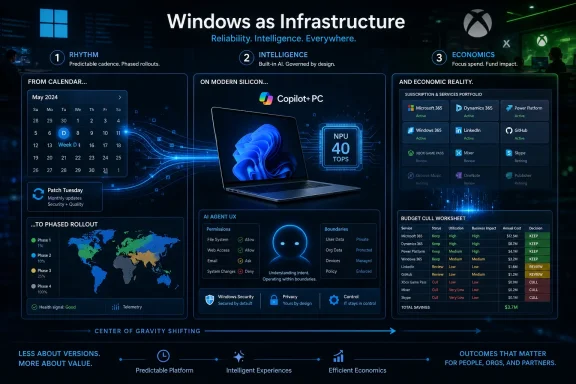 Microsoft Has Replaced the Big Windows Moment With a Monthly Drip
The old Windows story was easy to understand. Microsoft would spend years building a release, give it a codename, stage a keynote, hand reviewers a build, and then let consumers and IT departments argue about whether it was time to upgrade. Windows 95, XP, 7, 10, and even 11 all fit somewhere inside that model, even when the company insisted that Windows 10 would be the “last version of Windows.”Week D is the opposite of that theater. It is Windows as operational habit: optional preview updates in the fourth week of the month, security releases on Patch Tuesday, controlled feature rollouts slipping features onto some machines before others, and Insider builds telling the attentive what the mainstream will eventually receive. In Windows Weekly 989, the discussion of Week D as a preview of July’s Patch Tuesday is less about one patch than about Microsoft’s preferred rhythm.
That rhythm gives Microsoft flexibility, but it also turns Windows into a moving target. A feature may be announced, A/B tested, throttled, staged, paused, revived, and finally delivered without a single clean moment when users can say, “this is the new Windows.” For enthusiasts, that can be fun. For administrators, it can feel like reading weather radar for an operating system.
The July preview cycle is a reminder that Patch Tuesday is no longer just about closing holes. It is also one of Microsoft’s product distribution channels. Features arrive inside cumulative updates, and the security calendar gives the company a dependable monthly stage for work that, in a different era, might have been held for a service pack.
The Windows 12 Question Is Really a Windows Identity Crisis
The most revealing segment of the episode is not the update chatter but the “so, what about Windows 12?” detour. Thurrott’s framing is important because it cuts against the rumor mill. Copilot+ PC, he suggests, was once the kind of hardware-and-software moment that could plausibly have been Windows 12. It brought a new baseline of AI-capable silicon, a Microsoft-branded class of PCs, and a set of experiences that were not meant to be equally available on every machine.That sounds, in classic Microsoft language, like a new platform. But Microsoft did not call it Windows 12. It chose to keep the Windows 11 brand and create a premium hardware tier inside it.
That decision says a great deal about the modern Windows business. A new version number creates excitement, but it also creates resistance. It gives enterprises a reason to delay, consumers a reason to complain, OEMs a reason to negotiate, and competitors a chance to define the narrative. By contrast, Copilot+ PC lets Microsoft push the ecosystem forward without admitting that the old one is obsolete.
The irony is that this makes Windows feel both more stable and more fragmented. The name on the box stays Windows 11, but the feature set increasingly depends on whether the device has the right NPU, the right region, the right Microsoft account state, the right Insider channel, and the right staged rollout flag. The version number has become less informative just as the underlying platform differences have become more important.
Copilot+ PC Was the Windows 12 That Microsoft Would Not Name
Copilot+ PC was never just a marketing badge. It was Microsoft’s declaration that future Windows experiences would assume local AI acceleration, and that the PC industry needed a new reason to sell premium hardware after years of “good enough” laptops. The 40 TOPS NPU threshold was a line in the sand: below it, a PC could still run Windows; above it, it could participate in Microsoft’s preferred future.That distinction matters because Windows has traditionally prided itself on breadth. It runs on cheap laptops, old desktops, gaming rigs, workstations, rugged tablets, kiosks, and enterprise fleets that seem to outlive the people who deployed them. Copilot+ introduced a more Apple-like idea: the best experience belongs to current hardware designed around the platform owner’s roadmap.
Microsoft has tried to soften that message. Many AI features still run in the cloud. Some experiences are backported. Others are delayed, revised, or expanded over time. But the strategic direction is visible enough: Windows is being rebuilt around a split between what happens locally, what happens in the cloud, and what happens through a hybrid orchestration layer that hides the difference from the user.
That is why “Windows 12” may be the wrong question. The more interesting question is whether Microsoft can convert Windows from a graphical operating system into an agentic environment without breaking trust, performance, privacy, or administrative control. If it succeeds, the number in the About box will matter less. If it fails, no version number will rescue it.
Agentic Windows Is a Bigger Bet Than a New Start Menu
The phrase “agentic capabilities” has already become another piece of tech-industry fog, but underneath it is a concrete change in how Microsoft wants computing to work. A conventional assistant answers a question or launches a command. An agent interprets intent, gathers context, calls tools, makes decisions, and may act across local apps, cloud services, files, settings, and accounts.For Windows, that is both tantalizing and dangerous. The PC is the one place where the user’s entire digital life tends to converge: browser sessions, enterprise credentials, local documents, screenshots, chat histories, developer tools, personal photos, VPNs, password managers, and half-forgotten utilities installed years ago. An agent that can orchestrate across that territory could be genuinely useful. It could also become the most sensitive software component on the machine.
This is where the Windows 12 conversation collides with the Recall backlash, the Copilot branding sprawl, and the enterprise demand for predictable controls. Microsoft does not merely need to build clever AI features. It needs to prove that the agentic layer respects boundaries users actually understand and administrators can actually enforce.
The company’s problem is not a lack of ambition. It is that Windows users have been trained by decades of bundled features, defaults, telemetry debates, account nudges, Edge prompts, and update surprises to inspect every new convenience for a hidden agenda. Agentic Windows will need more than demos. It will need restraint.
Hardware Inflation Turns the AI PC Into a More Expensive Default
The episode’s hardware thread lands at an awkward moment for the PC market. AI PCs are supposed to refresh demand, but the bill of materials is not moving in Microsoft’s favor. Memory, storage, advanced processors, tariffs, supply chain constraints, and premium display expectations have all put upward pressure on the machines that are supposed to carry Windows into its next phase.That creates a tension Microsoft cannot fully solve with software. If the best Windows experiences require newer silicon, and newer silicon ships in more expensive PCs, then the AI transition becomes a price hike with a feature story attached. Enthusiasts may tolerate that. Enterprises will model it. Consumers may simply keep older machines longer.
The Copilot+ PC launch already showed how complicated this can get. Qualcomm’s Snapdragon X systems gave Microsoft a clean AI PC story, but the broader Windows ecosystem still depends on Intel, AMD, Nvidia, driver compatibility, gaming performance, peripheral support, and enterprise imaging realities. A sleek AI laptop is a proof point. A global Windows fleet is a messier proposition.
The danger is that Microsoft and its OEM partners confuse replacement demand with enthusiasm. Many Windows 10 users moved to Windows 11 because support deadlines forced the issue, not because they were clamoring for a redesigned Settings app or a Copilot key. If AI hardware becomes the next shove, Microsoft will need to show value quickly.
Cory Doctorow’s “Reverse Centaur” Cuts Close to Microsoft’s AI Economics
The episode’s discussion of Cory Doctorow’s new book brings a useful outside vocabulary to Microsoft’s AI moment, even if the new neologism is apparently less elegant than “enshittification.” The “reverse centaur” idea, as discussed on the show, points to a fear that AI will not simply augment humans. Instead, humans may become the support system for automated systems that capture the credit, set the pace, and define the work.That framing is relevant to Windows because Microsoft’s AI pitch has always leaned on augmentation. Copilot helps you write, summarize, search, configure, remember, code, and communicate. The user remains in control. The machine does the drudgery.
But the economics complicate the morality play. Microsoft’s relationship with OpenAI is not just a product partnership; it is also a cloud infrastructure flywheel. The episode notes the criticism that Microsoft’s investment structure can resemble a circular transaction: capital or credits go to OpenAI, OpenAI spends heavily on Azure, and Microsoft books cloud revenue from the consumption. Whether one views that as shrewd platform strategy or financial theater, it illustrates how much pressure there is to make AI usage grow.
That pressure inevitably flows into products. Windows, Office, Azure, GitHub, Edge, Teams, and Xbox all become surfaces where AI consumption can be encouraged, bundled, metered, or justified. The more Microsoft’s growth story depends on AI infrastructure utilization, the harder it becomes to separate user benefit from corporate necessity.
The Smart Home Sidebar Is Really a Trust Story
The Google Home Speaker discussion may seem like a detour, but it fits the episode’s larger anxiety about platform stewardship. Google shipping a Gemini-powered speaker while discontinuing older Nest Audio and Nest Mini products raises the familiar question: can users trust a cloud company to maintain hardware long enough for that hardware to feel like an appliance?That question applies beyond Google. The modern smart speaker, like the modern AI PC, is not a product in the old sense. It is a hardware endpoint for a service strategy. Its usefulness depends on servers, models, subscriptions, policies, integrations, and a company’s willingness to keep caring after the launch window closes.
Apple and Google’s lack of compelling home theater ecosystems is similarly revealing. The living room should be a natural target for voice, media, home automation, and AI assistance, yet the category remains strangely fragmented. Companies want the platform position, but they have often lacked the patience or clarity to make these systems feel durable.
For Windows users, the lesson is not that smart speakers matter to PC deployment. It is that AI-era hardware inherits the credibility of the service behind it. A Copilot+ PC is only as trustworthy as Microsoft’s willingness to support the features, preserve user choice, and avoid abandoning today’s flagship experience for tomorrow’s rebrand.
Adobe Shows the Same Agentic Future From the Creative Side
Adobe’s move to bring a creative agent into Firefly and major Creative Cloud applications is another sign that agentic software is becoming the default enterprise software pitch. Microsoft is not alone in arguing that the next interface is not a toolbar or a ribbon but a collaborator that understands context and executes multi-step work.Creative software makes the promise especially vivid. An agent that can generate variations, apply brand constraints, resize assets, clean up images, suggest edits, and move work between applications could save real time. It could also flatten craft into prompt management, which is why creative communities remain divided on whether these tools are liberating, exploitative, or both.
The comparison with Windows is useful because Adobe’s users are often professionals who understand their tools deeply. If an AI agent produces mediocre work, they will notice. If it hides assumptions, they will resent it. If it speeds up tedious production while leaving judgment intact, they may adopt it despite philosophical objections.
Microsoft faces a similar test with IT pros and power users. An agent that can explain a setting, diagnose a driver problem, or automate a repetitive workflow is valuable. An agent that changes defaults, hallucinates advice, or pushes users toward cloud services will be treated as Clippy with a budget.
Xbox Waits for the Restructuring Everyone Can Feel Coming
The Xbox portion of the episode has the atmosphere of a storm watch. No massive changes have landed yet, but the expectation of significant movement hangs over the conversation. That is unsurprising after years in which Microsoft has bought studios, expanded Game Pass, put former exclusives on rival platforms, experimented with cloud gaming, and struggled to explain what “Xbox” means when it is no longer synonymous with a box under the television.The rumored or expected Xbox shift is not merely a gaming story. It is Microsoft’s broader platform dilemma in miniature. The company owns valuable IP, a subscription service, cloud infrastructure, PC gaming hooks, console hardware, and a brand that still carries weight. But those assets do not automatically add up to a coherent strategy.
If Xbox becomes a device-agnostic gaming layer, then Microsoft must accept that hardware is no longer the center. If it doubles down on hardware, it must justify that hardware against PlayStation, Nintendo, handheld PCs, cloud clients, and living-room PCs. If it leans too heavily on Game Pass, it risks training customers to devalue individual games while raising costs for the company that must feed the catalog.
The note that Microsoft has “dozens” of gaming IP-based movies and TV shows in the works underscores the shift from console platform to entertainment portfolio. Halo, Fallout, Minecraft, Gears, Forza, and other properties are not merely games in this model. They are transmedia assets in a company trying to make Xbox mean more than hardware sales.
Game Prices Are Finally Saying the Quiet Part Out Loud
The GTA VI price discussion is where the economics become impossible to ignore. A base price of $79.99, with higher editions above that, signals that the $70 ceiling for blockbuster games was never going to hold forever. Development budgets, marketing spend, licensing expectations, long production cycles, and the opportunity cost of massive teams have all been pushing the industry toward a new price tier.Players will complain, but the market has been prepared for this in increments. Deluxe editions, early access bundles, battle passes, cosmetic stores, subscriptions, collector’s editions, and platform-specific upsells have already normalized the idea that the sticker price is only part of the transaction. GTA VI simply has enough cultural gravity to make the new number feel official.
For Xbox, this matters because Game Pass has always existed in tension with premium game pricing. If blockbuster games increasingly launch at $80 or $100-plus editions, a subscription can look more attractive to consumers. But that same price inflation also makes day-one subscription economics harder to sustain unless the service grows, prices rise, or content expectations change.
The industry is not choosing between expensive games and subscriptions. It is building a world where both coexist, each justifying the other. The $80 game makes the subscription look sensible; the subscription makes the à la carte game feel premium; the deluxe edition captures the enthusiast who would have paid more anyway.
The Steam Machine Price Makes the Console Argument Strange Again
The reported Steam Machine pricing, starting above $1,000 without a controller, is a reminder that the PC-console boundary remains stubbornly weird. Valve can sell openness, Steam libraries, living-room PC gaming, and a console-like experience, but it cannot repeal hardware economics. A small gaming PC with decent performance costs real money.That gives Xbox and PlayStation a continuing advantage, at least in theory. Console buyers understand the value proposition: fixed hardware, optimized games, a controller in the box, and a predictable living-room experience. A $1,000-plus Steam Machine appeals to a different buyer, one who wants the PC library and may tolerate PC complexity if the interface is clean enough.
But the existence of such devices still pressures Microsoft. Windows is not automatically the default gaming OS in every living-room or handheld scenario anymore. SteamOS has credibility, Proton has matured, and players increasingly care less about the operating system than about whether their games, saves, controllers, and storefronts work.
This is where Microsoft’s Windows and Xbox strategies intersect. If Windows becomes more expensive, more intrusive, or more AI-laden without improving the gaming experience, Valve has an opening. If Xbox hardware becomes less central, Windows gaming becomes even more important. Microsoft cannot afford to treat PC gamers as captive users.
The Subscription Cull Is the Consumer Version of IT Governance
The tip of the week — cutting subscriptions to save roughly $100 a month — may sound like personal finance filler, but it captures one of the defining user experiences of 2026. The digital household has become a miniature procurement department. Streaming services, cloud storage, password managers, productivity suites, game subscriptions, news sites, creator platforms, fitness apps, VPNs, and AI tools all nibble at the monthly budget.For individuals, the fix is a spreadsheet and a willingness to cancel. For enterprises, it is SaaS governance. The underlying disease is the same: recurring revenue models are wonderful for vendors and exhausting for customers. Every company wants to be a line item. Users eventually discover they have too many lines.
Microsoft sits at the center of this because it has mastered the subscription transition. Microsoft 365, Game Pass, Copilot add-ons, Azure consumption, GitHub plans, security SKUs, and enterprise bundles all reflect a company that no longer wants to sell software once. It wants to meter value continuously.
That can be fair when the value is continuous. It becomes corrosive when the customer cannot tell whether they are paying for innovation, lock-in, inertia, or fear of disruption. The subscription cull is not anti-technology. It is users rediscovering that convenience has a carrying cost.
iA Writer’s Windows Moment Is a Small Rebellion Against Software Bloat
The pick of iA Writer is a quieter but telling counterpoint to the rest of the episode. In a week dominated by AI agents, platform economics, gaming megafranchises, and hardware transitions, a Markdown editor that emphasizes authorship on Windows feels almost subversive. It is software built around focus rather than orchestration.That does not mean minimalist tools are immune to modern pressures. They still need cross-platform support, sustainable pricing, sync stories, search, outlines, and direct purchase options. But their appeal rests on a different promise: the tool gets out of the way.
For Windows enthusiasts, this matters because the platform has often been at its best when it supports both extremes. Windows can host Visual Studio, Blender, Excel models, flight simulators, CAD suites, DAWs, and games — but also a plain writing environment that treats text as text. A healthy Windows ecosystem leaves room for software that does not want to become a service portal.
The contrast with agentic computing is not absolute. AI can assist writing, editing, and organization. But iA Writer’s appeal is a reminder that not every workflow benefits from a copilot hovering over it. Sometimes the most advanced feature is silence.
The Week’s Real Signal Is That Windows Is Becoming Infrastructure Again
Windows Weekly 989 works because its topics seem scattered only at first glance. Week D, Windows 12, AI agents, Cory Doctorow, Google speakers, Adobe Firefly, Xbox restructuring, GTA pricing, Steam hardware, subscription cuts, and Markdown editors all point toward the same platform transition. The industry is moving from products users own and understand toward continuously updated systems that combine hardware, cloud services, AI models, and recurring payments.That transition is not inherently bad. Security updates are better than abandoned software. Cloud services can enable real collaboration. Local AI can make machines more responsive and private than cloud-only assistants. Subscriptions can fund ongoing development. Gaming ecosystems can reach more players across more devices.
But each benefit has a shadow. Continuous updates reduce user control. Cloud dependencies weaken ownership. Local AI raises hardware costs. Subscriptions accumulate until they feel like rent. Cross-device gaming can blur the value of dedicated platforms. The same forces that make software more capable also make it harder to know what, exactly, the customer bought.
Microsoft’s challenge is that it operates across every one of these tensions. It is the Windows vendor, the cloud provider, the AI infrastructure partner, the productivity suite owner, the gaming platform holder, the developer tooling company, and the enterprise security supplier. That breadth is its advantage. It is also why users are right to scrutinize every new convenience.
The Deer in the Headlights Are the Rest of Us
The episode’s joke-title weirdness aside, “Deer Hate MSDN” captures something accidentally apt about the Microsoft ecosystem. Developers, admins, enthusiasts, and ordinary users are all staring into the glare of a company accelerating toward an AI-defined future while still dragging decades of compatibility, policy, licensing, and trust baggage behind it.The concrete lessons from this week are not mysterious, but they are easy to miss amid the product names and rumor cycles.
- Windows 12 is less important than the way Microsoft is turning Windows 11 into a rolling AI platform with hardware-dependent capabilities.
- Week D previews are now part of Microsoft’s mainstream product strategy, not just optional plumbing for update obsessives.
- Copilot+ PCs should be evaluated as a new Windows tier, not merely as faster laptops with an AI sticker.
- Microsoft’s AI ambitions are inseparable from Azure economics, which makes user value and corporate incentives harder to disentangle.
- Xbox’s future depends on whether Microsoft can define the brand beyond console hardware without making it feel weightless.
- The subscription backlash is becoming a practical budgeting exercise for consumers and a governance problem for organizations.
That is why Windows 12 may never arrive in the form rumor culture expects. The next Windows is more likely to appear in pieces: a Week D preview here, an NPU-only feature there, an agent in Settings, a Copilot action in File Explorer, a cloud handoff in search, a security baseline in Patch Tuesday, a hardware badge on the next laptop refresh. If Microsoft can make those pieces feel coherent, useful, and trustworthy, the missing version number will look like discipline. If it cannot, users will keep asking where Windows 12 went because “Windows 11 with more AI” will not feel like an answer.
References
- Primary source: thurrott.com
Published: 2026-06-26T02:44:23.367917
Windows Weekly 989: Deer Hate MSDN - Thurrott.com
Leo, Richard, and Paul discuss Week D, what happened to Windows 12, hardware price hikes, a new Cory Doctorow book, Xbox and games, and much more.www.thurrott.com - Related coverage: windowslatest.com
Microsoft isn’t launching a subscription-based Windows 12 AI OS in 2026. The rumors are just AI hallucinations.
Windows 12 rumors claim Microsoft will launch an AI-first, subscription OS in 2026. But the claims about Hudson Valley and CorePC are false. www.windowslatest.com
- Related coverage: pureinfotech.com
No, Windows 12 isn't launching in 2026 – here’s what’s really happening - Pureinfotech
No, Windows 12 isn’t launching in 2026. Here’s why the viral AI-powered OS report is wrong and what Microsoft is actually planning. pureinfotech.com
- Related coverage: twit.tv
Windows Weekly | Microsoft Tech Podcast | Windows, Office, Xbox | TWiT
Dive into the world of Microsoft with the Windows Weekly podcast. Join experts Leo Laporte, Paul Thurrott, and Richard Campbell for insights on Windows, Office, Xbox, andtwit.tv - Related coverage: techradar.com
Windows 12 at Build 2026: What to expect | TechRadar
What Build 2026 signals about the future of the Windowswww.techradar.com - Related coverage: hothardware.com
Windows 12 Is Not Likely To Launch In 2026 Despite Viral AI Claims | HotHardware
Microsoft will probably release Windows 12 some day, but don't hold your breath waiting for it to debut in 2026.hothardware.com
- Related coverage: windowsforum.com
Windows 12 Rumors Debunked: No 2026 Release or Subscription OS | Windows Forum
A week of frenetic headlines and social posts claimed Microsoft was readying a shocking pivot: an AI-first Windows 12 arriving in 2026, locked to machines...windowsforum.com - Related coverage: ivy.fm
Windows Weekly (Video HI) | Ivy.fm
Podcast by TWiT. A weekly look at all things Microsoft, including Windows, Office, Xbox, and more, from two of the foremost Windows watchers in the world, Paul Thurrott of Thurrott.com and Mary Jo Foley of All About Microsoft. Records live every Wednesday at 2:00pm Eastern / 11:00am Pacific /...ivy.fm - Official source: news.microsoft.com
- Related coverage: techxplore.com
- Related coverage: windowsreport.com
Windows 11 KB5094126 & KB5093998 June 2026 Patch Tuesday Updates Released
Microsoft has officially released June 2026 Patch Tuesday update KB5094126 for Windows 11 version 24H2 and 25H2. windowsreport.com
- Related coverage: allthings.how
Windows 11 KB5095093 preview brings Point-in-time Restore (build 26200.8728)
The July 2026 preview update adds system recovery snapshots, calendar-based update pausing, and quieter Widgets across 25H2 and 24H2.allthings.how - Related coverage: windowscentral.com
Here are the 6 biggest features and improvements coming to Windows 11 in the June 2026 update on Tuesday | Windows Central
Microsoft's June 2026 Windows 11 update boosts responsiveness, adds Shared Audio, expands NPU metrics, and improves OOBE.www.windowscentral.com - Official source: learn.microsoft.com
Windows 11 - release information | Microsoft Learn
Learn release information for Windows 11 releaseslearn.microsoft.com - Related coverage: tomshardware.com
Microsoft issues emergency update for Windows 11 — fixes broken March preview update rollout from last week | Tom's Hardware
Out-of-band patch addresses installation failures.www.tomshardware.com