
Davicom Semiconductor, Tower Semiconductor, and Taiwan Semiconductor Manufacturing Company are appearing in TradingView valuation-ratio feeds for forward enterprise-value-to-EBIT or EBITDA metrics as semiconductor investors reprice chipmakers around AI demand, specialty foundry capacity, and uneven visibility into future earnings. The interesting part is not that another data terminal has a ratio page. It is that the market is trying to compress wildly different semiconductor businesses into the same deceptively tidy multiple. For Windows users, PC builders, admins, and anyone buying hardware at scale, those multiples are a reminder that the chip boom is not a single story — it is a chain of bottlenecks, pricing power, and capital risk.
Enterprise value to EBIT and enterprise value to EBITDA are supposed to be grown-up ratios. They look past share price, account for debt and cash, and compare a company’s operating earnings against the value the market assigns to the whole enterprise. In theory, that makes them cleaner than the retail-favorite price-to-earnings ratio.
In practice, forward EV multiples in semiconductors are only as good as the assumptions underneath them. A fabless networking-chip designer in Taiwan, a specialty analog foundry in Israel, and the world’s dominant advanced-node manufacturer do not belong in the same mental bucket just because all three sell into the semiconductor supply chain. The ratio is useful precisely because it forces the comparison — and dangerous because it can make unlike businesses appear more comparable than they are.
TradingView’s pages for Davicom, Tower Semiconductor, and TSMC point toward a broader market habit: investors increasingly reach for forward valuation metrics to make sense of a sector where trailing numbers already feel stale. AI server demand, advanced packaging shortages, geopolitical subsidy programs, export controls, and capacity prepayments can change the investment case faster than a backward-looking income statement can explain it.
That matters beyond finance. The same expectations that inflate or compress these multiples shape where foundries spend capital, which customers get capacity, how long lead times persist, and whether enterprise hardware buyers face another cycle of scarcity pricing.
That is why forward EV-to-EBIT for TSMC is not just a valuation ratio. It is a market vote on how durable the AI infrastructure cycle will be, how much pricing power TSMC can retain, and how efficiently it can turn massive capital expenditure into future operating profit. A low-looking multiple could mean the market is underappreciating future earnings. A high-looking multiple could mean investors are paying today for years of near-perfect execution.
The problem is that TSMC is being asked to behave like both a monopoly-quality platform and a capital-intensive industrial manufacturer. Its technology lead gives it scarcity value, but its business still requires huge spending on fabs, equipment, power, water, talent, and geographic diversification. That combination is rare: high strategic importance, strong margins, and relentless capital hunger.
For enterprise IT buyers, the TSMC story shows up in less glamorous places. Server refresh cycles, workstation GPU availability, client PC silicon roadmaps, networking accelerators, and AI inference hardware all trace back to foundry capacity. When TSMC’s forward earnings expectations rise, it usually means demand is strong — but strong demand also has a habit of becoming higher prices, longer allocation cycles, and tougher procurement planning.
That distinction is critical. The AI boom has trained investors to look for advanced-node exposure, but much of the real electronics economy depends on mature and specialty processes. Cars, industrial equipment, medical devices, communications hardware, and embedded systems often need reliability, analog performance, high voltage, or sensor integration more than they need the smallest possible process node.
Forward EV-to-EBITDA can flatter companies like Tower when utilization is improving and depreciation-heavy assets begin to generate better operating leverage. EBITDA strips out depreciation and amortization, which can make sense for comparing capital-intensive operators, but it can also soften the reality that fabs age, equipment must be upgraded, and capacity expansion is never free.
Tower’s recent financial reporting has emphasized year-over-year revenue growth and expectations for sequential improvement. That supports the idea that specialty foundry demand is not dead simply because the loudest market narrative is AI accelerators. But the multiple still has to answer a harder question: is Tower being valued for durable specialty demand, for a cyclical recovery, or for strategic scarcity in a world that suddenly remembers mature nodes matter?
That uncertainty is where the investment story intersects with the hardware story. Specialty chips are the quiet components inside the systems WindowsForum readers actually deploy: NICs, storage controllers, power circuitry, sensors, display hardware, industrial PCs, and edge devices. If specialty foundries run tight, the pain is not a flashy GPU shortage; it is the missing board revision, the delayed appliance, the unavailable ruggedized system, or the suddenly more expensive controller card.
That makes Davicom’s forward EV-to-EBIT page interesting for a different reason. For smaller semiconductor companies, a forward multiple can be less a statement of market consensus than a fragile model built on limited visibility. Analyst coverage may be thinner, liquidity may be lower, and a modest change in expected earnings can swing the ratio dramatically.
Small-cap semiconductor valuation is often a story of optionality. A company may have legacy product lines that throw off cash, niche design wins that improve margins, or emerging products tied to industrial IoT and edge computing. But it may also face brutal pricing pressure, customer concentration, and competition from larger vendors with broader catalogs.
For sysadmins and IT buyers, companies like Davicom matter because the edge of the network is full of unglamorous silicon. USB-to-Ethernet adapters, embedded network controllers, industrial gateways, and appliance boards rarely drive the front-page chip narrative. Yet they determine whether a field device can be serviced, whether a low-cost endpoint works with a Windows image, or whether a vendor can keep shipping a product line for another five years.
The long tail of semiconductors is where the industry’s abstraction breaks down. Cloud buyers may think in GPUs and CPUs, but real deployments also depend on PHYs, controllers, firmware, drivers, and reference designs. A valuation multiple cannot tell you whether a device driver will behave on the next Windows release, but it can hint at whether a supplier has the earnings base and market confidence to keep investing.
In semiconductors, forward estimates are especially treacherous because the industry moves in cycles while pretending each cycle is structurally different. Demand spikes, customers double-order, capacity expands, inventories normalize, and margins compress. Then a new platform shift arrives and the process begins again with better slides.
AI may indeed be different in scale, and for TSMC it has already altered the revenue mix and capital plan. But “different” does not mean immune to overbuild, customer concentration, or margin pressure. The most dangerous period in any semiconductor cycle is when the growth story is true enough to justify almost any price.
EV-to-EBIT and EV-to-EBITDA are attempts to impose discipline on that excitement. They ask how much investors are paying for operating earnings rather than vibes. But when earnings forecasts are themselves downstream of exuberant demand assumptions, the discipline can become circular.
That is why readers should treat these ratios as starting points, not verdicts. A multiple without context is like a benchmark score without thermals, power draw, firmware version, or workload profile. It may be accurate and still incomplete.
For a capital-light software company, the gap might be less central. For a foundry or chip manufacturer, depreciation is not an accounting footnote; it is the shadow cast by past capital spending. Every fab tool has a useful life, every process generation has a competitiveness window, and every expansion creates future depreciation that earnings must absorb.
This is why Tower’s EV-to-EBITDA lens and TSMC’s EV-to-EBIT lens can lead readers toward different instincts. EBITDA can highlight cash-generating capacity before non-cash charges. EBIT can remind investors that fabs are not magic boxes; they are expensive machines embedded in an even more expensive manufacturing ecosystem.
Neither metric is inherently superior. The right one depends on the question. If the question is near-term operating momentum, EBITDA has value. If the question is long-term economic profitability after the cost of capital equipment, EBIT deserves more respect.
For IT professionals, this accounting distinction has a practical analogue. A data center can look efficient if you ignore depreciation, refresh obligations, power upgrades, and cooling retrofits. But anyone who has managed infrastructure knows the bill eventually arrives. Semiconductor companies live with the same truth at industrial scale.
But certainty has become expensive. AI demand has pulled forward capital spending, intensified competition for capacity, and encouraged investors to treat semiconductor exposure as a strategic asset class rather than a cyclical industry. That shift may be justified, but it also reduces the margin for error.
The most important risk is not that AI demand vanishes overnight. It is that expectations become too smooth. Hardware ramps are lumpy. Customer forecasts change. Export rules shift. Governments subsidize fabs for strategic reasons that do not always align with shareholder returns. Power availability, water constraints, earthquakes, geopolitical tension, and tool delivery schedules all sit between demand and revenue.
A forward EV multiple compresses those risks into one number. That is convenient for a chart and inadequate for reality. The number may be useful, but the story around the number is where the truth lives.
For Windows enthusiasts, the practical lesson is that hardware availability and pricing will continue to be shaped by capital allocation decisions made years before products reach shelves. The chip industry is not a just-in-time miracle anymore, if it ever was. It is a strategic infrastructure contest with quarterly earnings reports attached.
That dynamic affects enterprise buyers in several ways. Server vendors plan around CPU, GPU, memory, networking, and power-component availability. PC OEMs make platform bets based on silicon roadmaps and expected volume. Peripheral and appliance makers depend on controllers and embedded chips whose suppliers may not be household names.
In a normal cycle, procurement teams can treat many of these inputs as background noise. In the post-pandemic, AI-constrained, geopolitically fragmented chip market, that is no longer safe. The supplier behind the supplier can determine whether a product line ships on time.
This is especially relevant for organizations standardizing Windows endpoints or maintaining mixed fleets of industrial and office hardware. A delayed NIC revision, storage controller change, or platform firmware update can create driver validation work that never appeared in the original budget. Component substitutions are not always visible in the model number, but they can be painfully visible in deployment.
The valuation story therefore becomes an operational signal. High expectations for foundries and chip designers may point to strong demand, but they also warn buyers that vendors are optimizing allocation. In a constrained market, the customer with the biggest forecast, longest commitment, or most strategic product often wins.
Financial-data platforms are only as complete as their underlying feeds, estimate coverage, and display logic. A missing or blank forward EV-to-EBIT field can mean estimates are unavailable, the calculation is not meaningful, the page failed to render fully, or the data provider lacks enough consensus input. For smaller or less-covered names, that limitation is common.
This is a useful brake on the urge to automate interpretation. A ratio page without a ratio is not a thesis. It is a prompt to ask why the data is missing and whether the company is covered well enough for forward valuation to carry weight.
Even for heavily followed companies, investors should compare data sources. Enterprise value can vary with market capitalization, debt, cash, minority interests, lease treatment, and currency conversion. Forward EBIT or EBITDA can vary with analyst models, fiscal-year definitions, and update timing. In cross-listed securities, the confusion can multiply.
That matters for Tower as well, where Nasdaq and European trading venues may surface related instruments under different tickers. The underlying business is the same, but data presentation can differ by exchange, currency, and feed. A serious reading starts by making sure the ratio describes the company, not an artifact of the listing.
TSMC’s defense is technological leadership, scale, and customer dependency. Tower’s defense is specialized manufacturing capability and relationships in markets where process knowledge matters. Davicom’s defense, if sustained, is product relevance in embedded connectivity niches where long life cycles and practical integration can matter more than glamour.
Forward EV ratios try to price those defenses. A premium multiple says the market believes earnings will be durable, growing, or strategically scarce. A discount says investors see cyclicality, execution risk, low growth, or poor visibility. The art is knowing which judgment is deserved.
For readers who care about the Windows ecosystem, the health of all three layers matters. Advanced nodes power CPUs, GPUs, NPUs, and accelerators. Specialty foundries support the analog and mixed-signal world around them. Smaller IC designers fill the connective tissue that makes devices affordable, serviceable, and deployable.
The PC is no longer just a CPU platform. It is a bundle of compute, connectivity, sensors, firmware, security modules, power management, and increasingly AI acceleration. A narrow view of semiconductor valuation misses the messy system reality.
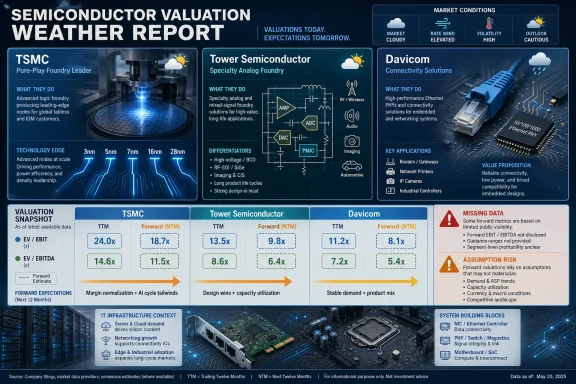 The Semiconductor Rally Has Turned the Multiple Into a Shortcut
Enterprise value to EBIT and enterprise value to EBITDA are supposed to be grown-up ratios. They look past share price, account for debt and cash, and compare a company’s operating earnings against the value the market assigns to the whole enterprise. In theory, that makes them cleaner than the retail-favorite price-to-earnings ratio.In practice, forward EV multiples in semiconductors are only as good as the assumptions underneath them. A fabless networking-chip designer in Taiwan, a specialty analog foundry in Israel, and the world’s dominant advanced-node manufacturer do not belong in the same mental bucket just because all three sell into the semiconductor supply chain. The ratio is useful precisely because it forces the comparison — and dangerous because it can make unlike businesses appear more comparable than they are.
TradingView’s pages for Davicom, Tower Semiconductor, and TSMC point toward a broader market habit: investors increasingly reach for forward valuation metrics to make sense of a sector where trailing numbers already feel stale. AI server demand, advanced packaging shortages, geopolitical subsidy programs, export controls, and capacity prepayments can change the investment case faster than a backward-looking income statement can explain it.
That matters beyond finance. The same expectations that inflate or compress these multiples shape where foundries spend capital, which customers get capacity, how long lead times persist, and whether enterprise hardware buyers face another cycle of scarcity pricing.
TSMC Is the Cleanest Story and the Hardest One to Price
Taiwan Semiconductor Manufacturing Company is the obvious gravitational center. If the modern compute stack has a physical layer, TSMC is one of its load-bearing columns. Nvidia, AMD, Apple, Qualcomm, and many other chip designers depend on the company’s most advanced manufacturing processes, and the AI buildout has only deepened that dependency.That is why forward EV-to-EBIT for TSMC is not just a valuation ratio. It is a market vote on how durable the AI infrastructure cycle will be, how much pricing power TSMC can retain, and how efficiently it can turn massive capital expenditure into future operating profit. A low-looking multiple could mean the market is underappreciating future earnings. A high-looking multiple could mean investors are paying today for years of near-perfect execution.
The problem is that TSMC is being asked to behave like both a monopoly-quality platform and a capital-intensive industrial manufacturer. Its technology lead gives it scarcity value, but its business still requires huge spending on fabs, equipment, power, water, talent, and geographic diversification. That combination is rare: high strategic importance, strong margins, and relentless capital hunger.
For enterprise IT buyers, the TSMC story shows up in less glamorous places. Server refresh cycles, workstation GPU availability, client PC silicon roadmaps, networking accelerators, and AI inference hardware all trace back to foundry capacity. When TSMC’s forward earnings expectations rise, it usually means demand is strong — but strong demand also has a habit of becoming higher prices, longer allocation cycles, and tougher procurement planning.
Tower Semiconductor Shows Why Not Every Foundry Is an AI Toll Road
Tower Semiconductor is a different animal. It is not TSMC with a smaller logo. Tower’s strength is in specialty analog, mixed-signal, power management, radio-frequency, imaging, and other process technologies where leading-edge transistor density is not always the point.That distinction is critical. The AI boom has trained investors to look for advanced-node exposure, but much of the real electronics economy depends on mature and specialty processes. Cars, industrial equipment, medical devices, communications hardware, and embedded systems often need reliability, analog performance, high voltage, or sensor integration more than they need the smallest possible process node.
Forward EV-to-EBITDA can flatter companies like Tower when utilization is improving and depreciation-heavy assets begin to generate better operating leverage. EBITDA strips out depreciation and amortization, which can make sense for comparing capital-intensive operators, but it can also soften the reality that fabs age, equipment must be upgraded, and capacity expansion is never free.
Tower’s recent financial reporting has emphasized year-over-year revenue growth and expectations for sequential improvement. That supports the idea that specialty foundry demand is not dead simply because the loudest market narrative is AI accelerators. But the multiple still has to answer a harder question: is Tower being valued for durable specialty demand, for a cyclical recovery, or for strategic scarcity in a world that suddenly remembers mature nodes matter?
That uncertainty is where the investment story intersects with the hardware story. Specialty chips are the quiet components inside the systems WindowsForum readers actually deploy: NICs, storage controllers, power circuitry, sensors, display hardware, industrial PCs, and edge devices. If specialty foundries run tight, the pain is not a flashy GPU shortage; it is the missing board revision, the delayed appliance, the unavailable ruggedized system, or the suddenly more expensive controller card.
Davicom Is a Reminder That the Chip Economy Has a Long Tail
Davicom Semiconductor sits far from the trillion-dollar AI spotlight. The Taiwanese company is associated with communications-network ICs, including Ethernet-related products and embedded connectivity. This is not the part of the semiconductor market that gets keynote applause, but it is exactly the kind of component layer that keeps ordinary systems useful.That makes Davicom’s forward EV-to-EBIT page interesting for a different reason. For smaller semiconductor companies, a forward multiple can be less a statement of market consensus than a fragile model built on limited visibility. Analyst coverage may be thinner, liquidity may be lower, and a modest change in expected earnings can swing the ratio dramatically.
Small-cap semiconductor valuation is often a story of optionality. A company may have legacy product lines that throw off cash, niche design wins that improve margins, or emerging products tied to industrial IoT and edge computing. But it may also face brutal pricing pressure, customer concentration, and competition from larger vendors with broader catalogs.
For sysadmins and IT buyers, companies like Davicom matter because the edge of the network is full of unglamorous silicon. USB-to-Ethernet adapters, embedded network controllers, industrial gateways, and appliance boards rarely drive the front-page chip narrative. Yet they determine whether a field device can be serviced, whether a low-cost endpoint works with a Windows image, or whether a vendor can keep shipping a product line for another five years.
The long tail of semiconductors is where the industry’s abstraction breaks down. Cloud buyers may think in GPUs and CPUs, but real deployments also depend on PHYs, controllers, firmware, drivers, and reference designs. A valuation multiple cannot tell you whether a device driver will behave on the next Windows release, but it can hint at whether a supplier has the earnings base and market confidence to keep investing.
Forward Multiples Reward Confidence Before Reality Arrives
The word forward does a lot of work in these ratios. It means the denominator is not what the company already earned, but what the market or data provider expects it to earn. That makes the ratio more relevant during inflection points and more vulnerable to fantasy.In semiconductors, forward estimates are especially treacherous because the industry moves in cycles while pretending each cycle is structurally different. Demand spikes, customers double-order, capacity expands, inventories normalize, and margins compress. Then a new platform shift arrives and the process begins again with better slides.
AI may indeed be different in scale, and for TSMC it has already altered the revenue mix and capital plan. But “different” does not mean immune to overbuild, customer concentration, or margin pressure. The most dangerous period in any semiconductor cycle is when the growth story is true enough to justify almost any price.
EV-to-EBIT and EV-to-EBITDA are attempts to impose discipline on that excitement. They ask how much investors are paying for operating earnings rather than vibes. But when earnings forecasts are themselves downstream of exuberant demand assumptions, the discipline can become circular.
That is why readers should treat these ratios as starting points, not verdicts. A multiple without context is like a benchmark score without thermals, power draw, firmware version, or workload profile. It may be accurate and still incomplete.
EBIT and EBITDA Tell Different Stories About the Same Fab
The distinction between EBIT and EBITDA matters more in semiconductors than in many other sectors. EBIT includes depreciation and amortization, so it is closer to the burden of owning and operating expensive manufacturing assets. EBITDA excludes those charges, which can make operating performance look smoother and stronger.For a capital-light software company, the gap might be less central. For a foundry or chip manufacturer, depreciation is not an accounting footnote; it is the shadow cast by past capital spending. Every fab tool has a useful life, every process generation has a competitiveness window, and every expansion creates future depreciation that earnings must absorb.
This is why Tower’s EV-to-EBITDA lens and TSMC’s EV-to-EBIT lens can lead readers toward different instincts. EBITDA can highlight cash-generating capacity before non-cash charges. EBIT can remind investors that fabs are not magic boxes; they are expensive machines embedded in an even more expensive manufacturing ecosystem.
Neither metric is inherently superior. The right one depends on the question. If the question is near-term operating momentum, EBITDA has value. If the question is long-term economic profitability after the cost of capital equipment, EBIT deserves more respect.
For IT professionals, this accounting distinction has a practical analogue. A data center can look efficient if you ignore depreciation, refresh obligations, power upgrades, and cooling retrofits. But anyone who has managed infrastructure knows the bill eventually arrives. Semiconductor companies live with the same truth at industrial scale.
The AI Boom Is Raising the Price of Certainty
The market is not merely valuing chip companies; it is buying certainty in an uncertain supply chain. TSMC offers the cleanest form of certainty because its advanced-node leadership is difficult to replicate. Tower offers a different kind of certainty in specialty processes customers cannot casually replace. Davicom, if it succeeds, offers niche continuity in the embedded connectivity layer.But certainty has become expensive. AI demand has pulled forward capital spending, intensified competition for capacity, and encouraged investors to treat semiconductor exposure as a strategic asset class rather than a cyclical industry. That shift may be justified, but it also reduces the margin for error.
The most important risk is not that AI demand vanishes overnight. It is that expectations become too smooth. Hardware ramps are lumpy. Customer forecasts change. Export rules shift. Governments subsidize fabs for strategic reasons that do not always align with shareholder returns. Power availability, water constraints, earthquakes, geopolitical tension, and tool delivery schedules all sit between demand and revenue.
A forward EV multiple compresses those risks into one number. That is convenient for a chart and inadequate for reality. The number may be useful, but the story around the number is where the truth lives.
For Windows enthusiasts, the practical lesson is that hardware availability and pricing will continue to be shaped by capital allocation decisions made years before products reach shelves. The chip industry is not a just-in-time miracle anymore, if it ever was. It is a strategic infrastructure contest with quarterly earnings reports attached.
Wall Street’s Chip Math Eventually Lands on the Admin’s Desk
The distance between a TradingView valuation page and a Windows deployment plan is shorter than it looks. When semiconductor companies are richly valued, they can raise capital more easily, justify expansion, and secure customer commitments. When multiples compress, spending discipline returns, marginal projects get delayed, and customers lower in the priority stack may feel it first.That dynamic affects enterprise buyers in several ways. Server vendors plan around CPU, GPU, memory, networking, and power-component availability. PC OEMs make platform bets based on silicon roadmaps and expected volume. Peripheral and appliance makers depend on controllers and embedded chips whose suppliers may not be household names.
In a normal cycle, procurement teams can treat many of these inputs as background noise. In the post-pandemic, AI-constrained, geopolitically fragmented chip market, that is no longer safe. The supplier behind the supplier can determine whether a product line ships on time.
This is especially relevant for organizations standardizing Windows endpoints or maintaining mixed fleets of industrial and office hardware. A delayed NIC revision, storage controller change, or platform firmware update can create driver validation work that never appeared in the original budget. Component substitutions are not always visible in the model number, but they can be painfully visible in deployment.
The valuation story therefore becomes an operational signal. High expectations for foundries and chip designers may point to strong demand, but they also warn buyers that vendors are optimizing allocation. In a constrained market, the customer with the biggest forecast, longest commitment, or most strategic product often wins.
TradingView’s Sparse Pages Say Something Too
The supplied TradingView snippets are notable partly because they are thin. Some pages identify the company, exchange, and metric, while the visible excerpt does not provide a usable value. That absence should not be overread, but it should be respected.Financial-data platforms are only as complete as their underlying feeds, estimate coverage, and display logic. A missing or blank forward EV-to-EBIT field can mean estimates are unavailable, the calculation is not meaningful, the page failed to render fully, or the data provider lacks enough consensus input. For smaller or less-covered names, that limitation is common.
This is a useful brake on the urge to automate interpretation. A ratio page without a ratio is not a thesis. It is a prompt to ask why the data is missing and whether the company is covered well enough for forward valuation to carry weight.
Even for heavily followed companies, investors should compare data sources. Enterprise value can vary with market capitalization, debt, cash, minority interests, lease treatment, and currency conversion. Forward EBIT or EBITDA can vary with analyst models, fiscal-year definitions, and update timing. In cross-listed securities, the confusion can multiply.
That matters for Tower as well, where Nasdaq and European trading venues may surface related instruments under different tickers. The underlying business is the same, but data presentation can differ by exchange, currency, and feed. A serious reading starts by making sure the ratio describes the company, not an artifact of the listing.
The Real Comparison Is Not Davicom Versus TSMC
It is tempting to rank the companies as if they occupy a single ladder: Davicom at the niche end, Tower in the specialty middle, TSMC at the advanced-node summit. That hierarchy is tidy and mostly useless. The better comparison is how each company converts semiconductor demand into defensible operating earnings.TSMC’s defense is technological leadership, scale, and customer dependency. Tower’s defense is specialized manufacturing capability and relationships in markets where process knowledge matters. Davicom’s defense, if sustained, is product relevance in embedded connectivity niches where long life cycles and practical integration can matter more than glamour.
Forward EV ratios try to price those defenses. A premium multiple says the market believes earnings will be durable, growing, or strategically scarce. A discount says investors see cyclicality, execution risk, low growth, or poor visibility. The art is knowing which judgment is deserved.
For readers who care about the Windows ecosystem, the health of all three layers matters. Advanced nodes power CPUs, GPUs, NPUs, and accelerators. Specialty foundries support the analog and mixed-signal world around them. Smaller IC designers fill the connective tissue that makes devices affordable, serviceable, and deployable.
The PC is no longer just a CPU platform. It is a bundle of compute, connectivity, sensors, firmware, security modules, power management, and increasingly AI acceleration. A narrow view of semiconductor valuation misses the messy system reality.
The Chip Multiple Is Now a Supply-Chain Weather Report
The concrete lesson from these TradingView entries is not to buy or sell any of the names. It is to read forward semiconductor valuation as a weather report for future hardware conditions. The sky may be bright, but the pressure system matters.- Forward EV-to-EBIT and EV-to-EBITDA ratios are most useful when they are paired with a clear understanding of the company’s business model and capital intensity.
- TSMC’s valuation is inseparable from AI demand, advanced-node scarcity, geographic expansion, and the cost of maintaining technology leadership.
- Tower Semiconductor should be read as a specialty foundry story, not as a miniature version of the advanced-node race.
- Davicom illustrates the importance of smaller embedded and networking-chip suppliers that rarely dominate headlines but still affect real hardware availability.
- Missing or thin ratio data on financial platforms should be treated as a warning to verify assumptions, not as an invitation to fill the gap with confidence.
- Enterprise IT teams should watch semiconductor valuation cycles because they often foreshadow pricing, allocation, and product-roadmap pressure before it reaches procurement.
References
- Primary source: TradingView
Published: 2026-06-26T04:10:12.542699
Loading…
www.tradingview.com - Related coverage: stockanalysis.com
Loading…
stockanalysis.com - Related coverage: valueinvesting.io
Loading…
www.valueinvesting.io - Related coverage: valueray.com
Loading…
www.valueray.com - Related coverage: simplywall.st
Loading…
simplywall.st - Related coverage: stockopedia.com
Loading…
www.stockopedia.com
- Related coverage: davicom.com.tw
Loading…
www.davicom.com.tw - Related coverage: ir.towersemi.com
Loading…
ir.towersemi.com - Related coverage: towerjazz.gcs-web.com
Loading…
towerjazz.gcs-web.com - Related coverage: globenewswire.com
Loading…
www.globenewswire.com - Related coverage: investing.com
Loading…
www.investing.com - Related coverage: veswin.com
Loading…
www.veswin.com - Related coverage: tomshardware.com
Loading…
www.tomshardware.com - Related coverage: towersemi.com
Loading…
towersemi.com