
Seoul National University said on May 19, 2026, that Professor Jong-Ho Lee’s team demonstrated a CMOS-compatible ferroelectric memory semiconductor that combines probabilistic sampling and deterministic image-generation computation in one memory-array platform, with results published May 8 in Nature Communications. The claim is narrow but important: this is not a finished AI chip ready to displace GPUs, but a device-level proof that a stubborn architectural split in generative AI hardware can be collapsed. If it scales, the work points toward a class of edge AI accelerators that generate rather than merely classify, without dragging every random draw and matrix multiply through separate circuitry. The real story is not that a memory device made faces from a dataset; it is that randomness and reliability, usually treated as enemies in silicon, were made to share the same physical home.
Most AI accelerators were built for a world where neural networks consumed data and returned a stable answer. A classifier looks at an image and says “cat,” a recommendation model ranks options, and a speech model maps audio into text. Those workloads are demanding, but their hardware needs are conceptually familiar: move numbers quickly, multiply and accumulate efficiently, and keep memory close enough that data movement does not dominate the power bill.
Generative AI changes the contract. A generator must not simply compute the same answer every time; it must sample from a distribution, then decode that sample into something coherent. In software, this is natural enough. In hardware, it creates a split personality.
One half of the system wants controlled randomness. The other half wants stable arithmetic. The former is comfortable with noise; the latter spends its life suppressing it. That tension is why many hardware proposals for generative AI have treated sampling as a sidecar function, handled by a separate random-number generator, external circuitry, or software loop, while the accelerator proper does deterministic computation.
That compromise works in a lab notebook and often works in a datacenter, where the machine already has enormous power, cooling, and memory bandwidth budgets. It is much less attractive for small devices that might need on-chip generation under tight energy and latency constraints. Every additional block, wire, conversion, and data transfer becomes a tax.
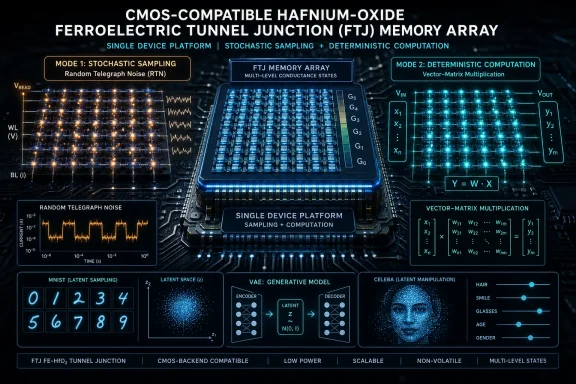
The SNU work attacks that tax at the device layer. Instead of asking one component to provide randomness and another to provide computation, the team used a hafnium-oxide ferroelectric tunnel junction array that changes behavior depending on operating voltage. At one operating regime, the device’s random telegraph noise becomes useful for probabilistic sampling. At another, the same memory platform behaves as a non-volatile, multi-level conductance array for vector–matrix multiplication.
That is the architectural wager: do not bolt randomness onto an accelerator after the fact. Build a device whose physics can be steered between stochastic and deterministic modes.
The SNU team’s platform is based on hafnium oxide, a material family that matters because it is not an exotic laboratory curiosity with no manufacturing path. Hafnia-based ferroelectrics have attracted attention partly because they can fit more naturally into CMOS and very-large-scale integration flows than many earlier ferroelectric materials. That does not make commercialization automatic, but it keeps the work in the realm of plausibility rather than science-fiction packaging.
The paper’s device is a ferroelectric tunnel junction, or FTJ. In simplified terms, the conductance state of the junction can be programmed and retained, allowing the memory cell to represent more than a binary zero or one. Those multi-level conductance states are what make the array useful for analog-style computation, particularly the vector–matrix multiplication operations that neural networks consume by the truckload.
But the same device also exhibits random telegraph noise under higher-voltage conditions. RTN is a fluctuation in current caused by charge trapping and detrapping events. In many conventional electronics contexts, that kind of noise is a nuisance. It perturbs signals, complicates reliability, and gives engineers another reason to add margin.
Here, the nuisance becomes a primitive. By tuning voltage and sampling time, the team showed that the randomness can be controlled enough to generate latent variables for a generative model. Then, by operating in a lower-voltage regime where RTN is suppressed, the same array can perform stable decoding computations.
The distinction matters because the proposal is not simply “use noisy memory for AI.” That phrase has become too broad to be useful. The more precise claim is that a single array can support two different generative-AI functions that normally pull hardware in opposite directions: stochastic latent-space sampling and deterministic decoding.
That two-step structure is why the SNU paper is more than another in-memory computing demonstration. Many accelerators can claim efficient matrix multiplication. Far fewer directly integrate a useful source of hardware stochasticity with the subsequent deterministic math needed to turn a random latent vector into an image.
The research team tested the concept on image-generation tasks, including handwritten digits and face images from the CelebA dataset. The press material emphasizes the CelebA result because faces are more visually persuasive than digits and because facial attributes make diversity easier to understand. The point is not that the hardware has become a modern diffusion model or a rival to cloud image generators. The point is that it completed the generative loop in a hardware framework where sampling and decoding were physically unified.
This distinction is important for WindowsForum readers because AI hardware announcements are now routinely inflated beyond recognition. A semiconductor that generates dataset-scale face images in a research setting is not a consumer GPU, not an NPU shipping in next year’s laptop, and not a replacement for the software stacks that currently power Copilot-class features. It is a proof of a mechanism.
Still, mechanisms matter. The industry’s current AI trajectory is constrained by memory bandwidth, energy consumption, and the awkwardness of moving data among specialized blocks. If generative workloads are to move deeper into PCs, phones, cameras, industrial sensors, vehicles, and embedded systems, the cost of generation has to fall. That will not happen by making every edge device pretend to be a miniature datacenter.
The SNU result should be read as a device-level answer to that problem. It asks whether the basic operations of generation can be packed more tightly into memory itself. That is a more radical question than whether a chip can run a smaller neural net.
Generative image, video, and multimodal workloads are a harder fit. They are heavier, more memory-hungry, and less forgiving of architectural inefficiency. Running a compact model locally is possible today, but doing it quickly, privately, cheaply, and without turning battery life into a rounding error remains a challenge.
That is why hardware research aimed at generative primitives deserves attention even when it is years away from products. The bottleneck is not merely that models are large. It is that the dominant hardware template still reflects a separation of storage, computation, and randomness. Generative AI stresses all three.
In a laptop or workstation, the penalty may show up as fan noise, heat, and power draw. In a sensor, robot, or medical device, it may show up as an impossible deployment. A cloud model can hide the energy cost in someone else’s datacenter; an edge device cannot. If it needs to generate outputs in real time, the silicon has to be more efficient at the primitive level.
SNU’s ferroelectric-memory approach is therefore best understood as part of a broader search for physical shortcuts. In-memory computing uses Kirchhoff’s laws and stored conductance values to perform parallel operations where the data already resides. Probabilistic hardware uses physical noise sources rather than digital pseudorandom machinery to produce randomness. The SNU work combines those two instincts.
The result is not guaranteed to win. Semiconductor history is full of elegant device concepts that stumbled on variability, endurance, yield, peripheral overhead, software integration, or plain economic inertia. But the direction is consistent with the industry’s need: less data movement, fewer separate blocks, and more computation happening where information is stored.
The team reports stable circuit-level generation performance after roughly 100,000 repeated operations. That is a useful validation for a proof of concept, especially because analog and emerging-memory systems often struggle with drift, endurance, and variability. But commercial memory and AI accelerators face punishing expectations across temperature, process variation, lifetime, error handling, and software compatibility.
There is also the problem of scale. A VAE demonstration on MNIST and CelebA is a legitimate scientific testbed, but today’s generative AI conversation is dominated by diffusion models, transformers, multimodal systems, and increasingly complex pipelines. A device that supports stochastic sampling and vector–matrix multiplication could, in principle, be relevant beyond VAEs. But the paper does not magically solve the full-stack problem of mapping frontier models onto emerging memory arrays.
Peripheral circuitry is another place where beautiful ideas meet accounting. The memory array may be compact, but the system still needs drivers, sense amplifiers, converters, control logic, error management, and interfaces. In analog in-memory computing, the array-level efficiency can be impressive while the system-level gain shrinks once the surrounding circuitry is counted.
The researchers appear aware of this. Their stated next steps include improving sampling speed, parallelism, array size, and peripheral circuitry. That list is not a formality; it is the hard part. The physics must become an architecture, the architecture must become a compiler target, and the compiler target must become something system designers can trust.
For the Windows ecosystem, that means nobody should expect this specific device to appear in a Surface or workstation motherboard soon. The more plausible near-term impact is intellectual: it gives AI hardware designers another demonstrated path for collapsing stochastic and deterministic work into a denser substrate.
That compatibility claim does not eliminate risk. It does, however, separate this work from proposals that depend on materials or processes unlikely to survive contact with a foundry roadmap. The semiconductor industry is conservative for good reasons. A device can be brilliant and still fail if it requires too many new process steps, contaminates a line, lacks endurance, or cannot be tested economically.
Ferroelectric memory has long attracted interest because non-volatility and low operating energy are attractive in a world where memory traffic consumes enormous power. The AI angle adds urgency. If the same device class can store weights, compute matrix operations, and generate controlled randomness, it becomes more than a memory candidate. It becomes a possible building block for accelerators that do not resemble the CPU-GPU-NPU hierarchy as we know it.
The phrase single device platform is therefore the center of the announcement. It is easy to overlook because it sounds like press-release language, but it captures the technical ambition. The team is not merely showing that ferroelectric memory can do one more thing. It is showing that different voltage regimes can make one physical platform perform roles that hardware designers usually assign to separate components.
That is also where the caveat lives. Dual-mode operation can simplify architecture only if switching modes is fast, reliable, controllable, and beneficial at scale. If a future implementation spends too much time managing modes, calibrating variation, or correcting errors, the elegance fades. The semiconductor industry does not reward cleverness in isolation; it rewards cleverness that survives packaging, testing, and cost models.
A VAE generating faces from a benchmark dataset is not the same problem as a modern text-to-image model interpreting a prompt, composing a scene, and iterating through a denoising process. The computational structure is different, the model scale is different, and the quality bar is different. The SNU demonstration is better read as a controlled experiment in hardware generative primitives than as a race against diffusion systems.
That does not diminish the result. In fact, it clarifies it. The achievement is not artistic output; it is integration. Sampling and decoding, the two functions highlighted by the researchers, were implemented within one ferroelectric memory-based framework. The images are the proof that the loop can produce recognizable generative output.
This is where semiconductor research and AI culture often talk past each other. AI users judge by visible output. Device researchers judge by mechanisms, endurance, process compatibility, and scaling paths. A fuzzy generated face can be more scientifically important than a polished synthetic portrait if it proves a new hardware primitive.
For IT professionals, the correct question is not “Would I use this to generate images today?” The better question is “Could this kind of device reduce the energy and area cost of future local generative workloads?” On that question, the SNU work is genuinely interesting.
Neural networks tolerate approximate arithmetic. Probabilistic models require distributions. Generative systems need controlled variation. Security primitives use physical unpredictability. Neuromorphic computing borrows from biological systems that are noisy by design. The clean digital abstraction is still indispensable, but it is no longer the only game in town.
The SNU device sits inside that broader reversal. Random telegraph noise, once a reliability headache, becomes a sampling source. Multi-level conductance, once difficult to manage compared with binary storage, becomes useful for dense computation. Ferroelectric retention, originally prized for memory, becomes part of an AI compute substrate.
There is a lesson here for the wider AI hardware market. The next efficiency gains may not come only from more TOPS, narrower quantization, or better packaging. They may come from matching the physics of a device to the statistical structure of the workload. If a model needs randomness, perhaps the hardware should not manufacture randomness through elaborate digital machinery. If a model is dominated by matrix operations over stored weights, perhaps the memory should participate directly in the math.
That is not an argument against GPUs or NPUs. Those architectures will remain central because they are programmable, mature, and supported by vast software ecosystems. But they are general-purpose answers to increasingly specialized workloads. The more AI fragments into cloud-scale training, local inference, embedded perception, and on-device generation, the more room there is for devices that solve a smaller problem extremely well.
The danger is over-specialization. A chip that accelerates one model family beautifully can become obsolete when the software frontier shifts. That is why the SNU work’s long-term value depends on whether stochastic sampling plus deterministic VMM remains a reusable pattern across generative systems, not merely a clever fit for a VAE demonstration.
Local AI features need power-efficient acceleration. Developers want predictable APIs rather than one-off vendor demos. Enterprises want privacy-preserving inference without shipping sensitive data to cloud services. Users want AI features that do not make a premium laptop behave like a gaming rig under load. Those demands all point toward more specialized and more efficient hardware.
Current NPUs are a first answer, not the final one. They are mainly optimized for inference workloads that can be mapped into existing neural-network acceleration flows. Generative workloads, especially those requiring sampling and iterative decoding, put new pressure on memory systems and execution models. If local generation becomes a mainstream PC feature rather than a novelty, the hardware will have to evolve.
That evolution may not look like a discrete “generative AI chip” installed next to the CPU. It may arrive as memory arrays embedded into accelerators, as mixed-signal blocks inside NPUs, or as specialized tiles in advanced packages. It may be invisible to users except through lower latency, lower power draw, and less dependence on cloud services.
For sysadmins, the practical questions will eventually be familiar ones. Can the hardware be managed? Can its behavior be audited? Are results reproducible when they need to be? How do firmware, drivers, and security boundaries work when a device includes stochastic computation? What happens when an enterprise wants deterministic behavior for compliance but generative diversity for user-facing tasks?
These are not reasons to reject probabilistic hardware. They are reasons to treat it as infrastructure, not magic. Once randomness becomes a hardware feature, it becomes something administrators and developers need to understand, constrain, and monitor.
Nvidia’s dominance has made GPUs the default symbol of AI infrastructure, but the search for alternatives is wide open. Some companies pursue custom datacenter accelerators. Others focus on photonics, analog computing, resistive memory, chiplets, or near-memory processing. Universities and research labs explore device concepts that may never ship but may influence future architectures.
The SNU work belongs to this lower layer. It is not competing for headlines against a chatbot release. It is asking whether a basic hardware inefficiency in generative AI can be removed. That kind of research rarely changes user experience immediately, but it can shape what becomes possible five or ten years later.
The timing is notable. As generative AI spreads into video, robotics, design tools, autonomous systems, and personalized content, the compute burden grows faster than many organizations can comfortably absorb. Cloud providers can build larger clusters, but energy, cost, and latency are not abstract constraints. They are business constraints, deployment constraints, and sometimes political constraints.
Edge generation intensifies the problem. A device at the edge cannot assume datacenter cooling or unlimited memory bandwidth. It may need to operate privately, intermittently, and under a strict power envelope. That is where compact hardware primitives become more than academic elegance.
If ferroelectric memory can shoulder both sampling and computation, it offers a route to reducing area and energy overhead in exactly those environments. The word “if” is doing work. But so is the phrase both sampling and computation.
SNU’s team demonstrated that a hafnium-oxide ferroelectric memory array can be operated in two regimes: one that uses random telegraph noise for stochastic latent-variable sampling, and another that suppresses that noise for stable vector–matrix multiplication. They validated the approach using image-generation tasks and reported stable operation over about 100,000 cycles. That is a concrete device-level contribution.
It also leaves major system-level questions unanswered. Scaling array size, improving sampling speed, managing peripheral circuitry, integrating with software stacks, and proving manufacturability remain open challenges. The work is promising because it addresses the right bottleneck, not because it has already cleared every obstacle.
For readers used to consumer AI announcements, this may feel modest. For semiconductor people, modest is often where real progress begins. A convincing device primitive can precede an architecture; an architecture can precede a toolchain; a toolchain can precede products that users eventually take for granted.
The important thing is that the research reframes generative AI hardware as a problem of physical integration, not just acceleration. Sampling is not an afterthought. Randomness is not merely software’s concern. Memory is not just a place where weights wait to be fetched. In this view, the memory array becomes an active participant in generation.
 Generative AI Hardware Has Been Borrowing the Wrong Body
Most AI accelerators were built for a world where neural networks consumed data and returned a stable answer. A classifier looks at an image and says “cat,” a recommendation model ranks options, and a speech model maps audio into text. Those workloads are demanding, but their hardware needs are conceptually familiar: move numbers quickly, multiply and accumulate efficiently, and keep memory close enough that data movement does not dominate the power bill.Generative AI changes the contract. A generator must not simply compute the same answer every time; it must sample from a distribution, then decode that sample into something coherent. In software, this is natural enough. In hardware, it creates a split personality.
One half of the system wants controlled randomness. The other half wants stable arithmetic. The former is comfortable with noise; the latter spends its life suppressing it. That tension is why many hardware proposals for generative AI have treated sampling as a sidecar function, handled by a separate random-number generator, external circuitry, or software loop, while the accelerator proper does deterministic computation.
That compromise works in a lab notebook and often works in a datacenter, where the machine already has enormous power, cooling, and memory bandwidth budgets. It is much less attractive for small devices that might need on-chip generation under tight energy and latency constraints. Every additional block, wire, conversion, and data transfer becomes a tax.
The SNU work attacks that tax at the device layer. Instead of asking one component to provide randomness and another to provide computation, the team used a hafnium-oxide ferroelectric tunnel junction array that changes behavior depending on operating voltage. At one operating regime, the device’s random telegraph noise becomes useful for probabilistic sampling. At another, the same memory platform behaves as a non-volatile, multi-level conductance array for vector–matrix multiplication.
That is the architectural wager: do not bolt randomness onto an accelerator after the fact. Build a device whose physics can be steered between stochastic and deterministic modes.
The Memory Array Becomes the Argument
The most interesting semiconductor papers are often less about performance charts than about what the device is allowed to be. Conventional memory stores information. In-memory computing schemes push that further by using memory arrays to perform operations such as vector–matrix multiplication, reducing the costly shuttling of data between memory and logic. Ferroelectric memory adds another twist because its electrical polarization can remain after power is removed, making it attractive for non-volatile storage and low-power computing.The SNU team’s platform is based on hafnium oxide, a material family that matters because it is not an exotic laboratory curiosity with no manufacturing path. Hafnia-based ferroelectrics have attracted attention partly because they can fit more naturally into CMOS and very-large-scale integration flows than many earlier ferroelectric materials. That does not make commercialization automatic, but it keeps the work in the realm of plausibility rather than science-fiction packaging.
The paper’s device is a ferroelectric tunnel junction, or FTJ. In simplified terms, the conductance state of the junction can be programmed and retained, allowing the memory cell to represent more than a binary zero or one. Those multi-level conductance states are what make the array useful for analog-style computation, particularly the vector–matrix multiplication operations that neural networks consume by the truckload.
But the same device also exhibits random telegraph noise under higher-voltage conditions. RTN is a fluctuation in current caused by charge trapping and detrapping events. In many conventional electronics contexts, that kind of noise is a nuisance. It perturbs signals, complicates reliability, and gives engineers another reason to add margin.
Here, the nuisance becomes a primitive. By tuning voltage and sampling time, the team showed that the randomness can be controlled enough to generate latent variables for a generative model. Then, by operating in a lower-voltage regime where RTN is suppressed, the same array can perform stable decoding computations.
The distinction matters because the proposal is not simply “use noisy memory for AI.” That phrase has become too broad to be useful. The more precise claim is that a single array can support two different generative-AI functions that normally pull hardware in opposite directions: stochastic latent-space sampling and deterministic decoding.
Randomness Is Not a Bug When the Model Needs Dice
Generative models are often described in magical language, but their machinery is bluntly statistical. A variational autoencoder, the model class used in the SNU demonstration, learns a compressed latent representation of data and then generates new outputs by sampling from that latent space and decoding the sample. If the sampling is badly behaved, outputs collapse, drift, or lose diversity. If the decoding is unstable, the generated result degrades.That two-step structure is why the SNU paper is more than another in-memory computing demonstration. Many accelerators can claim efficient matrix multiplication. Far fewer directly integrate a useful source of hardware stochasticity with the subsequent deterministic math needed to turn a random latent vector into an image.
The research team tested the concept on image-generation tasks, including handwritten digits and face images from the CelebA dataset. The press material emphasizes the CelebA result because faces are more visually persuasive than digits and because facial attributes make diversity easier to understand. The point is not that the hardware has become a modern diffusion model or a rival to cloud image generators. The point is that it completed the generative loop in a hardware framework where sampling and decoding were physically unified.
This distinction is important for WindowsForum readers because AI hardware announcements are now routinely inflated beyond recognition. A semiconductor that generates dataset-scale face images in a research setting is not a consumer GPU, not an NPU shipping in next year’s laptop, and not a replacement for the software stacks that currently power Copilot-class features. It is a proof of a mechanism.
Still, mechanisms matter. The industry’s current AI trajectory is constrained by memory bandwidth, energy consumption, and the awkwardness of moving data among specialized blocks. If generative workloads are to move deeper into PCs, phones, cameras, industrial sensors, vehicles, and embedded systems, the cost of generation has to fall. That will not happen by making every edge device pretend to be a miniature datacenter.
The SNU result should be read as a device-level answer to that problem. It asks whether the basic operations of generation can be packed more tightly into memory itself. That is a more radical question than whether a chip can run a smaller neural net.
The Edge AI Dream Needs More Than Smaller Models
The PC industry has spent the last few years selling the idea that AI will migrate from the cloud to the client. Microsoft has pushed Windows toward local inference with NPUs, OEMs have marketed AI PCs, and silicon vendors have competed on trillions of operations per second. But most of that client-side pitch still centers on deterministic inference: background blur, transcription, summarization, classification, indexing, enhancement, and small language-model tasks.Generative image, video, and multimodal workloads are a harder fit. They are heavier, more memory-hungry, and less forgiving of architectural inefficiency. Running a compact model locally is possible today, but doing it quickly, privately, cheaply, and without turning battery life into a rounding error remains a challenge.
That is why hardware research aimed at generative primitives deserves attention even when it is years away from products. The bottleneck is not merely that models are large. It is that the dominant hardware template still reflects a separation of storage, computation, and randomness. Generative AI stresses all three.
In a laptop or workstation, the penalty may show up as fan noise, heat, and power draw. In a sensor, robot, or medical device, it may show up as an impossible deployment. A cloud model can hide the energy cost in someone else’s datacenter; an edge device cannot. If it needs to generate outputs in real time, the silicon has to be more efficient at the primitive level.
SNU’s ferroelectric-memory approach is therefore best understood as part of a broader search for physical shortcuts. In-memory computing uses Kirchhoff’s laws and stored conductance values to perform parallel operations where the data already resides. Probabilistic hardware uses physical noise sources rather than digital pseudorandom machinery to produce randomness. The SNU work combines those two instincts.
The result is not guaranteed to win. Semiconductor history is full of elegant device concepts that stumbled on variability, endurance, yield, peripheral overhead, software integration, or plain economic inertia. But the direction is consistent with the industry’s need: less data movement, fewer separate blocks, and more computation happening where information is stored.
A Research Wafer Is Not a Product Roadmap
The demonstration used a NOR-type ferroelectric memory array fabricated on a 6-inch wafer, which is a meaningful experimental platform but not a declaration of manufacturing readiness. Academic semiconductor results often live in the gap between “fabricated on a wafer” and “ready for high-volume production.” That gap can be brutal.The team reports stable circuit-level generation performance after roughly 100,000 repeated operations. That is a useful validation for a proof of concept, especially because analog and emerging-memory systems often struggle with drift, endurance, and variability. But commercial memory and AI accelerators face punishing expectations across temperature, process variation, lifetime, error handling, and software compatibility.
There is also the problem of scale. A VAE demonstration on MNIST and CelebA is a legitimate scientific testbed, but today’s generative AI conversation is dominated by diffusion models, transformers, multimodal systems, and increasingly complex pipelines. A device that supports stochastic sampling and vector–matrix multiplication could, in principle, be relevant beyond VAEs. But the paper does not magically solve the full-stack problem of mapping frontier models onto emerging memory arrays.
Peripheral circuitry is another place where beautiful ideas meet accounting. The memory array may be compact, but the system still needs drivers, sense amplifiers, converters, control logic, error management, and interfaces. In analog in-memory computing, the array-level efficiency can be impressive while the system-level gain shrinks once the surrounding circuitry is counted.
The researchers appear aware of this. Their stated next steps include improving sampling speed, parallelism, array size, and peripheral circuitry. That list is not a formality; it is the hard part. The physics must become an architecture, the architecture must become a compiler target, and the compiler target must become something system designers can trust.
For the Windows ecosystem, that means nobody should expect this specific device to appear in a Surface or workstation motherboard soon. The more plausible near-term impact is intellectual: it gives AI hardware designers another demonstrated path for collapsing stochastic and deterministic work into a denser substrate.
The CMOS Compatibility Claim Is Doing Heavy Lifting
Every emerging device paper wants to say it is compatible with existing semiconductor manufacturing. Sometimes that phrase means “in principle, with heroic integration work.” Sometimes it means something closer to a realistic process path. The SNU paper’s use of hafnium-oxide ferroelectrics is important because hafnia is already a familiar material in advanced semiconductor manufacturing, and hafnia-based ferroelectricity has been one of the more practical threads in next-generation memory research.That compatibility claim does not eliminate risk. It does, however, separate this work from proposals that depend on materials or processes unlikely to survive contact with a foundry roadmap. The semiconductor industry is conservative for good reasons. A device can be brilliant and still fail if it requires too many new process steps, contaminates a line, lacks endurance, or cannot be tested economically.
Ferroelectric memory has long attracted interest because non-volatility and low operating energy are attractive in a world where memory traffic consumes enormous power. The AI angle adds urgency. If the same device class can store weights, compute matrix operations, and generate controlled randomness, it becomes more than a memory candidate. It becomes a possible building block for accelerators that do not resemble the CPU-GPU-NPU hierarchy as we know it.
The phrase single device platform is therefore the center of the announcement. It is easy to overlook because it sounds like press-release language, but it captures the technical ambition. The team is not merely showing that ferroelectric memory can do one more thing. It is showing that different voltage regimes can make one physical platform perform roles that hardware designers usually assign to separate components.
That is also where the caveat lives. Dual-mode operation can simplify architecture only if switching modes is fast, reliable, controllable, and beneficial at scale. If a future implementation spends too much time managing modes, calibrating variation, or correcting errors, the elegance fades. The semiconductor industry does not reward cleverness in isolation; it rewards cleverness that survives packaging, testing, and cost models.
The Face Images Are the Demo, Not the Destination
The use of the CelebA face dataset gives the research a familiar AI-showcase quality. Generated faces are easy to put in a figure, easy to compare visually, and easy for non-specialists to understand. They are also potentially misleading if readers treat them as evidence of consumer-grade image synthesis.A VAE generating faces from a benchmark dataset is not the same problem as a modern text-to-image model interpreting a prompt, composing a scene, and iterating through a denoising process. The computational structure is different, the model scale is different, and the quality bar is different. The SNU demonstration is better read as a controlled experiment in hardware generative primitives than as a race against diffusion systems.
That does not diminish the result. In fact, it clarifies it. The achievement is not artistic output; it is integration. Sampling and decoding, the two functions highlighted by the researchers, were implemented within one ferroelectric memory-based framework. The images are the proof that the loop can produce recognizable generative output.
This is where semiconductor research and AI culture often talk past each other. AI users judge by visible output. Device researchers judge by mechanisms, endurance, process compatibility, and scaling paths. A fuzzy generated face can be more scientifically important than a polished synthetic portrait if it proves a new hardware primitive.
For IT professionals, the correct question is not “Would I use this to generate images today?” The better question is “Could this kind of device reduce the energy and area cost of future local generative workloads?” On that question, the SNU work is genuinely interesting.
The Industry Is Relearning That Noise Has Value
Computing spent decades treating noise as an adversary. Digital logic won because it made systems robust against imperfect analog reality. Bits are clean abstractions, and the abstractions scale beautifully. But AI has complicated that old story.Neural networks tolerate approximate arithmetic. Probabilistic models require distributions. Generative systems need controlled variation. Security primitives use physical unpredictability. Neuromorphic computing borrows from biological systems that are noisy by design. The clean digital abstraction is still indispensable, but it is no longer the only game in town.
The SNU device sits inside that broader reversal. Random telegraph noise, once a reliability headache, becomes a sampling source. Multi-level conductance, once difficult to manage compared with binary storage, becomes useful for dense computation. Ferroelectric retention, originally prized for memory, becomes part of an AI compute substrate.
There is a lesson here for the wider AI hardware market. The next efficiency gains may not come only from more TOPS, narrower quantization, or better packaging. They may come from matching the physics of a device to the statistical structure of the workload. If a model needs randomness, perhaps the hardware should not manufacture randomness through elaborate digital machinery. If a model is dominated by matrix operations over stored weights, perhaps the memory should participate directly in the math.
That is not an argument against GPUs or NPUs. Those architectures will remain central because they are programmable, mature, and supported by vast software ecosystems. But they are general-purpose answers to increasingly specialized workloads. The more AI fragments into cloud-scale training, local inference, embedded perception, and on-device generation, the more room there is for devices that solve a smaller problem extremely well.
The danger is over-specialization. A chip that accelerates one model family beautifully can become obsolete when the software frontier shifts. That is why the SNU work’s long-term value depends on whether stochastic sampling plus deterministic VMM remains a reusable pattern across generative systems, not merely a clever fit for a VAE demonstration.
Windows Users Will Feel This First as Pressure, Not a Product
Windows enthusiasts tend to encounter AI hardware through branding: Copilot+ PC, NPU TOPS, GPU VRAM, driver support, DirectML, ONNX Runtime, and vendor utilities. A ferroelectric tunnel junction array feels remote from that world. But the pressure it responds to is already visible on the desktop.Local AI features need power-efficient acceleration. Developers want predictable APIs rather than one-off vendor demos. Enterprises want privacy-preserving inference without shipping sensitive data to cloud services. Users want AI features that do not make a premium laptop behave like a gaming rig under load. Those demands all point toward more specialized and more efficient hardware.
Current NPUs are a first answer, not the final one. They are mainly optimized for inference workloads that can be mapped into existing neural-network acceleration flows. Generative workloads, especially those requiring sampling and iterative decoding, put new pressure on memory systems and execution models. If local generation becomes a mainstream PC feature rather than a novelty, the hardware will have to evolve.
That evolution may not look like a discrete “generative AI chip” installed next to the CPU. It may arrive as memory arrays embedded into accelerators, as mixed-signal blocks inside NPUs, or as specialized tiles in advanced packages. It may be invisible to users except through lower latency, lower power draw, and less dependence on cloud services.
For sysadmins, the practical questions will eventually be familiar ones. Can the hardware be managed? Can its behavior be audited? Are results reproducible when they need to be? How do firmware, drivers, and security boundaries work when a device includes stochastic computation? What happens when an enterprise wants deterministic behavior for compliance but generative diversity for user-facing tasks?
These are not reasons to reject probabilistic hardware. They are reasons to treat it as infrastructure, not magic. Once randomness becomes a hardware feature, it becomes something administrators and developers need to understand, constrain, and monitor.
The Semiconductor Race Is Moving Below the Model Layer
The AI boom has encouraged a model-centric view of progress. Bigger models, better datasets, longer context windows, higher benchmark scores, more persuasive generated media. But beneath that visible layer is an equally consequential race over the cost of running those models.Nvidia’s dominance has made GPUs the default symbol of AI infrastructure, but the search for alternatives is wide open. Some companies pursue custom datacenter accelerators. Others focus on photonics, analog computing, resistive memory, chiplets, or near-memory processing. Universities and research labs explore device concepts that may never ship but may influence future architectures.
The SNU work belongs to this lower layer. It is not competing for headlines against a chatbot release. It is asking whether a basic hardware inefficiency in generative AI can be removed. That kind of research rarely changes user experience immediately, but it can shape what becomes possible five or ten years later.
The timing is notable. As generative AI spreads into video, robotics, design tools, autonomous systems, and personalized content, the compute burden grows faster than many organizations can comfortably absorb. Cloud providers can build larger clusters, but energy, cost, and latency are not abstract constraints. They are business constraints, deployment constraints, and sometimes political constraints.
Edge generation intensifies the problem. A device at the edge cannot assume datacenter cooling or unlimited memory bandwidth. It may need to operate privately, intermittently, and under a strict power envelope. That is where compact hardware primitives become more than academic elegance.
If ferroelectric memory can shoulder both sampling and computation, it offers a route to reducing area and energy overhead in exactly those environments. The word “if” is doing work. But so is the phrase both sampling and computation.
The Useful Lesson Is Smaller Than the Hype and Bigger Than the Demo
The safest way to misread this research is to inflate it into an imminent generative AI revolution. The second-safest way is to dismiss it because it is not yet a product. The more useful reading sits between those extremes.SNU’s team demonstrated that a hafnium-oxide ferroelectric memory array can be operated in two regimes: one that uses random telegraph noise for stochastic latent-variable sampling, and another that suppresses that noise for stable vector–matrix multiplication. They validated the approach using image-generation tasks and reported stable operation over about 100,000 cycles. That is a concrete device-level contribution.
It also leaves major system-level questions unanswered. Scaling array size, improving sampling speed, managing peripheral circuitry, integrating with software stacks, and proving manufacturability remain open challenges. The work is promising because it addresses the right bottleneck, not because it has already cleared every obstacle.
For readers used to consumer AI announcements, this may feel modest. For semiconductor people, modest is often where real progress begins. A convincing device primitive can precede an architecture; an architecture can precede a toolchain; a toolchain can precede products that users eventually take for granted.
The important thing is that the research reframes generative AI hardware as a problem of physical integration, not just acceleration. Sampling is not an afterthought. Randomness is not merely software’s concern. Memory is not just a place where weights wait to be fetched. In this view, the memory array becomes an active participant in generation.
The Ferroelectric Bet Comes With Concrete Stakes
The SNU demonstration matters because it narrows a real hardware problem to a device-level experiment that can be tested, criticized, and improved. It does not settle the future of AI accelerators, but it gives researchers and chip architects a sharper target.- The research team demonstrated a single ferroelectric memory-based platform that can support probabilistic sampling and deterministic computation for image generation.
- The device uses random telegraph noise at higher voltage for stochastic sampling and non-volatile multi-level conductance states at lower voltage for stable vector–matrix multiplication.
- The work was validated on image-generation tasks including MNIST and CelebA, making the generated images evidence of hardware integration rather than evidence of consumer-grade image quality.
- The use of hafnium-oxide ferroelectric tunnel junctions matters because CMOS and VLSI compatibility are central to whether the concept can plausibly scale.
- The reported stability over roughly 100,000 repeated operations is encouraging for a proof of concept, but commercial deployment would require much stronger answers on endurance, variation, peripheral overhead, and software integration.
- The most likely impact is not a near-term PC product, but a push toward future edge AI accelerators that treat randomness and in-memory computation as first-class hardware functions.