
AMD’s Ryzen 7 5800X3D returned to retail on June 25, 2026 as a 10th Anniversary Edition AM4 processor, keeping the original eight-core Zen 3, 96MB L3 cache formula while landing at a $349 suggested price in a market now crowded by cheaper DDR5-era alternatives. That makes the re-release less a comeback tour than a stress test for the economics of platform longevity. AMD is asking PC builders to value reuse — motherboards, DDR4 memory, coolers, Windows installs, familiar BIOS quirks — against raw silicon progress. The result is a chip that still makes emotional sense for AM4 diehards, but increasingly struggles to make mathematical sense for everyone else.
The Ryzen 7 5800X3D was never just another CPU. When it arrived in 2022, it gave AMD’s AM4 platform a remarkable late-life second act by stacking extra cache on top of a Zen 3 compute die and turning an aging DDR4 system into a genuinely high-end gaming machine. For a huge installed base of Ryzen owners, it was the cleanest upgrade imaginable: update the BIOS, drop in the chip, keep the RAM, keep the board, keep the system.
Four years later, AMD has chosen to sell that same basic proposition again. The new 10th Anniversary Edition reportedly uses the same core specifications: 8 cores, 16 threads, a 3.4GHz base clock, up to 4.5GHz boost, 96MB of L3 cache, and a 105W TDP. It does not include integrated graphics, and the retail package reportedly does not include a cooler.
That sameness is the point. AMD is not pretending the 5800X3D has become a new architecture. It is selling certainty to people who already own AM4 boards and DDR4 memory at a moment when memory pricing, platform costs, and upgrade fatigue all matter more than benchmark charts alone.
But the market around the 5800X3D has changed more than the chip has. Zen 4 and Zen 5 X3D parts have pushed cache-heavy gaming CPUs forward, DDR5 platforms have matured, and Intel’s own CPU stack has shifted through multiple generations. A great CPU can age gracefully; it cannot freeze the rest of the industry in place.
At $349, the Ryzen 7 5800X3D 10th Anniversary Edition lands in territory where buyers are no longer merely comparing it with used AM4 parts or discounted Zen 3 chips. They are comparing it with modern CPUs, newer chipsets, and increasingly affordable AM5 gaming options. Tom’s Hardware’s re-review captured the tension neatly: the 5800X3D remains a legendary DDR4 gaming processor, but at $350 it is hard to justify unless the buyer is already invested in AM4.
That phrase — already invested — is doing nearly all of the work here. If you own a solid B450, X470, B550, or X570 motherboard, already have 32GB of decent DDR4, and want to avoid rebuilding the machine, the 5800X3D remains compelling. The cost of the CPU is effectively the cost of the upgrade.
For a new build, the calculation collapses. Buying into AM4 from scratch in 2026 means deliberately choosing an end-of-life platform, older I/O assumptions, DDR4 memory, and a CPU with limited productivity headroom. That can still make sense for bargain hunters, but not at a premium price attached to a commemorative box.
AMD’s problem is that the 5800X3D’s original magic came from its role as an escape hatch. It let users avoid a platform migration while getting a massive gaming uplift. Re-releasing it at near-modern-CPU pricing turns that escape hatch into a boutique toll road.
That is why the 5800X3D remains the top-end gaming answer for DDR4 systems. It is not the fastest all-around CPU. It is not the best workstation chip. It is not the platform anyone would design from a blank sheet in 2026. But inside the world of AM4, it remains the most elegant gaming upgrade AMD ever shipped.
The limitation is that this world is now bounded. DDR4 is mature, inexpensive in normal market conditions, and widely deployed, but it is no longer where the forward-looking ecosystem is being built. New motherboards, faster memory kits, PCIe lane expectations, firmware work, and future CPU releases now orbit AM5 and DDR5.
This does not make DDR4 bad. It makes it contextual. For Windows gamers trying to stretch a capable machine through another GPU generation, DDR4 can still be perfectly serviceable. For system builders planning several years ahead, it increasingly looks like a cost-saving measure that must be justified, not a default assumption.
Currency, regional pricing, VAT, bundles, and availability make direct comparisons messy. Still, the directional signal is hard to ignore. The old chip is reappearing at a premium while the new chip is drifting downward.
That is where AMD’s segmentation becomes difficult to defend. The 9800X3D benefits from newer architecture, higher clocks, AM5 platform features, and AMD’s later-generation 3D V-Cache packaging improvements. It also sits on a platform with future CPU support, modern boards, and DDR5 memory.
The 5800X3D, by contrast, wins only when the buyer has already paid for the rest of the system years ago. It is not competing as a CPU alone. It is competing as an anti-rebuild device.
That can be powerful, but it is not universal. A user with a Ryzen 5 3600 and a good B550 board may see the 5800X3D as a painless transformation. A user with no parts on hand should probably see the same product as a warning sign: you are being invited to spend new-platform money on old-platform boundaries.
For WindowsForum readers, this is not abstract. Many enthusiasts maintain systems that have been Ship-of-Theseus upgraded for years. A CPU swap that avoids reinstalling Windows, avoids replacing RAM, and avoids rebuilding the machine has a value that does not appear in frame-time graphs.
That value is especially meaningful in households where a gaming PC is also a work PC, a school PC, a Plex box, a streaming rig, or a family machine. Downtime matters. Stability matters. Known-good hardware matters.
AMD understands this better than most vendors because AM4 became one of the most successful long-lived desktop platforms in modern PC history. The company is not merely selling silicon; it is monetizing the trust it built by supporting that socket across an unusually broad span of CPUs.
The danger is that trust can become a pricing umbrella. If the product is too expensive, AMD risks turning a pro-consumer legacy into a late-cycle upsell.
Modern semiconductor products are ecosystems of wafers, packaging, substrates, validation flows, suppliers, firmware support, and retail logistics. If one part of that chain has moved on, the supposedly old product becomes a new operational project. The 5800X3D 10th Anniversary Edition may look like a reissue, but it still has to exist in 2026’s manufacturing reality.
Tom’s Hardware noted that AMD says the new edition should be identical in performance to the original, while the different bonding process could have minor implications for power and thermals. That is the right place to keep expectations: not a new gaming tier, not a stealth refresh, but a likely near-equivalent part that may deserve lab verification around thermals and efficiency.
The inclusion of Carbice Ice Pad thermal interface material in at least one retail listing is a small but telling change. It gives the anniversary package a tangible difference without changing the CPU’s core identity. For collectors and brand loyalists, that may add charm. For practical buyers, it should not change the recommendation.
This is still a 5800X3D. Its greatness remains real, but it is greatness from another platform era.
If you are sitting on a Ryzen 5 2600, 3600, 3700X, or 5600X and have a motherboard with BIOS support, the 5800X3D can still feel like a generational upgrade without the generational rebuild. It can smooth out CPU-limited games, improve minimum frame rates, and pair well with a faster GPU. For many Windows gamers, that is exactly the upgrade they want.
If you are building a machine from scratch, the story changes. AM5 gives you DDR5, a live upgrade path, newer chipsets, and access to the 7800X3D, 9800X3D, and related parts. Even if the initial platform cost is higher, the long-term value may be better because the motherboard and memory are not already at the end of their roadmap.
There is also the productivity caveat. The 5800X3D’s cache helps games more than it helps many creation, compilation, encoding, and workstation tasks. Its relatively conservative clocks and older architecture mean it can be outpaced by newer CPUs that may look less glamorous in gaming-focused conversations.
For Windows users who do a little of everything, the question is not “Is the 5800X3D fast?” It is “Is the 5800X3D fast in the things I do, on the platform I already own, at this price?” That narrower question is where the chip still wins.
For small offices, labs, schools, and hobbyist workstations with AM4 systems, a drop-in CPU can extend service life without triggering a procurement chain of boards, RAM, images, and support issues. That is not the usual enthusiast framing, but it is a real-world reason long-lived platforms matter.
The counterargument is support horizon. AM4 may still be useful, but it is not the future of AMD’s client platform. Firmware attention, new feature enablement, board availability, and replacement-part economics will keep shifting toward AM5. An IT buyer extending AM4 today should be doing so knowingly, not because the re-release creates an illusion of renewed platform youth.
There is also a Windows 11 angle. Many AM4 systems can run Windows 11 just fine depending on CPU, TPM, firmware, and Secure Boot configuration, but older boards may require BIOS attention and settings cleanup. A CPU upgrade can be the easy part; fleet consistency is where the hidden work appears.
That makes the 5800X3D anniversary edition useful but not magical. It can extend a platform. It cannot reset the platform clock.
But Intel has spent the intervening years increasing cache, adjusting hybrid architectures, and competing aggressively on discounted parts. In mixed workloads, Intel’s higher core-count CPUs can look attractive at similar prices, especially for users who care about productivity as much as gaming.
The result is a more complicated competitive map than AMD faced in 2022. Back then, the 5800X3D was an almost absurdly clean recommendation for AM4 gamers. In 2026, it is a recommendation with footnotes: great for existing AM4 systems, questionable for new builds, weaker for heavy productivity, and price-sensitive against both Intel discounts and AMD’s own AM5 stack.
That does not diminish the chip’s historical importance. It simply means history is not a purchasing strategy.
The Ryzen 7 5700X3D is especially relevant because it has often served as the budget-minded cache upgrade for AM4 users. It may not match the 5800X3D clock-for-clock, but if the price gap is large enough, it can deliver much of the gaming uplift for much less money. That weakens the anniversary edition’s value case unless availability or warranty concerns dominate.
A new boxed CPU does offer advantages. It brings retailer support, warranty coverage, predictable condition, and freedom from the usual used-market anxiety about bent pins, mystery thermal paste, or an overconfident seller’s packaging choices. For some buyers, that peace of mind is worth paying for.
Still, AMD cannot price the 5800X3D as if the used market does not exist. Enthusiasts know how to shop. They know when a commemorative SKU is functionally a familiar CPU with a new label. They will pay for convenience, but not indefinitely.
The re-release therefore depends on a narrow retail sweet spot: enough supply to satisfy AM4 upgraders, enough discounting to feel rational, and enough scarcity to avoid becoming another overpriced nostalgia product.
That legacy now runs through the 7800X3D, 9800X3D, and AMD’s broader cache-heavy desktop strategy. The irony is that the better AMD’s newer X3D chips become, the less room the 5800X3D has to command premium pricing. Success created the replacement.
The 9800X3D’s lower UK pricing makes that transition visible. If the newer chip becomes more affordable while DDR5 platform costs stabilize, the argument for reviving AM4 at $349 narrows further. AMD may still sell plenty of anniversary units, but it will be selling them to a defined audience, not the whole enthusiast market.
That is fine. Not every product has to be universal. The problem begins only if AMD’s marketing lets the romance of AM4 obscure the practical reality that this is an end-of-line upgrade.
The 5800X3D deserves its reputation. Buyers deserve a price that reflects its age.
The best-case buyer owns a compatible AM4 motherboard, decent DDR4, a GPU that is being held back in some games, and no desire to rebuild the machine this year. That buyer can treat the 5800X3D as a platform life-extension card. It is not cheap, but it is simple.
The worst-case buyer is starting from zero and sees “X3D” and “anniversary” as a shortcut to value. That buyer should price a full AM5 build, look at current 7800X3D and 9800X3D deals, and decide whether saving on DDR4 really outweighs giving up the newer platform. In many cases, it will not.
There is also a middle case: owners of older AM4 boards with limited BIOS maturity, weak VRMs, small memory kits, or aging power supplies. For them, the CPU may be only the first expense. Once the “drop-in” upgrade requires a new cooler, more RAM, BIOS troubleshooting, and platform cleanup, the simplicity advantage starts to erode.
That is the real test for the 5800X3D in 2026. It is not whether the chip is good. It is whether the rest of the system is good enough to make the chip’s old magic reappear.
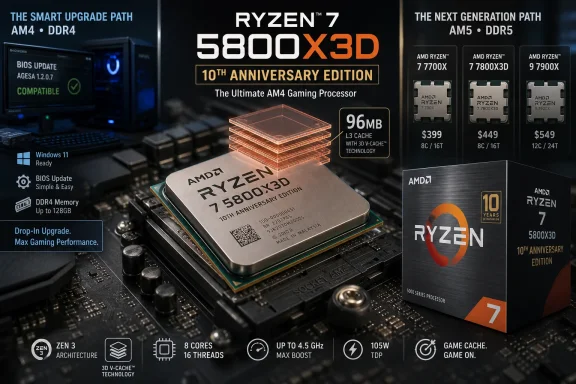 AMD Turns a Legacy Socket Into a Product Strategy
The Ryzen 7 5800X3D was never just another CPU. When it arrived in 2022, it gave AMD’s AM4 platform a remarkable late-life second act by stacking extra cache on top of a Zen 3 compute die and turning an aging DDR4 system into a genuinely high-end gaming machine. For a huge installed base of Ryzen owners, it was the cleanest upgrade imaginable: update the BIOS, drop in the chip, keep the RAM, keep the board, keep the system.Four years later, AMD has chosen to sell that same basic proposition again. The new 10th Anniversary Edition reportedly uses the same core specifications: 8 cores, 16 threads, a 3.4GHz base clock, up to 4.5GHz boost, 96MB of L3 cache, and a 105W TDP. It does not include integrated graphics, and the retail package reportedly does not include a cooler.
That sameness is the point. AMD is not pretending the 5800X3D has become a new architecture. It is selling certainty to people who already own AM4 boards and DDR4 memory at a moment when memory pricing, platform costs, and upgrade fatigue all matter more than benchmark charts alone.
But the market around the 5800X3D has changed more than the chip has. Zen 4 and Zen 5 X3D parts have pushed cache-heavy gaming CPUs forward, DDR5 platforms have matured, and Intel’s own CPU stack has shifted through multiple generations. A great CPU can age gracefully; it cannot freeze the rest of the industry in place.
The $349 Price Makes Nostalgia Do Too Much Work
The awkward part of AMD’s re-release is not the product. It is the price.At $349, the Ryzen 7 5800X3D 10th Anniversary Edition lands in territory where buyers are no longer merely comparing it with used AM4 parts or discounted Zen 3 chips. They are comparing it with modern CPUs, newer chipsets, and increasingly affordable AM5 gaming options. Tom’s Hardware’s re-review captured the tension neatly: the 5800X3D remains a legendary DDR4 gaming processor, but at $350 it is hard to justify unless the buyer is already invested in AM4.
That phrase — already invested — is doing nearly all of the work here. If you own a solid B450, X470, B550, or X570 motherboard, already have 32GB of decent DDR4, and want to avoid rebuilding the machine, the 5800X3D remains compelling. The cost of the CPU is effectively the cost of the upgrade.
For a new build, the calculation collapses. Buying into AM4 from scratch in 2026 means deliberately choosing an end-of-life platform, older I/O assumptions, DDR4 memory, and a CPU with limited productivity headroom. That can still make sense for bargain hunters, but not at a premium price attached to a commemorative box.
AMD’s problem is that the 5800X3D’s original magic came from its role as an escape hatch. It let users avoid a platform migration while getting a massive gaming uplift. Re-releasing it at near-modern-CPU pricing turns that escape hatch into a boutique toll road.
DDR4 Still Has Teeth, but the Bite Is Narrower
The 5800X3D’s continued strength comes from a reality gamers sometimes rediscover the expensive way: many games care less about peak clocks and memory bandwidth than about cache behavior, latency, and how often the CPU has to reach out to main memory. AMD’s 3D V-Cache design gave Zen 3 a massive L3 reservoir, and that reservoir still pays dividends in games that are sensitive to cache misses.That is why the 5800X3D remains the top-end gaming answer for DDR4 systems. It is not the fastest all-around CPU. It is not the best workstation chip. It is not the platform anyone would design from a blank sheet in 2026. But inside the world of AM4, it remains the most elegant gaming upgrade AMD ever shipped.
The limitation is that this world is now bounded. DDR4 is mature, inexpensive in normal market conditions, and widely deployed, but it is no longer where the forward-looking ecosystem is being built. New motherboards, faster memory kits, PCIe lane expectations, firmware work, and future CPU releases now orbit AM5 and DDR5.
This does not make DDR4 bad. It makes it contextual. For Windows gamers trying to stretch a capable machine through another GPU generation, DDR4 can still be perfectly serviceable. For system builders planning several years ahead, it increasingly looks like a cost-saving measure that must be justified, not a default assumption.
The 9800X3D Price Drop Exposes the Real Problem
The timing of the 5800X3D re-release is especially uncomfortable because newer X3D chips are moving in the opposite direction on price. In the UK, OC3D reported that the Ryzen 7 9800X3D dropped to £339 at Amazon UK, down from about £399.99 at the start of 2026. That puts AMD’s newer Zen 5 gaming flagship-class part within shouting distance of the reissued AM4 legend in some markets.Currency, regional pricing, VAT, bundles, and availability make direct comparisons messy. Still, the directional signal is hard to ignore. The old chip is reappearing at a premium while the new chip is drifting downward.
That is where AMD’s segmentation becomes difficult to defend. The 9800X3D benefits from newer architecture, higher clocks, AM5 platform features, and AMD’s later-generation 3D V-Cache packaging improvements. It also sits on a platform with future CPU support, modern boards, and DDR5 memory.
The 5800X3D, by contrast, wins only when the buyer has already paid for the rest of the system years ago. It is not competing as a CPU alone. It is competing as an anti-rebuild device.
That can be powerful, but it is not universal. A user with a Ryzen 5 3600 and a good B550 board may see the 5800X3D as a painless transformation. A user with no parts on hand should probably see the same product as a warning sign: you are being invited to spend new-platform money on old-platform boundaries.
AMD Is Selling the Absence of Disruption
The marketing line behind the re-release is obvious: no new platform, no guesswork, just drop in the CPU and keep gaming. It is a clean pitch because it speaks to something real. PC upgrades are not frictionless. Motherboard swaps mean teardown time, Windows activation uncertainty, BIOS configuration, driver cleanup, memory compatibility checks, cooler brackets, cable management, and the familiar dread of discovering that one tiny front-panel connector has vanished under the GPU.For WindowsForum readers, this is not abstract. Many enthusiasts maintain systems that have been Ship-of-Theseus upgraded for years. A CPU swap that avoids reinstalling Windows, avoids replacing RAM, and avoids rebuilding the machine has a value that does not appear in frame-time graphs.
That value is especially meaningful in households where a gaming PC is also a work PC, a school PC, a Plex box, a streaming rig, or a family machine. Downtime matters. Stability matters. Known-good hardware matters.
AMD understands this better than most vendors because AM4 became one of the most successful long-lived desktop platforms in modern PC history. The company is not merely selling silicon; it is monetizing the trust it built by supporting that socket across an unusually broad span of CPUs.
The danger is that trust can become a pricing umbrella. If the product is too expensive, AMD risks turning a pro-consumer legacy into a late-cycle upsell.
The Anniversary Edition Is a Victory Lap With a Supply-Chain Footnote
The re-release also carries an interesting manufacturing wrinkle. VideoCardz reported that AMD had to re-engineer the chip for a newer 3D V-Cache stacking process because the original production method was no longer available. That detail matters because it reminds us that “bringing back” an old CPU is not as simple as restarting an assembly line from 2022.Modern semiconductor products are ecosystems of wafers, packaging, substrates, validation flows, suppliers, firmware support, and retail logistics. If one part of that chain has moved on, the supposedly old product becomes a new operational project. The 5800X3D 10th Anniversary Edition may look like a reissue, but it still has to exist in 2026’s manufacturing reality.
Tom’s Hardware noted that AMD says the new edition should be identical in performance to the original, while the different bonding process could have minor implications for power and thermals. That is the right place to keep expectations: not a new gaming tier, not a stealth refresh, but a likely near-equivalent part that may deserve lab verification around thermals and efficiency.
The inclusion of Carbice Ice Pad thermal interface material in at least one retail listing is a small but telling change. It gives the anniversary package a tangible difference without changing the CPU’s core identity. For collectors and brand loyalists, that may add charm. For practical buyers, it should not change the recommendation.
This is still a 5800X3D. Its greatness remains real, but it is greatness from another platform era.
Windows Gamers Should Think in Platform Costs, Not CPU Rankings
The mistake many buyers make with CPUs is treating benchmark rankings as shopping lists. That is especially dangerous with the 5800X3D because its appeal depends so heavily on what the buyer already owns.If you are sitting on a Ryzen 5 2600, 3600, 3700X, or 5600X and have a motherboard with BIOS support, the 5800X3D can still feel like a generational upgrade without the generational rebuild. It can smooth out CPU-limited games, improve minimum frame rates, and pair well with a faster GPU. For many Windows gamers, that is exactly the upgrade they want.
If you are building a machine from scratch, the story changes. AM5 gives you DDR5, a live upgrade path, newer chipsets, and access to the 7800X3D, 9800X3D, and related parts. Even if the initial platform cost is higher, the long-term value may be better because the motherboard and memory are not already at the end of their roadmap.
There is also the productivity caveat. The 5800X3D’s cache helps games more than it helps many creation, compilation, encoding, and workstation tasks. Its relatively conservative clocks and older architecture mean it can be outpaced by newer CPUs that may look less glamorous in gaming-focused conversations.
For Windows users who do a little of everything, the question is not “Is the 5800X3D fast?” It is “Is the 5800X3D fast in the things I do, on the platform I already own, at this price?” That narrower question is where the chip still wins.
System Administrators Will See a Different Kind of Value
Although the 5800X3D is marketed as a gaming CPU, its re-release has a broader lesson for administrators and small IT shops: platform stability has economic value. Not every machine refresh is about chasing the newest socket. Sometimes the best upgrade is the one that avoids touching the rest of the stack.For small offices, labs, schools, and hobbyist workstations with AM4 systems, a drop-in CPU can extend service life without triggering a procurement chain of boards, RAM, images, and support issues. That is not the usual enthusiast framing, but it is a real-world reason long-lived platforms matter.
The counterargument is support horizon. AM4 may still be useful, but it is not the future of AMD’s client platform. Firmware attention, new feature enablement, board availability, and replacement-part economics will keep shifting toward AM5. An IT buyer extending AM4 today should be doing so knowingly, not because the re-release creates an illusion of renewed platform youth.
There is also a Windows 11 angle. Many AM4 systems can run Windows 11 just fine depending on CPU, TPM, firmware, and Secure Boot configuration, but older boards may require BIOS attention and settings cleanup. A CPU upgrade can be the easy part; fleet consistency is where the hidden work appears.
That makes the 5800X3D anniversary edition useful but not magical. It can extend a platform. It cannot reset the platform clock.
Intel Is the Background Character AMD Cannot Ignore
This re-release is also a quiet admission that AMD believes its older gaming silicon remains competitive enough to occupy shelf space against both its own newer chips and Intel’s current offerings. That confidence is not irrational. The original 5800X3D embarrassed many more power-hungry CPUs in games because cache sometimes beats brute force.But Intel has spent the intervening years increasing cache, adjusting hybrid architectures, and competing aggressively on discounted parts. In mixed workloads, Intel’s higher core-count CPUs can look attractive at similar prices, especially for users who care about productivity as much as gaming.
The result is a more complicated competitive map than AMD faced in 2022. Back then, the 5800X3D was an almost absurdly clean recommendation for AM4 gamers. In 2026, it is a recommendation with footnotes: great for existing AM4 systems, questionable for new builds, weaker for heavy productivity, and price-sensitive against both Intel discounts and AMD’s own AM5 stack.
That does not diminish the chip’s historical importance. It simply means history is not a purchasing strategy.
The Used Market Is the Shadow Competitor
The new 5800X3D also has to compete with the ghost of itself. Used and remaining-stock AM4 CPUs have circulated for years, and many buyers considering a late AM4 upgrade will inevitably compare the anniversary edition with secondhand 5800X3D chips, discounted 5700X3D models, or cheaper Ryzen 5000 parts.The Ryzen 7 5700X3D is especially relevant because it has often served as the budget-minded cache upgrade for AM4 users. It may not match the 5800X3D clock-for-clock, but if the price gap is large enough, it can deliver much of the gaming uplift for much less money. That weakens the anniversary edition’s value case unless availability or warranty concerns dominate.
A new boxed CPU does offer advantages. It brings retailer support, warranty coverage, predictable condition, and freedom from the usual used-market anxiety about bent pins, mystery thermal paste, or an overconfident seller’s packaging choices. For some buyers, that peace of mind is worth paying for.
Still, AMD cannot price the 5800X3D as if the used market does not exist. Enthusiasts know how to shop. They know when a commemorative SKU is functionally a familiar CPU with a new label. They will pay for convenience, but not indefinitely.
The re-release therefore depends on a narrow retail sweet spot: enough supply to satisfy AM4 upgraders, enough discounting to feel rational, and enough scarcity to avoid becoming another overpriced nostalgia product.
The 5800X3D’s Legacy Is Bigger Than This Re-Release
The reason this launch is worth debating at all is that the original 5800X3D changed expectations. It proved that cache could be a headline gaming feature rather than a spec-sheet afterthought. It gave AMD a distinctive weapon against Intel, and it helped establish X3D as a premium gaming brand rather than a one-off experiment.That legacy now runs through the 7800X3D, 9800X3D, and AMD’s broader cache-heavy desktop strategy. The irony is that the better AMD’s newer X3D chips become, the less room the 5800X3D has to command premium pricing. Success created the replacement.
The 9800X3D’s lower UK pricing makes that transition visible. If the newer chip becomes more affordable while DDR5 platform costs stabilize, the argument for reviving AM4 at $349 narrows further. AMD may still sell plenty of anniversary units, but it will be selling them to a defined audience, not the whole enthusiast market.
That is fine. Not every product has to be universal. The problem begins only if AMD’s marketing lets the romance of AM4 obscure the practical reality that this is an end-of-line upgrade.
The 5800X3D deserves its reputation. Buyers deserve a price that reflects its age.
The Sensible Upgrade Path Has a Narrow Doorway
For WindowsForum readers, the decision tree is refreshingly blunt. The 5800X3D 10th Anniversary Edition is a strong upgrade if it drops into a system you already like. It is a much weaker foundation for a system you have not built yet.The best-case buyer owns a compatible AM4 motherboard, decent DDR4, a GPU that is being held back in some games, and no desire to rebuild the machine this year. That buyer can treat the 5800X3D as a platform life-extension card. It is not cheap, but it is simple.
The worst-case buyer is starting from zero and sees “X3D” and “anniversary” as a shortcut to value. That buyer should price a full AM5 build, look at current 7800X3D and 9800X3D deals, and decide whether saving on DDR4 really outweighs giving up the newer platform. In many cases, it will not.
There is also a middle case: owners of older AM4 boards with limited BIOS maturity, weak VRMs, small memory kits, or aging power supplies. For them, the CPU may be only the first expense. Once the “drop-in” upgrade requires a new cooler, more RAM, BIOS troubleshooting, and platform cleanup, the simplicity advantage starts to erode.
That is the real test for the 5800X3D in 2026. It is not whether the chip is good. It is whether the rest of the system is good enough to make the chip’s old magic reappear.
The AM4 Legend Leaves Buyers With a Very 2026 Checklist
The anniversary edition’s value lives or dies in the gap between a CPU price and a platform price. That is why this launch is less about nostalgia than accounting: how much is it worth to keep a known Windows system intact for another GPU cycle?- The Ryzen 7 5800X3D 10th Anniversary Edition is best understood as a drop-in AM4 upgrade, not as a sensible starting point for most new gaming PCs.
- The reported $349 price is defensible only when it avoids the cost and disruption of a motherboard, DDR5 memory, and platform migration.
- The chip’s 96MB of L3 cache still makes it the strongest gaming option for many DDR4 systems, but its productivity performance and platform age limit its broader appeal.
- Falling prices on newer X3D processors, especially the Ryzen 7 9800X3D in some markets, make the old chip’s premium harder to justify.
- Buyers should verify BIOS support, cooling, memory capacity, and motherboard health before assuming the upgrade will be painless.
- A discounted 5700X3D, used 5800X3D, or full AM5 migration may be the better value depending on local pricing and the rest of the system.