
Adobe announced on June 25, 2026, that it has signed a definitive agreement to acquire Topaz Labs, the Texas-based maker of AI image and video enhancement tools used for upscaling, denoising, stabilization, frame interpolation, sharpening, and restoration. The deal is expected to close in the second half of 2026, pending regulatory approval, with no purchase price disclosed. Topaz products are set to remain available as standalone tools after closing, and CEO Eric Yang will continue to lead the team. The larger story is not that Adobe bought another creative software company; it is that Adobe is trying to pull one of the most useful pieces of practical AI back into its own orbit before creators, studios, and enterprises build too much of their workflow somewhere else.
For all the noise around generative AI, Topaz Labs has built its reputation on a less glamorous but more immediately useful promise: take imperfect visual material and make it usable. Low-resolution archival footage, noisy low-light clips, soft stills, shaky video, and footage that needs interpolation or restoration are not edge cases in real production. They are the daily mess of modern content work.
That makes Topaz a different kind of AI acquisition. Adobe is not simply buying a text-to-image novelty or a prompt interface. It is buying models that sit inside the production chain, where professionals judge tools by whether the final render survives scrutiny on a client monitor.
Topaz’s portfolio includes Topaz Photo, Topaz Video, Topaz Gigapixel, Astra, and Bloom. Its tools cover the chores that editors and photographers may not celebrate but absolutely depend on: upscaling, sharpening, noise removal, stabilization, frame interpolation, and restoration. In December 2025, its AI technology received a Technology & Engineering Emmy Award for high-quality television catalog restoration, which is exactly the sort of credential Adobe can fold into its pitch to studios and enterprise media teams.
Adobe’s announcement frames the deal as an expansion of Firefly, Firefly Services, and Creative Cloud. That is accurate, but it understates the strategic shift. Adobe is not merely adding another feature button to Premiere Pro or Photoshop. It is acquiring a layer of AI competence that helps decide whether synthetic, captured, and archival media can coexist in the same finished piece without looking like a compromise.
The creative software market has a long memory. Adobe’s subscription model is still a sore point for users who remember perpetual licenses, and every acquisition raises the same fear: a useful independent tool becomes another tile in a bundle, another upsell, or another cloud-connected entitlement. Keeping Topaz standalone is the easiest way for Adobe to reassure existing customers that the deal is not an immediate shutdown notice.
But the center of gravity will still move toward Adobe’s platforms. The company has already said Topaz technology will be integrated across its creative AI portfolio, including Firefly, Firefly Services, and Creative Cloud apps. That means the most consequential version of Topaz may eventually be the one that appears inside Premiere Pro, Photoshop, Lightroom, enterprise APIs, and Adobe’s broader AI services.
This is the familiar Adobe pattern: preserve the product long enough to retain trust and revenue, then let the technology become part of the suite. Sometimes that produces better workflows. Sometimes it produces licensing confusion, overlapping products, and the quiet erosion of the independent tool’s original identity. The difference here is that Topaz’s users are not just casual consumers; many are precisely the sort of power users who notice when quality, performance, or pricing changes.
Topaz helps Adobe make that argument more convincingly. In real workflows, generation is only part of the job. Editors need to match AI-generated clips with captured footage, upscale legacy media to modern delivery standards, clean noisy shots, repair damaged archival material, and make mixed-origin assets look coherent.
That is where enhancement models become strategically important. A studio or brand team may experiment with generative AI, but it still has to deliver in formats that clients, platforms, and audiences expect. The rough edges of AI-generated media are often not solved by more prompting; they are solved by post-production tools that can improve detail, reduce artifacts, and harmonize material.
Topaz also gives Adobe a practical bridge between the old world and the new one. The old world is camera footage, scanned film, still photography, and archive libraries. The new world is prompt-generated media, synthetic b-roll, automated localization, and AI-assisted editing. The companies that control the bridge between those worlds will have more leverage than companies that merely generate raw assets.
If Adobe integrates Topaz well, Premiere users could gain smoother access to high-quality upscaling and restoration without round-tripping to separate apps. That would be a real workflow improvement. Anyone who has moved footage through external enhancement tools knows that the process can create friction: exported intermediates, codec decisions, storage overhead, version tracking, and long render queues.
The danger is that Adobe treats Topaz as an AI feature layer rather than a craft tool. Professional users care about control. They want model choices, artifact management, preview fidelity, batch behavior, codec awareness, and repeatability across projects. A simplified “enhance” button might appeal to casual users, but the people who made Topaz important in the first place will expect more than a magic wand.
There is also the question of where computation happens. Video enhancement is expensive. If Adobe leans too heavily on cloud processing, it will raise concerns about cost, upload times, privacy, and control over sensitive client material. If it leans into local acceleration, the deal becomes more interesting for high-end Windows workstations and GPU-equipped creator laptops.
That is not just a performance footnote. It is potentially the part of the deal that matters most to the next phase of creative computing. AI video models are hungry, and video enhancement has historically pushed hardware hard. If Topaz can help Adobe run more capable models locally on consumer devices, Adobe gains a path away from making every serious AI workflow a cloud-metered service.
Local AI has three obvious attractions. It can be faster when the hardware is ready, because users avoid upload and queue latency. It can be more private, because footage does not necessarily leave the workstation. It can also be cheaper at scale, because Adobe does not have to absorb or pass through every GPU cycle from its own data centers.
But “on-device AI” is also where marketing often outruns reality. Windows PCs vary wildly. A creator workstation with an NVIDIA GeForce RTX 5090-class GPU is not the same universe as a thin laptop with integrated graphics or a low-end discrete GPU. Even among capable machines, VRAM, driver versions, thermals, storage speed, and background workloads can determine whether local AI feels magical or miserable.
Adobe’s challenge will be to make local AI predictable. Creative pros can tolerate long renders if they know what is happening and can trust the result. They have less patience for opaque acceleration paths that behave differently from one machine to another. If Neurostream becomes part of Adobe’s broader model deployment strategy, the company will need to explain what runs locally, what runs in the cloud, and what hardware actually benefits.
The creative PC market has always been shaped by software certification and acceleration. CUDA, Studio drivers, GPU effects, encoder support, and AI denoising have all given NVIDIA a strong position among video editors and 3D artists. If Adobe folds Topaz’s local AI technology deeply into Premiere, Photoshop, Lightroom, and Firefly, the GPU becomes even more central to the value of a Windows creative workstation.
That does not mean every user must rush to upgrade. It does mean that the line between “good enough for editing” and “good enough for AI-enhanced editing” may become more meaningful. A machine that can cut 4K footage may not be equally comfortable running AI upscaling, restoration, and frame interpolation in the background.
This is where IT departments will pay attention. Creative teams already ask for expensive hardware, and AI features will make those requests harder to standardize. If Adobe’s tools begin exposing meaningful local acceleration differences, procurement teams will need clearer guidance on GPU tiers, VRAM requirements, driver stability, and lifecycle planning. The AI PC will stop being a marketing phrase and become a budget line.
Topaz’s local-processing heritage gives Adobe a stronger story for those customers. If sensitive footage can be enhanced locally inside a controlled workstation environment, Adobe can appeal to users who are wary of cloud AI pipelines. That could be especially important for enterprise Firefly Services customers who want AI capabilities but need strict governance.
Still, the privacy story is not automatic. Adobe will need to be explicit about data handling, model execution, telemetry, temporary files, cache behavior, and whether any assets are transmitted for processing or analysis. Enterprise admins do not want soothing adjectives; they want settings, logs, policy controls, and contractual clarity.
There is also a cultural issue. Adobe has faced periodic user anxiety over terms of service, cloud documents, AI training, and data access. Even when those concerns are overstated, they reflect a trust gap. Acquiring a respected independent AI toolmaker does not close that gap by itself. It may even reopen it if users fear that Topaz workflows will become more cloud-dependent over time.
Topaz was part of that fragmentation. It was not trying to replace Adobe, but it gave users a reason to step outside Adobe. Once users get comfortable moving footage or images through external AI tools, the gravitational pull of Creative Cloud weakens. They may discover other editors, other asset managers, other collaboration systems, and other pricing models.
Buying Topaz helps Adobe contain that drift. It gives Adobe a high-quality enhancement layer that can be integrated into the suite and offered through enterprise services. It also removes an independent specialist that could have become more strategically important to a rival platform.
That last point will not be lost on skeptical users. Adobe can argue, plausibly, that integration will improve workflows and expand Topaz’s reach. Critics can argue, also plausibly, that Adobe is buying a competitor before it becomes too influential. Both readings can be true. In software markets, acquisitions often serve product ambition and competitive containment at the same time.
That distinction matters because Topaz earned its reputation by being specialized. It did not need to solve every creative problem. It needed to make images and video look better, with enough control and quality for demanding users. Adobe’s suite strategy can be powerful, but suites sometimes blur the sharpness that made specialist tools valuable.
There are optimistic scenarios. Topaz could gain more engineering resources, broader testing, better integration with Adobe formats, stronger enterprise support, and deeper GPU optimization. Its models could reach more users without forcing professionals into awkward round-trips.
There are pessimistic scenarios too. Topaz could become a premium feature tier, a cloud-credit sink, or a set of simplified controls embedded into Creative Cloud while the standalone apps stagnate. Adobe has not announced that outcome, and it would be unfair to assume it. But users are right to watch pricing, update cadence, offline behavior, and whether the standalone roadmap remains meaningful after the deal closes.
Still, creative software consolidation has practical consequences even when regulators do not intervene. Professionals live inside these tools for years. Small shifts in licensing, interoperability, plugin support, export behavior, or hardware requirements can ripple through studios and departments. A merger does not have to dominate a market to reshape daily work.
The lack of a disclosed purchase price also leaves room for speculation about Adobe’s priorities. If this is primarily a technology acquisition, Neurostream and model expertise may matter more than Topaz’s current subscription revenue. If it is also a customer acquisition, Adobe may be looking at Topaz’s millions of users as a pool of future Creative Cloud or Firefly customers.
For enterprise buyers, the acquisition raises a familiar planning question: wait for integration or standardize now? Teams that already use Topaz should not assume immediate disruption, but they should document current workflows, licensing terms, deployment methods, and output dependencies. If a tool becomes more important after an acquisition, it also becomes more important to manage deliberately.
If Adobe turns Topaz’s technology into a flagship local AI capability, Windows machines will be where many users test the promise first. That means real-world performance will depend on the messy ecosystem of GPU drivers, Windows updates, application versions, plugins, codecs, and storage pipelines. The marketing demo will be clean; the production bay rarely is.
For sysadmins supporting creative teams, the acquisition is a reminder that AI features are no longer optional curiosities. They affect endpoint specs, bandwidth planning, storage consumption, acceptable-use policies, and software governance. A restoration workflow that once required a specialist tool on one workstation may become a standard feature requested across a department.
The complication is that Adobe’s AI portfolio spans both local and cloud execution. Admins will need to know which features can be disabled, which require account entitlements, which generate billable usage, and which move data outside the organization. In regulated environments, “it is built into Premiere now” is not a compliance strategy.
Topaz makes the bundle more useful. That is the simple part. A creator who can enhance, restore, upscale, edit, composite, color, export, collaborate, and generate assets inside one ecosystem has fewer reasons to leave. If the integrations are fast and high quality, many users will welcome the convenience.
But the acquisition also sharpens the old Adobe tension. Every useful feature added to Creative Cloud makes the subscription easier to justify and harder to escape. Users who dislike Adobe’s pricing may still find themselves pulled back because the integrated workflow saves time. Enterprises may accept the cost because standardizing on one vendor reduces procurement and support complexity.
This is why the reaction from creators is likely to be mixed. Some will see the deal as validation that Topaz built best-in-class technology. Others will see it as another independent tool disappearing into a large subscription ecosystem. Adobe’s job is to prove that the former does not inevitably become the latter.
That has consequences beyond entertainment. Museums, local governments, schools, documentary filmmakers, legal teams, and corporate archives all sit on visual material that could become more useful if cleaned, upscaled, stabilized, or remastered. Adobe clearly sees archival enhancement as part of the opportunity.
Topaz’s Emmy-winning work gives Adobe a credible story here. It can tell broadcasters and enterprises that AI enhancement is not just a creator gimmick; it is a production-grade capability with recognized technical merit. That matters in markets where buyers need reassurance that AI tools are not simply hallucination engines.
The caution is that restoration is not only about making old footage look sharper. It is also about preserving authenticity. Over-aggressive AI enhancement can invent detail, alter texture, and create a false sense of fidelity. Adobe will need to give professionals enough control to distinguish between cleanup, interpretation, and fabrication.
Topaz users tend to care about those controls. They compare models, inspect artifacts, test outputs, and make decisions based on content type. A wildlife photographer denoising a high-ISO image, a wedding videographer upscaling a shot, and an archive specialist restoring television footage do not have the same tolerance for synthetic detail.
Adobe’s mainstreaming instinct can conflict with that culture. The company often excels at making complex tools approachable, but AI enhancement sometimes needs complexity. A professional-grade integration should expose enough settings for expert users while still offering simple paths for everyone else.
The same is true for deployment. Users should not have to guess whether a job is running locally or in the cloud. They should not have to discover after the fact that a feature consumed credits, uploaded client material, or used a different model than expected. If Adobe wants trust, it should make the execution path visible.
Early integration will likely emphasize obvious wins: upscaling in Premiere, enhancement in Firefly, restoration workflows in Creative Cloud, and enterprise APIs through Firefly Services. Those are sensible first moves. The risk is that Adobe overpromises seamlessness before the underlying experience is mature.
Users should watch for a few practical signals. Does Topaz continue shipping meaningful standalone updates? Do Adobe apps expose Topaz-powered features with professional controls? Does local acceleration work reliably on common Windows creator hardware? Does Adobe provide clear policy controls for enterprise admins? Does pricing stay understandable?
Those signals will matter more than launch-day language. Adobe’s press materials are full of reasonable claims about quality, control, accessibility, and on-device AI. The market will judge whether those claims survive contact with real projects, real deadlines, and real hardware.
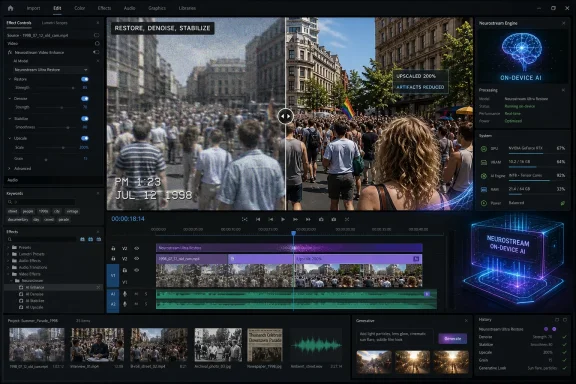 Adobe Is Buying the Part of AI That Actually Fixes Footage
For all the noise around generative AI, Topaz Labs has built its reputation on a less glamorous but more immediately useful promise: take imperfect visual material and make it usable. Low-resolution archival footage, noisy low-light clips, soft stills, shaky video, and footage that needs interpolation or restoration are not edge cases in real production. They are the daily mess of modern content work.That makes Topaz a different kind of AI acquisition. Adobe is not simply buying a text-to-image novelty or a prompt interface. It is buying models that sit inside the production chain, where professionals judge tools by whether the final render survives scrutiny on a client monitor.
Topaz’s portfolio includes Topaz Photo, Topaz Video, Topaz Gigapixel, Astra, and Bloom. Its tools cover the chores that editors and photographers may not celebrate but absolutely depend on: upscaling, sharpening, noise removal, stabilization, frame interpolation, and restoration. In December 2025, its AI technology received a Technology & Engineering Emmy Award for high-quality television catalog restoration, which is exactly the sort of credential Adobe can fold into its pitch to studios and enterprise media teams.
Adobe’s announcement frames the deal as an expansion of Firefly, Firefly Services, and Creative Cloud. That is accurate, but it understates the strategic shift. Adobe is not merely adding another feature button to Premiere Pro or Photoshop. It is acquiring a layer of AI competence that helps decide whether synthetic, captured, and archival media can coexist in the same finished piece without looking like a compromise.
The Standalone Promise Is Useful, but Nobody Should Mistake It for the Center of Gravity
Adobe says Topaz Labs products will remain available as standalone offerings through the company’s website after the transaction closes. That matters because Topaz has a devoted user base that includes photographers, editors, restoration specialists, and hobbyists who may not want a deeper relationship with Creative Cloud. It also matters because Adobe knows the backlash risk.The creative software market has a long memory. Adobe’s subscription model is still a sore point for users who remember perpetual licenses, and every acquisition raises the same fear: a useful independent tool becomes another tile in a bundle, another upsell, or another cloud-connected entitlement. Keeping Topaz standalone is the easiest way for Adobe to reassure existing customers that the deal is not an immediate shutdown notice.
But the center of gravity will still move toward Adobe’s platforms. The company has already said Topaz technology will be integrated across its creative AI portfolio, including Firefly, Firefly Services, and Creative Cloud apps. That means the most consequential version of Topaz may eventually be the one that appears inside Premiere Pro, Photoshop, Lightroom, enterprise APIs, and Adobe’s broader AI services.
This is the familiar Adobe pattern: preserve the product long enough to retain trust and revenue, then let the technology become part of the suite. Sometimes that produces better workflows. Sometimes it produces licensing confusion, overlapping products, and the quiet erosion of the independent tool’s original identity. The difference here is that Topaz’s users are not just casual consumers; many are precisely the sort of power users who notice when quality, performance, or pricing changes.
Firefly Needed More Than a Prompt Box
Adobe has spent the last several years positioning Firefly as the commercially safer, professionally integrated answer to generative AI. Its pitch is not simply that it can generate images or video, but that it belongs inside the tools professionals already use. Firefly is supposed to be AI that understands production, not a toy that throws output over the wall.Topaz helps Adobe make that argument more convincingly. In real workflows, generation is only part of the job. Editors need to match AI-generated clips with captured footage, upscale legacy media to modern delivery standards, clean noisy shots, repair damaged archival material, and make mixed-origin assets look coherent.
That is where enhancement models become strategically important. A studio or brand team may experiment with generative AI, but it still has to deliver in formats that clients, platforms, and audiences expect. The rough edges of AI-generated media are often not solved by more prompting; they are solved by post-production tools that can improve detail, reduce artifacts, and harmonize material.
Topaz also gives Adobe a practical bridge between the old world and the new one. The old world is camera footage, scanned film, still photography, and archive libraries. The new world is prompt-generated media, synthetic b-roll, automated localization, and AI-assisted editing. The companies that control the bridge between those worlds will have more leverage than companies that merely generate raw assets.
Premiere Pro Is Where This Deal Becomes Visible First
For WindowsForum readers, the most obvious place to watch is Premiere Pro. Adobe and Topaz already had visible overlap before the acquisition announcement, including Topaz upscaling appearing in Adobe’s AI ecosystem and a newer UXP panel for AI upscaling in Premiere. That matters because video enhancement is one of the workloads where local hardware, GPU memory, drivers, and workflow design all collide.If Adobe integrates Topaz well, Premiere users could gain smoother access to high-quality upscaling and restoration without round-tripping to separate apps. That would be a real workflow improvement. Anyone who has moved footage through external enhancement tools knows that the process can create friction: exported intermediates, codec decisions, storage overhead, version tracking, and long render queues.
The danger is that Adobe treats Topaz as an AI feature layer rather than a craft tool. Professional users care about control. They want model choices, artifact management, preview fidelity, batch behavior, codec awareness, and repeatability across projects. A simplified “enhance” button might appeal to casual users, but the people who made Topaz important in the first place will expect more than a magic wand.
There is also the question of where computation happens. Video enhancement is expensive. If Adobe leans too heavily on cloud processing, it will raise concerns about cost, upload times, privacy, and control over sensitive client material. If it leans into local acceleration, the deal becomes more interesting for high-end Windows workstations and GPU-equipped creator laptops.
Neurostream Is the Quietly Important Asset
The most intriguing part of the acquisition may be Topaz Labs’ Neurostream technology. Topaz announced Neurostream in March 2026 and described it as a way to dramatically reduce the VRAM demands of large AI models. Adobe’s own announcement emphasizes that Topaz brings expertise in making complex AI models run directly on device.That is not just a performance footnote. It is potentially the part of the deal that matters most to the next phase of creative computing. AI video models are hungry, and video enhancement has historically pushed hardware hard. If Topaz can help Adobe run more capable models locally on consumer devices, Adobe gains a path away from making every serious AI workflow a cloud-metered service.
Local AI has three obvious attractions. It can be faster when the hardware is ready, because users avoid upload and queue latency. It can be more private, because footage does not necessarily leave the workstation. It can also be cheaper at scale, because Adobe does not have to absorb or pass through every GPU cycle from its own data centers.
But “on-device AI” is also where marketing often outruns reality. Windows PCs vary wildly. A creator workstation with an NVIDIA GeForce RTX 5090-class GPU is not the same universe as a thin laptop with integrated graphics or a low-end discrete GPU. Even among capable machines, VRAM, driver versions, thermals, storage speed, and background workloads can determine whether local AI feels magical or miserable.
Adobe’s challenge will be to make local AI predictable. Creative pros can tolerate long renders if they know what is happening and can trust the result. They have less patience for opaque acceleration paths that behave differently from one machine to another. If Neurostream becomes part of Adobe’s broader model deployment strategy, the company will need to explain what runs locally, what runs in the cloud, and what hardware actually benefits.
NVIDIA Gets Another Reason to Matter in Creative Workflows
Topaz has already talked about optimizing its technology with NVIDIA and supporting GeForce RTX and RTX PRO GPUs. That places the acquisition squarely inside the larger contest over AI PCs, workstation GPUs, and local model acceleration. For Windows users, that contest is not theoretical; it influences buying decisions.The creative PC market has always been shaped by software certification and acceleration. CUDA, Studio drivers, GPU effects, encoder support, and AI denoising have all given NVIDIA a strong position among video editors and 3D artists. If Adobe folds Topaz’s local AI technology deeply into Premiere, Photoshop, Lightroom, and Firefly, the GPU becomes even more central to the value of a Windows creative workstation.
That does not mean every user must rush to upgrade. It does mean that the line between “good enough for editing” and “good enough for AI-enhanced editing” may become more meaningful. A machine that can cut 4K footage may not be equally comfortable running AI upscaling, restoration, and frame interpolation in the background.
This is where IT departments will pay attention. Creative teams already ask for expensive hardware, and AI features will make those requests harder to standardize. If Adobe’s tools begin exposing meaningful local acceleration differences, procurement teams will need clearer guidance on GPU tiers, VRAM requirements, driver stability, and lifecycle planning. The AI PC will stop being a marketing phrase and become a budget line.
The Privacy Argument Is Real, but It Cuts Both Ways
Adobe’s interest in efficient on-device AI is not just about speed or cost. It also speaks to privacy. Many creative workflows involve material that cannot casually be uploaded to a cloud service: unreleased films, legal evidence, medical imagery, internal corporate footage, government material, or brand campaigns under embargo.Topaz’s local-processing heritage gives Adobe a stronger story for those customers. If sensitive footage can be enhanced locally inside a controlled workstation environment, Adobe can appeal to users who are wary of cloud AI pipelines. That could be especially important for enterprise Firefly Services customers who want AI capabilities but need strict governance.
Still, the privacy story is not automatic. Adobe will need to be explicit about data handling, model execution, telemetry, temporary files, cache behavior, and whether any assets are transmitted for processing or analysis. Enterprise admins do not want soothing adjectives; they want settings, logs, policy controls, and contractual clarity.
There is also a cultural issue. Adobe has faced periodic user anxiety over terms of service, cloud documents, AI training, and data access. Even when those concerns are overstated, they reflect a trust gap. Acquiring a respected independent AI toolmaker does not close that gap by itself. It may even reopen it if users fear that Topaz workflows will become more cloud-dependent over time.
The Deal Is Also a Defensive Move Against Workflow Drift
Adobe’s public framing is about enhancing creative quality, but the competitive logic is just as important. The modern creative workflow is fragmenting. Editors use DaVinci Resolve for color and increasingly for full post-production. Canva has pushed aggressively into lightweight design and brand workflows. Mobile and web-native tools have trained younger creators to expect fast, AI-assisted output without a heavyweight desktop suite.Topaz was part of that fragmentation. It was not trying to replace Adobe, but it gave users a reason to step outside Adobe. Once users get comfortable moving footage or images through external AI tools, the gravitational pull of Creative Cloud weakens. They may discover other editors, other asset managers, other collaboration systems, and other pricing models.
Buying Topaz helps Adobe contain that drift. It gives Adobe a high-quality enhancement layer that can be integrated into the suite and offered through enterprise services. It also removes an independent specialist that could have become more strategically important to a rival platform.
That last point will not be lost on skeptical users. Adobe can argue, plausibly, that integration will improve workflows and expand Topaz’s reach. Critics can argue, also plausibly, that Adobe is buying a competitor before it becomes too influential. Both readings can be true. In software markets, acquisitions often serve product ambition and competitive containment at the same time.
The Standalone Tools Now Carry a Trust Burden
Topaz customers will understandably focus on the promise that the products remain available as standalone offerings. The immediate concern is not whether the installers vanish tomorrow. It is whether the products remain independent in spirit: clear pricing, direct access, fast updates, and features that serve Topaz’s core audience rather than merely feeding Adobe’s platform roadmap.That distinction matters because Topaz earned its reputation by being specialized. It did not need to solve every creative problem. It needed to make images and video look better, with enough control and quality for demanding users. Adobe’s suite strategy can be powerful, but suites sometimes blur the sharpness that made specialist tools valuable.
There are optimistic scenarios. Topaz could gain more engineering resources, broader testing, better integration with Adobe formats, stronger enterprise support, and deeper GPU optimization. Its models could reach more users without forcing professionals into awkward round-trips.
There are pessimistic scenarios too. Topaz could become a premium feature tier, a cloud-credit sink, or a set of simplified controls embedded into Creative Cloud while the standalone apps stagnate. Adobe has not announced that outcome, and it would be unfair to assume it. But users are right to watch pricing, update cadence, offline behavior, and whether the standalone roadmap remains meaningful after the deal closes.
Regulators May Not Care Much, but Customers Will
The transaction is expected to close in the second half of 2026, subject to regulatory approval and customary closing conditions. Compared with platform-defining mergers in search, social media, cloud infrastructure, or gaming, Adobe buying Topaz may not look like the sort of deal that draws maximal antitrust heat. Topaz is influential in a specialized market, but it is not a household platform.Still, creative software consolidation has practical consequences even when regulators do not intervene. Professionals live inside these tools for years. Small shifts in licensing, interoperability, plugin support, export behavior, or hardware requirements can ripple through studios and departments. A merger does not have to dominate a market to reshape daily work.
The lack of a disclosed purchase price also leaves room for speculation about Adobe’s priorities. If this is primarily a technology acquisition, Neurostream and model expertise may matter more than Topaz’s current subscription revenue. If it is also a customer acquisition, Adobe may be looking at Topaz’s millions of users as a pool of future Creative Cloud or Firefly customers.
For enterprise buyers, the acquisition raises a familiar planning question: wait for integration or standardize now? Teams that already use Topaz should not assume immediate disruption, but they should document current workflows, licensing terms, deployment methods, and output dependencies. If a tool becomes more important after an acquisition, it also becomes more important to manage deliberately.
Windows Workstations Are About to Become the Test Bed
This deal is particularly relevant to Windows users because the high-performance creative workstation remains one of Windows’ strongest professional niches. Editors, restoration artists, photographers, and AI experimenters often choose Windows because they can configure powerful GPUs, large amounts of RAM, fast local storage, and specialized peripherals at multiple price points.If Adobe turns Topaz’s technology into a flagship local AI capability, Windows machines will be where many users test the promise first. That means real-world performance will depend on the messy ecosystem of GPU drivers, Windows updates, application versions, plugins, codecs, and storage pipelines. The marketing demo will be clean; the production bay rarely is.
For sysadmins supporting creative teams, the acquisition is a reminder that AI features are no longer optional curiosities. They affect endpoint specs, bandwidth planning, storage consumption, acceptable-use policies, and software governance. A restoration workflow that once required a specialist tool on one workstation may become a standard feature requested across a department.
The complication is that Adobe’s AI portfolio spans both local and cloud execution. Admins will need to know which features can be disabled, which require account entitlements, which generate billable usage, and which move data outside the organization. In regulated environments, “it is built into Premiere now” is not a compliance strategy.
The Creative Cloud Bundle Gets More Useful and More Inescapable
Adobe’s biggest advantage has always been the bundle. Photoshop, Illustrator, Premiere Pro, After Effects, Lightroom, Acrobat, Frame.io, Firefly, and enterprise services form a universe that is difficult for rivals to match end to end. The downside, from the user’s perspective, is that the same universe can feel inescapable.Topaz makes the bundle more useful. That is the simple part. A creator who can enhance, restore, upscale, edit, composite, color, export, collaborate, and generate assets inside one ecosystem has fewer reasons to leave. If the integrations are fast and high quality, many users will welcome the convenience.
But the acquisition also sharpens the old Adobe tension. Every useful feature added to Creative Cloud makes the subscription easier to justify and harder to escape. Users who dislike Adobe’s pricing may still find themselves pulled back because the integrated workflow saves time. Enterprises may accept the cost because standardizing on one vendor reduces procurement and support complexity.
This is why the reaction from creators is likely to be mixed. Some will see the deal as validation that Topaz built best-in-class technology. Others will see it as another independent tool disappearing into a large subscription ecosystem. Adobe’s job is to prove that the former does not inevitably become the latter.
The Restoration Market Just Moved Closer to the Mainstream
One underappreciated part of this acquisition is what it says about restoration. For years, restoration was a specialist field associated with film archives, broadcasters, and boutique post houses. AI enhancement tools have broadened that market by making restoration-like workflows accessible to smaller creators and organizations.That has consequences beyond entertainment. Museums, local governments, schools, documentary filmmakers, legal teams, and corporate archives all sit on visual material that could become more useful if cleaned, upscaled, stabilized, or remastered. Adobe clearly sees archival enhancement as part of the opportunity.
Topaz’s Emmy-winning work gives Adobe a credible story here. It can tell broadcasters and enterprises that AI enhancement is not just a creator gimmick; it is a production-grade capability with recognized technical merit. That matters in markets where buyers need reassurance that AI tools are not simply hallucination engines.
The caution is that restoration is not only about making old footage look sharper. It is also about preserving authenticity. Over-aggressive AI enhancement can invent detail, alter texture, and create a false sense of fidelity. Adobe will need to give professionals enough control to distinguish between cleanup, interpretation, and fabrication.
The Next Adobe AI Fight Will Be Over Control
The acquisition fits neatly into Adobe’s larger AI strategy, but it also previews the next fight between vendors and professionals. The first phase of AI in creative software was about capability: can the tool generate, extend, remove, upscale, or enhance? The next phase is about control: can users decide how it does those things, where it runs, what it costs, and what trade-offs it makes?Topaz users tend to care about those controls. They compare models, inspect artifacts, test outputs, and make decisions based on content type. A wildlife photographer denoising a high-ISO image, a wedding videographer upscaling a shot, and an archive specialist restoring television footage do not have the same tolerance for synthetic detail.
Adobe’s mainstreaming instinct can conflict with that culture. The company often excels at making complex tools approachable, but AI enhancement sometimes needs complexity. A professional-grade integration should expose enough settings for expert users while still offering simple paths for everyone else.
The same is true for deployment. Users should not have to guess whether a job is running locally or in the cloud. They should not have to discover after the fact that a feature consumed credits, uploaded client material, or used a different model than expected. If Adobe wants trust, it should make the execution path visible.
The Real Test Will Arrive After the Deal Closes
The announcement is the easy part. The hard part begins after closing, assuming regulators approve the deal. Adobe will need to merge teams, roadmaps, model infrastructure, licensing systems, support channels, and product philosophies without breaking the thing it bought.Early integration will likely emphasize obvious wins: upscaling in Premiere, enhancement in Firefly, restoration workflows in Creative Cloud, and enterprise APIs through Firefly Services. Those are sensible first moves. The risk is that Adobe overpromises seamlessness before the underlying experience is mature.
Users should watch for a few practical signals. Does Topaz continue shipping meaningful standalone updates? Do Adobe apps expose Topaz-powered features with professional controls? Does local acceleration work reliably on common Windows creator hardware? Does Adobe provide clear policy controls for enterprise admins? Does pricing stay understandable?
Those signals will matter more than launch-day language. Adobe’s press materials are full of reasonable claims about quality, control, accessibility, and on-device AI. The market will judge whether those claims survive contact with real projects, real deadlines, and real hardware.
The Deal’s Meaning Is Written in the Render Queue
The immediate facts are straightforward, but the implications are broader than one acquisition notice.- Adobe has agreed to acquire Topaz Labs, with the transaction expected to close in the second half of 2026 if approvals and customary conditions are satisfied.
- Topaz Labs’ standalone products are expected to remain available after closing, and CEO Eric Yang is set to continue leading the team.
- Adobe plans to integrate Topaz technology into Firefly, Firefly Services, and Creative Cloud applications, making Premiere Pro and other creative tools the obvious places to watch.
- Neurostream may be the most strategically important asset because it points toward more efficient local AI video processing on consumer and workstation hardware.
- Windows creative PCs with capable GPUs could benefit significantly, but admins and professionals will need clarity on hardware requirements, cloud use, licensing, and data handling.
- The acquisition strengthens Adobe’s bundle while raising familiar concerns about pricing, independence, and whether a beloved specialist tool can survive inside a platform giant.
References
- Primary source: RedShark News
Published: 2026-06-26T07:21:44.362928
Adobe acquires Topaz Labs AI video tools
Adobe is acquiring Topaz Labs, whose Emmy-winning AI tools cover upscaling, noise removal and footage restoration. Standalone products remain on sale.www.redsharknews.com - Independent coverage: PetaPixel
Published: Thu, 25 Jun 2026 14:56:38 GMT
Adobe Acquires AI Upscaling Specialists Topaz Labs | PetaPixel
Adobe has today announced it is acquiring Topaz Labs, known for its professional-grade photo and video editing software.petapixel.com
- Related coverage: news.adobe.com
Adobe to Acquire Topaz Labs
Adobe announced that it has entered into a definitive agreement to acquire Topaz Labs, an AI company specializing in industry-leading video and image enhancement models.news.adobe.com - Related coverage: techcrunch.com
Adobe acquires image and video enhancement tool maker Topaz Labs | TechCrunch
Adobe said that it will integrate Topaz Labs' tools across its apps.techcrunch.com - Related coverage: aibusinessreview.org
Adobe Acquires Topaz Labs for AI Image Enhancement
Adobe to acquire Topaz Labs, adding specialist AI image enhancement capabilities to Creative Cloud as competition from startups and tech giants intensifies. www.aibusinessreview.org
- Related coverage: newsshooter.com
Adobe Acquires Topaz Labs, Bringing AI Upscaling and Restoration In-House - Newsshooter
dobe has entered into a definitive agreement to acquire Topaz Labs, the company behind Topaz Video, Topaz Photo, and Gigapixel. The deal was announcedwww.newsshooter.com
- Related coverage: acquire.fyi
Adobe Buys Topaz Labs to Deepen AI Video Stack
The deal adds high-end enhancement models and on-device inference technology as Adobe races to own more of the professional content workflow.www.acquire.fyi - Related coverage: marketscreener.com
- Related coverage: finanzen.ch
- Related coverage: mezha.net
Adobe acquires Topaz Labs and integrates its AI into Creative Cloud | Ukraine news - #Mezha
Adobe announced the acquisition of Topaz Labs to integrate its Emmy-winning AI models into Creative Cloud and Firefly, promising faster on-device image and video enhancement for creators. mezha.net
- Related coverage: cmswire.com
Adobe Brings Topaz Labs to Firefly and Creative Cloud
The deal expands Adobe's Firefly and Creative Cloud arsenal with on-device AI enhancement as creative teams race to industrialize generative workflows.www.cmswire.com - Related coverage: adobe.com