
AI chips in 2026 are specialized processors built to accelerate neural-network workloads, with GPUs dominating large-model training, TPUs anchoring Google’s cloud AI stack, NPUs moving inference onto Windows laptops and phones, and custom ASICs letting hyperscalers optimize for their own economics. The important story is not that one chip “wins.” It is that AI has split computing into layers, and each layer now wants different silicon.
That shift matters because AI is no longer a feature bolted onto software. It is becoming a workload class as fundamental as graphics, networking, storage, and cryptography. For Windows users, IT departments, developers, and buyers of new PCs, the alphabet soup of GPU, TPU, NPU, and ASIC is quickly turning into a purchasing decision, a cloud-cost problem, and a strategic supply-chain question.
For decades, the central processing unit was the unquestioned brain of the computer. A CPU is a brilliant generalist: it runs the operating system, schedules tasks, handles interrupts, talks to peripherals, and keeps a machine coherent even when dozens of applications are competing for attention. That flexibility is why CPUs remain indispensable.
Modern AI, however, is not primarily a flexibility problem. It is a repetition problem. Neural networks spend much of their time multiplying and adding enormous grids of numbers, pushing tensors through layer after layer until the model produces a prediction, a token, a label, or an image.
A CPU can do that work, but it does it in a relatively narrow way. Even a many-core server CPU is built for complex instruction flow, branching, caching, and general-purpose execution. AI accelerators trade much of that flexibility for brute-force parallel arithmetic.
That trade is the center of the AI hardware boom. AI chips are not mystical “thinking” machines. They are industrial calculators with very specific strengths: huge numbers of parallel math units, fast access to nearby memory, and support for lower-precision number formats that are “good enough” for neural networks but far cheaper in power and silicon area than traditional high-precision computing.
This is a very different pattern from running a spreadsheet or opening a browser tab. The work is highly parallel because many of the calculations can happen at the same time. If one processor has thousands of small arithmetic units, it can chew through the workload faster than a smaller number of complex CPU cores.
That is why the graphics processing unit became the workhorse of AI. GPUs were originally built to draw pixels, shade polygons, and run the same operation across huge numbers of screen elements. Deep learning discovered that the same hardware pattern was useful for tensors. The video-game accelerator became the AI accelerator almost by accident.
The industry then began pushing the idea further. If a GPU is a flexible parallel processor, a TPU or custom ASIC is a more opinionated one. It bakes more assumptions into the hardware. The reward is efficiency. The penalty is that the chip becomes less useful when the workload changes.
That software advantage is not a footnote. In AI, the chip is only one part of the system. Developers need compilers, libraries, drivers, profiling tools, distributed training frameworks, container images, cloud availability, and years of accumulated examples. A theoretically faster chip that requires painful software porting is often slower in practice because engineering time is part of the cost.
This is why Nvidia’s lead has been so durable. Hopper, Blackwell, and the newer Rubin-era roadmap are not just GPU families; they are platforms. Nvidia now sells racks, networking, CPUs, DPUs, switches, and software that make the data center look less like a room full of servers and more like a single AI machine.
AMD is the serious challenger, especially with its Instinct accelerators and ROCm software stack. The company has competitive hardware and a long history in high-performance computing. But in AI, catching Nvidia means catching an ecosystem, not merely a spec sheet.
For Windows enthusiasts, the GPU story is familiar. The same company that built gaming cards now sells the most coveted compute accelerators in the world. The difference is that AI buyers care less about frames per second and more about memory capacity, interconnect bandwidth, power envelopes, cluster scaling, and cost per token.
The TPU matters because it shows how hyperscalers think. A cloud provider does not merely buy chips; it operates fleets. It cares about utilization, cooling, networking, reliability, software integration, and predictable costs across millions or billions of queries. Even small efficiency gains become enormous when multiplied across global infrastructure.
Google’s advantage is vertical control. It owns the chip design, the cloud platform, the AI frameworks, and many of the workloads. TPUs power Google services and are also available through Google Cloud, but they are not a general consumer product in the way a GPU card is. Their value comes from being part of Google’s stack.
That is also their limitation. GPUs are the common language of AI infrastructure. TPUs can be extremely powerful, but developers often have to adapt code, tooling, and assumptions to use them well. The choice is not simply “which chip is faster?” It is “which ecosystem can my workload actually inhabit?”
Microsoft’s Copilot+ PC push made the NPU a mainstream PC specification. The headline threshold is 40 TOPS, or trillions of operations per second, for the NPU. That number is now plastered across laptop launches from Qualcomm, Intel, AMD, and PC makers trying to explain why this generation is different from last year’s “AI PC.”
The honest answer is more complicated. An NPU can run certain AI workloads efficiently on battery power: background blur, image generation features, live captions, translation, recall-like indexing, noise suppression, local language models, and photo enhancement. It can do this without waking a power-hungry discrete GPU or sending everything to a cloud service.
But an NPU does not magically make a laptop good at all AI tasks. Software support matters more than the TOPS number printed on the box. A 50 TOPS NPU with poor application support may feel less useful than a weaker NPU backed by a mature Windows feature set and developer adoption.
That line is important because it changes what “supported” means. A laptop without a strong enough NPU can still be a perfectly capable Windows PC. It can run Office, browsers, games, development tools, and even many AI applications through the cloud or a discrete GPU. But it may be excluded from Microsoft’s most visible on-device AI experiences.
This creates a strange market dynamic. Some expensive PCs with powerful CPUs and GPUs may not qualify for certain Copilot+ features because the relevant metric is the integrated NPU. Meanwhile, thinner systems with modest overall performance may qualify because their SoC includes the required AI block.
For IT departments, that means buying Windows hardware now involves a new kind of lifecycle bet. A fleet purchased in 2024 or 2025 may run Windows 11 well for years but miss the local AI feature curve. A fleet purchased in 2026 has to be judged not only on CPU, RAM, storage, and battery life, but on whether the NPU will remain useful as Microsoft’s AI stack evolves.
An application-specific integrated circuit is a chip designed for a narrow purpose. In AI, that can mean training, inference, recommendation systems, video processing, networking, or internal workloads at hyperscale. Google’s TPU is technically an ASIC. Amazon has Trainium and Inferentia. Microsoft has Maia. Meta has pursued its own AI accelerators. Broadcom and Marvell often appear behind the scenes as design and connectivity partners.
The appeal is obvious. A custom chip can be tuned for the exact math, memory, networking, and deployment patterns a company needs. It can reduce cost per query, lower power consumption, and give the buyer more leverage in a world where Nvidia GPUs have been scarce and expensive.
The downside is equally obvious. Custom silicon is expensive, slow to develop, and unforgiving. If the model architecture changes or the software stack fails to mature, the chip cannot be wished into a different shape. A GPU is a Swiss Army knife; an ASIC is a factory tool. The factory tool wins only when the factory is large enough.
Training frontier models requires clusters of high-end accelerators connected by fast networking and fed by vast memory bandwidth. The model must move data across thousands of chips without spending too much time waiting. This is where the most advanced GPUs, TPUs, and rack-scale systems dominate.
Inference is where the economics get more interesting. A chatbot answering a single user does not necessarily need the most expensive training GPU in the world. It needs low latency, enough memory for the model, efficient batching, and a cost structure that does not collapse when millions of people use the service at once.
That is why the industry’s center of gravity is moving. The first phase of the AI boom rewarded whoever could train bigger models. The next phase rewards whoever can serve useful AI cheaply, reliably, and close enough to the user. That creates room for inference ASICs, smaller GPUs, NPUs, and hybrid systems that decide dynamically whether a request should run locally or in the cloud.
That is why high-bandwidth memory has become one of the most important components in AI hardware. HBM stacks memory close to the processor and provides far more bandwidth than conventional memory designs. It is expensive, supply-constrained, and manufactured by a small group of companies.
This changes the meaning of chip competition. Nvidia versus AMD is not just about GPU cores. It is about who gets enough HBM, who packages it effectively, who can cool it, and who can ship systems at scale. The accelerator is the star, but the memory stack determines whether the star can perform.
For PC buyers, the same lesson applies at a smaller scale. Local AI features need memory capacity and bandwidth. A laptop marketed as an AI machine but equipped with too little RAM may age badly. The NPU may be efficient, but models still need somewhere to live.
This reflects the practical reality of frontier AI. Training and serving large models require coordination across many devices. The interconnect between chips can matter as much as the chips themselves. If data moves too slowly, expensive accelerators sit idle.
That is why networking companies and custom silicon partners have become central to AI. Broadcom and Marvell are not household AI brands, but they help build the plumbing that makes hyperscale AI possible. Ethernet, optical links, switches, and custom interconnects are now part of the AI performance story.
The phrase “AI factory” may sound like vendor theater, but it captures something real. The data center is shifting from general-purpose server farms toward tightly integrated compute plants optimized for model training and inference. That shift will affect power grids, cooling design, cloud pricing, and where new facilities are built.
This is where NPUs earn their keep. A phone or laptop cannot burn hundreds of watts on a data-center GPU. It needs AI features that sip power and run in the background. That means smaller models, quantized weights, and accelerators built for efficiency rather than maximum throughput.
The local-versus-cloud split will shape the next generation of Windows software. Some tasks will remain cloud-first because they require large models, fresh data, or centralized orchestration. Others will move onto the device because they are personal, repetitive, latency-sensitive, or cheap enough to run locally.
The best user experience will likely be hybrid. A Windows PC may use its NPU for local indexing, captions, image cleanup, and small language-model tasks, then call the cloud for heavier reasoning or generation. The user will not care where the inference happened. Administrators absolutely will.
The India Semiconductor Mission and related incentive programs are an attempt to move from design strength toward manufacturing capability. Projects involving Tata, PSMC, Micron, and others show that India wants fabs, assembly, testing, packaging, and a broader supply chain. The near-term goal is not to defeat Taiwan at the cutting edge. It is to build competence, capacity, and resilience.
That distinction matters. Advanced AI chips depend on an extraordinary chain: lithography tools, foundries, advanced packaging, HBM, substrates, power delivery, firmware, compilers, and data-center integration. No country becomes self-sufficient overnight. Even the United States, Europe, Japan, South Korea, and Taiwan depend on one another.
India’s realistic opportunity is layered. It can expand chip design, grow packaging and test capacity, build mature-node manufacturing, invest in RISC-V and indigenous IP, and improve access to AI compute for startups and researchers. If it does those things well, it becomes more than a market for imported accelerators. It becomes a participant in the stack.
This is why governments now talk about compute the way they once talked about oil, telecom networks, or rare earths. Access to AI hardware determines who can train models, who can deploy them at scale, and who can build domestic AI industries. The constraint is not only talent or data. It is physical infrastructure.
For enterprises, the geopolitical layer shows up as availability and price. A cloud region may not have enough capacity. A preferred GPU instance may be backordered. A vendor’s roadmap may be shaped by export rules or packaging shortages. An AI plan that assumes infinite accelerator supply is not a plan; it is a hope.
For WindowsForum readers, this is the broader context behind what looks like ordinary product news. A new GPU launch, a Copilot+ PC requirement, a cloud TPU generation, or a national semiconductor subsidy is not isolated. Each is a move in a global contest over where AI computation happens and who pays for it.
TOPS is a good example. It tells you how many low-precision operations a chip can theoretically perform. That helps compare NPUs at a glance, which is why it became central to AI PC marketing. But TOPS does not tell you whether your favorite Windows application uses the NPU, whether the driver stack is mature, or whether the system has enough memory.
Data-center benchmarks have the same problem. A GPU may look excellent on a dense matrix multiplication test but perform differently on real inference workloads with memory pressure, networking overhead, mixed precision, and unpredictable traffic. A rack may deliver spectacular training numbers while being too expensive for routine serving.
The right question is not “which chip has the biggest number?” It is “which system runs my workload at the lowest acceptable cost, latency, power draw, and operational complexity?” That is a less exciting question, but it is the one that determines budgets.
Microsoft’s answer is to make Windows a credible AI runtime across CPUs, GPUs, and NPUs. That means ONNX Runtime, DirectML, Windows AI APIs, and vendor drivers all matter. The dream is that developers can target a model format or runtime and let the platform schedule work on the best available hardware.
The reality is still messier. Performance tuning remains hardware-specific. Quantization choices matter. Model size matters. Operator support matters. A model that runs well on a discrete GPU may not fit comfortably on an NPU. A model optimized for cloud inference may be too large or too power-hungry for a laptop.
The winning Windows applications will be the ones that treat local AI as a capability tier. They will detect available hardware, scale model size, fall back gracefully, and avoid making every feature dependent on the newest NPU. That is how AI features become software, not demos.
A good AI PC still needs enough memory. Sixteen gigabytes should be treated as the floor for serious use, not a luxury. Storage matters because local models, cached data, development environments, and media files add up. Thermals matter because sustained performance depends on cooling, not just peak specifications.
The NPU matters most if you expect to use Copilot+ features, local transcription, translation, image tools, or AI-enhanced productivity software. It matters less if your AI work is cloud-based or if you use a discrete GPU for development and inference. A desktop workstation with a powerful GPU may be a better AI machine than a thin laptop with a qualifying NPU, even if the latter carries the newer badge.
That is the uncomfortable truth behind the AI PC wave. Some buyers should care deeply about the NPU. Others should treat it as future-proofing. Nobody should buy a bad laptop just because the sticker says AI.
That map also explains why the market feels chaotic. Nvidia can lead in GPUs while Google succeeds with TPUs. Microsoft can push NPUs in Windows while still renting and buying massive data-center accelerators. Amazon can build Trainium and still offer Nvidia instances. Meta can design chips and remain a major GPU buyer. These are not contradictions; they are signs of a layered compute stack.
The same workload may touch several chip types. A model may be trained on GPUs, distilled or optimized in the cloud, served partly on inference accelerators, and then run in smaller form on an NPU inside a Windows laptop. AI does not live in one place. It moves across the stack.
That mobility is what makes the hardware question so important. The chip determines cost, latency, privacy, battery life, and who controls the platform. In the AI era, silicon is not merely underneath the software. It shapes what the software can become.
That shift matters because AI is no longer a feature bolted onto software. It is becoming a workload class as fundamental as graphics, networking, storage, and cryptography. For Windows users, IT departments, developers, and buyers of new PCs, the alphabet soup of GPU, TPU, NPU, and ASIC is quickly turning into a purchasing decision, a cloud-cost problem, and a strategic supply-chain question.
 The CPU Is Still in Charge, but It Is No Longer Enough
For decades, the central processing unit was the unquestioned brain of the computer. A CPU is a brilliant generalist: it runs the operating system, schedules tasks, handles interrupts, talks to peripherals, and keeps a machine coherent even when dozens of applications are competing for attention. That flexibility is why CPUs remain indispensable.Modern AI, however, is not primarily a flexibility problem. It is a repetition problem. Neural networks spend much of their time multiplying and adding enormous grids of numbers, pushing tensors through layer after layer until the model produces a prediction, a token, a label, or an image.
A CPU can do that work, but it does it in a relatively narrow way. Even a many-core server CPU is built for complex instruction flow, branching, caching, and general-purpose execution. AI accelerators trade much of that flexibility for brute-force parallel arithmetic.
That trade is the center of the AI hardware boom. AI chips are not mystical “thinking” machines. They are industrial calculators with very specific strengths: huge numbers of parallel math units, fast access to nearby memory, and support for lower-precision number formats that are “good enough” for neural networks but far cheaper in power and silicon area than traditional high-precision computing.
AI Workloads Are a Wall of Multiplication
The reason special chips matter is that neural networks are built around matrix multiplication. Text, images, audio, and video are converted into numbers. Those numbers are multiplied by learned weights. The results pass through more layers. Repeat that enough times and a system can classify an image, translate a sentence, generate code, or predict the next word in a conversation.This is a very different pattern from running a spreadsheet or opening a browser tab. The work is highly parallel because many of the calculations can happen at the same time. If one processor has thousands of small arithmetic units, it can chew through the workload faster than a smaller number of complex CPU cores.
That is why the graphics processing unit became the workhorse of AI. GPUs were originally built to draw pixels, shade polygons, and run the same operation across huge numbers of screen elements. Deep learning discovered that the same hardware pattern was useful for tensors. The video-game accelerator became the AI accelerator almost by accident.
The industry then began pushing the idea further. If a GPU is a flexible parallel processor, a TPU or custom ASIC is a more opinionated one. It bakes more assumptions into the hardware. The reward is efficiency. The penalty is that the chip becomes less useful when the workload changes.
The GPU Won Because Software Made It More Than a Chip
The GPU remains the default AI chip because it combines three things that are difficult to beat: raw parallel throughput, programmability, and a mature software ecosystem. Nvidia’s CUDA platform is the canonical example. It turned Nvidia GPUs from graphics products into a general-purpose compute platform, and then into the default substrate for modern AI research and deployment.That software advantage is not a footnote. In AI, the chip is only one part of the system. Developers need compilers, libraries, drivers, profiling tools, distributed training frameworks, container images, cloud availability, and years of accumulated examples. A theoretically faster chip that requires painful software porting is often slower in practice because engineering time is part of the cost.
This is why Nvidia’s lead has been so durable. Hopper, Blackwell, and the newer Rubin-era roadmap are not just GPU families; they are platforms. Nvidia now sells racks, networking, CPUs, DPUs, switches, and software that make the data center look less like a room full of servers and more like a single AI machine.
AMD is the serious challenger, especially with its Instinct accelerators and ROCm software stack. The company has competitive hardware and a long history in high-performance computing. But in AI, catching Nvidia means catching an ecosystem, not merely a spec sheet.
For Windows enthusiasts, the GPU story is familiar. The same company that built gaming cards now sells the most coveted compute accelerators in the world. The difference is that AI buyers care less about frames per second and more about memory capacity, interconnect bandwidth, power envelopes, cluster scaling, and cost per token.
TPUs Prove That the Cloud Can Bend Silicon Around Its Own Workloads
Google’s Tensor Processing Unit is the most famous example of an AI chip designed by a cloud company for its own needs. A TPU is built around tensor operations and large-scale neural-network execution. In practical terms, it is Google saying: if our services are going to run billions of AI operations, we should not depend entirely on someone else’s general-purpose accelerator.The TPU matters because it shows how hyperscalers think. A cloud provider does not merely buy chips; it operates fleets. It cares about utilization, cooling, networking, reliability, software integration, and predictable costs across millions or billions of queries. Even small efficiency gains become enormous when multiplied across global infrastructure.
Google’s advantage is vertical control. It owns the chip design, the cloud platform, the AI frameworks, and many of the workloads. TPUs power Google services and are also available through Google Cloud, but they are not a general consumer product in the way a GPU card is. Their value comes from being part of Google’s stack.
That is also their limitation. GPUs are the common language of AI infrastructure. TPUs can be extremely powerful, but developers often have to adapt code, tooling, and assumptions to use them well. The choice is not simply “which chip is faster?” It is “which ecosystem can my workload actually inhabit?”
The NPU Is the AI Chip Most Windows Users Will Actually Own
The neural processing unit is the least glamorous of the four families, but it may be the one ordinary users encounter most. An NPU is a low-power AI accelerator built into a system-on-chip. It is designed for local inference, not frontier-model training. It lives in phones, tablets, and increasingly in Windows laptops.Microsoft’s Copilot+ PC push made the NPU a mainstream PC specification. The headline threshold is 40 TOPS, or trillions of operations per second, for the NPU. That number is now plastered across laptop launches from Qualcomm, Intel, AMD, and PC makers trying to explain why this generation is different from last year’s “AI PC.”
The honest answer is more complicated. An NPU can run certain AI workloads efficiently on battery power: background blur, image generation features, live captions, translation, recall-like indexing, noise suppression, local language models, and photo enhancement. It can do this without waking a power-hungry discrete GPU or sending everything to a cloud service.
But an NPU does not magically make a laptop good at all AI tasks. Software support matters more than the TOPS number printed on the box. A 50 TOPS NPU with poor application support may feel less useful than a weaker NPU backed by a mature Windows feature set and developer adoption.
Copilot+ Turned AI Silicon Into a Windows Compatibility Line
Windows has had hardware dividing lines before. TPM 2.0 became a flashpoint for Windows 11. DirectX feature levels have shaped gaming support. Secure Boot and virtualization-based security changed what enterprise-ready hardware looked like. Copilot+ PCs add another line: local AI capability as a platform requirement.That line is important because it changes what “supported” means. A laptop without a strong enough NPU can still be a perfectly capable Windows PC. It can run Office, browsers, games, development tools, and even many AI applications through the cloud or a discrete GPU. But it may be excluded from Microsoft’s most visible on-device AI experiences.
This creates a strange market dynamic. Some expensive PCs with powerful CPUs and GPUs may not qualify for certain Copilot+ features because the relevant metric is the integrated NPU. Meanwhile, thinner systems with modest overall performance may qualify because their SoC includes the required AI block.
For IT departments, that means buying Windows hardware now involves a new kind of lifecycle bet. A fleet purchased in 2024 or 2025 may run Windows 11 well for years but miss the local AI feature curve. A fleet purchased in 2026 has to be judged not only on CPU, RAM, storage, and battery life, but on whether the NPU will remain useful as Microsoft’s AI stack evolves.
ASICs Are the Hyperscaler Rebellion Against Nvidia Tax
Custom silicon is the natural response to dependence. If a company spends billions renting or buying AI accelerators, it eventually asks whether it can design something cheaper for its own workloads. That is where ASICs enter the story.An application-specific integrated circuit is a chip designed for a narrow purpose. In AI, that can mean training, inference, recommendation systems, video processing, networking, or internal workloads at hyperscale. Google’s TPU is technically an ASIC. Amazon has Trainium and Inferentia. Microsoft has Maia. Meta has pursued its own AI accelerators. Broadcom and Marvell often appear behind the scenes as design and connectivity partners.
The appeal is obvious. A custom chip can be tuned for the exact math, memory, networking, and deployment patterns a company needs. It can reduce cost per query, lower power consumption, and give the buyer more leverage in a world where Nvidia GPUs have been scarce and expensive.
The downside is equally obvious. Custom silicon is expensive, slow to develop, and unforgiving. If the model architecture changes or the software stack fails to mature, the chip cannot be wished into a different shape. A GPU is a Swiss Army knife; an ASIC is a factory tool. The factory tool wins only when the factory is large enough.
Training and Inference Are Different Economies
The public conversation often treats “AI compute” as one thing, but training and inference are almost opposite businesses. Training is the process of building or updating a model. It is enormous, expensive, and bursty. Inference is the process of using the trained model. It is lighter per request but constant, global, and brutally sensitive to cost.Training frontier models requires clusters of high-end accelerators connected by fast networking and fed by vast memory bandwidth. The model must move data across thousands of chips without spending too much time waiting. This is where the most advanced GPUs, TPUs, and rack-scale systems dominate.
Inference is where the economics get more interesting. A chatbot answering a single user does not necessarily need the most expensive training GPU in the world. It needs low latency, enough memory for the model, efficient batching, and a cost structure that does not collapse when millions of people use the service at once.
That is why the industry’s center of gravity is moving. The first phase of the AI boom rewarded whoever could train bigger models. The next phase rewards whoever can serve useful AI cheaply, reliably, and close enough to the user. That creates room for inference ASICs, smaller GPUs, NPUs, and hybrid systems that decide dynamically whether a request should run locally or in the cloud.
Memory Bandwidth Is the Bottleneck Hiding in Plain Sight
AI chips are often marketed by compute numbers, but memory is frequently the real constraint. A processor with thousands of arithmetic units is useless if those units are waiting for data. Large models need to read weights, cache activations, and move tokens through memory at staggering rates.That is why high-bandwidth memory has become one of the most important components in AI hardware. HBM stacks memory close to the processor and provides far more bandwidth than conventional memory designs. It is expensive, supply-constrained, and manufactured by a small group of companies.
This changes the meaning of chip competition. Nvidia versus AMD is not just about GPU cores. It is about who gets enough HBM, who packages it effectively, who can cool it, and who can ship systems at scale. The accelerator is the star, but the memory stack determines whether the star can perform.
For PC buyers, the same lesson applies at a smaller scale. Local AI features need memory capacity and bandwidth. A laptop marketed as an AI machine but equipped with too little RAM may age badly. The NPU may be efficient, but models still need somewhere to live.
The AI Data Center Is Becoming a Single Machine
The newest AI systems are no longer best understood as individual chips. They are rack-scale computers. Nvidia’s recent platforms make this explicit: GPUs, CPUs, networking chips, switches, DPUs, and memory are designed together so a rack or pod behaves like a giant accelerator.This reflects the practical reality of frontier AI. Training and serving large models require coordination across many devices. The interconnect between chips can matter as much as the chips themselves. If data moves too slowly, expensive accelerators sit idle.
That is why networking companies and custom silicon partners have become central to AI. Broadcom and Marvell are not household AI brands, but they help build the plumbing that makes hyperscale AI possible. Ethernet, optical links, switches, and custom interconnects are now part of the AI performance story.
The phrase “AI factory” may sound like vendor theater, but it captures something real. The data center is shifting from general-purpose server farms toward tightly integrated compute plants optimized for model training and inference. That shift will affect power grids, cooling design, cloud pricing, and where new facilities are built.
The Edge Is Where Privacy, Latency, and Battery Life Collide
Running AI locally is not just a marketing slogan. It solves real problems. A device that can transcribe audio, improve images, summarize text, or translate speech without sending raw data to the cloud has privacy and latency advantages. It can also keep working when connectivity is poor.This is where NPUs earn their keep. A phone or laptop cannot burn hundreds of watts on a data-center GPU. It needs AI features that sip power and run in the background. That means smaller models, quantized weights, and accelerators built for efficiency rather than maximum throughput.
The local-versus-cloud split will shape the next generation of Windows software. Some tasks will remain cloud-first because they require large models, fresh data, or centralized orchestration. Others will move onto the device because they are personal, repetitive, latency-sensitive, or cheap enough to run locally.
The best user experience will likely be hybrid. A Windows PC may use its NPU for local indexing, captions, image cleanup, and small language-model tasks, then call the cloud for heavier reasoning or generation. The user will not care where the inference happened. Administrators absolutely will.
India’s AI Hardware Story Is About Design First, Manufacturing Later
India’s place in the AI chip conversation is often misunderstood. The country does not yet manufacture leading-edge AI accelerators at TSMC-like nodes. That is the blunt reality. But India is already deeply involved in semiconductor design, verification, embedded software, and engineering services.The India Semiconductor Mission and related incentive programs are an attempt to move from design strength toward manufacturing capability. Projects involving Tata, PSMC, Micron, and others show that India wants fabs, assembly, testing, packaging, and a broader supply chain. The near-term goal is not to defeat Taiwan at the cutting edge. It is to build competence, capacity, and resilience.
That distinction matters. Advanced AI chips depend on an extraordinary chain: lithography tools, foundries, advanced packaging, HBM, substrates, power delivery, firmware, compilers, and data-center integration. No country becomes self-sufficient overnight. Even the United States, Europe, Japan, South Korea, and Taiwan depend on one another.
India’s realistic opportunity is layered. It can expand chip design, grow packaging and test capacity, build mature-node manufacturing, invest in RISC-V and indigenous IP, and improve access to AI compute for startups and researchers. If it does those things well, it becomes more than a market for imported accelerators. It becomes a participant in the stack.
The Supply Chain Is Now a Geopolitical Architecture
AI chips sit at the intersection of technology, trade, and national security. The most advanced accelerators are subject to export controls. Leading-edge manufacturing is concentrated in Taiwan. HBM supply depends heavily on a few memory vendors. EUV lithography depends on ASML. Packaging capacity is another chokepoint.This is why governments now talk about compute the way they once talked about oil, telecom networks, or rare earths. Access to AI hardware determines who can train models, who can deploy them at scale, and who can build domestic AI industries. The constraint is not only talent or data. It is physical infrastructure.
For enterprises, the geopolitical layer shows up as availability and price. A cloud region may not have enough capacity. A preferred GPU instance may be backordered. A vendor’s roadmap may be shaped by export rules or packaging shortages. An AI plan that assumes infinite accelerator supply is not a plan; it is a hope.
For WindowsForum readers, this is the broader context behind what looks like ordinary product news. A new GPU launch, a Copilot+ PC requirement, a cloud TPU generation, or a national semiconductor subsidy is not isolated. Each is a move in a global contest over where AI computation happens and who pays for it.
Benchmarks Are Useful Until They Become Theater
AI hardware vendors love numbers: TOPS, TFLOPS, tokens per second, memory bandwidth, parameter counts, rack-scale exaflops, and performance-per-watt claims. Some of those numbers are useful. Many are incomplete without context.TOPS is a good example. It tells you how many low-precision operations a chip can theoretically perform. That helps compare NPUs at a glance, which is why it became central to AI PC marketing. But TOPS does not tell you whether your favorite Windows application uses the NPU, whether the driver stack is mature, or whether the system has enough memory.
Data-center benchmarks have the same problem. A GPU may look excellent on a dense matrix multiplication test but perform differently on real inference workloads with memory pressure, networking overhead, mixed precision, and unpredictable traffic. A rack may deliver spectacular training numbers while being too expensive for routine serving.
The right question is not “which chip has the biggest number?” It is “which system runs my workload at the lowest acceptable cost, latency, power draw, and operational complexity?” That is a less exciting question, but it is the one that determines budgets.
Windows Developers Need to Think in Targets, Not Just APIs
For developers, the fragmentation of AI silicon creates a practical problem. A model might run on Nvidia CUDA in the cloud, DirectML on Windows, Core ML on Apple hardware, NNAPI-like paths on Android, a TPU stack on Google Cloud, or a vendor-specific NPU runtime on a laptop. The hardware is diversifying faster than the abstractions are stabilizing.Microsoft’s answer is to make Windows a credible AI runtime across CPUs, GPUs, and NPUs. That means ONNX Runtime, DirectML, Windows AI APIs, and vendor drivers all matter. The dream is that developers can target a model format or runtime and let the platform schedule work on the best available hardware.
The reality is still messier. Performance tuning remains hardware-specific. Quantization choices matter. Model size matters. Operator support matters. A model that runs well on a discrete GPU may not fit comfortably on an NPU. A model optimized for cloud inference may be too large or too power-hungry for a laptop.
The winning Windows applications will be the ones that treat local AI as a capability tier. They will detect available hardware, scale model size, fall back gracefully, and avoid making every feature dependent on the newest NPU. That is how AI features become software, not demos.
The PC Buying Checklist Has Changed
A traditional Windows buying checklist was straightforward: CPU class, RAM, storage, display, battery, ports, GPU if needed, warranty, and price. AI complicates that list. The NPU is now part of the platform decision, but it should not crowd out the basics.A good AI PC still needs enough memory. Sixteen gigabytes should be treated as the floor for serious use, not a luxury. Storage matters because local models, cached data, development environments, and media files add up. Thermals matter because sustained performance depends on cooling, not just peak specifications.
The NPU matters most if you expect to use Copilot+ features, local transcription, translation, image tools, or AI-enhanced productivity software. It matters less if your AI work is cloud-based or if you use a discrete GPU for development and inference. A desktop workstation with a powerful GPU may be a better AI machine than a thin laptop with a qualifying NPU, even if the latter carries the newer badge.
That is the uncomfortable truth behind the AI PC wave. Some buyers should care deeply about the NPU. Others should treat it as future-proofing. Nobody should buy a bad laptop just because the sticker says AI.
The Silicon Map Now Explains the AI Market
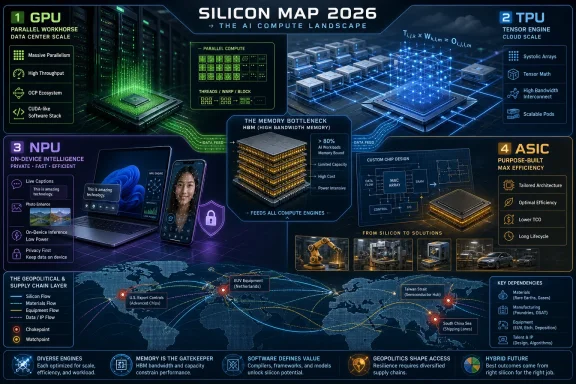
The four chip families are best understood as positions on a map. GPUs are flexible accelerators that dominate training and much of inference. TPUs are cloud-specific tensor engines that reflect Google’s vertical integration. NPUs are low-power local inference blocks for client devices. ASICs are custom tools for companies operating at enormous scale.That map also explains why the market feels chaotic. Nvidia can lead in GPUs while Google succeeds with TPUs. Microsoft can push NPUs in Windows while still renting and buying massive data-center accelerators. Amazon can build Trainium and still offer Nvidia instances. Meta can design chips and remain a major GPU buyer. These are not contradictions; they are signs of a layered compute stack.
The same workload may touch several chip types. A model may be trained on GPUs, distilled or optimized in the cloud, served partly on inference accelerators, and then run in smaller form on an NPU inside a Windows laptop. AI does not live in one place. It moves across the stack.
That mobility is what makes the hardware question so important. The chip determines cost, latency, privacy, battery life, and who controls the platform. In the AI era, silicon is not merely underneath the software. It shapes what the software can become.
The Practical Read for 2026 Is Less Hype, More Fit
The safest way to think about AI chips in 2026 is to match the silicon to the job rather than chase the acronym. The market is noisy because vendors are trying to collapse very different workloads into one word: AI. Buyers should resist that.- A GPU remains the most flexible choice for serious AI development, large-model training, workstation inference, and cloud workloads where software compatibility matters.
- A TPU makes the most sense when the workload already fits Google’s cloud ecosystem and the efficiency gains outweigh the cost of adapting tools and code.
- An NPU is most valuable for battery-efficient, privacy-sensitive, on-device inference in Windows laptops, phones, cameras, and embedded systems.
- A custom ASIC is compelling only at massive scale, where shaving cost and power from a repeated workload can justify years of design expense.
- Memory capacity, bandwidth, software support, and system integration often matter more than the peak arithmetic number printed in a launch deck.
- For Windows buyers, Copilot+ eligibility is a useful signal, but it is not a complete measure of whether a PC is powerful, durable, or well suited to real AI work.
References
- Primary source: Lapaas Voice
Published: 2026-06-25T11:10:12.395893
Loading…
voice.lapaas.com - Related coverage: developer.nvidia.com
NVIDIA Vera Rubin POD: Seven Chips, Five Rack-Scale Systems, One AI Supercomputer | NVIDIA Technical Blog
Artificial intelligence is token-driven. Every prompt, reasoning step, and agent interaction generates tokens. Over the past year, token consumption has grown…developer.nvidia.com
- Related coverage: axios.com
Google unifies Gemini Enterprise, debuts new chips
Google is in a pitched battle with Amazon and Microsoft to be the cloud provider of choice for AI workloads.www.axios.com