
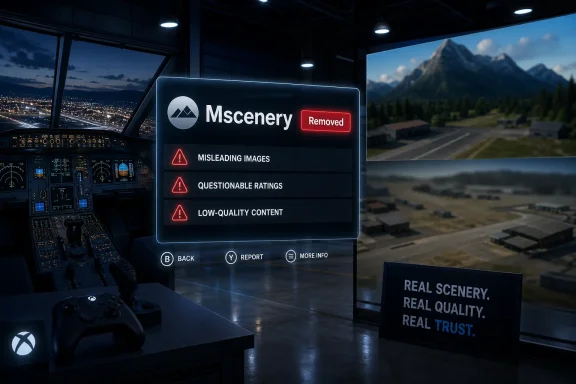
Microsoft has stopped selling Mscenery add-ons in the Microsoft Flight Simulator 2020 and 2024 in-game Marketplaces as of June 25, 2026, after community complaints about low-quality content, misleading product presentation, and the credibility of unusually high user ratings. The move is a rare public ejection of a marketplace vendor rather than a quiet cleanup of individual listings. It is also a reminder that Microsoft Flight Simulator’s add-on economy is now too important to be governed like a hobbyist bulletin board. Microsoft has solved the immediate embarrassment, but not yet the structural problem that let the embarrassment become a business model.
The most important part of Microsoft’s announcement is not that Mscenery is gone. It is that Microsoft said why. The Flight Simulator team pointed to three categories of complaints: low-quality content, incomplete or misleading descriptions and images, and doubts over the validity of high user scores.
That language matters because it shifts the issue from taste to trust. Flight simmers argue endlessly about whether an aircraft is “study level,” whether a cockpit texture is acceptable, or whether a developer has modeled obscure systems deeply enough. Those arguments are part of the hobby. Misleading images and questionable ratings are different; they strike at the market mechanism itself.
For years, flight simulation has depended on a strange blend of enthusiast labor, boutique studios, freeware generosity, and niche commercial products. Microsoft Flight Simulator 2020 expanded that world by putting a polished, platform-level storefront in front of millions of users, including console players who cannot simply wander off to traditional PC modding sites. Microsoft Flight Simulator 2024 inherits that model and raises the stakes further.
Once Microsoft takes a cut, hosts the storefront, controls access, and presents ratings inside the simulator, it is no longer just a neutral shelf. It is the shopkeeper. That does not mean every bad add-on is Microsoft’s fault, but it does mean Microsoft owns the experience of discovering, buying, installing, and trusting that add-on.
The accusation that stuck was not merely “this is bad.” Plenty of marketplace products disappoint buyers. The more damaging charge was that Mscenery listings appeared to benefit from polished or allegedly AI-generated promotional imagery, vague descriptions, and rating patterns that did not align with the wider community’s visible sentiment.
That combination is toxic in a curated store. A bad add-on with honest screenshots is a buyer-beware problem. A bad add-on with flattering imagery and a glowing score becomes a platform problem, because the store’s trust signals are helping close the sale.
The Flight Simulator community is unusually good at detecting this kind of mismatch. Its most engaged users know what a credible aircraft model looks like, what a functional cockpit should contain, and which third-party studios have earned reputations over time. But a platform marketplace is not built only for the old guard. It is also built for newcomers, casual players, Xbox users, and people who reasonably assume that a product sold in-game has passed a meaningful quality threshold.
That is where Microsoft’s delayed intervention became so frustrating. The issue was visible enough for forum threads, Reddit discussions, YouTube commentary, and specialist sites to keep circling the same name. If the community could see the pattern, many users asked, why could the platform not act sooner?
In a flight simulator, screenshots are not decoration. They are evidence. A buyer cannot test-fly a paid aircraft before purchase in the in-game Marketplace. They rely on images, descriptions, ratings, and whatever external research they are motivated enough to do. If those signals are weak, manipulated, or misleading, the storefront becomes a slot machine with aircraft silhouettes.
This matters more in Microsoft Flight Simulator than in many other games because add-ons often sell the fantasy of precision. A helicopter, fighter jet, regional airport, or landmark pack is purchased because it claims to represent something recognizable. The user is not just buying a cosmetic skin; they are buying fidelity, function, and immersion.
AI-generated marketing art can be especially corrosive in that context because it may produce a plausible-looking aircraft or scene that is not constrained by the actual asset. Even if a listing technically says little, the image does the selling. The buyer’s eye fills in the promise.
Microsoft’s statement did not announce a new rule requiring all Marketplace images to be unedited in-simulator captures. That is the obvious next fight. If the company wants to avoid repeating this episode under a different vendor name, it needs a simple standard: images used to sell simulator content should clearly and primarily show the content as it appears in the simulator.
The complaints around Mscenery centered on unusually high user scores that many community members felt did not match the broader reputation of the products. Microsoft’s own wording acknowledged concern over the “validity” of those scores. That is a careful corporate phrase, but it is still a meaningful admission: the company heard enough to treat the rating system as part of the problem.
Digital storefronts live or die by the quality of their trust infrastructure. Ratings, reviews, refund policies, screenshots, version history, developer identity, and support responsiveness all work together. If one piece is weak, the others can compensate. If several are weak at once, the marketplace rewards volume, presentation, and gaming of the system over craftsmanship.
Flight Simulator is especially vulnerable because the audience is fragmented. Some buyers want casual aircraft that are easy to fly and cheap. Others want deep simulation with accurate avionics, systems, flight models, and failures. A five-star score without context tells neither group enough.
That does not mean Microsoft should turn the Marketplace into a gatekept cathedral for only the most expensive professional-grade add-ons. There is room for accessible aircraft, simplified products, novelty scenery, and beginner-friendly content. But the store must be honest about what each product is, and its ratings must reflect real buyer experience.
The Marketplace has always carried an implicit promise. It is not merely a directory of random files. It is integrated into a Microsoft-published simulator, exposed to Xbox users, and presented as a sanctioned commercial channel. That promise may be limited, but it exists.
The danger for Microsoft is that every low-quality or misleading product does reputational damage beyond its own sales. Users do not distinguish neatly between “a third-party vendor made this” and “Microsoft sold me this.” The credit card charge may identify the platform. The installation happens through the simulator. The disappointment attaches to the game.
That is why the Mscenery removal feels overdue but still important. It tells users that there is a line. It tells other developers that aggressive marketplace flooding and questionable presentation can eventually trigger consequences. And it tells serious third-party studios that Microsoft understands the storefront’s credibility is part of the simulator’s long-term health.
The harder question is whether Microsoft will now define the line publicly. A one-off ejection can be framed as community responsiveness. A policy framework is governance. The former calms a scandal; the latter prevents the next one.
That context makes the Marketplace scandal more damaging. Flight Simulator 2024 is not just a boxed game with optional DLC. It is a cloud-connected platform that asks users to trust Microsoft’s servers, content pipeline, account entitlements, streaming infrastructure, and third-party ecosystem. Trust is not ornamental; it is the product.
When a user sees a questionable add-on at the top of a ratings sort, the message is not confined to that listing. It says the store may not know the difference between a reputable developer and a content mill. It says the discovery system may be rewarding the wrong behavior. It says Microsoft’s platform ambitions are outpacing its moderation.
That is the uncomfortable lesson here. The simulator’s marketplace is not a side quest anymore. For many users, especially on Xbox, it is the primary way to extend the sim. For developers, it is one of the most important routes to customers. For Microsoft, it is recurring revenue and ecosystem lock-in.
A marketplace that cannot reliably separate quality from noise eventually taxes everyone. Buyers hesitate. Good developers lose visibility. Community moderators become unpaid consumer-protection staff. The platform owner spends more time cleaning up preventable messes.
The Marketplace, however, changes the incentive structure. Visibility becomes money. Ratings become money. Thumbnails become money. Release cadence becomes money. If the store rewards quantity and presentation more than support, accuracy, and user satisfaction, then developers are nudged toward the wrong race.
That is unfair to serious studios. A developer that spends months modeling systems, building sound sets, validating flight dynamics, and responding to support tickets should not have to compete on equal footing with listings that look better in thumbnails than they do in the simulator. A curated marketplace should not flatten those differences; it should make them legible.
Microsoft also has to be careful not to overcorrect. The answer is not to purge anything that fails a hardcore simmer’s definition of realism. Casual products can be legitimate if they are labeled honestly and priced accordingly. The line should not be “complex or banned.” The line should be “accurate about what is being sold.”
That means richer product pages, clearer compatibility labels, more transparent update histories, better reporting tools, and ratings that buyers can interrogate rather than merely glance at. It also means consequences for vendors whose listings repeatedly mislead customers, even when each individual product falls into a gray area.
The announcement, at least as reported, does not establish a refund program. That omission is understandable legally and financially, but it is awkward ethically. If a vendor’s catalog is removed because of low quality, misleading presentation, and suspect scores, some buyers will reasonably ask why they must absorb the cost.
Digital marketplace refunds are complicated. Add-on content may have been purchased long ago, used extensively, discounted, bundled, or ported between simulator versions. Microsoft may not want to create a precedent in which delisting a vendor automatically triggers compensation across an entire catalog. Still, the absence of a refund path reinforces why proactive moderation matters.
The cleanest refund is the purchase that never happens. Once a questionable product has been sold for months or years, every remedy is messy. Some users will feel cheated. Some will feel Microsoft is doing enough by stopping new sales. Some will say buyers should have researched more carefully.
A more mature Marketplace would reduce the stakes of that argument. It would offer clearer complaint escalation, time-bound refund options, and visible seller accountability. That would not eliminate bad purchases, but it would make the system feel less like a trapdoor.
The real test comes when the next questionable developer appears without the same notoriety. Will Microsoft identify suspicious rating patterns early? Will it reject misleading promotional images before they go live? Will it require product pages to distinguish in-sim screenshots from concept art or generated marketing assets? Will it publish enforceable standards for functionality, support, and compatibility?
The company does not need to reveal every anti-fraud mechanism. In fact, it should not. But it does need to communicate enough that buyers and developers understand the Marketplace is being actively governed. Silence creates the impression that enforcement depends on outrage volume.
There is also a broader Microsoft angle. The company increasingly wants Windows, Xbox, Game Pass, cloud services, and creator economies to blend into seamless platforms. That strategy only works if users believe Microsoft is a competent custodian of the marketplaces inside those platforms. A weak storefront is not just a Flight Simulator problem; it is a platform credibility problem in miniature.
Microsoft has spent decades learning this lesson in other contexts. App stores, driver distribution, browser extensions, game mods, and enterprise marketplaces all eventually collide with the same reality: openness attracts creativity, and it also attracts exploitation. The hard part is designing a system where the former does not become camouflage for the latter.
 Microsoft Finally Treats the Marketplace Like Its Own Storefront
The most important part of Microsoft’s announcement is not that Mscenery is gone. It is that Microsoft said why. The Flight Simulator team pointed to three categories of complaints: low-quality content, incomplete or misleading descriptions and images, and doubts over the validity of high user scores.That language matters because it shifts the issue from taste to trust. Flight simmers argue endlessly about whether an aircraft is “study level,” whether a cockpit texture is acceptable, or whether a developer has modeled obscure systems deeply enough. Those arguments are part of the hobby. Misleading images and questionable ratings are different; they strike at the market mechanism itself.
For years, flight simulation has depended on a strange blend of enthusiast labor, boutique studios, freeware generosity, and niche commercial products. Microsoft Flight Simulator 2020 expanded that world by putting a polished, platform-level storefront in front of millions of users, including console players who cannot simply wander off to traditional PC modding sites. Microsoft Flight Simulator 2024 inherits that model and raises the stakes further.
Once Microsoft takes a cut, hosts the storefront, controls access, and presents ratings inside the simulator, it is no longer just a neutral shelf. It is the shopkeeper. That does not mean every bad add-on is Microsoft’s fault, but it does mean Microsoft owns the experience of discovering, buying, installing, and trusting that add-on.
Mscenery Became a Symbol Because the Store Had No Immune System
Mscenery’s reputation did not collapse overnight. Complaints about the developer’s output have circulated in the Flight Simulator community for years, with users objecting to aircraft and scenery that they considered crude, incomplete, or far below the standard implied by a paid marketplace listing. The latest backlash sharpened around Microsoft Flight Simulator 2024 because the Marketplace is increasingly central to the product experience.The accusation that stuck was not merely “this is bad.” Plenty of marketplace products disappoint buyers. The more damaging charge was that Mscenery listings appeared to benefit from polished or allegedly AI-generated promotional imagery, vague descriptions, and rating patterns that did not align with the wider community’s visible sentiment.
That combination is toxic in a curated store. A bad add-on with honest screenshots is a buyer-beware problem. A bad add-on with flattering imagery and a glowing score becomes a platform problem, because the store’s trust signals are helping close the sale.
The Flight Simulator community is unusually good at detecting this kind of mismatch. Its most engaged users know what a credible aircraft model looks like, what a functional cockpit should contain, and which third-party studios have earned reputations over time. But a platform marketplace is not built only for the old guard. It is also built for newcomers, casual players, Xbox users, and people who reasonably assume that a product sold in-game has passed a meaningful quality threshold.
That is where Microsoft’s delayed intervention became so frustrating. The issue was visible enough for forum threads, Reddit discussions, YouTube commentary, and specialist sites to keep circling the same name. If the community could see the pattern, many users asked, why could the platform not act sooner?
The AI Image Problem Was Really a Truth-in-Advertising Problem
The phrase AI imagery has become a convenient lightning rod, but it risks making the scandal sound narrower than it is. The problem is not that a marketplace thumbnail may have been generated or enhanced by AI. The problem is that promotional material can imply a level of detail, lighting, geometry, or polish that the product itself does not deliver.In a flight simulator, screenshots are not decoration. They are evidence. A buyer cannot test-fly a paid aircraft before purchase in the in-game Marketplace. They rely on images, descriptions, ratings, and whatever external research they are motivated enough to do. If those signals are weak, manipulated, or misleading, the storefront becomes a slot machine with aircraft silhouettes.
This matters more in Microsoft Flight Simulator than in many other games because add-ons often sell the fantasy of precision. A helicopter, fighter jet, regional airport, or landmark pack is purchased because it claims to represent something recognizable. The user is not just buying a cosmetic skin; they are buying fidelity, function, and immersion.
AI-generated marketing art can be especially corrosive in that context because it may produce a plausible-looking aircraft or scene that is not constrained by the actual asset. Even if a listing technically says little, the image does the selling. The buyer’s eye fills in the promise.
Microsoft’s statement did not announce a new rule requiring all Marketplace images to be unedited in-simulator captures. That is the obvious next fight. If the company wants to avoid repeating this episode under a different vendor name, it needs a simple standard: images used to sell simulator content should clearly and primarily show the content as it appears in the simulator.
Ratings Failed at the Exact Moment They Were Needed Most
The rating issue is arguably more serious than the asset-quality issue because ratings are supposed to be the defense against weak products. A marketplace can tolerate uneven supply if users can reliably punish the bad listings and elevate the good ones. When scores themselves become suspect, the store loses its steering wheel.The complaints around Mscenery centered on unusually high user scores that many community members felt did not match the broader reputation of the products. Microsoft’s own wording acknowledged concern over the “validity” of those scores. That is a careful corporate phrase, but it is still a meaningful admission: the company heard enough to treat the rating system as part of the problem.
Digital storefronts live or die by the quality of their trust infrastructure. Ratings, reviews, refund policies, screenshots, version history, developer identity, and support responsiveness all work together. If one piece is weak, the others can compensate. If several are weak at once, the marketplace rewards volume, presentation, and gaming of the system over craftsmanship.
Flight Simulator is especially vulnerable because the audience is fragmented. Some buyers want casual aircraft that are easy to fly and cheap. Others want deep simulation with accurate avionics, systems, flight models, and failures. A five-star score without context tells neither group enough.
That does not mean Microsoft should turn the Marketplace into a gatekept cathedral for only the most expensive professional-grade add-ons. There is room for accessible aircraft, simplified products, novelty scenery, and beginner-friendly content. But the store must be honest about what each product is, and its ratings must reflect real buyer experience.
A Curated Marketplace Cannot Hide Behind Caveat Emptor
The old PC modding ethic says users should research before buying. That is good advice, but it is not a governance model. Microsoft cannot build an in-game shop, invite users to spend money inside it, and then behave as if every customer should have watched a 40-minute YouTube teardown first.The Marketplace has always carried an implicit promise. It is not merely a directory of random files. It is integrated into a Microsoft-published simulator, exposed to Xbox users, and presented as a sanctioned commercial channel. That promise may be limited, but it exists.
The danger for Microsoft is that every low-quality or misleading product does reputational damage beyond its own sales. Users do not distinguish neatly between “a third-party vendor made this” and “Microsoft sold me this.” The credit card charge may identify the platform. The installation happens through the simulator. The disappointment attaches to the game.
That is why the Mscenery removal feels overdue but still important. It tells users that there is a line. It tells other developers that aggressive marketplace flooding and questionable presentation can eventually trigger consequences. And it tells serious third-party studios that Microsoft understands the storefront’s credibility is part of the simulator’s long-term health.
The harder question is whether Microsoft will now define the line publicly. A one-off ejection can be framed as community responsiveness. A policy framework is governance. The former calms a scandal; the latter prevents the next one.
Microsoft Flight Simulator 2024 Could Not Afford Another Trust Problem
Microsoft Flight Simulator 2024 arrived with more baggage than Microsoft would have liked. Its launch was marred by server congestion, streaming issues, long waits, missing content, and a wave of angry first impressions from users who expected a smoother transition from the 2020 platform. The game has improved, but launch memory matters.That context makes the Marketplace scandal more damaging. Flight Simulator 2024 is not just a boxed game with optional DLC. It is a cloud-connected platform that asks users to trust Microsoft’s servers, content pipeline, account entitlements, streaming infrastructure, and third-party ecosystem. Trust is not ornamental; it is the product.
When a user sees a questionable add-on at the top of a ratings sort, the message is not confined to that listing. It says the store may not know the difference between a reputable developer and a content mill. It says the discovery system may be rewarding the wrong behavior. It says Microsoft’s platform ambitions are outpacing its moderation.
That is the uncomfortable lesson here. The simulator’s marketplace is not a side quest anymore. For many users, especially on Xbox, it is the primary way to extend the sim. For developers, it is one of the most important routes to customers. For Microsoft, it is recurring revenue and ecosystem lock-in.
A marketplace that cannot reliably separate quality from noise eventually taxes everyone. Buyers hesitate. Good developers lose visibility. Community moderators become unpaid consumer-protection staff. The platform owner spends more time cleaning up preventable messes.
The Best Developers Need Protection From the Worst Incentives
The Flight Simulator add-on scene has always had a wide quality range. That is not a defect; it is part of the ecosystem’s vitality. The same world that produces painstaking airliners and meticulously researched airports also produces quick-and-dirty experiments, passion projects, and low-cost curiosities.The Marketplace, however, changes the incentive structure. Visibility becomes money. Ratings become money. Thumbnails become money. Release cadence becomes money. If the store rewards quantity and presentation more than support, accuracy, and user satisfaction, then developers are nudged toward the wrong race.
That is unfair to serious studios. A developer that spends months modeling systems, building sound sets, validating flight dynamics, and responding to support tickets should not have to compete on equal footing with listings that look better in thumbnails than they do in the simulator. A curated marketplace should not flatten those differences; it should make them legible.
Microsoft also has to be careful not to overcorrect. The answer is not to purge anything that fails a hardcore simmer’s definition of realism. Casual products can be legitimate if they are labeled honestly and priced accordingly. The line should not be “complex or banned.” The line should be “accurate about what is being sold.”
That means richer product pages, clearer compatibility labels, more transparent update histories, better reporting tools, and ratings that buyers can interrogate rather than merely glance at. It also means consequences for vendors whose listings repeatedly mislead customers, even when each individual product falls into a gray area.
Refunds Are the Silence at the Center of the Announcement
Microsoft’s message reassured existing buyers that their Mscenery purchases will remain accessible and usable. That is sensible from an entitlement standpoint, but it leaves a thorny question hanging: what about customers who bought products that Microsoft now implicitly says were not fit to keep selling?The announcement, at least as reported, does not establish a refund program. That omission is understandable legally and financially, but it is awkward ethically. If a vendor’s catalog is removed because of low quality, misleading presentation, and suspect scores, some buyers will reasonably ask why they must absorb the cost.
Digital marketplace refunds are complicated. Add-on content may have been purchased long ago, used extensively, discounted, bundled, or ported between simulator versions. Microsoft may not want to create a precedent in which delisting a vendor automatically triggers compensation across an entire catalog. Still, the absence of a refund path reinforces why proactive moderation matters.
The cleanest refund is the purchase that never happens. Once a questionable product has been sold for months or years, every remedy is messy. Some users will feel cheated. Some will feel Microsoft is doing enough by stopping new sales. Some will say buyers should have researched more carefully.
A more mature Marketplace would reduce the stakes of that argument. It would offer clearer complaint escalation, time-bound refund options, and visible seller accountability. That would not eliminate bad purchases, but it would make the system feel less like a trapdoor.
The Next Scandal Will Test Whether This Was Policy or Pressure
The community should enjoy this win, but it should not mistake it for a finished reform. Microsoft removed one vendor after sustained public attention. That is action, not architecture.The real test comes when the next questionable developer appears without the same notoriety. Will Microsoft identify suspicious rating patterns early? Will it reject misleading promotional images before they go live? Will it require product pages to distinguish in-sim screenshots from concept art or generated marketing assets? Will it publish enforceable standards for functionality, support, and compatibility?
The company does not need to reveal every anti-fraud mechanism. In fact, it should not. But it does need to communicate enough that buyers and developers understand the Marketplace is being actively governed. Silence creates the impression that enforcement depends on outrage volume.
There is also a broader Microsoft angle. The company increasingly wants Windows, Xbox, Game Pass, cloud services, and creator economies to blend into seamless platforms. That strategy only works if users believe Microsoft is a competent custodian of the marketplaces inside those platforms. A weak storefront is not just a Flight Simulator problem; it is a platform credibility problem in miniature.
Microsoft has spent decades learning this lesson in other contexts. App stores, driver distribution, browser extensions, game mods, and enterprise marketplaces all eventually collide with the same reality: openness attracts creativity, and it also attracts exploitation. The hard part is designing a system where the former does not become camouflage for the latter.
The Marketplace Now Has to Earn Its Five Stars
The practical lesson from the Mscenery episode is not complicated, but it is demanding. Microsoft has to make the Flight Simulator Marketplace feel less like a glossy shelf and more like a trustworthy procurement channel for hobbyists and serious simmers alike.- Microsoft has stopped new sales of Mscenery content in both the Microsoft Flight Simulator 2020 and 2024 in-game Marketplaces, while preserving access for customers who already bought those products.
- The company’s stated reasons go beyond subjective quality complaints and include misleading product presentation and concerns about unusually high user scores.
- The controversy exposes a deeper weakness in marketplace trust signals, especially screenshots, ratings, descriptions, and discoverability.
- Microsoft does not need to ban simplified or casual add-ons, but it does need to make sure buyers can tell what level of fidelity and functionality they are paying for.
- The next meaningful reform would be a clearer seller policy, stronger image standards, better rating integrity checks, and a more visible complaint-and-remedy process.
References
- Primary source: Windows Central
Published: 2026-06-25T22:52:10.236340
Loading…
www.windowscentral.com - Related coverage: msfsaddons.com
Loading…
msfsaddons.com - Related coverage: change.org
Loading…
www.change.org - Related coverage: techspot.com
Loading…
www.techspot.com - Related coverage: flightsimulator.zendesk.com
Loading…
flightsimulator.zendesk.com - Related coverage: forums.flightsimulator.com
Loading…
forums.flightsimulator.com