
Linux 7.2 is adding a new
The most interesting thing about the Wacom W9000 driver is not that it exists. It is that it exists now.
The W9002, one of the devices reportedly tested with the new driver, is associated with hardware from the Surface Pro era roughly a decade ago. That period produced a fleet of hybrid PCs that were neither classic laptops nor modern ARM tablets, and their long-term Linux support often depended on a messy stack of ACPI quirks, I2C oddities, reverse engineering, and user patience. The hardware was capable, but its input plumbing was often too specific to work well without focused driver attention.
That is why a driver for passive Wacom pen-enabled touchscreens matters. A tablet without reliable pen input is not a tablet in any meaningful sense; it is a compromised laptop with a glossy screen. For artists, note-takers, students, field workers, and tinkerers, the difference between “boots Linux” and “works as intended” is the difference between a curiosity and a daily machine.
Linux has become very good at the first part. The second part remains where kernel work like this earns its keep.
That distinction matters because Linux users do not experience “W9002 support” as a kernel feature. They experience it as whether an old Surface-class machine can become a clean GNOME, KDE, Fedora, Arch, Debian, or Ubuntu pen tablet without out-of-tree patches and forum spelunking. The kernel’s input subsystem is the invisible layer that turns a device from a pile of detected buses into something desktops can expose as touch, stylus, buttons, and coordinates.
The W9000 series uses I2C, which is common for embedded touchscreen and sensor hardware in tablets and convertibles. I2C is not exotic, but the device-specific interpretation still matters. If the driver does not know the hardware’s report format, coordinate behavior, pressure data, or quirks, the rest of the stack can only do so much.
Mainlining the driver changes that equation. Once support is upstream, distributions can inherit it through normal kernel updates. Users no longer need the right forum post, the right DKMS package, or the right patched tree. That is the boring part of Linux progress, and it is also the part that makes hardware feel permanently supported.
That caution is important because digitizer hardware can be deceptively similar. Two devices may share a family name and still differ in firmware behavior, coordinate ranges, interrupt handling, or power-management expectations. The wrong assumption can turn a clean driver into a stream of ghost touches, dead pens, broken suspend, or unusable calibration.
For users, the practical result is simple: some devices may work as soon as Linux 7.2 reaches their distribution, while related models may need follow-up patches. That is not failure. That is the upstream process doing what it does best: start with verified hardware, then expand support as more testers appear.
The key point is that the hard part has moved from “write a driver” to “confirm variants.” That is a much better problem to have.
But the W9000 driver should not be read only as a Surface story. It is part of a broader pattern in which Linux slowly normalizes hardware that was once treated as Windows-specific. Touchscreens, pen digitizers, accelerometers, keyboard covers, special buttons, and firmware-controlled features have all moved through the same lifecycle: first unsupported, then hacked around, then partially upstreamed, then eventually boring.
Boring is the win. The best possible future for a pen-enabled touchscreen driver is that nobody thinks about it. The pen appears in the desktop settings panel, pressure works in supported applications, palm rejection behaves well enough, and users stop knowing the controller name.
That is how hardware support becomes infrastructure.
A mouse that jitters, a touchpad with poor palm rejection, a touchscreen with reversed axes, a stylus with missing pressure, or a keyboard cover that fails after resume can make the fastest kernel in the world feel unfinished. This is especially true on convertible PCs, where the value proposition depends on the machine fluidly changing roles. If pen and touch do not work, the device collapses back into a laptop with compromises.
That is why input subsystem updates matter beyond the devices named in a pull request. They are trust-building work. Every new driver and every removed bit of unused code narrows the gap between Linux as a capable operating system and Linux as a polished client platform.
For sysadmins and IT pros, this has a practical dimension. Secondary fleets, lab devices, kiosks, refurb projects, education deployments, and field tablets often live long past their original Windows support window. Linux becomes more attractive when “old but functional” hardware does not require bespoke driver maintenance.
Input bugs are not always spectacular security stories, but malformed reports, stale assumptions, and unsafe parsing are exactly the kind of low-level problems kernel developers have spent years trying to eliminate. A driver that handles a touchscreen report incorrectly may simply misbehave. A driver that mishandles memory while parsing device input is a more serious matter.
The removal of old input drivers is part of the same discipline. Kernel code has a maintenance cost even when nobody talks about it. Dead drivers consume review attention, complicate tree-wide changes, and preserve patterns that newer code is trying to leave behind. Pruning them is not as exciting as adding support for a tablet, but it improves the health of the subsystem.
This is where Linux kernel development often looks least glamorous and most valuable. The platform advances because someone adds a driver, someone else removes a fossil, and a third person tightens memory handling in code that users never knew existed.
A forum thread can get one person’s stylus working. A DKMS module can carry a niche device for a while. A custom kernel can solve a problem for a particular distribution release. None of those are equivalent to mainline support.
Mainline changes the maintenance model. It lets distributions ship the fix, lets regression testing see the code, lets other developers refactor it with the rest of the subsystem, and lets future hardware IDs be added in a normal way. It also gives users a much clearer path when something breaks: file a bug against upstream behavior, not against an abandoned patch set from three kernel cycles ago.
For WindowsForum readers, this is the part that should sound familiar. Windows hardware support often appears seamless because the vendor stack is coordinated before the user ever sees the machine. Linux has to reconstruct that coordination in public, after the fact, across vendors that may or may not help. When that work lands upstream, it is the closest Linux gets to turning a community repair into a platform feature.
On one edge, the kernel is preparing for new silicon, new GPUs, new handhelds, new laptops, and new platform controllers. On the other, it is still making decade-old machines more complete. That dual mandate is one of Linux’s defining traits. It wants to boot tomorrow’s workstation and yesterday’s tablet with the same source tree.
That creates tension. Supporting old hardware forever is not free, and kernel developers are increasingly willing to remove unused drivers rather than preserve museum pieces indefinitely. But the W9000 driver shows the healthier version of long-tail support: not nostalgia for its own sake, but support for hardware that still has real utility.
A pen-enabled x86 tablet from the mid-2010s may not be a performance monster in 2026. It can still be a note-taking slate, a lightweight Linux test machine, a Home Assistant dashboard, a drawing pad, a workshop terminal, or a child’s learning computer. Good input support is what makes those second lives plausible.
The best Linux hardware support often comes from a thousand small merges that remove friction from machines users already own. A touchscreen works. A special key reports correctly. A stylus stops needing a patch. A gaming handheld exposes configuration controls. A laptop sensor behaves after suspend. No single item transforms the desktop, but together they determine whether Linux feels like an operating system built for the machine in front of you.
That is especially relevant as Windows users face familiar pressures: hardware requirements, account integration, telemetry debates, support deadlines, and the general churn of modern client computing. Linux does not need to be perfect to become attractive. It needs to be predictable enough that trying it does not feel like volunteering for driver archaeology.
The W9000 driver is one small move in that direction. It tells users of older pen-enabled tablets that the upstream kernel has not forgotten their class of device. More importantly, it tells future contributors that there is still value in doing the unglamorous work of turning “almost works” into “supported.”
Linux is uniquely positioned to catch that hardware when commercial attention fades. That does not mean every device will be saved, or that every old tablet deserves infinite maintenance. It means the kernel community can turn scattered knowledge into durable support when developers have documentation, devices, testing, and patience.
The Wacom W9000 work fits that pattern neatly. It starts with known-good testing on specific models. It leaves room for nearby devices to join after verification. It lands alongside cleanup and hardening rather than as an isolated hardware stunt. That is exactly how mature platform support should look.
There is a quiet politics to this, too. A device that depends entirely on one vendor’s original software stack has a fixed lifespan. A device whose essential functions are supported upstream has a chance at a longer one. For users, that is not ideology; it is whether a perfectly usable screen and pen end up in a drawer.
wacom_w9000 input driver for Wacom W9000-series pen-enabled touchscreens, with verified support for W9002 and W9007A devices and a path for nearby models such as W9001 and W9010 once IDs and behavior are confirmed. That sounds like a small kernel changelog item, because in raw line count it probably is. But for anyone who has tried to keep older pen-first Windows tablets useful under Linux, it is also a reminder that hardware support often arrives not as a grand platform strategy, but as a belated act of preservation. Linux is not merely chasing new devices here; it is absorbing the forgotten middle years of mobile PC hardware into the mainline kernel.
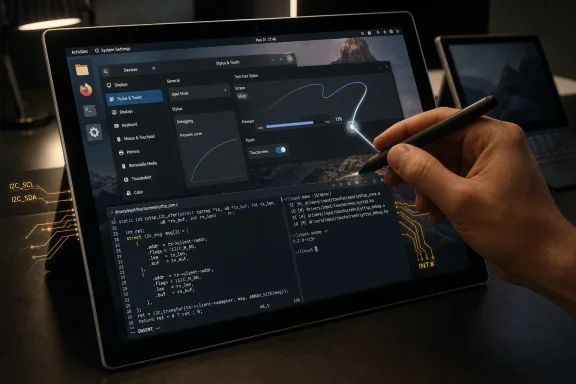 The Kernel Is Still Where Old Hardware Gets a Second Life
The most interesting thing about the Wacom W9000 driver is not that it exists. It is that it exists now.The W9002, one of the devices reportedly tested with the new driver, is associated with hardware from the Surface Pro era roughly a decade ago. That period produced a fleet of hybrid PCs that were neither classic laptops nor modern ARM tablets, and their long-term Linux support often depended on a messy stack of ACPI quirks, I2C oddities, reverse engineering, and user patience. The hardware was capable, but its input plumbing was often too specific to work well without focused driver attention.
That is why a driver for passive Wacom pen-enabled touchscreens matters. A tablet without reliable pen input is not a tablet in any meaningful sense; it is a compromised laptop with a glossy screen. For artists, note-takers, students, field workers, and tinkerers, the difference between “boots Linux” and “works as intended” is the difference between a curiosity and a daily machine.
Linux has become very good at the first part. The second part remains where kernel work like this earns its keep.
Wacom Support Has Always Been Bigger Than Drawing Tablets
Wacom is commonly understood as a graphics-tablet company, but in PC history its technology has often been buried inside machines sold under someone else’s logo. The Windows tablet market, especially in the 2010s, relied on digitizer hardware that users rarely identified by controller model. They knew whether the pen worked, whether pressure behaved, whether palm rejection felt sane, and whether suspend-resume broke the device.That distinction matters because Linux users do not experience “W9002 support” as a kernel feature. They experience it as whether an old Surface-class machine can become a clean GNOME, KDE, Fedora, Arch, Debian, or Ubuntu pen tablet without out-of-tree patches and forum spelunking. The kernel’s input subsystem is the invisible layer that turns a device from a pile of detected buses into something desktops can expose as touch, stylus, buttons, and coordinates.
The W9000 series uses I2C, which is common for embedded touchscreen and sensor hardware in tablets and convertibles. I2C is not exotic, but the device-specific interpretation still matters. If the driver does not know the hardware’s report format, coordinate behavior, pressure data, or quirks, the rest of the stack can only do so much.
Mainlining the driver changes that equation. Once support is upstream, distributions can inherit it through normal kernel updates. Users no longer need the right forum post, the right DKMS package, or the right patched tree. That is the boring part of Linux progress, and it is also the part that makes hardware feel permanently supported.
This Is a Small Driver With a Long Tail
The initial driver has reportedly been tested successfully with W9002 and W9007A devices. The phrasing around W9001 and W9010 is deliberately cautious: they are expected to be supportable after verifying correct operation and adding the necessary IDs. That is how kernel hardware support should be described. It is not a press-release promise; it is an engineering claim bounded by hardware that developers have actually seen.That caution is important because digitizer hardware can be deceptively similar. Two devices may share a family name and still differ in firmware behavior, coordinate ranges, interrupt handling, or power-management expectations. The wrong assumption can turn a clean driver into a stream of ghost touches, dead pens, broken suspend, or unusable calibration.
For users, the practical result is simple: some devices may work as soon as Linux 7.2 reaches their distribution, while related models may need follow-up patches. That is not failure. That is the upstream process doing what it does best: start with verified hardware, then expand support as more testers appear.
The key point is that the hard part has moved from “write a driver” to “confirm variants.” That is a much better problem to have.
The Surface Angle Is the Hook, Not the Whole Story
The mention of W9002-era Surface Pro hardware gives this driver a nostalgic charge. Microsoft’s early Surface Pro line was an influential but awkward family of machines: too hot and heavy to be effortless tablets, too unusual to be normal laptops, and too interesting to disappear. Linux support for Surface devices has long existed in the shadow of that ambition, with community projects filling gaps that vendors did not prioritize.But the W9000 driver should not be read only as a Surface story. It is part of a broader pattern in which Linux slowly normalizes hardware that was once treated as Windows-specific. Touchscreens, pen digitizers, accelerometers, keyboard covers, special buttons, and firmware-controlled features have all moved through the same lifecycle: first unsupported, then hacked around, then partially upstreamed, then eventually boring.
Boring is the win. The best possible future for a pen-enabled touchscreen driver is that nobody thinks about it. The pen appears in the desktop settings panel, pressure works in supported applications, palm rejection behaves well enough, and users stop knowing the controller name.
That is how hardware support becomes infrastructure.
Input Is Where Desktop Linux Still Wins or Loses Trust
Graphics drivers get the headlines. Filesystems get the drama. CPU scheduling gets the benchmarks. But input is where users decide, in the first five minutes, whether an operating system feels serious.A mouse that jitters, a touchpad with poor palm rejection, a touchscreen with reversed axes, a stylus with missing pressure, or a keyboard cover that fails after resume can make the fastest kernel in the world feel unfinished. This is especially true on convertible PCs, where the value proposition depends on the machine fluidly changing roles. If pen and touch do not work, the device collapses back into a laptop with compromises.
That is why input subsystem updates matter beyond the devices named in a pull request. They are trust-building work. Every new driver and every removed bit of unused code narrows the gap between Linux as a capable operating system and Linux as a polished client platform.
For sysadmins and IT pros, this has a practical dimension. Secondary fleets, lab devices, kiosks, refurb projects, education deployments, and field tablets often live long past their original Windows support window. Linux becomes more attractive when “old but functional” hardware does not require bespoke driver maintenance.
Hardening Is the Less Glamorous Half of the Story
The W9000 driver is the headline feature in this input pull, but the surrounding theme reportedly includes code hardening across other drivers and removal of old or unused input code. That matters because kernel input drivers sit at an uncomfortable boundary. They parse data from physical devices, firmware, embedded controllers, docks, dongles, and sometimes untrusted peripherals.Input bugs are not always spectacular security stories, but malformed reports, stale assumptions, and unsafe parsing are exactly the kind of low-level problems kernel developers have spent years trying to eliminate. A driver that handles a touchscreen report incorrectly may simply misbehave. A driver that mishandles memory while parsing device input is a more serious matter.
The removal of old input drivers is part of the same discipline. Kernel code has a maintenance cost even when nobody talks about it. Dead drivers consume review attention, complicate tree-wide changes, and preserve patterns that newer code is trying to leave behind. Pruning them is not as exciting as adding support for a tablet, but it improves the health of the subsystem.
This is where Linux kernel development often looks least glamorous and most valuable. The platform advances because someone adds a driver, someone else removes a fossil, and a third person tightens memory handling in code that users never knew existed.
Mainline Beats the Forever Workaround
The Linux desktop has always had a workaround culture. That culture is powerful, and sometimes it is the reason unsupported hardware becomes supported at all. But workarounds are also a tax, and the people who pay it most heavily are often the users least able to diagnose failures.A forum thread can get one person’s stylus working. A DKMS module can carry a niche device for a while. A custom kernel can solve a problem for a particular distribution release. None of those are equivalent to mainline support.
Mainline changes the maintenance model. It lets distributions ship the fix, lets regression testing see the code, lets other developers refactor it with the rest of the subsystem, and lets future hardware IDs be added in a normal way. It also gives users a much clearer path when something breaks: file a bug against upstream behavior, not against an abandoned patch set from three kernel cycles ago.
For WindowsForum readers, this is the part that should sound familiar. Windows hardware support often appears seamless because the vendor stack is coordinated before the user ever sees the machine. Linux has to reconstruct that coordination in public, after the fact, across vendors that may or may not help. When that work lands upstream, it is the closest Linux gets to turning a community repair into a platform feature.
The Timing Shows How Linux 7.2 Is Shaping Up
Linux 7.2’s merge window is wrapping up with the usual mix of headline features and small subsystem work. Graphics changes, scheduler work, build-system updates, and hardware enablement tend to dominate the conversation. The input pull is quieter, but it is part of the same release story: Linux is continuing to expand at both edges of the hardware timeline.On one edge, the kernel is preparing for new silicon, new GPUs, new handhelds, new laptops, and new platform controllers. On the other, it is still making decade-old machines more complete. That dual mandate is one of Linux’s defining traits. It wants to boot tomorrow’s workstation and yesterday’s tablet with the same source tree.
That creates tension. Supporting old hardware forever is not free, and kernel developers are increasingly willing to remove unused drivers rather than preserve museum pieces indefinitely. But the W9000 driver shows the healthier version of long-tail support: not nostalgia for its own sake, but support for hardware that still has real utility.
A pen-enabled x86 tablet from the mid-2010s may not be a performance monster in 2026. It can still be a note-taking slate, a lightweight Linux test machine, a Home Assistant dashboard, a drawing pad, a workshop terminal, or a child’s learning computer. Good input support is what makes those second lives plausible.
The Real Beneficiaries Are Not Kernel Hobbyists
It is tempting to frame this as a win for kernel hobbyists who enjoy reviving old hardware. They will benefit, certainly. But the larger audience is anyone who depends on Linux becoming less surprising on commodity PCs.The best Linux hardware support often comes from a thousand small merges that remove friction from machines users already own. A touchscreen works. A special key reports correctly. A stylus stops needing a patch. A gaming handheld exposes configuration controls. A laptop sensor behaves after suspend. No single item transforms the desktop, but together they determine whether Linux feels like an operating system built for the machine in front of you.
That is especially relevant as Windows users face familiar pressures: hardware requirements, account integration, telemetry debates, support deadlines, and the general churn of modern client computing. Linux does not need to be perfect to become attractive. It needs to be predictable enough that trying it does not feel like volunteering for driver archaeology.
The W9000 driver is one small move in that direction. It tells users of older pen-enabled tablets that the upstream kernel has not forgotten their class of device. More importantly, it tells future contributors that there is still value in doing the unglamorous work of turning “almost works” into “supported.”
The Patch Notes Say Driver, but the Subtext Says Stewardship
The most concrete lesson in this merge is that hardware enablement is not just about new product launches. It is also about stewardship. A vendor ships a device, the market moves on, operating systems change, and users are left with hardware that may be electronically sound but software-fragile.Linux is uniquely positioned to catch that hardware when commercial attention fades. That does not mean every device will be saved, or that every old tablet deserves infinite maintenance. It means the kernel community can turn scattered knowledge into durable support when developers have documentation, devices, testing, and patience.
The Wacom W9000 work fits that pattern neatly. It starts with known-good testing on specific models. It leaves room for nearby devices to join after verification. It lands alongside cleanup and hardening rather than as an isolated hardware stunt. That is exactly how mature platform support should look.
There is a quiet politics to this, too. A device that depends entirely on one vendor’s original software stack has a fixed lifespan. A device whose essential functions are supported upstream has a chance at a longer one. For users, that is not ideology; it is whether a perfectly usable screen and pen end up in a drawer.
What Linux 7.2’s Wacom Merge Actually Changes
The W9000 addition is narrow, but its implications are practical enough to separate signal from release-note noise. Users should not expect a universal miracle for every Wacom-equipped tablet, but they should recognize the direction of travel.- Linux 7.2 adds a new mainline input driver for Wacom W9000-series pen-enabled touchscreens that communicate over I2C.
- The driver has reportedly been tested with W9002 and W9007A hardware, making those the safest early expectations for working support.
- Related devices such as W9001 and W9010 may be supportable with small additions, but they still need verification rather than assumptions.
- Older pen-enabled Windows tablets stand to benefit most because mainline support reduces dependence on custom kernels, DKMS modules, and distribution-specific workarounds.
- The wider input pull is not just about new hardware, because driver hardening and removal of unused code are part of making the subsystem safer and easier to maintain.
- The practical test will come after Linux 7.2 reaches mainstream distributions and users with real hardware report whether pen, touch, suspend, and calibration behave correctly.
References
- Primary source: Phoronix
Published: 2026-06-26T09:56:10.234779
Loading…
www.phoronix.com - Official source: github.com
Loading…
github.com - Related coverage: lists.openwall.net
Loading…
lists.openwall.net - Related coverage: sourceforge.net
Loading…
sourceforge.net - Related coverage: blog.foool.net
Loading…
blog.foool.net - Related coverage: tldp.org
Loading…
tldp.org