
A Tesla Model 3 driven by 44-year-old Michael Butler crashed into a home in Katy, Texas, on June 19, 2026, killing 76-year-old Martha Avila and prompting her family to sue both Butler and Tesla in Harris County District Court. The driver reportedly told deputies that Tesla driver-assistance technology was engaged, while Tesla executives have publicly argued that the data points instead to a human accelerator override. That factual dispute is the narrow question investigators will try to answer. The wider question is harder for Tesla: whether a company can market increasingly capable automated driving as a safety revolution while placing nearly all legal and practical responsibility on a human who may already have been trained to trust the machine.
Most fights over Tesla’s Autopilot and Full Self-Driving systems begin on highways, at intersections, or in the gray zone where software confidence and driver attention fail at the same time. This one began in a residential neighborhood and ended inside a brick house, with a woman who was not in the car, not using the technology, and not consenting to the risks around it.
That detail matters. Product-liability cases about driver assistance often get pulled into arguments about whether the driver misused the system, ignored warnings, or failed to intervene. Those arguments will surely appear here too. But Martha Avila’s death shifts the moral center of the case away from the familiar “driver versus software” debate and toward a simpler public-safety question: how much risk should a beta-like consumer automation system be allowed to export to everyone else?
The lawsuit reportedly alleges design defect, failure to warn, gross negligence, and wrongful death. Tesla’s apparent defense, previewed by executives on X, is that the crash does not fit the behavior of Full Self-Driving and that the driver manually overrode the system by pressing the accelerator fully. If Tesla’s vehicle logs support that claim, the company will argue that the crash was not a software failure at all.
But that may not end the case. The law does not always ask only whether a machine directly caused the last second of a crash. It can also ask whether a product was designed, named, constrained, monitored, and explained in a way that made foreseeable misuse more likely.
That defense may be factually strong. Modern vehicles record enormous amounts of state data: pedal position, steering input, braking, system engagement, disengagement timing, speed, warnings, and driver inputs. If the Model 3’s logs show sustained human accelerator input, Tesla will have a powerful narrative for a jury: the car did what the driver told it to do.
The problem for Tesla is that this argument lives inside a larger product story the company has been telling for years. Tesla does not sell its driver-assistance systems as dull cruise-control utilities. It sells them as stepping stones toward autonomy, wrapped in names like Autopilot and Full Self-Driving, and demonstrated in videos and social media posts that emphasize capability more than limitation.
That gap between legal fine print and public meaning has always been the danger zone. Tesla tells regulators and courts that the driver must supervise at all times. Tesla tells customers, investors, and fans that the car is learning to drive itself. When something catastrophic happens, the company retreats to the first message; when it sells the future, it leans hard on the second.
That tension is not merely semantic. Human factors research has long warned that partial automation can create a complacency trap: the better a system performs most of the time, the harder it becomes for a human to remain alert for the rare moment when it fails. This is the paradox at the heart of Tesla’s success. A bad driver-assistance system is annoying and gets turned off; a good one earns trust, and trust can dull vigilance.
Tesla’s supporters often argue that the system warns drivers to pay attention and that millions of miles of real-world data show safety benefits. That may be true in some conditions. But safety averages do not resolve the design question in a single crash, especially when the plaintiffs can argue that a feature capable enough to invite reliance must also be constrained enough to prevent predictable overreliance.
In other words, “the driver was responsible” is not a magic phrase. If a product predictably encourages people to become less capable supervisors, the adequacy of warnings becomes part of the design debate rather than an escape hatch from it.
The facts were different, as they always are in crash litigation. The Florida case involved Autopilot rather than the latest FSD stack, and it centered on whether Tesla had allowed the system to be used in circumstances for which it was not adequately designed. But the legal theme is transferable: a driver can be negligent, and a manufacturer can still be responsible for creating or failing to mitigate a foreseeable danger.
That is the lane Avila’s family will likely try to occupy. They do not necessarily need to prove that Tesla’s software alone drove through the home while Butler sat passively. They may instead argue that Tesla’s system, warnings, restrictions, data practices, naming, or driver-monitoring design contributed to a chain of events that ended in Avila’s death.
Tesla will contest each link in that chain. It will likely argue that the driver’s alleged accelerator input was an intervening act, that the system disengaged or was overridden, and that no reasonable warning or design change would have prevented a driver from flooring the pedal. That is a serious defense. But after Florida, it is no longer fanciful to imagine a jury saying: yes, the driver failed, but Tesla helped build the conditions for failure.
The company’s public posture is already data-centric. Elluswamy’s statement suggests Tesla believes the logs are clear enough to exonerate the automation system. Plaintiffs will want the raw vehicle data, not a social media summary of it. Investigators will want to know whether FSD or Autopilot was active, when it was active, whether it disengaged, what warnings were issued, what the pedal and steering inputs were, and how the vehicle perceived the end of the road.
The distinction between Autopilot and Full Self-Driving will also matter. Public reports have used both terms, sometimes loosely. Autopilot traditionally refers to adaptive cruise and lane-centering capabilities, while FSD (Supervised) is Tesla’s more ambitious city-street system. A lawsuit can plead in the alternative, but a jury will eventually need a clearer timeline than “some automated driving assistance system was engaged.”
That timeline could decide whether this case becomes a landmark automation trial or a narrower sudden-acceleration and driver-negligence dispute. If logs show the system was inactive well before impact, Tesla gains ground. If logs show automation was engaged near the critical moment, or disengaged in a way that left the driver with little time to recover, the plaintiffs’ case becomes much more dangerous for the company.
Regulators and courts ask different questions. NHTSA wants to know whether a defect exists across a fleet, whether a recall is needed, and whether Tesla’s remedies are sufficient. A civil jury wants to know whether this product and this conduct contributed to this death. But the factual record can overlap, and regulatory findings often shape public understanding of whether a company’s safety claims were credible.
Tesla has historically preferred over-the-air software fixes to traditional automotive recalls. That model is efficient when the problem is code. It is less satisfying when the issue is human-machine interaction, because the “bug” may not be a single line of software but the behavioral system created by names, warnings, incentives, interface design, and driver monitoring.
That is why the Texas case has stakes beyond one crash. If the official record shows that Tesla’s supervision model failed in a foreseeable way, regulators may look again at whether warnings and torque nags are enough. If the record supports Tesla’s claim of a clear manual override, regulators may still ask whether the system’s engagement, disengagement, and driver-attention design played any role before the final input.
Level 2 automation is commercially attractive because it delivers visible convenience without forcing automakers to accept the full legal and technical burden of autonomy. The driver remains the fallback system. The car can steer, accelerate, brake, change lanes, and navigate complex roads, but the human must stay ready to correct it instantly.
That arrangement may work statistically better than ordinary driving in some contexts. But it is psychologically awkward. Humans are bad at monitoring machines that rarely fail, especially when the machine performs the interesting parts of the task while leaving the human responsible for the boring, impossible one: sustained vigilance without sustained control.
Tesla is not alone in facing that dilemma, but Tesla is uniquely exposed because it has pushed the most aggressive consumer-facing autonomy narrative. Other automakers tend to geofence, limit operational domains, or brand their systems more conservatively. Tesla has chosen broader deployment, faster iteration, and a more theatrical promise of eventual self-driving.
That is why words like “Autopilot” and “Full Self-Driving” keep returning to the center of these disputes. Tesla fans argue that nobody should misunderstand them because the car tells drivers to supervise. Critics argue that the names are themselves part of the problem because they plant an expectation that later warnings must work to undo.
The Texas case may sharpen that argument because the victim was not a Tesla occupant. A jury may be less receptive to the idea that only the user assumed the risk when the person killed was standing in her own home. That does not automatically make Tesla liable, but it changes the emotional geometry of the trial.
Punitive damages, if they remain in play, would make the marketing history even more important. Punitive awards are not just about compensation; they are about punishment and deterrence. Plaintiffs will try to show that Tesla knew enough about misuse, overtrust, and crashes to act differently. Tesla will argue that it improves safety, warns drivers, and cannot be blamed for conduct outside the system’s intended use.
Driver assistance turns the road into a live software environment with no rollback window. Updates arrive over the air. Features change names, capabilities expand, and users learn the system by interacting with it in production. The car is both endpoint and actuator, and its failure modes are measured not in lost files but in impact speed.
That is not an argument against advanced driver assistance. Automation can reduce fatigue, smooth traffic flow, and prevent crashes when designed conservatively. The question is whether the industry’s deployment model has outrun its safety case, especially when companies use public roads as the feedback loop.
Tesla’s defenders often point out that human drivers kill tens of thousands of people in the United States every year. That is true, and it is the strongest argument for better automation. But replacing human error with a hybrid system that can add automation confusion, attention decay, and opaque data control does not automatically solve the problem. It may simply move responsibility into a more complicated place.
Civil courts are built for mess. They can assign percentages of fault, weigh competing causes, and decide that more than one actor contributed to a death. That is why Tesla’s partial-liability risk remains even if Butler bears most of the blame.
The coming discovery process will likely focus on vehicle logs, software version history, warnings, driver-monitoring data, internal Tesla documents, crash reconstruction, and prior incidents. It will also test whether Tesla’s public claims align with what the company knew internally about system limits. The facts may vindicate Tesla on the narrow mechanics of the crash. They may also expose a broader design problem.
For now, the public record is incomplete. The responsible posture is to avoid declaring that FSD caused the crash, just as it is premature to declare that Tesla has no exposure. What can be said is that the lawsuit has landed at the precise fault line in modern vehicle automation: the gap between what the system appears to do and what the company insists the human must still be ready to do.
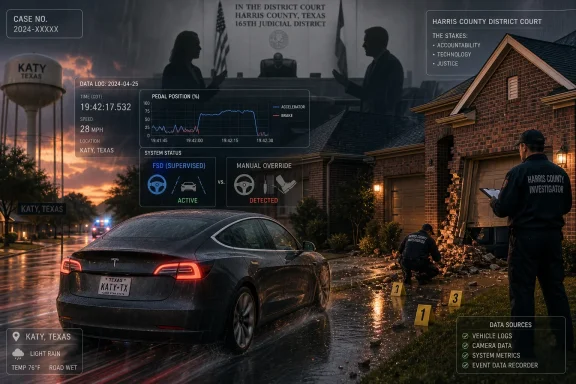 The Crash Moved Tesla’s Automation Fight Into Someone’s Living Room
Most fights over Tesla’s Autopilot and Full Self-Driving systems begin on highways, at intersections, or in the gray zone where software confidence and driver attention fail at the same time. This one began in a residential neighborhood and ended inside a brick house, with a woman who was not in the car, not using the technology, and not consenting to the risks around it.That detail matters. Product-liability cases about driver assistance often get pulled into arguments about whether the driver misused the system, ignored warnings, or failed to intervene. Those arguments will surely appear here too. But Martha Avila’s death shifts the moral center of the case away from the familiar “driver versus software” debate and toward a simpler public-safety question: how much risk should a beta-like consumer automation system be allowed to export to everyone else?
The lawsuit reportedly alleges design defect, failure to warn, gross negligence, and wrongful death. Tesla’s apparent defense, previewed by executives on X, is that the crash does not fit the behavior of Full Self-Driving and that the driver manually overrode the system by pressing the accelerator fully. If Tesla’s vehicle logs support that claim, the company will argue that the crash was not a software failure at all.
But that may not end the case. The law does not always ask only whether a machine directly caused the last second of a crash. It can also ask whether a product was designed, named, constrained, monitored, and explained in a way that made foreseeable misuse more likely.
Tesla’s Best Defense Is Also Its Long-Term Problem
Tesla’s immediate argument is straightforward: if the accelerator was pinned at 100 percent, then the driver was commanding the car, not the autonomy stack. Elon Musk said the idea that Full Self-Driving caused a high-speed residential crash “makes no sense,” and Tesla’s AI software chief Ashok Elluswamy wrote that the company’s data showed a manual override.That defense may be factually strong. Modern vehicles record enormous amounts of state data: pedal position, steering input, braking, system engagement, disengagement timing, speed, warnings, and driver inputs. If the Model 3’s logs show sustained human accelerator input, Tesla will have a powerful narrative for a jury: the car did what the driver told it to do.
The problem for Tesla is that this argument lives inside a larger product story the company has been telling for years. Tesla does not sell its driver-assistance systems as dull cruise-control utilities. It sells them as stepping stones toward autonomy, wrapped in names like Autopilot and Full Self-Driving, and demonstrated in videos and social media posts that emphasize capability more than limitation.
That gap between legal fine print and public meaning has always been the danger zone. Tesla tells regulators and courts that the driver must supervise at all times. Tesla tells customers, investors, and fans that the car is learning to drive itself. When something catastrophic happens, the company retreats to the first message; when it sells the future, it leans hard on the second.
“Supervised” Is Doing More Work Than It Can Bear
Tesla’s current branding, Full Self-Driving (Supervised), is a lawyerly compromise disguised as a product name. The “Full Self-Driving” half suggests an ambitious destination. The “Supervised” half attempts to keep the system within the legal category of Level 2 driver assistance, where the human remains responsible for driving.That tension is not merely semantic. Human factors research has long warned that partial automation can create a complacency trap: the better a system performs most of the time, the harder it becomes for a human to remain alert for the rare moment when it fails. This is the paradox at the heart of Tesla’s success. A bad driver-assistance system is annoying and gets turned off; a good one earns trust, and trust can dull vigilance.
Tesla’s supporters often argue that the system warns drivers to pay attention and that millions of miles of real-world data show safety benefits. That may be true in some conditions. But safety averages do not resolve the design question in a single crash, especially when the plaintiffs can argue that a feature capable enough to invite reliance must also be constrained enough to prevent predictable overreliance.
In other words, “the driver was responsible” is not a magic phrase. If a product predictably encourages people to become less capable supervisors, the adequacy of warnings becomes part of the design debate rather than an escape hatch from it.
The Florida Verdict Gave Plaintiffs a Map
The Texas lawsuit arrives after Tesla suffered a major courtroom defeat in Florida over an earlier Autopilot crash. In that case, a jury found the driver mostly responsible but still assigned Tesla a share of fault and hit the company with major punitive damages. The result was significant because it punctured the assumption that Tesla could always avoid liability by pointing to the person behind the wheel.The facts were different, as they always are in crash litigation. The Florida case involved Autopilot rather than the latest FSD stack, and it centered on whether Tesla had allowed the system to be used in circumstances for which it was not adequately designed. But the legal theme is transferable: a driver can be negligent, and a manufacturer can still be responsible for creating or failing to mitigate a foreseeable danger.
That is the lane Avila’s family will likely try to occupy. They do not necessarily need to prove that Tesla’s software alone drove through the home while Butler sat passively. They may instead argue that Tesla’s system, warnings, restrictions, data practices, naming, or driver-monitoring design contributed to a chain of events that ended in Avila’s death.
Tesla will contest each link in that chain. It will likely argue that the driver’s alleged accelerator input was an intervening act, that the system disengaged or was overridden, and that no reasonable warning or design change would have prevented a driver from flooring the pedal. That is a serious defense. But after Florida, it is no longer fanciful to imagine a jury saying: yes, the driver failed, but Tesla helped build the conditions for failure.
The Data Will Be the Battlefield
Tesla vehicles are rolling computers with cameras, sensors, logs, and event data that can reconstruct a crash in extraordinary detail. That should make cases like this easier to resolve. In practice, Tesla crash litigation often becomes a fight over which data exists, who controls it, how it is interpreted, and whether plaintiffs can independently verify it.The company’s public posture is already data-centric. Elluswamy’s statement suggests Tesla believes the logs are clear enough to exonerate the automation system. Plaintiffs will want the raw vehicle data, not a social media summary of it. Investigators will want to know whether FSD or Autopilot was active, when it was active, whether it disengaged, what warnings were issued, what the pedal and steering inputs were, and how the vehicle perceived the end of the road.
The distinction between Autopilot and Full Self-Driving will also matter. Public reports have used both terms, sometimes loosely. Autopilot traditionally refers to adaptive cruise and lane-centering capabilities, while FSD (Supervised) is Tesla’s more ambitious city-street system. A lawsuit can plead in the alternative, but a jury will eventually need a clearer timeline than “some automated driving assistance system was engaged.”
That timeline could decide whether this case becomes a landmark automation trial or a narrower sudden-acceleration and driver-negligence dispute. If logs show the system was inactive well before impact, Tesla gains ground. If logs show automation was engaged near the critical moment, or disengaged in a way that left the driver with little time to recover, the plaintiffs’ case becomes much more dangerous for the company.
The Regulatory Story Is No Longer Catching Up; It Is Converging
Federal safety regulators have spent years examining Tesla crashes involving Autopilot, emergency vehicles, driver monitoring, and recall remedies. The National Highway Traffic Safety Administration has already opened a special crash investigation into the Texas incident, and the National Transportation Safety Board has reportedly launched its own probe. That dual attention signals that this is not being treated as a routine traffic fatality.Regulators and courts ask different questions. NHTSA wants to know whether a defect exists across a fleet, whether a recall is needed, and whether Tesla’s remedies are sufficient. A civil jury wants to know whether this product and this conduct contributed to this death. But the factual record can overlap, and regulatory findings often shape public understanding of whether a company’s safety claims were credible.
Tesla has historically preferred over-the-air software fixes to traditional automotive recalls. That model is efficient when the problem is code. It is less satisfying when the issue is human-machine interaction, because the “bug” may not be a single line of software but the behavioral system created by names, warnings, incentives, interface design, and driver monitoring.
That is why the Texas case has stakes beyond one crash. If the official record shows that Tesla’s supervision model failed in a foreseeable way, regulators may look again at whether warnings and torque nags are enough. If the record supports Tesla’s claim of a clear manual override, regulators may still ask whether the system’s engagement, disengagement, and driver-attention design played any role before the final input.
The Automation Industry Should Fear the Middle Ground
The most uncomfortable outcome for Tesla would not be a finding that FSD suddenly and inexplicably drove into a house. It would be a finding that the system was good enough to encourage reliance, limited enough to require constant human rescue, and permissive enough to be used in situations where human attention predictably decays. That middle ground is where today’s driver-assistance industry lives.Level 2 automation is commercially attractive because it delivers visible convenience without forcing automakers to accept the full legal and technical burden of autonomy. The driver remains the fallback system. The car can steer, accelerate, brake, change lanes, and navigate complex roads, but the human must stay ready to correct it instantly.
That arrangement may work statistically better than ordinary driving in some contexts. But it is psychologically awkward. Humans are bad at monitoring machines that rarely fail, especially when the machine performs the interesting parts of the task while leaving the human responsible for the boring, impossible one: sustained vigilance without sustained control.
Tesla is not alone in facing that dilemma, but Tesla is uniquely exposed because it has pushed the most aggressive consumer-facing autonomy narrative. Other automakers tend to geofence, limit operational domains, or brand their systems more conservatively. Tesla has chosen broader deployment, faster iteration, and a more theatrical promise of eventual self-driving.
The Courtroom Will Put Tesla’s Marketing on Trial
Tesla’s product warnings will be read closely, but so will its public claims. Plaintiffs in automation cases often try to show that a company’s marketing made foreseeable misuse more likely. That does not require proving that a driver ignored every warning because of a single ad. It requires building a pattern: names, demonstrations, executive statements, purchase flows, dashboard language, and user experience all pointing toward greater trust than the legal disclaimers admit.That is why words like “Autopilot” and “Full Self-Driving” keep returning to the center of these disputes. Tesla fans argue that nobody should misunderstand them because the car tells drivers to supervise. Critics argue that the names are themselves part of the problem because they plant an expectation that later warnings must work to undo.
The Texas case may sharpen that argument because the victim was not a Tesla occupant. A jury may be less receptive to the idea that only the user assumed the risk when the person killed was standing in her own home. That does not automatically make Tesla liable, but it changes the emotional geometry of the trial.
Punitive damages, if they remain in play, would make the marketing history even more important. Punitive awards are not just about compensation; they are about punishment and deterrence. Plaintiffs will try to show that Tesla knew enough about misuse, overtrust, and crashes to act differently. Tesla will argue that it improves safety, warns drivers, and cannot be blamed for conduct outside the system’s intended use.
For WindowsForum Readers, This Is a Software Reliability Story in Automotive Form
This case belongs on a Windows-focused site because the underlying issue is one IT professionals understand instinctively: software does not become safe merely because the user agreement assigns responsibility to the operator. A sysadmin would never accept a production system that silently shifts from automated control to manual rescue under time pressure and then blames the operator for not catching the edge case.Driver assistance turns the road into a live software environment with no rollback window. Updates arrive over the air. Features change names, capabilities expand, and users learn the system by interacting with it in production. The car is both endpoint and actuator, and its failure modes are measured not in lost files but in impact speed.
That is not an argument against advanced driver assistance. Automation can reduce fatigue, smooth traffic flow, and prevent crashes when designed conservatively. The question is whether the industry’s deployment model has outrun its safety case, especially when companies use public roads as the feedback loop.
Tesla’s defenders often point out that human drivers kill tens of thousands of people in the United States every year. That is true, and it is the strongest argument for better automation. But replacing human error with a hybrid system that can add automation confusion, attention decay, and opaque data control does not automatically solve the problem. It may simply move responsibility into a more complicated place.
The Texas Case Turns on More Than Who Pressed the Pedal
The cleanest version of Tesla’s defense is that Butler pressed the accelerator, the car obeyed, and the automation system either was not responsible or was overridden. The cleanest version of the plaintiffs’ case is that Tesla’s technology failed to detect danger, failed to constrain unsafe behavior, or left the driver in a degraded supervisory state at the worst possible moment. Reality may be messier than either version.Civil courts are built for mess. They can assign percentages of fault, weigh competing causes, and decide that more than one actor contributed to a death. That is why Tesla’s partial-liability risk remains even if Butler bears most of the blame.
The coming discovery process will likely focus on vehicle logs, software version history, warnings, driver-monitoring data, internal Tesla documents, crash reconstruction, and prior incidents. It will also test whether Tesla’s public claims align with what the company knew internally about system limits. The facts may vindicate Tesla on the narrow mechanics of the crash. They may also expose a broader design problem.
For now, the public record is incomplete. The responsible posture is to avoid declaring that FSD caused the crash, just as it is premature to declare that Tesla has no exposure. What can be said is that the lawsuit has landed at the precise fault line in modern vehicle automation: the gap between what the system appears to do and what the company insists the human must still be ready to do.
The Hard Lessons Are Already Visible
The litigation will take months or years, but the practical implications are already clear. The Texas crash is not just another entry in a grim database of Tesla incidents; it is a test of whether courts will continue expanding the circle of accountability around partial automation.- A driver’s negligence does not automatically erase a manufacturer’s liability if a jury believes the product design made that negligence foreseeable.
- Tesla’s strongest factual defense will depend on raw vehicle data, not executive posts summarizing what the company says the data shows.
- The difference between Autopilot and Full Self-Driving will be central, because capability, warnings, and expected operating conditions vary by system.
- The Florida Autopilot verdict gives plaintiffs a working theory for partial Tesla liability even when the human driver remains mostly at fault.
- The victim’s position inside her own home may make this case more difficult for Tesla than crashes involving only vehicle occupants.
- The broader industry should treat this as a warning that Level 2 automation’s legal fiction may be weaker than its commercial appeal.
References
- Primary source: WIRED
Published: 2026-06-25T18:20:19.564550
Loading…
www.wired.com - Related coverage: thedailybeast.com
Loading…
www.thedailybeast.com - Related coverage: techcrunch.com
Loading…
techcrunch.com - Related coverage: investing.com
Loading…
www.investing.com - Related coverage: www-cdn.abcnews.com
Loading…
www-cdn.abcnews.com - Related coverage: ubergizmo.com
Loading…
www.ubergizmo.com
- Related coverage: techtimes.com
Loading…
www.techtimes.com - Related coverage: nbcnewyork.com
Loading…
www.nbcnewyork.com - Related coverage: globalnews.ca
Loading…
globalnews.ca - Related coverage: roadandtrack.com
Loading…
www.roadandtrack.com - Related coverage: engadget.com
Loading…
www.engadget.com - Related coverage: axios.com
Loading…
www.axios.com - Related coverage: pcgamer.com
Loading…
www.pcgamer.com - Related coverage: cadenaser.com
Loading…
cadenaser.com