
The Trump administration has asked OpenAI to limit the initial release of GPT-5.6 in June 2026 to a small group of government-approved partners, reportedly requiring access to be cleared customer by customer before a broader public rollout. That is not just a delay in the ChatGPT upgrade cycle. It is a sign that frontier model launches are being pulled into the same political gravity well as chips, cloud infrastructure, export controls, and cyber weapons. The era when the most capable AI systems arrived as consumer product drops may be ending faster than the public understands.
For most users, the launch pattern of modern AI has become familiar: a cryptic teaser, a benchmark-heavy livestream, a sudden model picker update, and then several days of social media arguments over whether the new thing is actually smarter. GPT-5.6, according to multiple reports, is being handled differently. OpenAI is said to be preparing a limited preview in which the government has a role in approving who gets access before the model is opened more widely.
That matters because the mechanism is the story. A phased release is not unusual in software; staged rollouts are how responsible companies avoid catastrophic outages. What is unusual is the reported involvement of the White House in approving model access during the preview window.
The justification is security. GPT-5.6 is reportedly a meaningful improvement over GPT-5.5, with better efficiency and a larger context window. Those sound like ordinary product gains until they are applied to software vulnerability research, automated code analysis, exploit chaining, social engineering, and the sort of agentic workflows that can turn a chatbot from a clever autocomplete into a scalable operations assistant.
This is the uncomfortable truth beneath the consumer disappointment. If a model can debug a sprawling Windows deployment faster, it may also help probe one. If it can reason across a massive context window full of logs, code, tickets, and network traces, it can aid defenders and attackers in the same breath.
That episode turned what had been an abstract AI governance debate into an operational fact. Customers that thought they were buying API access to a model discovered that access could be interrupted not just by pricing, outages, or vendor policy, but by a federal order. For enterprise IT, that is a different category of risk.
The Anthropic case also sharpened the government’s view of frontier AI as a cyber capability rather than a mere productivity tool. Mythos was positioned as an unusually capable model for cyber work, and Fable 5 was described as a more broadly accessible version. Whether the government’s response was proportional, premature, or politically driven, it established a template: if a model is judged to have sensitive capability, access can be gated.
OpenAI’s reported GPT-5.6 rollout looks like the next stage of that template. Instead of waiting for a model to ship and then intervening after a controversy, the government is moving closer to the launch gate itself. That is cleaner from a national security standpoint, but much messier for markets, customers, developers, and international users who now have to ask whether a model roadmap is really a regulatory roadmap in disguise.
The old framing treated AI models as software services. Under that model, the relevant questions were privacy, bias, hallucination, copyright, safety testing, and platform accountability. Those issues have not disappeared, but they are being joined by a harder national security question: who should be allowed to use the best general-purpose reasoning systems the moment they exist?
That is a profoundly different debate. Privacy rules govern how data is handled. Safety rules govern what products should refuse to do. Export controls and access restrictions govern who gets power in the first place.
This is why the reported “customer by customer” approval language is so important. It implies that the risk is not only in the model’s behavior, but in the identity, geography, intent, and institutional profile of the user. The model is not merely being tested; the audience is being tested too.
That may not survive the next wave. If the most capable models are treated as sensitive infrastructure, the first users will not be the general public. They will be defense-adjacent contractors, selected enterprises, major cloud partners, approved research groups, and agencies with existing relationships.
The William Gibson line quoted in Mashable’s report — the future being unevenly distributed — fits too well because frontier AI may now become uneven by design. The first distribution will not be shaped by curiosity or willingness to pay. It will be shaped by trust, jurisdiction, and political comfort.
For ordinary ChatGPT users, that means the next model may arrive late, softened, rate-limited, or bundled into a less capable consumer experience. For developers, it means the model advertised on a provider’s roadmap may not be the model available in the API. For sysadmins, it means the vendor dependency question gets sharper: what happens when your automation layer depends on a model whose availability can be altered by federal review?
Advanced AI models are already changing vulnerability discovery, malware analysis, phishing, and code generation. The same capabilities that help a blue team triage a fleet of Windows endpoints can help an attacker sort through leaked credentials, write convincing lures, or automate reconnaissance. The jump from “assistant” to “operator” is not a philosophical abstraction for security teams; it is the daily direction of tooling.
The risk is not that GPT-5.6 wakes up and becomes a villain. The risk is that a more capable model lowers the cost of skilled technical work for everyone, including actors who previously lacked that skill. Even modest improvements in reliability, context handling, and tool use can compound when deployed at scale.
That is why the model release question now lands in the lap of cyber policy officials. A frontier model is not a rifle, but it can be a force multiplier. It is not a vulnerability, but it can accelerate the search for vulnerabilities. It is not an intrusion platform, but it can make intrusion workflows easier to assemble.
That does not automatically make a model dangerous. It does make it more useful in domains where partial information is the enemy. A model that can reason across a whole repository rather than a pasted function is more valuable to a developer. A model that can ingest a full incident packet is more valuable to a security analyst. A model that can retain more operational detail is more useful to anyone trying to coordinate complex work.
Efficiency matters for a different reason. Cheaper inference means more queries, more automation, and more background tasks. A model that is slightly smarter but much cheaper can be more disruptive than a model that is dramatically smarter but too expensive to use broadly.
This is where consumer arguments about “is it smarter than the last one?” miss the operational point. GPT-5.6 does not need to be a science-fiction leap to matter. If it is better enough, cheaper enough, and context-rich enough, it can change the economics of both defense and abuse.
If a company builds around a frontier model, it inherits that model’s governance instability. Model behavior can change. Safety filters can change. Pricing can change. Data retention terms can change. Now, access itself may be subject to government pressure or approval, especially for the newest and most capable systems.
This does not mean enterprises should abandon AI deployments. It does mean they should stop treating model access as a guaranteed utility. A cloud region, an identity provider, or an endpoint management platform comes with service-level assumptions and procurement scrutiny. Frontier AI should be treated with the same seriousness, not as a clever plug-in someone expensed on a corporate card.
Windows-heavy organizations should be particularly attentive because Microsoft’s ecosystem is one of the main delivery channels for enterprise AI. Copilot, Azure OpenAI, GitHub Copilot, Defender integrations, and third-party automation tools all sit near sensitive operational data. If model availability becomes tiered by government approval, contract language and architecture choices will matter more than demo-day benchmarks.
Developers need predictable platforms. They can tolerate deprecations, version changes, and staged rollouts if the rules are visible. What they cannot easily tolerate is a release path in which access to the best model depends on a nontransparent approval process involving the government and a private lab.
That kind of system favors incumbents. Large enterprises already have vendor relationships, compliance teams, government affairs staff, and procurement leverage. Smaller companies may be left waiting for the broader release, building against older models, or guessing whether their use case looks too sensitive.
The result could be an AI economy in which frontier access becomes another moat. The biggest firms get early access not merely because they pay more, but because they are easier to vet and more politically legible. Everyone else gets the future after the preview period ends.
Sam Altman’s reported message that GPT-5.6 is not OpenAI’s preferred long-term model is notable. It suggests the company may view this release as an awkward bridge rather than the destination. It also suggests OpenAI knows the current approach is not sustainable if every major model requires bespoke negotiation with Washington.
The company’s problem is that it cannot credibly claim these systems are trivial. OpenAI’s entire business depends on persuading customers, investors, and partners that its models are powerful enough to transform work. Once that claim is accepted, governments will naturally ask whether the power needs controls.
That is the paradox facing every frontier lab. If the model is just autocomplete, why is it worth hundreds of billions in infrastructure and market value? If it is more than autocomplete, why should it ship globally with the same casualness as a photo filter?
That may be inevitable in a fast-moving field, but it is not healthy as a long-term model. A customer-by-customer approval process may calm officials in the short run, yet it leaves everyone else guessing. What capabilities trigger review? Which customers qualify? Which countries are excluded? What appeal process exists? How are competitors treated equally?
Without answers, the risk is that AI governance becomes a series of ad hoc bargains between the state and a handful of powerful labs. That is bad for public accountability and bad for market trust. It also invites conspiracy theories, because opaque systems always do.
The better path is not a naïve free-for-all. It is a defined release regime with clear thresholds, independent evaluation, due process, and public reporting where possible. If frontier AI is going to be treated as sensitive infrastructure, the rules should look like rules, not phone calls.
That does not mean restrictions are pointless. Export controls can buy time. Access controls can reduce exposure. Vetting can make abuse harder. But none of these measures are permanent walls in a field where techniques diffuse, papers circulate, talent moves, and model capabilities can be approximated over time.
The strategic question is whether the United States can preserve a lead while narrowing access. Too much openness may create security risk. Too much gating may reduce adoption, weaken developer ecosystems, and push innovation toward less controllable platforms.
For WindowsForum readers, this tension should sound familiar. The history of computing is full of fights between closed ecosystems and open distribution, between security and extensibility, between trusted partners and unruly developers. AI is replaying that argument with national security stakes bolted on.
That disconnect will become harder to hide. When models arrive late, disappear suddenly, or show different capabilities for different classes of users, people will ask why. The answer will increasingly involve not just load, safety, or product packaging, but government policy.
This could change how AI companies communicate. The old launch blog post filled with benchmark charts may need to be joined by release governance disclosures. Customers will want to know whether a model is generally available, preview-only, region-restricted, citizenship-restricted, contract-restricted, or subject to additional monitoring.
In enterprise software, those distinctions are ordinary. In consumer AI, they still feel alien. GPT-5.6 may be remembered as one of the moments when that alienness became unavoidable.
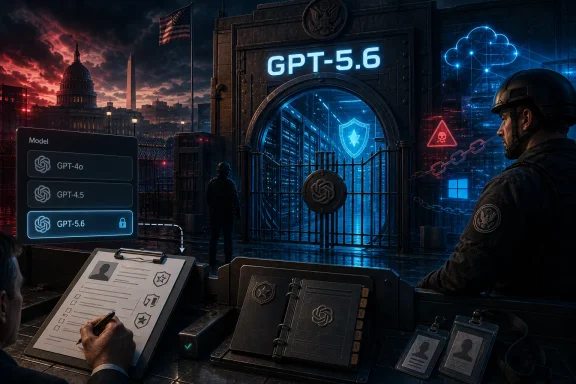 Washington Turns the Model Launch Into a Checkpoint
For most users, the launch pattern of modern AI has become familiar: a cryptic teaser, a benchmark-heavy livestream, a sudden model picker update, and then several days of social media arguments over whether the new thing is actually smarter. GPT-5.6, according to multiple reports, is being handled differently. OpenAI is said to be preparing a limited preview in which the government has a role in approving who gets access before the model is opened more widely.That matters because the mechanism is the story. A phased release is not unusual in software; staged rollouts are how responsible companies avoid catastrophic outages. What is unusual is the reported involvement of the White House in approving model access during the preview window.
The justification is security. GPT-5.6 is reportedly a meaningful improvement over GPT-5.5, with better efficiency and a larger context window. Those sound like ordinary product gains until they are applied to software vulnerability research, automated code analysis, exploit chaining, social engineering, and the sort of agentic workflows that can turn a chatbot from a clever autocomplete into a scalable operations assistant.
This is the uncomfortable truth beneath the consumer disappointment. If a model can debug a sprawling Windows deployment faster, it may also help probe one. If it can reason across a massive context window full of logs, code, tickets, and network traces, it can aid defenders and attackers in the same breath.
The Anthropic Shock Made a Precedent Out of a Panic
The OpenAI request did not arrive in a vacuum. It follows the far more dramatic intervention against Anthropic’s Fable 5 and Mythos 5 models, which were reportedly restricted after the administration raised national security concerns about access by foreign nationals. Anthropic ended up pulling access broadly while it tried to comply with the government directive.That episode turned what had been an abstract AI governance debate into an operational fact. Customers that thought they were buying API access to a model discovered that access could be interrupted not just by pricing, outages, or vendor policy, but by a federal order. For enterprise IT, that is a different category of risk.
The Anthropic case also sharpened the government’s view of frontier AI as a cyber capability rather than a mere productivity tool. Mythos was positioned as an unusually capable model for cyber work, and Fable 5 was described as a more broadly accessible version. Whether the government’s response was proportional, premature, or politically driven, it established a template: if a model is judged to have sensitive capability, access can be gated.
OpenAI’s reported GPT-5.6 rollout looks like the next stage of that template. Instead of waiting for a model to ship and then intervening after a controversy, the government is moving closer to the launch gate itself. That is cleaner from a national security standpoint, but much messier for markets, customers, developers, and international users who now have to ask whether a model roadmap is really a regulatory roadmap in disguise.
Frontier AI Is Being Reclassified Without Anyone Saying So
No one has formally announced that large language models are munitions. No one has declared that the next ChatGPT is a dual-use export item in the way advanced GPUs increasingly are. But policy often changes before vocabulary catches up, and the reported GPT-5.6 process suggests that the United States is inching toward a new classification regime by practice.The old framing treated AI models as software services. Under that model, the relevant questions were privacy, bias, hallucination, copyright, safety testing, and platform accountability. Those issues have not disappeared, but they are being joined by a harder national security question: who should be allowed to use the best general-purpose reasoning systems the moment they exist?
That is a profoundly different debate. Privacy rules govern how data is handled. Safety rules govern what products should refuse to do. Export controls and access restrictions govern who gets power in the first place.
This is why the reported “customer by customer” approval language is so important. It implies that the risk is not only in the model’s behavior, but in the identity, geography, intent, and institutional profile of the user. The model is not merely being tested; the audience is being tested too.
The Consumer Internet Is Losing Its Default Seat at the Front
The public version of AI progress has been unusually democratic by the standards of advanced technology. A teenager, a startup founder, a Fortune 500 engineer, and a hobbyist could often poke at the same underlying model within days of release. Rate limits, subscriptions, and API tiers created inequality, but the gap was still smaller than in semiconductors, defense computing, or enterprise software.That may not survive the next wave. If the most capable models are treated as sensitive infrastructure, the first users will not be the general public. They will be defense-adjacent contractors, selected enterprises, major cloud partners, approved research groups, and agencies with existing relationships.
The William Gibson line quoted in Mashable’s report — the future being unevenly distributed — fits too well because frontier AI may now become uneven by design. The first distribution will not be shaped by curiosity or willingness to pay. It will be shaped by trust, jurisdiction, and political comfort.
For ordinary ChatGPT users, that means the next model may arrive late, softened, rate-limited, or bundled into a less capable consumer experience. For developers, it means the model advertised on a provider’s roadmap may not be the model available in the API. For sysadmins, it means the vendor dependency question gets sharper: what happens when your automation layer depends on a model whose availability can be altered by federal review?
Security Officials Have a Real Problem, Even If Their Answer Is Crude
It is tempting to read the White House request as a clumsy power grab, and parts of it may well prove clumsy. Government approval of AI customers raises obvious concerns about opacity, favoritism, political influence, and the creation of an insider class. But dismissing the security rationale outright would be naïve.Advanced AI models are already changing vulnerability discovery, malware analysis, phishing, and code generation. The same capabilities that help a blue team triage a fleet of Windows endpoints can help an attacker sort through leaked credentials, write convincing lures, or automate reconnaissance. The jump from “assistant” to “operator” is not a philosophical abstraction for security teams; it is the daily direction of tooling.
The risk is not that GPT-5.6 wakes up and becomes a villain. The risk is that a more capable model lowers the cost of skilled technical work for everyone, including actors who previously lacked that skill. Even modest improvements in reliability, context handling, and tool use can compound when deployed at scale.
That is why the model release question now lands in the lap of cyber policy officials. A frontier model is not a rifle, but it can be a force multiplier. It is not a vulnerability, but it can accelerate the search for vulnerabilities. It is not an intrusion platform, but it can make intrusion workflows easier to assemble.
The Bigger Context Window Is Not a Boring Spec
The reported improvements in context size and efficiency may sound like typical release-note fodder. In practice, those are the kinds of changes that matter most to enterprise and security use cases. A larger context window lets a model ingest more of the real world at once: codebases, incident timelines, audit logs, configuration files, policy documents, and chat histories.That does not automatically make a model dangerous. It does make it more useful in domains where partial information is the enemy. A model that can reason across a whole repository rather than a pasted function is more valuable to a developer. A model that can ingest a full incident packet is more valuable to a security analyst. A model that can retain more operational detail is more useful to anyone trying to coordinate complex work.
Efficiency matters for a different reason. Cheaper inference means more queries, more automation, and more background tasks. A model that is slightly smarter but much cheaper can be more disruptive than a model that is dramatically smarter but too expensive to use broadly.
This is where consumer arguments about “is it smarter than the last one?” miss the operational point. GPT-5.6 does not need to be a science-fiction leap to matter. If it is better enough, cheaper enough, and context-rich enough, it can change the economics of both defense and abuse.
Enterprise IT Gets Another Reason to Fear the Magic Layer
Over the past two years, companies have been encouraged to wire AI into everything: help desks, developer workflows, productivity suites, customer support, endpoint management, business intelligence, and security operations. The pitch has been that AI is a flexible capability layer rather than a single application. That flexibility is exactly why sudden access restrictions are so disruptive.If a company builds around a frontier model, it inherits that model’s governance instability. Model behavior can change. Safety filters can change. Pricing can change. Data retention terms can change. Now, access itself may be subject to government pressure or approval, especially for the newest and most capable systems.
This does not mean enterprises should abandon AI deployments. It does mean they should stop treating model access as a guaranteed utility. A cloud region, an identity provider, or an endpoint management platform comes with service-level assumptions and procurement scrutiny. Frontier AI should be treated with the same seriousness, not as a clever plug-in someone expensed on a corporate card.
Windows-heavy organizations should be particularly attentive because Microsoft’s ecosystem is one of the main delivery channels for enterprise AI. Copilot, Azure OpenAI, GitHub Copilot, Defender integrations, and third-party automation tools all sit near sensitive operational data. If model availability becomes tiered by government approval, contract language and architecture choices will matter more than demo-day benchmarks.
Developers Will Feel the Gating Before Consumers Understand It
The immediate disappointment will be felt by enthusiasts who expected GPT-5.6 to show up in ChatGPT. The deeper disruption will be felt by developers and startups trying to build on the frontier. A two-week delay may sound trivial, but the precedent is not trivial at all.Developers need predictable platforms. They can tolerate deprecations, version changes, and staged rollouts if the rules are visible. What they cannot easily tolerate is a release path in which access to the best model depends on a nontransparent approval process involving the government and a private lab.
That kind of system favors incumbents. Large enterprises already have vendor relationships, compliance teams, government affairs staff, and procurement leverage. Smaller companies may be left waiting for the broader release, building against older models, or guessing whether their use case looks too sensitive.
The result could be an AI economy in which frontier access becomes another moat. The biggest firms get early access not merely because they pay more, but because they are easier to vet and more politically legible. Everyone else gets the future after the preview period ends.
OpenAI Is Learning That Scale Means Sovereignty Problems
OpenAI has spent years trying to be both a consumer technology company and an infrastructure provider for the next computing platform. Those ambitions now collide with the reality that infrastructure at global scale attracts sovereign control. The bigger the model, the less it looks like an app.Sam Altman’s reported message that GPT-5.6 is not OpenAI’s preferred long-term model is notable. It suggests the company may view this release as an awkward bridge rather than the destination. It also suggests OpenAI knows the current approach is not sustainable if every major model requires bespoke negotiation with Washington.
The company’s problem is that it cannot credibly claim these systems are trivial. OpenAI’s entire business depends on persuading customers, investors, and partners that its models are powerful enough to transform work. Once that claim is accepted, governments will naturally ask whether the power needs controls.
That is the paradox facing every frontier lab. If the model is just autocomplete, why is it worth hundreds of billions in infrastructure and market value? If it is more than autocomplete, why should it ship globally with the same casualness as a photo filter?
The Government Is Building Policy in the Shadow of the Labs
The reported request also exposes a governance gap. The United States does not yet have a settled, durable, transparent framework for frontier AI releases. Instead, it has executive pressure, agency coordination, export-control instincts, voluntary testing language, and emergency interventions that appear to be evolving case by case.That may be inevitable in a fast-moving field, but it is not healthy as a long-term model. A customer-by-customer approval process may calm officials in the short run, yet it leaves everyone else guessing. What capabilities trigger review? Which customers qualify? Which countries are excluded? What appeal process exists? How are competitors treated equally?
Without answers, the risk is that AI governance becomes a series of ad hoc bargains between the state and a handful of powerful labs. That is bad for public accountability and bad for market trust. It also invites conspiracy theories, because opaque systems always do.
The better path is not a naïve free-for-all. It is a defined release regime with clear thresholds, independent evaluation, due process, and public reporting where possible. If frontier AI is going to be treated as sensitive infrastructure, the rules should look like rules, not phone calls.
The Global AI Race Will Not Pause for American Process
There is another tension Washington cannot wish away: restricting American model releases may slow access to U.S. systems, but it does not freeze the rest of the world. Open models, Chinese labs, European AI firms, and private research groups will continue advancing. The harder the United States gates its best models, the more incentive global users have to find alternatives.That does not mean restrictions are pointless. Export controls can buy time. Access controls can reduce exposure. Vetting can make abuse harder. But none of these measures are permanent walls in a field where techniques diffuse, papers circulate, talent moves, and model capabilities can be approximated over time.
The strategic question is whether the United States can preserve a lead while narrowing access. Too much openness may create security risk. Too much gating may reduce adoption, weaken developer ecosystems, and push innovation toward less controllable platforms.
For WindowsForum readers, this tension should sound familiar. The history of computing is full of fights between closed ecosystems and open distribution, between security and extensibility, between trusted partners and unruly developers. AI is replaying that argument with national security stakes bolted on.
The Model Picker Is Becoming a Policy Interface
There is an almost comic disconnect between the user interface and the politics beneath it. To the average ChatGPT subscriber, model access appears as a dropdown menu. To policymakers, that same dropdown may represent access to a strategic capability.That disconnect will become harder to hide. When models arrive late, disappear suddenly, or show different capabilities for different classes of users, people will ask why. The answer will increasingly involve not just load, safety, or product packaging, but government policy.
This could change how AI companies communicate. The old launch blog post filled with benchmark charts may need to be joined by release governance disclosures. Customers will want to know whether a model is generally available, preview-only, region-restricted, citizenship-restricted, contract-restricted, or subject to additional monitoring.
In enterprise software, those distinctions are ordinary. In consumer AI, they still feel alien. GPT-5.6 may be remembered as one of the moments when that alienness became unavoidable.
The Real Message Inside the GPT-5.6 Slow Roll
The concrete lesson from the reported GPT-5.6 rollout is not that ChatGPT users must wait a couple of weeks. The lesson is that the most capable AI systems are becoming governed infrastructure before the public has finished treating them as apps.- OpenAI’s next model is reportedly headed for a limited preview rather than an immediate broad release.
- The White House is said to want access approved customer by customer during the early period.
- The move follows the government’s intervention against Anthropic’s Fable 5 and Mythos 5 models.
- The security concern is less about chatbots as personalities and more about AI as a force multiplier for cyber work.
- Enterprises should treat frontier model access as a supply-chain and governance risk, not just a feature upgrade.
- Developers and smaller companies may be disadvantaged if early access increasingly favors large, vetted partners.
References
- Primary source: Mashable
Published: 2026-06-26T15:52:11.703139
Loading…
mashable.com - Related coverage: axios.com
Loading…
www.axios.com - Related coverage: tomshardware.com
Loading…
www.tomshardware.com - Related coverage: kesq.com
Loading…
kesq.com - Related coverage: techcrunch.com
Loading…
techcrunch.com - Related coverage: engadget.com
Loading…
www.engadget.com
- Related coverage: business-standard.com
Loading…
www.business-standard.com - Related coverage: arstechnica.com
Anthropic shuts down Fable, Mythos models following Trump admin directive - Ars Technica
Commerce dept. worries that a Fable 5 "jailbreak" could be a national security threat.arstechnica.com - Related coverage: semafor.com
Loading…
www.semafor.com - Related coverage: abit.ee
Loading…
abit.ee - Related coverage: therundown.ai
Loading…
www.therundown.ai