
Riot Games began rolling out Vanguard On-Demand on June 24, 2026, giving eligible Windows 11 players a way to load its kernel-level anti-cheat only when launching supported Riot games instead of at every system boot. The change does not end the argument over kernel anti-cheat, but it does move the fight onto more modern Windows security ground. Riot is effectively saying that the price of a less intrusive Vanguard is a more locked-down PC. For Windows users, that trade-off is the real story.
For years, Vanguard’s defenders and critics have talked past each other. Riot argued that cheating in a competitive shooter like Valorant required early, deep visibility into the operating system, while players objected to an anti-cheat driver that loaded whether they intended to play or not. Both arguments contained some truth, which is why the controversy never fully burned out.
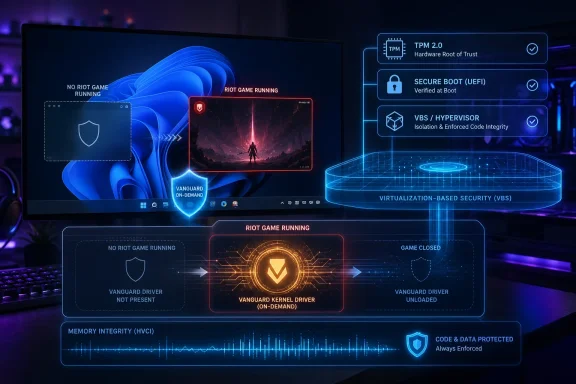
The new On-Demand mode is Riot’s first major concession that the boot-time model carried a trust cost. It allows Vanguard to start when a Riot title starts and shut down when the session ends, which is closer to how many players intuitively expect anti-cheat software to behave. That does not make Vanguard lightweight, nor does it remove its kernel-level nature, but it narrows the window in which the driver is active.
That distinction matters because the criticism was never only about performance. It was about jurisdiction. A game company asking for ring-0 access to a Windows PC is one thing; asking to occupy that position from the moment the machine starts is another.
The old model made every Windows session feel partially enlisted into Riot’s security perimeter. The new model gives some players a way to draw a cleaner line between “I am playing Valorant” and “I am using my computer.”
That list is not cosmetic. It describes a PC where Windows, firmware, and hardware are cooperating to police the boot chain, protect memory integrity, and restrict direct memory access. Riot is trading one kind of persistent anti-cheat presence for another kind of platform assurance.
This is the most WindowsForum.com part of the story: the user-facing feature is simple, but the machinery underneath is pure modern Windows security architecture. Secure Boot helps establish that the system starts from trusted components. TPM 2.0 gives Windows a hardware-backed trust anchor. VBS and HVCI move sensitive code integrity checks into a more isolated environment. IOMMU closes off a class of attacks involving devices that can read or write memory directly.
In other words, Vanguard On-Demand is not Riot simply deciding to be nicer. It is Riot deciding that newer Windows security primitives can shoulder enough of the burden that Vanguard no longer needs to be awake from boot on qualifying systems.
That makes the feature both welcome and limited. Players with older PCs, misconfigured BIOS settings, unsupported firmware, or disabled Windows security features may find that “optional” still feels like “out of reach.”
That is a major philosophical shift. Anti-cheat has often been treated as a private arms race between game publishers and cheat developers, with Windows merely the battlefield. Here, Riot is leaning on Microsoft’s security architecture as part of the product design.
For Microsoft, this is exactly the kind of third-party pressure that helps normalize Windows 11’s stricter baseline. Features like Secure Boot, TPM 2.0, VBS, HVCI, and IOMMU are easier to sell when they are abstract security improvements. They become much more visible when a popular game says, effectively, “turn these on and we can stop loading our driver at boot.”
That will annoy some users. It will also expose years of messy PC configuration reality. Many gaming desktops technically support these features but ship with some disabled, especially where motherboard vendors, custom builds, dual-boot setups, or legacy habits collide with Microsoft’s preferred security posture.
Riot’s redesigned tray app is meant to soften that transition by identifying missing requirements and guiding players through the setup. But anyone who has helped a friend enable Secure Boot on a home-built PC knows the experience can range from painless to weekend-ruining. Firmware menus are still where user experience goes to die.
It is more because a third of the player base being ready on day one suggests that Microsoft’s Windows 11 security baseline is no longer theoretical. Newer laptops, prebuilt desktops, and modern gaming systems increasingly arrive with the right pieces enabled or at least available. For those users, the change may feel like a simple quality-of-life upgrade.
It is less because the remaining majority may not be blocked by desire, but by hardware age, firmware complexity, or operating-system timing. Windows 11 25H2 is itself a gating factor. Even users who have TPM 2.0 and Secure Boot may not be on the right release yet, and some may be unwilling to move early if their system is stable.
This split is important because it turns Vanguard On-Demand into a preview of where PC gaming is heading rather than an instant fix for everyone. The newest, most security-compliant Windows machines get the least intrusive anti-cheat behavior. Older or less locked-down machines keep the legacy model.
That may be defensible from a security standpoint, but it also creates a new class divide in PC gaming. The reward for embracing Microsoft’s security stack is not merely better protection; it is less third-party software running at boot.
Kernel-level anti-cheat remains controversial for good reason. A kernel driver has access and potential blast radius that ordinary applications do not. Bugs, incompatibilities, and security flaws in that layer can have consequences far beyond a game crash.
That is why players often react strongly to Vanguard even when they accept anti-cheat in principle. They are not merely being asked to trust Riot’s motives. They are being asked to trust Riot’s engineering, update discipline, incident response, and judgment about what belongs inside the most privileged part of Windows.
On-Demand mode reduces one dimension of exposure: time. If Vanguard is running only during Riot game sessions, there are fewer hours in which its driver is active on a player’s machine. But time is not the only dimension. Privilege, complexity, and update risk remain.
The right way to understand the update is therefore not “Vanguard is fixed.” It is “Vanguard’s most visibly invasive behavior now has an escape hatch for users whose Windows installations meet a high security bar.”
But the framing of control is still complicated. Users are getting the ability to make Vanguard less persistent only if they accept a platform posture approved by Riot and Microsoft. The choice is real, but bounded.
That is not necessarily sinister. Anti-cheat systems are, by nature, built around distrust. If a player could freely decide which low-level protections to disable while still receiving the least intrusive anti-cheat mode, the feature would likely be useless against the people it is designed to catch.
Still, the result is a very modern form of PC control: you can have more freedom from Vanguard if your machine looks less free to tamper with. For security engineers, that is a rational trade. For some enthusiasts, it will feel like the walls moving inward.
This is where Riot’s communication has to be careful. The company should not sell On-Demand mode as a universal retreat from kernel anti-cheat. It is a conditional bargain. The driver steps back because the platform steps forward.
Anti-cheat vendors respond by demanding stronger guarantees. Operating-system vendors respond by hardening the platform. Hardware vendors respond by adding features that make memory access and boot integrity more controllable. Each step is understandable, but the combined effect is a PC that behaves less like the wild frontier and more like a managed trust environment.
Gamers often notice this only when something breaks. A BIOS setting blocks a game. A driver trips an anti-cheat warning. A Windows security toggle becomes mandatory. A device that worked yesterday suddenly appears suspicious.
Vanguard On-Demand is unusually revealing because it ties the benefit directly to that trust environment. The more your PC resembles Microsoft’s preferred secure configuration, the less Riot needs to sit in memory from boot. The “console-ification” critique is too simple, but the direction of travel is hard to miss.
For sysadmins and security-minded Windows users, there is a familiar logic here. Enterprises have spent years moving toward measured boot, virtualization-based protections, and stronger device control. Riot is bringing a similar bargain into consumer gaming, only with match integrity instead of corporate compliance as the selling point.
For everyone else, the road may be bumpier. Secure Boot can be disabled on systems that technically support it. TPM settings can hide behind vendor-specific names. IOMMU may appear as Intel VT-d, AMD-Vi, or another firmware option. HVCI may conflict with older drivers. VBS can raise performance anxieties, even when the real-world impact varies by system and workload.
This is where Riot’s tray app has to do more than display red X marks. It needs to explain in plain language what is missing, what must be changed in Windows, what must be changed in firmware, and what risks a user should consider before flipping switches. A bad support experience here could sour the very users Riot is trying to win back.
There is also a meaningful difference between “supported” and “safe to casually enable.” Secure Boot changes can be painful on systems with unusual bootloaders, older installs, or nonstandard storage configurations. Memory integrity can expose old drivers that should have been retired but still power peripherals people use every day.
The audience most likely to care about Vanguard’s persistence may also be the audience most likely to have customized Windows in ways that make these requirements less straightforward. That irony should not be lost on Riot.
But the underlying privacy debate does not vanish just because the runtime window narrows. When Vanguard is active, it still has substantial access. Players still have to trust Riot’s data handling, security practices, and internal controls. The question shifts from “why is this running while I am writing email?” to “what exactly happens during the hours I play?”
That is a better question for Riot to have to answer. It is more proportional to the purpose of the software. A competitive anti-cheat running during a competitive game is easier to justify than an anti-cheat running through every non-gaming task on the machine.
The change also gives users a clearer behavioral boundary. If you want Vanguard active, open a Riot game. If you do not, close it. That sounds basic, but boundaries are what make trust manageable.
Still, Riot should expect skepticism to continue. Vanguard’s reputation was built over years, and one on-demand toggle will not erase the memory of boot-time loading, support disputes, driver conflicts, or the broader unease around kernel anti-cheat in consumer entertainment software.
Windows 11’s hardware requirements were controversial when Microsoft introduced them, especially around TPM 2.0 and supported CPUs. Years later, Riot’s On-Demand mode shows one of the downstream consequences: software vendors can now assume a more capable security substrate, at least for a growing slice of the installed base.
That does not mean Microsoft designed these features for Riot. It means Riot can now productize assumptions that were previously too uneven across the Windows ecosystem. If enough PCs can prove a trustworthy boot path, enforce code integrity, and restrict dangerous device behavior, then a game anti-cheat can rely less on being present from the first moments of startup.
This is the best version of platform hardening: a user-visible reduction in third-party persistence. Security features often feel like restrictions imposed in the name of hypothetical threats. Here, the payoff is concrete. Enable the right stack, and a controversial driver stops camping out from boot.
But the bargain also gives Microsoft’s security defaults more cultural power. Gamers who might ignore enterprise-style hardening now have a reason to care. The path to a cleaner taskbar runs through Windows security settings.
If other vendors can offer effective anti-cheat without boot-time drivers, Riot’s old model looks harder to defend. If Riot can offer on-demand operation only on strongly secured Windows 11 systems, competitors may be asked why they are not making similar use of modern OS protections. Either way, the conversation moves.
For players, that is healthy. Anti-cheat has too often been presented as a binary: accept invasive software or accept rampant cheating. Vanguard On-Demand suggests a third path, where the operating system and hardware provide stronger guarantees so game-specific tools can narrow their footprint.
The danger is that the industry treats this as a mandate rather than an option. If every competitive title starts requiring the full Windows 11 security stack, the PC gaming compatibility map could become more fragmented. Older machines, experimental setups, and alternative configurations may find themselves pushed further toward the margins.
That may be inevitable in high-stakes competitive games, but it should be stated plainly. The future of anti-cheat is not just better detection. It is stricter admission control.
 Riot Finally Concedes That “Always On” Was the Problem
For years, Vanguard’s defenders and critics have talked past each other. Riot argued that cheating in a competitive shooter like Valorant required early, deep visibility into the operating system, while players objected to an anti-cheat driver that loaded whether they intended to play or not. Both arguments contained some truth, which is why the controversy never fully burned out.The new On-Demand mode is Riot’s first major concession that the boot-time model carried a trust cost. It allows Vanguard to start when a Riot title starts and shut down when the session ends, which is closer to how many players intuitively expect anti-cheat software to behave. That does not make Vanguard lightweight, nor does it remove its kernel-level nature, but it narrows the window in which the driver is active.
That distinction matters because the criticism was never only about performance. It was about jurisdiction. A game company asking for ring-0 access to a Windows PC is one thing; asking to occupy that position from the moment the machine starts is another.
The old model made every Windows session feel partially enlisted into Riot’s security perimeter. The new model gives some players a way to draw a cleaner line between “I am playing Valorant” and “I am using my computer.”
The Less Intrusive Vanguard Requires a More Intrusive Windows
The catch is not hidden in fine print: Vanguard On-Demand is available only to players on Windows 11 version 25H2 or later who also have a full stack of security features enabled. Riot’s requirements include UEFI Secure Boot, TPM 2.0, Virtualization-Based Security, Hypervisor-Protected Code Integrity, and IOMMU support.That list is not cosmetic. It describes a PC where Windows, firmware, and hardware are cooperating to police the boot chain, protect memory integrity, and restrict direct memory access. Riot is trading one kind of persistent anti-cheat presence for another kind of platform assurance.
This is the most WindowsForum.com part of the story: the user-facing feature is simple, but the machinery underneath is pure modern Windows security architecture. Secure Boot helps establish that the system starts from trusted components. TPM 2.0 gives Windows a hardware-backed trust anchor. VBS and HVCI move sensitive code integrity checks into a more isolated environment. IOMMU closes off a class of attacks involving devices that can read or write memory directly.
In other words, Vanguard On-Demand is not Riot simply deciding to be nicer. It is Riot deciding that newer Windows security primitives can shoulder enough of the burden that Vanguard no longer needs to be awake from boot on qualifying systems.
That makes the feature both welcome and limited. Players with older PCs, misconfigured BIOS settings, unsupported firmware, or disabled Windows security features may find that “optional” still feels like “out of reach.”
Microsoft’s Security Stack Becomes Riot’s New Anti-Cheat Boundary
The most interesting part of Riot’s move is that it turns Windows itself into a more explicit participant in the anti-cheat model. Vanguard’s old pitch was simple: load early, watch early, catch tampering early. The new pitch is subtler: if Windows can provide stronger guarantees about the system’s integrity, Vanguard can arrive later.That is a major philosophical shift. Anti-cheat has often been treated as a private arms race between game publishers and cheat developers, with Windows merely the battlefield. Here, Riot is leaning on Microsoft’s security architecture as part of the product design.
For Microsoft, this is exactly the kind of third-party pressure that helps normalize Windows 11’s stricter baseline. Features like Secure Boot, TPM 2.0, VBS, HVCI, and IOMMU are easier to sell when they are abstract security improvements. They become much more visible when a popular game says, effectively, “turn these on and we can stop loading our driver at boot.”
That will annoy some users. It will also expose years of messy PC configuration reality. Many gaming desktops technically support these features but ship with some disabled, especially where motherboard vendors, custom builds, dual-boot setups, or legacy habits collide with Microsoft’s preferred security posture.
Riot’s redesigned tray app is meant to soften that transition by identifying missing requirements and guiding players through the setup. But anyone who has helped a friend enable Secure Boot on a home-built PC knows the experience can range from painless to weekend-ruining. Firmware menus are still where user experience goes to die.
The 35 Percent Figure Shows How Uneven the Windows Base Still Is
Riot anti-cheat lead Phillip Koskinas reportedly said roughly 35 percent of players already meet the requirements for On-Demand mode. That is both more and less than it sounds.It is more because a third of the player base being ready on day one suggests that Microsoft’s Windows 11 security baseline is no longer theoretical. Newer laptops, prebuilt desktops, and modern gaming systems increasingly arrive with the right pieces enabled or at least available. For those users, the change may feel like a simple quality-of-life upgrade.
It is less because the remaining majority may not be blocked by desire, but by hardware age, firmware complexity, or operating-system timing. Windows 11 25H2 is itself a gating factor. Even users who have TPM 2.0 and Secure Boot may not be on the right release yet, and some may be unwilling to move early if their system is stable.
This split is important because it turns Vanguard On-Demand into a preview of where PC gaming is heading rather than an instant fix for everyone. The newest, most security-compliant Windows machines get the least intrusive anti-cheat behavior. Older or less locked-down machines keep the legacy model.
That may be defensible from a security standpoint, but it also creates a new class divide in PC gaming. The reward for embracing Microsoft’s security stack is not merely better protection; it is less third-party software running at boot.
Vanguard Is Still Kernel-Level, and That Still Matters
It would be easy to overstate the change. Vanguard On-Demand does not transform Riot’s anti-cheat into a conventional user-mode app. It still operates with deep privileges when active, and it still exists because Riot believes competitive integrity requires inspection and enforcement below the level available to ordinary software.Kernel-level anti-cheat remains controversial for good reason. A kernel driver has access and potential blast radius that ordinary applications do not. Bugs, incompatibilities, and security flaws in that layer can have consequences far beyond a game crash.
That is why players often react strongly to Vanguard even when they accept anti-cheat in principle. They are not merely being asked to trust Riot’s motives. They are being asked to trust Riot’s engineering, update discipline, incident response, and judgment about what belongs inside the most privileged part of Windows.
On-Demand mode reduces one dimension of exposure: time. If Vanguard is running only during Riot game sessions, there are fewer hours in which its driver is active on a player’s machine. But time is not the only dimension. Privilege, complexity, and update risk remain.
The right way to understand the update is therefore not “Vanguard is fixed.” It is “Vanguard’s most visibly invasive behavior now has an escape hatch for users whose Windows installations meet a high security bar.”
Riot Is Reframing Control Without Fully Handing It Back
Riot deserves credit for making the mode optional. Players who prefer the existing behavior can leave Vanguard alone. Players who want the on-demand model can opt into the stricter security configuration. That is better than forcing a sudden migration through BIOS settings and Windows toggles.But the framing of control is still complicated. Users are getting the ability to make Vanguard less persistent only if they accept a platform posture approved by Riot and Microsoft. The choice is real, but bounded.
That is not necessarily sinister. Anti-cheat systems are, by nature, built around distrust. If a player could freely decide which low-level protections to disable while still receiving the least intrusive anti-cheat mode, the feature would likely be useless against the people it is designed to catch.
Still, the result is a very modern form of PC control: you can have more freedom from Vanguard if your machine looks less free to tamper with. For security engineers, that is a rational trade. For some enthusiasts, it will feel like the walls moving inward.
This is where Riot’s communication has to be careful. The company should not sell On-Demand mode as a universal retreat from kernel anti-cheat. It is a conditional bargain. The driver steps back because the platform steps forward.
Competitive Games Are Pushing the PC Toward Console-Like Trust
The broader trend is bigger than Riot. Competitive multiplayer games increasingly treat the open PC as both a feature and a liability. The same flexibility that lets users build exotic rigs, run overlays, customize drivers, and dual-boot operating systems also creates space for cheats, spoofers, vulnerable drivers, and hardware-assisted attacks.Anti-cheat vendors respond by demanding stronger guarantees. Operating-system vendors respond by hardening the platform. Hardware vendors respond by adding features that make memory access and boot integrity more controllable. Each step is understandable, but the combined effect is a PC that behaves less like the wild frontier and more like a managed trust environment.
Gamers often notice this only when something breaks. A BIOS setting blocks a game. A driver trips an anti-cheat warning. A Windows security toggle becomes mandatory. A device that worked yesterday suddenly appears suspicious.
Vanguard On-Demand is unusually revealing because it ties the benefit directly to that trust environment. The more your PC resembles Microsoft’s preferred secure configuration, the less Riot needs to sit in memory from boot. The “console-ification” critique is too simple, but the direction of travel is hard to miss.
For sysadmins and security-minded Windows users, there is a familiar logic here. Enterprises have spent years moving toward measured boot, virtualization-based protections, and stronger device control. Riot is bringing a similar bargain into consumer gaming, only with match integrity instead of corporate compliance as the selling point.
The Practical Headaches Will Arrive in Firmware Menus
For the eligible player with a modern Windows 11 machine, Vanguard On-Demand may be almost invisible. Enable the mode, launch the game, close the game, and recover the psychological comfort of not seeing Vanguard constantly present in the tray.For everyone else, the road may be bumpier. Secure Boot can be disabled on systems that technically support it. TPM settings can hide behind vendor-specific names. IOMMU may appear as Intel VT-d, AMD-Vi, or another firmware option. HVCI may conflict with older drivers. VBS can raise performance anxieties, even when the real-world impact varies by system and workload.
This is where Riot’s tray app has to do more than display red X marks. It needs to explain in plain language what is missing, what must be changed in Windows, what must be changed in firmware, and what risks a user should consider before flipping switches. A bad support experience here could sour the very users Riot is trying to win back.
There is also a meaningful difference between “supported” and “safe to casually enable.” Secure Boot changes can be painful on systems with unusual bootloaders, older installs, or nonstandard storage configurations. Memory integrity can expose old drivers that should have been retired but still power peripherals people use every day.
The audience most likely to care about Vanguard’s persistence may also be the audience most likely to have customized Windows in ways that make these requirements less straightforward. That irony should not be lost on Riot.
The Privacy Argument Changes, But It Does Not Disappear
On-Demand mode gives privacy-conscious players something they have wanted since Vanguard’s early controversy: a way to stop the anti-cheat from running all day. That is meaningful. Software that is not active cannot observe, interfere, crash, or consume resources in the same way active software can.But the underlying privacy debate does not vanish just because the runtime window narrows. When Vanguard is active, it still has substantial access. Players still have to trust Riot’s data handling, security practices, and internal controls. The question shifts from “why is this running while I am writing email?” to “what exactly happens during the hours I play?”
That is a better question for Riot to have to answer. It is more proportional to the purpose of the software. A competitive anti-cheat running during a competitive game is easier to justify than an anti-cheat running through every non-gaming task on the machine.
The change also gives users a clearer behavioral boundary. If you want Vanguard active, open a Riot game. If you do not, close it. That sounds basic, but boundaries are what make trust manageable.
Still, Riot should expect skepticism to continue. Vanguard’s reputation was built over years, and one on-demand toggle will not erase the memory of boot-time loading, support disputes, driver conflicts, or the broader unease around kernel anti-cheat in consumer entertainment software.
The Windows Crowd Gets the Feature First Because Windows Is the Feature
It is notable that this update is framed around Windows 11 rather than a generic PC gaming promise. Riot’s anti-cheat problem is inseparable from Windows because Windows remains the central platform for competitive PC gaming, and because Microsoft has been steadily reshaping what a “secure” Windows PC means.Windows 11’s hardware requirements were controversial when Microsoft introduced them, especially around TPM 2.0 and supported CPUs. Years later, Riot’s On-Demand mode shows one of the downstream consequences: software vendors can now assume a more capable security substrate, at least for a growing slice of the installed base.
That does not mean Microsoft designed these features for Riot. It means Riot can now productize assumptions that were previously too uneven across the Windows ecosystem. If enough PCs can prove a trustworthy boot path, enforce code integrity, and restrict dangerous device behavior, then a game anti-cheat can rely less on being present from the first moments of startup.
This is the best version of platform hardening: a user-visible reduction in third-party persistence. Security features often feel like restrictions imposed in the name of hypothetical threats. Here, the payoff is concrete. Enable the right stack, and a controversial driver stops camping out from boot.
But the bargain also gives Microsoft’s security defaults more cultural power. Gamers who might ignore enterprise-style hardening now have a reason to care. The path to a cleaner taskbar runs through Windows security settings.
Riot’s Move Pressures Other Anti-Cheat Vendors in Both Directions
Riot has often been criticized because Vanguard appeared more aggressive than rival anti-cheat systems that load closer to game launch. With On-Demand mode, Riot can now argue that it is reducing persistence without abandoning stronger platform requirements. That puts pressure on competitors in an interesting way.If other vendors can offer effective anti-cheat without boot-time drivers, Riot’s old model looks harder to defend. If Riot can offer on-demand operation only on strongly secured Windows 11 systems, competitors may be asked why they are not making similar use of modern OS protections. Either way, the conversation moves.
For players, that is healthy. Anti-cheat has too often been presented as a binary: accept invasive software or accept rampant cheating. Vanguard On-Demand suggests a third path, where the operating system and hardware provide stronger guarantees so game-specific tools can narrow their footprint.
The danger is that the industry treats this as a mandate rather than an option. If every competitive title starts requiring the full Windows 11 security stack, the PC gaming compatibility map could become more fragmented. Older machines, experimental setups, and alternative configurations may find themselves pushed further toward the margins.
That may be inevitable in high-stakes competitive games, but it should be stated plainly. The future of anti-cheat is not just better detection. It is stricter admission control.
The Toggle That Turns a Trust Fight Into a Windows Upgrade Path
The concrete lesson for players is simple, but the implications are not. Vanguard On-Demand is a quality-of-life improvement wrapped inside a platform-security migration. It gives some users exactly what they asked for while telling everyone else that the path runs through Windows 11 25H2 and modern firmware settings.- Vanguard On-Demand lets eligible players load Riot’s anti-cheat only when a supported Riot game launches and unload it after the session ends.
- The feature is optional, so players who prefer the existing boot-time behavior do not have to change their setup.
- Eligibility requires Windows 11 version 25H2 or later plus UEFI Secure Boot, TPM 2.0, VBS, HVCI, and IOMMU enabled.
- Riot says roughly 35 percent of players already meet the requirements, leaving a majority who may need newer hardware, OS updates, or firmware changes.
- The change reduces Vanguard’s persistence, but it does not remove its kernel-level privileges while active.
- The practical pain point for many users will be enabling and validating Windows and motherboard security features without breaking existing configurations.
References
- Primary source: TalkEsport
Published: 2026-06-26T16:10:21.852219
Riot Games Makes Vanguard Less Intrusive With New On-Demand Mode
Riot Games launches Vanguard On-Demand, a new mode allowing the anti-cheat to close when you stop playing. Check out the Windows 11 hardware requirements to enable it.www.talkesport.com - Related coverage: tomshardware.com
Riot Vanguard finally drops its controversial always-on requirement for anti-cheat — new on-demand mode requires a strict Windows 11 security stack | Tom's Hardware
The toggle needs Windows 11 25H2 plus TPM 2.0, Secure Boot, VBS, HVCI, and IOMMU.www.tomshardware.com - Related coverage: bo3.gg
- Related coverage: pcgamer.com
You can finally turn Riot's Vanguard anti-cheat off when you're not playing a game | PC Gamer
Most of you, anyway.www.pcgamer.com - Related coverage: tech.sportskeeda.com
Riot Vanguard anti-cheat becomes less intrusive with on-demand mode
Riot Games has officially introduced an on-demand mode for its Vanguard anti-cheat, giving users a little more control over when it functions.tech.sportskeeda.com - Related coverage: altchar.com
Riot's Vanguard anti-cheat no longer needs to run all the time | AltChar
Riot Games has introduced Vanguard On-Demand, allowing League of Legends and VALORANT players to run Vanguard only while playing supported games. www.altchar.com
- Related coverage: gamerreflex.com
Vanguard On-Demand Is Now Live — Here's Why It's a Big Deal for 35% of Players
Vanguard On-Demand is now live — Riot's anti-cheat finally stops running at startup. Here's what changed, what your PC needs, and how to enable it.gamerreflex.com - Related coverage: telset.id
Riot Hentikan Vanguard Boot-Time, Ganti Mode On-Demand | Telset.id
Riot Games akhirnya mengubah Vanguard anti-cheat dengan mode On-Demand yang hanya aktif saat game dimainkan. Simak persyaratan teknisnya.telset.id - Related coverage: techyorker.com
Can't install riot vanguard Windows 11 - TechYorker
×Recommended: Maximize Your PC's Performance with Chipps AI Assistant →Recommended: Click Here to Fix Windows Issues and Optimize System Performance... techyorker.com
- Related coverage: dexerto.com
Valorant makes anti-cheat change people have been asking for - Dexerto
Riot is finally letting Valorant players switch Vanguard to on-demand mode, ending its notorious 24/7 run on your PC.www.dexerto.com - Related coverage: thespike.gg
VAN 1067: League of Legends Vanguard error fix
Fix League of Legends VAN 1067 error with TPM 2.0, Secure Boot, Vanguard reinstall, driver checks, and proven solutions.www.thespike.gg
- Related coverage: tweakers.net
- Related coverage: gamesradar.com
Riot's anti-cheat "does not in any way brick PCs," though Valorant cheaters say otherwise | GamesRadar+
You might want to consider not cheatingwww.gamesradar.com - Related coverage: windowscentral.com
"Congrats to the owners of a brand new $6k paperweight": Valorant dev Riot makes players think Vanguard anti-cheat will brick their PCs, causing uproar — here's what's really happening | Windows Central
A sassy Riot Games post ignited major controversy in the Valorant community.www.windowscentral.com