
OpenAI launched GPT-5.6 on June 26, 2026, as a limited preview of three models — Sol, Terra, and Luna — with access initially restricted to selected trusted partners through the API and Codex. The headline is not merely that OpenAI has a stronger model. It is that the strongest consumer-facing AI company is now treating frontier capability as something that may need a release valve, a price ladder, and a government conversation before it reaches everyone else. For Windows developers, enterprise administrators, security teams, and anyone who has folded ChatGPT or Codex into daily work, GPT-5.6 is less a product launch than a preview of how AI deployment may start to feel: faster, more segmented, and more controlled.
The GPT-5.6 family arrives with three names that sound more like orbital bodies than software SKUs: Sol, Terra, and Luna. That is not accidental branding fluff. OpenAI is trying to replace the old habit of asking “which model number is best?” with a more durable map of capability tiers.
Sol is the flagship, the model OpenAI describes as its strongest yet. It is aimed at complex reasoning, agentic coding, biology workflows, and cybersecurity tasks where the value of a correct answer can justify greater latency and cost. Terra is the middle tier, pitched as the workhorse for everyday tasks, with performance competitive with GPT-5.5 at half the price. Luna is the volume tier, designed for lower-cost, high-throughput use where speed and affordability matter more than squeezing out the last percentage point of capability.
That three-way split matters because the AI market is no longer one monolithic race toward “the biggest model.” Enterprises increasingly want predictable economics, administrators want governable access, and developers want to route tasks intelligently rather than send every request to the most expensive brain in the room. GPT-5.6 is OpenAI’s clearest acknowledgment yet that frontier AI has become an operations problem as much as a research problem.
This is especially relevant in Windows-heavy environments, where AI is now likely to appear in several places at once: developer tooling, help desk automation, endpoint management scripts, security analysis, Office workflows, and internal knowledge systems. The question is no longer whether an organization uses AI. The question is which tier handles which work, who is allowed to invoke the top tier, and how much auditability surrounds the result.
That is a remarkable sentence in the history of commercial software. Microsoft has spent decades shipping Windows, Office, Exchange, Azure services, and developer tools under regulatory scrutiny, but the ordinary rhythm of release has remained fundamentally commercial: build, test, publish, patch, support. GPT-5.6 suggests that the frontier model business may be drifting toward something different, where the most capable systems are released in stages not merely because of server capacity or product readiness, but because of national-security-adjacent concerns.
OpenAI is careful to say it does not want this access process to become the long-term default. That caveat is important, because a world where every major model launch requires opaque government-adjacent approval would be difficult for customers to plan around and difficult for global developers to trust. Still, the precedent has now been made visible. The company is arguing, in effect, that a temporary bottleneck is the price of broader availability later.
There is an obvious tension here. Cyber defenders want better models because attackers already automate reconnaissance, phishing, exploit research, and code generation. Governments worry that the same better models could accelerate offensive use. Vendors want to ship quickly enough to compete. Enterprises want access, but not if the tool creates new compliance risks. GPT-5.6 sits directly in that triangle.
That is exactly where AI becomes more useful and more unsettling. A chatbot that answers a PowerShell question is one thing. An agent that can plan a debugging session, inspect logs, propose code changes, coordinate terminal commands, and iterate toward a working fix is something else. The former is an assistant. The latter begins to resemble a junior operator with superhuman recall and uneven judgment.
OpenAI says Sol sets a new state of the art on Terminal-Bench 2.1, a benchmark focused on command-line workflows requiring planning, iteration, and tool coordination. That should get the attention of every developer who uses Windows Terminal, WSL, PowerShell, GitHub, Visual Studio Code, or Codex-like tools as part of daily work. Command-line competence is not glamorous, but it is the plumbing of modern software operations. A model that gets materially better there can shave hours from debugging, migration, packaging, and deployment work.
The same capability can also misfire in expensive ways. A model that coordinates tools well may be able to clean up a messy build pipeline, but it may also confidently execute a destructive command if placed in a poorly sandboxed environment. The GPT-5.6 story for developers is therefore not simply “better coding.” It is better coding wrapped in a renewed obligation to design guardrails around execution.
Terra is positioned as the sensible default: capable enough for routine analysis, content generation, summarization, structured data work, and internal tooling, but cheaper than the previous generation’s comparable tier. If OpenAI’s claim that Terra performs competitively with GPT-5.5 at half the price holds up in production, it could become the model that quietly replaces a lot of older AI deployments.
Luna is the more interesting signal for scale. A low-cost, fast model is what makes AI economically plausible in places where the user never sees the model name: ticket triage, customer support drafts, classification, extraction, policy lookup, alert enrichment, and lightweight workflow automation. For a WindowsForum audience, think less “write me a novel” and more “read 10,000 endpoint alerts and tell me which ones deserve a human.”
This segmentation mirrors the way cloud computing matured. Nobody runs every workload on the largest VM size. Nobody stores every object in the most expensive hot tier. AI is moving toward the same architecture: route the easy tasks to the cheap model, escalate ambiguous work to the balanced model, and reserve the flagship for the jobs where failure is costly or reasoning depth matters. GPT-5.6 gives that design pattern a more explicit product surface.
That has practical consequences. If a developer routes every internal code review, documentation query, and help desk request to Sol because it is “best,” the monthly invoice may become the governance mechanism. If the same organization builds routing logic that sends routine extraction to Luna, complex internal analysis to Terra, and only high-stakes debugging to Sol, the economics look very different.
OpenAI is also introducing more predictable prompt caching, including explicit cache breakpoints and a minimum cache life. That feature may sound niche, but it matters for serious deployments. Many enterprise prompts contain repeated context: policy documents, coding standards, product manuals, schemas, repository summaries, or security rules. If caching becomes predictable enough to design around, AI applications can become less financially chaotic.
This is the part of the launch that should interest IT architects as much as AI enthusiasts. The next wave of AI implementation will reward teams that think like systems designers. The model is not the application. The application is the routing layer, the cache strategy, the permission model, the evaluation suite, the logging pipeline, and the escalation path when the model is unsure or wrong.
For defenders, better cyber reasoning is badly needed. Security teams drown in alerts, operate across fragmented tools, and often face attackers who need only one path through an environment. A capable model can help analyze logs, explain suspicious scripts, identify risky configuration drift, draft detections, compare patches, and accelerate post-incident review. In Windows estates, where Active Directory, Entra ID, Intune, Defender, legacy scripts, SMB shares, and third-party agents often coexist uneasily, an assistant that can reason across messy context has obvious value.
But the same skills are not cleanly separable from misuse. A model that can explain why a vulnerability matters can also help an attacker understand it. A model that can reason through exploit primitives may help defenders validate a patch, but it also pushes the industry closer to the line where automated exploitation becomes more accessible. OpenAI says GPT-5.6 Sol does not cross its Cyber Critical threshold under tested conditions, but it also acknowledges that benchmarks cannot capture every real-world combination of model, tool, operator, and environment.
That last point deserves more attention than any benchmark. Real incidents are not benchmark tasks. They involve partial access, stolen credentials, misconfigured services, forgotten machines, brittle scripts, social engineering, and time pressure. A model’s dangerousness is not only what it can do in isolation, but what it enables a determined user to do when paired with scanners, exploit frameworks, leaked data, and cloud infrastructure.
The old AI safety debate often sounded abstract, especially to users who mostly wanted help writing emails or code. GPT-5.6 makes it concrete. If the model is materially better at coding, biology, and cybersecurity, then safety is not an optional moral appendix. It is part of whether the product can be shipped at all.
This is where enterprise buyers should be skeptical in a productive way. “Robust safeguards” is not a magic phrase. Administrators should want to know how misuse is detected, what logs are retained, how policy violations are handled, what data is exposed to model providers, how appeals work, and whether legitimate defensive workflows get blocked at the worst possible time. A security analyst who cannot ask detailed vulnerability questions during an incident because a classifier panics is not being protected; they are being slowed down.
The best version of this future is not a model that refuses anything vaguely technical. It is a model that understands authorization, context, intent, and operational boundaries. That requires more than a system prompt. It requires identity-aware integrations, auditable workflows, and product designs that distinguish a defender working inside a tenant from a random user asking for offensive instructions.
The immediate use cases are obvious: debugging failing builds, writing tests, modernizing scripts, explaining compiler errors, navigating unfamiliar repositories, and translating intent into code changes. On Windows, that also means more competent handling of PowerShell, .NET, Visual Studio projects, MSBuild, NuGet, WSL boundaries, and hybrid environments where Linux tooling lives inside a Windows development machine.
The risk is equally obvious. Developers may over-trust agentic changes because the model appears fluent and productive. A model that can modify multiple files, run commands, and iterate toward passing tests can also introduce subtle regressions, insecure defaults, licensing problems, or maintainability debt. The more autonomous the assistant becomes, the more traditional code review has to adapt.
The winning teams will not ban these tools, because that would be like banning compilers for being too powerful. They will constrain them. They will run generated changes through tests, static analysis, dependency review, secret scanning, and human approval. They will treat AI-generated pull requests as useful but untrusted contributions, not as finished work from an infallible colleague.
This is the same pattern that played out with cloud storage, SaaS messaging, browser extensions, and low-code automation. The first wave arrives through productivity. The second wave arrives through shadow IT. The third wave becomes governance, procurement, and incident response. AI is moving through that cycle at unsafe speed.
Model tiering may help, but only if organizations use it deliberately. A company might allow Luna broadly for low-risk summarization, Terra for approved internal workflows, and Sol only for designated technical teams handling complex development or security work. That sort of policy is not glamorous, but it is how AI becomes manageable instead of magical.
The harder question is who owns the routing logic. If business units choose models directly, cost and risk fragment. If central IT locks everything down, users route around the policy. If vendors hide the routing behind a friendly interface, enterprises may lose the visibility they need. GPT-5.6 makes clear that model selection is becoming part of enterprise architecture, not a preference buried in a dropdown.
There are good arguments for some form of review. The most capable models may compress the time needed to perform sensitive technical work, including cyber operations. Governments have a legitimate interest in understanding those capabilities before they are widely available. A release-first, apologize-later model could create real risks.
There are also good arguments against opaque gating. If access depends on behind-the-scenes coordination, smaller developers and non-U.S. partners may be disadvantaged. If government review becomes slow or politicized, frontier capability may concentrate among a few approved incumbents. If the rules are unclear, companies may self-censor releases or shape products around regulatory guesswork rather than user need.
For WindowsForum readers, the important point is not partisan. It is operational. If AI tools become subject to staged access based on government concern, product roadmaps will become less predictable. Enterprises that build heavily around a specific model family will need contingency plans, abstraction layers, and vendor diversification, just as they already do for cloud outages or licensing changes.
The important competition is shifting from who can produce the most impressive isolated model to who can deploy capability responsibly, cheaply, quickly, and reliably into real workflows. That is a different kind of race. It rewards infrastructure, policy design, customer support, abuse monitoring, pricing discipline, developer ergonomics, and integration depth.
OpenAI’s GPT-5.6 announcement reflects that shift. The product story is not “one model to rule them all.” It is a family of models, tiered prices, caching rules, Codex integration, safety systems, red-team claims, partner previews, and government coordination. The model weights may be the technical miracle, but the launch machinery is the business.
Microsoft will be watching this closely, not only as OpenAI’s major partner but as a company whose customers expect AI to appear inside Windows, GitHub, Visual Studio, Microsoft 365, Defender, and Azure. The more capable the underlying models become, the more Microsoft’s real job is packaging them into experiences that administrators can govern. In the enterprise, raw intelligence without controls is not a product. It is an incident waiting for a ticket number.
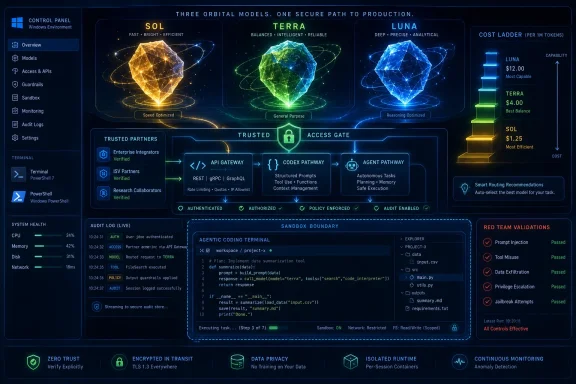 OpenAI Splits the Frontier Into a Product Line
The GPT-5.6 family arrives with three names that sound more like orbital bodies than software SKUs: Sol, Terra, and Luna. That is not accidental branding fluff. OpenAI is trying to replace the old habit of asking “which model number is best?” with a more durable map of capability tiers.Sol is the flagship, the model OpenAI describes as its strongest yet. It is aimed at complex reasoning, agentic coding, biology workflows, and cybersecurity tasks where the value of a correct answer can justify greater latency and cost. Terra is the middle tier, pitched as the workhorse for everyday tasks, with performance competitive with GPT-5.5 at half the price. Luna is the volume tier, designed for lower-cost, high-throughput use where speed and affordability matter more than squeezing out the last percentage point of capability.
That three-way split matters because the AI market is no longer one monolithic race toward “the biggest model.” Enterprises increasingly want predictable economics, administrators want governable access, and developers want to route tasks intelligently rather than send every request to the most expensive brain in the room. GPT-5.6 is OpenAI’s clearest acknowledgment yet that frontier AI has become an operations problem as much as a research problem.
This is especially relevant in Windows-heavy environments, where AI is now likely to appear in several places at once: developer tooling, help desk automation, endpoint management scripts, security analysis, Office workflows, and internal knowledge systems. The question is no longer whether an organization uses AI. The question is which tier handles which work, who is allowed to invoke the top tier, and how much auditability surrounds the result.
The Limited Preview Is the Real Story
OpenAI says it plans broader availability in the coming weeks, but GPT-5.6 begins life behind a narrow gate. During the preview, the models are available to a select group of trusted partners and organizations, initially through the API and Codex. OpenAI has also said the limited rollout follows engagement with the U.S. government, with participation shared with officials before wider release.That is a remarkable sentence in the history of commercial software. Microsoft has spent decades shipping Windows, Office, Exchange, Azure services, and developer tools under regulatory scrutiny, but the ordinary rhythm of release has remained fundamentally commercial: build, test, publish, patch, support. GPT-5.6 suggests that the frontier model business may be drifting toward something different, where the most capable systems are released in stages not merely because of server capacity or product readiness, but because of national-security-adjacent concerns.
OpenAI is careful to say it does not want this access process to become the long-term default. That caveat is important, because a world where every major model launch requires opaque government-adjacent approval would be difficult for customers to plan around and difficult for global developers to trust. Still, the precedent has now been made visible. The company is arguing, in effect, that a temporary bottleneck is the price of broader availability later.
There is an obvious tension here. Cyber defenders want better models because attackers already automate reconnaissance, phishing, exploit research, and code generation. Governments worry that the same better models could accelerate offensive use. Vendors want to ship quickly enough to compete. Enterprises want access, but not if the tool creates new compliance risks. GPT-5.6 sits directly in that triangle.
Sol Is Built for the Work That Makes Executives Nervous
OpenAI’s claims for GPT-5.6 Sol focus heavily on agentic capability. The company says Sol introduces a new max reasoning effort for deeper analysis and an ultra mode that uses subagents to accelerate complex work. In plain English, this means OpenAI is not just making the model better at answering prompts; it is making the system better at breaking work into parts, coordinating steps, and persisting through multi-stage tasks.That is exactly where AI becomes more useful and more unsettling. A chatbot that answers a PowerShell question is one thing. An agent that can plan a debugging session, inspect logs, propose code changes, coordinate terminal commands, and iterate toward a working fix is something else. The former is an assistant. The latter begins to resemble a junior operator with superhuman recall and uneven judgment.
OpenAI says Sol sets a new state of the art on Terminal-Bench 2.1, a benchmark focused on command-line workflows requiring planning, iteration, and tool coordination. That should get the attention of every developer who uses Windows Terminal, WSL, PowerShell, GitHub, Visual Studio Code, or Codex-like tools as part of daily work. Command-line competence is not glamorous, but it is the plumbing of modern software operations. A model that gets materially better there can shave hours from debugging, migration, packaging, and deployment work.
The same capability can also misfire in expensive ways. A model that coordinates tools well may be able to clean up a messy build pipeline, but it may also confidently execute a destructive command if placed in a poorly sandboxed environment. The GPT-5.6 story for developers is therefore not simply “better coding.” It is better coding wrapped in a renewed obligation to design guardrails around execution.
Terra and Luna Are the Models Most Businesses Will Actually Use
The model everyone will talk about is Sol. The models most organizations may live with are Terra and Luna. That distinction is worth emphasizing because enterprise AI adoption is usually decided by cost curves, latency targets, and procurement policies, not benchmark heroics.Terra is positioned as the sensible default: capable enough for routine analysis, content generation, summarization, structured data work, and internal tooling, but cheaper than the previous generation’s comparable tier. If OpenAI’s claim that Terra performs competitively with GPT-5.5 at half the price holds up in production, it could become the model that quietly replaces a lot of older AI deployments.
Luna is the more interesting signal for scale. A low-cost, fast model is what makes AI economically plausible in places where the user never sees the model name: ticket triage, customer support drafts, classification, extraction, policy lookup, alert enrichment, and lightweight workflow automation. For a WindowsForum audience, think less “write me a novel” and more “read 10,000 endpoint alerts and tell me which ones deserve a human.”
This segmentation mirrors the way cloud computing matured. Nobody runs every workload on the largest VM size. Nobody stores every object in the most expensive hot tier. AI is moving toward the same architecture: route the easy tasks to the cheap model, escalate ambiguous work to the balanced model, and reserve the flagship for the jobs where failure is costly or reasoning depth matters. GPT-5.6 gives that design pattern a more explicit product surface.
Pricing Turns Model Choice Into Architecture
OpenAI’s published pricing puts Sol at $5 per million input tokens and $30 per million output tokens, Terra at $2.50 input and $15 output, and Luna at $1 input and $6 output. Those numbers matter less as trivia than as architectural pressure. Output tokens are where the bill climbs, and agentic workflows tend to produce a lot of them.That has practical consequences. If a developer routes every internal code review, documentation query, and help desk request to Sol because it is “best,” the monthly invoice may become the governance mechanism. If the same organization builds routing logic that sends routine extraction to Luna, complex internal analysis to Terra, and only high-stakes debugging to Sol, the economics look very different.
OpenAI is also introducing more predictable prompt caching, including explicit cache breakpoints and a minimum cache life. That feature may sound niche, but it matters for serious deployments. Many enterprise prompts contain repeated context: policy documents, coding standards, product manuals, schemas, repository summaries, or security rules. If caching becomes predictable enough to design around, AI applications can become less financially chaotic.
This is the part of the launch that should interest IT architects as much as AI enthusiasts. The next wave of AI implementation will reward teams that think like systems designers. The model is not the application. The application is the routing layer, the cache strategy, the permission model, the evaluation suite, the logging pipeline, and the escalation path when the model is unsure or wrong.
Cybersecurity Is the Opportunity and the Alarm Bell
OpenAI is unusually direct that GPT-5.6 improves cybersecurity capability. It says Sol is its most capable model yet for security tasks, including vulnerability research and exploitation-related workflows, while also saying the model is better at helping find and fix vulnerabilities than reliably carrying out end-to-end attacks. That distinction is the moral and technical center of the release.For defenders, better cyber reasoning is badly needed. Security teams drown in alerts, operate across fragmented tools, and often face attackers who need only one path through an environment. A capable model can help analyze logs, explain suspicious scripts, identify risky configuration drift, draft detections, compare patches, and accelerate post-incident review. In Windows estates, where Active Directory, Entra ID, Intune, Defender, legacy scripts, SMB shares, and third-party agents often coexist uneasily, an assistant that can reason across messy context has obvious value.
But the same skills are not cleanly separable from misuse. A model that can explain why a vulnerability matters can also help an attacker understand it. A model that can reason through exploit primitives may help defenders validate a patch, but it also pushes the industry closer to the line where automated exploitation becomes more accessible. OpenAI says GPT-5.6 Sol does not cross its Cyber Critical threshold under tested conditions, but it also acknowledges that benchmarks cannot capture every real-world combination of model, tool, operator, and environment.
That last point deserves more attention than any benchmark. Real incidents are not benchmark tasks. They involve partial access, stolen credentials, misconfigured services, forgotten machines, brittle scripts, social engineering, and time pressure. A model’s dangerousness is not only what it can do in isolation, but what it enables a determined user to do when paired with scanners, exploit frameworks, leaked data, and cloud infrastructure.
Safety Has Become a Feature, Not a Footnote
OpenAI says GPT-5.6 ships with its most robust safety stack to date, including model-level protections, real-time misuse classifiers, and account-level review processes. It also says it spent weeks pressure-testing the system and used extensive automated red-teaming to uncover and fix weaknesses before preview. That is not just corporate reassurance; it is a product requirement.The old AI safety debate often sounded abstract, especially to users who mostly wanted help writing emails or code. GPT-5.6 makes it concrete. If the model is materially better at coding, biology, and cybersecurity, then safety is not an optional moral appendix. It is part of whether the product can be shipped at all.
This is where enterprise buyers should be skeptical in a productive way. “Robust safeguards” is not a magic phrase. Administrators should want to know how misuse is detected, what logs are retained, how policy violations are handled, what data is exposed to model providers, how appeals work, and whether legitimate defensive workflows get blocked at the worst possible time. A security analyst who cannot ask detailed vulnerability questions during an incident because a classifier panics is not being protected; they are being slowed down.
The best version of this future is not a model that refuses anything vaguely technical. It is a model that understands authorization, context, intent, and operational boundaries. That requires more than a system prompt. It requires identity-aware integrations, auditable workflows, and product designs that distinguish a defender working inside a tenant from a random user asking for offensive instructions.
Windows Developers Will Feel This First Through Codex
OpenAI says GPT-5.6 will be available through Codex during the preview for selected partners, with broader availability planned for ChatGPT, Codex, and the API. For Windows developers, Codex is likely to be the first place GPT-5.6 feels less like a press release and more like a workflow change. The model’s command-line and agentic improvements map naturally onto the daily grind of software work.The immediate use cases are obvious: debugging failing builds, writing tests, modernizing scripts, explaining compiler errors, navigating unfamiliar repositories, and translating intent into code changes. On Windows, that also means more competent handling of PowerShell, .NET, Visual Studio projects, MSBuild, NuGet, WSL boundaries, and hybrid environments where Linux tooling lives inside a Windows development machine.
The risk is equally obvious. Developers may over-trust agentic changes because the model appears fluent and productive. A model that can modify multiple files, run commands, and iterate toward passing tests can also introduce subtle regressions, insecure defaults, licensing problems, or maintainability debt. The more autonomous the assistant becomes, the more traditional code review has to adapt.
The winning teams will not ban these tools, because that would be like banning compilers for being too powerful. They will constrain them. They will run generated changes through tests, static analysis, dependency review, secret scanning, and human approval. They will treat AI-generated pull requests as useful but untrusted contributions, not as finished work from an infallible colleague.
Enterprise IT Gets a Governance Problem Disguised as a Productivity Upgrade
For enterprise IT, GPT-5.6 is a preview of the next governance headache. Users will want the best model. Finance will want the cheap model. Security will want logs, controls, and data boundaries. Legal will want guarantees that may not exist. Meanwhile, departments will quietly build workflows around whatever access they can get.This is the same pattern that played out with cloud storage, SaaS messaging, browser extensions, and low-code automation. The first wave arrives through productivity. The second wave arrives through shadow IT. The third wave becomes governance, procurement, and incident response. AI is moving through that cycle at unsafe speed.
Model tiering may help, but only if organizations use it deliberately. A company might allow Luna broadly for low-risk summarization, Terra for approved internal workflows, and Sol only for designated technical teams handling complex development or security work. That sort of policy is not glamorous, but it is how AI becomes manageable instead of magical.
The harder question is who owns the routing logic. If business units choose models directly, cost and risk fragment. If central IT locks everything down, users route around the policy. If vendors hide the routing behind a friendly interface, enterprises may lose the visibility they need. GPT-5.6 makes clear that model selection is becoming part of enterprise architecture, not a preference buried in a dropdown.
The Government Gate May Not Stay Temporary
OpenAI’s limited preview comes with a political subtext: frontier AI is becoming a regulated strategic asset before the regulatory machinery is fully formed. The company says it is working with the administration on a cyber Executive Order framework and wants a repeatable process for future model releases. That sounds reasonable. It also sounds like the beginning of a long fight over who gets to decide when a model is safe enough to ship.There are good arguments for some form of review. The most capable models may compress the time needed to perform sensitive technical work, including cyber operations. Governments have a legitimate interest in understanding those capabilities before they are widely available. A release-first, apologize-later model could create real risks.
There are also good arguments against opaque gating. If access depends on behind-the-scenes coordination, smaller developers and non-U.S. partners may be disadvantaged. If government review becomes slow or politicized, frontier capability may concentrate among a few approved incumbents. If the rules are unclear, companies may self-censor releases or shape products around regulatory guesswork rather than user need.
For WindowsForum readers, the important point is not partisan. It is operational. If AI tools become subject to staged access based on government concern, product roadmaps will become less predictable. Enterprises that build heavily around a specific model family will need contingency plans, abstraction layers, and vendor diversification, just as they already do for cloud outages or licensing changes.
The Benchmark Race Is Giving Way to the Deployment Race
The launch coverage naturally emphasizes benchmarks: Terminal-Bench, GeneBench, ExploitBench, ExploitGym, and comparisons with rival frontier models. Benchmarks are useful. They are also increasingly insufficient.The important competition is shifting from who can produce the most impressive isolated model to who can deploy capability responsibly, cheaply, quickly, and reliably into real workflows. That is a different kind of race. It rewards infrastructure, policy design, customer support, abuse monitoring, pricing discipline, developer ergonomics, and integration depth.
OpenAI’s GPT-5.6 announcement reflects that shift. The product story is not “one model to rule them all.” It is a family of models, tiered prices, caching rules, Codex integration, safety systems, red-team claims, partner previews, and government coordination. The model weights may be the technical miracle, but the launch machinery is the business.
Microsoft will be watching this closely, not only as OpenAI’s major partner but as a company whose customers expect AI to appear inside Windows, GitHub, Visual Studio, Microsoft 365, Defender, and Azure. The more capable the underlying models become, the more Microsoft’s real job is packaging them into experiences that administrators can govern. In the enterprise, raw intelligence without controls is not a product. It is an incident waiting for a ticket number.
The Fine Print Windows Pros Should Carry Into Monday
GPT-5.6 is early, limited, and still filtered through OpenAI’s own claims, so the right response is neither hype nor dismissal. Treat it as a signal that AI capability is advancing into more operationally sensitive territory, and that access, cost, and governance will matter as much as raw performance.- GPT-5.6 launched on June 26, 2026, as a limited preview with three tiers named Sol, Terra, and Luna.
- Sol is the flagship model aimed at deeper reasoning, agentic coding, biology workflows, and cybersecurity tasks.
- Terra is positioned as the everyday balanced model, while Luna is designed for faster and cheaper high-volume work.
- Initial access is limited to selected trusted partners through the API and Codex, with broader ChatGPT, Codex, and API availability planned later.
- OpenAI says the restricted rollout follows engagement with the U.S. government and should not become the long-term default.
- The most practical enterprise question is not which model is smartest, but which model should be allowed to handle which workload under which controls.
References
- Primary source: MacRumors
Published: Fri, 26 Jun 2026 18:16:09 GMT
OpenAI Launches GPT-5.6 Sol, Terra, and Luna in Limited Preview
OpenAI today launched a limited preview of its GPT–5.6 series, which includes flagship model Sol, a balanced everyday work model named Terra, and Luna, a fast and affordable model. Terra is similar in performance to GPT–5.5 but it is 2x cheaper, and Luna offers "strong capability" at...www.macrumors.com - Independent coverage: blockchain.news
Published: 2026-06-26T18:10:12.702041
GPT5.6 Sol debuts with Terra and Luna | AI News Detail
According to @OpenAI, GPT-5.6 Sol launches in limited preview with Terra for balanced tasks and Luna for fast, affordable high-volume work.blockchain.news - Independent coverage: LatestLY
Published: 2026-06-26T18:10:12.701106
OpenAI GPT-5.6 Models Unveiled With Advanced Reasoning and Safety Features | 📲 LatestLY
OpenAI has launched GPT-5.6 with Sol, Terra, and Luna tiers, featuring advanced reasoning and enhanced cybersecurity capabilities. The release includes robust, layered safety protections developed through extensive automated red-teaming. The models are currently in a limited preview with broader...www.latestly.com
- Related coverage: axios.com
OpenAI releases powerful new GPT-5.6 model
The company agreed to limit the rollout after a request from the Trump administration, which cited national security concerns.www.axios.com
- Related coverage: techcrunch.com
OpenAI limits GPT-5.6 rollout after government request, says restrictions shouldn’t be the norm | TechCrunch
“We don’t believe this kind of government access process should become the long-term default,” says OpenAI. “It keeps the best tools from users, developers, enterprises, cyber defenders, and global partners who need them.”techcrunch.com - Related coverage: 9to5mac.com
OpenAI upgrading ChatGPT and Codex with new GPT-5.6 models in limited release - 9to5Mac
OpenAI is introducing GPT-5.6, its next-generation model, two months after the release of GPT-5.5. However, the rollout to customers won’t...9to5mac.com
- Related coverage: frandroid.com
OpenAI annonce GPT-5.6 (Sol, Terra, Luna) mais en limite l'accès à la demande du gouvernement américain — Frandroid
OpenAI dévoile GPT-5.6, sa nouvelle famille de modèles, mais l’accès reste verrouillé : l’entreprise commence par une préversion réservée à quelqueswww.frandroid.com - Official source: help-lb.openai.com
Retiring GPT-4o and other ChatGPT models | OpenAI Help Center
GPT-4o and additional models were deprecated in ChatGPT on February 13, 2026. These models will continue to be available in the API. help-lb.openai.com
- Related coverage: genalphai.com
GPT-5.6 Deployment Starts Behind a Federal Gate — Gen α AI
GPT-5.6 deployment guide for engineers: Sol, Terra, Luna tiers, Bidi-1 voice, METR safety signals, Terra's 50% cost cut, and a production checklist. genalphai.com
- Related coverage: all-ai.de
OpenAI veröffentlicht GPT-5.6 mit den Modellen Sol, Terra und Luna
Das stärkste Modell schlägt Mythos 5 in manchen Bereichen und kommt mit einem neuen Ultra Modus. www.all-ai.de
- Official source: cdn.openai.com
