
Microsoft’s latest BKW case study describes how the Swiss energy and infrastructure group is working with Microsoft Energy & Resources Industry, Microsoft Research AI for Science, and Microsoft AI Weather to test AI weather foundation models as part of a broader intelligence layer for energy-transition operations in Europe. The point is not that a utility has discovered weather forecasting. It is that weather, geospatial data, grid planning, and cloud AI are being folded into the same operational stack. For WindowsForum readers, the story is less about a single customer win than about where Microsoft wants the next generation of critical infrastructure computing to live: in managed cloud platforms where models, maps, enterprise data, and operational decisions converge.
The energy transition has always been described in physical terms: turbines, panels, batteries, substations, heat pumps, transmission corridors, and the awkward politics of getting all of them built. Microsoft’s BKW story reframes that familiar picture around a quieter but equally consequential layer: the intelligence system that decides how those assets are planned, operated, and optimized.
That is a commercially convenient framing for Microsoft, of course. A company that sells cloud infrastructure, AI platforms, developer tools, security services, and industry templates has every incentive to argue that the hard part of decarbonization is data orchestration. But the claim is not merely marketing. A grid with more solar and wind is not just a cleaner grid; it is a more weather-sensitive grid, a more geographically distributed grid, and a grid whose operating assumptions can change faster than legacy planning cycles were built to tolerate.
BKW is a useful protagonist because it sits across several of those fault lines. The company is rooted in Switzerland but operates across parts of Europe, with business spanning energy generation, distribution networks, engineering, building technology, and infrastructure services. That breadth matters. A narrower power producer might use better forecasts to schedule generation; a broader infrastructure operator can apply environmental intelligence to asset planning, maintenance, customer services, and risk management.
Microsoft’s argument is that AI weather models can become part of an enterprise decision fabric rather than a specialist tool used only by meteorologists. That is the strategic shift. Weather data moves from the forecast desk into the same analytics and application environment used by planners, engineers, field teams, and executives.
Traditional numerical weather prediction remains the scientific backbone of serious forecasting. These models simulate the atmosphere using physics-based equations and massive computation, and they underpin much of the operational forecasting used by governments, aviation, utilities, and emergency planners. No credible energy operator is throwing that away because a vendor has attached the word AI to a model.
The change is that AI weather models are beginning to offer a different operating profile. Foundation models such as Microsoft’s Aurora are trained on large collections of atmospheric and climate data, then adapted to forecasting tasks. Their promise is not magic atmospheric omniscience; it is speed, flexibility, and lower marginal cost for generating forecasts and running variations once the model has been trained.
That matters because the energy business does not merely need one forecast. It needs forecasts at different horizons, resolutions, locations, and confidence levels, often joined with asset data, market data, maintenance schedules, and customer demand. The value of AI forecasting is therefore not only accuracy on a benchmark. It is whether forecasts can be made more usable inside the messy operational systems where infrastructure decisions are actually made.
That is a familiar enterprise technology story. Organizations rarely suffer from an absolute absence of information. They suffer from fragmentation, latency, incompatible systems, governance problems, uneven tooling, and the human difficulty of translating specialized data into decisions that other teams can act on.
In energy, that fragmentation has a cost. If weather intelligence lives in one expert workflow, asset data in another, and operational planning in yet another, the organization can be technically informed while still being slow. The energy transition punishes that slowness because variability increases the premium on anticipation.
BKW’s exploration with Microsoft is therefore best read as a platform bet. The company is asking whether AI weather foundation models, geospatial intelligence, and enterprise cloud systems can create a shared analytical foundation. That foundation would not remove the need for meteorological expertise, engineering judgment, or operational discipline. It would try to make those forms of expertise easier to combine.
Those claims are significant, but they should be handled carefully. Weather is a brutal domain for overconfident technology narratives. Extreme events, local terrain effects, sparse observational data, and chaotic atmospheric dynamics can expose weaknesses in both traditional and AI models. Even strong benchmark performance does not automatically translate into operational trust for a grid operator or infrastructure company.
The more durable part of Microsoft’s pitch is not simply “our model forecasts better.” It is “our model can live inside the enterprise platform where you already govern data, build applications, secure access, and deploy AI services.” For BKW, that could mean environmental forecasts are not delivered as static reports but embedded in workflows that also understand assets, geography, teams, and business constraints.
That distinction matters for Microsoft’s wider AI strategy. The company does not need every customer to become a weather-modeling lab. It needs customers to believe that specialized foundation models can be consumed through familiar cloud and AI tooling, alongside internal data and business processes. In that world, Azure is not merely compute capacity. It becomes the layer where industry-specific intelligence is operationalized.
Numerical models have decades of institutional trust behind them. They are interpretable in ways that matter to scientists, supported by mature verification practices, and embedded in operational forecasting organizations. AI models, by contrast, are advancing rapidly but still face questions about generalization, extremes, physical consistency, uncertainty quantification, and how they behave when the climate system produces patterns underrepresented in training data.
That does not make AI forecasting a toy. It makes it a powerful new instrument that must be validated for specific operational purposes. A model can be excellent at medium-range global pressure fields while still requiring careful handling for local wind ramps near a particular ridge, fog in a valley, or solar irradiance under complex cloud conditions. For an energy company, the question is always practical: does this improve a decision?
BKW’s framing appears appropriately pragmatic. The company is exploring whether AI-driven foundational models can support more scalable and accessible workflows, not declaring the death of meteorology. That is the correct posture for critical infrastructure. The first job is not to chase novelty; it is to understand where the new tool can safely sharpen existing operations.
The company’s earlier work with BKW around an internal AI platform called Edison already pointed in this direction. That project used Azure AI capabilities to help employees work with internal information and identify new AI use cases. The weather-foundation-model story adds a more specialized layer: not just generative AI over corporate documents, but AI trained on scientific data and applied to operational planning.
This is where the enterprise AI market is heading. The first wave of generative AI in business was about chatbots, summarization, and document search. The next wave is about domain-specific models that interact with the physical world through data: weather, chemistry, biology, manufacturing, logistics, cyber defense, and power systems. The user interface may still look conversational, but the underlying value comes from connecting models to governed data and real processes.
That also raises the stakes. If cloud AI becomes part of infrastructure planning, then questions of resilience, sovereignty, auditability, vendor lock-in, and model governance become unavoidable. A productivity chatbot can be wrong and annoying. A forecasting workflow that informs grid maintenance or renewable generation planning needs a different level of scrutiny.
That is why geospatial intelligence is central to the BKW story. The energy transition is not happening on a spreadsheet. It is happening across landscapes, rooftops, substations, rights of way, rivers, mountain passes, cities, and industrial sites. Each has different exposure to weather and climate risk.
Microsoft’s advantage is that it can combine mapping, data storage, analytics, AI services, identity, security, and application development into one enterprise environment. Whether that is the best environment for every customer is a separate debate, but the integrated proposition is obvious. Instead of treating geospatial systems, weather models, and enterprise applications as separate islands, Microsoft wants them operating as parts of the same decision platform.
For BKW, this could help multidisciplinary teams work from a shared picture. Engineers, planners, energy traders, maintenance coordinators, and customer-facing teams do not need identical tools, but they benefit from consistent assumptions. If the organization can connect forecast uncertainty to assets and decisions more quickly, it gains more than technical elegance. It gains operational tempo.
Renewable-heavy systems increase the need for those loops. Solar output can shift quickly with cloud cover. Wind production can ramp up or down over short windows. Heat waves can push demand and stress equipment. Storms can alter maintenance priorities and emergency readiness. The operating environment is not static enough for slow, siloed analysis to remain sufficient.
AI models may help because they can generate forecasts quickly enough to support more iteration. A planner might compare several weather scenarios against asset constraints. An operator might test how forecast uncertainty affects reserve planning. A maintenance team might adjust schedules based on short-range risk. A customer-service function might prepare communications before a weather-driven disruption becomes obvious.
The key phrase is decision velocity. Faster forecasts are only valuable if the organization can absorb them into better decisions. That requires data engineering, workflow design, governance, training, and trust. The model is necessary, but it is not the system.
The bargain is that the intelligence layer becomes entangled with a vendor platform. That is not automatically bad; most enterprises already standardize around major platforms because integration has value. But critical infrastructure should be wary of confusing convenience with strategic neutrality. Weather models, geospatial data, asset systems, and operational workflows are too important to be trapped in opaque architectures without exit paths.
This is especially important as foundation models become more specialized. If a company builds business processes around a particular model interface, data schema, or cloud-native service, switching later can become difficult. The cost is not just licensing. It is retraining staff, rewriting integrations, revalidating models, and proving to regulators or internal risk teams that the new system performs as expected.
Microsoft will argue that its enterprise controls, responsible AI tooling, and platform maturity address these concerns. To some extent, that is true. But the energy sector should insist on portability, auditability, clear performance validation, and governance from the beginning. The smarter the platform becomes, the more important it is to know where its assumptions live.
That makes companies like BKW early governance laboratories. They must decide how AI forecasts are validated, who can act on them, how uncertainty is communicated, how internal data is protected, and how human expertise remains in the loop. They must also determine when AI output is advisory and when it becomes operationally consequential.
The phrase “human in the loop” is often used as a comfort blanket, but in infrastructure it needs substance. Which human? With what expertise? At what point in the workflow? With what authority to override? And how is that override recorded and used to improve the system? These are not philosophical questions. They are the plumbing of accountable AI operations.
Microsoft’s case study understandably emphasizes opportunity. That is what customer stories do. But the real test will be whether AI weather and geospatial workflows can become boringly reliable. In critical infrastructure, boredom is a compliment.
Sysadmins and IT pros should notice the pattern. AI initiatives that begin as executive strategy quickly become identity projects, data-governance projects, security projects, compliance projects, and integration projects. Someone has to decide which users can access which data, how models authenticate to services, where logs are retained, how outputs are monitored, and how systems recover when dependencies fail.
The BKW story also shows why Microsoft keeps pushing industry-specific AI rather than generic chatbot demos alone. The durable money is in workflows where AI is attached to revenue, risk, assets, and operations. A model that helps an energy company plan renewable assets or manage grid risk is far more defensible than another tool that summarizes meeting notes.
That does not mean every Microsoft AI story deserves applause. It means the evaluation criteria should change. The right question is not whether the demo looks impressive. It is whether the system improves a concrete operational decision, under governance, with measurable reliability, at a cost that makes sense.
The practical implications are already visible:
The energy transition will be built with steel, copper, concrete, silicon, software, and a growing amount of probabilistic judgment. Microsoft’s BKW story is a reminder that the next grid will not only be cleaner and more distributed; it will be more computationally mediated. The winners will not be the organizations that blindly trust AI forecasts, or the ones that cling to old workflows out of institutional habit. They will be the ones that turn weather intelligence into governed, testable, everyday operational advantage before volatility makes that capability non-negotiable.
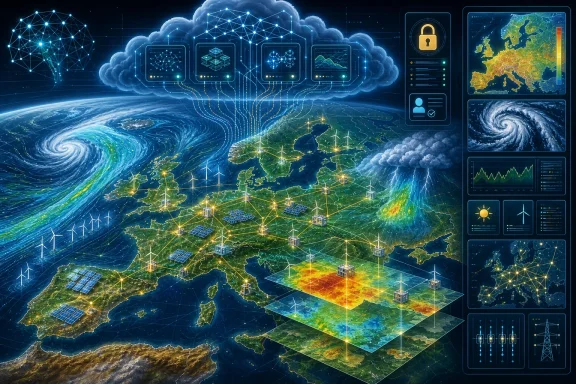 Microsoft Is Selling the Energy Transition as a Data-Platform Problem
The energy transition has always been described in physical terms: turbines, panels, batteries, substations, heat pumps, transmission corridors, and the awkward politics of getting all of them built. Microsoft’s BKW story reframes that familiar picture around a quieter but equally consequential layer: the intelligence system that decides how those assets are planned, operated, and optimized.That is a commercially convenient framing for Microsoft, of course. A company that sells cloud infrastructure, AI platforms, developer tools, security services, and industry templates has every incentive to argue that the hard part of decarbonization is data orchestration. But the claim is not merely marketing. A grid with more solar and wind is not just a cleaner grid; it is a more weather-sensitive grid, a more geographically distributed grid, and a grid whose operating assumptions can change faster than legacy planning cycles were built to tolerate.
BKW is a useful protagonist because it sits across several of those fault lines. The company is rooted in Switzerland but operates across parts of Europe, with business spanning energy generation, distribution networks, engineering, building technology, and infrastructure services. That breadth matters. A narrower power producer might use better forecasts to schedule generation; a broader infrastructure operator can apply environmental intelligence to asset planning, maintenance, customer services, and risk management.
Microsoft’s argument is that AI weather models can become part of an enterprise decision fabric rather than a specialist tool used only by meteorologists. That is the strategic shift. Weather data moves from the forecast desk into the same analytics and application environment used by planners, engineers, field teams, and executives.
The Weather Forecast Becomes an Infrastructure Primitive
Wind and solar power make weather more than a background condition. A cloudy hour, a wind lull, an incoming storm, or a heat wave can affect generation, demand, grid stress, maintenance windows, and the economics of buying or selling power. Those effects are not abstract. They land in dispatch decisions, load planning, outage prevention, and the daily work of balancing reliability against cost.Traditional numerical weather prediction remains the scientific backbone of serious forecasting. These models simulate the atmosphere using physics-based equations and massive computation, and they underpin much of the operational forecasting used by governments, aviation, utilities, and emergency planners. No credible energy operator is throwing that away because a vendor has attached the word AI to a model.
The change is that AI weather models are beginning to offer a different operating profile. Foundation models such as Microsoft’s Aurora are trained on large collections of atmospheric and climate data, then adapted to forecasting tasks. Their promise is not magic atmospheric omniscience; it is speed, flexibility, and lower marginal cost for generating forecasts and running variations once the model has been trained.
That matters because the energy business does not merely need one forecast. It needs forecasts at different horizons, resolutions, locations, and confidence levels, often joined with asset data, market data, maintenance schedules, and customer demand. The value of AI forecasting is therefore not only accuracy on a benchmark. It is whether forecasts can be made more usable inside the messy operational systems where infrastructure decisions are actually made.
BKW’s Problem Was Never a Lack of Data
The case study’s most important line is also the least glamorous: BKW’s challenge was not that the data did not exist. Modern energy and infrastructure businesses are awash in signals: weather feeds, satellite data, grid telemetry, asset histories, customer demand curves, maintenance records, market prices, topographic information, and engineering models. The bottleneck is turning those signals into timely, reliable decisions across disciplines.That is a familiar enterprise technology story. Organizations rarely suffer from an absolute absence of information. They suffer from fragmentation, latency, incompatible systems, governance problems, uneven tooling, and the human difficulty of translating specialized data into decisions that other teams can act on.
In energy, that fragmentation has a cost. If weather intelligence lives in one expert workflow, asset data in another, and operational planning in yet another, the organization can be technically informed while still being slow. The energy transition punishes that slowness because variability increases the premium on anticipation.
BKW’s exploration with Microsoft is therefore best read as a platform bet. The company is asking whether AI weather foundation models, geospatial intelligence, and enterprise cloud systems can create a shared analytical foundation. That foundation would not remove the need for meteorological expertise, engineering judgment, or operational discipline. It would try to make those forms of expertise easier to combine.
Aurora Is the Headline, but Integration Is the Product
Microsoft’s Aurora model has attracted attention because it is a large AI foundation model for atmospheric forecasting, with Microsoft positioning it as capable of producing high-resolution global forecasts faster and, in selected tasks, at accuracy comparable to or better than traditional systems. It has also been presented as extending beyond ordinary weather into areas such as air quality, tropical cyclone tracking, ocean waves, and energy-related flows.Those claims are significant, but they should be handled carefully. Weather is a brutal domain for overconfident technology narratives. Extreme events, local terrain effects, sparse observational data, and chaotic atmospheric dynamics can expose weaknesses in both traditional and AI models. Even strong benchmark performance does not automatically translate into operational trust for a grid operator or infrastructure company.
The more durable part of Microsoft’s pitch is not simply “our model forecasts better.” It is “our model can live inside the enterprise platform where you already govern data, build applications, secure access, and deploy AI services.” For BKW, that could mean environmental forecasts are not delivered as static reports but embedded in workflows that also understand assets, geography, teams, and business constraints.
That distinction matters for Microsoft’s wider AI strategy. The company does not need every customer to become a weather-modeling lab. It needs customers to believe that specialized foundation models can be consumed through familiar cloud and AI tooling, alongside internal data and business processes. In that world, Azure is not merely compute capacity. It becomes the layer where industry-specific intelligence is operationalized.
AI Forecasting Complements Numerical Models Rather Than Replacing Them
The most credible version of this story is not a duel between AI and physics. It is a hybrid future in which AI models complement established numerical weather prediction, especially where speed, scenario generation, accessibility, and integration are valuable. Utilities and infrastructure operators are conservative for good reason. Bad forecasts can mean wasted money, safety risks, reliability problems, and public scrutiny.Numerical models have decades of institutional trust behind them. They are interpretable in ways that matter to scientists, supported by mature verification practices, and embedded in operational forecasting organizations. AI models, by contrast, are advancing rapidly but still face questions about generalization, extremes, physical consistency, uncertainty quantification, and how they behave when the climate system produces patterns underrepresented in training data.
That does not make AI forecasting a toy. It makes it a powerful new instrument that must be validated for specific operational purposes. A model can be excellent at medium-range global pressure fields while still requiring careful handling for local wind ramps near a particular ridge, fog in a valley, or solar irradiance under complex cloud conditions. For an energy company, the question is always practical: does this improve a decision?
BKW’s framing appears appropriately pragmatic. The company is exploring whether AI-driven foundational models can support more scalable and accessible workflows, not declaring the death of meteorology. That is the correct posture for critical infrastructure. The first job is not to chase novelty; it is to understand where the new tool can safely sharpen existing operations.
The Cloud Is Becoming the Control Plane for Physical Infrastructure
For Windows and Microsoft watchers, the BKW case study fits into a larger pattern. Microsoft has spent years pushing industry cloud offerings, Azure AI services, Microsoft Fabric, geospatial partnerships, digital twins, and Copilot-style interfaces into sectors that operate real-world assets. Energy is one of the most attractive targets because it is capital-intensive, data-heavy, regulated, and under pressure to modernize.The company’s earlier work with BKW around an internal AI platform called Edison already pointed in this direction. That project used Azure AI capabilities to help employees work with internal information and identify new AI use cases. The weather-foundation-model story adds a more specialized layer: not just generative AI over corporate documents, but AI trained on scientific data and applied to operational planning.
This is where the enterprise AI market is heading. The first wave of generative AI in business was about chatbots, summarization, and document search. The next wave is about domain-specific models that interact with the physical world through data: weather, chemistry, biology, manufacturing, logistics, cyber defense, and power systems. The user interface may still look conversational, but the underlying value comes from connecting models to governed data and real processes.
That also raises the stakes. If cloud AI becomes part of infrastructure planning, then questions of resilience, sovereignty, auditability, vendor lock-in, and model governance become unavoidable. A productivity chatbot can be wrong and annoying. A forecasting workflow that informs grid maintenance or renewable generation planning needs a different level of scrutiny.
Geospatial Intelligence Is Where the Forecast Meets the Asset
Weather forecasts become more useful when they are tied to place. A wind forecast matters differently depending on turbine location, terrain, transmission constraints, and maintenance crews. Solar forecasts become operationally meaningful when linked to plant capacity, cloud movement, inverter behavior, and local demand. Flood, heat, and storm risks become infrastructure questions only when mapped against actual assets and communities.That is why geospatial intelligence is central to the BKW story. The energy transition is not happening on a spreadsheet. It is happening across landscapes, rooftops, substations, rights of way, rivers, mountain passes, cities, and industrial sites. Each has different exposure to weather and climate risk.
Microsoft’s advantage is that it can combine mapping, data storage, analytics, AI services, identity, security, and application development into one enterprise environment. Whether that is the best environment for every customer is a separate debate, but the integrated proposition is obvious. Instead of treating geospatial systems, weather models, and enterprise applications as separate islands, Microsoft wants them operating as parts of the same decision platform.
For BKW, this could help multidisciplinary teams work from a shared picture. Engineers, planners, energy traders, maintenance coordinators, and customer-facing teams do not need identical tools, but they benefit from consistent assumptions. If the organization can connect forecast uncertainty to assets and decisions more quickly, it gains more than technical elegance. It gains operational tempo.
The Energy Transition Needs Faster Loops, Not Just Better Models
It is tempting to evaluate AI weather solely as a contest of accuracy. That is the benchmark culture of machine learning, and accuracy matters enormously. But infrastructure management often depends just as much on feedback loops: how quickly data can be ingested, forecasts generated, scenarios compared, decisions made, and outcomes reviewed.Renewable-heavy systems increase the need for those loops. Solar output can shift quickly with cloud cover. Wind production can ramp up or down over short windows. Heat waves can push demand and stress equipment. Storms can alter maintenance priorities and emergency readiness. The operating environment is not static enough for slow, siloed analysis to remain sufficient.
AI models may help because they can generate forecasts quickly enough to support more iteration. A planner might compare several weather scenarios against asset constraints. An operator might test how forecast uncertainty affects reserve planning. A maintenance team might adjust schedules based on short-range risk. A customer-service function might prepare communications before a weather-driven disruption becomes obvious.
The key phrase is decision velocity. Faster forecasts are only valuable if the organization can absorb them into better decisions. That requires data engineering, workflow design, governance, training, and trust. The model is necessary, but it is not the system.
Microsoft’s Bet Carries the Usual Cloud Bargain
The upside of Microsoft’s approach is straightforward. Enterprise cloud platforms can give organizations scale, security tooling, identity management, data governance, AI services, and developer ecosystems that would be difficult to assemble independently. For a company like BKW, that can lower the barrier to experimenting with advanced forecasting workflows and then scaling the useful ones across teams.The bargain is that the intelligence layer becomes entangled with a vendor platform. That is not automatically bad; most enterprises already standardize around major platforms because integration has value. But critical infrastructure should be wary of confusing convenience with strategic neutrality. Weather models, geospatial data, asset systems, and operational workflows are too important to be trapped in opaque architectures without exit paths.
This is especially important as foundation models become more specialized. If a company builds business processes around a particular model interface, data schema, or cloud-native service, switching later can become difficult. The cost is not just licensing. It is retraining staff, rewriting integrations, revalidating models, and proving to regulators or internal risk teams that the new system performs as expected.
Microsoft will argue that its enterprise controls, responsible AI tooling, and platform maturity address these concerns. To some extent, that is true. But the energy sector should insist on portability, auditability, clear performance validation, and governance from the beginning. The smarter the platform becomes, the more important it is to know where its assumptions live.
Europe’s Infrastructure Operators Are Becoming AI Governance Laboratories
BKW’s European context matters. Energy infrastructure in Europe operates under intense regulatory, political, and public scrutiny. Reliability, affordability, decarbonization, and sovereignty all collide in the same boardroom. AI adoption in this environment cannot be treated like a consumer app rollout.That makes companies like BKW early governance laboratories. They must decide how AI forecasts are validated, who can act on them, how uncertainty is communicated, how internal data is protected, and how human expertise remains in the loop. They must also determine when AI output is advisory and when it becomes operationally consequential.
The phrase “human in the loop” is often used as a comfort blanket, but in infrastructure it needs substance. Which human? With what expertise? At what point in the workflow? With what authority to override? And how is that override recorded and used to improve the system? These are not philosophical questions. They are the plumbing of accountable AI operations.
Microsoft’s case study understandably emphasizes opportunity. That is what customer stories do. But the real test will be whether AI weather and geospatial workflows can become boringly reliable. In critical infrastructure, boredom is a compliment.
The WindowsForum Angle Is Enterprise AI Growing Up
For a WindowsForum audience, the story may seem far from desktop Windows, Patch Tuesday, or the daily realities of endpoint management. It is not. The same Microsoft stack that touches identity, security, device management, collaboration, and cloud infrastructure is expanding into specialized operational intelligence. The boundary between IT and operational technology keeps getting thinner.Sysadmins and IT pros should notice the pattern. AI initiatives that begin as executive strategy quickly become identity projects, data-governance projects, security projects, compliance projects, and integration projects. Someone has to decide which users can access which data, how models authenticate to services, where logs are retained, how outputs are monitored, and how systems recover when dependencies fail.
The BKW story also shows why Microsoft keeps pushing industry-specific AI rather than generic chatbot demos alone. The durable money is in workflows where AI is attached to revenue, risk, assets, and operations. A model that helps an energy company plan renewable assets or manage grid risk is far more defensible than another tool that summarizes meeting notes.
That does not mean every Microsoft AI story deserves applause. It means the evaluation criteria should change. The right question is not whether the demo looks impressive. It is whether the system improves a concrete operational decision, under governance, with measurable reliability, at a cost that makes sense.
The Practical Signal Behind Microsoft’s Weather-AI Story
BKW’s work with Microsoft should not be mistaken for proof that AI has solved energy forecasting. It is better understood as a signpost showing where enterprise infrastructure software is moving. Weather, geography, assets, and AI are being assembled into common decision environments, and the companies that manage physical infrastructure will increasingly be judged by how well they use those environments.The practical implications are already visible:
- AI weather models are becoming credible enough for serious organizations to evaluate them alongside established numerical forecasting systems.
- The strongest near-term use case is likely decision support, where faster scenario generation and integration matter as much as raw forecast accuracy.
- Geospatial context is essential because weather intelligence only becomes operational when tied to real assets, terrain, customers, and constraints.
- Enterprise IT teams will inherit much of the governance burden as AI forecasting workflows connect to identity, data platforms, security controls, and audit systems.
- Critical infrastructure operators should demand validation, transparency, portability, and clear human accountability before embedding AI forecasts into consequential workflows.
The energy transition will be built with steel, copper, concrete, silicon, software, and a growing amount of probabilistic judgment. Microsoft’s BKW story is a reminder that the next grid will not only be cleaner and more distributed; it will be more computationally mediated. The winners will not be the organizations that blindly trust AI forecasts, or the ones that cling to old workflows out of institutional habit. They will be the ones that turn weather intelligence into governed, testable, everyday operational advantage before volatility makes that capability non-negotiable.
References
- Primary source: Microsoft
Published: 2026-06-26T06:42:07.552466
Loading…
www.microsoft.com - Official source: blogs.microsoft.com
Loading…
blogs.microsoft.com - Related coverage: bkw.com
Loading…
www.bkw.com - Related coverage: bkw.ch
Loading…
www.bkw.ch - Related coverage: techcrunch.com
Loading…
techcrunch.com - Official source: news.microsoft.com
Loading…
news.microsoft.com
- Related coverage: phys.org
Loading…
phys.org