

AI Search Engineers said on June 26, 2026, that its analysis of nine professional-service client engagements and more than 50 AI visibility audits found that schema markup deployment order can affect how quickly businesses appear in AI-generated search answers. The claim lands in a market that is racing to turn yesterday’s SEO playbooks into tomorrow’s Answer Engine Optimization services. It is also the kind of claim that deserves both attention and skepticism, because the future of search is being sold faster than it is being measured. The useful story here is not that one agency has found a magic sequence; it is that structured data is becoming a proving ground for whether AEO is engineering discipline or marketing costume.
For years, schema markup sat in the unglamorous corner of technical SEO. It was the JSON-LD block someone added after the page was written, the machine-readable appendix that helped Google understand whether a page described a product, a business, a recipe, a job listing, a review, or a frequently asked question. It mattered, but it was rarely the center of the sales pitch.
AI search has changed the incentives. If traditional search rewarded the page that ranked, answer engines reward the source that can be summarized, trusted, and cited. That makes structured data feel less like decorative metadata and more like a passport: a way to tell crawlers, retrieval systems, and AI products what an entity is, what it does, where it operates, and why it should be believed.
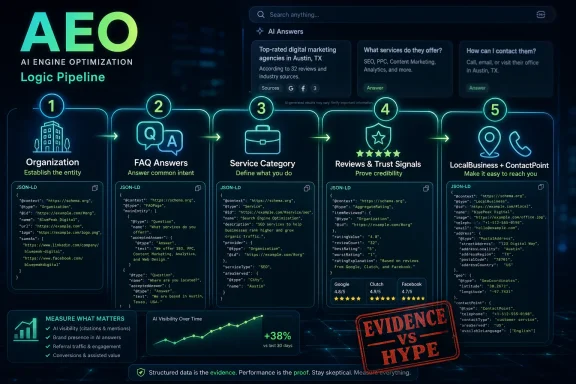
AI Search Engineers’ new findings push that logic one step further. The company argues that it is not enough to deploy the right schema types; businesses also need to deploy them in the right sequence. Organization schema should come first, FAQPage schema should follow alongside an expanded entity profile, service-specific schema should come next, review and rating markup should arrive only after the business is clearly defined, and LocalBusiness plus ContactPoint schema should finish the stack.
That is a neat theory, and the neatness is part of the appeal. It turns a messy market into a checklist. But it also exposes the tension at the heart of AEO in 2026: practitioners are trying to infer the operating habits of systems whose ranking, retrieval, citation, and synthesis behavior remain largely opaque.
The company says its sequence finding comes from nine professional-service engagements and more than 50 audits. That is useful field evidence, especially because law firms, financial advisors, medical practices, and B2B consultants all face the same core problem: they need AI systems to associate a named business with a category of expertise, a market, a service area, and a set of trustworthy answers. Professional services are also a rational test bed because the queries are high intent and entity-heavy. “Best estate planning lawyer in Phoenix” or “financial advisor for physicians in Dallas” is not a casual informational query; it is a commercial selection problem.
But the sample size also matters. Nine engagements can reveal patterns, but they cannot settle causality across ChatGPT, Gemini, Copilot, Perplexity, Grok, and Google AI Overviews. More than 50 audits can identify common mistakes, but an audit is not the same as a controlled experiment across identical businesses, identical content, identical authority profiles, identical crawl timing, and identical competitive landscapes.
That does not make the findings worthless. It makes them practitioner evidence rather than scientific proof. In a young field, practitioner evidence often arrives first. The danger comes when the market treats early operational patterns as universal law.
This is not a radical departure from technical SEO practice. Entity consistency has mattered for years across local SEO, knowledge panels, business profiles, and brand search. The difference is that answer engines make the penalty for ambiguity more visible. If an AI system cannot confidently connect a service page, a review profile, a LinkedIn page, a directory listing, and a press mention to the same business, it is less likely to elevate that business as a reliable answer.
The release argues that subsequent schema types “reference or depend on” the Organization entity. That is partly a technical claim and partly an interpretive one. In JSON-LD, schema can be connected through IDs, nested entities, and graph structures; properly implemented markup can describe relationships among organization, service, review, location, and web page entities. If those relationships are sloppy, machines have to infer what the site owner could have declared explicitly.
This is where the order argument becomes plausible. Even if AI systems do not literally build a permanent entity model in the simplistic step-by-step way described in the release, the site owner’s implementation process can still benefit from sequence. Starting with Organization schema forces the team to settle names, identifiers, sameAs references, service descriptions, and entity boundaries before adding more specialized markup. A cleaner build process often produces cleaner machine-readable output.
The problem is that Google has not turned AI Overview inclusion into a schema vending machine. Google has repeatedly treated structured data as a way to understand content, not as a guarantee of rich results, ranking, or generative citation. FAQ rich results have also been narrowed over time, with Google limiting the traditional FAQ display experience largely to authoritative government and health sites. That history should make anyone cautious about treating FAQPage markup as a direct lever.
Still, “not a guarantee” does not mean “not useful.” FAQPage schema can make question-and-answer content explicit. It can reduce ambiguity. It can help align visible page copy with machine-readable intent. For professional services, where pages often bury specific answers under brand copy, FAQ structure can force the content into a format that retrieval systems can actually use.
The release’s sequencing recommendation is sensible in one practical respect: FAQ answers are more valuable when they are attached to a well-defined entity. A law firm answering “How long do I have to file a personal injury claim?” gains more AEO value when the system can also understand the firm’s name, jurisdiction, practice area, attorneys, and credibility signals. A generic answer may be retrievable; an answer attached to a trusted provider is recommendable.
For a professional-service business, category clarity is not a minor detail. A firm may call itself a “wealth strategy partner,” but users ask for a financial advisor. A consultancy may brand itself around “growth architecture,” but procurement teams search for B2B consulting, revenue operations, or digital transformation support. Schema cannot fix vague positioning, but it can translate a business into a vocabulary machines already understand.
The sequence claim here is that service-specific schema works better after Organization and FAQPage schema are in place. That makes intuitive sense if the goal is to layer category relevance on top of identity and answer content. A business that is already defined and already associated with useful answers is easier to match to service queries than a business that only declares a category.
But the danger is overestimating schema’s power relative to content and authority. A law firm can add flawless LegalService markup and still fail to appear in AI answers if its site is thin, its attorneys lack credible external mentions, its reviews are weak, its local presence is inconsistent, or its content does not answer real user questions. Structured data is a clarifier. It is not a substitute for evidence.
Reviews are among the few trust signals ordinary users understand immediately. They also create risk. Review markup has a long history of abuse, and search engines have had to police self-serving ratings, fake testimonials, and markup that does not match visible page content. In regulated or reputation-sensitive categories such as medical, legal, and financial services, careless review presentation can create compliance, ethics, or consumer-protection problems.
The sequence argument usefully reframes reviews as contextual evidence rather than the first thing to advertise. A five-star rating attached to an ambiguous entity is not nearly as useful as verified review data attached to a known business, known service line, known location, and known body of expertise. Trust signals need something to trust.
For admins and site owners, this is also where validation matters. Review schema should match what users can see on the page. Aggregate ratings should reflect legitimate sources and not a hand-picked hallucination of customer sentiment. If AEO becomes an arms race of inflated structured-data claims, the platforms will respond the same way search engines always have: by discounting, restricting, or penalizing abuse.
AI Search Engineers argues that starting with LocalBusiness creates a geographic entity before a fully defined organizational entity. That may sound abstract, but it maps to a real implementation problem. Local markup can become a dumping ground for NAP data while leaving the larger entity graph underdeveloped. The result is a business that is machine-readable as a place but not necessarily as an expert.
For a restaurant, location-first markup may be enough to solve many user needs. For a law firm, financial advisor, clinic, or consultant, geography is only one dimension of relevance. The user does not merely need “near me”; the user needs competence, specialization, availability, proof, and sometimes regulatory fit.
That makes LocalBusiness schema a finishing layer rather than the foundation in many professional-service contexts. Once the entity is clear, the services are declared, the answer content is structured, and the trust signals are attached, local markup can sharpen the query match. It turns “this is a firm” into “this is a firm serving this market with these contact paths.”
Modern crawlers do not all behave the same way. Googlebot, Bingbot, AI crawlers, browser-based retrieval systems, and third-party answer engines may discover, render, cache, and revisit pages at different intervals. Some systems may see the full schema graph on the first crawl. Others may rely on indexed search results, snippets, training data, cached pages, knowledge graphs, or partner feeds. The idea of a single incremental model-building process across all AI systems is too simple.
But there is a more grounded version of the claim. Sequenced deployment can make measurement cleaner. If a team rolls out Organization schema first, watches crawl and validation behavior, then adds FAQPage, then service schema, then reviews, it has a better chance of spotting which layer broke, which layer was ignored, and which layer coincided with visibility movement. A simultaneous dump may be technically complete but operationally opaque.
That distinction matters. “The platforms reward sequence” is a stronger claim than “sequence helps practitioners build, validate, and measure better.” The first needs evidence that most agencies cannot produce publicly. The second is already good engineering practice.
That makes entity clarity more valuable. A business must be legible across its own website, third-party profiles, directories, knowledge sources, press mentions, reviews, and social platforms. Schema is one piece of that legibility, but it cannot carry the whole load.
This is where the “SEO rebrand” critique has teeth. Agencies that merely add a ChatGPT slide to an SEO deck may miss the structural work required for AI visibility. AEO requires prompt testing, entity audits, crawlability checks, source analysis, content restructuring, schema validation, and measurement across multiple answer surfaces. It also requires humility, because the platforms are changing quickly and do not publish full recipes for inclusion.
The best AEO work will look less like keyword stuffing and more like evidence architecture. It will ask what claims the business wants machines to repeat, what proof supports those claims, where that proof appears, whether the entity is consistently identified, and whether the content can be extracted without a human interpreting the page’s design.
That makes AEO valuable. It also makes the market vulnerable to overclaiming. Law firms, medical practices, and financial advisors are accustomed to paying for visibility, and they often lack the technical staff to evaluate whether an agency’s methodology is meaningful. A confident framework can sound like proof even when it is really a hypothesis wrapped in operational experience.
AI Search Engineers’ suggested buyer question is useful: ask an agency in what order it deploys schema types and why that order matters. A weak agency will answer with buzzwords. A stronger agency will explain entity graphs, validation, crawl timing, content alignment, and measurement limits. The best agency will also admit what schema cannot do.
That last part is essential. Schema cannot manufacture authority. It cannot guarantee that ChatGPT recommends a business. It cannot force Google AI Overviews to cite a page. It cannot compensate for bad content, inconsistent branding, thin external proof, or a weak reputation. Any AEO vendor that sells certainty in this market is selling the one thing the platforms have not given anyone.
That affects more than agencies and law firms. Documentation teams care whether Microsoft Copilot or Google AI Mode extracts the right answer from a support page. Software vendors care whether AI systems identify the correct product edition, licensing model, compatibility matrix, and update channel. MSPs care whether local businesses appear in AI-generated recommendations when customers ask for migration help, security audits, or Windows deployment support.
Structured data is one of the few places where site owners can still speak in a machine-readable format instead of hoping a model infers intent from layout and prose. That does not make it a control plane. It makes it a signal plane. Signals matter, but they compete with content quality, authority, freshness, external references, user behavior, and platform-specific retrieval logic.
The practical takeaway for technical teams is to treat AEO claims the way they would treat performance claims from a vendor. Ask for the test conditions. Ask what changed. Ask what stayed constant. Ask whether the result replicated across platforms. Ask whether the implementation is valid, visible in rendered HTML, and aligned with the page users actually see.
That will require better measurement. AEO teams need baselines before deployment, not screenshots after success. They need query sets, platform-specific tracking, crawl logs, structured-data validation, content-change records, and timelines that separate schema updates from broader site improvements. Without that instrumentation, every improvement can be attributed to the last thing the agency sold.
It will also require language discipline. “AI systems build entity models incrementally” may be a useful shorthand, but it should not be treated as a literal description of every platform. Google AI Overviews, ChatGPT with browsing or retrieval, Microsoft Copilot, Perplexity, and Grok do not necessarily use the same sources, the same crawl cadence, the same ranking signals, or the same citation policies. AEO that ignores those differences will become as sloppy as the worst SEO it claims to replace.
The industry needs more public case studies, more disclosed methodologies, and more negative results. If simultaneous schema deployment sometimes works as well as sequenced deployment, say so. If FAQPage schema helps only when paired with strong visible content, say so. If sameAs references matter more for some entities than others, say so. The fastest way to turn AEO into snake oil is to pretend every observation is a law.
For site owners, the value is not mystical. It is operational. A sequenced schema rollout creates discipline, reduces ambiguity, and gives teams a chance to validate each layer before adding the next. It also keeps the conversation focused on the relationship among schema types rather than treating each block of markup as an isolated charm.
The concrete lesson is that completeness alone is not strategy. A site can contain every fashionable schema type and still be confusing. A smaller, cleaner graph that accurately describes the business, matches visible content, and reinforces external evidence may outperform a bloated deployment full of disconnected claims.
For professional-service businesses evaluating AEO vendors, the right posture is neither cynicism nor blind belief. The market is young, but the need is real. Machines are increasingly mediating discovery, and businesses that are hard for machines to understand will be easier to ignore.
 The Schema Wars Have Reached the Order-of-Operations Phase
For years, schema markup sat in the unglamorous corner of technical SEO. It was the JSON-LD block someone added after the page was written, the machine-readable appendix that helped Google understand whether a page described a product, a business, a recipe, a job listing, a review, or a frequently asked question. It mattered, but it was rarely the center of the sales pitch.AI search has changed the incentives. If traditional search rewarded the page that ranked, answer engines reward the source that can be summarized, trusted, and cited. That makes structured data feel less like decorative metadata and more like a passport: a way to tell crawlers, retrieval systems, and AI products what an entity is, what it does, where it operates, and why it should be believed.
AI Search Engineers’ new findings push that logic one step further. The company argues that it is not enough to deploy the right schema types; businesses also need to deploy them in the right sequence. Organization schema should come first, FAQPage schema should follow alongside an expanded entity profile, service-specific schema should come next, review and rating markup should arrive only after the business is clearly defined, and LocalBusiness plus ContactPoint schema should finish the stack.
That is a neat theory, and the neatness is part of the appeal. It turns a messy market into a checklist. But it also exposes the tension at the heart of AEO in 2026: practitioners are trying to infer the operating habits of systems whose ranking, retrieval, citation, and synthesis behavior remain largely opaque.
The Agency Claim Is Clearer Than the Industry Evidence
The press release frames AI Search Engineers as the only AEO Verified agency in the United States under its AEO Differentiation Standard, a classification framework the company introduced earlier this year to distinguish “real” answer-engine optimization from SEO rebranding. That positioning is aggressive, and it is meant to be. The AEO market has become a land rush, and land rushes reward anyone who can define the map before competitors agree where the borders are.The company says its sequence finding comes from nine professional-service engagements and more than 50 audits. That is useful field evidence, especially because law firms, financial advisors, medical practices, and B2B consultants all face the same core problem: they need AI systems to associate a named business with a category of expertise, a market, a service area, and a set of trustworthy answers. Professional services are also a rational test bed because the queries are high intent and entity-heavy. “Best estate planning lawyer in Phoenix” or “financial advisor for physicians in Dallas” is not a casual informational query; it is a commercial selection problem.
But the sample size also matters. Nine engagements can reveal patterns, but they cannot settle causality across ChatGPT, Gemini, Copilot, Perplexity, Grok, and Google AI Overviews. More than 50 audits can identify common mistakes, but an audit is not the same as a controlled experiment across identical businesses, identical content, identical authority profiles, identical crawl timing, and identical competitive landscapes.
That does not make the findings worthless. It makes them practitioner evidence rather than scientific proof. In a young field, practitioner evidence often arrives first. The danger comes when the market treats early operational patterns as universal law.
Organization Schema First Is the Least Controversial Part
The strongest part of the sequence argument is the first step: define the entity before describing its services, answers, reviews, and locations. Organization schema is the logical anchor because it names the business, links it to its official site, describes what it is, and can connect that identity to external profiles through sameAs references. If AEO is about convincing machines that a business is a recognizable entity, then entity definition belongs at the foundation.This is not a radical departure from technical SEO practice. Entity consistency has mattered for years across local SEO, knowledge panels, business profiles, and brand search. The difference is that answer engines make the penalty for ambiguity more visible. If an AI system cannot confidently connect a service page, a review profile, a LinkedIn page, a directory listing, and a press mention to the same business, it is less likely to elevate that business as a reliable answer.
The release argues that subsequent schema types “reference or depend on” the Organization entity. That is partly a technical claim and partly an interpretive one. In JSON-LD, schema can be connected through IDs, nested entities, and graph structures; properly implemented markup can describe relationships among organization, service, review, location, and web page entities. If those relationships are sloppy, machines have to infer what the site owner could have declared explicitly.
This is where the order argument becomes plausible. Even if AI systems do not literally build a permanent entity model in the simplistic step-by-step way described in the release, the site owner’s implementation process can still benefit from sequence. Starting with Organization schema forces the team to settle names, identifiers, sameAs references, service descriptions, and entity boundaries before adding more specialized markup. A cleaner build process often produces cleaner machine-readable output.
FAQPage Schema Is Useful, but the Hype Needs a Seatbelt
The second step in the proposed sequence is more contentious. AI Search Engineers says FAQPage schema should be deployed alongside expanded Organization markup and describes FAQPage as the highest-impact schema type for Google AI Overview selection. That is an attractive claim because FAQ markup maps neatly to the way people ask questions and the way answer engines produce responses.The problem is that Google has not turned AI Overview inclusion into a schema vending machine. Google has repeatedly treated structured data as a way to understand content, not as a guarantee of rich results, ranking, or generative citation. FAQ rich results have also been narrowed over time, with Google limiting the traditional FAQ display experience largely to authoritative government and health sites. That history should make anyone cautious about treating FAQPage markup as a direct lever.
Still, “not a guarantee” does not mean “not useful.” FAQPage schema can make question-and-answer content explicit. It can reduce ambiguity. It can help align visible page copy with machine-readable intent. For professional services, where pages often bury specific answers under brand copy, FAQ structure can force the content into a format that retrieval systems can actually use.
The release’s sequencing recommendation is sensible in one practical respect: FAQ answers are more valuable when they are attached to a well-defined entity. A law firm answering “How long do I have to file a personal injury claim?” gains more AEO value when the system can also understand the firm’s name, jurisdiction, practice area, attorneys, and credibility signals. A generic answer may be retrievable; an answer attached to a trusted provider is recommendable.
Service Schema Turns Identity Into Commercial Relevance
The third step is service-specific schema: LegalService for law firms, FinancialService for advisors, MedicalOrganization for medical practices, and ProfessionalService for consultants. This is where the AEO conversation moves from “who are you?” to “when should the machine select you?”For a professional-service business, category clarity is not a minor detail. A firm may call itself a “wealth strategy partner,” but users ask for a financial advisor. A consultancy may brand itself around “growth architecture,” but procurement teams search for B2B consulting, revenue operations, or digital transformation support. Schema cannot fix vague positioning, but it can translate a business into a vocabulary machines already understand.
The sequence claim here is that service-specific schema works better after Organization and FAQPage schema are in place. That makes intuitive sense if the goal is to layer category relevance on top of identity and answer content. A business that is already defined and already associated with useful answers is easier to match to service queries than a business that only declares a category.
But the danger is overestimating schema’s power relative to content and authority. A law firm can add flawless LegalService markup and still fail to appear in AI answers if its site is thin, its attorneys lack credible external mentions, its reviews are weak, its local presence is inconsistent, or its content does not answer real user questions. Structured data is a clarifier. It is not a substitute for evidence.
Reviews Are Trust Signals, Not Reputation Laundering
AI Search Engineers places Review and AggregateRating schema fourth, after identity, FAQ, and service definitions. The reasoning is that reviews should be attached to a clearly defined entity and interpreted in the context of the service category. This is one of the more defensible parts of the framework, especially for local and professional-service discovery.Reviews are among the few trust signals ordinary users understand immediately. They also create risk. Review markup has a long history of abuse, and search engines have had to police self-serving ratings, fake testimonials, and markup that does not match visible page content. In regulated or reputation-sensitive categories such as medical, legal, and financial services, careless review presentation can create compliance, ethics, or consumer-protection problems.
The sequence argument usefully reframes reviews as contextual evidence rather than the first thing to advertise. A five-star rating attached to an ambiguous entity is not nearly as useful as verified review data attached to a known business, known service line, known location, and known body of expertise. Trust signals need something to trust.
For admins and site owners, this is also where validation matters. Review schema should match what users can see on the page. Aggregate ratings should reflect legitimate sources and not a hand-picked hallucination of customer sentiment. If AEO becomes an arms race of inflated structured-data claims, the platforms will respond the same way search engines always have: by discounting, restricting, or penalizing abuse.
LocalBusiness Last Is a Reversal of the Local SEO Instinct
The press release’s fifth step is LocalBusiness and ContactPoint schema, which it says should complete the stack after the entity, answers, services, and reviews have been established. That recommendation cuts against a common local SEO instinct. Many agencies start with LocalBusiness because the information is obvious: name, address, phone number, hours, service area, and contact details.AI Search Engineers argues that starting with LocalBusiness creates a geographic entity before a fully defined organizational entity. That may sound abstract, but it maps to a real implementation problem. Local markup can become a dumping ground for NAP data while leaving the larger entity graph underdeveloped. The result is a business that is machine-readable as a place but not necessarily as an expert.
For a restaurant, location-first markup may be enough to solve many user needs. For a law firm, financial advisor, clinic, or consultant, geography is only one dimension of relevance. The user does not merely need “near me”; the user needs competence, specialization, availability, proof, and sometimes regulatory fit.
That makes LocalBusiness schema a finishing layer rather than the foundation in many professional-service contexts. Once the entity is clear, the services are declared, the answer content is structured, and the trust signals are attached, local markup can sharpen the query match. It turns “this is a firm” into “this is a firm serving this market with these contact paths.”
The “Simultaneous Deployment” Warning Is the Hardest to Prove
The most provocative part of the release is not that schema types matter. It is the claim that deploying all schema types simultaneously produces slower initial results than deploying them in sequence. That is also the hardest claim to validate from the outside.Modern crawlers do not all behave the same way. Googlebot, Bingbot, AI crawlers, browser-based retrieval systems, and third-party answer engines may discover, render, cache, and revisit pages at different intervals. Some systems may see the full schema graph on the first crawl. Others may rely on indexed search results, snippets, training data, cached pages, knowledge graphs, or partner feeds. The idea of a single incremental model-building process across all AI systems is too simple.
But there is a more grounded version of the claim. Sequenced deployment can make measurement cleaner. If a team rolls out Organization schema first, watches crawl and validation behavior, then adds FAQPage, then service schema, then reviews, it has a better chance of spotting which layer broke, which layer was ignored, and which layer coincided with visibility movement. A simultaneous dump may be technically complete but operationally opaque.
That distinction matters. “The platforms reward sequence” is a stronger claim than “sequence helps practitioners build, validate, and measure better.” The first needs evidence that most agencies cannot produce publicly. The second is already good engineering practice.
AEO Is Becoming SEO With a Smaller Margin for Vagueness
The larger story is that AEO is forcing marketing teams to confront the ambiguity they used to hide behind. Traditional SEO tolerated a lot of mush: generic service pages, vague brand promises, repetitive blog posts, and keyword clusters built around what the company wanted to rank for rather than what it could authoritatively answer. AI search is less forgiving because the output is compressed. The system may name only a few sources, summarize only a few claims, or recommend only a few providers.That makes entity clarity more valuable. A business must be legible across its own website, third-party profiles, directories, knowledge sources, press mentions, reviews, and social platforms. Schema is one piece of that legibility, but it cannot carry the whole load.
This is where the “SEO rebrand” critique has teeth. Agencies that merely add a ChatGPT slide to an SEO deck may miss the structural work required for AI visibility. AEO requires prompt testing, entity audits, crawlability checks, source analysis, content restructuring, schema validation, and measurement across multiple answer surfaces. It also requires humility, because the platforms are changing quickly and do not publish full recipes for inclusion.
The best AEO work will look less like keyword stuffing and more like evidence architecture. It will ask what claims the business wants machines to repeat, what proof supports those claims, where that proof appears, whether the entity is consistently identified, and whether the content can be extracted without a human interpreting the page’s design.
Professional Services Are the Perfect Market for Both Value and Overclaiming
Professional-service businesses are highly exposed to AI search because their customers often begin with advisory questions. Someone looking for a divorce lawyer, tax planner, orthopedic clinic, or cybersecurity consultant may not start by typing a brand name. They start with a problem. If an AI system supplies a short list of recommended providers or cites a firm’s answer inside a generated response, that can reshape the funnel.That makes AEO valuable. It also makes the market vulnerable to overclaiming. Law firms, medical practices, and financial advisors are accustomed to paying for visibility, and they often lack the technical staff to evaluate whether an agency’s methodology is meaningful. A confident framework can sound like proof even when it is really a hypothesis wrapped in operational experience.
AI Search Engineers’ suggested buyer question is useful: ask an agency in what order it deploys schema types and why that order matters. A weak agency will answer with buzzwords. A stronger agency will explain entity graphs, validation, crawl timing, content alignment, and measurement limits. The best agency will also admit what schema cannot do.
That last part is essential. Schema cannot manufacture authority. It cannot guarantee that ChatGPT recommends a business. It cannot force Google AI Overviews to cite a page. It cannot compensate for bad content, inconsistent branding, thin external proof, or a weak reputation. Any AEO vendor that sells certainty in this market is selling the one thing the platforms have not given anyone.
WindowsForum Readers Should See the Systems Problem Beneath the Marketing
For WindowsForum’s audience of enthusiasts, sysadmins, and IT pros, the schema-sequence story is not just a marketing-technology oddity. It is another example of a broader systems problem: organizations are being asked to optimize for AI intermediaries that sit between users and the open web, while the rules of those intermediaries remain partly hidden.That affects more than agencies and law firms. Documentation teams care whether Microsoft Copilot or Google AI Mode extracts the right answer from a support page. Software vendors care whether AI systems identify the correct product edition, licensing model, compatibility matrix, and update channel. MSPs care whether local businesses appear in AI-generated recommendations when customers ask for migration help, security audits, or Windows deployment support.
Structured data is one of the few places where site owners can still speak in a machine-readable format instead of hoping a model infers intent from layout and prose. That does not make it a control plane. It makes it a signal plane. Signals matter, but they compete with content quality, authority, freshness, external references, user behavior, and platform-specific retrieval logic.
The practical takeaway for technical teams is to treat AEO claims the way they would treat performance claims from a vendor. Ask for the test conditions. Ask what changed. Ask what stayed constant. Ask whether the result replicated across platforms. Ask whether the implementation is valid, visible in rendered HTML, and aligned with the page users actually see.
The Real Test Is Whether AEO Becomes Measurable Engineering
The most important question raised by AI Search Engineers’ release is not whether its exact five-step schema sequence becomes the industry standard. The question is whether AEO matures into a discipline that can distinguish correlation from causation, implementation quality from vendor theater, and platform behavior from wishful thinking.That will require better measurement. AEO teams need baselines before deployment, not screenshots after success. They need query sets, platform-specific tracking, crawl logs, structured-data validation, content-change records, and timelines that separate schema updates from broader site improvements. Without that instrumentation, every improvement can be attributed to the last thing the agency sold.
It will also require language discipline. “AI systems build entity models incrementally” may be a useful shorthand, but it should not be treated as a literal description of every platform. Google AI Overviews, ChatGPT with browsing or retrieval, Microsoft Copilot, Perplexity, and Grok do not necessarily use the same sources, the same crawl cadence, the same ranking signals, or the same citation policies. AEO that ignores those differences will become as sloppy as the worst SEO it claims to replace.
The industry needs more public case studies, more disclosed methodologies, and more negative results. If simultaneous schema deployment sometimes works as well as sequenced deployment, say so. If FAQPage schema helps only when paired with strong visible content, say so. If sameAs references matter more for some entities than others, say so. The fastest way to turn AEO into snake oil is to pretend every observation is a law.
The Five-Step Stack Is Useful If You Treat It as a Build Plan, Not a Spell
The most constructive reading of the release is as an implementation philosophy. Start by defining the entity. Add answerable content. Declare the service category. Attach trust evidence. Then sharpen the local and contact signals. That sequence is sensible even if the strongest causal claims remain unproven.For site owners, the value is not mystical. It is operational. A sequenced schema rollout creates discipline, reduces ambiguity, and gives teams a chance to validate each layer before adding the next. It also keeps the conversation focused on the relationship among schema types rather than treating each block of markup as an isolated charm.
The concrete lesson is that completeness alone is not strategy. A site can contain every fashionable schema type and still be confusing. A smaller, cleaner graph that accurately describes the business, matches visible content, and reinforces external evidence may outperform a bloated deployment full of disconnected claims.
For professional-service businesses evaluating AEO vendors, the right posture is neither cynicism nor blind belief. The market is young, but the need is real. Machines are increasingly mediating discovery, and businesses that are hard for machines to understand will be easier to ignore.
The Deployment Order That Should Survive the Sales Pitch
AI Search Engineers’ announcement is most valuable when stripped of exclusivity language and treated as a pressure test for AEO maturity. The schema sequence may not be a universal rule, but it captures several practical ideas that technical teams can use immediately.- Businesses should define the core organization entity before layering on services, reviews, locations, and answer content.
- FAQPage markup is most defensible when the questions and answers are visible, useful, and attached to a clearly identified expert source.
- Service-specific schema should translate the business into machine-readable categories without exaggerating what the business actually does.
- Review and rating markup should be handled conservatively because trust signals become liabilities when they are inflated, mismatched, or unverifiable.
- LocalBusiness and ContactPoint schema are more powerful when they refine an already coherent entity rather than compensate for an undefined one.
- Agencies that cannot explain their schema deployment order, measurement method, and limitations are probably selling AEO as a label rather than practicing it as a discipline.
References
- Primary source: Digital Journal
Published: 2026-06-26T16:50:20.598085
Loading…
www.digitaljournal.com - Related coverage: capston.ai
Loading…
capston.ai - Related coverage: morningstar.com
Loading…
www.morningstar.com - Related coverage: squin.org
Loading…
squin.org - Related coverage: seoscore.tools
Loading…
seoscore.tools - Related coverage: stackmatix.com
Loading…
www.stackmatix.com
- Related coverage: heeya.fr
Loading…
heeya.fr - Related coverage: karpi.studio
Loading…
www.karpi.studio - Official source: developers.google.com
Loading…
developers.google.com - Related coverage: studiomeyer.io
Loading…
studiomeyer.io - Related coverage: home.norg.ai
Loading…
home.norg.ai - Related coverage: stateofsearch.org
Loading…
www.stateofsearch.org