

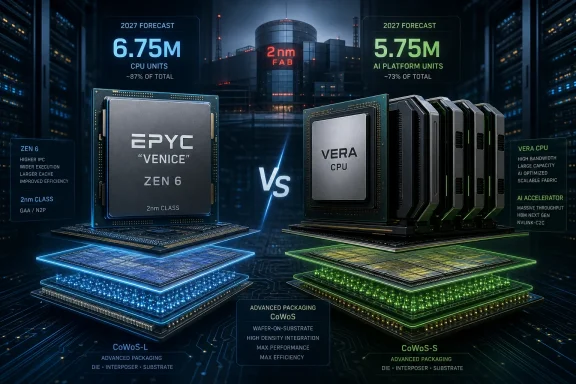
Morgan Stanley reportedly expects AMD’s Zen 6-based EPYC “Venice” server CPU to reach 6.75 million units in 2027, outshipping Nvidia’s Vera CPU at 5.75 million units, even as Nvidia remains TSMC’s largest advanced-packaging customer for AI accelerators and related silicon. That is the sort of forecast that looks, at first glance, like a simple horse race between two chip vendors. It is not. The more interesting story is that CPUs, once treated as supporting actors in the AI boom, are being pulled back into the center of the data-center economy.
For most of the generative AI boom, the market’s shorthand has been brutally simple: GPUs mattered, everything else fed the GPUs. Nvidia’s H100, Blackwell, and Rubin families became the units of scarcity, the objects around which power budgets, capital spending, networking fabrics, and cloud roadmaps were organized. CPUs were necessary, but rarely glamorous.
The Morgan Stanley numbers reported by Wccftech point to a more complicated next act. If AMD Venice really reaches 6.75 million units in 2027 while Nvidia Vera reaches 5.75 million, the data-center CPU is no longer just the host processor sitting quietly next to the expensive accelerator. It is becoming a contested, high-volume, advanced-packaging product in its own right.
That shift matters because the AI rack is changing. Training clusters and inference farms are no longer merely collections of accelerators bolted to conventional server platforms. The most ambitious systems are rack-scale machines with custom interconnects, tightly coupled memory hierarchies, and CPUs chosen not just for general-purpose compute but for how well they keep accelerators busy.
Nvidia understands this, which is why Vera exists. AMD understands it too, which is why Venice is being positioned not just as another EPYC generation but as a 2nm Zen 6 platform for AI, HPC, and conventional cloud workloads. The CPU is not dethroning the GPU. It is becoming too strategic to be ignored.
The caveat is important. These are forecasts, not shipment results, and they reportedly derive from CoWoS consumption assumptions rather than public vendor shipment disclosures. Analyst models can be directionally useful while still being wrong in the details, especially in a market where capacity, yield, customer pull-ins, export controls, and hyperscaler build schedules can all move quickly.
Still, the forecast is meaningful because it captures where the industry expects demand to form. Nvidia’s Vera is not a hobby project. The company has presented it as a CPU purpose-built for agentic AI and reinforcement learning, and it has said Vera is in full production with partner availability in the second half of 2026. A 5.75 million-unit forecast for a new CPU line would be huge.
That makes the AMD number more striking. EPYC Venice is not merely expected to sell into AI racks; it is expected to carry AMD’s broader server franchise forward. Cloud vendors, enterprise server makers, HPC centers, and AI infrastructure builders all know what EPYC is. Nvidia has to establish Vera as a CPU platform; AMD is extending one that has already spent years taking share from Intel.
CoWoS, TSMC’s chip-on-wafer-on-substrate advanced-packaging family, has become one of the defining bottlenecks of the AI era. High-end accelerators need advanced packaging to tie compute dies, HBM memory, and interposers into workable products. Whoever books that capacity early and at scale shapes what the rest of the market can build.
Nvidia’s CoWoS-L demand for Blackwell and Rubin-class AI GPUs is reportedly expected to reach around 910,000 units in 2027, up roughly 40 percent year over year. Vera, meanwhile, is tied to CoWoS-R in the report’s framing. The point is not just that Nvidia buys a lot from TSMC; it is that Nvidia’s product architecture has turned advanced packaging into a strategic supply chain weapon.
This is where the CPU volume comparison can be misleading if read too narrowly. AMD may outship Vera in CPUs, but Nvidia’s GPU platforms continue to command the premium economics of AI compute. Nvidia’s leverage comes from owning the accelerator, the networking story, the software stack, and increasingly the rack-level architecture.
AMD’s opportunity is different. It does not need Venice to beat Nvidia’s entire platform. It needs Venice to make AMD unavoidable in the parts of the AI and HPC market where open server choice, x86 continuity, and mixed workloads still matter.
EPYC’s rise has been one of the most consequential server stories of the last decade. AMD went from near-irrelevance in data-center CPUs to a credible, often preferred, alternative to Intel Xeon. It did so by offering more cores, aggressive platform economics, and a steady cadence from Naples through Rome, Milan, Genoa, Bergamo, Siena, and Turin.
Venice has to extend that run into a harsher environment. The server CPU market is no longer just an AMD-versus-Intel contest over sockets in cloud and enterprise servers. It now includes Nvidia’s Arm-based data-center CPU ambitions, cloud provider internal silicon, and rack-scale AI systems where the CPU may be specified as part of a complete vendor-controlled platform.
That is why the unit forecast is more than bragging rights. If Venice really grows from roughly 1.25 million units in 2026 to 6.75 million in 2027, as the reported Morgan Stanley model suggests, AMD would be preserving scale at precisely the moment competitors are trying to redefine the server around proprietary AI systems. Scale keeps OEMs engaged, keeps platform validation broad, and keeps software vendors honest.
Vera gives Nvidia more control over the CPU side of the equation. It lets the company optimize the host processor around its accelerator roadmap, its interconnects, and its own notion of what agentic AI workloads require. It also gives Nvidia a way to capture more silicon value per rack.
This does not mean Vera needs to conquer the entire general-purpose server CPU market. Nvidia’s target is narrower and potentially more lucrative: the AI systems where the company already has enormous influence over the bill of materials. If a customer is buying Rubin-scale infrastructure, Nvidia can make a strong argument that the CPU should be Vera because the entire platform was designed together.
AMD’s challenge is to prevent that logic from becoming universal. EPYC has historically benefited from being the flexible, high-performance x86 option that customers can deploy across many workloads. Venice must preserve that advantage while also proving it can play in AI-heavy systems where the buying decision is increasingly made at rack scale rather than server scale.
Modern high-end silicon performance is not determined by process node alone. Packaging, memory bandwidth, interconnect topology, firmware, compilers, thermals, and workload placement all matter. A CPU built on a denser node can still be constrained by platform memory or I/O. A CPU built on a less aggressive node can still win in a rack-level design if the system around it is better integrated.
This is why CoWoS sits underneath the entire story. Advanced packaging is no longer a backend manufacturing detail; it is a front-line determinant of product availability. Nvidia’s GPU roadmap has already trained the market to think in terms of packaging capacity. Now CPUs are entering the same conversation.
That should worry anyone hoping for a quick normalization of AI infrastructure supply. If CPUs, GPUs, custom accelerators, and networking silicon all compete for advanced packaging, the bottleneck does not disappear. It migrates. The industry may find itself with plenty of demand, ambitious product roadmaps, and a stubbornly finite ability to package the most valuable chips.
The reason is obvious. At sufficient scale, the cost of being dependent on external accelerators becomes enormous. Hyperscalers want chips tuned to their workloads, their power envelopes, their data-center designs, and their software stacks. They also want negotiating leverage against suppliers whose products have become strategically indispensable.
Google’s TPU program showed long ago that internal AI silicon can be more than a science project. Amazon’s Trainium and Inferentia efforts reflect the same impulse inside AWS. Microsoft has its own silicon ambitions. OpenAI has reportedly pursued custom chip work because no company spending tens or hundreds of billions on compute wants to be permanently price-taker, allocation-taker, and roadmap-taker.
But custom silicon is not magic. Designing a competitive AI accelerator is hard; building the networking, software, compiler, memory, and manufacturing ecosystem around it is harder. Merchant suppliers survive because they amortize that complexity across many customers and many workloads. Nvidia in particular has turned ecosystem breadth into a moat that custom silicon cannot quickly copy.
For AMD, custom silicon is both threat and opening. If hyperscalers diversify away from Nvidia accelerators, AMD Instinct gets a chance. If those same hyperscalers build more of their own AI chips, AMD’s EPYC CPUs may still remain useful as general-purpose hosts, cloud processors, and infrastructure anchors. Venice’s volume forecast suggests that even in a world of custom accelerators, the standardized server CPU still has a large role.
That does not mean Intel is irrelevant. Xeon remains deeply entrenched in enterprises, cloud fleets, and software validation pipelines. Intel is also fighting to reestablish process leadership and revive its foundry ambitions. But the symbolic shift is hard to miss: the most heated CPU conversation in AI infrastructure is not centered on Santa Clara’s traditional server incumbent.
AMD’s EPYC franchise did the initial damage by exploiting Intel’s delays and platform stumbles. Nvidia’s Vera applies pressure from a different direction by making the CPU part of an AI platform stack rather than a standalone server procurement decision. Intel now has to compete against x86 continuity from AMD and vertical AI integration from Nvidia at the same time.
For WindowsForum readers, that matters even if the immediate products are data-center parts. Server silicon choices shape cloud pricing, enterprise infrastructure refresh cycles, virtualization economics, and eventually workstation and client roadmaps. The CPU battles in hyperscale data centers have a way of filtering down into the tools administrators and developers use every day.
That is why CPUs are resurfacing in the AI conversation. Not every part of an AI workflow belongs on an accelerator. Scheduling, networking, storage coordination, pre- and post-processing, security boundaries, database calls, and application logic all need general-purpose compute. As AI systems become more operational and less demo-like, those “boring” tasks become bottlenecks.
Nvidia’s claim for Vera is that it is designed for precisely this era. AMD’s counterclaim is less vertically packaged but potentially broader: Venice brings Zen 6, high core counts, a leading TSMC process, and the EPYC ecosystem into AI and HPC deployments that do not want to surrender their platform choices. One is a platform-control strategy; the other is an ecosystem-scale strategy.
The market may have room for both. Nvidia can win inside Nvidia-defined AI factories. AMD can win in heterogeneous infrastructure where customers want to mix accelerators, storage, networking, virtualization, and conventional cloud services. The 2027 unit comparison suggests that the latter category remains very large.
Cloud providers use server CPU economics to shape instance families. If Venice delivers the expected performance-per-watt and density improvements, it could influence the next generation of general-purpose, compute-optimized, and AI-adjacent cloud instances. That affects everything from Windows Server deployments to SQL Server workloads, CI/CD runners, virtual desktops, and AI-enabled enterprise applications.
For IT departments, the practical question will not be whether Zen 6 beats Vera in a synthetic benchmark. It will be whether the platforms built around these chips improve capacity, reliability, licensing efficiency, and predictable performance. A high-core-count EPYC server that runs existing x86 workloads well is a different proposition from a Vera-based AI rack optimized around Nvidia’s stack.
There is also a procurement angle. Enterprises have spent years learning how to diversify away from single-vendor infrastructure dependencies. The AI boom has pulled many organizations back toward Nvidia dependence because the software and hardware stack is so strong. AMD’s Venice volume, if it materializes, gives the market another source of high-end CPU capacity at a moment when buyers are desperate for options.
TSMC’s expected wafer capacity growth and CoWoS expansion are therefore not background details. They are macroeconomic inputs. If TSMC has enough capacity, the AI infrastructure buildout accelerates. If bottlenecks persist, vendors prioritize the highest-margin products, customers fight for allocation, and smaller buyers wait.
This is one reason the United States, Europe, Japan, and Taiwan have all treated semiconductor manufacturing as a strategic priority. The most advanced chips are not fungible commodities. They require years of process development, supplier coordination, packaging expertise, and customer co-design. You cannot simply move a 2nm CPU ramp or CoWoS-heavy GPU program to another fab on short notice.
AMD’s mention of future Venice production at TSMC’s Arizona facility is politically and strategically significant, but it should not be mistaken for immediate independence from Taiwan. Leading-edge capacity diversification is a process measured in years. In the meantime, the AI market remains highly exposed to TSMC’s execution.
Nvidia could exceed the Vera estimate if its rack-scale AI platforms ramp faster than expected. AMD could miss the Venice figure if customer qualification takes longer, if 2nm yields or packaging allocation become constraints, or if hyperscalers shift more aggressively toward internal silicon. The numbers are useful because they reveal expectations, not because they guarantee outcomes.
The best way to read the forecast is as a statement about strategic pressure. Nvidia is trying to make its CPU part of the default AI rack. AMD is trying to keep EPYC central to both AI and non-AI server infrastructure. TSMC is trying to feed both while expanding the advanced packaging base that now underwrites the entire boom.
For buyers, the uncertainty is itself a planning variable. The safest infrastructure strategy in 2027 may not be picking the winner early. It may be preserving optionality across x86 servers, accelerator vendors, cloud providers, and AI software stacks so that a single supply crunch or roadmap slip does not dictate the whole estate.
Nvidia’s lesson is different. Vera does not need to beat EPYC everywhere to be successful. If it becomes the preferred CPU inside Nvidia-defined AI racks, it strengthens the company’s grip on the most profitable infrastructure category in the market.
AMD’s risk is that the industry’s center of purchasing gravity moves from server platforms to complete AI factories. Nvidia’s risk is that customers resist total stack dependence and keep demanding open, heterogeneous infrastructure. Both risks can be true at the same time.
The next 18 months will test whether the AI boom standardizes around vertically integrated systems or remains a messy mix of merchant CPUs, GPUs, custom accelerators, and cloud-specific designs. The reported unit forecasts suggest messiness will survive.
The old data-center map had CPUs at the center and accelerators at the edge; the first AI boom inverted that picture so completely that GPUs seemed to become the whole story. The 2027 forecasts suggest a third map is emerging, one in which CPUs, GPUs, memory, packaging, networking, and software are fused into competing platform strategies. If AMD’s Venice reaches the volumes Morgan Stanley reportedly expects, it will prove that the open server CPU still has considerable force. If Nvidia’s Vera succeeds inside the company’s AI racks, it will prove that vertical integration is no longer optional at the high end. The winners will not be decided by one shipment forecast, but by who can turn scarce silicon into reliable, programmable, power-efficient infrastructure at global scale.
 The AI Server Is Becoming a CPU Story Again
For most of the generative AI boom, the market’s shorthand has been brutally simple: GPUs mattered, everything else fed the GPUs. Nvidia’s H100, Blackwell, and Rubin families became the units of scarcity, the objects around which power budgets, capital spending, networking fabrics, and cloud roadmaps were organized. CPUs were necessary, but rarely glamorous.The Morgan Stanley numbers reported by Wccftech point to a more complicated next act. If AMD Venice really reaches 6.75 million units in 2027 while Nvidia Vera reaches 5.75 million, the data-center CPU is no longer just the host processor sitting quietly next to the expensive accelerator. It is becoming a contested, high-volume, advanced-packaging product in its own right.
That shift matters because the AI rack is changing. Training clusters and inference farms are no longer merely collections of accelerators bolted to conventional server platforms. The most ambitious systems are rack-scale machines with custom interconnects, tightly coupled memory hierarchies, and CPUs chosen not just for general-purpose compute but for how well they keep accelerators busy.
Nvidia understands this, which is why Vera exists. AMD understands it too, which is why Venice is being positioned not just as another EPYC generation but as a 2nm Zen 6 platform for AI, HPC, and conventional cloud workloads. The CPU is not dethroning the GPU. It is becoming too strategic to be ignored.
Morgan Stanley’s Unit Forecast Reframes the Fight
The headline comparison is blunt: 6.75 million Venice units against 5.75 million Vera units in 2027, according to the report cited by Wccftech. That would put AMD roughly 17 percent ahead in this particular CPU volume race, despite Nvidia’s overwhelming leadership in AI accelerators and its expected position as TSMC’s largest customer for advanced packaging.The caveat is important. These are forecasts, not shipment results, and they reportedly derive from CoWoS consumption assumptions rather than public vendor shipment disclosures. Analyst models can be directionally useful while still being wrong in the details, especially in a market where capacity, yield, customer pull-ins, export controls, and hyperscaler build schedules can all move quickly.
Still, the forecast is meaningful because it captures where the industry expects demand to form. Nvidia’s Vera is not a hobby project. The company has presented it as a CPU purpose-built for agentic AI and reinforcement learning, and it has said Vera is in full production with partner availability in the second half of 2026. A 5.75 million-unit forecast for a new CPU line would be huge.
That makes the AMD number more striking. EPYC Venice is not merely expected to sell into AI racks; it is expected to carry AMD’s broader server franchise forward. Cloud vendors, enterprise server makers, HPC centers, and AI infrastructure builders all know what EPYC is. Nvidia has to establish Vera as a CPU platform; AMD is extending one that has already spent years taking share from Intel.
Nvidia Still Owns the Scarcity Layer
None of this means AMD is about to displace Nvidia as the center of gravity in AI infrastructure. The same Morgan Stanley framing reportedly says Nvidia remains TSMC’s largest customer for CoWoS capacity in 2027. That is the more important business reality.CoWoS, TSMC’s chip-on-wafer-on-substrate advanced-packaging family, has become one of the defining bottlenecks of the AI era. High-end accelerators need advanced packaging to tie compute dies, HBM memory, and interposers into workable products. Whoever books that capacity early and at scale shapes what the rest of the market can build.
Nvidia’s CoWoS-L demand for Blackwell and Rubin-class AI GPUs is reportedly expected to reach around 910,000 units in 2027, up roughly 40 percent year over year. Vera, meanwhile, is tied to CoWoS-R in the report’s framing. The point is not just that Nvidia buys a lot from TSMC; it is that Nvidia’s product architecture has turned advanced packaging into a strategic supply chain weapon.
This is where the CPU volume comparison can be misleading if read too narrowly. AMD may outship Vera in CPUs, but Nvidia’s GPU platforms continue to command the premium economics of AI compute. Nvidia’s leverage comes from owning the accelerator, the networking story, the software stack, and increasingly the rack-level architecture.
AMD’s opportunity is different. It does not need Venice to beat Nvidia’s entire platform. It needs Venice to make AMD unavoidable in the parts of the AI and HPC market where open server choice, x86 continuity, and mixed workloads still matter.
Venice Carries the Weight of AMD’s Server Credibility
AMD has confirmed that Venice is its next-generation EPYC processor, based on Zen 6 and ramping on TSMC’s 2nm-class process technology. The company has also described Venice as the first high-performance computing product to reach production on TSMC’s N2 node. That is not a small positioning claim.EPYC’s rise has been one of the most consequential server stories of the last decade. AMD went from near-irrelevance in data-center CPUs to a credible, often preferred, alternative to Intel Xeon. It did so by offering more cores, aggressive platform economics, and a steady cadence from Naples through Rome, Milan, Genoa, Bergamo, Siena, and Turin.
Venice has to extend that run into a harsher environment. The server CPU market is no longer just an AMD-versus-Intel contest over sockets in cloud and enterprise servers. It now includes Nvidia’s Arm-based data-center CPU ambitions, cloud provider internal silicon, and rack-scale AI systems where the CPU may be specified as part of a complete vendor-controlled platform.
That is why the unit forecast is more than bragging rights. If Venice really grows from roughly 1.25 million units in 2026 to 6.75 million in 2027, as the reported Morgan Stanley model suggests, AMD would be preserving scale at precisely the moment competitors are trying to redefine the server around proprietary AI systems. Scale keeps OEMs engaged, keeps platform validation broad, and keeps software vendors honest.
Vera Is Nvidia’s Bid to Stop Renting the Host CPU
Nvidia’s Vera is best understood as a strategic refusal to leave any important part of the AI rack to chance. For years, Nvidia GPUs have relied heavily on host CPUs from Intel and AMD. That arrangement worked fine when the GPU was a card inside a server. It becomes less comfortable when Nvidia is selling complete rack-scale systems.Vera gives Nvidia more control over the CPU side of the equation. It lets the company optimize the host processor around its accelerator roadmap, its interconnects, and its own notion of what agentic AI workloads require. It also gives Nvidia a way to capture more silicon value per rack.
This does not mean Vera needs to conquer the entire general-purpose server CPU market. Nvidia’s target is narrower and potentially more lucrative: the AI systems where the company already has enormous influence over the bill of materials. If a customer is buying Rubin-scale infrastructure, Nvidia can make a strong argument that the CPU should be Vera because the entire platform was designed together.
AMD’s challenge is to prevent that logic from becoming universal. EPYC has historically benefited from being the flexible, high-performance x86 option that customers can deploy across many workloads. Venice must preserve that advantage while also proving it can play in AI-heavy systems where the buying decision is increasingly made at rack scale rather than server scale.
Process Nodes Matter, but Packaging May Matter More
The reported contrast between AMD’s 2nm Venice and Nvidia’s 3nm or 5nm-class Vera details invites the usual process-node scoreboard. AMD can claim a cutting-edge manufacturing story with TSMC N2. Nvidia can claim a CPU tuned for its AI platform. Both claims are true enough, and neither tells the whole story.Modern high-end silicon performance is not determined by process node alone. Packaging, memory bandwidth, interconnect topology, firmware, compilers, thermals, and workload placement all matter. A CPU built on a denser node can still be constrained by platform memory or I/O. A CPU built on a less aggressive node can still win in a rack-level design if the system around it is better integrated.
This is why CoWoS sits underneath the entire story. Advanced packaging is no longer a backend manufacturing detail; it is a front-line determinant of product availability. Nvidia’s GPU roadmap has already trained the market to think in terms of packaging capacity. Now CPUs are entering the same conversation.
That should worry anyone hoping for a quick normalization of AI infrastructure supply. If CPUs, GPUs, custom accelerators, and networking silicon all compete for advanced packaging, the bottleneck does not disappear. It migrates. The industry may find itself with plenty of demand, ambitious product roadmaps, and a stubbornly finite ability to package the most valuable chips.
The Real Rival Is the Hyperscaler’s Own Silicon
Wccftech’s report rightly points beyond AMD and Nvidia to custom silicon. That is the shadow hanging over every merchant chip vendor in AI. OpenAI, Google, Amazon, Microsoft, Meta, and other large-scale buyers either already have internal silicon efforts or are widely reported to be exploring more of them.The reason is obvious. At sufficient scale, the cost of being dependent on external accelerators becomes enormous. Hyperscalers want chips tuned to their workloads, their power envelopes, their data-center designs, and their software stacks. They also want negotiating leverage against suppliers whose products have become strategically indispensable.
Google’s TPU program showed long ago that internal AI silicon can be more than a science project. Amazon’s Trainium and Inferentia efforts reflect the same impulse inside AWS. Microsoft has its own silicon ambitions. OpenAI has reportedly pursued custom chip work because no company spending tens or hundreds of billions on compute wants to be permanently price-taker, allocation-taker, and roadmap-taker.
But custom silicon is not magic. Designing a competitive AI accelerator is hard; building the networking, software, compiler, memory, and manufacturing ecosystem around it is harder. Merchant suppliers survive because they amortize that complexity across many customers and many workloads. Nvidia in particular has turned ecosystem breadth into a moat that custom silicon cannot quickly copy.
For AMD, custom silicon is both threat and opening. If hyperscalers diversify away from Nvidia accelerators, AMD Instinct gets a chance. If those same hyperscalers build more of their own AI chips, AMD’s EPYC CPUs may still remain useful as general-purpose hosts, cloud processors, and infrastructure anchors. Venice’s volume forecast suggests that even in a world of custom accelerators, the standardized server CPU still has a large role.
Intel Is the Missing Giant in This Particular Headline
It is notable how little Intel appears in the headline version of this story. For decades, a server CPU forecast of this magnitude would have been framed first around Intel. Now the drama is AMD versus Nvidia, with TSMC as the indispensable manufacturer and advanced packaging as the battlefield.That does not mean Intel is irrelevant. Xeon remains deeply entrenched in enterprises, cloud fleets, and software validation pipelines. Intel is also fighting to reestablish process leadership and revive its foundry ambitions. But the symbolic shift is hard to miss: the most heated CPU conversation in AI infrastructure is not centered on Santa Clara’s traditional server incumbent.
AMD’s EPYC franchise did the initial damage by exploiting Intel’s delays and platform stumbles. Nvidia’s Vera applies pressure from a different direction by making the CPU part of an AI platform stack rather than a standalone server procurement decision. Intel now has to compete against x86 continuity from AMD and vertical AI integration from Nvidia at the same time.
For WindowsForum readers, that matters even if the immediate products are data-center parts. Server silicon choices shape cloud pricing, enterprise infrastructure refresh cycles, virtualization economics, and eventually workstation and client roadmaps. The CPU battles in hyperscale data centers have a way of filtering down into the tools administrators and developers use every day.
Agentic AI Turns Boring Infrastructure Into Strategic Infrastructure
The phrase agentic AI has already been stretched by marketing departments, but the infrastructure implications are real. Agentic workloads tend to involve repeated planning, tool use, retrieval, code execution, validation, and feedback loops. That can mean more orchestration overhead, more data movement, and more mixed CPU-GPU work than a simple prompt-in, answer-out model suggests.That is why CPUs are resurfacing in the AI conversation. Not every part of an AI workflow belongs on an accelerator. Scheduling, networking, storage coordination, pre- and post-processing, security boundaries, database calls, and application logic all need general-purpose compute. As AI systems become more operational and less demo-like, those “boring” tasks become bottlenecks.
Nvidia’s claim for Vera is that it is designed for precisely this era. AMD’s counterclaim is less vertically packaged but potentially broader: Venice brings Zen 6, high core counts, a leading TSMC process, and the EPYC ecosystem into AI and HPC deployments that do not want to surrender their platform choices. One is a platform-control strategy; the other is an ecosystem-scale strategy.
The market may have room for both. Nvidia can win inside Nvidia-defined AI factories. AMD can win in heterogeneous infrastructure where customers want to mix accelerators, storage, networking, virtualization, and conventional cloud services. The 2027 unit comparison suggests that the latter category remains very large.
Windows and Enterprise IT Will Feel This Through the Cloud First
Most Windows enthusiasts will not buy an EPYC Venice or Nvidia Vera CPU directly. Even many enterprise administrators will encounter them indirectly through cloud instances, hosted AI services, virtualization platforms, and managed infrastructure. That does not make the story remote. It makes it infrastructural.Cloud providers use server CPU economics to shape instance families. If Venice delivers the expected performance-per-watt and density improvements, it could influence the next generation of general-purpose, compute-optimized, and AI-adjacent cloud instances. That affects everything from Windows Server deployments to SQL Server workloads, CI/CD runners, virtual desktops, and AI-enabled enterprise applications.
For IT departments, the practical question will not be whether Zen 6 beats Vera in a synthetic benchmark. It will be whether the platforms built around these chips improve capacity, reliability, licensing efficiency, and predictable performance. A high-core-count EPYC server that runs existing x86 workloads well is a different proposition from a Vera-based AI rack optimized around Nvidia’s stack.
There is also a procurement angle. Enterprises have spent years learning how to diversify away from single-vendor infrastructure dependencies. The AI boom has pulled many organizations back toward Nvidia dependence because the software and hardware stack is so strong. AMD’s Venice volume, if it materializes, gives the market another source of high-end CPU capacity at a moment when buyers are desperate for options.
The TSMC Dependency Keeps Getting Larger
The reported forecast also reinforces a less comfortable truth: the AI hardware boom is deeply dependent on TSMC. AMD Venice is ramping on TSMC 2nm. Nvidia’s most important accelerators and related platform silicon rely on TSMC manufacturing and advanced packaging. The world’s AI buildout is increasingly tied to a small number of facilities, process nodes, substrates, and packaging lines.TSMC’s expected wafer capacity growth and CoWoS expansion are therefore not background details. They are macroeconomic inputs. If TSMC has enough capacity, the AI infrastructure buildout accelerates. If bottlenecks persist, vendors prioritize the highest-margin products, customers fight for allocation, and smaller buyers wait.
This is one reason the United States, Europe, Japan, and Taiwan have all treated semiconductor manufacturing as a strategic priority. The most advanced chips are not fungible commodities. They require years of process development, supplier coordination, packaging expertise, and customer co-design. You cannot simply move a 2nm CPU ramp or CoWoS-heavy GPU program to another fab on short notice.
AMD’s mention of future Venice production at TSMC’s Arizona facility is politically and strategically significant, but it should not be mistaken for immediate independence from Taiwan. Leading-edge capacity diversification is a process measured in years. In the meantime, the AI market remains highly exposed to TSMC’s execution.
Forecasts Are Not Destiny, Especially in AI Hardware
There is a temptation to treat analyst shipment numbers as if they are scheduled train arrivals. They are not. A 2027 forecast in mid-2026 rests on assumptions about product readiness, customer demand, packaging allocation, macro conditions, power availability, export policy, and competitive responses.Nvidia could exceed the Vera estimate if its rack-scale AI platforms ramp faster than expected. AMD could miss the Venice figure if customer qualification takes longer, if 2nm yields or packaging allocation become constraints, or if hyperscalers shift more aggressively toward internal silicon. The numbers are useful because they reveal expectations, not because they guarantee outcomes.
The best way to read the forecast is as a statement about strategic pressure. Nvidia is trying to make its CPU part of the default AI rack. AMD is trying to keep EPYC central to both AI and non-AI server infrastructure. TSMC is trying to feed both while expanding the advanced packaging base that now underwrites the entire boom.
For buyers, the uncertainty is itself a planning variable. The safest infrastructure strategy in 2027 may not be picking the winner early. It may be preserving optionality across x86 servers, accelerator vendors, cloud providers, and AI software stacks so that a single supply crunch or roadmap slip does not dictate the whole estate.
The 2027 CPU Race Is Really a Platform Test
The most concrete lesson from the reported Morgan Stanley forecast is that AMD’s server CPU business still has room to scale, even under the shadow of Nvidia’s AI empire. Venice outshipping Vera would not make AMD the AI king. It would show that the data center remains pluralistic enough for a strong x86 CPU platform to thrive beside vertically integrated AI systems.Nvidia’s lesson is different. Vera does not need to beat EPYC everywhere to be successful. If it becomes the preferred CPU inside Nvidia-defined AI racks, it strengthens the company’s grip on the most profitable infrastructure category in the market.
AMD’s risk is that the industry’s center of purchasing gravity moves from server platforms to complete AI factories. Nvidia’s risk is that customers resist total stack dependence and keep demanding open, heterogeneous infrastructure. Both risks can be true at the same time.
The next 18 months will test whether the AI boom standardizes around vertically integrated systems or remains a messy mix of merchant CPUs, GPUs, custom accelerators, and cloud-specific designs. The reported unit forecasts suggest messiness will survive.
The Numbers That Should Stay on the Whiteboard
The forecast deserves attention, but it should be kept in perspective. These figures are most useful as signposts for how vendors and customers are allocating scarce manufacturing and packaging resources.- AMD’s EPYC Venice is reportedly forecast to reach 6.75 million units in 2027, compared with 5.75 million units for Nvidia’s Vera CPU.
- Nvidia is still expected to remain TSMC’s largest advanced-packaging customer, driven primarily by AI GPU platforms such as Blackwell and Rubin.
- Venice’s ramp on TSMC’s 2nm-class process gives AMD a leading-edge manufacturing story at a time when server CPUs are becoming more important to AI systems.
- Vera gives Nvidia a CPU designed around its own AI platform strategy rather than a general-purpose server market first.
- Custom silicon from hyperscalers remains the long-term threat that could pressure both AMD and Nvidia’s merchant silicon assumptions.
- Enterprise users will feel the impact mostly through cloud instance design, AI service pricing, server refresh economics, and platform availability.
The old data-center map had CPUs at the center and accelerators at the edge; the first AI boom inverted that picture so completely that GPUs seemed to become the whole story. The 2027 forecasts suggest a third map is emerging, one in which CPUs, GPUs, memory, packaging, networking, and software are fused into competing platform strategies. If AMD’s Venice reaches the volumes Morgan Stanley reportedly expects, it will prove that the open server CPU still has considerable force. If Nvidia’s Vera succeeds inside the company’s AI racks, it will prove that vertical integration is no longer optional at the high end. The winners will not be decided by one shipment forecast, but by who can turn scarce silicon into reliable, programmable, power-efficient infrastructure at global scale.
References
- Primary source: Wccftech
Published: Fri, 26 Jun 2026 01:05:00 GMT
AMD's EPYC Venice To Outpace NVIDIA's Vera CPUs With 6.75M Units by 2027, Morgan Stanley Says, as Zen 6 Eclipses a 5.75M Rival
NVIDIA is going to retain its top position as TSMC's biggest customer in 2027, but AMD EPYC Venice could outpace its Vera CPUs.wccftech.com
- Related coverage: ir.amd.com
AMD Announces Production Ramp of Next-Generation AMD EPYC Processor “Venice” on TSMC 2nm Process Technology :: Advanced Micro Devices, Inc. (AMD)
News Summary: AMD has begun production ramp of its 6th Gen AMD EPYC™ CPUs, codenamed “Venice,” marking a major milestone for the AMD and…...ir.amd.com - Related coverage: investor.nvidia.com
NVIDIA Corporation - NVIDIA Launches Vera CPU, Purpose-Built for Agentic AI
NVIDIA Vera CPU Delivers the Highest Performance and Energy Efficiency for Data Processing, AI Training and Agentic Inference at Scale News Summary: The NVIDIA Vera CPU delivers results with twice the efficiency and 50% faster than traditional CPUs. Customers collaborating with NVIDIA to deploy...investor.nvidia.com - Related coverage: tomshardware.com
AMD begins production ramp of 256-core EPYC Venice — first 2nm HPC chip claims 70% performance leap | Tom's Hardware
Intel's competing P-core Xeon won't arrive until 2027 at the earliest.www.tomshardware.com - Related coverage: fullstackevolved.com
AMD EPYC Venice (Zen 6, 256 Cores) Enters Volume Production on TSMC 2nm — First HPC CPU at This Node | FullStackEvolved
AMD's 6th-gen EPYC server processor is now in volume production at TSMC's 2nm fab, making it the first high-performance computing CPU at this node. Venice claims over 70% performance-per-watt improvement and 30% more thread density versus the current EPYC Turin generation.www.fullstackevolved.com - Related coverage: techshowup.com
AMD EPYC Venice 2nm Ramp Puts 256-Core Zen 6 Servers in Focus - Tech ShowUp
AMD’s EPYC Venice is now in production ramp on TSMC 2nm, making its 256-core Zen 6 design one of the most important server CPU stories to watch in 2026. techshowup.com
- Related coverage: news.metal.com
Morgan Stanley released a research report, forecasting that production - Shanghai Metals Market (SMM)
Morgan Stanley released a research report, forecasting that production of EPYC Venice processors will reach 6.75 million units in 2027, about 17% morenews.metal.com - Related coverage: rcrtech.com
AMD moves EPYC "Venice" to volume production
AMD's 6th Gen EPYC 'Venice' is in volume production on TSMC's 2nm node, scaling to 256 cores per socket and targeting agentic AI workloads in the data center.rcrtech.com - Related coverage: techspot.com
AMD Epyc 'Venice' will be built on TSMC's N2 node, 5th-gen Epyc to be fabbed in Arizona | TechSpot
Venice, built on AMD's upcoming Zen 6 microarchitecture, represents a major milestone in the company's data center roadmap and remains on track for release next year. While...www.techspot.com - Related coverage: pcgamer.com
AMD announces production ramp of first 2 nm CPUs as Intel teases 10A and 7A chip roadmap | PC Gamer
Moore's Law alive and kinda kicking…www.pcgamer.com - Related coverage: techradar.com
AMD doubles rack size for 2027 with Verano CPUs and 144 MI500 GPUs | TechRadar
AMD is focused on driving performance, efficiency and scalabilitywww.techradar.com