

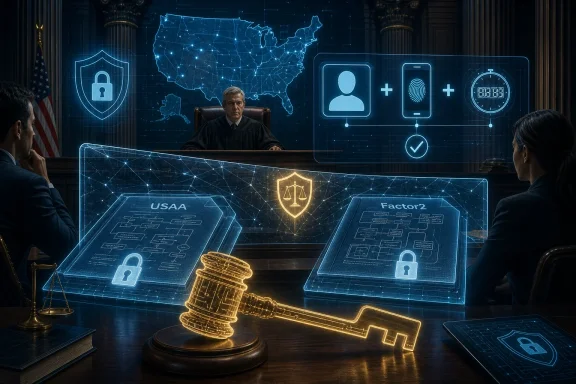
The US Court of Federal Claims dismissed Factor2 Multimedia Systems LLC’s 2024 patent infringement suit against the United States after finding that an earlier loss by inventors Nader and Kamran Asghari-Kamrani against USAA barred the company from relitigating related two-factor authentication patents. The ruling is narrow as law, but broad as a warning. In authentication, where the same architectural concepts reappear across banks, agencies, and consumer platforms, one adverse patent-eligibility decision can become a litigation sinkhole. The government did not merely win a motion; it turned a decade-old software-patent defeat into a shield for modern federal login systems.
Factor2’s case looked, at first glance, like a familiar modern patent dispute: a company asserting authentication patents against a large institution that allegedly used similar login-security workflows. The twist was the defendant. Rather than suing another bank or platform operator, Factor2 sued the United States in the Court of Federal Claims, targeting government use of authentication systems associated with the Patent and Trademark Office and other agencies.
That venue matters. Patent suits against the federal government are not ordinary infringement cases in district court; they are compensation claims against the United States under a specialized statutory route. The government cannot be enjoined in the same practical way a private company might be, and the remedy is generally monetary compensation rather than a halt to public systems.
But the case never reached the point where those remedies mattered. Judge Robin M. Meriweather concluded that Factor2 was precluded from litigating the asserted patents because the core dispute had already been decided against the same inventors in earlier litigation. In plainer English: the court saw the new six-patent case as another run at an old loss.
That is the legal doctrine doing the heavy lifting here. Preclusion is not glamorous, and it is not usually the part of patent law that gets technologists’ attention. Yet it is often where litigation campaigns go to die, because courts are reluctant to let a party keep repackaging the same underlying dispute after a final defeat.
The Virginia court’s reasoning went to the heart of the claimed invention. It characterized the patent as being directed to the abstract idea of using a third party and a time-sensitive code to confirm a participant’s identity in a transaction. The fact that the process happened in an electronic or Internet setting did not save it.
That was devastating because two-factor authentication, in its everyday form, often looks conceptually simple: one system asks for identity proof, another channel supplies a temporary code or confirmation, and a central service decides whether the user should proceed. The technical implementation may be complicated, but patent law asks a different question. It asks whether the claim protects a specific technological improvement or merely captures an old verification idea performed with generic computers.
The old USAA case answered that question unfavorably for the inventors. The Court of Federal Claims appears to have treated the later Factor2 patents as close enough relatives that the earlier eligibility defeat could not be ignored. For Factor2, the problem was not only that one patent had failed; it was that the family resemblance among the patents made the failure contagious.
Authentication patents live in a danger zone under that test. The security industry has spent decades turning familiar trust concepts into software workflows: passwords, tokens, second devices, trusted intermediaries, risk scoring, push approvals, and short-lived codes. Some of those implementations may be technically novel, but claims written at a high level can sound like “verify a user through another trusted party,” which courts often view as abstraction rather than invention.
That distinction frustrates inventors, especially those who believe they anticipated later industry-standard behavior. It also protects the public from patents that would tax basic security hygiene. If a patent effectively covers the act of confirming identity with a second factor, the burden would fall not just on one defendant but on almost every bank, cloud provider, agency, and consumer service that has adopted modern login protections.
This is why the Factor2 dispute matters to WindowsForum readers even though it did not involve Microsoft or Windows directly. Two-factor authentication is now a baseline security expectation across Microsoft accounts, Entra ID deployments, remote access systems, banking portals, and government services. If broad 2FA patent theories were easy to enforce, the downstream cost and uncertainty would ripple through the same identity stack administrators are trying to harden.
A Virginia federal court rejected that constitutional theory earlier this year. The court reasoned that any institutional interest the PTO had in the outcome of the government infringement case was too remote to create a due-process problem, and that the PTO remained the body Congress assigned to conduct reexaminations. In other words, the agency’s dual proximity to patent rights and federal systems was awkward, but not legally disqualifying.
That background helps explain why Factor2’s campaign was more than a single damages suit. It involved infringement allegations, reexamination fights, and constitutional arguments about agency neutrality. The company was not simply asking whether the government used a claimed authentication method; it was also challenging the machinery that could weaken or invalidate the patents while the infringement case was pending.
The courts have been unmoved. That matters because patent owners often try to manage parallel tracks: district court or claims court infringement litigation on one side, PTO validity proceedings on the other. Factor2’s attempt to frame that parallelism as an unconstitutional conflict ran into a basic institutional reality: the patent system is designed to let different proceedings move at once, even when the same patent family is under pressure from multiple directions.
But patent litigation still affects the ecosystem in which those tools are built. Vendors price legal risk into products. Smaller companies may hesitate to implement common security flows if they fear being dragged into litigation. Larger platforms may win, but only after years of expense. Government agencies have additional exposure because their systems are public, their procurement processes are documented, and their authentication flows are often visible to citizens and contractors.
The Factor2 dismissal reduces one slice of that risk. It does not invalidate every authentication patent, and it does not mean every 2FA-related claim is doomed. It does suggest that courts will scrutinize attempts to revive broad authentication theories after a closely related patent has already failed under Alice.
That is good news for the normalization of strong authentication. The security industry has spent years trying to move users away from passwords alone and toward hardware keys, app-based approvals, passkeys, certificate-backed access, and phishing-resistant identity systems. The last thing that migration needs is a thicket of broad patents claiming ownership over the general idea of a second proof point.
But the same family relationship can become a liability. If a court concludes that the underlying inventive concept is the same, an earlier invalidity or ineligibility ruling can follow the family into later cases. That is especially true when the later patents use similar specifications, similar titles, and similar claim architecture.
Factor2 asserted six patents, including patents titled around “Direct Authentication System and Method Via Trusted Authenticators” and “Centralized Identification and Authentication System and Method.” The company’s complaint presented them as distinct issued rights. The government, however, successfully persuaded the court that the earlier USAA loss over a related patent was not a historical footnote but a legal barrier.
That is the larger litigation lesson. A portfolio is not automatically stronger because it has more patents. If the patents rise and fall on the same abstract idea, more paper may simply create more targets for the same preclusion argument.
Courts are not supposed to decide patent eligibility by asking whether a technology is socially useful. Yet the effect of these decisions is undeniably practical. When broad claims over routine authentication logic fail, implementers get more room to deploy familiar security patterns without negotiating around patents that read like ownership claims over common sense.
That does not mean all authentication innovation is unpatentable. A specific cryptographic protocol, hardware-backed architecture, device-binding technique, or novel anti-phishing mechanism may present a different case. The key is specificity. Patent law is more hospitable to claims that improve how computers or networks operate than to claims that describe a desired trust outcome and assign the work to generic systems.
For administrators, that distinction mirrors real security practice. “Turn on 2FA” is not a complete architecture. The details matter: whether the factor is phishable, whether recovery flows are hardened, whether device trust is meaningful, whether logs are actionable, and whether privileged accounts require stronger controls. Patent law, at its best, is also supposed to care about the details.
That is particularly important in sectors where nearly every major actor uses similar workflows. Banking, cloud identity, federal portals, insurance systems, and mobile platforms all rely on layered authentication. A plaintiff that loses against one major financial institution might be tempted to pursue others under related patents. Preclusion doctrine is one way courts prevent that campaign from becoming endless.
The result also shows why early Alice motions remain powerful. A dismissal with prejudice at the beginning of a case can shape the fate of later litigation years afterward. Patent owners often prefer to argue claim construction, infringement details, and expert-heavy factual disputes; defendants often push eligibility early because it can end the case before discovery becomes expensive.
In the Factor2 story, the early loss against USAA became the foundation for the government’s later defense. That is a brutal reminder that software-patent litigation has a long memory. A plaintiff may view each new case as a fresh enforcement action, but courts may see a single unresolved attempt to patent an abstract authentication idea.
A successful broad infringement theory against the government’s use of 2FA could have created an awkward precedent. It might not have stopped agencies from using authentication systems, but it could have invited compensation claims around security features that are now standard. That would be a strange outcome: the government would be financially penalized for adopting the kind of login protection it often urges others to use.
The dismissal avoids that outcome, at least for this patent family. It also underscores why public-sector technology policy cannot be separated from patent doctrine. A federal agency’s security posture depends not only on budgets, procurement rules, and technical standards, but also on the legal environment around widely deployed software patterns.
For the broader market, the case offers reassurance without total certainty. Patent assertions around authentication will continue, and some will involve more specific claims than Factor2’s. But courts have shown a consistent skepticism toward claims that try to monopolize old trust relationships merely because the trust is mediated by computers.
 A Patent Case About 2FA Became a Case About Finality
Factor2’s case looked, at first glance, like a familiar modern patent dispute: a company asserting authentication patents against a large institution that allegedly used similar login-security workflows. The twist was the defendant. Rather than suing another bank or platform operator, Factor2 sued the United States in the Court of Federal Claims, targeting government use of authentication systems associated with the Patent and Trademark Office and other agencies.That venue matters. Patent suits against the federal government are not ordinary infringement cases in district court; they are compensation claims against the United States under a specialized statutory route. The government cannot be enjoined in the same practical way a private company might be, and the remedy is generally monetary compensation rather than a halt to public systems.
But the case never reached the point where those remedies mattered. Judge Robin M. Meriweather concluded that Factor2 was precluded from litigating the asserted patents because the core dispute had already been decided against the same inventors in earlier litigation. In plainer English: the court saw the new six-patent case as another run at an old loss.
That is the legal doctrine doing the heavy lifting here. Preclusion is not glamorous, and it is not usually the part of patent law that gets technologists’ attention. Yet it is often where litigation campaigns go to die, because courts are reluctant to let a party keep repackaging the same underlying dispute after a final defeat.
The USAA Loss Cast a Long Shadow
The earlier case involved Nader and Kamran Asghari-Kamrani’s infringement claims against USAA over a related patent, US Patent No. 8,266,432. In 2016, a federal court in Virginia dismissed the case with prejudice after finding the asserted claims patent-ineligible under the Supreme Court’s Alice framework. That doctrine has become the central weapon against broad software and business-method patents.The Virginia court’s reasoning went to the heart of the claimed invention. It characterized the patent as being directed to the abstract idea of using a third party and a time-sensitive code to confirm a participant’s identity in a transaction. The fact that the process happened in an electronic or Internet setting did not save it.
That was devastating because two-factor authentication, in its everyday form, often looks conceptually simple: one system asks for identity proof, another channel supplies a temporary code or confirmation, and a central service decides whether the user should proceed. The technical implementation may be complicated, but patent law asks a different question. It asks whether the claim protects a specific technological improvement or merely captures an old verification idea performed with generic computers.
The old USAA case answered that question unfavorably for the inventors. The Court of Federal Claims appears to have treated the later Factor2 patents as close enough relatives that the earlier eligibility defeat could not be ignored. For Factor2, the problem was not only that one patent had failed; it was that the family resemblance among the patents made the failure contagious.
Alice Still Haunts Authentication Patents
The Alice decision did not make software patents impossible, but it made broad software patents much harder to enforce. Courts now ask whether a claim is directed to an abstract idea and, if so, whether it adds an inventive concept sufficient to transform that idea into patent-eligible subject matter. Generic computer implementation rarely does the trick.Authentication patents live in a danger zone under that test. The security industry has spent decades turning familiar trust concepts into software workflows: passwords, tokens, second devices, trusted intermediaries, risk scoring, push approvals, and short-lived codes. Some of those implementations may be technically novel, but claims written at a high level can sound like “verify a user through another trusted party,” which courts often view as abstraction rather than invention.
That distinction frustrates inventors, especially those who believe they anticipated later industry-standard behavior. It also protects the public from patents that would tax basic security hygiene. If a patent effectively covers the act of confirming identity with a second factor, the burden would fall not just on one defendant but on almost every bank, cloud provider, agency, and consumer service that has adopted modern login protections.
This is why the Factor2 dispute matters to WindowsForum readers even though it did not involve Microsoft or Windows directly. Two-factor authentication is now a baseline security expectation across Microsoft accounts, Entra ID deployments, remote access systems, banking portals, and government services. If broad 2FA patent theories were easy to enforce, the downstream cost and uncertainty would ripple through the same identity stack administrators are trying to harden.
The Government’s Odd Role Made the Case More Interesting
There is a certain irony in suing the Patent and Trademark Office for patent infringement. The agency grants patents, examines patents, and reexamines patents, but here it was also part of the government apparatus accused of using patented authentication technology without permission. Factor2 leaned into that tension in related litigation, arguing that the PTO could not neutrally reexamine patents while the United States was also defending against infringement claims involving those patents.A Virginia federal court rejected that constitutional theory earlier this year. The court reasoned that any institutional interest the PTO had in the outcome of the government infringement case was too remote to create a due-process problem, and that the PTO remained the body Congress assigned to conduct reexaminations. In other words, the agency’s dual proximity to patent rights and federal systems was awkward, but not legally disqualifying.
That background helps explain why Factor2’s campaign was more than a single damages suit. It involved infringement allegations, reexamination fights, and constitutional arguments about agency neutrality. The company was not simply asking whether the government used a claimed authentication method; it was also challenging the machinery that could weaken or invalidate the patents while the infringement case was pending.
The courts have been unmoved. That matters because patent owners often try to manage parallel tracks: district court or claims court infringement litigation on one side, PTO validity proceedings on the other. Factor2’s attempt to frame that parallelism as an unconstitutional conflict ran into a basic institutional reality: the patent system is designed to let different proceedings move at once, even when the same patent family is under pressure from multiple directions.
For IT, the Practical Lesson Is About Platform Risk
The average administrator does not read patent opinions before enabling multifactor authentication. Nor should they. Security teams deploy 2FA because credential theft is rampant, phishing kits are effective, and single-factor passwords remain one of the weakest links in enterprise defense.But patent litigation still affects the ecosystem in which those tools are built. Vendors price legal risk into products. Smaller companies may hesitate to implement common security flows if they fear being dragged into litigation. Larger platforms may win, but only after years of expense. Government agencies have additional exposure because their systems are public, their procurement processes are documented, and their authentication flows are often visible to citizens and contractors.
The Factor2 dismissal reduces one slice of that risk. It does not invalidate every authentication patent, and it does not mean every 2FA-related claim is doomed. It does suggest that courts will scrutinize attempts to revive broad authentication theories after a closely related patent has already failed under Alice.
That is good news for the normalization of strong authentication. The security industry has spent years trying to move users away from passwords alone and toward hardware keys, app-based approvals, passkeys, certificate-backed access, and phishing-resistant identity systems. The last thing that migration needs is a thicket of broad patents claiming ownership over the general idea of a second proof point.
The Patent Family Strategy Cuts Both Ways
Patent families are often useful for inventors. A family can include continuations, refinements, different claim scopes, and later-issued patents that adapt the disclosure to different implementations. In litigation, that gives a patent owner options: if one claim set is too narrow, another may be broader; if one patent expires sooner, another may still be enforceable.But the same family relationship can become a liability. If a court concludes that the underlying inventive concept is the same, an earlier invalidity or ineligibility ruling can follow the family into later cases. That is especially true when the later patents use similar specifications, similar titles, and similar claim architecture.
Factor2 asserted six patents, including patents titled around “Direct Authentication System and Method Via Trusted Authenticators” and “Centralized Identification and Authentication System and Method.” The company’s complaint presented them as distinct issued rights. The government, however, successfully persuaded the court that the earlier USAA loss over a related patent was not a historical footnote but a legal barrier.
That is the larger litigation lesson. A portfolio is not automatically stronger because it has more patents. If the patents rise and fall on the same abstract idea, more paper may simply create more targets for the same preclusion argument.
The Decision Reinforces a Security Commons
There is an uncomfortable tension at the center of software-patent policy. Inventors deserve protection for genuine technical advances, including in security. At the same time, the Internet depends on common defensive practices spreading quickly and cheaply. Authentication is not a luxury feature; it is public infrastructure.Courts are not supposed to decide patent eligibility by asking whether a technology is socially useful. Yet the effect of these decisions is undeniably practical. When broad claims over routine authentication logic fail, implementers get more room to deploy familiar security patterns without negotiating around patents that read like ownership claims over common sense.
That does not mean all authentication innovation is unpatentable. A specific cryptographic protocol, hardware-backed architecture, device-binding technique, or novel anti-phishing mechanism may present a different case. The key is specificity. Patent law is more hospitable to claims that improve how computers or networks operate than to claims that describe a desired trust outcome and assign the work to generic systems.
For administrators, that distinction mirrors real security practice. “Turn on 2FA” is not a complete architecture. The details matter: whether the factor is phishable, whether recovery flows are hardened, whether device trust is meaningful, whether logs are actionable, and whether privileged accounts require stronger controls. Patent law, at its best, is also supposed to care about the details.
The Ruling Leaves Less Room for Patent Recycling
Factor2’s defeat is not just a win for the government; it is a signal to repeat patent plaintiffs in the software space. Courts may tolerate new defendants, new accused systems, and newly issued patents, but they are less tolerant of recycled eligibility theories. Once the essential claim concept has been judged abstract, the next complaint has to show more than a different caption and a longer patent list.That is particularly important in sectors where nearly every major actor uses similar workflows. Banking, cloud identity, federal portals, insurance systems, and mobile platforms all rely on layered authentication. A plaintiff that loses against one major financial institution might be tempted to pursue others under related patents. Preclusion doctrine is one way courts prevent that campaign from becoming endless.
The result also shows why early Alice motions remain powerful. A dismissal with prejudice at the beginning of a case can shape the fate of later litigation years afterward. Patent owners often prefer to argue claim construction, infringement details, and expert-heavy factual disputes; defendants often push eligibility early because it can end the case before discovery becomes expensive.
In the Factor2 story, the early loss against USAA became the foundation for the government’s later defense. That is a brutal reminder that software-patent litigation has a long memory. A plaintiff may view each new case as a fresh enforcement action, but courts may see a single unresolved attempt to patent an abstract authentication idea.
The Narrow Order Carries a Broad Message for Federal Tech
Federal systems increasingly look like enterprise systems because they face the same threats. Agencies operate identity portals, public-facing services, internal authentication stacks, contractor access workflows, and cloud-integrated applications. They use 2FA because the alternative is unacceptable.A successful broad infringement theory against the government’s use of 2FA could have created an awkward precedent. It might not have stopped agencies from using authentication systems, but it could have invited compensation claims around security features that are now standard. That would be a strange outcome: the government would be financially penalized for adopting the kind of login protection it often urges others to use.
The dismissal avoids that outcome, at least for this patent family. It also underscores why public-sector technology policy cannot be separated from patent doctrine. A federal agency’s security posture depends not only on budgets, procurement rules, and technical standards, but also on the legal environment around widely deployed software patterns.
For the broader market, the case offers reassurance without total certainty. Patent assertions around authentication will continue, and some will involve more specific claims than Factor2’s. But courts have shown a consistent skepticism toward claims that try to monopolize old trust relationships merely because the trust is mediated by computers.
The Signal Under the Courtroom Noise
The most concrete reading of the case is simple: Factor2 lost because the courts had already rejected a closely related authentication patent theory. The broader reading is more consequential for technologists.- The Court of Federal Claims treated the earlier USAA patent-eligibility defeat as a barrier to Factor2’s later six-patent suit against the United States.
- The asserted patents concerned two-factor authentication and trusted-authenticator concepts used in modern login systems.
- The earlier Virginia ruling described the related patent as an abstract identity-confirmation idea implemented with computers, not a patentable improvement to computer technology.
- Factor2’s related challenges to PTO reexamination activity also failed, weakening its attempt to frame the agency’s role as constitutionally conflicted.
- The decision strengthens the practical freedom of agencies and platforms to deploy ordinary multifactor authentication without facing this particular patent campaign.
- The ruling does not kill all authentication patents, but it raises the cost of enforcing broad claims tied to the same abstract concept after an earlier loss.
References
- Primary source: Bloomberg Law News
Published: 2026-06-26T21:50:14.541089
Loading…
news.bloomberglaw.com - Related coverage: patsnap.com
Loading…
www.patsnap.com - Related coverage: unifiedpatents.com
Loading…
www.unifiedpatents.com - Related coverage: studicata.com
Loading…
www.studicata.com - Related coverage: dockets.justia.com
Loading…
dockets.justia.com