

On Friday, June 26, 2026, U.S. District Judge David J. Novak in the Eastern District of Virginia dismissed Toll Road Investors Partnership II’s federal lawsuit claiming Virginia regulators unconstitutionally forced the Dulles Greenway’s owners toward bankruptcy by denying requested toll increases. The ruling is not just another skirmish over a notoriously expensive 14-mile road in Northern Virginia. It is a warning to private infrastructure investors that rate regulation is not a constitutional escape hatch when traffic, debt, and public patience all move in the wrong direction. The Greenway’s owners wanted the courts to treat denied toll hikes as confiscation; Virginia successfully framed them as ordinary regulation in a market where the public interest still matters.
The Greenway lawsuit was built to sound existential. Toll Road Investors Partnership II argued that Virginia’s State Corporation Commission and state officials had boxed the private road into financial distress by refusing to approve higher tolls, allegedly violating the Takings Clause and the constitutional ban on bills of attainder. In the company’s telling, this was not merely a failed rate case; it was state policy aimed at destroying a specific private enterprise.
Judge Novak’s dismissal cut that theory down to pleading size. The court said the investors had not adequately alleged federal or state constitutional violations, and sovereign immunity barred several claims against SCC members. That matters because constitutional litigation often succeeds or fails not on political drama, but on whether the complaint can translate grievance into a legally cognizable injury.
For Virginia, the win preserves a regulatory posture that has been hardening for years. The SCC denied the Greenway’s 2023 rate application in September 2024, finding the proposed hikes contrary to the public interest under Virginia law. The Supreme Court of Virginia upheld that denial in July 2025, rejecting statutory and constitutional attacks on the commission’s decision.
The federal dismissal now gives the state a third layer of validation. It does not erase the Greenway’s financial problems, and it does not magically solve the broader transportation politics of Loudoun County. But it weakens the most aggressive argument available to the road’s owners: that refusing a toll increase is, in effect, an unconstitutional taking.
That private status is not trivia. Unlike many public-private partnership roads, the Greenway is regulated by the State Corporation Commission under a bespoke legal regime. The operator does not simply set prices like a parking garage owner; it must persuade regulators that its tolls satisfy statutory requirements, including whether they are reasonable and whether they discourage use of the road.
For investors, the model promised a long stream of revenue from a fast-growing suburb. For drivers, the value proposition was more brutal: pay more to save time, or sit on alternative routes. That bargain works only as long as enough drivers believe the time saved is worth the toll.
The problem is that toll roads are not software subscriptions. A company can raise the price of a cloud service and hope users grumble but stay locked in. A toll road faces daily, physical substitution. Drivers can reroute, carpool, shift hours, work from home, or simply decide the road is no longer worth the price. The SCC’s public-interest analysis has increasingly treated that behavioral reality as central rather than incidental.
That public reaction mattered because Virginia law had changed the terrain. A 2021 statute associated with then-state Delegate Suhas Subramanyam sharpened the criteria the SCC had to apply, including whether toll increases would materially discourage use of the road. In other words, the commission was no longer looking only at the operator’s need for revenue; it also had to weigh whether higher prices would push drivers away.
That is the central paradox of the Greenway. The owners argued that higher tolls were necessary to stabilize the business. Regulators concluded that higher tolls could undermine the road’s usefulness and burden the public. Both positions can be true at once, which is why the dispute became so combustible.
A private toll road can be financially distressed even if its requested rates are socially undesirable. That distinction is uncomfortable for investors because it means capital structure does not dictate public policy. Debt obligations may explain why a company wants more revenue, but they do not automatically prove that drivers should supply it.
Courts are wary of that move. Rate-regulated businesses have long argued that denied price increases can become unconstitutional if rates are so low that they prevent a reasonable return. But that is a demanding claim, especially when the regulated entity is not being ordered to provide service for free and when the dispute concerns proposed future increases rather than a direct seizure of property.
The Greenway’s owners faced another problem: financial distress is not always the same as constitutional harm. A company can be overleveraged, unlucky, misforecast, or trapped by changed commuting patterns without the state having taken its property. The pandemic-era shift toward remote and hybrid work only complicates the picture, because commuter behavior changed across the region in ways no rate order created by itself.
That is why the dismissal is significant beyond this one road. It reinforces a boundary between bad investment outcomes and government takings. Investors may dislike that boundary, but infrastructure finance depends on it. If every denied rate hike could become a federal constitutional claim, utility and transportation regulation would become hostage to the most fragile balance sheet in the room.
Invoking that doctrine against Virginia’s Greenway regulation was a bold escalation. It suggested that the state had not merely updated toll-road rules, but had targeted one operator for punishment. That theory fit the company’s broader narrative: politicians responded to public anger over tolls by tightening the law around one unpopular road.
But constitutional law does not treat political specificity as automatic punishment. Legislatures often pass laws in response to a single visible problem, especially when the problem is unique. The Greenway is, by the operator’s own public description, unusual among Virginia toll roads because of its private ownership and SCC oversight. A law aimed at the only road fitting that category may be politically pointed without being an unconstitutional attainder.
The distinction matters for future regulation. If lawmakers could not adjust rules for a singular infrastructure asset without triggering bill-of-attainder litigation, then any one-off franchise, concession, utility, or regulated monopoly would become unusually insulated from reform. The court’s dismissal suggests that specificity alone is not enough; plaintiffs must plausibly plead punishment of the constitutional kind.
For regulated companies, naming individual commissioners can be a way to keep litigation alive when the state itself is immune. For states, immunity is a firewall against turning every administrative rate dispute into federal damages litigation. The Greenway case shows how quickly that firewall can narrow the battlefield.
This is not a complete shield for all state action. Federal courts can, in some circumstances, hear claims seeking prospective relief against officials who allegedly violate federal law. But the doctrine is technical, and plaintiffs must fit their claims carefully within its exceptions. TRIP II’s complaint did not persuade the court that enough of its case belonged there.
The result is that Virginia did not have to win every policy argument to win the case. It had to show that the lawsuit, as pleaded, could not proceed through the constitutional and immunity gates. That is a different kind of victory: less sweeping in rhetoric, more durable in litigation.
That is why the SCC’s “materially discourage” analysis is so powerful. A toll road whose price discourages use is not merely expensive; it may fail its transportation purpose. The Greenway exists to move traffic efficiently through a congested corridor. If the price climbs high enough that drivers abandon it for local roads, the public loses twice: once through higher costs for those who pay, and again through spillover congestion for those who do not.
This is where private infrastructure can diverge from public need. Investors want revenue per vehicle. The region needs mobility. Those goals overlap when pricing fills capacity without choking demand, but they split when the road becomes a premium product that too many commuters avoid.
The Greenway’s owners have long argued that they must recover costs and service obligations tied to the road. That may be true as a business reality. But regulators are not bankruptcy trustees for infrastructure investors. Their job is not to guarantee that a past financing model produces the desired return.
Part of the backlash comes from price visibility. Gas taxes and general transportation funding are diffuse; tolls are immediate and personal. A driver sees the charge, remembers the trip, and assigns blame. That makes toll roads politically brittle even when they are economically rational.
Another part comes from the asymmetry of risk. Private investors are invited to build or operate infrastructure because governments want capacity without immediate public borrowing. But when the revenue model strains, the public is often asked to absorb higher prices, renegotiated terms, or political pressure for a buyout. Voters understandably ask why private upside should become public pain.
The Greenway ruling does not settle that policy debate. It does, however, strengthen the state’s hand in saying no. That may encourage lawmakers and regulators elsewhere to be more assertive when private concessionaires argue that contract economics require unpopular price increases.
The question is who. In an investor-friendly model, users pay through toll increases or the public pays through subsidies and renegotiations. In a regulator-friendly model, investors absorb more of the downside. The Greenway case pushes toward the latter, at least for roads subject to public-interest rate review.
That may make private infrastructure capital more cautious. Investors will price in the possibility that regulators can deny rate relief even when the project is financially distressed. Future bids may demand stronger contractual protections, higher returns, or more explicit public backstops.
But caution is not necessarily bad. If infrastructure finance only works when courts constitutionalize revenue expectations, the model is weaker than advertised. Public-private partnerships should transfer some risk to private capital, not merely disguise public obligations until the bill comes due.
This restraint is important because rate disputes generate large records and competing expert models. A company can show revenue need; opponents can show demand suppression; staff can model alternatives. Turning every disagreement into federal constitutional litigation would reward the party most willing to escalate.
The Virginia Supreme Court’s 2025 decision already kept the core dispute inside the state regulatory system. Judge Novak’s ruling continues that pattern by refusing to let the federal complaint repackage the same conflict as constitutional wrongdoing. The combined effect is to tell TRIP II that its primary path runs through Virginia’s rate process, not around it.
That does not mean the operator is powerless. It can file new applications, present different evidence, seek legislative changes, negotiate structural alternatives, or pursue bankruptcy remedies if insolvency becomes unavoidable. What it cannot do, at least on the dismissed pleadings, is force a toll increase by claiming the Constitution requires one.
The bankruptcy backdrop also remains important. If the road or affiliated entities move deeper into restructuring, creditors and public officials will face hard choices about valuation, control, and future pricing. A distressed infrastructure asset can become a negotiation table where legal rights, political optics, and commuter frustration collide.
One possibility is continued private operation under tighter rate discipline. Another is some form of public acquisition, concession restructuring, or conversion into a different transportation model. None of those paths is simple, because the Greenway’s value depends heavily on the same toll assumptions now under dispute.
Virginia’s legal victory improves its bargaining position. The state can now point to the SCC, the Virginia Supreme Court, and a federal district court as evidence that denying the requested hikes was not unlawful. That does not eliminate the need for a practical solution, but it changes who enters the next round with leverage.
The Greenway dismissal shows the limits of that tactic. A regulated company must do more than allege financial pain. It must connect the government action to a recognized constitutional injury, overcome immunity barriers, and explain why public-interest regulation has become confiscation or punishment.
For IT pros and systems-minded readers, the analogy is familiar. A brittle architecture may run for years until demand patterns change, costs rise, and the old assumptions fail. The failure is real, but it does not mean the operating environment owes the architect a rollback. Infrastructure contracts, like enterprise systems, need resilience against changed conditions.
That is the uncomfortable truth behind the Greenway fight. The owners may be right that the economics are strained. Virginia may be right that the requested tolls are too burdensome. The court’s ruling says those tensions belong in regulation and restructuring, not necessarily in constitutional litigation.
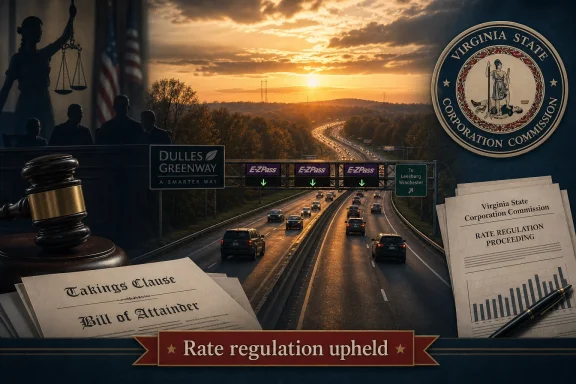 Virginia Wins by Making the Case Smaller
The Greenway lawsuit was built to sound existential. Toll Road Investors Partnership II argued that Virginia’s State Corporation Commission and state officials had boxed the private road into financial distress by refusing to approve higher tolls, allegedly violating the Takings Clause and the constitutional ban on bills of attainder. In the company’s telling, this was not merely a failed rate case; it was state policy aimed at destroying a specific private enterprise.Judge Novak’s dismissal cut that theory down to pleading size. The court said the investors had not adequately alleged federal or state constitutional violations, and sovereign immunity barred several claims against SCC members. That matters because constitutional litigation often succeeds or fails not on political drama, but on whether the complaint can translate grievance into a legally cognizable injury.
For Virginia, the win preserves a regulatory posture that has been hardening for years. The SCC denied the Greenway’s 2023 rate application in September 2024, finding the proposed hikes contrary to the public interest under Virginia law. The Supreme Court of Virginia upheld that denial in July 2025, rejecting statutory and constitutional attacks on the commission’s decision.
The federal dismissal now gives the state a third layer of validation. It does not erase the Greenway’s financial problems, and it does not magically solve the broader transportation politics of Loudoun County. But it weakens the most aggressive argument available to the road’s owners: that refusing a toll increase is, in effect, an unconstitutional taking.
The Greenway Was Always a Bet on Northern Virginia’s Future
The Dulles Greenway occupies a strange place in Virginia’s transportation map. It is a privately owned toll road connecting Leesburg and the Dulles Toll Road, a commuter artery that grew out of the late-20th-century belief that private capital could build public infrastructure faster than the state. It opened in 1995, before the full scale of Loudoun County’s population boom had arrived.That private status is not trivia. Unlike many public-private partnership roads, the Greenway is regulated by the State Corporation Commission under a bespoke legal regime. The operator does not simply set prices like a parking garage owner; it must persuade regulators that its tolls satisfy statutory requirements, including whether they are reasonable and whether they discourage use of the road.
For investors, the model promised a long stream of revenue from a fast-growing suburb. For drivers, the value proposition was more brutal: pay more to save time, or sit on alternative routes. That bargain works only as long as enough drivers believe the time saved is worth the toll.
The problem is that toll roads are not software subscriptions. A company can raise the price of a cloud service and hope users grumble but stay locked in. A toll road faces daily, physical substitution. Drivers can reroute, carpool, shift hours, work from home, or simply decide the road is no longer worth the price. The SCC’s public-interest analysis has increasingly treated that behavioral reality as central rather than incidental.
The Requested Toll Hikes Became a Political Exhibit
The rejected rate application was not small. TRIP II sought to raise most two-axle peak tolls from $5.80 to $8.10 and off-peak tolls from $5.25 to $6.40. In percentage terms, the peak increase approached 40 percent, which made it easy for opponents to frame the request as a commuter surcharge rather than a financing necessity.That public reaction mattered because Virginia law had changed the terrain. A 2021 statute associated with then-state Delegate Suhas Subramanyam sharpened the criteria the SCC had to apply, including whether toll increases would materially discourage use of the road. In other words, the commission was no longer looking only at the operator’s need for revenue; it also had to weigh whether higher prices would push drivers away.
That is the central paradox of the Greenway. The owners argued that higher tolls were necessary to stabilize the business. Regulators concluded that higher tolls could undermine the road’s usefulness and burden the public. Both positions can be true at once, which is why the dispute became so combustible.
A private toll road can be financially distressed even if its requested rates are socially undesirable. That distinction is uncomfortable for investors because it means capital structure does not dictate public policy. Debt obligations may explain why a company wants more revenue, but they do not automatically prove that drivers should supply it.
Bankruptcy Talk Changed the Optics, Not the Legal Standard
The company’s bankruptcy argument was designed to raise the stakes. If Virginia refused sufficient toll increases, the owners said, the state was effectively steering the road toward insolvency. The implication was that regulation had crossed the line from oversight into destruction.Courts are wary of that move. Rate-regulated businesses have long argued that denied price increases can become unconstitutional if rates are so low that they prevent a reasonable return. But that is a demanding claim, especially when the regulated entity is not being ordered to provide service for free and when the dispute concerns proposed future increases rather than a direct seizure of property.
The Greenway’s owners faced another problem: financial distress is not always the same as constitutional harm. A company can be overleveraged, unlucky, misforecast, or trapped by changed commuting patterns without the state having taken its property. The pandemic-era shift toward remote and hybrid work only complicates the picture, because commuter behavior changed across the region in ways no rate order created by itself.
That is why the dismissal is significant beyond this one road. It reinforces a boundary between bad investment outcomes and government takings. Investors may dislike that boundary, but infrastructure finance depends on it. If every denied rate hike could become a federal constitutional claim, utility and transportation regulation would become hostage to the most fragile balance sheet in the room.
The Bill of Attainder Theory Was the Lawsuit’s Sharpest Rhetorical Weapon
The bill of attainder claim was always the most dramatic part of the case. Bills of attainder are legislative acts that punish identifiable parties without a judicial trial. They are forbidden because the Constitution does not allow legislatures to single out enemies and impose punishment by statute.Invoking that doctrine against Virginia’s Greenway regulation was a bold escalation. It suggested that the state had not merely updated toll-road rules, but had targeted one operator for punishment. That theory fit the company’s broader narrative: politicians responded to public anger over tolls by tightening the law around one unpopular road.
But constitutional law does not treat political specificity as automatic punishment. Legislatures often pass laws in response to a single visible problem, especially when the problem is unique. The Greenway is, by the operator’s own public description, unusual among Virginia toll roads because of its private ownership and SCC oversight. A law aimed at the only road fitting that category may be politically pointed without being an unconstitutional attainder.
The distinction matters for future regulation. If lawmakers could not adjust rules for a singular infrastructure asset without triggering bill-of-attainder litigation, then any one-off franchise, concession, utility, or regulated monopoly would become unusually insulated from reform. The court’s dismissal suggests that specificity alone is not enough; plaintiffs must plausibly plead punishment of the constitutional kind.
Sovereign Immunity Did Quiet Work
The Eleventh Amendment portion of the ruling is less headline-friendly but just as consequential. Sovereign immunity limits suits against states and state officials in federal court, and Judge Novak concluded that it shielded SCC members from various claims. That is procedural doctrine with practical force.For regulated companies, naming individual commissioners can be a way to keep litigation alive when the state itself is immune. For states, immunity is a firewall against turning every administrative rate dispute into federal damages litigation. The Greenway case shows how quickly that firewall can narrow the battlefield.
This is not a complete shield for all state action. Federal courts can, in some circumstances, hear claims seeking prospective relief against officials who allegedly violate federal law. But the doctrine is technical, and plaintiffs must fit their claims carefully within its exceptions. TRIP II’s complaint did not persuade the court that enough of its case belonged there.
The result is that Virginia did not have to win every policy argument to win the case. It had to show that the lawsuit, as pleaded, could not proceed through the constitutional and immunity gates. That is a different kind of victory: less sweeping in rhetoric, more durable in litigation.
Commuters Are the Silent Party in Every Rate Case
The Greenway dispute is often described as a fight between Virginia and the road’s owners, but the missing protagonist is the driver. For Loudoun County commuters, the road is not a financial instrument or a constitutional test case. It is a recurring household expense paid in exchange for minutes.That is why the SCC’s “materially discourage” analysis is so powerful. A toll road whose price discourages use is not merely expensive; it may fail its transportation purpose. The Greenway exists to move traffic efficiently through a congested corridor. If the price climbs high enough that drivers abandon it for local roads, the public loses twice: once through higher costs for those who pay, and again through spillover congestion for those who do not.
This is where private infrastructure can diverge from public need. Investors want revenue per vehicle. The region needs mobility. Those goals overlap when pricing fills capacity without choking demand, but they split when the road becomes a premium product that too many commuters avoid.
The Greenway’s owners have long argued that they must recover costs and service obligations tied to the road. That may be true as a business reality. But regulators are not bankruptcy trustees for infrastructure investors. Their job is not to guarantee that a past financing model produces the desired return.
Northern Virginia’s Toll Politics Are Bigger Than One Road
The Dulles Greenway fight lands in a region already saturated with toll anxiety. Northern Virginia drivers know variable-rate express lanes, airport access roads, E-ZPass decisions, and the quiet arithmetic of whether saving 12 minutes is worth a painful charge. The Greenway is not the only toll road in the area, but it has become the cleanest symbol of the political backlash.Part of the backlash comes from price visibility. Gas taxes and general transportation funding are diffuse; tolls are immediate and personal. A driver sees the charge, remembers the trip, and assigns blame. That makes toll roads politically brittle even when they are economically rational.
Another part comes from the asymmetry of risk. Private investors are invited to build or operate infrastructure because governments want capacity without immediate public borrowing. But when the revenue model strains, the public is often asked to absorb higher prices, renegotiated terms, or political pressure for a buyout. Voters understandably ask why private upside should become public pain.
The Greenway ruling does not settle that policy debate. It does, however, strengthen the state’s hand in saying no. That may encourage lawmakers and regulators elsewhere to be more assertive when private concessionaires argue that contract economics require unpopular price increases.
The Public-Private Partnership Model Gets a Stress Test
The Greenway is older than many modern public-private partnership frameworks, but its current crisis speaks directly to them. These deals often rely on forecasts: traffic growth, revenue, development, inflation, work patterns, financing costs. When forecasts miss, someone pays.The question is who. In an investor-friendly model, users pay through toll increases or the public pays through subsidies and renegotiations. In a regulator-friendly model, investors absorb more of the downside. The Greenway case pushes toward the latter, at least for roads subject to public-interest rate review.
That may make private infrastructure capital more cautious. Investors will price in the possibility that regulators can deny rate relief even when the project is financially distressed. Future bids may demand stronger contractual protections, higher returns, or more explicit public backstops.
But caution is not necessarily bad. If infrastructure finance only works when courts constitutionalize revenue expectations, the model is weaker than advertised. Public-private partnerships should transfer some risk to private capital, not merely disguise public obligations until the bill comes due.
The Courts Are Refusing to Become Toll Boards
There is a broader institutional message in the dismissal: federal courts do not want to become super-regulators of toll policy. Judges can review constitutional claims, but they are poorly positioned to decide the optimal commuter price between Leesburg and Dulles. That job belongs to agencies and legislatures, subject to state-law review.This restraint is important because rate disputes generate large records and competing expert models. A company can show revenue need; opponents can show demand suppression; staff can model alternatives. Turning every disagreement into federal constitutional litigation would reward the party most willing to escalate.
The Virginia Supreme Court’s 2025 decision already kept the core dispute inside the state regulatory system. Judge Novak’s ruling continues that pattern by refusing to let the federal complaint repackage the same conflict as constitutional wrongdoing. The combined effect is to tell TRIP II that its primary path runs through Virginia’s rate process, not around it.
That does not mean the operator is powerless. It can file new applications, present different evidence, seek legislative changes, negotiate structural alternatives, or pursue bankruptcy remedies if insolvency becomes unavoidable. What it cannot do, at least on the dismissed pleadings, is force a toll increase by claiming the Constitution requires one.
The Next Greenway Fight Is Already About Leverage
Even after dismissal, the Greenway’s future remains unsettled. The owners have continued to seek higher toll authority, and local opposition remains fierce. A public hearing on a newer toll request was reportedly scheduled for June 29, 2026, underscoring that the litigation loss does not end the regulatory campaign.The bankruptcy backdrop also remains important. If the road or affiliated entities move deeper into restructuring, creditors and public officials will face hard choices about valuation, control, and future pricing. A distressed infrastructure asset can become a negotiation table where legal rights, political optics, and commuter frustration collide.
One possibility is continued private operation under tighter rate discipline. Another is some form of public acquisition, concession restructuring, or conversion into a different transportation model. None of those paths is simple, because the Greenway’s value depends heavily on the same toll assumptions now under dispute.
Virginia’s legal victory improves its bargaining position. The state can now point to the SCC, the Virginia Supreme Court, and a federal district court as evidence that denying the requested hikes was not unlawful. That does not eliminate the need for a practical solution, but it changes who enters the next round with leverage.
The Greenway Ruling Leaves a Map for the Next Regulated Asset Fight
The immediate lesson is local, but the pattern is national. Privately financed infrastructure, regulated utilities, broadband buildouts, energy projects, and transportation concessions all rely on assumptions about future prices. When those assumptions collide with public resistance, constitutional claims can become an attractive pressure tactic.The Greenway dismissal shows the limits of that tactic. A regulated company must do more than allege financial pain. It must connect the government action to a recognized constitutional injury, overcome immunity barriers, and explain why public-interest regulation has become confiscation or punishment.
For IT pros and systems-minded readers, the analogy is familiar. A brittle architecture may run for years until demand patterns change, costs rise, and the old assumptions fail. The failure is real, but it does not mean the operating environment owes the architect a rollback. Infrastructure contracts, like enterprise systems, need resilience against changed conditions.
That is the uncomfortable truth behind the Greenway fight. The owners may be right that the economics are strained. Virginia may be right that the requested tolls are too burdensome. The court’s ruling says those tensions belong in regulation and restructuring, not necessarily in constitutional litigation.
The Road Ahead Runs Through Regulators, Not Around Them
The practical consequences are now clearer, even if the policy solution is not. Virginia has defended the principle that privately owned public infrastructure remains subject to public-interest constraints. TRIP II has lost another attempt to convert toll-setting frustration into a broader constitutional confrontation.- Virginia’s federal court victory reinforces the SCC’s authority to reject toll increases that regulators deem contrary to the public interest.
- The ruling narrows the Greenway owners’ constitutional strategy by rejecting inadequately pleaded takings and bill-of-attainder theories.
- Sovereign immunity remains a significant obstacle for regulated companies trying to sue state commissioners in federal court.
- The case strengthens the argument that investor distress does not automatically require higher user fees.
- The Greenway’s long-term future still likely depends on regulatory filings, restructuring pressure, political negotiation, or some combination of all three.
References
- Primary source: Bloomberg Law News
Published: 2026-06-26T19:50:14.541563
Loading…
news.bloomberglaw.com - Related coverage: scc.virginia.gov
Loading…
www.scc.virginia.gov - Related coverage: law.justia.com
Loading…
law.justia.com - Related coverage: virginiaappeals.org
Loading…
virginiaappeals.org - Related coverage: patch.com
Loading…
patch.com - Related coverage: suhasforvirginia.com
Loading…
www.suhasforvirginia.com