
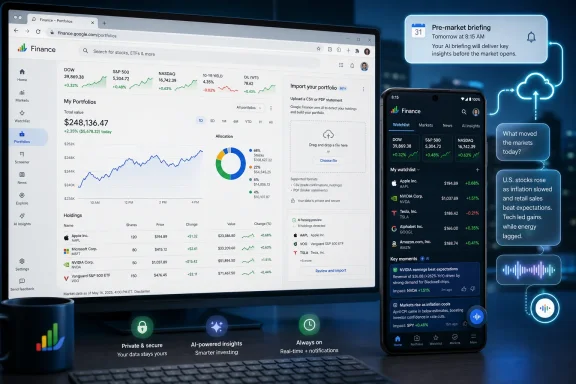
Google released a dedicated Google Finance app for Android on June 25, 2026, alongside a broader Google Finance upgrade that brings the redesigned web service out of beta, adds global portfolio tools, and promises an iOS app later in 2026. The headline is not merely that Android finally gets a finance app with Google’s name on it. It is that Google is turning financial information into another AI-driven, cross-device habit loop. For Windows users and IT pros, the interesting part is not the app icon on a phone, but the way Google is repositioning finance as a cloud service that follows users from browser to notification shade to AI assistant.
Google Finance has always been one of the stranger survivors in Google’s product cemetery-adjacent portfolio. It was useful, familiar, and widely indexed in people’s habits, yet it often felt like a website Google maintained because Search needed a finance surface rather than because the company had a coherent consumer finance strategy.
That has now changed, or at least Google wants users to believe it has. The new Android app arrives after the AI-powered Google Finance redesign began testing in 2025 and now leaves beta with a more ambitious pitch: portfolios, market briefings, research prompts, watchlists, news, real-time data, and AI-generated explanations for stock movement.
The timing matters. Google is not launching into a sleepy market of desktop watchlists and delayed quotes. It is arriving in an era where retail investors expect push alerts, AI summaries, portfolio diagnostics, crypto coverage, earnings-call access, and natural-language research tools from whichever platform already owns their attention.
That is why the Android release feels both overdue and strategically revealing. Google did not just ship a mobile wrapper for finance.google.com. It shipped a signal that financial information is becoming another front in the platform war over ambient assistance.
Google’s more important move is the backend experience that surrounds the app. The redesigned Google Finance web service is now coming out of beta, and portfolios are rolling out globally. Users can consolidate investments into a dashboard, view performance and allocation data, and ask research questions against the portfolio rather than against a generic ticker.
That changes the product from “look up Microsoft stock” to “interpret my financial exposure.” Once a service crosses that line, it stops being a quote page and starts becoming a personal data layer.
Google is also letting users create portfolios by uploading files such as CSVs or PDFs, dropping in screenshots, or describing holdings in natural language. That is a very 2026 feature: the interface is no longer the form, but the ingestion pipe. Google wants users to throw financial artifacts at the system and let AI turn them into structured context.
This is the direction every major AI platform is moving: from chat box to scheduled agent. The old model required the user to ask a question. The new model asks the user to define an information ritual and then lets the system perform it repeatedly.
For finance, that is powerful and potentially dangerous. A daily briefing can help users stay informed, but it can also create a veneer of personalized authority around volatile, noisy, and incomplete market data. The more customized the briefing feels, the more likely a user is to treat it as insight rather than a generated summary of selected inputs.
Google appears to understand the engagement upside. Briefings can use a user’s watchlist or portfolio, run on a preferred schedule, and arrive through Google app notifications on Android and iOS. In other words, Google Finance is not merely waiting inside a browser tab. It is becoming a scheduled interruption.
That is the bigger business: not finance as a destination, but finance as a recurring notification stream.
The mobile app is the pocket surface. The desktop browser is where users will likely upload CSVs, review PDFs, compare holdings, research sectors, and cross-reference financial data with spreadsheets, brokerage portals, tax documents, and news sources. For many users, that means Chrome on Windows. For others, it means Edge, where Google’s web services still compete for attention inside Microsoft’s operating system.
This is where the announcement intersects with Microsoft’s world. Microsoft has spent the last several years trying to make Edge, Bing, Copilot, widgets, and Windows search feel like native gateways to information. Google’s move says: fine, but the user’s financial workflow may still begin and end in Google’s cloud.
There is a quiet platform contest here. Microsoft owns the desktop shell, Excel, and a growing set of Copilot experiences. Google owns Search habits, Android distribution, Gmail identity, and an enormous amount of user trust in finding information quickly. A modern finance product sits directly between those empires.
If Google Finance becomes the place where users upload holdings, schedule briefings, and ask AI questions about allocation, then Windows is not excluded. It is the workstation where Google’s finance cloud gets serious.
Google is implicitly admitting that the clean, API-connected version of personal finance is not how many users actually operate. Brokerages differ. Retirement accounts are fragmented. Crypto holdings may sit elsewhere. Cash, bonds, funds, and employer stock plans often arrive in formats that are readable to humans but awkward for software.
AI changes the calculus because it can ingest messier inputs and produce a structured starting point. A screenshot of holdings, a PDF statement, or a rough natural-language description can become a portfolio dashboard without forcing the user through a tedious manual entry process.
That convenience is the hook. It is also the privacy question.
Uploading financial documents to a consumer internet platform is not the same as typing a ticker into a search box. Even if the files contain no account numbers, holdings reveal a lot: risk tolerance, wealth level, employer exposure, retirement strategy, crypto appetite, and sometimes geography or tax status. Google’s finance assistant becomes more useful as it knows more, but that usefulness depends on users treating Google as a safe place for unusually sensitive data.
For Windows users accustomed to local spreadsheets, password managers, encrypted folders, and carefully separated financial workflows, this is the trade-off to scrutinize. The future Google is offering is easier than a spreadsheet. It is also less local, less inspectable, and more dependent on trusting a cloud service to correctly parse and protect the details.
Google will almost certainly be careful to avoid presenting this as formal investment advice. The legal and regulatory boundaries around financial advice are not something a consumer tech company can casually ignore. Still, users do not always experience the distinction between “educational analysis” and “advice” the way lawyers write it.
If an AI tool reviews a portfolio and says a sector is underrepresented, many users will hear a recommendation, even if the interface avoids that word. If it explains why a stock moved, users may treat the explanation as definitive, even when market movements often have multiple plausible causes and plenty of post-hoc storytelling.
This is the burden of AI in financial products. Summarization is useful, but confidence can be performative. A crisp explanation can make uncertainty look solved.
The question for Google is whether it can make the product feel helpful without making it feel omniscient. The question for users is whether they can keep treating AI output as research material rather than as a surrogate adviser.
But Google is not merely copying Apple’s built-in app model. Apple Stocks benefits from being preinstalled, visually restrained, and tied into Apple’s broader services ecosystem. Google Finance is arriving as a more explicitly AI-native product, with natural-language research, generated explanations, portfolio ingestion, and scheduled briefings.
That makes the comparison less about app parity and more about philosophy. Apple tends to make finance feel like a polished information panel. Google wants to make it feel like a conversational research environment.
The Android-first launch also reflects Google’s distribution logic. Android gives Google a native mobile surface, Google Play reach, notification pathways, and a user base already accustomed to Google account integration. The iOS app coming later this year broadens the audience, but Android is where Google can most directly test the full experience.
The more interesting rival may not be Apple Stocks at all. It may be the brokerage app, the AI search engine, the spreadsheet, and the morning newsletter. Google Finance is trying to collapse all four into a single workflow.
Finance is not messaging, where Google’s history is famously chaotic, but the same skepticism applies. A dedicated app can signal commitment. It can also be a phase in a product cycle if engagement fails to justify investment.
This time, however, Google Finance is tied to AI, Search, notifications, and personal data ingestion. Those are not side quests inside Google. They are central to the company’s current operating system for product development.
That gives the new Finance push a better chance of durability. Google is not just reviving a neglected utility; it is using the service as another showcase for Gemini-era interaction patterns. Ask questions, upload messy inputs, receive generated explanations, subscribe to scheduled outputs — that is the template Google wants across domains.
The risk is that finance is a harsher domain than recipes, shopping, travel, or general search. Mistakes cost money. Explanations need caveats. Latency matters. Data quality matters. Users may forgive a mediocre AI summary of a movie; they will be less forgiving if a portfolio feature misreads a statement or overstates the reason a stock fell.
Google’s scheduled briefings could be genuinely useful for disciplined users. A pre-market summary, an earnings-call reminder, a watchlist alert, or a portfolio allocation note can reduce the need to hop across sites. For professionals and serious retail investors, better aggregation is not trivial.
But consumer finance products have a long history of making activity feel like control. More alerts do not necessarily produce better decisions. More explanations do not necessarily produce deeper understanding. More personalization can simply make noise feel relevant.
Google’s challenge is to avoid turning Finance into another attention-maximizing feed. The company’s advertising and engagement instincts do not automatically disqualify it from building useful financial tools, but they do mean users should watch the product’s default settings carefully.
A good finance app helps users decide when not to look. A bad one teaches them that every market twitch deserves a notification.
The Google Finance workflow invites users to upload CSVs, PDFs, and screenshots. In a personal context, that may be harmless. In a work context, files can be misclassified, stored in the wrong folder, synced through corporate endpoints, or uploaded from managed browsers where policy boundaries are supposed to matter.
For organizations using Android Enterprise, managed Google Play, Chrome policies, Edge policies, data loss prevention, or mobile application management, the arrival of a dedicated app is a reminder that consumer AI tools increasingly blur document handling and assistant behavior. The app may not be an enterprise product, but its interaction model resembles the one IT is already trying to govern across ChatGPT, Gemini, Copilot, and browser-based AI tools.
The Windows side is just as relevant. If employees use Windows PCs to download brokerage statements, maintain spreadsheets, or generate PDFs, the path from local file to cloud AI parser may pass through a browser session that enterprise policy can observe or restrict. That does not mean companies should block Google Finance by default. It means they should understand whether existing controls cover this new class of personal-but-sensitive upload behavior.
Financial data is not always corporate data. But unmanaged financial uploads from corporate devices still create audit, privacy, and compliance discomfort. IT policies that distinguish “company confidential” from “everything else” may need more nuance as AI services encourage users to feed them increasingly personal documents.
That is surprising given Microsoft’s assets. Excel is still where serious amateurs and professionals build models. Edge has a sidebar and Copilot integration. Windows has widgets. Microsoft 365 has identity, storage, and document intelligence. LinkedIn has professional and market context. Bing has financial search results.
Yet Google is the company making the cleaner consumer move: one recognizable finance brand, one Android app, one web experience, one AI research surface, and one scheduled briefing model.
Microsoft could respond by leaning into Excel and Copilot rather than trying to recreate a stock app. The more compelling Windows-native answer would not be a glossy quote widget. It would be secure, auditable, local-friendly portfolio analysis inside Excel and Microsoft 365, with clear controls over what goes to the cloud and what stays in the workbook.
That is where Microsoft still has an opening. Google can make finance conversational and mobile. Microsoft can make it rigorous, inspectable, and productivity-native. But only if it treats personal finance as more than content for a news feed.
Trust is harder to copy. Users need to trust the market data, the portfolio parsing, the privacy model, the AI’s caveats, the notification settings, and the product’s longevity. That is a lot of trust to ask for in a category where the output can influence real financial behavior.
Google has advantages: scale, Search distribution, Android, Gemini, cloud infrastructure, and brand recognition. It also has baggage: product churn, advertising incentives, AI hallucination concerns, and the general discomfort of giving more personal context to a company that already knows a great deal.
The best version of Google Finance would be humble. It would show sources and assumptions clearly, separate factual market data from generated interpretation, make portfolio ingestion transparent, and provide strong privacy controls. It would help users understand risk without nudging them toward constant engagement.
The worst version would be a confident black box that turns financial anxiety into daily AI content.
That bargain may be worthwhile for many people. A casual investor with a few funds and a watchlist may benefit from consolidated views and plain-English explanations. A power user may still prefer spreadsheets, brokerage research, paid terminals, or dedicated charting platforms. A privacy-minded user may decide that uploading financial statements into a consumer AI workflow is not worth the convenience.
The app’s staggered feature rollout also deserves attention. At launch, the Android app does not yet include every capability from the web experience. Google says more features, including live earnings calls and the new portfolio and task tools, will arrive on mobile over the coming months. That means early adopters are not just using a finished product; they are stepping into a roadmap.
The iOS promise is similarly broad. Google says an iOS app is coming later in 2026, but the exact timing and feature parity remain details to watch. If Google wants Finance to become a credible cross-platform habit, Android cannot remain the only first-class mobile client for long.
 Google Finally Discovers the App It Should Have Had Years Ago
Google Finance has always been one of the stranger survivors in Google’s product cemetery-adjacent portfolio. It was useful, familiar, and widely indexed in people’s habits, yet it often felt like a website Google maintained because Search needed a finance surface rather than because the company had a coherent consumer finance strategy.That has now changed, or at least Google wants users to believe it has. The new Android app arrives after the AI-powered Google Finance redesign began testing in 2025 and now leaves beta with a more ambitious pitch: portfolios, market briefings, research prompts, watchlists, news, real-time data, and AI-generated explanations for stock movement.
The timing matters. Google is not launching into a sleepy market of desktop watchlists and delayed quotes. It is arriving in an era where retail investors expect push alerts, AI summaries, portfolio diagnostics, crypto coverage, earnings-call access, and natural-language research tools from whichever platform already owns their attention.
That is why the Android release feels both overdue and strategically revealing. Google did not just ship a mobile wrapper for finance.google.com. It shipped a signal that financial information is becoming another front in the platform war over ambient assistance.
The Android App Is the Smallest Part of the Announcement
At launch, the Android app provides the obvious mobile primitives: watchlists, real-time market data, a live financial news feed, AI research, and AI-powered “key moments” meant to explain why a stock moved. These are useful, but they are not revolutionary. Yahoo Finance, Apple Stocks, brokerage apps, TradingView, Bloomberg, and a long tail of fintech services have conditioned users to expect the phone to be the place where the market taps them on the shoulder.Google’s more important move is the backend experience that surrounds the app. The redesigned Google Finance web service is now coming out of beta, and portfolios are rolling out globally. Users can consolidate investments into a dashboard, view performance and allocation data, and ask research questions against the portfolio rather than against a generic ticker.
That changes the product from “look up Microsoft stock” to “interpret my financial exposure.” Once a service crosses that line, it stops being a quote page and starts becoming a personal data layer.
Google is also letting users create portfolios by uploading files such as CSVs or PDFs, dropping in screenshots, or describing holdings in natural language. That is a very 2026 feature: the interface is no longer the form, but the ingestion pipe. Google wants users to throw financial artifacts at the system and let AI turn them into structured context.
The Real Product Is a Scheduled Briefing Machine
The most Google-ish part of the announcement is not the app. It is the new market-intel task system, which lets users describe scheduled briefings in plain English. Google’s own example is a daily pre-market briefing analyzing significant overnight moves across major cryptocurrencies.This is the direction every major AI platform is moving: from chat box to scheduled agent. The old model required the user to ask a question. The new model asks the user to define an information ritual and then lets the system perform it repeatedly.
For finance, that is powerful and potentially dangerous. A daily briefing can help users stay informed, but it can also create a veneer of personalized authority around volatile, noisy, and incomplete market data. The more customized the briefing feels, the more likely a user is to treat it as insight rather than a generated summary of selected inputs.
Google appears to understand the engagement upside. Briefings can use a user’s watchlist or portfolio, run on a preferred schedule, and arrive through Google app notifications on Android and iOS. In other words, Google Finance is not merely waiting inside a browser tab. It is becoming a scheduled interruption.
That is the bigger business: not finance as a destination, but finance as a recurring notification stream.
Windows Users Should Read This as a Browser Story
WindowsForum readers may reasonably ask why an Android finance app belongs in a Windows conversation. The answer is that Google Finance remains fundamentally a web-first service, and Windows is still where a large share of serious browsing, spreadsheet work, research, and portfolio administration happens.The mobile app is the pocket surface. The desktop browser is where users will likely upload CSVs, review PDFs, compare holdings, research sectors, and cross-reference financial data with spreadsheets, brokerage portals, tax documents, and news sources. For many users, that means Chrome on Windows. For others, it means Edge, where Google’s web services still compete for attention inside Microsoft’s operating system.
This is where the announcement intersects with Microsoft’s world. Microsoft has spent the last several years trying to make Edge, Bing, Copilot, widgets, and Windows search feel like native gateways to information. Google’s move says: fine, but the user’s financial workflow may still begin and end in Google’s cloud.
There is a quiet platform contest here. Microsoft owns the desktop shell, Excel, and a growing set of Copilot experiences. Google owns Search habits, Android distribution, Gmail identity, and an enormous amount of user trust in finding information quickly. A modern finance product sits directly between those empires.
If Google Finance becomes the place where users upload holdings, schedule briefings, and ask AI questions about allocation, then Windows is not excluded. It is the workstation where Google’s finance cloud gets serious.
The Spreadsheet Is Still the Ghost in the Machine
One of the more revealing details in Google’s update is support for CSV and PDF uploads. That is not glamorous, but it is the connective tissue between consumer finance and the real world. People’s financial lives still live in exports, statements, screenshots, tax packets, account summaries, and spreadsheet tabs named things like “Portfolio 2024 final FINAL.”Google is implicitly admitting that the clean, API-connected version of personal finance is not how many users actually operate. Brokerages differ. Retirement accounts are fragmented. Crypto holdings may sit elsewhere. Cash, bonds, funds, and employer stock plans often arrive in formats that are readable to humans but awkward for software.
AI changes the calculus because it can ingest messier inputs and produce a structured starting point. A screenshot of holdings, a PDF statement, or a rough natural-language description can become a portfolio dashboard without forcing the user through a tedious manual entry process.
That convenience is the hook. It is also the privacy question.
Uploading financial documents to a consumer internet platform is not the same as typing a ticker into a search box. Even if the files contain no account numbers, holdings reveal a lot: risk tolerance, wealth level, employer exposure, retirement strategy, crypto appetite, and sometimes geography or tax status. Google’s finance assistant becomes more useful as it knows more, but that usefulness depends on users treating Google as a safe place for unusually sensitive data.
For Windows users accustomed to local spreadsheets, password managers, encrypted folders, and carefully separated financial workflows, this is the trade-off to scrutinize. The future Google is offering is easier than a spreadsheet. It is also less local, less inspectable, and more dependent on trusting a cloud service to correctly parse and protect the details.
AI Research Moves the Product Beyond Quotes
Google says the research tool can answer questions such as which sectors are underrepresented in a portfolio or how fixed income allocation could affect long-term growth potential. Those are not simple quote lookups. They are analytical prompts, and they edge the product toward personalized financial interpretation.Google will almost certainly be careful to avoid presenting this as formal investment advice. The legal and regulatory boundaries around financial advice are not something a consumer tech company can casually ignore. Still, users do not always experience the distinction between “educational analysis” and “advice” the way lawyers write it.
If an AI tool reviews a portfolio and says a sector is underrepresented, many users will hear a recommendation, even if the interface avoids that word. If it explains why a stock moved, users may treat the explanation as definitive, even when market movements often have multiple plausible causes and plenty of post-hoc storytelling.
This is the burden of AI in financial products. Summarization is useful, but confidence can be performative. A crisp explanation can make uncertainty look solved.
The question for Google is whether it can make the product feel helpful without making it feel omniscient. The question for users is whether they can keep treating AI output as research material rather than as a surrogate adviser.
Apple Stocks Was the Obvious Comparison, but Not the Whole One
GIGAZINE’s framing is simple and fair: Apple had a finance app, and Google did not. On the surface, the new Android app closes that gap. Apple Stocks has long given iPhone users a default place to check tickers, business news, charts, and watchlists.But Google is not merely copying Apple’s built-in app model. Apple Stocks benefits from being preinstalled, visually restrained, and tied into Apple’s broader services ecosystem. Google Finance is arriving as a more explicitly AI-native product, with natural-language research, generated explanations, portfolio ingestion, and scheduled briefings.
That makes the comparison less about app parity and more about philosophy. Apple tends to make finance feel like a polished information panel. Google wants to make it feel like a conversational research environment.
The Android-first launch also reflects Google’s distribution logic. Android gives Google a native mobile surface, Google Play reach, notification pathways, and a user base already accustomed to Google account integration. The iOS app coming later this year broadens the audience, but Android is where Google can most directly test the full experience.
The more interesting rival may not be Apple Stocks at all. It may be the brokerage app, the AI search engine, the spreadsheet, and the morning newsletter. Google Finance is trying to collapse all four into a single workflow.
The Return of a Google Finance App Carries Product-Memory Baggage
9to5Google notes that Google Finance previously had an Android app, which disappeared years ago. That history matters because Google’s consumer product reputation is complicated. Users like Google’s services, but many have also learned to ask how long a new Google app will last if it does not become strategically central.Finance is not messaging, where Google’s history is famously chaotic, but the same skepticism applies. A dedicated app can signal commitment. It can also be a phase in a product cycle if engagement fails to justify investment.
This time, however, Google Finance is tied to AI, Search, notifications, and personal data ingestion. Those are not side quests inside Google. They are central to the company’s current operating system for product development.
That gives the new Finance push a better chance of durability. Google is not just reviving a neglected utility; it is using the service as another showcase for Gemini-era interaction patterns. Ask questions, upload messy inputs, receive generated explanations, subscribe to scheduled outputs — that is the template Google wants across domains.
The risk is that finance is a harsher domain than recipes, shopping, travel, or general search. Mistakes cost money. Explanations need caveats. Latency matters. Data quality matters. Users may forgive a mediocre AI summary of a movie; they will be less forgiving if a portfolio feature misreads a statement or overstates the reason a stock fell.
Notification Finance Is a Feature and a Trap
The app launch leans into the idea that some users check the market multiple times per day. That is true. It is also a design smell. Finance apps sit at the intersection of information, anxiety, habit, and dopamine, and every push notification risks nudging users from informed monitoring into compulsive checking.Google’s scheduled briefings could be genuinely useful for disciplined users. A pre-market summary, an earnings-call reminder, a watchlist alert, or a portfolio allocation note can reduce the need to hop across sites. For professionals and serious retail investors, better aggregation is not trivial.
But consumer finance products have a long history of making activity feel like control. More alerts do not necessarily produce better decisions. More explanations do not necessarily produce deeper understanding. More personalization can simply make noise feel relevant.
Google’s challenge is to avoid turning Finance into another attention-maximizing feed. The company’s advertising and engagement instincts do not automatically disqualify it from building useful financial tools, but they do mean users should watch the product’s default settings carefully.
A good finance app helps users decide when not to look. A bad one teaches them that every market twitch deserves a notification.
Enterprise IT Will Care About the Data Path, Not the Stock Chart
In managed environments, the Android app is not just a consumer convenience. It is another app that may touch sensitive personal data, corporate networks, and managed devices. IT departments do not generally care whether an employee tracks index funds at lunch, but they do care about unsanctioned data movement, screenshots, file uploads, and identity mixing.The Google Finance workflow invites users to upload CSVs, PDFs, and screenshots. In a personal context, that may be harmless. In a work context, files can be misclassified, stored in the wrong folder, synced through corporate endpoints, or uploaded from managed browsers where policy boundaries are supposed to matter.
For organizations using Android Enterprise, managed Google Play, Chrome policies, Edge policies, data loss prevention, or mobile application management, the arrival of a dedicated app is a reminder that consumer AI tools increasingly blur document handling and assistant behavior. The app may not be an enterprise product, but its interaction model resembles the one IT is already trying to govern across ChatGPT, Gemini, Copilot, and browser-based AI tools.
The Windows side is just as relevant. If employees use Windows PCs to download brokerage statements, maintain spreadsheets, or generate PDFs, the path from local file to cloud AI parser may pass through a browser session that enterprise policy can observe or restrict. That does not mean companies should block Google Finance by default. It means they should understand whether existing controls cover this new class of personal-but-sensitive upload behavior.
Financial data is not always corporate data. But unmanaged financial uploads from corporate devices still create audit, privacy, and compliance discomfort. IT policies that distinguish “company confidential” from “everything else” may need more nuance as AI services encourage users to feed them increasingly personal documents.
Microsoft’s Own Finance Surface Looks Thin by Comparison
There is an awkward Microsoft angle here: Windows has no equivalent first-class consumer finance destination with this level of apparent ambition. Microsoft Start and MSN Money have long existed as web properties and feed components, and Excel remains a power tool for portfolio obsessives. But Microsoft has not made personal finance feel like a modern AI-native app experience.That is surprising given Microsoft’s assets. Excel is still where serious amateurs and professionals build models. Edge has a sidebar and Copilot integration. Windows has widgets. Microsoft 365 has identity, storage, and document intelligence. LinkedIn has professional and market context. Bing has financial search results.
Yet Google is the company making the cleaner consumer move: one recognizable finance brand, one Android app, one web experience, one AI research surface, and one scheduled briefing model.
Microsoft could respond by leaning into Excel and Copilot rather than trying to recreate a stock app. The more compelling Windows-native answer would not be a glossy quote widget. It would be secure, auditable, local-friendly portfolio analysis inside Excel and Microsoft 365, with clear controls over what goes to the cloud and what stays in the workbook.
That is where Microsoft still has an opening. Google can make finance conversational and mobile. Microsoft can make it rigorous, inspectable, and productivity-native. But only if it treats personal finance as more than content for a news feed.
The AI Finance Race Will Be Won on Trust, Not Features
Most of the announced Google Finance features can be copied in some form. Watchlists are commodities. News feeds are commodities. Chart annotations can be replicated. AI summaries will become table stakes. Scheduled briefings will spread across every assistant platform that wants daily relevance.Trust is harder to copy. Users need to trust the market data, the portfolio parsing, the privacy model, the AI’s caveats, the notification settings, and the product’s longevity. That is a lot of trust to ask for in a category where the output can influence real financial behavior.
Google has advantages: scale, Search distribution, Android, Gemini, cloud infrastructure, and brand recognition. It also has baggage: product churn, advertising incentives, AI hallucination concerns, and the general discomfort of giving more personal context to a company that already knows a great deal.
The best version of Google Finance would be humble. It would show sources and assumptions clearly, separate factual market data from generated interpretation, make portfolio ingestion transparent, and provide strong privacy controls. It would help users understand risk without nudging them toward constant engagement.
The worst version would be a confident black box that turns financial anxiety into daily AI content.
The Fine Print Users Should Notice Before Uploading Their Holdings
Google’s announcement is exciting because it makes finance feel easier. That is exactly why users should slow down before treating it as the default home for their investment life. The product’s convenience rests on a bargain: give Google more context, and Google gives you more personalized analysis.That bargain may be worthwhile for many people. A casual investor with a few funds and a watchlist may benefit from consolidated views and plain-English explanations. A power user may still prefer spreadsheets, brokerage research, paid terminals, or dedicated charting platforms. A privacy-minded user may decide that uploading financial statements into a consumer AI workflow is not worth the convenience.
The app’s staggered feature rollout also deserves attention. At launch, the Android app does not yet include every capability from the web experience. Google says more features, including live earnings calls and the new portfolio and task tools, will arrive on mobile over the coming months. That means early adopters are not just using a finished product; they are stepping into a roadmap.
The iOS promise is similarly broad. Google says an iOS app is coming later in 2026, but the exact timing and feature parity remain details to watch. If Google wants Finance to become a credible cross-platform habit, Android cannot remain the only first-class mobile client for long.
The New Google Finance Bargain Is Convenience for Context
The concrete story is simple enough: Google Finance is back on Android, the redesigned web service is leaving beta, and mobile parity with iOS is coming later. The strategic story is sharper: Google is asking users to let AI sit closer to their money.- Google Finance for Android launched on June 25, 2026, as a dedicated app with watchlists, real-time data, news, AI research, and AI-generated explanations for stock movement.
- The redesigned Google Finance web experience is coming out of beta with global portfolio features that can ingest holdings from screenshots, CSVs, PDFs, existing portfolios, or natural-language descriptions.
- Google’s scheduled market briefings turn Finance into a recurring notification product, not just a site users visit when they remember to check a ticker.
- The Android app does not yet include every new web feature, with portfolio tools, task features, and live earnings calls planned for the coming months.
- An iOS app is planned for later in 2026, which will test whether Google Finance can become a truly cross-platform consumer finance habit.
- Windows users should view the launch as a browser-and-cloud story, because the serious work of uploading files, reviewing portfolios, and using AI research will often happen on desktop PCs.
References
- Primary source: GIGAZINE
Published: Fri, 26 Jun 2026 02:30:00 GMT
Google has finally released its finance app for Android, 'Google Finance,' with the iOS version scheduled for release in the second half of 2026. - GIGAZINE
One of the apps that Apple had but Google didn't was a finance app, but now Google has released a finance app for Android called 'Google Finance.' Google Finance - Google Play app https://play.google.com/store/apps/details?id=com.google.android.apps.finance Google Finance updates: New...gigazine.net - Independent coverage: blog.google
Published: Thu, 25 Jun 2026 16:02:56 GMT
Google Finance updates: New app, portfolios
The new Google Finance is coming out of beta and launching a new Android app.blog.google - Independent coverage: 9to5Google
Published: Thu, 25 Jun 2026 16:00:00 GMT
Google Finance now available as dedicated Android app
After beta testing got underway last August, the AI-powered redesign of Google Finance is now launching with a new Android app.9to5google.com
