
In 2024, a World Bank-supported randomized trial in Edo State, Nigeria, put senior secondary students in computer labs with Microsoft Copilot for six weeks and reported learning gains roughly equal to 1.5 to two years of ordinary schooling. That result should have jolted Nigerian higher education into experimentation. Instead, too many universities have treated generative AI as a disciplinary problem first and a teaching problem second. The danger is not that students will use AI; it is that institutions will pretend prohibition is a strategy while the labor market moves on without them.
The most important fact about the Edo State trial is not the brand name of the tool. It is the design of the intervention. Students did not simply get access to a chatbot and wander through the internet hoping for enlightenment. They used AI in structured sessions, under teacher supervision, with a defined curricular goal: improving English language performance.
That matters because the public debate around AI in education often collapses into two lazy positions. One side treats large language models as a universal tutor that can compensate for decades of underinvestment. The other treats them as plagiarism machines that must be kept outside the classroom gates. Edo’s results point to a harder, more useful conclusion: generative AI can produce meaningful learning gains when it is embedded in pedagogy, not when it is sprinkled over a broken system.
The trial also cuts against a familiar fatalism about technology in low-resource education systems. Nigeria’s schools face teacher shortages, overcrowded classrooms, uneven digital infrastructure, and deep regional inequalities. Those conditions are usually invoked as reasons to delay AI adoption until everything else is fixed. Edo suggests the opposite possibility: where educational capacity is scarce, carefully managed AI may be most valuable.
But the trial should not be misread as proof that every student with a browser now has a private tutor. The reported gains came from a bounded program with scheduled access, human facilitation, and a clear assessment target. That is a blueprint, not a miracle story. And it is precisely the kind of blueprint Nigerian universities should be studying instead of reducing AI policy to misconduct forms and detection dashboards.
But integrity is not the same thing as prohibition. A university that merely tells students “do not use AI” is not defending scholarship; it is outsourcing policy to fear. Students will use these tools anyway, especially those with better devices, better internet access, and more digitally literate peer networks. The result is not fairness but secrecy.
The detection-software response is especially weak. AI detectors have a record of uncertainty, false positives, and arms-race failure. They can be useful as a signal in narrow circumstances, but they cannot carry the moral weight of academic judgment. A system that accuses students of misconduct because a machine guessed that another machine wrote their paragraph is building bureaucracy on sand.
The deeper problem is that universities are preserving assignments designed for a pre-AI world and then punishing students for encountering the present. If a generic essay question can be answered convincingly by a chatbot, the assignment may be the weak link. The response should be better assessment: oral defenses, iterative drafts, source audits, reflective logs, in-class work, project-based tasks, and discipline-specific evaluation of reasoning.
Prompting is only the surface skill. The more important competence is verification. Students must learn that a fluent answer can still be false, that generated citations may be invented, that models reproduce bias, and that privacy matters when uploading documents into commercial systems. A graduate who can produce a polished AI-assisted memo but cannot check its claims is not technologically advanced; he is merely faster at being wrong.
This is why universities should not treat AI as a computer science elective. Law students need to understand AI-assisted legal research and its risks. Medical students need to understand the limits of automated summarization and diagnosis-adjacent tools. Education students need to learn how tutoring systems can help or harm classrooms. Journalism students need to learn verification in an era of synthetic text, images, audio, and video.
The old digital divide was about who had access to computers and the internet. The new divide is about who is taught to use intelligent systems critically. Nigerian universities risk creating a generation of graduates who have encountered AI informally but never learned to use it professionally.
This does not mean every job will become “prompt engineering.” That phrase has already become too narrow and too fashionable. The durable skill is not typing clever instructions into a chatbot. It is knowing how to combine domain knowledge with machine assistance while retaining responsibility for the result.
That is exactly what universities are supposed to teach. Higher education is not merely a credentialing factory; it is where students learn how to think within a discipline. If AI changes how writing, coding, research, analysis, and presentation happen inside those disciplines, then refusing to teach AI is not a defense of academic standards. It is a retreat from relevance.
Nigeria’s technology ecosystem has long benefited from self-taught talent. Developers, designers, founders, and product managers have built careers through online courses, bootcamps, open-source communities, and startup networks that often move faster than universities. That resilience is impressive, but it is not a sustainable national talent strategy. A country cannot scale a digital economy by relying on motivated outliers to educate themselves around the university system.
A useful policy would distinguish between assistance and substitution. AI used to brainstorm topics, explain difficult readings, improve grammar, or generate practice questions is not the same as AI used to fabricate a research paper. AI used to summarize a lecturer’s notes is not the same as AI used to invent data. AI used transparently in a coding assignment is not the same as submitting generated code one cannot explain.
That distinction requires judgment, and judgment is harder than enforcement theater. It asks lecturers to redesign assignments and departments to publish clear rules. It asks students to disclose AI use without assuming that disclosure is self-incrimination. It asks universities to move from catching misconduct after the fact to building assessments that make authentic learning visible.
The irony is that a better AI policy may improve academic integrity beyond AI itself. Oral defenses, process documentation, project logs, version histories, and applied assessments make it harder to outsource work to anyone — chatbot, ghostwriter, roommate, or commercial essay mill. AI did not create Nigeria’s academic-integrity problem. It exposed how brittle some existing assessment models already were.
In higher education, the equivalent is not simply giving every student a Copilot account. It is training lecturers to design AI-aware coursework. It is creating departmental policies that say when AI is encouraged, when it is restricted, and when it must be disclosed. It is building rubrics that evaluate the student’s reasoning, not merely the surface polish of the final submission.
Universities should also resist the fantasy that one central AI policy can solve every disciplinary problem. A chemistry lab report, a legal memo, a literature essay, a software project, and a medical case discussion do not raise the same issues. The institution can set principles, but departments must translate them into practice.
This is where Nigeria has a chance to leapfrog some of the confusion seen elsewhere. Many universities around the world spent 2023 and 2024 oscillating between bans, vague guidelines, and quiet permissiveness. Nigerian institutions can learn from that muddle. They do not need to repeat the same panic cycle.
But that is an argument for institutional provision, not institutional avoidance. If AI tools become part of academic work while access remains private, wealthy students gain an advantage. If universities create supervised labs, shared access programs, negotiated education licenses, and offline or low-bandwidth workflows where possible, they can at least narrow the gap.
The Edo example is relevant again because access was organized. Students came to computer laboratories on a schedule. The intervention did not assume each student had a laptop, stable home broadband, and a quiet study room. Nigerian universities should be thinking in the same practical terms: where can access be pooled, supervised, and tied to instruction?
There is also a procurement trap to avoid. AI integration should not become another market for overpriced vendor contracts, glossy dashboards, and consultant-led “transformation” projects that leave lecturers unsupported. The first investment should be in people: faculty development, curriculum redesign, assessment reform, student guidance, and technical support.
That power comes with dependency. Nigerian universities should not simply import the assumptions of American software companies and call that modernization. Commercial AI systems have their own incentives, data practices, content filters, pricing models, and cultural blind spots. A serious national strategy would teach students to use these tools while also interrogating them.
This is particularly important for language, culture, and local knowledge. AI systems trained largely on global internet data may not adequately reflect Nigerian contexts, legal realities, educational standards, indigenous languages, or local research priorities. If universities do not develop critical AI literacy, they will produce graduates who can operate foreign tools but cannot question their outputs.
The long-term goal should be more ambitious than user training. Nigeria needs students who can build, evaluate, localize, govern, and audit AI systems. That requires computer science departments, yes, but it also requires linguists, lawyers, educators, sociologists, economists, ethicists, and domain specialists. AI is not a single discipline; it is a general-purpose technology entering every discipline.
Where universities treat AI as a topic for experimentation, students learn to navigate uncertainty. Where universities treat it mainly as contraband, students learn to hide. That difference compounds over time. A student who spends four years using AI transparently in research, coding, writing, analysis, and presentation will graduate with a different professional reflex than one who spent four years pretending not to use it.
Nigeria’s size gives it enormous potential advantage. Its university system, youth population, startup ecosystem, creative industries, and diaspora links could make it a continental leader in applied AI education. But scale can become inertia. Large systems often move slowly, and slow movement in a technological shift is itself a decision.
There is still time to choose a better path. The first mover advantage in AI education will not belong to the country with the most dramatic speeches. It will belong to institutions that revise assessment, train lecturers, provide access, protect students from false accusations, and align curricula with real work.
Lecturers then need assignment categories. Some tasks should be AI-free because they test memory, fluency, foundational reasoning, or professional judgment under constraint. Some should be AI-assisted because the point is to evaluate how students use tools. Some should be AI-integrated because the discipline itself is changing. The absence of categories creates confusion, and confusion punishes honest students.
Universities should also create due-process rules for AI misconduct allegations. No student should face serious academic penalty based solely on an AI detector score. Evidence should include the student’s drafting history, oral explanation, consistency with prior work, assignment context, and human academic judgment. Anything less risks turning integrity enforcement into automated suspicion.
Faculty support is equally important. Lecturers cannot be expected to redesign courses overnight while carrying heavy teaching loads and administrative burdens. If institutions want AI-aware teaching, they must fund workshops, create sample rubrics, support peer exchange, and recognize curriculum innovation in promotion criteria.
That is why the university response matters so much. Higher education sits at the point where schooling, employment, research, and national development meet. If universities misread AI, the consequences will not be confined to lecture halls. They will show up in graduate employability, research quality, startup capacity, public-sector modernization, and Nigeria’s ability to participate in the global knowledge economy.
The country does not need reckless adoption. It needs disciplined adoption. There is a difference between allowing students to paste chatbot output into assignments and teaching them to challenge, refine, cite, verify, and improve machine assistance. The first is academic decay. The second is contemporary education.
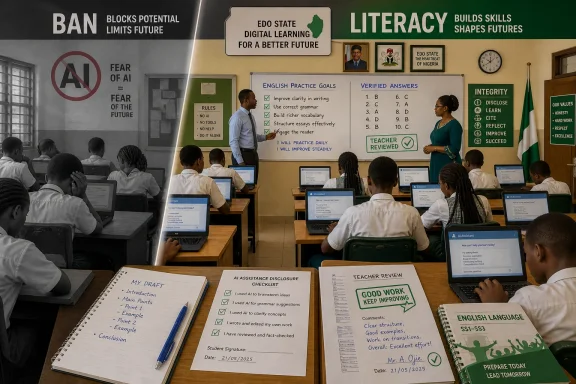 Edo’s Lesson Was Not That Chatbots Are Magic
The most important fact about the Edo State trial is not the brand name of the tool. It is the design of the intervention. Students did not simply get access to a chatbot and wander through the internet hoping for enlightenment. They used AI in structured sessions, under teacher supervision, with a defined curricular goal: improving English language performance.That matters because the public debate around AI in education often collapses into two lazy positions. One side treats large language models as a universal tutor that can compensate for decades of underinvestment. The other treats them as plagiarism machines that must be kept outside the classroom gates. Edo’s results point to a harder, more useful conclusion: generative AI can produce meaningful learning gains when it is embedded in pedagogy, not when it is sprinkled over a broken system.
The trial also cuts against a familiar fatalism about technology in low-resource education systems. Nigeria’s schools face teacher shortages, overcrowded classrooms, uneven digital infrastructure, and deep regional inequalities. Those conditions are usually invoked as reasons to delay AI adoption until everything else is fixed. Edo suggests the opposite possibility: where educational capacity is scarce, carefully managed AI may be most valuable.
But the trial should not be misread as proof that every student with a browser now has a private tutor. The reported gains came from a bounded program with scheduled access, human facilitation, and a clear assessment target. That is a blueprint, not a miracle story. And it is precisely the kind of blueprint Nigerian universities should be studying instead of reducing AI policy to misconduct forms and detection dashboards.
Universities Are Fighting the Last Academic War
Nigerian universities are not wrong to worry about academic integrity. Essays generated by ChatGPT, Copilot, Gemini, Claude, and similar systems can blur authorship, flatten student voice, and make traditional take-home assignments easier to fake. In a system already strained by overcrowding, underpaid lecturers, and examination malpractice, generative AI adds a new layer of complexity.But integrity is not the same thing as prohibition. A university that merely tells students “do not use AI” is not defending scholarship; it is outsourcing policy to fear. Students will use these tools anyway, especially those with better devices, better internet access, and more digitally literate peer networks. The result is not fairness but secrecy.
The detection-software response is especially weak. AI detectors have a record of uncertainty, false positives, and arms-race failure. They can be useful as a signal in narrow circumstances, but they cannot carry the moral weight of academic judgment. A system that accuses students of misconduct because a machine guessed that another machine wrote their paragraph is building bureaucracy on sand.
The deeper problem is that universities are preserving assignments designed for a pre-AI world and then punishing students for encountering the present. If a generic essay question can be answered convincingly by a chatbot, the assignment may be the weak link. The response should be better assessment: oral defenses, iterative drafts, source audits, reflective logs, in-class work, project-based tasks, and discipline-specific evaluation of reasoning.
The Real Divide Is Between Use and Literacy
The phrase AI literacy is quickly becoming one of those institutional slogans that means everything and nothing. In practice, it should mean three things: knowing how to use AI tools productively, knowing when not to trust them, and knowing how to document their role in one’s work. Nigerian higher education needs all three.Prompting is only the surface skill. The more important competence is verification. Students must learn that a fluent answer can still be false, that generated citations may be invented, that models reproduce bias, and that privacy matters when uploading documents into commercial systems. A graduate who can produce a polished AI-assisted memo but cannot check its claims is not technologically advanced; he is merely faster at being wrong.
This is why universities should not treat AI as a computer science elective. Law students need to understand AI-assisted legal research and its risks. Medical students need to understand the limits of automated summarization and diagnosis-adjacent tools. Education students need to learn how tutoring systems can help or harm classrooms. Journalism students need to learn verification in an era of synthetic text, images, audio, and video.
The old digital divide was about who had access to computers and the internet. The new divide is about who is taught to use intelligent systems critically. Nigerian universities risk creating a generation of graduates who have encountered AI informally but never learned to use it professionally.
The Labor Market Will Not Wait for Senate Committees
Employers are not waiting for academic senates to settle the philosophical status of machine-generated prose. Across technology, finance, media, consulting, education, design, customer support, and software development, workers are already being asked to use AI tools to draft, summarize, analyze, translate, prototype, debug, and automate. Even where companies are cautious, the baseline expectation is shifting.This does not mean every job will become “prompt engineering.” That phrase has already become too narrow and too fashionable. The durable skill is not typing clever instructions into a chatbot. It is knowing how to combine domain knowledge with machine assistance while retaining responsibility for the result.
That is exactly what universities are supposed to teach. Higher education is not merely a credentialing factory; it is where students learn how to think within a discipline. If AI changes how writing, coding, research, analysis, and presentation happen inside those disciplines, then refusing to teach AI is not a defense of academic standards. It is a retreat from relevance.
Nigeria’s technology ecosystem has long benefited from self-taught talent. Developers, designers, founders, and product managers have built careers through online courses, bootcamps, open-source communities, and startup networks that often move faster than universities. That resilience is impressive, but it is not a sustainable national talent strategy. A country cannot scale a digital economy by relying on motivated outliers to educate themselves around the university system.
Academic Integrity Needs a Better Target
The most common university fear is simple: students will submit work they did not write. That concern is legitimate. But the cure is not to pretend that text generation can be uninvented. The cure is to redefine what counts as student work in an AI-mediated environment.A useful policy would distinguish between assistance and substitution. AI used to brainstorm topics, explain difficult readings, improve grammar, or generate practice questions is not the same as AI used to fabricate a research paper. AI used to summarize a lecturer’s notes is not the same as AI used to invent data. AI used transparently in a coding assignment is not the same as submitting generated code one cannot explain.
That distinction requires judgment, and judgment is harder than enforcement theater. It asks lecturers to redesign assignments and departments to publish clear rules. It asks students to disclose AI use without assuming that disclosure is self-incrimination. It asks universities to move from catching misconduct after the fact to building assessments that make authentic learning visible.
The irony is that a better AI policy may improve academic integrity beyond AI itself. Oral defenses, process documentation, project logs, version histories, and applied assessments make it harder to outsource work to anyone — chatbot, ghostwriter, roommate, or commercial essay mill. AI did not create Nigeria’s academic-integrity problem. It exposed how brittle some existing assessment models already were.
Edo Shows the Importance of the Human in the Loop
The Edo trial’s most transferable lesson is that AI worked as part of a guided learning environment. The technology did not replace teachers; it gave students more opportunities to practice, receive feedback, and engage with material. That point should be central to any university response.In higher education, the equivalent is not simply giving every student a Copilot account. It is training lecturers to design AI-aware coursework. It is creating departmental policies that say when AI is encouraged, when it is restricted, and when it must be disclosed. It is building rubrics that evaluate the student’s reasoning, not merely the surface polish of the final submission.
Universities should also resist the fantasy that one central AI policy can solve every disciplinary problem. A chemistry lab report, a legal memo, a literature essay, a software project, and a medical case discussion do not raise the same issues. The institution can set principles, but departments must translate them into practice.
This is where Nigeria has a chance to leapfrog some of the confusion seen elsewhere. Many universities around the world spent 2023 and 2024 oscillating between bans, vague guidelines, and quiet permissiveness. Nigerian institutions can learn from that muddle. They do not need to repeat the same panic cycle.
The Infrastructure Objection Is Real but Not Decisive
The strongest argument against AI integration in Nigerian universities is not moral but material. Many campuses struggle with unstable electricity, expensive data, weak Wi-Fi, overcrowded facilities, and limited access to modern devices. A policy that assumes every student can use AI equally would reproduce inequality.But that is an argument for institutional provision, not institutional avoidance. If AI tools become part of academic work while access remains private, wealthy students gain an advantage. If universities create supervised labs, shared access programs, negotiated education licenses, and offline or low-bandwidth workflows where possible, they can at least narrow the gap.
The Edo example is relevant again because access was organized. Students came to computer laboratories on a schedule. The intervention did not assume each student had a laptop, stable home broadband, and a quiet study room. Nigerian universities should be thinking in the same practical terms: where can access be pooled, supervised, and tied to instruction?
There is also a procurement trap to avoid. AI integration should not become another market for overpriced vendor contracts, glossy dashboards, and consultant-led “transformation” projects that leave lecturers unsupported. The first investment should be in people: faculty development, curriculum redesign, assessment reform, student guidance, and technical support.
Nigeria Cannot Outsource Its AI Curriculum to Silicon Valley
Microsoft Copilot’s role in the Edo trial is noteworthy, especially for a WindowsForum.com audience, because it shows how mainstream productivity platforms are becoming educational infrastructure. Copilot is no longer just a sidebar in Microsoft 365 or a feature in Edge. In classrooms, it can become a tutor, writing coach, explainer, and practice partner.That power comes with dependency. Nigerian universities should not simply import the assumptions of American software companies and call that modernization. Commercial AI systems have their own incentives, data practices, content filters, pricing models, and cultural blind spots. A serious national strategy would teach students to use these tools while also interrogating them.
This is particularly important for language, culture, and local knowledge. AI systems trained largely on global internet data may not adequately reflect Nigerian contexts, legal realities, educational standards, indigenous languages, or local research priorities. If universities do not develop critical AI literacy, they will produce graduates who can operate foreign tools but cannot question their outputs.
The long-term goal should be more ambitious than user training. Nigeria needs students who can build, evaluate, localize, govern, and audit AI systems. That requires computer science departments, yes, but it also requires linguists, lawyers, educators, sociologists, economists, ethicists, and domain specialists. AI is not a single discipline; it is a general-purpose technology entering every discipline.
The Continental Competition Is About Institutions, Not Hype
The comparison with Kenya, South Africa, Rwanda, and other African technology hubs should be handled carefully. It is easy to turn continental AI adoption into a leaderboard of press releases. Every country has gaps between strategy documents and classroom reality. Still, institutional posture matters.Where universities treat AI as a topic for experimentation, students learn to navigate uncertainty. Where universities treat it mainly as contraband, students learn to hide. That difference compounds over time. A student who spends four years using AI transparently in research, coding, writing, analysis, and presentation will graduate with a different professional reflex than one who spent four years pretending not to use it.
Nigeria’s size gives it enormous potential advantage. Its university system, youth population, startup ecosystem, creative industries, and diaspora links could make it a continental leader in applied AI education. But scale can become inertia. Large systems often move slowly, and slow movement in a technological shift is itself a decision.
There is still time to choose a better path. The first mover advantage in AI education will not belong to the country with the most dramatic speeches. It will belong to institutions that revise assessment, train lecturers, provide access, protect students from false accusations, and align curricula with real work.
Detection Is Not a Strategy for the Next University
If Nigerian universities want practical reform, they should begin with disclosure rather than surveillance. Students should be required to state how they used AI in assignments where it is permitted. That statement can be simple: which tool was used, for what purpose, and how the student verified the output. This changes the conversation from “Did you cheat?” to “Can you explain your process?”Lecturers then need assignment categories. Some tasks should be AI-free because they test memory, fluency, foundational reasoning, or professional judgment under constraint. Some should be AI-assisted because the point is to evaluate how students use tools. Some should be AI-integrated because the discipline itself is changing. The absence of categories creates confusion, and confusion punishes honest students.
Universities should also create due-process rules for AI misconduct allegations. No student should face serious academic penalty based solely on an AI detector score. Evidence should include the student’s drafting history, oral explanation, consistency with prior work, assignment context, and human academic judgment. Anything less risks turning integrity enforcement into automated suspicion.
Faculty support is equally important. Lecturers cannot be expected to redesign courses overnight while carrying heavy teaching loads and administrative burdens. If institutions want AI-aware teaching, they must fund workshops, create sample rubrics, support peer exchange, and recognize curriculum innovation in promotion criteria.
The Edo Result Cuts Through the Excuses
The World Bank-supported Edo trial does not prove that AI will save Nigerian education. It does something more useful: it proves that the right question is no longer whether generative AI has educational value. The question is what institutional design is required to capture that value without sacrificing rigor, equity, or trust.That is why the university response matters so much. Higher education sits at the point where schooling, employment, research, and national development meet. If universities misread AI, the consequences will not be confined to lecture halls. They will show up in graduate employability, research quality, startup capacity, public-sector modernization, and Nigeria’s ability to participate in the global knowledge economy.
The country does not need reckless adoption. It needs disciplined adoption. There is a difference between allowing students to paste chatbot output into assignments and teaching them to challenge, refine, cite, verify, and improve machine assistance. The first is academic decay. The second is contemporary education.
The Choice Nigerian Universities Are Actually Making
The concrete path forward is not mysterious, even if it is politically and administratively difficult. Nigerian universities need to move from panic to policy, from policy to curriculum, and from curriculum to assessment. The institutions that do this first will not merely look modern; they will produce graduates better prepared for the work they are already entering.- Nigerian universities should stop treating AI use as automatically suspicious and start defining permitted, restricted, and prohibited uses by discipline and assignment type.
- AI detection tools should never be the sole basis for academic misconduct findings, because their uncertainty can turn enforcement into guesswork.
- Students should be taught to disclose AI assistance, verify outputs, protect sensitive data, and explain their own reasoning.
- Lecturers need institutional support to redesign assessments around process, oral defense, applied work, and source evaluation.
- Shared access through labs and supervised sessions can prevent AI integration from becoming another advantage reserved for students with better devices and connectivity.
- The Edo State trial’s real lesson is that AI works best when paired with human guidance, clear goals, and structured pedagogy.
References
- Primary source: streamlinefeed.co.ke
Published: 2026-06-27T12:50:13.429914
Why Nigerian Universities Are Misjudging AI Integration in Higher Education | Streamline
Despite the success of a World Bank AI tutoring trial in Edo State, Nigerian universities remain fiercely resistant, treating generative AI as a cheating tool.streamlinefeed.co.ke - Related coverage: blogs.worldbank.org
People-centered AI in education: Five lessons from the Global South
People-centered AI in education: Five lessons from the Global South blogs.worldbank.org
- Related coverage: the-decoder.com
AI tutoring helps Nigerian students gain two years of learning in six weeks
A recent pilot project in Nigeria's Edo State shows how AI tutoring can accelerate student learning when combined with teacher guidance. Students who used Microsoft Copilot as a virtual tutor twice weekly made significant gains in both English and digital skills.the-decoder.com - Related coverage: voxdev.org
How AI tutors improved learning in Nigeria
In an RCT in Nigeria, we tested a six-week after-school programme where students worked in pairs using GPT-4 under teacher supervision.voxdev.org - Related coverage: researchgate.net
(PDF) ChatGPT Usage and Plagiarism in Academic Writing: The Mediating Role of Academic Integrity among Nigerian Universities’ Students
PDF | Plagiarism remains a significant issue in university education worldwide and continues to prevail despite efforts to address it through training... | Find, read and cite all the research you need on ResearchGate www.researchgate.net
- Related coverage: thedocs.worldbank.org
