
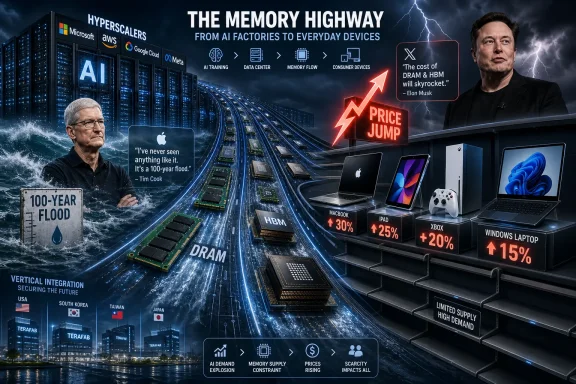
Elon Musk publicly backed Tim Cook’s description of the 2026 memory shortage this week, saying on X that the current surge in memory pricing is the biggest price jump he has ever seen, after Apple and Microsoft moved to raise hardware prices. The agreement matters less as celebrity CEO commentary than as a signal that the AI boom has crossed from cloud infrastructure into consumer tech. Memory is no longer the invisible commodity that quietly gets cheaper every product cycle. It is becoming the part that decides who can ship, who can train, who can automate, and who has to ask customers for more money.
For most of the modern PC era, the bargain between the industry and the buyer was simple: wait long enough and the same money bought more machine. Processors became faster, storage expanded, memory doubled, and even when premium devices stayed expensive, the invisible slope of component economics pointed downward. That assumption is now colliding with a more brutal market reality.
The memory shortage that Cook called a “hundred-year flood” and Musk called the biggest price jump he had ever seen is not merely another supply-chain hiccup. It is the result of the most powerful companies in technology treating memory as a strategic input for artificial intelligence, not as a commodity part for laptops, tablets, consoles, and phones. The data center has begun outbidding the living room.
That distinction is important. The pandemic-era chip shortage was broad, messy, and heavily shaped by logistics, factory shutdowns, automotive demand whiplash, and panic ordering. The current crunch is narrower but potentially more structural. AI systems do not merely need fast logic chips; they need enormous amounts of high-bandwidth memory, DRAM, NAND, and advanced packaging capacity to keep those processors fed.
A GPU without enough memory bandwidth is like a supercar on a dirt road. The expensive logic silicon may get the headlines, but the memory subsystem decides how much useful work the system can perform. That has turned memory suppliers from background players into toll collectors on the AI highway.
Musk’s agreement carries a different kind of weight. Tesla is not primarily a PC company, but its future story is increasingly a compute story: autonomous driving, robotaxis, humanoid robots, fleet learning, in-car inference, simulation, and AI training. In that world, memory is not an accessory to the chip; it is the limiter that determines whether the grand plan can scale.
Musk had already warned during Tesla’s January earnings call that supplier output of chips could constrain the company and that memory was an even bigger limiter than AI logic. That phrasing cut through a common misunderstanding of the AI boom. The industry does not just need more accelerators. It needs more complete systems, and those systems require logic, memory, substrates, packaging, power, cooling, networking, and software to arrive together.
That is why Tesla’s Terafab ambition, tied to SpaceX, xAI, and Intel, is not just another Muskian moonshot announcement. Its premise is an indictment of the current supply chain. If the companies building AI models, vehicles, robots, and space systems cannot trust the market to deliver enough integrated silicon, they will try to drag more of the stack under their own roof.
The practical problem is that semiconductor capacity does not appear by executive declaration. Memory fabs cost billions, take years, depend on specialized equipment, and require brutal process expertise. Even if Terafab becomes real at meaningful scale, it is not a 2026 solution to a 2026 shortage. It is a bet that the next shortage will be too strategically important to leave entirely to merchant suppliers.
This time, the move was more direct. Some Apple products reportedly rose by as much as $300, and the company spared the iPhone at least for now. That carve-out says plenty about Apple’s hierarchy of pain. The iPhone is too central to revenue, services growth, carrier relationships, and ecosystem lock-in to treat casually. The Mac and iPad can absorb the first wave.
For buyers, the distinction may feel academic. A student choosing an iPad, a developer replacing a MacBook Pro, or a family buying a media box now sees the AI data center reflected in the checkout cart. The cloud’s capital expenditure cycle has become a household electronics tax.
Apple’s problem is especially sharp because its modern product strategy leans heavily on unified memory. Apple Silicon Macs use memory integrated into the system architecture rather than conventional user-upgradable DIMMs. That design brings real performance and efficiency advantages, but it also makes memory a central cost lever in every configuration. When memory prices spike, Apple cannot pretend it is selling the same box with a cheap commodity add-on inside.
There is an irony here that Windows users will recognize. For years, PC enthusiasts criticized Apple for expensive memory upgrades and limited post-purchase flexibility. Now the broader market is discovering that memory pricing can distort even the base product, not merely the upgrade page. The old advice to “just add RAM later” is less comforting when RAM itself is the scarce resource.
Game consoles usually get cheaper as a generation ages. Manufacturing improves, yields rise, components fall in cost, and platform owners use lower hardware prices to expand the installed base. The profit comes later through software, subscriptions, storefront cuts, accessories, and services. A mid-generation price hike is awkward. Repeated price hikes are a warning.
The Xbox Series hardware is already in a difficult strategic position. Microsoft has pushed Game Pass, PC gaming, cloud gaming, and multiplatform publishing so aggressively that the console is no longer the single center of the Xbox universe. Raising console prices under those conditions may be economically necessary, but it also makes the dedicated Xbox box a harder sell.
Memory and storage are not optional in a console. A fixed-spec gaming platform has to deliver predictable performance for years, and modern games are voracious consumers of RAM bandwidth and SSD capacity. Microsoft cannot simply downgrade the core spec without fracturing the platform. It can eat the cost, redesign the machine, or charge more. This time, it chose to charge more.
The Windows PC market will not be insulated from the same pressure. OEM desktops, gaming laptops, workstations, handheld PCs, and AI-branded Copilot+ machines all depend on the same broad memory ecosystem. If console vendors with massive procurement scale are struggling, smaller PC builders and boutique integrators will feel it faster and with less room to maneuver.
Consumer electronics companies operate on a different clock. They plan products years in advance, target price bands, and depend on predictable bills of materials. A laptop cannot easily jump from $999 to $1,299 without losing a class of buyers. A console cannot rise late in its life cycle without inviting comparison to PCs, handhelds, used hardware, and rival platforms.
That mismatch creates a bidding war in which the cloud has the deeper pockets. The AI buildout has not merely increased demand for leading-edge GPUs. It has distorted adjacent markets: HBM for accelerators, DRAM for servers, NAND for data center storage, advanced substrates for packaging, and the equipment used to expand production. Once the bottleneck shifts, capital floods toward the bottleneck.
Memory manufacturers have lived through brutal boom-and-bust cycles. Samsung, SK hynix, Micron, and other suppliers know that overbuilding capacity can turn a shortage into a glut with devastating speed. They are incentivized to expand, but not recklessly. AI customers want guaranteed supply now; consumer device makers want lower prices; shareholders want discipline. Those goals do not comfortably coexist.
The result is a market that feels irrational to buyers but rational to suppliers. If AI customers are willing to sign large, long-duration, high-margin commitments, memory capacity will flow toward them. The laptop buyer gets whatever is left at the new clearing price.
The first response will be configuration games. Expect more base models with just enough RAM and storage to hit an advertised price, paired with higher upgrade costs and fewer genuinely good midrange options. The second response will be promotional fog: instant discounts, limited-time bundles, education pricing, financing offers, and retailer-specific SKUs that make clean comparisons harder.
The third response may be a slowdown in the democratization of AI PCs. Microsoft and its partners have spent the last two years pitching local AI features as the next reason to upgrade. But richer local AI workloads want memory, and they want it in machines that are already under pressure from higher component costs. If OEMs must choose between preserving margins and shipping generous memory configurations, many will protect margins.
That matters for Windows users because under-specced machines age badly. A Windows laptop with insufficient RAM may look affordable on launch day and feel compromised two years later. The industry’s temptation during a memory spike will be to normalize base configurations that serve the spreadsheet better than the customer.
For IT departments, the challenge is more concrete. Device refresh budgets are typically planned annually, sometimes years ahead. A sudden memory-driven increase across laptops, desktops, tablets, and peripherals can blow up procurement assumptions. Fleet managers may delay refreshes, standardize on fewer configurations, or push more workloads into virtual desktops and cloud PCs. Each choice merely moves the cost around.
Microsoft sits directly on both sides of that paradox. It sells Windows PCs through partners, Xbox consoles through its gaming business, cloud compute through Azure, AI subscriptions through Copilot, and virtualized desktops through Windows 365. A memory shortage can hurt hardware adoption while strengthening the case for centralized compute. But centralized compute is precisely where the memory demand is exploding.
That circularity is why this is not just a component story. It is a redistribution story. The industry is deciding which workloads belong on the device, which belong in the cloud, and who pays for the memory required by both. The answer will shape product design for years.
Consumers may see fewer generous base configurations. Enterprises may see more pressure to justify local workstations. Developers may find that serious AI experimentation increasingly depends on rented infrastructure. Gamers may discover that the console as a cheap fixed-cost entry point is less durable than it once looked.
None of those outcomes is guaranteed, but all are now plausible. The memory shortage turns abstract AI investment into a visible price signal. That is why Cook and Musk using nearly identical language matters. They are describing the same wall from opposite sides.
Terafab, as described, would combine logic, memory, and advanced packaging under one roof. That is an audacious response to a fragmented supply chain. It imagines a world where the company designing AI systems is not merely ordering chips from suppliers but participating directly in the creation of the manufacturing capacity behind them.
The appeal is obvious. If you are Tesla, SpaceX, or xAI, dependence on external memory supply is a strategic vulnerability. If your roadmap requires training clusters, inference systems, autonomous vehicles, robots, and perhaps space-based compute, then memory shortages are not just a cost problem. They are a control problem.
But the semiconductor industry is littered with reminders that vertical integration is hard. Intel itself spent years trying to regain process leadership. TSMC’s dominance was not built by press release but by decades of execution. Memory manufacturing has its own brutal economics and process specialization. Advanced packaging is rapidly becoming a chokepoint of its own.
So Terafab should be read less as an immediate fix than as a market signal. The most aggressive AI companies no longer believe the existing supply chain will automatically satisfy their ambitions. Whether Musk’s project succeeds or stumbles, the instinct behind it will spread: secure supply, prepay capacity, partner deeper, own more, and treat memory as strategic infrastructure.
AI has made memory visible. High-bandwidth memory is now discussed alongside GPUs in earnings calls and product roadmaps. DRAM pricing affects not only server margins but iPad pricing. SSD costs can move the price of an Xbox. The component that once quietly enabled computing is now a front-page constraint on the industry’s ambitions.
That visibility will change buyer behavior. Consumers who were trained to wait for discounts may buy earlier if they believe prices are headed higher. Businesses may extend leases or lock in procurement contracts. Enthusiasts may hoard RAM and SSDs the way GPU buyers once watched crypto cycles. Retailers will happily turn uncertainty into urgency.
There is risk in overreacting. Component markets can reverse, and memory has a long history of sharp corrections. If suppliers expand capacity into a future demand slowdown, today’s shortage can become tomorrow’s inventory problem. But the AI buildout complicates the old cycle because its appetite is not tied to one consumer product category. It is tied to a platform race among the richest companies in the world.
That is why this shortage feels different. It is not simply that prices are high. It is that the buyers driving prices higher may be willing to keep paying because they view compute as existential. The consumer market is used to competing against itself. It is now competing against the balance sheets of the AI superpowers.
If local AI is to be useful, devices need enough memory to run models, maintain context, process media, and multitask without collapsing into swap. If cloud AI is to scale, data centers need staggering amounts of memory near accelerators and storage behind them. Either way, the memory has to exist somewhere.
That means product roadmaps will increasingly be shaped by supply contracts. A Windows laptop’s AI capabilities may depend less on the sticker on the palm rest than on whether its maker could secure enough memory at a tolerable cost. A console revision may be delayed or repriced because storage economics no longer cooperate. A smart home device may become more expensive not because its own intelligence improved, but because the whole memory market moved beneath it.
For Microsoft, the consequences are especially tangled. Windows needs modern hardware to carry the AI PC story. Xbox needs affordable hardware to preserve the console proposition. Azure needs memory-rich infrastructure to compete in AI. These businesses are not independent in the component market. They are siblings fighting over the same family dinner.
Apple has a cleaner product stack but no easier escape. Its control over hardware and software lets it optimize aggressively, but it also owns the customer-facing price decision. When memory inflation hits an Apple device, there are fewer intermediaries to blame. That is why Cook’s statement felt like a breach in the company’s usual armor.
Apple can redesign and persuade, but even it is raising prices. Microsoft can subsidize and bundle, but Xbox hardware is still moving upward. Tesla can promise vertical integration, but fabs are not built on automotive timelines. PC OEMs can compete aggressively, but competition may simply compress margins in a market where components are no longer cooperating.
The losers will be products with weak strategic justification. If a device is not central to an ecosystem, not essential to productivity, and not differentiated enough to command a premium, memory inflation will expose it. Some low-end models may quietly disappear. Some midrange devices may become worse values. Some experimental hardware may never leave the planning stage.
The winners may be less obvious. Repairable and upgradeable systems could regain appeal if buyers become wary of locked-in configurations. Refurbished hardware may look better as new prices rise. Enterprise vendors that can guarantee stable supply may beat rivals with flashier specs. Software that runs efficiently on modest memory may become newly valuable after years of abundance encouraged bloat.
There is also a policy angle, though not a simple one. Governments have spent heavily to encourage domestic semiconductor manufacturing, but much of the public attention has focused on leading-edge logic. The current crunch is a reminder that compute sovereignty includes memory, packaging, substrates, and equipment. A country that can design AI chips but cannot secure memory at scale is still dependent.
The useful lesson is not panic. It is timing, configuration discipline, and skepticism toward base-model marketing. Memory and storage choices made in 2026 may carry more long-term consequence than they did when prices were falling predictably every year.
The Cook-Musk agreement is striking because it collapses the distance between the polished consumer device and the frontier AI factory. Apple’s price tags, Microsoft’s Xbox economics, Tesla’s AI ambitions, and the hyperscalers’ data centers are now connected by the same constrained supply of memory. The industry will eventually build more capacity, because high prices are the market’s loudest construction order. But until that capacity arrives, the AI boom will keep sending a simple message to everyone buying hardware: the future may be intelligent, but it is not going to be cheap.
 AI Has Finally Made the Cheap Computer More Expensive
For most of the modern PC era, the bargain between the industry and the buyer was simple: wait long enough and the same money bought more machine. Processors became faster, storage expanded, memory doubled, and even when premium devices stayed expensive, the invisible slope of component economics pointed downward. That assumption is now colliding with a more brutal market reality.The memory shortage that Cook called a “hundred-year flood” and Musk called the biggest price jump he had ever seen is not merely another supply-chain hiccup. It is the result of the most powerful companies in technology treating memory as a strategic input for artificial intelligence, not as a commodity part for laptops, tablets, consoles, and phones. The data center has begun outbidding the living room.
That distinction is important. The pandemic-era chip shortage was broad, messy, and heavily shaped by logistics, factory shutdowns, automotive demand whiplash, and panic ordering. The current crunch is narrower but potentially more structural. AI systems do not merely need fast logic chips; they need enormous amounts of high-bandwidth memory, DRAM, NAND, and advanced packaging capacity to keep those processors fed.
A GPU without enough memory bandwidth is like a supercar on a dirt road. The expensive logic silicon may get the headlines, but the memory subsystem decides how much useful work the system can perform. That has turned memory suppliers from background players into toll collectors on the AI highway.
Cook’s Flood Met Musk’s Factory Problem
Tim Cook’s warning landed with unusual force because Apple is perhaps the best supply-chain operator in consumer electronics. The company has spent decades using scale, prepayments, long-term agreements, and obsessive operational discipline to secure components at prices rivals envy. When Apple says it can no longer shield customers from memory costs, the rest of the hardware industry hears a siren.Musk’s agreement carries a different kind of weight. Tesla is not primarily a PC company, but its future story is increasingly a compute story: autonomous driving, robotaxis, humanoid robots, fleet learning, in-car inference, simulation, and AI training. In that world, memory is not an accessory to the chip; it is the limiter that determines whether the grand plan can scale.
Musk had already warned during Tesla’s January earnings call that supplier output of chips could constrain the company and that memory was an even bigger limiter than AI logic. That phrasing cut through a common misunderstanding of the AI boom. The industry does not just need more accelerators. It needs more complete systems, and those systems require logic, memory, substrates, packaging, power, cooling, networking, and software to arrive together.
That is why Tesla’s Terafab ambition, tied to SpaceX, xAI, and Intel, is not just another Muskian moonshot announcement. Its premise is an indictment of the current supply chain. If the companies building AI models, vehicles, robots, and space systems cannot trust the market to deliver enough integrated silicon, they will try to drag more of the stack under their own roof.
The practical problem is that semiconductor capacity does not appear by executive declaration. Memory fabs cost billions, take years, depend on specialized equipment, and require brutal process expertise. Even if Terafab becomes real at meaningful scale, it is not a 2026 solution to a 2026 shortage. It is a bet that the next shortage will be too strategically important to leave entirely to merchant suppliers.
Apple’s Price Hikes Break a Psychological Contract
Apple raising prices on MacBooks, iMacs, iPads, HomePods, and Apple TV hardware is not shocking because Apple products are cheap. They are not. It is shocking because Apple almost never frames broad price increases as a public concession to component inflation. The company prefers to shift configurations, introduce new tiers, alter storage ladders, or let foreign exchange adjustments do quiet work in individual markets.This time, the move was more direct. Some Apple products reportedly rose by as much as $300, and the company spared the iPhone at least for now. That carve-out says plenty about Apple’s hierarchy of pain. The iPhone is too central to revenue, services growth, carrier relationships, and ecosystem lock-in to treat casually. The Mac and iPad can absorb the first wave.
For buyers, the distinction may feel academic. A student choosing an iPad, a developer replacing a MacBook Pro, or a family buying a media box now sees the AI data center reflected in the checkout cart. The cloud’s capital expenditure cycle has become a household electronics tax.
Apple’s problem is especially sharp because its modern product strategy leans heavily on unified memory. Apple Silicon Macs use memory integrated into the system architecture rather than conventional user-upgradable DIMMs. That design brings real performance and efficiency advantages, but it also makes memory a central cost lever in every configuration. When memory prices spike, Apple cannot pretend it is selling the same box with a cheap commodity add-on inside.
There is an irony here that Windows users will recognize. For years, PC enthusiasts criticized Apple for expensive memory upgrades and limited post-purchase flexibility. Now the broader market is discovering that memory pricing can distort even the base product, not merely the upgrade page. The old advice to “just add RAM later” is less comforting when RAM itself is the scarce resource.
Xbox Shows the Console Subsidy Model Is Wearing Thin
Microsoft’s Xbox price increase is the WindowsForum angle hiding in plain sight. Starting August 1, Xbox consoles are set to become $100 to $150 more expensive, with Microsoft pointing to storage and memory costs that have reportedly increased by more than 2.5 times. That is not a minor adjustment. It is a reversal of the normal console life cycle.Game consoles usually get cheaper as a generation ages. Manufacturing improves, yields rise, components fall in cost, and platform owners use lower hardware prices to expand the installed base. The profit comes later through software, subscriptions, storefront cuts, accessories, and services. A mid-generation price hike is awkward. Repeated price hikes are a warning.
The Xbox Series hardware is already in a difficult strategic position. Microsoft has pushed Game Pass, PC gaming, cloud gaming, and multiplatform publishing so aggressively that the console is no longer the single center of the Xbox universe. Raising console prices under those conditions may be economically necessary, but it also makes the dedicated Xbox box a harder sell.
Memory and storage are not optional in a console. A fixed-spec gaming platform has to deliver predictable performance for years, and modern games are voracious consumers of RAM bandwidth and SSD capacity. Microsoft cannot simply downgrade the core spec without fracturing the platform. It can eat the cost, redesign the machine, or charge more. This time, it chose to charge more.
The Windows PC market will not be insulated from the same pressure. OEM desktops, gaming laptops, workstations, handheld PCs, and AI-branded Copilot+ machines all depend on the same broad memory ecosystem. If console vendors with massive procurement scale are struggling, smaller PC builders and boutique integrators will feel it faster and with less room to maneuver.
The Hyperscalers Are Writing Checks Consumer Hardware Cannot Match
The root of the crunch is brutally simple: hyperscalers and AI labs can justify paying more for memory because memory enables revenue, model performance, and strategic advantage. A cloud provider buying high-bandwidth memory for AI accelerators is not thinking like a parent buying a laptop before the school year. The cloud provider can monetize the memory through training runs, inference services, enterprise contracts, and platform lock-in.Consumer electronics companies operate on a different clock. They plan products years in advance, target price bands, and depend on predictable bills of materials. A laptop cannot easily jump from $999 to $1,299 without losing a class of buyers. A console cannot rise late in its life cycle without inviting comparison to PCs, handhelds, used hardware, and rival platforms.
That mismatch creates a bidding war in which the cloud has the deeper pockets. The AI buildout has not merely increased demand for leading-edge GPUs. It has distorted adjacent markets: HBM for accelerators, DRAM for servers, NAND for data center storage, advanced substrates for packaging, and the equipment used to expand production. Once the bottleneck shifts, capital floods toward the bottleneck.
Memory manufacturers have lived through brutal boom-and-bust cycles. Samsung, SK hynix, Micron, and other suppliers know that overbuilding capacity can turn a shortage into a glut with devastating speed. They are incentivized to expand, but not recklessly. AI customers want guaranteed supply now; consumer device makers want lower prices; shareholders want discipline. Those goals do not comfortably coexist.
The result is a market that feels irrational to buyers but rational to suppliers. If AI customers are willing to sign large, long-duration, high-margin commitments, memory capacity will flow toward them. The laptop buyer gets whatever is left at the new clearing price.
Windows OEMs Are Next in Line for the Squeeze
Windows PC makers rarely have Apple’s pricing power or Microsoft’s platform economics. Dell, HP, Lenovo, Asus, Acer, MSI, and the long tail of system builders compete in brutal segments where a $50 difference can decide a sale. Memory inflation therefore hits them in a particularly uncomfortable way.The first response will be configuration games. Expect more base models with just enough RAM and storage to hit an advertised price, paired with higher upgrade costs and fewer genuinely good midrange options. The second response will be promotional fog: instant discounts, limited-time bundles, education pricing, financing offers, and retailer-specific SKUs that make clean comparisons harder.
The third response may be a slowdown in the democratization of AI PCs. Microsoft and its partners have spent the last two years pitching local AI features as the next reason to upgrade. But richer local AI workloads want memory, and they want it in machines that are already under pressure from higher component costs. If OEMs must choose between preserving margins and shipping generous memory configurations, many will protect margins.
That matters for Windows users because under-specced machines age badly. A Windows laptop with insufficient RAM may look affordable on launch day and feel compromised two years later. The industry’s temptation during a memory spike will be to normalize base configurations that serve the spreadsheet better than the customer.
For IT departments, the challenge is more concrete. Device refresh budgets are typically planned annually, sometimes years ahead. A sudden memory-driven increase across laptops, desktops, tablets, and peripherals can blow up procurement assumptions. Fleet managers may delay refreshes, standardize on fewer configurations, or push more workloads into virtual desktops and cloud PCs. Each choice merely moves the cost around.
The Cloud Is Both Cause and Escape Hatch
There is a paradox at the center of this shortage. AI data centers are a major driver of the memory crunch, but cloud services are also one of the ways companies will try to avoid buying expensive local hardware. If laptops become more expensive, the argument for cloud-hosted compute gets easier. If cloud compute becomes more expensive because AI infrastructure is consuming capital, the argument gets harder again.Microsoft sits directly on both sides of that paradox. It sells Windows PCs through partners, Xbox consoles through its gaming business, cloud compute through Azure, AI subscriptions through Copilot, and virtualized desktops through Windows 365. A memory shortage can hurt hardware adoption while strengthening the case for centralized compute. But centralized compute is precisely where the memory demand is exploding.
That circularity is why this is not just a component story. It is a redistribution story. The industry is deciding which workloads belong on the device, which belong in the cloud, and who pays for the memory required by both. The answer will shape product design for years.
Consumers may see fewer generous base configurations. Enterprises may see more pressure to justify local workstations. Developers may find that serious AI experimentation increasingly depends on rented infrastructure. Gamers may discover that the console as a cheap fixed-cost entry point is less durable than it once looked.
None of those outcomes is guaranteed, but all are now plausible. The memory shortage turns abstract AI investment into a visible price signal. That is why Cook and Musk using nearly identical language matters. They are describing the same wall from opposite sides.
The Terafab Dream Reveals a Trust Problem
Musk’s answer to the shortage was blunt: much higher production is needed. That is true, but it is also the least controversial part of the story. The more interesting question is who should build that production, who controls it, and whether vertically integrated AI empires are about to become the new normal.Terafab, as described, would combine logic, memory, and advanced packaging under one roof. That is an audacious response to a fragmented supply chain. It imagines a world where the company designing AI systems is not merely ordering chips from suppliers but participating directly in the creation of the manufacturing capacity behind them.
The appeal is obvious. If you are Tesla, SpaceX, or xAI, dependence on external memory supply is a strategic vulnerability. If your roadmap requires training clusters, inference systems, autonomous vehicles, robots, and perhaps space-based compute, then memory shortages are not just a cost problem. They are a control problem.
But the semiconductor industry is littered with reminders that vertical integration is hard. Intel itself spent years trying to regain process leadership. TSMC’s dominance was not built by press release but by decades of execution. Memory manufacturing has its own brutal economics and process specialization. Advanced packaging is rapidly becoming a chokepoint of its own.
So Terafab should be read less as an immediate fix than as a market signal. The most aggressive AI companies no longer believe the existing supply chain will automatically satisfy their ambitions. Whether Musk’s project succeeds or stumbles, the instinct behind it will spread: secure supply, prepay capacity, partner deeper, own more, and treat memory as strategic infrastructure.
The End of Invisible Memory
Memory used to be the least glamorous answer to many performance questions. Add more RAM. Buy a bigger SSD. Choose the higher configuration if you can afford it. Enthusiasts cared, sysadmins cared, and everyone else encountered memory mostly when their machine became slow.AI has made memory visible. High-bandwidth memory is now discussed alongside GPUs in earnings calls and product roadmaps. DRAM pricing affects not only server margins but iPad pricing. SSD costs can move the price of an Xbox. The component that once quietly enabled computing is now a front-page constraint on the industry’s ambitions.
That visibility will change buyer behavior. Consumers who were trained to wait for discounts may buy earlier if they believe prices are headed higher. Businesses may extend leases or lock in procurement contracts. Enthusiasts may hoard RAM and SSDs the way GPU buyers once watched crypto cycles. Retailers will happily turn uncertainty into urgency.
There is risk in overreacting. Component markets can reverse, and memory has a long history of sharp corrections. If suppliers expand capacity into a future demand slowdown, today’s shortage can become tomorrow’s inventory problem. But the AI buildout complicates the old cycle because its appetite is not tied to one consumer product category. It is tied to a platform race among the richest companies in the world.
That is why this shortage feels different. It is not simply that prices are high. It is that the buyers driving prices higher may be willing to keep paying because they view compute as existential. The consumer market is used to competing against itself. It is now competing against the balance sheets of the AI superpowers.
The Price Tag Is the Product Roadmap Now
The memory shock also exposes a weakness in the industry’s marketing language. Companies have spent years promising AI everywhere, intelligence in every app, assistants in every workflow, and local inference on every device. Those promises were made in the language of software magic. The bill is arriving in the language of hardware.If local AI is to be useful, devices need enough memory to run models, maintain context, process media, and multitask without collapsing into swap. If cloud AI is to scale, data centers need staggering amounts of memory near accelerators and storage behind them. Either way, the memory has to exist somewhere.
That means product roadmaps will increasingly be shaped by supply contracts. A Windows laptop’s AI capabilities may depend less on the sticker on the palm rest than on whether its maker could secure enough memory at a tolerable cost. A console revision may be delayed or repriced because storage economics no longer cooperate. A smart home device may become more expensive not because its own intelligence improved, but because the whole memory market moved beneath it.
For Microsoft, the consequences are especially tangled. Windows needs modern hardware to carry the AI PC story. Xbox needs affordable hardware to preserve the console proposition. Azure needs memory-rich infrastructure to compete in AI. These businesses are not independent in the component market. They are siblings fighting over the same family dinner.
Apple has a cleaner product stack but no easier escape. Its control over hardware and software lets it optimize aggressively, but it also owns the customer-facing price decision. When memory inflation hits an Apple device, there are fewer intermediaries to blame. That is why Cook’s statement felt like a breach in the company’s usual armor.
The Shortage Turns Strategy Into Triage
The companies best positioned for this environment are the ones that can do three things at once: secure supply, redesign products around scarcity, and convince customers the resulting prices still make sense. That is a hard combination. Most companies can manage one or two. Very few can manage all three.Apple can redesign and persuade, but even it is raising prices. Microsoft can subsidize and bundle, but Xbox hardware is still moving upward. Tesla can promise vertical integration, but fabs are not built on automotive timelines. PC OEMs can compete aggressively, but competition may simply compress margins in a market where components are no longer cooperating.
The losers will be products with weak strategic justification. If a device is not central to an ecosystem, not essential to productivity, and not differentiated enough to command a premium, memory inflation will expose it. Some low-end models may quietly disappear. Some midrange devices may become worse values. Some experimental hardware may never leave the planning stage.
The winners may be less obvious. Repairable and upgradeable systems could regain appeal if buyers become wary of locked-in configurations. Refurbished hardware may look better as new prices rise. Enterprise vendors that can guarantee stable supply may beat rivals with flashier specs. Software that runs efficiently on modest memory may become newly valuable after years of abundance encouraged bloat.
There is also a policy angle, though not a simple one. Governments have spent heavily to encourage domestic semiconductor manufacturing, but much of the public attention has focused on leading-edge logic. The current crunch is a reminder that compute sovereignty includes memory, packaging, substrates, and equipment. A country that can design AI chips but cannot secure memory at scale is still dependent.
The Practical Read for Windows Buyers Is Uncomfortably Simple
For WindowsForum readers, the temptation is to treat this as an Apple-and-Musk spectacle. That would be a mistake. The same forces pushing Apple and Xbox prices higher are moving through the PC channel, the server market, and the upgrade aisle.The useful lesson is not panic. It is timing, configuration discipline, and skepticism toward base-model marketing. Memory and storage choices made in 2026 may carry more long-term consequence than they did when prices were falling predictably every year.
- Buyers planning a near-term laptop, desktop, console, RAM, or SSD purchase should not assume normal late-cycle price cuts will arrive on schedule.
- Windows users should be wary of low-memory base configurations that exist mainly to preserve an advertised starting price.
- IT departments should revisit refresh budgets now, because memory-driven increases can compound quickly across fleets.
- Gamers should treat the Xbox increase as a warning that fixed hardware platforms are no longer immune to component inflation late in a generation.
- Developers and AI hobbyists should expect local experimentation to become more sensitive to memory capacity, not less.
- Enterprises should press vendors for supply and pricing commitments rather than relying on last year’s procurement assumptions.
The Cook-Musk agreement is striking because it collapses the distance between the polished consumer device and the frontier AI factory. Apple’s price tags, Microsoft’s Xbox economics, Tesla’s AI ambitions, and the hyperscalers’ data centers are now connected by the same constrained supply of memory. The industry will eventually build more capacity, because high prices are the market’s loudest construction order. But until that capacity arrives, the AI boom will keep sending a simple message to everyone buying hardware: the future may be intelligent, but it is not going to be cheap.
References
- Primary source: Business Insider
Published: 2026-06-26T18:00:46.684787
Musk Agrees With Cook: the Memory Shortage Is Unprecedented - Business Insider
Elon Musk said soaring memory costs are the "biggest price jump in anything I've ever seen" and that the solution is "MUCH higher production."www.businessinsider.com - Related coverage: macrumors.com
Apple Just Increased Prices on MacBooks, iPads, and More
Apple today dramatically increased device prices across multiple product lines. Subscribe to the MacRumors YouTube channel for more videos. After temporarily taking it down earlier today, Apple's online store is back up with a series of product price increases.www.macrumors.com - Related coverage: techcrunch.com
Apple raises Mac and iPad prices, spares iPhone for now | TechCrunch
Apple raises prices of MacBook Air and Pro along with iPad Air and Pro.techcrunch.com - Related coverage: investing.com
Apple raises prices of MacBooks, iPads as memory costs skyrocket By Reuters
Apple raises prices of MacBooks, iPads as memory costs skyrocketwww.investing.com - Related coverage: tomshardware.com
RAM crisis bites Apple as unprecedented Mac and iPad price rises arrive — cheapest MacBook Pro price hiked by $400 to $1,999 | Tom's Hardware
iPhone prices haven't risen, for now.www.tomshardware.com - Related coverage: macobserver.com
Apple Raises Prices for MacBooks, iPad, Apple TV, HomePod, and Vision Pro
Apple raises prices for Macs, iPads, HomePod, Apple TV, and Vision Pro while iPhone, Apple Watch, and AirPods remain unchanged.www.macobserver.com
- Related coverage: cincodias.elpais.com
- Related coverage: app.dealroom.co
Terafab: Musk's $55-119B semiconductor mega-fab announced | Dealroom.co
Tesla, SpaceX | xAI, and Intel are jointly developing Terafab, a…app.dealroom.co - Related coverage: coinedition.com
Elon Musk Calls AI Chip Price Surge the Biggest Increase He Has Ever Seen
Elon Musk warned that AI hardware demand is far outpacing production as Apple raised MacBook and iPad prices amid soaring memory and storage costs. coinedition.com
- Related coverage: theguardian.com
Elon Musk becomes world’s first trillionaire as SpaceX ends trading day with valuation of $2.1tn – as it happened | Business | The Guardian
One economist says Musk’s world-first level of extreme wealth highlights massive economic disparities and could have profound effects on society<br>www.theguardian.com - Related coverage: latimes.com
AI giants are hoarding memory chips, pushing prices to hyperinflation levels
Companies like Alphabet Inc. and OpenAI are gobbling up memory chip production to run their chatbots and other applications. That’s left consumer electronics producers fighting over a dwindling supply.www.latimes.com - Related coverage: fourweekmba.com
Tim Cook: Unlike Anything in 40 Years. Elon Musk: Biggest Price Jump Ever. AI Broke the Deflation Machine. - FourWeekMBA
Tim Cook told the Wall Street Journal it’s “unlike anything I’ve seen in any area in over 40 years.” Elon Musk called it “the biggest price jump in anything I’ve ever seen.” The WSJ chart shows computer prices going positive year-over-year for the first...fourweekmba.com - Related coverage: phys.org
