

Geordie said this week that it added two senior leaders, expanded enterprise deployments with customers including Owkin and Forge Holiday Group, and deepened Microsoft-aligned work on AI agent controls for regulated organizations running multi-agent and multi-LLM systems. The story is not merely that another AI security startup has collected customer logos. It is that agent governance is becoming a practical enterprise buying category before most organizations have even agreed on what an “agent” is. The companies moving fastest with autonomous AI are discovering that the old chatbot-era security model does not stretch to software that can use tools, touch data, trigger workflows, and act across cloud estates.
Enterprise AI adoption has entered its second, messier phase. The first phase was about access: whether employees could use ChatGPT, Copilot, Claude, or internal assistants without leaking data. The second phase is about delegation: whether those systems can act with credentials, call APIs, write code, analyze regulated datasets, and hand tasks to other agents.
That is a much more difficult security problem. A chatbot session can be logged and governed like an application interaction. An agent ecosystem behaves more like a living mesh of identities, tools, prompts, data stores, and model providers. The danger is not simply that a model says the wrong thing. The danger is that no one can reconstruct what acted, under whose authority, with which data, and through which downstream tool.
Geordie’s announcement lands in that gap. The company is pitching itself as a visibility and control layer for environments where AI agents are no longer experimental side projects but production actors. Its recent customer examples are designed to make a pointed argument: the risk is already inside the enterprise, and the first control many companies need is not a grand AI ethics framework but an inventory that tells them what is actually running.
That message will sound familiar to anyone who lived through cloud misconfiguration, SaaS sprawl, or the early bring-your-own-device years. The pattern repeats with new vocabulary. Business units adopt the useful thing faster than central IT can classify it, then security arrives later to discover a larger estate than the official diagram shows.
Geordie’s counter-message is not anti-agent. It is anti-blindness. The company’s value proposition depends on the idea that enterprises will not standardize on one model, one agent framework, one cloud, or one workflow tool. They will run Anthropic here, OpenAI there, Microsoft tooling in the productivity estate, developer agents in the software pipeline, and specialized agents inside business applications.
That heterogeneity is exactly where security vendors find oxygen. Native controls tend to be strongest inside their own vendor boundaries. Enterprise risk, however, does not respect those boundaries. An agent that begins in a productivity workflow, calls an internal API, reads a customer dataset, writes to a ticketing system, and escalates to a developer tool has crossed several administrative zones before anyone can say whether the action was safe.
Geordie is therefore trying to position itself as a control plane rather than a model vendor. That distinction matters. If customers believe the future is multi-agent and multi-LLM by default, then governance cannot be bolted only to the model endpoint. It has to follow the agent’s behavior across runtime, identity, tool calls, and data access.
The phrase “agent-level governance” can sound like yet another vendor abstraction, but the underlying problem is concrete. Models generate outputs. Agents pursue tasks. Once software can pursue a task by choosing tools, sequencing actions, and operating with delegated authority, security has to move from monitoring text to monitoring execution.
Those numbers should be read with the usual caution reserved for vendor case studies. Risk exposure is not the same as realized loss, and avoided-loss calculations depend heavily on assumptions about probability and impact. Still, the shape of the story is plausible because it mirrors what security teams repeatedly find when new developer and productivity tooling spreads through a large organization.
The first surprise is usually inventory. Teams think they know how many systems exist because they know what was officially approved. Then discovery tooling reveals prototypes, workflow automations, abandoned scripts, duplicate agents, service accounts, integrations, and data paths that never made it into the formal register. With AI agents, that surprise becomes more dangerous because a small automation can inherit a large blast radius if it runs with broad permissions.
Owkin’s environment is also a useful example because healthcare and biomedical research are unforgiving domains for sloppy governance. Data sensitivity, partner obligations, regulatory scrutiny, and intellectual property risk all converge. An AI agent operating in such an environment is not just a productivity helper. It can become a compliance event, a data handling risk, or a partner assurance issue.
The important detail is not merely that Geordie found more agents. It is that the customer reportedly used the platform to produce evidence quickly enough to change conversations with partners and auditors. That is where enterprise AI governance becomes a budget line: not when a tool promises abstract safety, but when it shortens the distance between “we think we are compliant” and “here is the evidence.”
This is the more commercially important story. A health AI case study proves depth in a high-risk technical environment. A private equity deployment speaks the language of institutional buyers: unblock adoption, reduce rollout friction, preserve oversight, and make risk legible enough for executives.
Enterprises rarely want to ban useful tools forever. They block them when they cannot explain the risk, assign accountability, or prove control. That is why security products often win not by saying “no” more effectively, but by giving organizations a defensible path to “yes.” If Geordie can credibly help regulated firms move from prohibition to governed deployment, it is selling acceleration disguised as control.
The list of supported providers in the private equity example is also telling. It reflects the actual state of enterprise AI: mixed, overlapping, and politically fragmented. Developers may prefer one model. Business teams may use another. Microsoft may dominate office productivity and identity. Cloud teams may route workloads through Azure or another hyperscaler. Security has to make sense of the whole map, not the clean version shown in a procurement deck.
This is where the Windows and Microsoft ecosystem angle becomes unavoidable. Copilot Studio, Azure DevOps, Microsoft Entra, Defender, Purview, and Foundry all sit in the orbit of organizations that already run Microsoft-heavy infrastructure. A third-party governance vendor that integrates with that orbit is not competing with Microsoft in a simple way. It is trying to live in the gaps between Microsoft’s expanding AI stack and the multi-vendor reality customers refuse to abandon.
That kind of standardization is badly needed. Without common control language, every agent framework risks inventing its own permissions model, logging scheme, and policy syntax. The result would be a governance swamp: each vendor claiming safety, each enterprise stitching together translations, and each audit requiring custom interpretation.
But a specification is not the same thing as operational control. Standards help only when they are adopted broadly enough and enforced close enough to runtime. Geordie’s Beam mitigation engine is meant to sit in that enforcement layer, importing and exporting policies aligned with Microsoft’s work and applying them across compatible environments.
This is a familiar Microsoft-era pattern. The company defines or backs a framework that makes enterprise adoption easier, while partners build tooling around implementation, monitoring, enforcement, and reporting. For customers, the opportunity is consistency. For vendors like Geordie, the opportunity is to become the practical layer that turns an emerging standard into something security teams can actually operate.
The risk is that the standards landscape hardens too slowly. Agentic AI is moving at a speed that makes governance documents feel late the moment they are published. Developers are already wiring agents into workflows, codebases, and operational systems. If control specifications remain aspirational while tool use proliferates, the enterprise will again find itself retrofitting guardrails after the fact.
Traditional compliance often begins with design-time artifacts: policies, architecture diagrams, risk assessments, access reviews, and approved vendor lists. Those artifacts still matter, but they are weaker in dynamic AI environments where an agent’s behavior can vary depending on prompts, context, tool availability, model output, and chained interactions. A well-documented agent can still behave unexpectedly when the runtime context changes.
Runtime visibility can expose the uncomfortable gap between policy and behavior. Did the agent call a tool it was not expected to call? Did it access a dataset outside the intended scope? Did it pass sensitive context to another service? Did it act under a human identity when it should have used a governed non-human identity? Did it delegate to another agent that the security team did not know existed?
These are not philosophical questions. They are the questions an incident responder, regulator, insurer, or customer will ask after something goes wrong. The enterprise that can answer them from logs, traces, and policy evidence is in a very different position from the enterprise that can only say its AI use was “approved.”
Runtime observability also changes internal politics. If security can show developers and business teams exactly where an agent crosses a boundary, the conversation becomes less theological. It is no longer “AI is risky” versus “AI is innovative.” It is “this agent is using this credential to touch this system in this way, and here is the control we need.”
That is precisely why the example is useful. Agent sprawl will not remain confined to AI-first companies. It will appear anywhere employees and vendors can automate customer service, pricing, marketing, analytics, support, operations, compliance, and developer work. A company does not need to think of itself as an AI company to end up running an AI agent estate.
The “return of control” framing is also sharper than generic safety language. It acknowledges that the point of agents is to hand over some work. The governance challenge is deciding when control must return to a human, a policy engine, or an approval workflow. In other words, the enterprise does not need every agent to stop being autonomous. It needs autonomy bounded by context, permissions, and escalation rules.
That boundary is especially important in customer-facing and operational environments. A low-risk agent summarizing documents can tolerate more latitude than an agent that changes bookings, issues refunds, modifies customer records, or triggers downstream financial workflows. Governance has to be granular enough to distinguish between those actions without turning every automation into a manual approval queue.
The more agents an organization deploys, the less realistic it becomes to manage them through spreadsheets and periodic reviews. At some threshold, the estate demands live inventory, ownership mapping, risk scoring, and enforcement. Geordie’s bet is that many enterprises are reaching that threshold sooner than their governance teams expected.
A legal and people operations leader is a growth signal in a category where trust is part of the product. If a vendor is asking regulated enterprises to route sensitive telemetry, policy decisions, and AI governance evidence through its platform, its own internal controls become part of the sale. Customers will ask about data handling, contractual risk, employee access, audit readiness, and regional compliance. A startup that cannot answer those questions cleanly will struggle with the very buyers most likely to need its product.
The channel hire tells a different but related story. Enterprise security distribution still runs heavily through partners, integrators, consultancies, and managed service providers. AI governance may be new, but the buying motion is familiar: a CISO has a problem, an integrator helps map the environment, a platform is deployed, policies are tuned, and reporting is folded into existing risk processes.
If Geordie wants to become more than a specialist tool for early adopters, it needs that ecosystem. The customers most exposed to agent risk are also the customers least likely to tolerate bespoke startup-led deployments for every new control category. They will want implementation help, reference architectures, procurement confidence, and compatibility with the security stack they already operate.
The timing is notable. Geordie recently raised significant funding, and now it is showing the kinds of appointments and customer references investors expect after a growth round. The company is trying to look less like an interesting technical vendor and more like an enterprise platform company.
An agent with tools can turn a bad instruction into an action. An agent with credentials can amplify a permissions mistake. An agent connected to business systems can create operational consequences. An agent embedded in a software pipeline can change code or configuration. The old mental model of “malicious input causes bad output” is too narrow.
The emerging agentic AI security discussion is therefore about identity, tool authorization, memory, data boundaries, human approval, chain-of-action logging, and policy enforcement. It is also about governance drift: the way an agent’s available tools, permissions, model behavior, and business context can change over time until the original approval no longer describes the real system.
Geordie’s emphasis on governing full agent toolsets beyond the Model Context Protocol is part of that shift. MCP has quickly become an important way to connect models and agents to external tools and data sources, but MCP governance alone cannot cover every pathway an agent may use. Enterprises will need to monitor the broader runtime environment, including custom integrations, SaaS APIs, developer tools, cloud permissions, and identity systems.
That is where agent security begins to resemble cloud security posture management, identity governance, and application security at the same time. It is not a single control. It is an intersection. Vendors that simplify that intersection without hiding its complexity will have an advantage.
The opposite failure mode is worse: performative governance. In that version, the company approves AI usage, writes a policy, adds a dashboard, and continues operating without meaningful runtime control. Executives get comfort. Developers get speed. Security gets a screenshot. Then an agent behaves in a way no one can explain.
The useful middle ground is contextual enforcement. Low-risk actions proceed. Sensitive data access is logged and constrained. Dangerous tool calls are blocked or escalated. Human approval appears when the action matters, not as a blanket ritual. Policies are written in a way that can travel across environments, but enforcement happens close to the actual behavior.
That middle ground is difficult because agents blur categories. Is an agent a user, an application, a workload, a service account, or a decision system? The answer may change depending on what it is doing. An agent drafting an email looks like software assistance. An agent querying a database with delegated credentials looks like identity risk. An agent filing a transaction looks like an operational control issue.
This is why agent governance will not be solved by model safety teams alone. It will require security operations, identity teams, legal, compliance, platform engineering, data governance, and business owners. Geordie’s recent leadership and customer announcements should be understood in that context: the company is selling into a cross-functional mess that enterprises are only beginning to name.
Copilot Studio and Azure AI Foundry make it easier for organizations to build and deploy agents. GitHub Copilot and developer-facing agents change how code is written, reviewed, and shipped. Microsoft 365 Copilot brings AI into the daily fabric of documents, email, meetings, and knowledge work. Each layer expands the surface area where identity, data, and automation intersect.
That does not mean Microsoft customers should panic. It means they should resist the temptation to treat agent governance as a future procurement category. The operational groundwork starts with inventory, identity hygiene, least privilege, data classification, logging, and policy ownership. Those are not new disciplines, but agents make weak spots visible faster.
A Windows-heavy enterprise also needs to decide where native Microsoft controls are sufficient and where third-party oversight is necessary. The answer will vary. Some organizations may prefer to stay as native as possible, especially if their AI estate is mostly Microsoft. Others will need cross-provider visibility because their developers, data scientists, and business units are already using multiple model and agent platforms.
Geordie’s Microsoft-aligned work is therefore best seen as an attempt to ride the Microsoft wave without being trapped inside it. If Agent Control Specification becomes a meaningful part of the governance stack, vendors that support it early may gain credibility. If the specification remains one of several competing approaches, the broader value will still depend on how well tools discover, map, and enforce behavior in the wild.
That is why Geordie’s customer stories focus on measurable outcomes: more agents discovered than expected, compliance evidence produced quickly, risk exposure quantified, rollout time reduced, and nearly 1,000 agents brought under governance. The numbers are marketing numbers, but they are the right kind of numbers. They translate a fuzzy AI risk discussion into something a CISO, CIO, general counsel, or board committee can debate.
The next phase of the market will test whether those outcomes repeat outside curated case studies. Can the platform find unknown agents reliably across messy environments? Can it distinguish meaningful risk from noise? Can it integrate with the controls enterprises already use? Can it enforce policies without breaking workflows? Can it produce audit evidence that regulators, customers, and insurers accept?
Those questions matter because agent governance could easily become another dashboard category. Security teams do not need more panes of glass that admire the problem. They need systems that connect visibility to action and action to accountability.
If Geordie can keep proving that link, its timing is excellent. The market is moving from “Should we allow AI agents?” to “How do we allow them safely?” That is the moment when governance vendors either become infrastructure or become shelfware.
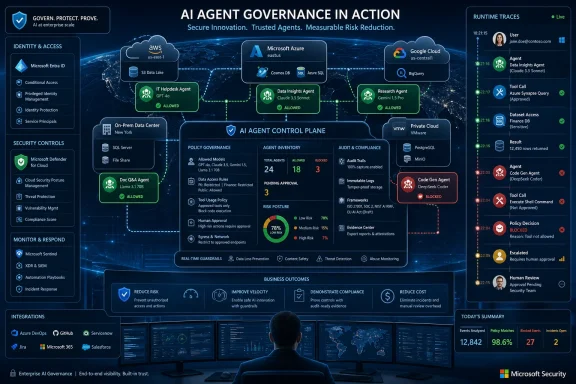 Agent Sprawl Has Become the New Shadow IT
Enterprise AI adoption has entered its second, messier phase. The first phase was about access: whether employees could use ChatGPT, Copilot, Claude, or internal assistants without leaking data. The second phase is about delegation: whether those systems can act with credentials, call APIs, write code, analyze regulated datasets, and hand tasks to other agents.That is a much more difficult security problem. A chatbot session can be logged and governed like an application interaction. An agent ecosystem behaves more like a living mesh of identities, tools, prompts, data stores, and model providers. The danger is not simply that a model says the wrong thing. The danger is that no one can reconstruct what acted, under whose authority, with which data, and through which downstream tool.
Geordie’s announcement lands in that gap. The company is pitching itself as a visibility and control layer for environments where AI agents are no longer experimental side projects but production actors. Its recent customer examples are designed to make a pointed argument: the risk is already inside the enterprise, and the first control many companies need is not a grand AI ethics framework but an inventory that tells them what is actually running.
That message will sound familiar to anyone who lived through cloud misconfiguration, SaaS sprawl, or the early bring-your-own-device years. The pattern repeats with new vocabulary. Business units adopt the useful thing faster than central IT can classify it, then security arrives later to discover a larger estate than the official diagram shows.
Geordie Is Selling Control Where the Platform Vendors Sell Possibility
The AI platform giants have spent the last year telling enterprises that agents will transform work. Microsoft has Copilot Studio, Azure AI Foundry, GitHub Copilot, and a growing agent governance toolkit. OpenAI, Anthropic, Google, and others are building richer tool-use capabilities into their ecosystems. The message from the platform layer is acceleration: create agents, connect data, automate workflows, and move faster.Geordie’s counter-message is not anti-agent. It is anti-blindness. The company’s value proposition depends on the idea that enterprises will not standardize on one model, one agent framework, one cloud, or one workflow tool. They will run Anthropic here, OpenAI there, Microsoft tooling in the productivity estate, developer agents in the software pipeline, and specialized agents inside business applications.
That heterogeneity is exactly where security vendors find oxygen. Native controls tend to be strongest inside their own vendor boundaries. Enterprise risk, however, does not respect those boundaries. An agent that begins in a productivity workflow, calls an internal API, reads a customer dataset, writes to a ticketing system, and escalates to a developer tool has crossed several administrative zones before anyone can say whether the action was safe.
Geordie is therefore trying to position itself as a control plane rather than a model vendor. That distinction matters. If customers believe the future is multi-agent and multi-LLM by default, then governance cannot be bolted only to the model endpoint. It has to follow the agent’s behavior across runtime, identity, tool calls, and data access.
The phrase “agent-level governance” can sound like yet another vendor abstraction, but the underlying problem is concrete. Models generate outputs. Agents pursue tasks. Once software can pursue a task by choosing tools, sequencing actions, and operating with delegated authority, security has to move from monitoring text to monitoring execution.
The Owkin Case Study Gives the Pitch Its Sharpest Edge
The most striking claim in Geordie’s recent push is its deployment with Owkin, a health AI company operating across more than 50 petabytes of data. In Geordie’s telling, Owkin used the platform to uncover far more active agents than expected, demonstrate EU AI Act compliance evidence in under 10 minutes, and quantify roughly $12 million to $13 million in averted risk exposure.Those numbers should be read with the usual caution reserved for vendor case studies. Risk exposure is not the same as realized loss, and avoided-loss calculations depend heavily on assumptions about probability and impact. Still, the shape of the story is plausible because it mirrors what security teams repeatedly find when new developer and productivity tooling spreads through a large organization.
The first surprise is usually inventory. Teams think they know how many systems exist because they know what was officially approved. Then discovery tooling reveals prototypes, workflow automations, abandoned scripts, duplicate agents, service accounts, integrations, and data paths that never made it into the formal register. With AI agents, that surprise becomes more dangerous because a small automation can inherit a large blast radius if it runs with broad permissions.
Owkin’s environment is also a useful example because healthcare and biomedical research are unforgiving domains for sloppy governance. Data sensitivity, partner obligations, regulatory scrutiny, and intellectual property risk all converge. An AI agent operating in such an environment is not just a productivity helper. It can become a compliance event, a data handling risk, or a partner assurance issue.
The important detail is not merely that Geordie found more agents. It is that the customer reportedly used the platform to produce evidence quickly enough to change conversations with partners and auditors. That is where enterprise AI governance becomes a budget line: not when a tool promises abstract safety, but when it shortens the distance between “we think we are compliant” and “here is the evidence.”
The Private Equity Example Shows the Business Case in Boardroom Language
Geordie also highlighted a deployment with a global private equity firm managing about $150 billion in assets. According to the company, the firm moved from blocking AI agents to broader deployment after adopting Geordie’s controls, reducing rollout timelines from months to days across environments that included Anthropic, OpenAI, Microsoft Copilot Studio, Foundry, and Azure DevOps.This is the more commercially important story. A health AI case study proves depth in a high-risk technical environment. A private equity deployment speaks the language of institutional buyers: unblock adoption, reduce rollout friction, preserve oversight, and make risk legible enough for executives.
Enterprises rarely want to ban useful tools forever. They block them when they cannot explain the risk, assign accountability, or prove control. That is why security products often win not by saying “no” more effectively, but by giving organizations a defensible path to “yes.” If Geordie can credibly help regulated firms move from prohibition to governed deployment, it is selling acceleration disguised as control.
The list of supported providers in the private equity example is also telling. It reflects the actual state of enterprise AI: mixed, overlapping, and politically fragmented. Developers may prefer one model. Business teams may use another. Microsoft may dominate office productivity and identity. Cloud teams may route workloads through Azure or another hyperscaler. Security has to make sense of the whole map, not the clean version shown in a procurement deck.
This is where the Windows and Microsoft ecosystem angle becomes unavoidable. Copilot Studio, Azure DevOps, Microsoft Entra, Defender, Purview, and Foundry all sit in the orbit of organizations that already run Microsoft-heavy infrastructure. A third-party governance vendor that integrates with that orbit is not competing with Microsoft in a simple way. It is trying to live in the gaps between Microsoft’s expanding AI stack and the multi-vendor reality customers refuse to abandon.
Microsoft’s Agent Control Work Is a Standardization Bet, Not a Finished Answer
Geordie’s expanded collaboration with Microsoft around the Agent Control Specification is one of the more strategically important parts of the announcement. Microsoft has been working on ways to define and enforce more consistent controls over agent behavior, including policy structures that describe what agents may do, what tools they may use, and under what conditions actions should be allowed, blocked, or routed for approval.That kind of standardization is badly needed. Without common control language, every agent framework risks inventing its own permissions model, logging scheme, and policy syntax. The result would be a governance swamp: each vendor claiming safety, each enterprise stitching together translations, and each audit requiring custom interpretation.
But a specification is not the same thing as operational control. Standards help only when they are adopted broadly enough and enforced close enough to runtime. Geordie’s Beam mitigation engine is meant to sit in that enforcement layer, importing and exporting policies aligned with Microsoft’s work and applying them across compatible environments.
This is a familiar Microsoft-era pattern. The company defines or backs a framework that makes enterprise adoption easier, while partners build tooling around implementation, monitoring, enforcement, and reporting. For customers, the opportunity is consistency. For vendors like Geordie, the opportunity is to become the practical layer that turns an emerging standard into something security teams can actually operate.
The risk is that the standards landscape hardens too slowly. Agentic AI is moving at a speed that makes governance documents feel late the moment they are published. Developers are already wiring agents into workflows, codebases, and operational systems. If control specifications remain aspirational while tool use proliferates, the enterprise will again find itself retrofitting guardrails after the fact.
Runtime Observability Is the New Compliance Theater Detector
The phrase “runtime observability” does a lot of work in Geordie’s pitch. It means the company is not merely asking customers to document intended behavior. It wants to show what agents actually do while they are running. In agentic systems, that distinction is everything.Traditional compliance often begins with design-time artifacts: policies, architecture diagrams, risk assessments, access reviews, and approved vendor lists. Those artifacts still matter, but they are weaker in dynamic AI environments where an agent’s behavior can vary depending on prompts, context, tool availability, model output, and chained interactions. A well-documented agent can still behave unexpectedly when the runtime context changes.
Runtime visibility can expose the uncomfortable gap between policy and behavior. Did the agent call a tool it was not expected to call? Did it access a dataset outside the intended scope? Did it pass sensitive context to another service? Did it act under a human identity when it should have used a governed non-human identity? Did it delegate to another agent that the security team did not know existed?
These are not philosophical questions. They are the questions an incident responder, regulator, insurer, or customer will ask after something goes wrong. The enterprise that can answer them from logs, traces, and policy evidence is in a very different position from the enterprise that can only say its AI use was “approved.”
Runtime observability also changes internal politics. If security can show developers and business teams exactly where an agent crosses a boundary, the conversation becomes less theological. It is no longer “AI is risky” versus “AI is innovative.” It is “this agent is using this credential to touch this system in this way, and here is the control we need.”
Forge Holiday Group Shows the Governance Problem Is Not Limited to Elite AI Labs
The Forge Holiday Group case study broadens the story beyond biotech and finance. Geordie says Forge uses its platform to govern nearly 1,000 AI agents under a “return of control” security model aligned with Five Eyes guidance on agentic AI. The number matters less than the setting: travel and hospitality are not usually treated as the bleeding edge of AI infrastructure risk.That is precisely why the example is useful. Agent sprawl will not remain confined to AI-first companies. It will appear anywhere employees and vendors can automate customer service, pricing, marketing, analytics, support, operations, compliance, and developer work. A company does not need to think of itself as an AI company to end up running an AI agent estate.
The “return of control” framing is also sharper than generic safety language. It acknowledges that the point of agents is to hand over some work. The governance challenge is deciding when control must return to a human, a policy engine, or an approval workflow. In other words, the enterprise does not need every agent to stop being autonomous. It needs autonomy bounded by context, permissions, and escalation rules.
That boundary is especially important in customer-facing and operational environments. A low-risk agent summarizing documents can tolerate more latitude than an agent that changes bookings, issues refunds, modifies customer records, or triggers downstream financial workflows. Governance has to be granular enough to distinguish between those actions without turning every automation into a manual approval queue.
The more agents an organization deploys, the less realistic it becomes to manage them through spreadsheets and periodic reviews. At some threshold, the estate demands live inventory, ownership mapping, risk scoring, and enforcement. Geordie’s bet is that many enterprises are reaching that threshold sooner than their governance teams expected.
Leadership Hires Signal a Company Trying to Grow Up Before the Market Does
Geordie’s appointments of Joel Furniss to lead Legal and People operations in the U.K. and Courtney Broadwell as Vice President of Channel are not the flashiest parts of the announcement, but they reveal the company’s stage. Security startups often begin by proving a technical thesis. They scale by turning that thesis into contracts, partner motions, compliance machinery, and repeatable implementation.A legal and people operations leader is a growth signal in a category where trust is part of the product. If a vendor is asking regulated enterprises to route sensitive telemetry, policy decisions, and AI governance evidence through its platform, its own internal controls become part of the sale. Customers will ask about data handling, contractual risk, employee access, audit readiness, and regional compliance. A startup that cannot answer those questions cleanly will struggle with the very buyers most likely to need its product.
The channel hire tells a different but related story. Enterprise security distribution still runs heavily through partners, integrators, consultancies, and managed service providers. AI governance may be new, but the buying motion is familiar: a CISO has a problem, an integrator helps map the environment, a platform is deployed, policies are tuned, and reporting is folded into existing risk processes.
If Geordie wants to become more than a specialist tool for early adopters, it needs that ecosystem. The customers most exposed to agent risk are also the customers least likely to tolerate bespoke startup-led deployments for every new control category. They will want implementation help, reference architectures, procurement confidence, and compatibility with the security stack they already operate.
The timing is notable. Geordie recently raised significant funding, and now it is showing the kinds of appointments and customer references investors expect after a growth round. The company is trying to look less like an interesting technical vendor and more like an enterprise platform company.
OWASP and the Security Community Are Moving the Debate Beyond Prompt Injection
Geordie’s contribution to OWASP’s work on agentic AI security and governance places it inside a broader professional conversation. That matters because the security industry’s first instinct with generative AI was to focus heavily on prompt injection. Prompt injection remains a real issue, but agentic systems widen the threat model.An agent with tools can turn a bad instruction into an action. An agent with credentials can amplify a permissions mistake. An agent connected to business systems can create operational consequences. An agent embedded in a software pipeline can change code or configuration. The old mental model of “malicious input causes bad output” is too narrow.
The emerging agentic AI security discussion is therefore about identity, tool authorization, memory, data boundaries, human approval, chain-of-action logging, and policy enforcement. It is also about governance drift: the way an agent’s available tools, permissions, model behavior, and business context can change over time until the original approval no longer describes the real system.
Geordie’s emphasis on governing full agent toolsets beyond the Model Context Protocol is part of that shift. MCP has quickly become an important way to connect models and agents to external tools and data sources, but MCP governance alone cannot cover every pathway an agent may use. Enterprises will need to monitor the broader runtime environment, including custom integrations, SaaS APIs, developer tools, cloud permissions, and identity systems.
That is where agent security begins to resemble cloud security posture management, identity governance, and application security at the same time. It is not a single control. It is an intersection. Vendors that simplify that intersection without hiding its complexity will have an advantage.
The Hard Part Is Proving Governance Without Killing Usefulness
The most obvious failure mode for agent governance is overblocking. If every tool call requires friction, every workflow slows down, and every developer treats security as the department that made the AI investment useless. Enterprises have seen that movie before with data loss prevention, endpoint lockdowns, and overzealous access controls.The opposite failure mode is worse: performative governance. In that version, the company approves AI usage, writes a policy, adds a dashboard, and continues operating without meaningful runtime control. Executives get comfort. Developers get speed. Security gets a screenshot. Then an agent behaves in a way no one can explain.
The useful middle ground is contextual enforcement. Low-risk actions proceed. Sensitive data access is logged and constrained. Dangerous tool calls are blocked or escalated. Human approval appears when the action matters, not as a blanket ritual. Policies are written in a way that can travel across environments, but enforcement happens close to the actual behavior.
That middle ground is difficult because agents blur categories. Is an agent a user, an application, a workload, a service account, or a decision system? The answer may change depending on what it is doing. An agent drafting an email looks like software assistance. An agent querying a database with delegated credentials looks like identity risk. An agent filing a transaction looks like an operational control issue.
This is why agent governance will not be solved by model safety teams alone. It will require security operations, identity teams, legal, compliance, platform engineering, data governance, and business owners. Geordie’s recent leadership and customer announcements should be understood in that context: the company is selling into a cross-functional mess that enterprises are only beginning to name.
The Windows Enterprise Has a Front-Row Seat
For WindowsForum readers, the Microsoft angle is not incidental. Many organizations that standardize on Windows also depend on Microsoft 365, Entra ID, Defender, Purview, Intune, Azure DevOps, and increasingly Copilot. As Microsoft turns agents into a core productivity and development primitive, Windows-centric IT teams will inherit governance questions whether or not they asked for them.Copilot Studio and Azure AI Foundry make it easier for organizations to build and deploy agents. GitHub Copilot and developer-facing agents change how code is written, reviewed, and shipped. Microsoft 365 Copilot brings AI into the daily fabric of documents, email, meetings, and knowledge work. Each layer expands the surface area where identity, data, and automation intersect.
That does not mean Microsoft customers should panic. It means they should resist the temptation to treat agent governance as a future procurement category. The operational groundwork starts with inventory, identity hygiene, least privilege, data classification, logging, and policy ownership. Those are not new disciplines, but agents make weak spots visible faster.
A Windows-heavy enterprise also needs to decide where native Microsoft controls are sufficient and where third-party oversight is necessary. The answer will vary. Some organizations may prefer to stay as native as possible, especially if their AI estate is mostly Microsoft. Others will need cross-provider visibility because their developers, data scientists, and business units are already using multiple model and agent platforms.
Geordie’s Microsoft-aligned work is therefore best seen as an attempt to ride the Microsoft wave without being trapped inside it. If Agent Control Specification becomes a meaningful part of the governance stack, vendors that support it early may gain credibility. If the specification remains one of several competing approaches, the broader value will still depend on how well tools discover, map, and enforce behavior in the wild.
The Next AI Security Budget Will Be Justified by Evidence, Not Anxiety
There is plenty of fear available in the AI security market. Vendors can warn about prompt injection, data leakage, rogue agents, compliance failures, credential misuse, and autonomous errors. Much of that fear is justified, but fear alone does not sustain enterprise budgets. Evidence does.That is why Geordie’s customer stories focus on measurable outcomes: more agents discovered than expected, compliance evidence produced quickly, risk exposure quantified, rollout time reduced, and nearly 1,000 agents brought under governance. The numbers are marketing numbers, but they are the right kind of numbers. They translate a fuzzy AI risk discussion into something a CISO, CIO, general counsel, or board committee can debate.
The next phase of the market will test whether those outcomes repeat outside curated case studies. Can the platform find unknown agents reliably across messy environments? Can it distinguish meaningful risk from noise? Can it integrate with the controls enterprises already use? Can it enforce policies without breaking workflows? Can it produce audit evidence that regulators, customers, and insurers accept?
Those questions matter because agent governance could easily become another dashboard category. Security teams do not need more panes of glass that admire the problem. They need systems that connect visibility to action and action to accountability.
If Geordie can keep proving that link, its timing is excellent. The market is moving from “Should we allow AI agents?” to “How do we allow them safely?” That is the moment when governance vendors either become infrastructure or become shelfware.
The Week’s News Points to a Bigger Enterprise Reckoning
Geordie’s week is best read less as a standalone company update and more as a snapshot of where enterprise AI is heading.- Enterprises are moving from blocking agents to governing them because prohibition is increasingly incompatible with business demand.
- Agent inventories are likely to be wrong in many organizations because adoption is spreading faster than official approval processes.
- Microsoft’s Agent Control Specification could become an important policy bridge, but runtime enforcement will determine whether it matters operationally.
- Regulated customers are beginning to value AI governance tools that produce evidence for partners, auditors, insurers, and boards.
- The competitive market will reward vendors that secure multi-model, multi-agent environments without forcing enterprises into a single AI stack.
- Security teams should treat agents as identity-bearing, tool-using actors rather than as chat sessions with better branding.
References
- Primary source: TipRanks
Published: 2026-06-27T14:50:26.706548
- Related coverage: geordie.ai
How Owkin Averted $13M in Risk Exposure With Geordie AI · Geordie
Owkin uncovered 327% more AI agents than expected, identified $13M in risk exposure, and proved EU AI Act compliance in minutes, all in a single Geordie AI POC www.geordie.ai
- Related coverage: beri.net
Geordie's $180M Bet: 79% of AI Agents Are Shadow | THE D[AI]LY BRIEF
Geordie AI raised $30M from Balderton to govern shadow AI agents. 79% of enterprises are blind to what their agents do. Here's the decision matrix CIOs need.www.beri.net - Official source: microsoft.github.io

Agent Control Specification - Agent Governance Toolkit
Governance, trust, identity, and compliance for AI agents
microsoft.github.io
- Related coverage: natlawreview.com
- Related coverage: atpartners.co.jp
企業の安全なAIエージェント運用を支援するセキュリティ及びガバナンスPFの"Geordie"がSeries Aで$30Mを調達
企業の安全なAIエージェント運用を支援するセキュリティ及びガバナンスPFの"Geordie"がSeries Aで$30Mを調達www.atpartners.co.jp
- Related coverage: techcrunch.com
Microsoft offers devs a better way to control AI agent behavior | TechCrunch
The specification lets developer, compliance, and security teams define their own policies for agents to follow in portable policy files.techcrunch.com - Related coverage: theaiworld.org
Geordie AI Raises $30M to Govern Enterprise AI Agents
London startup Geordie AI has raised $30M in Series A funding to help enterprises securely govern and monitor autonomous AI agents at scale.theaiworld.org - Official source: cdn-dynmedia-1.microsoft.com
- Related coverage: pages.aviatrix.com