
The NubiaPage ranking published for 2026 names ChatGPT, Gemini, Claude, Perplexity, NotebookLM, You.com, Quantilope, Hebbia, Visualping, and Brandwatch as the world’s ten best AI research platforms, spanning frontier chat systems, AI search, document notebooks, market research, finance, monitoring, and social intelligence. Its larger point is right: “AI research platform” no longer means one box where a user types a prompt. But the list also exposes a problem the industry has not solved. We are now using the same label for tools that think, tools that search, tools that watch, tools that survey, and tools that package evidence for executives.
That matters because researchers, sysadmins, developers, analysts, and enterprise buyers are making budget and workflow decisions under a fog of category confusion. The platform that helps a graduate student digest 80 PDFs is not necessarily the platform that helps a security team triage advisories, and neither is the same as the system a private equity analyst uses for due diligence. The best AI research stack in 2026 is not a single winner’s podium. It is a layered architecture, and the NubiaPage list is most useful when read as a map of those layers rather than a clean global ranking.
ChatGPT’s placement at the top of the list is hard to dispute, even if the exact user figures attached to it vary by source and reporting window. By 2026, OpenAI’s assistant had become the default public interface for working with large language models, and its reach gives it an unfair but very real advantage: it is where millions of people first learn how to ask machines to reason, summarize, code, compare, and draft.
That ubiquity makes ChatGPT more than a chatbot. It is a research workbench, a prototyping surface, a coding companion, and, through the API, a programmable substrate for organizations building their own workflows. For WindowsForum readers, that distinction matters because the consumer app and the platform are now intertwined. A sysadmin might use ChatGPT to draft a PowerShell remediation script in the morning, review a vendor security advisory in the afternoon, and test an internal automation idea through the API by the end of the day.
The NubiaPage entry leans heavily on OpenAI’s model quality and ecosystem dominance, which is fair. ChatGPT’s biggest advantage is not merely that the underlying models are strong. It is that the surrounding ecosystem — documentation, plug-ins, enterprise controls, developer tools, community examples, and third-party integrations — turns model capability into repeatable practice.
But dominance has a shadow. A platform this broad becomes the benchmark even when it is not the best tool for a specific research workflow. Researchers may default to ChatGPT because it is familiar, not because it has the cleanest source handling, the best document grounding, the strongest institutional controls, or the most transparent retrieval behavior. In 2026, the question is less “Can ChatGPT do this?” and more “Should this task be trusted to a general-purpose assistant, or should it move into a specialized system with narrower guarantees?”
That is the strategic difference between OpenAI and Google. OpenAI’s gravitational center is the assistant. Google’s is the information infrastructure around the assistant. For researchers, that means Gemini’s value often appears not in a single answer but in the handoff: from search to document, from document to model, from model to spreadsheet, from spreadsheet to cloud-hosted experiment.
The NubiaPage description rightly emphasizes Gemini’s fit for multimodal and infrastructure-heavy workflows. This is especially relevant for technical users working across code, logs, screenshots, datasets, and documentation. A Windows administrator debugging a deployment problem, for example, may need to correlate an error message, a policy setting, a vendor doc, and a change history. The platform that can bridge those sources with the least friction has an advantage that raw benchmark scores do not fully capture.
Still, Google’s weakness is the same as its strength: sprawl. The Gemini brand touches consumer chat, developer APIs, Workspace features, Android features, cloud services, and research tooling. That can be powerful inside an organization already standardized on Google. It can also make evaluation harder, because “Gemini” may mean very different products depending on whether the buyer is a developer, educator, analyst, or enterprise administrator.
The NubiaPage list highlights Claude’s influence in software engineering through tools such as Cursor and Windsurf, and that is where Anthropic’s impact may be most visible to technical communities. Coding agents have moved from novelty to daily workflow with remarkable speed. For developers, the research task is often inseparable from implementation: read the docs, inspect the repository, infer intent, propose a patch, run the tests, explain the tradeoff.
Claude’s safety-and-alignment positioning also gives it a distinct identity. Anthropic has built its brand around more predictable model behavior, constitutional AI, and careful deployment. Whether one views that as a philosophical advantage or a marketing frame, it has made Claude an important platform for studying human-AI interaction, model refusals, long-context behavior, and enterprise trust.
The limitation is ecosystem breadth. Claude is powerful, but Anthropic does not yet command the same platform surface area as OpenAI or Google. That makes Claude feel less like the default operating layer for all research and more like a high-end instrument: excellent when selected deliberately, less dominant when the workflow depends on surrounding distribution, storage, search, office tools, or cloud infrastructure.
That changes the user’s posture. In a conventional chatbot, citations may feel optional or bolted on. In Perplexity, source attribution is central to the product experience. For literature surveys, market scans, competitive research, and fast technical orientation, that makes the tool genuinely useful. It can compress the early phase of research: the messy stage where a person tries to understand what exists, which sources matter, and which claims are repeated across the web.
But citation-first AI search has an uncomfortable weakness: citing a source is not the same as understanding it, and retrieval is not neutrality. By 2026, researchers had already begun paying closer attention to source-selection bias in generative search systems. If an AI answer engine consistently favors certain domains, formats, communities, or highly optimized pages, its polished answers may hide a distorted evidence base.
That does not make Perplexity untrustworthy. It makes it a research instrument that must be used with method. Its best role is as a fast scout, not a final authority. For professional work, the cited sources still need to be opened, compared, and challenged — especially in domains where marketing pages, SEO content, forum threads, and outdated documentation can all appear authoritative when squeezed into the same answer box.
That is where NotebookLM’s document-centric design matters. It encourages users to create a bounded knowledge space, upload or connect sources, and ask questions against that corpus. The model’s job is not to hallucinate a grand tour of the internet but to help the user navigate a defined set of materials.
For academics, students, journalists, lawyers, analysts, and enterprise teams, this is arguably closer to real research than a blank prompt window. Serious work often involves source discipline. The researcher needs to know not only what the system says, but which document it drew from, where the claim appears, and whether the answer reflects the corpus or slips beyond it.
NotebookLM also points toward a broader future: AI tools that are less interested in being omniscient and more interested in being faithful to a workspace. That may be less glamorous than a frontier model launch, but it is often more useful. A model that stays grounded in the right 40 documents can outperform a more powerful model wandering through the wrong universe of sources.
The interesting part of You.com is not simply that it can summarize web results. Many tools now do that. Its more important idea is that research workflows can be assembled from search, private indexing, model selection, and task-specific agents. That makes it appealing to users who want more control over how an AI research assistant behaves and which information spaces it can access.
For organizations, private indexing is not a minor feature. Most valuable enterprise knowledge does not live on the public web. It lives in ticketing systems, file shares, SharePoint libraries, Slack archives, Teams chats, internal wikis, customer notes, and code repositories. A research platform that can blend public and private retrieval while preserving access controls becomes far more relevant than a generic answer engine.
The challenge for You.com is visibility. OpenAI has the mass interface, Google has the infrastructure, Perplexity has the answer-engine brand, and Microsoft has distribution through Windows, Edge, Office, GitHub, and Azure. You.com’s value proposition is real, but in enterprise software, being flexible is not enough. The market also rewards default placement, procurement familiarity, and integration inertia.
Quantilope represents AI-assisted market research. Its strength is not that it can answer any question but that it can structure surveys, automate advanced methods, accelerate analysis, and turn consumer data into business decisions. That is a different proposition from asking a chatbot to summarize survey responses. The platform embeds methodology into the workflow.
Hebbia does something similar for financial and professional research. Its Matrix-style approach is built around multi-document synthesis, due diligence, and evidence-backed answers across large collections of documents. In finance, the value of AI is not a clever paragraph; it is the ability to process deal rooms, filings, memos, and proprietary documents without losing traceability.
Visualping is narrower still. It monitors websites for changes: pricing updates, product language, policy shifts, feature launches, job postings, regulatory notices, or competitor moves. Calling that an AI research platform may seem generous, but it captures an important truth. Research is not only synthesis. Sometimes it is surveillance — the disciplined act of noticing that something changed.
Brandwatch closes the list from the social intelligence side. It is built for monitoring conversations, sentiment, brand health, campaign impact, and social signals at scale. That makes it relevant not only to marketers but to researchers studying public opinion, consumer behavior, reputation risk, and cultural trends.
The common thread is specialization. These platforms are not trying to beat ChatGPT at general reasoning. They are trying to own a research domain where data collection, workflow design, analytics, and reporting matter as much as model fluency. In 2026, that may be where many enterprise AI budgets end up: not in one universal assistant, but in vertical systems that make a specific department faster.
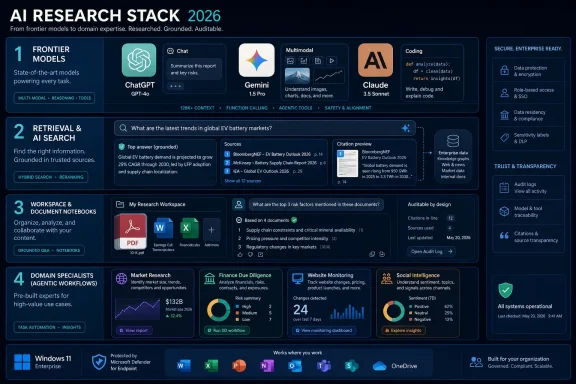
A better framework has at least four layers. The first is the frontier model layer, where OpenAI, Google, and Anthropic compete on reasoning, coding, multimodality, latency, safety, and developer access. The second is the retrieval layer, where Perplexity, You.com, and similar tools compete on source discovery, citation quality, private indexing, and answer generation.
The third is the workspace layer, where NotebookLM and document-grounded systems help users reason over known sources. The fourth is the domain layer, where Quantilope, Hebbia, Visualping, and Brandwatch turn AI into industry-specific research operations. Each layer has its own definition of “best.”
This is why IT buyers should be cautious with global rankings. A vendor can be outstanding in one layer and irrelevant in another. The best financial due diligence platform is not necessarily a good literature review tool. The best social listening platform is not a coding assistant. The best general assistant may be the wrong place to store sensitive internal documents without the right enterprise controls.
Copilot’s advantage is distribution. It lives where many organizations already work: Windows, Edge, Microsoft 365, Teams, Outlook, Excel, Word, PowerPoint, GitHub, Security Copilot, and Azure. That does not automatically make it the best reasoning system. But enterprise adoption is not determined only by model quality. It is determined by identity, permissions, compliance, procurement, admin controls, and whether the tool appears inside the workflow employees already use.
This is especially true for IT and security teams. A research assistant that understands tenant data, device posture, security alerts, email context, and documentation can be more operationally valuable than a more dazzling public chatbot. Microsoft’s challenge is consistency: Copilot experiences have varied across products, licensing tiers, and workloads. But the company’s strategic position remains formidable.
The omission also reveals how fast the category is moving. A list built from AI-native research enthusiasm may favor ChatGPT, Claude, Perplexity, and NotebookLM. A list built from CIO adoption patterns might elevate Microsoft, ServiceNow, Salesforce, Atlassian, or other embedded enterprise platforms. In 2026, AI research is not confined to tools marketed as research tools.
Evidence handling has several dimensions. The platform must retrieve relevant material, distinguish current sources from stale ones, preserve context, expose uncertainty, and avoid laundering weak sources into strong-sounding conclusions. It must also let users inspect enough of the underlying material to verify the answer.
This is where document-grounded and domain-specific tools can outperform general assistants. NotebookLM’s source-bounded design, Hebbia’s emphasis on citations inside document collections, Perplexity’s citation-first search interface, and Visualping’s change logs all reflect a move toward auditable AI. They do not eliminate error, but they make error easier to detect.
For enterprise users, evidence handling intersects with governance. Who uploaded the documents? Who can query them? Are answers logged? Can sensitive data leak into training? Are citations permission-aware? Can administrators enforce retention policies? These questions are less exciting than benchmark scores, but they determine whether AI research tools can move from individual productivity hacks to approved infrastructure.
For Windows environments, that shift has practical implications. Agentic tools will touch browsers, local files, cloud storage, identity providers, endpoint security, developer environments, and business applications. They will need permissions. They will make mistakes. They will create logs. They will become part of the attack surface.
This is why the best AI research platform for a hobbyist is not automatically the best one for an enterprise. A consumer AI assistant can be evaluated on speed, writing quality, and convenience. An enterprise research agent must be evaluated on access control, auditability, data isolation, source transparency, integration with existing systems, and failure modes.
The risk is not that AI research tools will be useless. The risk is that they will be useful enough to be adopted informally before governance catches up. Shadow AI is the new shadow IT, and research workflows are a perfect breeding ground because they often begin as harmless personal productivity experiments.
The AI research platform market in 2026 is not converging on one universal winner; it is dividing into layers that will increasingly interoperate, compete, and blur. The strongest organizations will not be the ones that pick the trendiest assistant, but the ones that understand when to use a frontier model, when to use an answer engine, when to lock the model inside a document set, and when to hand the job to a specialized research system built for the domain.
That matters because researchers, sysadmins, developers, analysts, and enterprise buyers are making budget and workflow decisions under a fog of category confusion. The platform that helps a graduate student digest 80 PDFs is not necessarily the platform that helps a security team triage advisories, and neither is the same as the system a private equity analyst uses for due diligence. The best AI research stack in 2026 is not a single winner’s podium. It is a layered architecture, and the NubiaPage list is most useful when read as a map of those layers rather than a clean global ranking.
 The Winner Is Not a Tool, It Is the Interface Layer
ChatGPT’s placement at the top of the list is hard to dispute, even if the exact user figures attached to it vary by source and reporting window. By 2026, OpenAI’s assistant had become the default public interface for working with large language models, and its reach gives it an unfair but very real advantage: it is where millions of people first learn how to ask machines to reason, summarize, code, compare, and draft.That ubiquity makes ChatGPT more than a chatbot. It is a research workbench, a prototyping surface, a coding companion, and, through the API, a programmable substrate for organizations building their own workflows. For WindowsForum readers, that distinction matters because the consumer app and the platform are now intertwined. A sysadmin might use ChatGPT to draft a PowerShell remediation script in the morning, review a vendor security advisory in the afternoon, and test an internal automation idea through the API by the end of the day.
The NubiaPage entry leans heavily on OpenAI’s model quality and ecosystem dominance, which is fair. ChatGPT’s biggest advantage is not merely that the underlying models are strong. It is that the surrounding ecosystem — documentation, plug-ins, enterprise controls, developer tools, community examples, and third-party integrations — turns model capability into repeatable practice.
But dominance has a shadow. A platform this broad becomes the benchmark even when it is not the best tool for a specific research workflow. Researchers may default to ChatGPT because it is familiar, not because it has the cleanest source handling, the best document grounding, the strongest institutional controls, or the most transparent retrieval behavior. In 2026, the question is less “Can ChatGPT do this?” and more “Should this task be trusted to a general-purpose assistant, or should it move into a specialized system with narrower guarantees?”
Google’s Research Bet Is the Stack, Not the Chat Window
Gemini’s second-place ranking reflects a different kind of strength. Google does not need Gemini to win every side-by-side prompt contest to make it indispensable for research. It needs Gemini to become the connective tissue across Search, Workspace, Cloud, Android, Chrome, and specialized tools such as NotebookLM.That is the strategic difference between OpenAI and Google. OpenAI’s gravitational center is the assistant. Google’s is the information infrastructure around the assistant. For researchers, that means Gemini’s value often appears not in a single answer but in the handoff: from search to document, from document to model, from model to spreadsheet, from spreadsheet to cloud-hosted experiment.
The NubiaPage description rightly emphasizes Gemini’s fit for multimodal and infrastructure-heavy workflows. This is especially relevant for technical users working across code, logs, screenshots, datasets, and documentation. A Windows administrator debugging a deployment problem, for example, may need to correlate an error message, a policy setting, a vendor doc, and a change history. The platform that can bridge those sources with the least friction has an advantage that raw benchmark scores do not fully capture.
Still, Google’s weakness is the same as its strength: sprawl. The Gemini brand touches consumer chat, developer APIs, Workspace features, Android features, cloud services, and research tooling. That can be powerful inside an organization already standardized on Google. It can also make evaluation harder, because “Gemini” may mean very different products depending on whether the buyer is a developer, educator, analyst, or enterprise administrator.
Claude Became the Researcher’s Second Brain by Refusing to Sound Like One
Anthropic’s Claude earns its place because it has become the model family many professionals reach for when the work involves long-form reasoning, code, or prose that should not read like a machine-generated corporate memo. Its reputation for natural writing is not a trivial feature. Research is not just retrieval and calculation; it is argument, framing, explanation, and judgment.The NubiaPage list highlights Claude’s influence in software engineering through tools such as Cursor and Windsurf, and that is where Anthropic’s impact may be most visible to technical communities. Coding agents have moved from novelty to daily workflow with remarkable speed. For developers, the research task is often inseparable from implementation: read the docs, inspect the repository, infer intent, propose a patch, run the tests, explain the tradeoff.
Claude’s safety-and-alignment positioning also gives it a distinct identity. Anthropic has built its brand around more predictable model behavior, constitutional AI, and careful deployment. Whether one views that as a philosophical advantage or a marketing frame, it has made Claude an important platform for studying human-AI interaction, model refusals, long-context behavior, and enterprise trust.
The limitation is ecosystem breadth. Claude is powerful, but Anthropic does not yet command the same platform surface area as OpenAI or Google. That makes Claude feel less like the default operating layer for all research and more like a high-end instrument: excellent when selected deliberately, less dominant when the workflow depends on surrounding distribution, storage, search, office tools, or cloud infrastructure.
AI Search Made Citations a Product Feature, Then Made Them a Liability
Perplexity’s placement is one of the most interesting parts of the ranking because it represents the rise of AI search as a distinct research category. Unlike a general chatbot, Perplexity’s promise is not merely to produce an answer. It is to produce an answer that can be traced back to live sources.That changes the user’s posture. In a conventional chatbot, citations may feel optional or bolted on. In Perplexity, source attribution is central to the product experience. For literature surveys, market scans, competitive research, and fast technical orientation, that makes the tool genuinely useful. It can compress the early phase of research: the messy stage where a person tries to understand what exists, which sources matter, and which claims are repeated across the web.
But citation-first AI search has an uncomfortable weakness: citing a source is not the same as understanding it, and retrieval is not neutrality. By 2026, researchers had already begun paying closer attention to source-selection bias in generative search systems. If an AI answer engine consistently favors certain domains, formats, communities, or highly optimized pages, its polished answers may hide a distorted evidence base.
That does not make Perplexity untrustworthy. It makes it a research instrument that must be used with method. Its best role is as a fast scout, not a final authority. For professional work, the cited sources still need to be opened, compared, and challenged — especially in domains where marketing pages, SEO content, forum threads, and outdated documentation can all appear authoritative when squeezed into the same answer box.
NotebookLM Shows That Research Often Starts After the Web Search Ends
NotebookLM’s inclusion is a useful corrective to the idea that all research begins with the open web. In many real workflows, the important material is already in front of the user: PDFs, meeting notes, policy documents, transcripts, spreadsheets, slide decks, manuals, draft papers, legal exhibits, or internal reports. The problem is not finding more information. The problem is making sense of what has already been collected.That is where NotebookLM’s document-centric design matters. It encourages users to create a bounded knowledge space, upload or connect sources, and ask questions against that corpus. The model’s job is not to hallucinate a grand tour of the internet but to help the user navigate a defined set of materials.
For academics, students, journalists, lawyers, analysts, and enterprise teams, this is arguably closer to real research than a blank prompt window. Serious work often involves source discipline. The researcher needs to know not only what the system says, but which document it drew from, where the claim appears, and whether the answer reflects the corpus or slips beyond it.
NotebookLM also points toward a broader future: AI tools that are less interested in being omniscient and more interested in being faithful to a workspace. That may be less glamorous than a frontier model launch, but it is often more useful. A model that stays grounded in the right 40 documents can outperform a more powerful model wandering through the wrong universe of sources.
You.com Is a Reminder That AI Search Was Never Just Google Versus Perplexity
You.com sits in the ranking as a search-native AI platform with agentic ambitions, and its presence is a reminder that the AI search market is broader than the most visible brands. The company’s early bet was that search would become conversational, customizable, and multi-model. In 2026, that thesis looks less radical than it once did.The interesting part of You.com is not simply that it can summarize web results. Many tools now do that. Its more important idea is that research workflows can be assembled from search, private indexing, model selection, and task-specific agents. That makes it appealing to users who want more control over how an AI research assistant behaves and which information spaces it can access.
For organizations, private indexing is not a minor feature. Most valuable enterprise knowledge does not live on the public web. It lives in ticketing systems, file shares, SharePoint libraries, Slack archives, Teams chats, internal wikis, customer notes, and code repositories. A research platform that can blend public and private retrieval while preserving access controls becomes far more relevant than a generic answer engine.
The challenge for You.com is visibility. OpenAI has the mass interface, Google has the infrastructure, Perplexity has the answer-engine brand, and Microsoft has distribution through Windows, Edge, Office, GitHub, and Azure. You.com’s value proposition is real, but in enterprise software, being flexible is not enough. The market also rewards default placement, procurement familiarity, and integration inertia.
The Specialist Platforms Prove That “Research” Is Not One Market
The back half of the NubiaPage ranking shifts from general AI platforms to specialized research tools: Quantilope, Hebbia, Visualping, and Brandwatch. This is where the list becomes less like a model leaderboard and more like a taxonomy of applied intelligence.Quantilope represents AI-assisted market research. Its strength is not that it can answer any question but that it can structure surveys, automate advanced methods, accelerate analysis, and turn consumer data into business decisions. That is a different proposition from asking a chatbot to summarize survey responses. The platform embeds methodology into the workflow.
Hebbia does something similar for financial and professional research. Its Matrix-style approach is built around multi-document synthesis, due diligence, and evidence-backed answers across large collections of documents. In finance, the value of AI is not a clever paragraph; it is the ability to process deal rooms, filings, memos, and proprietary documents without losing traceability.
Visualping is narrower still. It monitors websites for changes: pricing updates, product language, policy shifts, feature launches, job postings, regulatory notices, or competitor moves. Calling that an AI research platform may seem generous, but it captures an important truth. Research is not only synthesis. Sometimes it is surveillance — the disciplined act of noticing that something changed.
Brandwatch closes the list from the social intelligence side. It is built for monitoring conversations, sentiment, brand health, campaign impact, and social signals at scale. That makes it relevant not only to marketers but to researchers studying public opinion, consumer behavior, reputation risk, and cultural trends.
The common thread is specialization. These platforms are not trying to beat ChatGPT at general reasoning. They are trying to own a research domain where data collection, workflow design, analytics, and reporting matter as much as model fluency. In 2026, that may be where many enterprise AI budgets end up: not in one universal assistant, but in vertical systems that make a specific department faster.
The Ranking Is Useful, But the Category Is Too Blunt
The biggest weakness in a “Top 10 AI research platforms” list is that it implies a single axis of comparison. That is not how these products compete. ChatGPT, NotebookLM, Hebbia, Visualping, and Brandwatch may all support research, but they do not solve the same problem.A better framework has at least four layers. The first is the frontier model layer, where OpenAI, Google, and Anthropic compete on reasoning, coding, multimodality, latency, safety, and developer access. The second is the retrieval layer, where Perplexity, You.com, and similar tools compete on source discovery, citation quality, private indexing, and answer generation.
The third is the workspace layer, where NotebookLM and document-grounded systems help users reason over known sources. The fourth is the domain layer, where Quantilope, Hebbia, Visualping, and Brandwatch turn AI into industry-specific research operations. Each layer has its own definition of “best.”
This is why IT buyers should be cautious with global rankings. A vendor can be outstanding in one layer and irrelevant in another. The best financial due diligence platform is not necessarily a good literature review tool. The best social listening platform is not a coding assistant. The best general assistant may be the wrong place to store sensitive internal documents without the right enterprise controls.
Microsoft Is the Missing Giant in the Room
For a Windows-focused audience, the most conspicuous absence in the NubiaPage list is Microsoft Copilot. Whether one agrees with leaving it out depends on how the term “AI research platform” is defined. If the list is weighted toward standalone research products and frontier model brands, the omission is understandable. If it is meant to capture the tools that will shape everyday enterprise research in 2026, Microsoft is difficult to ignore.Copilot’s advantage is distribution. It lives where many organizations already work: Windows, Edge, Microsoft 365, Teams, Outlook, Excel, Word, PowerPoint, GitHub, Security Copilot, and Azure. That does not automatically make it the best reasoning system. But enterprise adoption is not determined only by model quality. It is determined by identity, permissions, compliance, procurement, admin controls, and whether the tool appears inside the workflow employees already use.
This is especially true for IT and security teams. A research assistant that understands tenant data, device posture, security alerts, email context, and documentation can be more operationally valuable than a more dazzling public chatbot. Microsoft’s challenge is consistency: Copilot experiences have varied across products, licensing tiers, and workloads. But the company’s strategic position remains formidable.
The omission also reveals how fast the category is moving. A list built from AI-native research enthusiasm may favor ChatGPT, Claude, Perplexity, and NotebookLM. A list built from CIO adoption patterns might elevate Microsoft, ServiceNow, Salesforce, Atlassian, or other embedded enterprise platforms. In 2026, AI research is not confined to tools marketed as research tools.
The Real Test Is Not Intelligence, But Evidence Handling
Across the entire ranking, one criterion matters more than the marketing copy admits: how each platform handles evidence. Research is not the same as fluent synthesis. A system that produces a confident answer without a clear evidence trail can be useful for brainstorming but dangerous for decision-making.Evidence handling has several dimensions. The platform must retrieve relevant material, distinguish current sources from stale ones, preserve context, expose uncertainty, and avoid laundering weak sources into strong-sounding conclusions. It must also let users inspect enough of the underlying material to verify the answer.
This is where document-grounded and domain-specific tools can outperform general assistants. NotebookLM’s source-bounded design, Hebbia’s emphasis on citations inside document collections, Perplexity’s citation-first search interface, and Visualping’s change logs all reflect a move toward auditable AI. They do not eliminate error, but they make error easier to detect.
For enterprise users, evidence handling intersects with governance. Who uploaded the documents? Who can query them? Are answers logged? Can sensitive data leak into training? Are citations permission-aware? Can administrators enforce retention policies? These questions are less exciting than benchmark scores, but they determine whether AI research tools can move from individual productivity hacks to approved infrastructure.
Agentic Research Raises the Stakes for Windows Shops
The next stage of AI research platforms is not better summaries. It is agentic workflows: systems that search, read, compare, extract, code, monitor, file tickets, generate reports, and update dashboards with less human prompting. Every platform in the NubiaPage list is being pulled in that direction, even if some are moving faster than others.For Windows environments, that shift has practical implications. Agentic tools will touch browsers, local files, cloud storage, identity providers, endpoint security, developer environments, and business applications. They will need permissions. They will make mistakes. They will create logs. They will become part of the attack surface.
This is why the best AI research platform for a hobbyist is not automatically the best one for an enterprise. A consumer AI assistant can be evaluated on speed, writing quality, and convenience. An enterprise research agent must be evaluated on access control, auditability, data isolation, source transparency, integration with existing systems, and failure modes.
The risk is not that AI research tools will be useless. The risk is that they will be useful enough to be adopted informally before governance catches up. Shadow AI is the new shadow IT, and research workflows are a perfect breeding ground because they often begin as harmless personal productivity experiments.
The 2026 Shortlist Says More About Workflows Than Winners
The NubiaPage ranking is most valuable when treated as a set of signals about where AI-assisted research is going, not as a final league table. The names on the list show a market splitting into recognizable roles: general reasoning, AI search, private document synthesis, vertical analytics, monitoring, and social intelligence.- ChatGPT remains the default general-purpose AI research interface because its model quality, adoption, API access, and ecosystem reinforce one another.
- Gemini’s strongest research advantage is Google’s surrounding infrastructure, especially when users already live inside Search, Workspace, Cloud, and NotebookLM.
- Claude has become a premium choice for code-heavy, writing-heavy, and alignment-sensitive workflows, even without the same distribution footprint as OpenAI or Google.
- Perplexity and You.com show that AI search is now a separate research category where retrieval quality and source behavior matter as much as prose.
- NotebookLM, Hebbia, Quantilope, Visualping, and Brandwatch prove that specialized platforms can beat general assistants when the workflow requires structure, auditability, or domain-specific data.
- The absence of Microsoft Copilot is a reminder that AI research rankings can underweight embedded enterprise platforms that may matter more inside real Windows and Microsoft 365 environments.
The AI research platform market in 2026 is not converging on one universal winner; it is dividing into layers that will increasingly interoperate, compete, and blur. The strongest organizations will not be the ones that pick the trendiest assistant, but the ones that understand when to use a frontier model, when to use an answer engine, when to lock the model inside a document set, and when to hand the job to a specialized research system built for the domain.
References
- Primary source: Nubia Magazine!
Published: 2026-06-27T16:50:14.253179
Top 10 Best AI Research Platforms In The World 2026 | Nubia Magazine
Artificial intelligence has transformed how researchers across every discipline conduct their work.nubiapage.com - Related coverage: presenc.ai
ChatGPT Usage Statistics 2026 | Presenc AI
Comprehensive ChatGPT usage statistics for 2026: 900M+ weekly active users, session data, enterprise vs consumer split, geographic breakdown, and growth...presenc.ai - Related coverage: androidcentral.com
Google stocks 'featured notebooks' on NotebookLM shelves for curated topics | Android Central
Learning and understanding continue to advance for this research notebook app.www.androidcentral.com - Related coverage: quantilope.com
Accelerate Consumer Insights with quantilope's Market Research Platform
Discover quantilope's market research platform combining advanced methodology, automation, and real-time tracking to deliver actionable consumer insights. www.quantilope.com
- Related coverage: visualping.io
10 Best AI Tools for Competitor Analysis (2026)
Compare the 10 best AI competitor analysis tools for 2026, tested against data from 9,705 live competitor monitors. Free to $3K/mo, with decision matrix.visualping.io
- Related coverage: foglift.io
AI Search Tool Citation Benchmark 2026 | Vendor Share of Voice | Foglift
2026 benchmark of buyer questions across five AI engines, measuring which AI search visibility tools and source domains get named and cited.foglift.io
- Related coverage: techradar.com
Best website change monitoring software of 2025 | TechRadar
Watch for unauthorized changeswww.techradar.com
