

CVE-2026-53304 is a newly published Linux kernel vulnerability, added to NVD on June 26, 2026, in the SCSI generic driver, where an invalid
The vulnerable path is almost comically simple. The SCSI generic driver exposes a module parameter named
The problem is that one path enforced the rule and another did not. Writing through the documented proc interface applied validation, but writing directly to the module parameter under
That matters because a soft lockup is not merely an ugly log message. It means a CPU has spent too long in kernel mode without yielding in the way the scheduler expects. On a single-purpose lab machine, that may look like a frozen shell and an annoyed engineer; on a multi-tenant host or storage gateway, it can become service degradation, hung automation, or a forced reboot at exactly the wrong time.
The call trace tells a tidy story. The failure runs through
That makes this CVE more interesting than its likely severity score, which NVD had not yet assigned at publication time. A vulnerability in
The exploit condition described in the advisory requires the ability to write the module parameter. On a normal distribution, that is not something an unprivileged user should be able to do. That sharply limits the practical threat model and is the difference between “patch during your normal kernel cadence” and “drop everything before lunch.”
Still, that does not make the flaw irrelevant. Root-triggered denial of service may sound redundant until one remembers how many automated scripts, privileged agents, container hosts, management daemons, and hardware probes run with elevated rights. A bug that turns a bad parameter write into a kernel stall can transform a configuration mistake or compromised privileged helper into a host-level availability problem.
That is good kernel engineering, but it is also a reminder of a recurring pattern. Security bugs often appear where a value has two doors into the same room and only one door has a guard. The procfs path knew the acceptable range. The sysfs module-parameter path did not. The system did not lack a policy; it lacked policy centralization.
This distinction matters for admins reading vulnerability feeds. CVE descriptions often compress bugs into cryptic fragments: “improper validation,” “out-of-bounds,” “use-after-free,” “soft lockup.” The practical question is whether the subsystem accepts attacker-influenced state in more than one way. Here it did, and the fix moves validation closer to the actual assignment of the sensitive variable.
The patch history also shows the familiar stable-kernel machinery doing its work. The fix was propagated across multiple supported branches, including long-term series, rather than being treated as a mainline-only cleanup. That is the right outcome for a driver whose affected logic reaches back many years.
WSL changed developer workstations. Hyper-V changed local virtualization. Azure, mixed fleets, backup appliances, NAS devices, Kubernetes nodes, and security tooling changed the operational boundary. A Windows admin may never type
The more subtle issue is cultural. Windows administrators are used to Microsoft’s consolidated patch narrative: cumulative updates, KB numbers, known issues, and support matrices. Linux kernel CVEs arrive through a messier supply chain. Kernel.org may publish the fix, NVD may lag on scoring, distributions may backport without changing the headline version in obvious ways, and appliance vendors may publish advisories weeks later.
That means the right question is not “Is my kernel version numerically higher than the vulnerable one?” The better question is whether the exact distribution kernel you run has the fix backported. Enterprise Linux vendors routinely patch older version streams while preserving ABI compatibility and familiar version branding. A system can look old and be fixed, or look new enough and still be waiting on a vendor update.
For this vulnerability, a sober reading points toward availability impact, local prerequisites, and constrained exploitability. The advisory’s reproducer requires writing a module parameter under sysfs, which normally implies administrative privilege. That is not the same class of risk as an unauthenticated network-triggered kernel panic.
But CVSS scores have always struggled with context. On a developer laptop, the bug is likely a curiosity fixed by the next distro kernel update. On a storage host where privileged automation can touch SCSI generic devices, a soft lockup is more meaningful. On an appliance with limited shell access but vendor daemons running as root, the question becomes whether any managed pathway can write module parameters or indirectly influence them.
This is where security teams should resist both panic and dismissal. The vulnerability is probably not a fire drill for most organizations. It is also not “nothing” simply because root access is involved. Availability bugs in kernel-space code have a nasty habit of becoming operational incidents when combined with automation, unusual hardware, or constrained recovery windows.
That does not make legacy kernel code bad. It makes it expensive to maintain. Every old interface has documentation, users, scripts, and expectations. Removing it is hard; tightening it can break obscure workflows; leaving it alone invites exactly this class of bug. The kernel community’s answer is usually incremental hardening: validate earlier, reject impossible states, consolidate checks, and backport fixes when a real failure mode appears.
CVE-2026-53304 is a useful example because the invalid value is absurd. A negative reserved buffer size should never have meaningful semantics. Yet low-level code often operates on types and assumptions that turn absurd inputs into loops, wraparounds, oversized allocations, or impossible branches. The more privileged the code, the less forgiving it can be.
This is also why fuzzers and hostile test cases keep finding bugs in mature code. They do not need to understand the human intention of a module parameter. They only need to ask what happens when the value violates the contract. The answer, in this case, was: the kernel may get stuck opening a device node.
The affected code dates back far enough that many supported kernel branches needed attention. The CVE record lists affected Git ranges and marks several stable versions as fixed, including long-term lines such as 5.10, 5.15, 6.1, and 6.6. That broad backport pattern is exactly what admins should expect from a bug in a common driver: it is less about the shiny latest kernel and more about whether your vendor has pulled the targeted fix into your maintenance stream.
There is also a configuration angle. Systems without the
Temporary mitigations should be treated carefully. Locking down write access to sysfs module parameters is already the normal posture, and device-node permissions should be kept conservative. But if a system’s defense against a kernel bug depends on nobody with privilege ever making a mistake, the real mitigation is still the patched kernel.
Virtualization does, however, make the operational impact more plausible. Lab hosts often attach and detach virtual disks, pass through USB devices, run storage tests, and expose kernel interfaces to automation. CI systems build and boot custom kernels. Developers run privileged containers or VMs that are less locked down than production. Those are the environments where a local denial-of-service bug can be rediscovered by accident.
There is also a Windows-adjacent wrinkle. A Windows workstation running Linux VMs for development or hardware testing may not be managed like a production server, but it can still hold valuable work and act as part of a larger engineering pipeline. If that Linux guest or host can be wedged by a bad privileged script, the result may be lost time rather than a breach. Lost time is still a cost.
Enterprise risk management tends to focus on external attackers, and rightly so. But availability vulnerabilities in kernel code often surface as reliability problems before they surface as adversarial ones. The same bug that a researcher triggers with two shell commands can later be triggered by a malformed internal script, an overeager tuning guide, or a vendor diagnostic tool that assumes a parameter accepts a wider range than it should.
That flattening is dangerous because this CVE is not primarily about the SCSI subsystem in the abstract. It is about input validation at an administrative boundary. It is about the difference between documented configuration and raw module state. It is about a driver accepting a value it could never safely honor. Those details tell defenders what kind of adjacent mistakes to look for elsewhere.
The Linux kernel has been moving steadily toward treating “root can crash the machine” as less acceptable than it once was. That is healthy. Root may be powerful, but modern systems divide root-like authority among services, containers, orchestrators, installers, and remote management agents. A robust kernel should reject impossible inputs even when they arrive from privileged paths.
Windows has followed a similar philosophical arc in its own way. Administrators can still destroy a system, of course, but the platform increasingly assumes that privileged operations should be constrained, audited, policy-bound, and recoverable. The old model of “if an admin can do it, it is not a bug” fits poorly in a world of endpoint agents, remote scripts, and just-in-time privilege.
That smallness is the point. Kernel reliability often depends on mundane checks being in exactly the right place. A missing range check does not need a marketing name to matter. It only needs to sit on a code path where an impossible value becomes real work for the kernel.
For security teams, the best response is disciplined normalcy. Track the CVE, map it to your distributions, deploy fixed kernels through the usual maintenance process, and avoid treating an unscored NVD entry as invisible. If you operate storage-heavy Linux systems, virtualization hosts, or appliances that expose SCSI generic interfaces, give this one a little more attention than a random low-impact driver cleanup.
The story also argues for better inventory. Many organizations cannot easily answer whether
def_reserved_size module parameter can trigger a CPU soft lockup when a process opens /dev/sgX. The bug is not a cinematic remote-code-execution disaster, and that is precisely why it is worth paying attention to. It sits in the uncomfortable middle ground where a small validation mistake becomes a local denial-of-service primitive in code that still matters to virtualization hosts, storage tooling, removable media stacks, scanners, tape devices, and old-fashioned sysadmin muscle memory. For WindowsForum readers, the lesson is not that Linux suddenly became fragile; it is that every modern platform, including Windows, lives or dies by the boring correctness of kernel boundary checks.
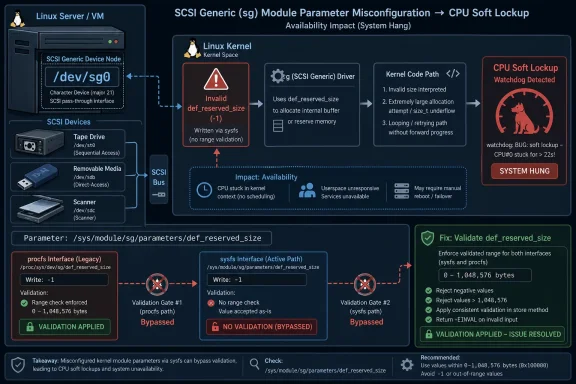 A One-Line Parameter Turns Into a Kernel-Wide Stall
The vulnerable path is almost comically simple. The SCSI generic driver exposes a module parameter named def_reserved_size, intended to define the default buffer reserved for each SCSI generic file descriptor. Documentation and existing procfs handling put that value in a sane range: zero through 1,048,576 bytes.The problem is that one path enforced the rule and another did not. Writing through the documented proc interface applied validation, but writing directly to the module parameter under
/sys/module/sg/parameters/def_reserved_size could bypass the same range checks. Set the value to -1, open a device such as /dev/sg0, and the kernel can spin long enough for the watchdog to report a soft lockup.That matters because a soft lockup is not merely an ugly log message. It means a CPU has spent too long in kernel mode without yielding in the way the scheduler expects. On a single-purpose lab machine, that may look like a frozen shell and an annoyed engineer; on a multi-tenant host or storage gateway, it can become service degradation, hung automation, or a forced reboot at exactly the wrong time.
The call trace tells a tidy story. The failure runs through
sg_open, then into sg_add_sfp, and into sg_build_reserve, which is where the nonsensical buffer size finally becomes operationally dangerous. The bug is not in a grand security architecture decision; it is in the assumption that one validation gate was enough.The SCSI Generic Driver Is Old, Useful, and Still in the Blast Radius
Thesg driver is one of those Linux subsystems that many users never knowingly touch but plenty of tools quietly rely on. It provides a generic user-space interface to SCSI commands, which historically covered disks and tapes but now also intersects with USB storage, optical drives, scanners, media changers, and assorted hardware-management workflows. In the modern stack, SCSI is less a product category than a protocol vocabulary that refuses to die.That makes this CVE more interesting than its likely severity score, which NVD had not yet assigned at publication time. A vulnerability in
drivers/scsi/sg.c is not automatically catastrophic, but it lives in code paths that can be present on servers, desktops, appliances, and virtualized test environments. Kernel bugs in broadly compiled drivers tend to have a long tail because exposure depends less on branding and more on configuration, device nodes, permissions, and local access.The exploit condition described in the advisory requires the ability to write the module parameter. On a normal distribution, that is not something an unprivileged user should be able to do. That sharply limits the practical threat model and is the difference between “patch during your normal kernel cadence” and “drop everything before lunch.”
Still, that does not make the flaw irrelevant. Root-triggered denial of service may sound redundant until one remembers how many automated scripts, privileged agents, container hosts, management daemons, and hardware probes run with elevated rights. A bug that turns a bad parameter write into a kernel stall can transform a configuration mistake or compromised privileged helper into a host-level availability problem.
The Fix Is Small Because the Mistake Was Architectural
The kernel patch takes the direct route: replace the simple module parameter declaration with a callback-backed parameter handler. Instead of letting the generic integer setter accept whatever fits into anint, the new setter parses the value and rejects anything below zero or above 1 MB. The result is a straightforward -ERANGE instead of a watchdog screaming about a stuck CPU.That is good kernel engineering, but it is also a reminder of a recurring pattern. Security bugs often appear where a value has two doors into the same room and only one door has a guard. The procfs path knew the acceptable range. The sysfs module-parameter path did not. The system did not lack a policy; it lacked policy centralization.
This distinction matters for admins reading vulnerability feeds. CVE descriptions often compress bugs into cryptic fragments: “improper validation,” “out-of-bounds,” “use-after-free,” “soft lockup.” The practical question is whether the subsystem accepts attacker-influenced state in more than one way. Here it did, and the fix moves validation closer to the actual assignment of the sensitive variable.
The patch history also shows the familiar stable-kernel machinery doing its work. The fix was propagated across multiple supported branches, including long-term series, rather than being treated as a mainline-only cleanup. That is the right outcome for a driver whose affected logic reaches back many years.
This Is Not a Windows Bug, but Windows Shops Should Still Care
At first glance, a Linux SCSI generic CVE seems outside the WindowsForum orbit. It is not a Windows kernel flaw, it does not target NTFS, Hyper-V, Defender, or the Win32 subsystem, and it will not be fixed by Patch Tuesday. But Windows-heavy environments increasingly run Linux in places where Windows administrators still own the risk.WSL changed developer workstations. Hyper-V changed local virtualization. Azure, mixed fleets, backup appliances, NAS devices, Kubernetes nodes, and security tooling changed the operational boundary. A Windows admin may never type
modprobe sg, yet still be responsible for a Linux VM that exposes SCSI pass-through to a backup stack or a lab host that uses generic SCSI tooling to test devices.The more subtle issue is cultural. Windows administrators are used to Microsoft’s consolidated patch narrative: cumulative updates, KB numbers, known issues, and support matrices. Linux kernel CVEs arrive through a messier supply chain. Kernel.org may publish the fix, NVD may lag on scoring, distributions may backport without changing the headline version in obvious ways, and appliance vendors may publish advisories weeks later.
That means the right question is not “Is my kernel version numerically higher than the vulnerable one?” The better question is whether the exact distribution kernel you run has the fix backported. Enterprise Linux vendors routinely patch older version streams while preserving ABI compatibility and familiar version branding. A system can look old and be fixed, or look new enough and still be waiting on a vendor update.
NVD’s Missing Score Is a Signal, Not an Excuse
At the time the CVE record appeared in the NVD dataset, NVD had not yet provided CVSS 4.0, 3.x, or 2.0 scoring. That absence is not unusual for freshly published kernel CVEs, but it can create confusion inside organizations that route remediation work by numeric severity. No score does not mean no bug. It means the enrichment pipeline has not finished turning the record into the simplified risk token that dashboards prefer.For this vulnerability, a sober reading points toward availability impact, local prerequisites, and constrained exploitability. The advisory’s reproducer requires writing a module parameter under sysfs, which normally implies administrative privilege. That is not the same class of risk as an unauthenticated network-triggered kernel panic.
But CVSS scores have always struggled with context. On a developer laptop, the bug is likely a curiosity fixed by the next distro kernel update. On a storage host where privileged automation can touch SCSI generic devices, a soft lockup is more meaningful. On an appliance with limited shell access but vendor daemons running as root, the question becomes whether any managed pathway can write module parameters or indirectly influence them.
This is where security teams should resist both panic and dismissal. The vulnerability is probably not a fire drill for most organizations. It is also not “nothing” simply because root access is involved. Availability bugs in kernel-space code have a nasty habit of becoming operational incidents when combined with automation, unusual hardware, or constrained recovery windows.
The Old Driver Problem Keeps Returning
Kernel subsystems likesg accumulate history. They were designed for eras when the threat model was different, the set of expected users was smaller, and local root was treated as an almost absolute boundary. Modern deployments have complicated that assumption. Privilege is delegated, namespaced, automated, proxied, and sometimes accidentally overexposed.That does not make legacy kernel code bad. It makes it expensive to maintain. Every old interface has documentation, users, scripts, and expectations. Removing it is hard; tightening it can break obscure workflows; leaving it alone invites exactly this class of bug. The kernel community’s answer is usually incremental hardening: validate earlier, reject impossible states, consolidate checks, and backport fixes when a real failure mode appears.
CVE-2026-53304 is a useful example because the invalid value is absurd. A negative reserved buffer size should never have meaningful semantics. Yet low-level code often operates on types and assumptions that turn absurd inputs into loops, wraparounds, oversized allocations, or impossible branches. The more privileged the code, the less forgiving it can be.
This is also why fuzzers and hostile test cases keep finding bugs in mature code. They do not need to understand the human intention of a module parameter. They only need to ask what happens when the value violates the contract. The answer, in this case, was: the kernel may get stuck opening a device node.
The Practical Patch Story Is Distribution-Specific
For administrators, the remediation path is straightforward in principle and annoyingly specific in practice. Update to a kernel build that includes the upstream fix or a vendor backport. If you build kernels yourself, verify that thesg module parameter now uses a callback setter that rejects values outside the documented range. If you run a distribution kernel, trust the distribution’s security advisory over upstream version-number intuition.The affected code dates back far enough that many supported kernel branches needed attention. The CVE record lists affected Git ranges and marks several stable versions as fixed, including long-term lines such as 5.10, 5.15, 6.1, and 6.6. That broad backport pattern is exactly what admins should expect from a bug in a common driver: it is less about the shiny latest kernel and more about whether your vendor has pulled the targeted fix into your maintenance stream.
There is also a configuration angle. Systems without the
sg module loaded, without accessible SCSI generic device nodes, or without administrative users who can write the module parameter have a narrower exposure surface. But configuration should not become an excuse for indefinite deferral. Kernel updates carry many fixes at once, and this is the kind of low-drama bug that is best retired before it becomes part of a future incident report.Temporary mitigations should be treated carefully. Locking down write access to sysfs module parameters is already the normal posture, and device-node permissions should be kept conservative. But if a system’s defense against a kernel bug depends on nobody with privilege ever making a mistake, the real mitigation is still the patched kernel.
The Cloud and Virtualization Angle Is Less Exotic Than It Sounds
The reproducer in the CVE text used QEMU hardware, which is not surprising. Virtual machines are ideal places to test kernel bugs because they are disposable, observable, and easy to freeze. But the QEMU detail should not be overread as meaning this is a “VM-only” problem. The vulnerable logic is in the Linux SCSI generic driver, not in QEMU itself.Virtualization does, however, make the operational impact more plausible. Lab hosts often attach and detach virtual disks, pass through USB devices, run storage tests, and expose kernel interfaces to automation. CI systems build and boot custom kernels. Developers run privileged containers or VMs that are less locked down than production. Those are the environments where a local denial-of-service bug can be rediscovered by accident.
There is also a Windows-adjacent wrinkle. A Windows workstation running Linux VMs for development or hardware testing may not be managed like a production server, but it can still hold valuable work and act as part of a larger engineering pipeline. If that Linux guest or host can be wedged by a bad privileged script, the result may be lost time rather than a breach. Lost time is still a cost.
Enterprise risk management tends to focus on external attackers, and rightly so. But availability vulnerabilities in kernel code often surface as reliability problems before they surface as adversarial ones. The same bug that a researcher triggers with two shell commands can later be triggered by a malformed internal script, an overeager tuning guide, or a vendor diagnostic tool that assumes a parameter accepts a wider range than it should.
Security Feeds Flatten the Story Too Much
The modern vulnerability pipeline is efficient and oddly dehumanizing. A kernel patch becomes a CVE. The CVE lands in NVD. A scanner ingests the record. A dashboard assigns a row to an owner. Somewhere in that chain, the actual engineering story gets reduced to a component name, a version range, and a severity cell.That flattening is dangerous because this CVE is not primarily about the SCSI subsystem in the abstract. It is about input validation at an administrative boundary. It is about the difference between documented configuration and raw module state. It is about a driver accepting a value it could never safely honor. Those details tell defenders what kind of adjacent mistakes to look for elsewhere.
The Linux kernel has been moving steadily toward treating “root can crash the machine” as less acceptable than it once was. That is healthy. Root may be powerful, but modern systems divide root-like authority among services, containers, orchestrators, installers, and remote management agents. A robust kernel should reject impossible inputs even when they arrive from privileged paths.
Windows has followed a similar philosophical arc in its own way. Administrators can still destroy a system, of course, but the platform increasingly assumes that privileged operations should be constrained, audited, policy-bound, and recoverable. The old model of “if an admin can do it, it is not a bug” fits poorly in a world of endpoint agents, remote scripts, and just-in-time privilege.
The Patch Is Small; the Lesson Is Larger
The concrete fix for CVE-2026-53304 is not dramatic. Validate the parameter. Reject negative values. Reject anything over 1 MB. Usemodule_param_cb so the module parameter path enforces the same kind of sanity that the procfs path already understood.That smallness is the point. Kernel reliability often depends on mundane checks being in exactly the right place. A missing range check does not need a marketing name to matter. It only needs to sit on a code path where an impossible value becomes real work for the kernel.
For security teams, the best response is disciplined normalcy. Track the CVE, map it to your distributions, deploy fixed kernels through the usual maintenance process, and avoid treating an unscored NVD entry as invisible. If you operate storage-heavy Linux systems, virtualization hosts, or appliances that expose SCSI generic interfaces, give this one a little more attention than a random low-impact driver cleanup.
The story also argues for better inventory. Many organizations cannot easily answer whether
sg is loaded, which systems expose /dev/sgX, which scripts tune kernel module parameters, or which appliances ship a vulnerable driver. Those gaps matter more than the CVE’s eventual numeric score.The Kernel Boundary That Deserves Your Next Maintenance Window
This vulnerability is not the week’s biggest security crisis, and pretending otherwise would be unserious. Its value is as a clean case study in how a narrow kernel bug travels from an obscure parameter to a system-level availability risk.- CVE-2026-53304 affects the Linux kernel SCSI generic driver and was published in NVD on June 26, 2026.
- The bug allows invalid
def_reserved_sizevalues through the sysfs module-parameter path even though the documented range is zero through 1,048,576 bytes. - A negative value can cause a soft lockup when opening a SCSI generic device such as
/dev/sg0. - The practical risk is mainly local denial of service, with exposure depending on permissions, loaded modules, device-node access, and vendor kernel status.
- The fix validates the module parameter with a callback and rejects out-of-range values before they reach the vulnerable open path.
- Administrators should rely on distribution advisories and patched kernel packages rather than judging safety from upstream version numbers alone.
References
- Primary source: NVD / Linux Kernel
Published: 2026-06-28T01:02:48-07:00
Loading…
nvd.nist.gov - Security advisory: MSRC
Published: 2026-06-28T01:02:48-07:00
Original feed URL
Loading…
msrc.microsoft.com - Related coverage: stack.watch
Linux Kernel Security Vulnerabilities in 2026
 stack.watch
- Related coverage: docs.redhat.com
- Related coverage: support.bull.com
PSM Customer
support.bull.com