
CVE-2026-53279, published by NVD on June 26, 2026, covers a Linux kernel display-driver bug in
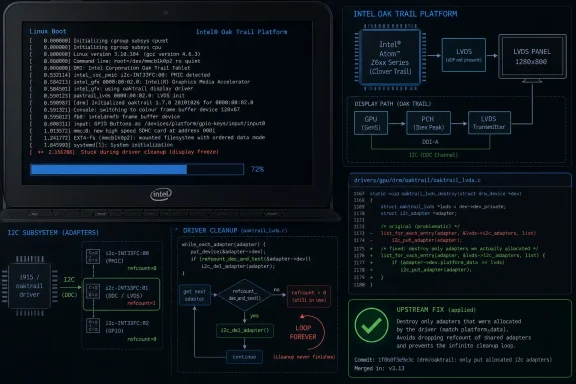
The vulnerability is narrow: the Linux kernel’s GMA500 Oak Trail LVDS initialization code tries to use an existing I2C adapter to read display EDID data, then falls back to creating and registering its own adapter if that path fails. The bug is in the cleanup path. If initialization fails late enough, the driver can mistakenly attempt to deregister and free an adapter it did not allocate.
That distinction matters because
The upstream fix is almost comically small: initialize the local
This is why the CVE is more interesting than its affected hardware population suggests. It is a case study in how kernel security accounting has expanded to include denial-of-service-class hangs in obscure driver paths, even when the vulnerable component is neither fashionable nor widely deployed.
That does not make it irrelevant. Old hardware persists in kiosks, point-of-sale systems, lab machines, thin clients, factory equipment, and hobbyist setups long after the consumer market has forgotten it. In those environments, a boot hang is not merely annoying; it can be an operational incident.
The affected file,
For WindowsForum readers, the Windows angle is indirect but real. Many administrators run mixed environments, dual-boot test benches, Linux-based appliances, WSL-adjacent developer systems, or Linux rescue environments alongside Windows fleets. A Linux kernel CVE in display initialization will not compromise Windows, but it can still affect the tools, appliances, and recovery media that Windows professionals depend on.
The LVDS initialization path obtains an I2C adapter in one of two ways. In one case, it borrows an adapter that already exists, taking a reference through
The broken code did not separate them cleanly. On a later failure, it could run a cleanup routine intended for an adapter created by the LVDS init path against an adapter that was merely looked up. That is where reference counting becomes unforgiving.
Kernel code lives and dies by these little contracts. If a function borrows a reference, it must put the reference. If it creates an object, it must destroy the object. If it confuses those two responsibilities, cleanup code can become more dangerous than the original error.
That is exactly the sort of bug static analysis, defensive initialization, and careful error-path review are supposed to catch. But driver initialization code is often a museum of hardware quirks, legacy assumptions, and paths that are hard to exercise without the right board on the bench. The code most likely to fail is often the code least frequently tested.
Still, the shape of the bug gives us reasonable boundaries. This is a local kernel driver initialization hang in a specific graphics path. The supplied description does not claim privilege escalation, information disclosure, memory corruption, sandbox escape, or remote exploitation.
The plausible impact is denial of service: a system can hang while initializing display hardware after a particular failure path is reached. That is serious if the affected system must boot unattended, less serious if the system does not contain the affected hardware or driver.
The absence of a score also illustrates a recurring frustration for defenders. CVE feeds deliver identifiers before they deliver context. Patch-management tools may flag a vulnerability, while the actual risk depends on hardware inventory, kernel configuration, driver loading behavior, and whether the affected path can be triggered on a given system.
For enterprise IT, the correct response is not panic. It is classification.
That version map is more useful than the missing CVSS score. If your distribution has already pulled in the relevant stable kernel update, this issue is likely already closed. If you build kernels yourself, carry vendor kernels, or maintain embedded Linux images, you need to check whether the GMA500 Oak Trail LVDS fix has landed in your tree.
The upstream patch was posted in May 2026 by Johan Hovold as part of a small GMA500 series addressing I2C adapter hangs and leaks. It was also tagged for stable backporting from the 6.0 line. The CVE publication followed on June 26, 2026, after the fix had already entered the kernel vulnerability machinery.
That chronology is important. This is not a case where defenders are learning about an actively exploited zero-day and waiting for a vendor response. It is the increasingly common kernel pattern: a bug is fixed upstream, backported to stable trees, then assigned a CVE so downstream consumers can track exposure.
But Windows administrators often own more than Windows endpoints. They own PXE infrastructure, imaging tools, recovery USBs, hypervisor hosts, Linux-based monitoring appliances, NAS devices, developer workstations, lab machines, and industrial PCs that are only “not Windows” until they break and land on the same help desk.
For those environments, a boot-time or display-init hang can be disproportionately disruptive. A machine that cannot finish initializing a panel may not expose a friendly error message. It may appear dead, frozen, or stuck before remote management is ready.
The more specialized the hardware, the more careful the patching strategy must be. Old Atom-era platforms can be fragile under kernel updates because the same stable release that fixes one driver bug may alter timing, power management, or another hardware path. The answer is not to avoid the fix; it is to test the exact image on the exact class of device before rolling it into unattended equipment.
The old mental model of a CVE as a headline-grade security bug no longer fits every kernel CVE. Some are critical. Some are exploitable only under constrained local conditions. Some are reliability failures that can be framed as denial of service. Some matter mainly to vendors shipping kernels into appliances or embedded products.
This is not a failure of the CVE system so much as a consequence of applying vulnerability tracking to a massive, fast-moving kernel. The Linux kernel is not one product in the way a standalone application is one product. It is an operating system core, hardware compatibility layer, driver collection, network stack, filesystem hub, and platform substrate.
That breadth means a bug in an obscure display driver can enter the same vulnerability pipeline as a major filesystem flaw. The identifier alone cannot tell you which is which. Defenders need to read the affected component, affected versions, and fix description before assigning operational urgency.
That is where cleanup code must unwind precisely. It must release what it acquired, unregister what it registered, and leave alone what it merely borrowed. CVE-2026-53279 is a textbook example of how a small ownership mistake in that unwind path can freeze the system.
The bug also shows why drivers are such a persistent source of kernel defects. Drivers sit at the boundary between generic kernel abstractions and hardware-specific reality. They often need to support devices that few developers still possess, using initialization paths that are difficult to test continuously.
The fix’s simplicity should not be mistaken for triviality. A one-line condition around destruction can encode a vital invariant: only destroy what this function created. That invariant is obvious after the fact and easy to miss when a patch is refactoring display connector behavior years earlier.
For Linux appliances and embedded systems, the inventory question comes first. Does the device use Intel Oak Trail-era graphics? Does its kernel include
Distribution users should look for the vendor’s kernel advisory rather than cherry-picking upstream commits blindly. Enterprise distributions often backport fixes without changing the visible upstream version number in a way that matches mainline version tables neatly. Embedded vendors may do the same, sometimes with slower cadence and less transparent changelogs.
Self-maintained kernel users have a more direct task. Confirm whether the fix corresponding to
Administrators should treat the missing NVD score as a reason to inspect, not a reason to ignore. A vulnerability without a CVSS number can still matter operationally. Conversely, a CVE identifier attached to a kernel driver fix does not automatically justify emergency change windows across unrelated infrastructure.
The right workflow is boring and effective: inventory, determine exposure, map vendor kernel status, test on hardware, and roll out through the normal maintenance channel. That is less satisfying than a red-alert security narrative, but it is how most kernel CVEs should be handled.
The lesson for Windows-heavy shops is equally practical. Linux may be “just” the appliance OS, the rescue environment, the hypervisor host, or the lab box — until it becomes the thing that prevents a service from coming back after a reboot. Hardware-specific kernel fixes deserve enough attention to avoid surprises in exactly those places.
drivers/gpu/drm/gma500/oaktrail_lvds.c where failed LVDS initialization on Intel Oak Trail-era graphics can hang indefinitely during I2C adapter cleanup. It is not a Windows vulnerability, not a remote-code-execution story, and not the sort of CVE that should send desktop fleets into emergency patch mode. But it is a useful reminder that the kernel’s modern CVE firehose increasingly includes highly specific reliability fixes whose security value depends less on dramatic exploitability than on where the affected code sits in the boot path.
 A Small Display Bug Becomes a CVE Because the Kernel Now Treats Hangs as Security-Relevant
The vulnerability is narrow: the Linux kernel’s GMA500 Oak Trail LVDS initialization code tries to use an existing I2C adapter to read display EDID data, then falls back to creating and registering its own adapter if that path fails. The bug is in the cleanup path. If initialization fails late enough, the driver can mistakenly attempt to deregister and free an adapter it did not allocate.That distinction matters because
i2c_get_adapter() increments the adapter’s reference count. Deregistering an already registered adapter while an extra reference remains can leave the kernel waiting forever for a reference release that will not happen in that path. The practical result is an indefinite hang during driver initialization failure handling.The upstream fix is almost comically small: initialize the local
ddc_bus pointer to NULL, and only destroy the I2C adapter that the LVDS init routine actually allocated. Five lines touched, three insertions, two deletions. But those are the kinds of changes that keep hardware initialization from turning a recoverable failure into a stuck machine.This is why the CVE is more interesting than its affected hardware population suggests. It is a case study in how kernel security accounting has expanded to include denial-of-service-class hangs in obscure driver paths, even when the vulnerable component is neither fashionable nor widely deployed.
Oak Trail Is Old, but Boot-Time Hangs Do Not Age Gracefully
Intel’s Oak Trail platform belongs to a very different era of computing: Atom-based tablets, embedded devices, netbooks, industrial systems, and other low-power machines that predate today’s polished Windows-on-Arm and Linux-on-modern-SoC story. The GMA500 graphics stack, historically associated with PowerVR-derived Intel graphics, has never been anyone’s favorite corner of the Linux DRM subsystem.That does not make it irrelevant. Old hardware persists in kiosks, point-of-sale systems, lab machines, thin clients, factory equipment, and hobbyist setups long after the consumer market has forgotten it. In those environments, a boot hang is not merely annoying; it can be an operational incident.
The affected file,
oaktrail_lvds.c, is not part of a general-purpose modern desktop GPU driver. It sits in the path for LVDS panel handling on Oak Trail-style hardware. LVDS is the kind of display interface one expects in older laptops, embedded panels, and integrated systems rather than new consumer PCs.For WindowsForum readers, the Windows angle is indirect but real. Many administrators run mixed environments, dual-boot test benches, Linux-based appliances, WSL-adjacent developer systems, or Linux rescue environments alongside Windows fleets. A Linux kernel CVE in display initialization will not compromise Windows, but it can still affect the tools, appliances, and recovery media that Windows professionals depend on.
The Bug Is Really About Ownership, Not Graphics
The technical heart of CVE-2026-53279 is not rendering, acceleration, or pixels. It is ownership.The LVDS initialization path obtains an I2C adapter in one of two ways. In one case, it borrows an adapter that already exists, taking a reference through
i2c_get_adapter(). In another case, it allocates and registers a new adapter itself. Those two cases demand different cleanup behavior.The broken code did not separate them cleanly. On a later failure, it could run a cleanup routine intended for an adapter created by the LVDS init path against an adapter that was merely looked up. That is where reference counting becomes unforgiving.
Kernel code lives and dies by these little contracts. If a function borrows a reference, it must put the reference. If it creates an object, it must destroy the object. If it confuses those two responsibilities, cleanup code can become more dangerous than the original error.
That is exactly the sort of bug static analysis, defensive initialization, and careful error-path review are supposed to catch. But driver initialization code is often a museum of hardware quirks, legacy assumptions, and paths that are hard to exercise without the right board on the bench. The code most likely to fail is often the code least frequently tested.
The Security Rating Vacuum Is Part of the Story
As of publication, NVD lists no CVSS 4.0, 3.x, or 2.0 base score for CVE-2026-53279. That absence should not be read as proof that the issue is harmless. It means the public vulnerability record has not yet been enriched with a formal NVD severity assessment.Still, the shape of the bug gives us reasonable boundaries. This is a local kernel driver initialization hang in a specific graphics path. The supplied description does not claim privilege escalation, information disclosure, memory corruption, sandbox escape, or remote exploitation.
The plausible impact is denial of service: a system can hang while initializing display hardware after a particular failure path is reached. That is serious if the affected system must boot unattended, less serious if the system does not contain the affected hardware or driver.
The absence of a score also illustrates a recurring frustration for defenders. CVE feeds deliver identifiers before they deliver context. Patch-management tools may flag a vulnerability, while the actual risk depends on hardware inventory, kernel configuration, driver loading behavior, and whether the affected path can be triggered on a given system.
For enterprise IT, the correct response is not panic. It is classification.
The Patch Window Is Clearer Than the Risk Window
The CVE record indicates that affected Linux versions begin with the upstream change identified by the original fixing reference, marked as affecting from Linux 6.0-era code. The record also marks fixed or unaffected states across stable lines including 6.1.175, 6.6.141, 6.12.91, 6.18.33, 7.0.10, and 7.1 and later.That version map is more useful than the missing CVSS score. If your distribution has already pulled in the relevant stable kernel update, this issue is likely already closed. If you build kernels yourself, carry vendor kernels, or maintain embedded Linux images, you need to check whether the GMA500 Oak Trail LVDS fix has landed in your tree.
The upstream patch was posted in May 2026 by Johan Hovold as part of a small GMA500 series addressing I2C adapter hangs and leaks. It was also tagged for stable backporting from the 6.0 line. The CVE publication followed on June 26, 2026, after the fix had already entered the kernel vulnerability machinery.
That chronology is important. This is not a case where defenders are learning about an actively exploited zero-day and waiting for a vendor response. It is the increasingly common kernel pattern: a bug is fixed upstream, backported to stable trees, then assigned a CVE so downstream consumers can track exposure.
Windows Admins Should Care, but Not Because Windows Is Exposed
Windows systems are not vulnerable to this Linux kernel driver bug. The affected code is in the Linux DRM subsystem, not Microsoft’s display stack. There is no reason to treat CVE-2026-53279 as a Windows endpoint emergency.But Windows administrators often own more than Windows endpoints. They own PXE infrastructure, imaging tools, recovery USBs, hypervisor hosts, Linux-based monitoring appliances, NAS devices, developer workstations, lab machines, and industrial PCs that are only “not Windows” until they break and land on the same help desk.
For those environments, a boot-time or display-init hang can be disproportionately disruptive. A machine that cannot finish initializing a panel may not expose a friendly error message. It may appear dead, frozen, or stuck before remote management is ready.
The more specialized the hardware, the more careful the patching strategy must be. Old Atom-era platforms can be fragile under kernel updates because the same stable release that fixes one driver bug may alter timing, power management, or another hardware path. The answer is not to avoid the fix; it is to test the exact image on the exact class of device before rolling it into unattended equipment.
The Kernel CVE Model Is Becoming Noisier by Design
CVE-2026-53279 also belongs to a larger trend: Linux kernel CVEs are increasingly attached to individual upstream fixes, including fixes for rare races, refcount mishaps, device-specific hangs, and cleanup-path errors. That is good for traceability and often painful for triage.The old mental model of a CVE as a headline-grade security bug no longer fits every kernel CVE. Some are critical. Some are exploitable only under constrained local conditions. Some are reliability failures that can be framed as denial of service. Some matter mainly to vendors shipping kernels into appliances or embedded products.
This is not a failure of the CVE system so much as a consequence of applying vulnerability tracking to a massive, fast-moving kernel. The Linux kernel is not one product in the way a standalone application is one product. It is an operating system core, hardware compatibility layer, driver collection, network stack, filesystem hub, and platform substrate.
That breadth means a bug in an obscure display driver can enter the same vulnerability pipeline as a major filesystem flaw. The identifier alone cannot tell you which is which. Defenders need to read the affected component, affected versions, and fix description before assigning operational urgency.
The Real Lesson Is in the Error Path
The most revealing phrase in the CVE description is “late init failure.” Mature systems often handle the happy path well. They detect hardware, allocate structures, register devices, and move on. The messy part comes when step seven fails after steps one through six have partially succeeded.That is where cleanup code must unwind precisely. It must release what it acquired, unregister what it registered, and leave alone what it merely borrowed. CVE-2026-53279 is a textbook example of how a small ownership mistake in that unwind path can freeze the system.
The bug also shows why drivers are such a persistent source of kernel defects. Drivers sit at the boundary between generic kernel abstractions and hardware-specific reality. They often need to support devices that few developers still possess, using initialization paths that are difficult to test continuously.
The fix’s simplicity should not be mistaken for triviality. A one-line condition around destruction can encode a vital invariant: only destroy what this function created. That invariant is obvious after the fact and easy to miss when a patch is refactoring display connector behavior years earlier.
What Patch Managers Should Do With This One
For mainstream desktops, servers, and cloud instances, CVE-2026-53279 is unlikely to be a top-line risk unless they actually load the affected GMA500 Oak Trail LVDS code. Most modern WindowsForum readers running current x86 desktops, laptops, and servers will never encounter this path.For Linux appliances and embedded systems, the inventory question comes first. Does the device use Intel Oak Trail-era graphics? Does its kernel include
CONFIG_DRM_GMA500 or related driver support? Is the LVDS panel path active? Is the kernel based on an affected 6.0-or-newer tree without the stable fix?Distribution users should look for the vendor’s kernel advisory rather than cherry-picking upstream commits blindly. Enterprise distributions often backport fixes without changing the visible upstream version number in a way that matches mainline version tables neatly. Embedded vendors may do the same, sometimes with slower cadence and less transparent changelogs.
Self-maintained kernel users have a more direct task. Confirm whether the fix corresponding to
drm/gma500/oaktrail_lvds: fix hang on init failure is present. If not, apply the stable backport appropriate to the branch, rebuild, and test on representative hardware.The Oak Trail Fix Belongs in the “Patch Normally, Verify Hardware” Bucket
This CVE deserves attention, not alarm. Its affected area is specific, its impact appears to be a hang rather than data compromise, and fixed stable versions are already identified. The real risk sits with unattended or embedded Linux systems that rely on old Intel graphics hardware and cannot tolerate boot failures.Administrators should treat the missing NVD score as a reason to inspect, not a reason to ignore. A vulnerability without a CVSS number can still matter operationally. Conversely, a CVE identifier attached to a kernel driver fix does not automatically justify emergency change windows across unrelated infrastructure.
The right workflow is boring and effective: inventory, determine exposure, map vendor kernel status, test on hardware, and roll out through the normal maintenance channel. That is less satisfying than a red-alert security narrative, but it is how most kernel CVEs should be handled.
The lesson for Windows-heavy shops is equally practical. Linux may be “just” the appliance OS, the rescue environment, the hypervisor host, or the lab box — until it becomes the thing that prevents a service from coming back after a reboot. Hardware-specific kernel fixes deserve enough attention to avoid surprises in exactly those places.
The Five Details That Keep This CVE in Proportion
CVE-2026-53279 is best understood as a narrow Linux kernel reliability-security issue with denial-of-service implications, not as a broad compromise vector. The affected code path is old, specialized, and easy to overlook, which is precisely why it belongs in vulnerability tracking rather than buried in a changelog.- The vulnerability affects the Linux kernel’s GMA500 Oak Trail LVDS display initialization code, not Microsoft Windows.
- The failure mode is an indefinite hang caused by incorrect cleanup of an I2C adapter reference during a late initialization failure.
- The upstream fix changes the error path so the driver only destroys I2C adapters it allocated during LVDS initialization.
- NVD had not assigned a CVSS score when the record was published on June 26, 2026, so defenders should rely on exposure analysis rather than severity automation alone.
- Systems already running fixed stable kernels such as 6.1.175, 6.6.141, 6.12.91, 6.18.33, 7.0.10, or 7.1 and later should not need special action beyond confirming vendor backport status.
References
- Primary source: NVD / Linux Kernel
Published: 2026-06-28T01:04:23-07:00
NVD - CVE-2026-53279
 nvd.nist.gov
- Security advisory: MSRC
Published: 2026-06-28T01:04:23-07:00
Original feed URL
Security Update Guide - Microsoft Security Response Center
 msrc.microsoft.com
- Related coverage: stackoverflow.com
Why git does not contain the latest Linux kernel? - Stack Overflow
I can see that the latest version is 4.4-rc8 however my git pull ; git log says: Linux 4.4-rc6. Am I doing something wrong?stackoverflow.com
- Related coverage: db.gcve.eu
Vulnerability-Lookup
Vulnerability-Lookup - Fast vulnerability lookup correlation from different sources.db.gcve.eu - Related coverage: unix.stackexchange.com
Where to download Linux Kernel source code of a specific version? - Unix & Linux Stack Exchange
Is there a resource to download a specific kernel version source?
For example, I want to get 2.6.36.2 sources to compare with this package and see what changes were introduced?unix.stackexchange.com
- Related coverage: kernel.googlesource.com
- Related coverage: android.googlesource.com
- Related coverage: windowsforum.com
CVE-2026-43191 AMD Linux Display Fix: TMDS PHY PLL Atomic Transition Hang | Windows Forum
CVE-2026-43191 is a newly published Linux kernel vulnerability from kernel.org, dated May 6, 2026, affecting AMD’s display driver path where DCN35 hardware...windowsforum.com
