
CVE-2026-53314 is a Linux kernel vulnerability entry tied to the padata subsystem’s CPU hotplug handling, surfaced through Microsoft’s Security Update Guide on June 28, 2026, while the public MSRC page was intermittently unavailable or returning maintenance and error messages. That combination is the story: not just a kernel bug, but a disclosure pipeline exposing how dependent modern Windows-adjacent infrastructure has become on Linux components, cloud images, and automated vulnerability feeds. For administrators, the immediate task is not panic-patching Windows Server, but determining where Microsoft-packaged Linux, Azure-hosted workloads, appliances, containers, or downstream vendor images may inherit the affected kernel code. The bigger lesson is that vulnerability management has moved beyond operating-system tribalism; a Microsoft advisory can now be about Linux, and the weakest link may be the metadata you cannot load.
For years, a Microsoft CVE page meant Windows, Office, Exchange, Edge, SQL Server, or some component that most administrators could mentally place on a familiar patching calendar. CVE-2026-53314 sits in a different category. Its short description points to
That is not the sort of bug description that maps neatly to the old Patch Tuesday ritual. It sounds like kernel plumbing because it is kernel plumbing. The issue lives in code paths concerned with CPUs going online and offline, which matters most in systems that support hotplug, virtualization, suspend and resume, CPU isolation, or dynamic topology changes.
The Microsoft angle is still real. Microsoft ships, hosts, maintains, mirrors, or depends on Linux in several places: Azure infrastructure, Azure Linux, Windows Subsystem for Linux kernels, Defender for Endpoint on Linux, appliance-style products, container host images, and service-side platforms customers never directly administer. A Microsoft Security Update Guide entry for a Linux kernel CVE is no longer an oddity; it is a symptom of Microsoft’s actual product surface.
That is why the outage message matters. When the advisory page is unavailable, the CVE does not become irrelevant. It becomes harder to triage, and triage is the work that separates a routine kernel fix from an unnecessary emergency.
The padata subsystem exists to spread work across CPUs while preserving order where needed. It has been used in performance-sensitive kernel operations where work can be parallelized safely. If CPU availability changes underneath that system, padata has to update its masks and internal assumptions without leaving work stranded or state inconsistent.
The apparent fix moves the padata CPU-offline callback into a section of the CPU hotplug process where failure is permitted. That sounds procedural, but in kernel development, the stage at which a callback runs can be the difference between a clean abort and a warning, lockup, inconsistent state, or denial of service. If the callback can fail but is registered at a point where the framework assumes it cannot, the kernel is left with a contradiction.
This is the kind of defect that rarely produces a cinematic exploit chain. It is more likely to appear as instability, warnings during CPU offline operations, or a failure mode reachable by fuzzers and specialized local workloads. But kernel reliability bugs often become security bugs because unprivileged or lower-privileged actors may be able to trigger code paths that administrators assumed were purely operational.
That uncertainty should not be papered over. A CVE identifier alone does not tell administrators whether a flaw is remotely exploitable, locally exploitable, denial-of-service only, privilege-escalating, already exploited, or merely reserved and awaiting publication. The patch title points strongly toward Linux kernel CPU hotplug correctness, but Microsoft’s product mapping is what would tell a WindowsForum audience which Microsoft-distributed assets are in scope.
The phrase “servers are down for maintenance” is almost comic in this context. A security advisory about CPU-offline failure handling appears behind an advisory system that itself is temporarily failing to serve the advisory. It is a small incident, but it captures a larger problem: vulnerability management increasingly depends on web applications, APIs, JSON feeds, search indexes, and dashboards that can fail at precisely the moment administrators need clarity.
The right reaction is measured skepticism. Treat the CVE as real enough to track, but do not invent product impact that Microsoft has not published. If you operate Linux kernels from Microsoft channels or images derived from Microsoft-maintained distributions, put the item on your watch list and verify once the advisory feed stabilizes.
That does not mean every Linux kernel CVE is a Windows crisis. It means Windows shops can no longer ignore Linux kernel CVEs simply because the word “Linux” appears in the affected component. If the vulnerable code sits inside an Azure marketplace image, a container host, an appliance firmware, a Microsoft-maintained kernel package, or a developer environment with privileged integration, the boundary has already been crossed.
WSL is the most visible example for desktop users, but it is not necessarily the most important one for enterprise risk. WSL kernels are updated through Microsoft mechanisms, and many organizations do not treat them with the same rigor as server kernels. Developers, however, routinely use WSL for package builds, container workflows, SSH keys, cloud credentials, and infrastructure tooling.
In the data center, the more relevant question is image provenance. If a server runs Ubuntu, Debian, Red Hat, SUSE, Azure Linux, Flatcar, Bottlerocket, or another distribution in Azure, the patch source may be the distribution vendor, Microsoft, or a layered appliance vendor. CVE-2026-53314’s presence in Microsoft’s guide is a prompt to trace ownership, not a substitute for that work.
Cloud platforms abstract this away. A tenant may never knowingly offline a CPU, but the guest kernel still contains the machinery for CPU state transitions. Fuzzers such as syzkaller have repeatedly found bugs in kernel paths that seemed obscure until someone demonstrated they were reachable under controlled conditions.
The vulnerability title suggests a failure-handling mismatch rather than an obvious memory corruption bug. That distinction matters. A denial-of-service kernel bug can still be severe in shared environments, production clusters, CI runners, and any system where local code execution is easy to obtain.
In practical terms, the riskiest systems are not necessarily the most powerful servers. They are the ones where untrusted or semi-trusted workloads can run code close to the kernel: multi-tenant build machines, research clusters, container hosts with weak isolation assumptions, lab systems exposed to users, and developer workstations running aggressive virtualization or kernel-adjacent tooling.
When those answers disappear, teams fall back to secondary signals. They search mailing lists, distro trackers, NVD mirrors, vendor bulletins, package changelogs, and social feeds. That works for mature security teams, but it is slower and more error-prone than a reliable first-party advisory.
Microsoft has improved the Security Update Guide over the years, especially with searchable metadata and machine-readable workflows. But a front-end failure still undercuts confidence, particularly when the page returns different failure modes depending on access path. A maintenance banner says “try again later”; a 404 says “not found”; an API problem says “maybe the data exists but the app cannot retrieve it.”
That ambiguity is poison for patch prioritization. If the advisory is merely not yet published, administrators should wait. If it is published but hidden by a service issue, they should monitor aggressively. If it was withdrawn or corrected, they need to know why. The security industry talks endlessly about transparency, but transparency begins with pages that load.
That role creates weird-looking advisories. A Linux kernel bug may appear in Microsoft’s system because Microsoft ships a Linux kernel somewhere, consumes it in a supported product, or needs to disclose impact for hosted services. Customers may not know which of those is true until the advisory loads.
This is not a criticism of Microsoft for tracking Linux CVEs. Quite the opposite: the modern Microsoft estate is full of open-source components, and pretending otherwise would be dangerous. The problem is that the advisory model has not fully caught up with the product model.
A Windows admin can understand “install this cumulative update on Windows Server 2022.” It is harder to understand “this CVE may affect a Linux kernel component in a Microsoft-maintained image used by a workload you deployed indirectly through a marketplace template eighteen months ago.” Yet that second sentence is increasingly the shape of real infrastructure risk.
That suggests the primary engineering concern was state-machine correctness. If a callback that can fail runs in a stage where the CPU hotplug core does not allow failure, the kernel can trip over an impossible situation. The fix is to move the callback earlier or into a different state where failure can be propagated.
Security classification often arrives after such fixes. Kernel maintainers fix bugs because they are bugs; CVE assignment later maps some of those bugs into the vulnerability ecosystem. That can make CVE writeups feel oddly understated, especially when compared with application-layer flaws that come with obvious attack narratives.
For defenders, the understated nature of the bug is not a reason to ignore it. Kernel denial-of-service issues are often about availability rather than data theft, but availability is security when the affected machine runs authentication, storage, CI/CD, telemetry, or customer-facing workloads. A local crash primitive can be a business-impacting event even if it never becomes remote code execution.
For traditional Linux servers, the answer is straightforward: check the distribution’s security tracker and package versions. For cloud images, the answer may involve the image publisher. For appliances, it may require a firmware advisory. For containers, the host kernel matters more than the container image, which still surprises teams that treat containers as miniature virtual machines.
For WSL, the answer depends on the installed kernel path and update mechanism. WSL distributions share the Microsoft-provided WSL kernel unless users have configured a custom kernel. That makes WSL patching a desktop-management issue, not just a developer preference.
The Microsoft advisory, once available, should clarify affected products and remediations. Until then, the safe move is inventory. Find the Microsoft-maintained Linux assets in your environment, identify kernel versions, and compare them with the upstream and distribution fixes once package advisories are published.
That is especially true for Linux kernel CVEs in Windows-centric organizations. The affected systems may be owned by platform engineering, DevOps, security research, cloud operations, endpoint engineering, or a vendor. They may not appear in the same dashboard as Windows servers, and they may not be governed by the same service-level agreements.
A CVE involving CPU hotplug and padata is unlikely to trigger executive alarm by name alone. But low-drama kernel flaws are exactly the kind that linger in forgotten places. They sit in lab hosts, old marketplace images, nested virtualization environments, and developer machines that nobody wants to reboot.
The path from bug to breach is not always exploit sophistication. Sometimes it is operational neglect. A patch exists, a CVE exists, an advisory exists somewhere, but the organization does not connect the asset to the fix until the next incident review.
Managed services add another layer. Azure Kubernetes Service, Azure Linux node images, marketplace appliances, and managed security products can each have different update channels. A vulnerability may be remediated by rotating node images, applying OS packages, upgrading an extension, redeploying an appliance, or waiting for a vendor-managed backend fix.
That is why advisory metadata matters so much. The phrase “affected products” is not bureaucratic filler; it determines who has to act. Without it, teams can waste time chasing kernels they do not control or, worse, assume Microsoft has handled guest systems that remain their responsibility.
The correct posture is shared-responsibility realism. Microsoft may disclose the CVE, host the advisory, and patch its own services. Customers still need to know whether their guest kernels, node pools, dev machines, and vendor images are current.
If the MSRC front end fails while the backend feed remains healthy, automated systems may continue working. If the underlying API fails, scanners may miss newly published information or retain stale metadata. If a page returns 404 for a CVE that exists elsewhere, deduplication logic may treat the item as withdrawn or invalid.
This is the unglamorous side of modern security operations. The tooling stack is only as good as its assumptions about upstream data. A transient MSRC outage should not break an enterprise patch program, but it should prompt teams to ask how their systems handle advisory unavailability.
Resilience means using multiple signals. Pair vendor advisories with distribution trackers, NVD or CVE feeds, package repositories, endpoint telemetry, and actual version inventory. The goal is not to distrust Microsoft; it is to avoid a single web application becoming the choke point for operational truth.
That makes classification important. If the vulnerability affects only obscure CPU hotplug paths and requires local privileges, organizations may bundle it into the next scheduled kernel maintenance. If Microsoft or distributions rate it higher, or if exploitability turns out broader, the reboot window moves forward.
Server reboot politics are rarely technical. They involve application owners, maintenance windows, redundancy, change freezes, regulatory environments, and the fear of discovering that a system only worked because it had not restarted in 300 days. Kernel CVEs expose the distance between “patch available” and “risk reduced.”
For WindowsForum readers, the practical lesson is familiar from Windows cumulative updates: patching is an operational capability, not a button. The organizations that handle CVE-2026-53314 smoothly will be the ones that already know how to drain nodes, rotate workloads, rebuild images, and prove that updates landed.
Here, the architecture is hybrid all the way down. Microsoft advisories can point to Linux kernel internals. Windows administrators may need to understand CPU hotplug callbacks. Cloud customers may need to distinguish Microsoft-managed remediation from guest OS patching. Vulnerability feeds may become more important than the pages humans read.
That is not a failure of Microsoft’s strategy; it is the consequence of Microsoft’s success in cloud and open source. The company inserted itself into enough layers of the modern stack that its security disclosures now reflect the whole stack. The brand on the advisory no longer tells you the operating system involved.
The operational model has to change accordingly. Windows teams need Linux visibility. Linux teams need Microsoft advisory awareness. Security teams need asset graphs that understand WSL, Azure images, Kubernetes nodes, and vendor appliances as first-class patching targets.
Once those answers appear, administrators can act quickly. Until then, the work is inventory and monitoring. A transient advisory outage is annoying, but it does not prevent teams from finding where Microsoft-supplied Linux kernels and Linux-based workloads exist.
For smaller shops, that may be as simple as checking Azure VMs, WSL installations, and NAS or security appliances. For enterprises, it means querying endpoint management, cloud asset inventories, container platforms, vulnerability scanners, and golden-image pipelines. The point is to make the eventual advisory actionable rather than merely interesting.
This is also a good moment to revisit alert routing. If a Microsoft advisory names a Linux kernel component, does it go to the Windows team, the Linux team, the cloud team, or nobody? The wrong answer is “whoever sees it first.”
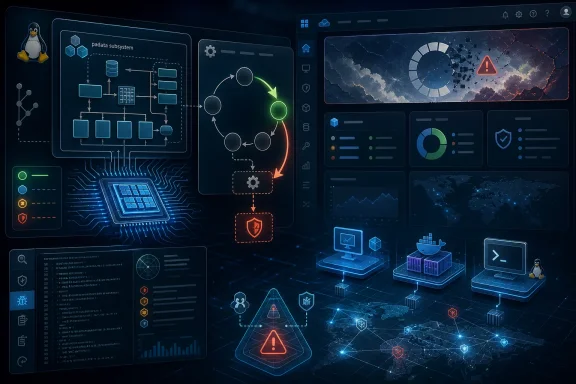 Microsoft’s Security Feed Now Covers a World Bigger Than Windows
For years, a Microsoft CVE page meant Windows, Office, Exchange, Edge, SQL Server, or some component that most administrators could mentally place on a familiar patching calendar. CVE-2026-53314 sits in a different category. Its short description points to padata, a Linux kernel mechanism for parallelized work, and to a CPU offline callback being moved into an ONLINE section so failure can be handled correctly.That is not the sort of bug description that maps neatly to the old Patch Tuesday ritual. It sounds like kernel plumbing because it is kernel plumbing. The issue lives in code paths concerned with CPUs going online and offline, which matters most in systems that support hotplug, virtualization, suspend and resume, CPU isolation, or dynamic topology changes.
The Microsoft angle is still real. Microsoft ships, hosts, maintains, mirrors, or depends on Linux in several places: Azure infrastructure, Azure Linux, Windows Subsystem for Linux kernels, Defender for Endpoint on Linux, appliance-style products, container host images, and service-side platforms customers never directly administer. A Microsoft Security Update Guide entry for a Linux kernel CVE is no longer an oddity; it is a symptom of Microsoft’s actual product surface.
That is why the outage message matters. When the advisory page is unavailable, the CVE does not become irrelevant. It becomes harder to triage, and triage is the work that separates a routine kernel fix from an unnecessary emergency.
The Bug Is Boring in the Way Kernel Bugs Are Dangerous
The phrase “Put CPU offline callback in ONLINE section to allow failure” is terse, but it says a lot to kernel maintainers. Linux uses CPU hotplug state machines to coordinate what happens as processors enter and leave service. Callbacks run at specific stages, and not every stage is allowed to fail.The padata subsystem exists to spread work across CPUs while preserving order where needed. It has been used in performance-sensitive kernel operations where work can be parallelized safely. If CPU availability changes underneath that system, padata has to update its masks and internal assumptions without leaving work stranded or state inconsistent.
The apparent fix moves the padata CPU-offline callback into a section of the CPU hotplug process where failure is permitted. That sounds procedural, but in kernel development, the stage at which a callback runs can be the difference between a clean abort and a warning, lockup, inconsistent state, or denial of service. If the callback can fail but is registered at a point where the framework assumes it cannot, the kernel is left with a contradiction.
This is the kind of defect that rarely produces a cinematic exploit chain. It is more likely to appear as instability, warnings during CPU offline operations, or a failure mode reachable by fuzzers and specialized local workloads. But kernel reliability bugs often become security bugs because unprivileged or lower-privileged actors may be able to trigger code paths that administrators assumed were purely operational.
The Exploit Story Is Still Murky, and That Is the Point
At the time of writing, the public MSRC page for CVE-2026-53314 was not reliably displaying advisory details. The user-facing error text suggested maintenance, session trouble, or a transient backend failure, while a direct fetch returned a not-found page. That leaves a gap around severity, exploitability assessment, affected Microsoft products, and remediation guidance.That uncertainty should not be papered over. A CVE identifier alone does not tell administrators whether a flaw is remotely exploitable, locally exploitable, denial-of-service only, privilege-escalating, already exploited, or merely reserved and awaiting publication. The patch title points strongly toward Linux kernel CPU hotplug correctness, but Microsoft’s product mapping is what would tell a WindowsForum audience which Microsoft-distributed assets are in scope.
The phrase “servers are down for maintenance” is almost comic in this context. A security advisory about CPU-offline failure handling appears behind an advisory system that itself is temporarily failing to serve the advisory. It is a small incident, but it captures a larger problem: vulnerability management increasingly depends on web applications, APIs, JSON feeds, search indexes, and dashboards that can fail at precisely the moment administrators need clarity.
The right reaction is measured skepticism. Treat the CVE as real enough to track, but do not invent product impact that Microsoft has not published. If you operate Linux kernels from Microsoft channels or images derived from Microsoft-maintained distributions, put the item on your watch list and verify once the advisory feed stabilizes.
Linux Inside the Microsoft Estate Is No Longer an Edge Case
The old Windows-versus-Linux framing does not survive contact with current infrastructure. Windows administrators manage Hyper-V hosts that run Linux guests, Azure tenants filled with Linux VMs, Kubernetes clusters dominated by Linux nodes, and developer workstations where WSL is part of the daily toolchain. Microsoft’s own platform strategy has followed the same route.That does not mean every Linux kernel CVE is a Windows crisis. It means Windows shops can no longer ignore Linux kernel CVEs simply because the word “Linux” appears in the affected component. If the vulnerable code sits inside an Azure marketplace image, a container host, an appliance firmware, a Microsoft-maintained kernel package, or a developer environment with privileged integration, the boundary has already been crossed.
WSL is the most visible example for desktop users, but it is not necessarily the most important one for enterprise risk. WSL kernels are updated through Microsoft mechanisms, and many organizations do not treat them with the same rigor as server kernels. Developers, however, routinely use WSL for package builds, container workflows, SSH keys, cloud credentials, and infrastructure tooling.
In the data center, the more relevant question is image provenance. If a server runs Ubuntu, Debian, Red Hat, SUSE, Azure Linux, Flatcar, Bottlerocket, or another distribution in Azure, the patch source may be the distribution vendor, Microsoft, or a layered appliance vendor. CVE-2026-53314’s presence in Microsoft’s guide is a prompt to trace ownership, not a substitute for that work.
CPU Hotplug Sounds Exotic Until Virtualization Makes It Ordinary
Many administrators hear “CPU offline callback” and assume the bug affects only unusual systems where processors are physically added or removed. That assumption is too narrow. CPU hotplug machinery is part of how modern kernels reason about topology changes, suspend states, virtualization events, isolation features, and increasingly dynamic compute environments.Cloud platforms abstract this away. A tenant may never knowingly offline a CPU, but the guest kernel still contains the machinery for CPU state transitions. Fuzzers such as syzkaller have repeatedly found bugs in kernel paths that seemed obscure until someone demonstrated they were reachable under controlled conditions.
The vulnerability title suggests a failure-handling mismatch rather than an obvious memory corruption bug. That distinction matters. A denial-of-service kernel bug can still be severe in shared environments, production clusters, CI runners, and any system where local code execution is easy to obtain.
In practical terms, the riskiest systems are not necessarily the most powerful servers. They are the ones where untrusted or semi-trusted workloads can run code close to the kernel: multi-tenant build machines, research clusters, container hosts with weak isolation assumptions, lab systems exposed to users, and developer workstations running aggressive virtualization or kernel-adjacent tooling.
The Advisory Outage Is a Vulnerability-Management Smell
The maintenance and error text attached to the MSRC page would be forgettable if it appeared on a marketing site. On a security advisory page, it is more consequential. Administrators use these pages to answer basic operational questions: Is my product affected? Is there an update? Is exploitation observed? Is mitigation available? Is this already included in a cumulative package?When those answers disappear, teams fall back to secondary signals. They search mailing lists, distro trackers, NVD mirrors, vendor bulletins, package changelogs, and social feeds. That works for mature security teams, but it is slower and more error-prone than a reliable first-party advisory.
Microsoft has improved the Security Update Guide over the years, especially with searchable metadata and machine-readable workflows. But a front-end failure still undercuts confidence, particularly when the page returns different failure modes depending on access path. A maintenance banner says “try again later”; a 404 says “not found”; an API problem says “maybe the data exists but the app cannot retrieve it.”
That ambiguity is poison for patch prioritization. If the advisory is merely not yet published, administrators should wait. If it is published but hidden by a service issue, they should monitor aggressively. If it was withdrawn or corrected, they need to know why. The security industry talks endlessly about transparency, but transparency begins with pages that load.
Microsoft Is Becoming a CVE Router, Not Just a Patch Vendor
CVE-2026-53314 also highlights Microsoft’s changing role. The company is no longer only the vendor that ships Windows patches on the second Tuesday of the month. It is a cloud operator, Linux distributor, package maintainer, security data broker, container platform provider, and identity layer for workloads that run everywhere.That role creates weird-looking advisories. A Linux kernel bug may appear in Microsoft’s system because Microsoft ships a Linux kernel somewhere, consumes it in a supported product, or needs to disclose impact for hosted services. Customers may not know which of those is true until the advisory loads.
This is not a criticism of Microsoft for tracking Linux CVEs. Quite the opposite: the modern Microsoft estate is full of open-source components, and pretending otherwise would be dangerous. The problem is that the advisory model has not fully caught up with the product model.
A Windows admin can understand “install this cumulative update on Windows Server 2022.” It is harder to understand “this CVE may affect a Linux kernel component in a Microsoft-maintained image used by a workload you deployed indirectly through a marketplace template eighteen months ago.” Yet that second sentence is increasingly the shape of real infrastructure risk.
The Patch Title Points to Reliability First, Security Second
The upstream patch title is unusually revealing. It does not describe an attacker, a privilege boundary, a remote packet, or a crafted file. It describes correcting callback placement so a CPU-offline operation can fail safely.That suggests the primary engineering concern was state-machine correctness. If a callback that can fail runs in a stage where the CPU hotplug core does not allow failure, the kernel can trip over an impossible situation. The fix is to move the callback earlier or into a different state where failure can be propagated.
Security classification often arrives after such fixes. Kernel maintainers fix bugs because they are bugs; CVE assignment later maps some of those bugs into the vulnerability ecosystem. That can make CVE writeups feel oddly understated, especially when compared with application-layer flaws that come with obvious attack narratives.
For defenders, the understated nature of the bug is not a reason to ignore it. Kernel denial-of-service issues are often about availability rather than data theft, but availability is security when the affected machine runs authentication, storage, CI/CD, telemetry, or customer-facing workloads. A local crash primitive can be a business-impacting event even if it never becomes remote code execution.
Windows Shops Should Audit Ownership Before They Audit Panic
The most common mistake with cross-ecosystem CVEs is to ask the wrong first question. The wrong question is “Do we run Linux?” because almost every modern organization does somewhere. The better question is “Which Linux kernels do we rely on, who supplies them, and how do they get updated?”For traditional Linux servers, the answer is straightforward: check the distribution’s security tracker and package versions. For cloud images, the answer may involve the image publisher. For appliances, it may require a firmware advisory. For containers, the host kernel matters more than the container image, which still surprises teams that treat containers as miniature virtual machines.
For WSL, the answer depends on the installed kernel path and update mechanism. WSL distributions share the Microsoft-provided WSL kernel unless users have configured a custom kernel. That makes WSL patching a desktop-management issue, not just a developer preference.
The Microsoft advisory, once available, should clarify affected products and remediations. Until then, the safe move is inventory. Find the Microsoft-maintained Linux assets in your environment, identify kernel versions, and compare them with the upstream and distribution fixes once package advisories are published.
The Real Risk Is the Gap Between Disclosure and Inventory
Security teams often talk about “time to patch,” but for CVEs like this the more important metric is time to know. You cannot patch what you cannot locate. You cannot prioritize what you cannot classify. You cannot classify what your advisory source cannot display.That is especially true for Linux kernel CVEs in Windows-centric organizations. The affected systems may be owned by platform engineering, DevOps, security research, cloud operations, endpoint engineering, or a vendor. They may not appear in the same dashboard as Windows servers, and they may not be governed by the same service-level agreements.
A CVE involving CPU hotplug and padata is unlikely to trigger executive alarm by name alone. But low-drama kernel flaws are exactly the kind that linger in forgotten places. They sit in lab hosts, old marketplace images, nested virtualization environments, and developer machines that nobody wants to reboot.
The path from bug to breach is not always exploit sophistication. Sometimes it is operational neglect. A patch exists, a CVE exists, an advisory exists somewhere, but the organization does not connect the asset to the fix until the next incident review.
Cloud Customers Need to Separate Host Responsibility From Guest Responsibility
Azure complicates the question in a familiar way. Microsoft owns the cloud fabric, but customers own much of what runs inside their VMs and clusters. If the vulnerable kernel is in Microsoft’s underlying host infrastructure, customers may receive no direct patching action beyond Microsoft’s service-side remediation. If it is in a customer-managed Linux VM, the customer must update the guest.Managed services add another layer. Azure Kubernetes Service, Azure Linux node images, marketplace appliances, and managed security products can each have different update channels. A vulnerability may be remediated by rotating node images, applying OS packages, upgrading an extension, redeploying an appliance, or waiting for a vendor-managed backend fix.
That is why advisory metadata matters so much. The phrase “affected products” is not bureaucratic filler; it determines who has to act. Without it, teams can waste time chasing kernels they do not control or, worse, assume Microsoft has handled guest systems that remain their responsibility.
The correct posture is shared-responsibility realism. Microsoft may disclose the CVE, host the advisory, and patch its own services. Customers still need to know whether their guest kernels, node pools, dev machines, and vendor images are current.
The Maintenance Banner Is a Warning About Automation Too
Many organizations no longer read advisory pages manually. They ingest feeds into vulnerability scanners, ticketing systems, SIEM pipelines, CMDB enrichers, and patch-management dashboards. That automation is useful, but it can hide data-quality failures until someone notices a missing ticket.If the MSRC front end fails while the backend feed remains healthy, automated systems may continue working. If the underlying API fails, scanners may miss newly published information or retain stale metadata. If a page returns 404 for a CVE that exists elsewhere, deduplication logic may treat the item as withdrawn or invalid.
This is the unglamorous side of modern security operations. The tooling stack is only as good as its assumptions about upstream data. A transient MSRC outage should not break an enterprise patch program, but it should prompt teams to ask how their systems handle advisory unavailability.
Resilience means using multiple signals. Pair vendor advisories with distribution trackers, NVD or CVE feeds, package repositories, endpoint telemetry, and actual version inventory. The goal is not to distrust Microsoft; it is to avoid a single web application becoming the choke point for operational truth.
Kernel Fixes Still Demand Reboots, and Reboots Still Demand Politics
Even if CVE-2026-53314 turns out to be a moderate-severity local denial-of-service issue, it will run into the oldest problem in infrastructure: kernel updates usually require reboots. Live patching can help in some Linux environments, but it is not universal, and not every fix is suitable for live patch delivery.That makes classification important. If the vulnerability affects only obscure CPU hotplug paths and requires local privileges, organizations may bundle it into the next scheduled kernel maintenance. If Microsoft or distributions rate it higher, or if exploitability turns out broader, the reboot window moves forward.
Server reboot politics are rarely technical. They involve application owners, maintenance windows, redundancy, change freezes, regulatory environments, and the fear of discovering that a system only worked because it had not restarted in 300 days. Kernel CVEs expose the distance between “patch available” and “risk reduced.”
For WindowsForum readers, the practical lesson is familiar from Windows cumulative updates: patching is an operational capability, not a button. The organizations that handle CVE-2026-53314 smoothly will be the ones that already know how to drain nodes, rotate workloads, rebuild images, and prove that updates landed.
A Small padata Fix Exposes a Larger Microsoft Reality
CVE-2026-53314 will probably not be remembered as a landmark vulnerability. It lacks the branding of a speculative-execution flaw, the drama of remote code execution, and the obvious enterprise blast radius of an Exchange or WSUS bug. But small CVEs often reveal the architecture of the world more clearly than blockbuster bugs do.Here, the architecture is hybrid all the way down. Microsoft advisories can point to Linux kernel internals. Windows administrators may need to understand CPU hotplug callbacks. Cloud customers may need to distinguish Microsoft-managed remediation from guest OS patching. Vulnerability feeds may become more important than the pages humans read.
That is not a failure of Microsoft’s strategy; it is the consequence of Microsoft’s success in cloud and open source. The company inserted itself into enough layers of the modern stack that its security disclosures now reflect the whole stack. The brand on the advisory no longer tells you the operating system involved.
The operational model has to change accordingly. Windows teams need Linux visibility. Linux teams need Microsoft advisory awareness. Security teams need asset graphs that understand WSL, Azure images, Kubernetes nodes, and vendor appliances as first-class patching targets.
The Concrete Work Starts Before the Advisory Comes Back
The smartest response to this CVE is not to wait passively for the page to load. It is to prepare the questions the advisory must answer. Which Microsoft products list CVE-2026-53314 as affected? Which kernel versions contain the fix? Are there mitigations? Is exploitation more than theoretical? Which update channels carry the remediation?Once those answers appear, administrators can act quickly. Until then, the work is inventory and monitoring. A transient advisory outage is annoying, but it does not prevent teams from finding where Microsoft-supplied Linux kernels and Linux-based workloads exist.
For smaller shops, that may be as simple as checking Azure VMs, WSL installations, and NAS or security appliances. For enterprises, it means querying endpoint management, cloud asset inventories, container platforms, vulnerability scanners, and golden-image pipelines. The point is to make the eventual advisory actionable rather than merely interesting.
This is also a good moment to revisit alert routing. If a Microsoft advisory names a Linux kernel component, does it go to the Windows team, the Linux team, the cloud team, or nobody? The wrong answer is “whoever sees it first.”
The padata Advisory Leaves Administrators With Five Jobs
CVE-2026-53314 is still an incomplete picture until Microsoft’s advisory data is consistently available, but the shape of the work is already visible. Treat this as a cross-platform kernel maintenance item with Microsoft ecosystem implications, not as a conventional Windows Patch Tuesday entry.- Confirm whether any Microsoft-maintained Linux kernels, Azure Linux systems, WSL kernels, or Microsoft-published images in your environment are listed as affected once the advisory becomes available.
- Check your Linux distribution security trackers and package repositories for kernel updates that include the padata CPU hotplug callback fix.
- Prioritize systems where untrusted users, CI jobs, containers, or research workloads can trigger unusual kernel paths.
- Do not assume Azure guest VMs are patched by Microsoft simply because the CVE appears in Microsoft’s Security Update Guide.
- Make sure advisory-feed failures do not silently suppress tickets, scanner findings, or patch exceptions in your vulnerability-management workflow.
References
- Primary source: MSRC
Published: 2026-06-28T01:04:10-07:00
Security Update Guide - Microsoft Security Response Center
 msrc.microsoft.com
