

On June 24, 2026, Android phones in parts of Venezuela reportedly displayed earthquake warnings moments before two major quakes struck, offering some residents a few seconds of notice before shaking that has killed at least hundreds and possibly far more. The technology behind those warnings is not magic, and it is not a substitute for building codes, sirens, drills, or competent disaster response. But it is one of the clearest demonstrations yet that the smartphone has quietly become civil-defense infrastructure. The hard part now is deciding whether societies will treat it that way before the next alert arrives.
The most important fact about the Venezuelan alerts is also the easiest to overlook: nobody had to install a special gadget in the ground for an Android phone to notice that something was wrong. The same accelerometer that lets a handset rotate a screen, count steps, stabilize photos, and detect a dropped device can also sense the first faint violence of an earthquake.
Google’s Android Earthquake Alerts System is built around that mundane sensor. When enough phones in an area detect motion consistent with the first, faster-moving P-wave of an earthquake, they can report the pattern to Google’s servers. The system then attempts to determine whether the signals are an actual quake, estimate location and magnitude, and push a warning to people likely to experience stronger shaking.
The physics is simple enough to explain and unforgiving enough to matter. P-waves travel faster and usually do less damage; S-waves arrive later and are more destructive. If a system can detect the first and warn before the second, even a few seconds can change behavior: step away from glass, move from a stairwell, unlock a door, drop to the floor, or stop a train.
That is the promise, and Venezuela is now one of its most visible public tests. Social media reports and videos from users suggested that Android alerts reached some people shortly before shaking began. In a disaster where death toll figures have been rising and where rescue crews are still working through collapsed structures, the distinction between “a few seconds” and “nothing” is not academic.
Google’s intervention is different because it rides on existing consumer hardware. Instead of building a dense network of dedicated seismic instruments in every country, Android tries to turn the installed base of phones into a distributed detection grid. That idea is both elegant and unnerving.
It is elegant because Android’s scale is extraordinary. In countries where formal seismic infrastructure is thin or uneven, phones may be the densest sensor network available. They are already powered, networked, geographically dispersed, and owned by the people most at risk.
It is unnerving because the detection grid is controlled by a private platform company whose incentives, update practices, data policies, and public accountability mechanisms are not the same as those of a national emergency agency. A government seismometer is boring by design. A phone-based warning network is a civil-safety feature embedded inside a commercial operating system.
That tension is not a reason to reject the technology. It is a reason to stop pretending it is merely a nice Android feature.
Yet this is precisely where responsible analysis has to slow down. A warning delivered to some users is not the same thing as a warning delivered to a country. A viral clip is not a coverage map. Praise on social media is not a post-incident audit. The fact that Android alerted some Venezuelans tells us the system worked somewhere, for someone, under extreme pressure; it does not tell us how many phones were eligible, how many received alerts, how quickly they arrived, how accurate they were, or whether people knew what to do.
That distinction matters because earthquake warning is not judged only by whether an alert exists. It is judged by whether the right people receive the right alert early enough to act without being misled. The difference between a “BeAware” notification and a screen-seizing “TakeAction” warning is not just interface design. It is a risk classification with consequences.
The technology can detect, calculate, and notify. It cannot make a building safe, clear a stairwell, teach a family what to do at midnight, or ensure mobile networks survive the first shock. The Venezuelan quake should therefore be read as both a validation of smartphone warning and an indictment of how fragile preparedness remains when warning is the last line of defense.
The Turkey case matters because it shows that detection is not binary. A system can detect an earthquake and still classify it badly. It can send lower-level notifications when higher-level warnings are warranted. It can be technically present but practically inadequate.
That is a brutal problem for any early-warning system, but especially for one embedded in consumer devices. Users do not think in probability thresholds or model confidence. When a phone takes over the screen and screams, they assume danger is imminent. When it does not, many assume there is no danger. The interface collapses uncertainty into action.
False negatives are the nightmare because they create invisible harm. A missed high-level warning leaves no obvious artifact on the phone. There is no screenshot of the notification that never arrived. There is only the after-action reconstruction, the server logs, and the uncomfortable question of whether a system that was supposed to help failed at the moment it mattered most.
That is why the Venezuelan reports, encouraging as they are, should not be used to declare the problem solved. They suggest improvement. They do not prove reliability across fault types, network conditions, population density, device models, or local behavior.
False positives are often treated as embarrassing but survivable. In practice, they can be dangerous. People may run into streets, overload communications networks, clog emergency lines, or begin ignoring future alerts. In places where earthquakes are rare, a false alarm may be the only earthquake warning many users have ever experienced, shaping their expectations for years.
This is especially complicated for phone-based warning because the device is intimate. A siren is public; everyone hears it together. A phone alert is personal, vibrating in a pocket or lighting up a bedside table. If one person receives a warning and another does not, trust becomes fragmented immediately.
That fragmentation is already part of the Venezuela story. Android users reportedly saw warnings; iPhone users may have depended on government alerts or other alert originators depending on region and configuration. The result is a disaster-warning environment split by operating system, device settings, network access, and platform strategy.
For IT professionals, that should sound familiar. Consumer technology has a way of becoming mission-critical before anyone writes the governance model.
There are defensible reasons for that. A distributed seismic network based on user devices raises privacy, accuracy, liability, and public-safety questions. Apple’s instinct is often to avoid turning the iPhone into infrastructure unless it can tightly control the experience. In many product categories, that caution pays off.
In earthquake warning, however, caution has a cost. If Android devices can provide earlier warnings in countries without dense government systems, then iPhone users may be at a disadvantage in the same room, the same apartment block, or the same city. That is an uncomfortable platform divide, because earthquakes do not respect ecosystems.
The issue is not that Apple should simply copy Google. It is that emergency alerting is becoming a competitive platform capability with public consequences. If one operating system can detect and warn using its installed base while another mostly acts as a receiver and relay, regulators and emergency agencies will eventually ask whether that difference is acceptable.
This is where the smartphone war stops being about cameras, chips, and app stores. It becomes about whether a privately designed platform architecture affects who gets a warning before a wall falls.
Android’s earthquake system is not merely an app. It relies on OS-level sensors, background services, location inference, connectivity, notification privileges, full-screen interruption, and centralized cloud processing. That makes it a platform service in the strongest sense.
The upside is reach. A feature baked into the operating system can scale faster than a public app campaign. It can work for users who do not know the name of their local seismic agency. It can bypass the familiar problem of emergency apps that only the most prepared residents install.
The downside is opacity. Most users cannot audit whether earthquake detection is enabled, whether their location qualifies, whether their device model participates properly, or how Google’s model classifies risk. Even administrators managing fleets of Android devices may not have much visibility into the emergency behavior of personal phones in a workplace.
That matters for schools, hospitals, logistics operators, factories, municipal offices, and office towers. When employees’ phones become part of a warning system, emergency plans need to account for the signals those phones may send. A workplace that ignores mobile alerts because it has its own alarm system may miss useful seconds. A workplace that blindly follows every phone alert may create unsafe evacuations.
If users do not understand what “TakeAction” means, the alert loses value. If they instinctively run downstairs during shaking, the alert can push them toward danger. If they stop to film, call relatives, or search social media for confirmation, the seconds vanish. A technically successful alert can still fail as public instruction.
That is not Google’s burden alone. Governments, schools, employers, and media organizations all play a role in turning warnings into muscle memory. The problem is that smartphone alerts can scale faster than public education. A country may effectively receive a modern warning network before it has a modern warning culture.
Venezuela demonstrates the gap. Some people reportedly acted. Others praised the technology afterward. But the broader disaster shows that warnings cannot compensate for vulnerable buildings, strained infrastructure, and uneven emergency capacity.
The phrase “life-saving alert” is tempting, and in individual cases it may be true. At population scale, the more accurate formulation is colder: alerts create a chance for life-saving action. Whether that chance becomes survival depends on everything surrounding the phone.
Every link can fail. Connectivity may be weak, especially in rural or mountainous regions. Power outages can reduce network resilience. Congested mobile systems can delay delivery. Device settings, battery optimization, old OS versions, and vendor customizations can interfere. Even if the initial alert is pushed before the strongest shaking, local conditions determine whether it arrives in time.
This is why dedicated seismic networks still matter. They are purpose-built, maintained, calibrated, and governed. Smartphone networks are powerful because they are everywhere, but “everywhere” is not the same as dependable in every emergency.
For administrators and policymakers, the lesson is not to choose one model. It is to layer them. Government sensors, broadcast alerts, mobile OS alerts, sirens, radio, satellite, workplace alarms, and public drills should reinforce one another. Redundancy is not inefficiency in disaster systems; it is the design principle.
The danger is that governments with tight budgets may see Google’s Android network as a substitute for public investment. That would be a category error. A private platform can extend warning coverage. It should not become the state’s only seismic strategy.
That ambiguity is manageable when the stakes are low. It is not manageable when the alert concerns a deadly earthquake. If a government fails to maintain sirens, voters can theoretically punish officials. If a private platform changes an algorithm, disables a region after a false alarm, or limits a feature by market, accountability is less direct.
The answer is not theatrical suspicion of Big Tech. Google’s earthquake-alert project is a serious public-interest effort, and the Venezuela reports suggest it may have provided real value. But public-interest infrastructure should not depend solely on corporate discretion.
At minimum, emergency-alert platforms need clearer transparency after major events. How many devices were eligible? How many received each alert tier? What was the estimated warning time by region? What classification thresholds were used? Were there network delays? Were any groups excluded by device age, Android version, language, or settings?
Some of that information will be sensitive. Some of it will require careful privacy protection. But without it, societies are left with anecdotes, screenshots, and platform statements. That is not enough for systems that may shape life-or-death decisions.
That creates a familiar trade-off. The same scale that makes Android useful as a quake detector also makes it powerful as a data network. Users may consent to emergency functionality in principle without understanding how it works in practice. Governments may welcome the capability while lacking leverage over the company providing it.
Privacy advocates should be careful not to flatten the issue into reflexive opposition. There is a real public-safety benefit here. A well-designed system can preserve privacy while saving seconds. The question is whether design choices are documented, independently examined, and constrained by rules that outlast any one product team.
For IT pros, this is where mobile-device governance meets civil society. Organizations already think about telemetry, device compliance, location services, and emergency communications. Earthquake detection adds a new category: sensor-driven public alerts that may matter even on unmanaged personal devices.
That means emergency planning can no longer assume that phones are just communication endpoints. They are detectors, receivers, relays, and behavioral triggers.
Android’s distributed approach cuts across those differences. It can bring warning capability to places that have not built traditional networks. But it can also create uneven dependency on Google in countries with weaker institutions, limited public funding, or strained telecommunications systems.
That divide will become a policy issue. If a private operating system becomes the most effective earthquake-warning tool in a country, governments will want guarantees. They will want regional support, language localization, alert reporting, uptime commitments, and integration with national agencies. Google may not want to become the de facto seismic authority for dozens of jurisdictions, but its technology is already pushing in that direction.
Apple will face a parallel question from the other side. If iPhones do not participate in distributed detection, should they integrate more deeply with third-party or government systems? Should Apple provide a comparable privacy-preserving sensor network? Should regulators require emergency-alert parity across major mobile platforms?
The worst outcome would be a fragmented global warning environment where safety depends on handset brand, OS version, carrier behavior, and whether a government happened to negotiate the right integration. The best outcome is more boring and more valuable: interoperable alerting, transparent performance reporting, and public education that treats phones as one layer in a broader warning stack.
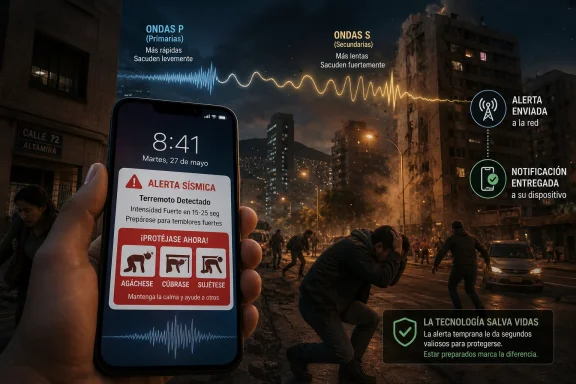 The Phone in Your Pocket Has Become a Seismometer by Default
The most important fact about the Venezuelan alerts is also the easiest to overlook: nobody had to install a special gadget in the ground for an Android phone to notice that something was wrong. The same accelerometer that lets a handset rotate a screen, count steps, stabilize photos, and detect a dropped device can also sense the first faint violence of an earthquake.Google’s Android Earthquake Alerts System is built around that mundane sensor. When enough phones in an area detect motion consistent with the first, faster-moving P-wave of an earthquake, they can report the pattern to Google’s servers. The system then attempts to determine whether the signals are an actual quake, estimate location and magnitude, and push a warning to people likely to experience stronger shaking.
The physics is simple enough to explain and unforgiving enough to matter. P-waves travel faster and usually do less damage; S-waves arrive later and are more destructive. If a system can detect the first and warn before the second, even a few seconds can change behavior: step away from glass, move from a stairwell, unlock a door, drop to the floor, or stop a train.
That is the promise, and Venezuela is now one of its most visible public tests. Social media reports and videos from users suggested that Android alerts reached some people shortly before shaking began. In a disaster where death toll figures have been rising and where rescue crews are still working through collapsed structures, the distinction between “a few seconds” and “nothing” is not academic.
Google Did Not Invent Earthquake Warning, But It Did Change Its Distribution
Earthquake early warning is not new. Japan, Mexico, Taiwan, parts of the United States, and other quake-prone regions have long invested in sensor networks, alerting pipelines, sirens, broadcast systems, and public education. Those systems are expensive, technical, and usually tied to government institutions with geological expertise and long-term funding.Google’s intervention is different because it rides on existing consumer hardware. Instead of building a dense network of dedicated seismic instruments in every country, Android tries to turn the installed base of phones into a distributed detection grid. That idea is both elegant and unnerving.
It is elegant because Android’s scale is extraordinary. In countries where formal seismic infrastructure is thin or uneven, phones may be the densest sensor network available. They are already powered, networked, geographically dispersed, and owned by the people most at risk.
It is unnerving because the detection grid is controlled by a private platform company whose incentives, update practices, data policies, and public accountability mechanisms are not the same as those of a national emergency agency. A government seismometer is boring by design. A phone-based warning network is a civil-safety feature embedded inside a commercial operating system.
That tension is not a reason to reject the technology. It is a reason to stop pretending it is merely a nice Android feature.
Venezuela Shows the Best Case and the Hardest Question at Once
The Venezuelan reports are compelling because they show the upside in human terms. Users said their phones warned them just before the shaking. Some praised Google publicly. Others shared videos that appeared to show alerts prompting people to move.Yet this is precisely where responsible analysis has to slow down. A warning delivered to some users is not the same thing as a warning delivered to a country. A viral clip is not a coverage map. Praise on social media is not a post-incident audit. The fact that Android alerted some Venezuelans tells us the system worked somewhere, for someone, under extreme pressure; it does not tell us how many phones were eligible, how many received alerts, how quickly they arrived, how accurate they were, or whether people knew what to do.
That distinction matters because earthquake warning is not judged only by whether an alert exists. It is judged by whether the right people receive the right alert early enough to act without being misled. The difference between a “BeAware” notification and a screen-seizing “TakeAction” warning is not just interface design. It is a risk classification with consequences.
The technology can detect, calculate, and notify. It cannot make a building safe, clear a stairwell, teach a family what to do at midnight, or ensure mobile networks survive the first shock. The Venezuelan quake should therefore be read as both a validation of smartphone warning and an indictment of how fragile preparedness remains when warning is the last line of defense.
The Turkey Failure Still Hangs Over Every Success Story
No assessment of Android earthquake alerts can responsibly stop at Venezuela. The system’s recent history includes a severe public failure during the February 2023 Turkey-Syria earthquakes, when the highest-level Android warnings reportedly did not reach millions of people who might have expected them. Google later said it had updated its algorithms, but the episode remains the central cautionary tale.The Turkey case matters because it shows that detection is not binary. A system can detect an earthquake and still classify it badly. It can send lower-level notifications when higher-level warnings are warranted. It can be technically present but practically inadequate.
That is a brutal problem for any early-warning system, but especially for one embedded in consumer devices. Users do not think in probability thresholds or model confidence. When a phone takes over the screen and screams, they assume danger is imminent. When it does not, many assume there is no danger. The interface collapses uncertainty into action.
False negatives are the nightmare because they create invisible harm. A missed high-level warning leaves no obvious artifact on the phone. There is no screenshot of the notification that never arrived. There is only the after-action reconstruction, the server logs, and the uncomfortable question of whether a system that was supposed to help failed at the moment it mattered most.
That is why the Venezuelan reports, encouraging as they are, should not be used to declare the problem solved. They suggest improvement. They do not prove reliability across fault types, network conditions, population density, device models, or local behavior.
The Brazil False Alarm Is the Other Side of the Same Knife
The February 2025 false alarm in Brazil illustrates the opposite failure mode. A system designed to prevent catastrophe can create confusion if it warns people of a quake that is not happening. Google apologized after some Android users received an erroneous alert, and the incident revived an old emergency-management dilemma: a warning system that never alarms is useless, but one that alarms incorrectly too often loses trust.False positives are often treated as embarrassing but survivable. In practice, they can be dangerous. People may run into streets, overload communications networks, clog emergency lines, or begin ignoring future alerts. In places where earthquakes are rare, a false alarm may be the only earthquake warning many users have ever experienced, shaping their expectations for years.
This is especially complicated for phone-based warning because the device is intimate. A siren is public; everyone hears it together. A phone alert is personal, vibrating in a pocket or lighting up a bedside table. If one person receives a warning and another does not, trust becomes fragmented immediately.
That fragmentation is already part of the Venezuela story. Android users reportedly saw warnings; iPhone users may have depended on government alerts or other alert originators depending on region and configuration. The result is a disaster-warning environment split by operating system, device settings, network access, and platform strategy.
For IT professionals, that should sound familiar. Consumer technology has a way of becoming mission-critical before anyone writes the governance model.
Apple’s Caution Looks Sensible Until Seconds Start Counting
Apple’s earthquake-alert posture is more conservative. iOS can display government emergency alerts, and Apple says users in some regions can receive earthquake warnings from other alert originators. iPhones can also help relay certain alerts to nearby Apple devices without their own connectivity. But Apple has not built the same global, phone-sensor-driven earthquake detection network that Google has attempted with Android.There are defensible reasons for that. A distributed seismic network based on user devices raises privacy, accuracy, liability, and public-safety questions. Apple’s instinct is often to avoid turning the iPhone into infrastructure unless it can tightly control the experience. In many product categories, that caution pays off.
In earthquake warning, however, caution has a cost. If Android devices can provide earlier warnings in countries without dense government systems, then iPhone users may be at a disadvantage in the same room, the same apartment block, or the same city. That is an uncomfortable platform divide, because earthquakes do not respect ecosystems.
The issue is not that Apple should simply copy Google. It is that emergency alerting is becoming a competitive platform capability with public consequences. If one operating system can detect and warn using its installed base while another mostly acts as a receiver and relay, regulators and emergency agencies will eventually ask whether that difference is acceptable.
This is where the smartphone war stops being about cameras, chips, and app stores. It becomes about whether a privately designed platform architecture affects who gets a warning before a wall falls.
The Operating System Is Now Part of the Emergency Stack
WindowsForum readers know this pattern well from another domain: features that begin as conveniences become infrastructure, and infrastructure inherits obligations. Automatic updates were once a user-experience matter; now they are a national cybersecurity issue. Browser certificate handling was once an implementation detail; now it governs trust on the web. Mobile emergency alerts are moving down the same path.Android’s earthquake system is not merely an app. It relies on OS-level sensors, background services, location inference, connectivity, notification privileges, full-screen interruption, and centralized cloud processing. That makes it a platform service in the strongest sense.
The upside is reach. A feature baked into the operating system can scale faster than a public app campaign. It can work for users who do not know the name of their local seismic agency. It can bypass the familiar problem of emergency apps that only the most prepared residents install.
The downside is opacity. Most users cannot audit whether earthquake detection is enabled, whether their location qualifies, whether their device model participates properly, or how Google’s model classifies risk. Even administrators managing fleets of Android devices may not have much visibility into the emergency behavior of personal phones in a workplace.
That matters for schools, hospitals, logistics operators, factories, municipal offices, and office towers. When employees’ phones become part of a warning system, emergency plans need to account for the signals those phones may send. A workplace that ignores mobile alerts because it has its own alarm system may miss useful seconds. A workplace that blindly follows every phone alert may create unsafe evacuations.
A Warning Is Only as Good as the Behavior It Triggers
The easiest mistake in covering earthquake alerts is to treat warning delivery as the finish line. It is not. A warning is a prompt for behavior, and behavior is shaped long before the quake arrives.If users do not understand what “TakeAction” means, the alert loses value. If they instinctively run downstairs during shaking, the alert can push them toward danger. If they stop to film, call relatives, or search social media for confirmation, the seconds vanish. A technically successful alert can still fail as public instruction.
That is not Google’s burden alone. Governments, schools, employers, and media organizations all play a role in turning warnings into muscle memory. The problem is that smartphone alerts can scale faster than public education. A country may effectively receive a modern warning network before it has a modern warning culture.
Venezuela demonstrates the gap. Some people reportedly acted. Others praised the technology afterward. But the broader disaster shows that warnings cannot compensate for vulnerable buildings, strained infrastructure, and uneven emergency capacity.
The phrase “life-saving alert” is tempting, and in individual cases it may be true. At population scale, the more accurate formulation is colder: alerts create a chance for life-saving action. Whether that chance becomes survival depends on everything surrounding the phone.
The Network Layer Is the Weak Link Nobody Wants to Discuss
Phone-based earthquake warning depends on a chain of events that has to complete in seconds. Sensors must detect motion. Phones must transmit data. Servers must classify the event. Alerts must return through networks. Devices must display them loudly and visibly. Users must react.Every link can fail. Connectivity may be weak, especially in rural or mountainous regions. Power outages can reduce network resilience. Congested mobile systems can delay delivery. Device settings, battery optimization, old OS versions, and vendor customizations can interfere. Even if the initial alert is pushed before the strongest shaking, local conditions determine whether it arrives in time.
This is why dedicated seismic networks still matter. They are purpose-built, maintained, calibrated, and governed. Smartphone networks are powerful because they are everywhere, but “everywhere” is not the same as dependable in every emergency.
For administrators and policymakers, the lesson is not to choose one model. It is to layer them. Government sensors, broadcast alerts, mobile OS alerts, sirens, radio, satellite, workplace alarms, and public drills should reinforce one another. Redundancy is not inefficiency in disaster systems; it is the design principle.
The danger is that governments with tight budgets may see Google’s Android network as a substitute for public investment. That would be a category error. A private platform can extend warning coverage. It should not become the state’s only seismic strategy.
Big Tech Has Entered the Civil-Defense Business Without a Ballot
There is an uncomfortable governance question beneath the technical story: who is accountable when a platform alert succeeds, fails, or frightens the public for no reason? Google can publish blog posts, research, and apologies. Apple can describe supported alert channels. Governments can integrate or ignore platform systems. But the ordinary user experiences the outcome as a single event: my phone warned me, or it did not.That ambiguity is manageable when the stakes are low. It is not manageable when the alert concerns a deadly earthquake. If a government fails to maintain sirens, voters can theoretically punish officials. If a private platform changes an algorithm, disables a region after a false alarm, or limits a feature by market, accountability is less direct.
The answer is not theatrical suspicion of Big Tech. Google’s earthquake-alert project is a serious public-interest effort, and the Venezuela reports suggest it may have provided real value. But public-interest infrastructure should not depend solely on corporate discretion.
At minimum, emergency-alert platforms need clearer transparency after major events. How many devices were eligible? How many received each alert tier? What was the estimated warning time by region? What classification thresholds were used? Were there network delays? Were any groups excluded by device age, Android version, language, or settings?
Some of that information will be sensitive. Some of it will require careful privacy protection. But without it, societies are left with anecdotes, screenshots, and platform statements. That is not enough for systems that may shape life-or-death decisions.
Privacy Is Not the Reason to Avoid the System, But It Is the Reason to Govern It
A smartphone seismic network does not need to be a surveillance machine to deserve scrutiny. The data involved can be minimized, aggregated, and bounded. But the basic premise still involves phones sending location-adjacent sensor reports to a centralized service under emergency conditions.That creates a familiar trade-off. The same scale that makes Android useful as a quake detector also makes it powerful as a data network. Users may consent to emergency functionality in principle without understanding how it works in practice. Governments may welcome the capability while lacking leverage over the company providing it.
Privacy advocates should be careful not to flatten the issue into reflexive opposition. There is a real public-safety benefit here. A well-designed system can preserve privacy while saving seconds. The question is whether design choices are documented, independently examined, and constrained by rules that outlast any one product team.
For IT pros, this is where mobile-device governance meets civil society. Organizations already think about telemetry, device compliance, location services, and emergency communications. Earthquake detection adds a new category: sensor-driven public alerts that may matter even on unmanaged personal devices.
That means emergency planning can no longer assume that phones are just communication endpoints. They are detectors, receivers, relays, and behavioral triggers.
The International Divide Will Get Sharper
The United States has ShakeAlert on the West Coast, integrated with apps, wireless emergency alerts, and other channels. Japan has a mature national warning culture. Mexico City has public sirens that are culturally embedded. Other countries have partial coverage, limited infrastructure, or no meaningful early-warning system at all.Android’s distributed approach cuts across those differences. It can bring warning capability to places that have not built traditional networks. But it can also create uneven dependency on Google in countries with weaker institutions, limited public funding, or strained telecommunications systems.
That divide will become a policy issue. If a private operating system becomes the most effective earthquake-warning tool in a country, governments will want guarantees. They will want regional support, language localization, alert reporting, uptime commitments, and integration with national agencies. Google may not want to become the de facto seismic authority for dozens of jurisdictions, but its technology is already pushing in that direction.
Apple will face a parallel question from the other side. If iPhones do not participate in distributed detection, should they integrate more deeply with third-party or government systems? Should Apple provide a comparable privacy-preserving sensor network? Should regulators require emergency-alert parity across major mobile platforms?
The worst outcome would be a fragmented global warning environment where safety depends on handset brand, OS version, carrier behavior, and whether a government happened to negotiate the right integration. The best outcome is more boring and more valuable: interoperable alerting, transparent performance reporting, and public education that treats phones as one layer in a broader warning stack.
The Seconds Venezuela Bought Are Not a Strategy by Themselves
The practical lessons from Venezuela are concrete, even before full post-incident data emerges. The Android alerts appear to have shown the value of crowdsourced detection, while the scale of the disaster shows the limits of warning without resilience. A phone can buy seconds; policy decides what those seconds are worth.- Android’s earthquake alerts use ordinary phone accelerometers to detect early seismic motion and can issue warnings before more destructive shaking arrives.
- Venezuela’s June 2026 quakes appear to be a major real-world demonstration of the system’s potential, but public reports do not yet provide a complete audit of coverage, timing, accuracy, or outcomes.
- Google’s past problems in Turkey and Brazil show that both missed high-severity alerts and false alarms remain serious risks for smartphone-based warning systems.
- Apple’s more conservative approach may reduce some platform risks, but it also raises uncomfortable questions if iPhone users receive less timely earthquake information in regions where Android detection works.
- Governments and employers should treat mobile alerts as one layer of emergency preparedness, not as a replacement for seismic infrastructure, building safety, drills, or resilient communications.
- Platform companies should publish clearer post-event performance data for major disasters, because public trust cannot rest on anecdotes and screenshots alone.
References
- Primary source: Pakistan Today
Published: 2026-06-27T13:50:16.952934
Loading…
www.pakistantoday.com.pk - Independent coverage: Dawn
Published: 2026-06-27T12:50:16.952378
Loading…
www.dawn.com - Related coverage: techspot.com
Google admits Android alert failure during 2023 Turkey earthquake | TechSpot
On 6 February 2023, a 7.8 magnitude earthquake struck near Gaziantep in southern Turkey, close to the Syrian border. It was followed by a second major quake...www.techspot.com - Related coverage: phonearena.com
Loading…
www.phonearena.com - Related coverage: gadgets360.com
Loading…
www.gadgets360.com - Official source: 9to5google.com
Loading…
9to5google.com
- Related coverage: androidauthority.com
Google admits Android's earthquake alerts failed ahead of deadly quake
Google has admitted that its Android Earthquake Alerts system failed to deliver accurate warnings during the 2023 Turkey earthquakes.www.androidauthority.com - Related coverage: androidcentral.com
Loading…
www.androidcentral.com - Related coverage: geo.tv
How some Venezuelans' smartphones warned of quake
Many social media users in Venezuela have reported receiving alerts on Android smartphones moments before Wednesday's quake with over 900 confirmed dead.Google's Android and Apple's iOS, both include the option to display government...www.geo.tv - Related coverage: ubergizmo.com
Loading…
www.ubergizmo.com - Related coverage: news.sky.com
Loading…
news.sky.com - Related coverage: livescience.com
Google has turned 2 billion smartphones into a global earthquake warning system — it's just as effective as seismometers | Live Science
Google's earthquake early-warning system has used phone accelerometers to increase quake alerts by tenfold across 98 countries.www.livescience.com - Related coverage: lemonde.fr
Loading…
www.lemonde.fr - Related coverage: phys.org
Loading…
phys.org - Related coverage: vajiramias.sgp1.cdn.digitaloceanspaces.com
Loading…
vajiramias.sgp1.cdn.digitaloceanspaces.com