
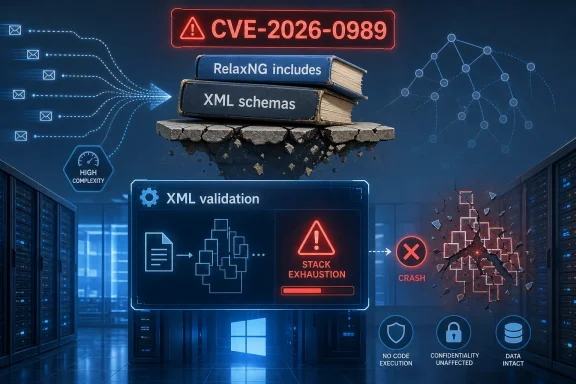
CVE-2026-0989 is a low-severity libxml2 vulnerability disclosed on January 15, 2026, affecting the RelaxNG parser’s handling of nested schema includes and allowing a network-capable attacker, under high-complexity conditions, to crash vulnerable applications through stack exhaustion rather than steal data or execute code. That framing matters because this is not a Windows takeover bug, a wormable remote code execution flaw, or a credential theft path. It is the kind of dependency-level denial-of-service issue that rarely dominates Patch Tuesday headlines but still shows up in real production risk when XML parsing sits on an exposed path. Microsoft’s advisory language is doing something useful here: it is warning administrators not to confuse “network exploitable” with “easy to exploit.”
Libxml2 is one of those components that most users never knowingly install and many administrators never inventory directly. It is an XML parsing library, written in C, used across Linux distributions, desktop environments, developer tools, language bindings, appliances, and application stacks that need to read, validate, transform, or inspect XML. On Windows, it may arrive not as a first-party operating system component in the way kernel drivers or Edge do, but as part of third-party software, cross-platform tooling, bundled runtimes, container images, WSL environments, database utilities, backup products, security scanners, or developer stacks.
That is why CVE-2026-0989 is more interesting than its CVSS score suggests. The technical bug is narrow: libxml2’s RelaxNG parser can recurse too deeply while resolving nested include directives, exhausting the call stack and crashing the process. The operational story is broader: a mature, widely embedded parser still carries sharp edges in relatively obscure parts of an old but persistent data format.
RelaxNG is not the XML feature most Windows admins are thinking about on a Monday morning. Many will recognize XML from configuration files, Office formats, web services, SAML assertions, or application manifests. Fewer will have spent time with RelaxNG, a schema language used to validate XML documents. Fewer still will know whether any exposed service in their estate accepts RelaxNG schemas, dereferences external includes, or processes XML supplied by users, partners, build systems, or automation pipelines.
That obscurity cuts both ways. It lowers the probability that attackers can casually hit every endpoint on the Internet with a reliable exploit. It also raises the odds that vulnerable code paths remain unexamined because everyone assumes XML validation is plumbing, and plumbing is only discussed after it floods the basement.
That is a meaningful limitation. Attack complexity is high, privileges are not required, user interaction is not required, confidentiality and integrity are not impacted, and availability impact is rated low. The base score commonly associated with this CVE is 3.7, which puts it firmly in the “do not panic” bucket for most vulnerability management dashboards.
But “do not panic” is not the same as “ignore.” High-complexity denial-of-service bugs are often dismissed because they do not provide the attacker with a shell. That is the wrong mental model for environments where process availability is the asset. If the vulnerable parser runs inside a document ingestion service, API gateway, CI validation job, security product, messaging bridge, or customer-facing upload pipeline, a crash can become an outage, a queue backup, or a repeated service interruption.
The most important word in Microsoft’s description is not “high.” It is “conditions.” Security teams should ask what conditions would make the bug reachable in their environment. If no application accepts untrusted RelaxNG schemas, no service fetches schema includes over a network, and libxml2 is present only as an inert dependency, the risk is theoretical. If an internal or external workflow validates attacker-influenced XML against attacker-influenced schemas, the risk becomes much less theoretical.
This is not the same class of bug as a classic stack buffer overflow that overwrites return addresses and opens a route to code execution. The public characterization of this CVE points to stack exhaustion and application crash, not control-flow hijacking. That distinction matters, because defenders need to avoid both underreaction and overreaction.
The underreaction is treating a crash-only bug as harmless. In highly available systems, a reliable crash primitive against the right process is a weapon. It can disable a converter, interrupt a gateway, stall a pipeline, or trigger cascading retries. In security software, even a crash in a scanning or parsing component can create blind spots or force administrators into a degraded mode.
The overreaction is treating every libxml2 CVE as an emergency worthy of the same response as a remotely exploitable Windows service bug. That burns credibility and patching energy. CVE-2026-0989 is not asking for weekend war-room drama in a normal desktop fleet. It is asking for sober dependency mapping, especially around systems that parse XML from untrusted sources.
This is the uncomfortable reality of cross-platform dependencies on Windows. A library can exist inside a Git installation, a Python environment, a Ruby stack, a database client, a vendor appliance agent, an Electron app, a container base image, a WSL distribution, or a server application’s private
The result is a patching model that looks less like “apply KB, reboot, done” and more like archaeology. Administrators need to know which products embed libxml2, which versions they ship, whether the vulnerable RelaxNG parser is enabled, and whether untrusted input can reach it. Software composition analysis tools help, but only if they can see into vendor bundles and not just package managers.
This is where many Windows shops are still weaker than they think. They have mature WSUS, Intune, Configuration Manager, Defender for Endpoint, and vulnerability scanning workflows for Microsoft updates. They may have weaker visibility into open-source libraries carried inside commercial software. CVE-2026-0989 is a reminder that the attack surface of a Windows estate increasingly includes the Unix-shaped components vendors bring along for the ride.
CVE-2026-0989 fits that lineage. It is not an exotic cryptographic break or a speculative execution flaw. It is a parser doing too much work because input structure forces it into pathological behavior. In that sense, it belongs to a family of bugs where the attacker’s payload is not “malicious code” so much as malicious shape.
That is why schema handling deserves scrutiny. Many defenses focus on XML document payloads while treating schemas as trusted metadata. In some environments that assumption is reasonable. In others, schemas may be uploaded, fetched, generated, transformed, synchronized, or referenced from locations an attacker can influence. Once a parser follows external references, the boundary between data and control becomes fuzzier.
RelaxNG include recursion is a niche corner, but niche corners are where mature parsers often still bleed. The common code paths get fuzzed, audited, and hammered by production traffic. The less common features survive because someone, somewhere, still depends on them. Security debt hides in backward compatibility.
The problem is that CVSS is a baseline, not an asset model. It cannot know whether the affected parser is buried in an optional desktop feature or sits in front of a revenue-generating document intake service. It cannot know whether a crashing process restarts cleanly, drops work, corrupts state, or triggers an outage page. It cannot know whether attackers can repeatedly feed the same service because rate limits are absent and retries are cheap.
For vulnerability managers, the right response is to keep the global score but add local context. Does the host process parse untrusted XML? Does it validate against RelaxNG? Can schema includes be remote? Are outbound schema fetches allowed? Does the service run with watchdog restart? Are crashes visible in telemetry? Does the application isolate parsing in a worker process, or does the whole service die?
Those questions are more useful than arguing whether “low” should be “medium.” Severity inflation has already made too many dashboards unreadable. The better discipline is to preserve the score while identifying the few places where local exposure makes the bug matter.
If an application accepts uploaded XML but validates it only against administrator-controlled local schemas, CVE-2026-0989 may be difficult to trigger. If the same application accepts user-submitted schemas, follows external includes, or resolves schema references over HTTP, the attack surface expands. If a network attacker can alter a schema include response because transport security is weak or disabled, the “man in the middle” language becomes relevant.
This is also why internal systems cannot be dismissed. Many enterprise XML workflows live behind the firewall and assume partner feeds, internal file shares, CI artifacts, or message queues are trustworthy. Attackers who already have a foothold may use those trusted channels to create disruption. A low-severity parser crash becomes more useful when it can break a build pipeline, monitoring import, compliance feed, or document conversion process at a strategic moment.
The practical control is to reduce parser freedom. Disable remote schema fetching where it is not required. Pin schemas to known local copies. Put depth limits and resource limits around validation. Treat schemas as input, not as automatically trusted instructions. The patch matters, but so does constraining the execution environment so the next parser bug has less room to operate.
This creates a familiar mismatch between security truth and inventory truth. A Red Hat package may carry a fix without advertising the latest upstream libxml2 version. An Ubuntu or Debian package may be marked vulnerable or fixed depending on release stream and backport status. A Windows application may bundle a DLL with no obvious package metadata at all. A scanner may flag everything named libxml2 until exceptions are documented.
The risk for administrators is not only missing the patch. It is drowning in ambiguous findings. CVE-2026-0989 is low severity, so it will likely compete with dozens or hundreds of other dependency alerts. If every alert requires manual reverse engineering, the organization will either ignore the backlog or waste time on theoretical exposure.
The better approach is triage by reachability. Inventory instances of libxml2, but prioritize the ones reachable from services that parse untrusted XML or schemas. Ask vendors whether their affected product uses the RelaxNG parser and whether attacker-controlled schemas can reach it. For internally developed applications, developers can answer that question faster than infrastructure teams can.
The fix pattern is familiar. Enforce maximum include depth. Detect cycles. Bound total fetched resources. Limit document size and expansion behavior. Refuse remote includes unless explicitly required. Make parser limits configurable but safe by default. Fail closed with clear errors rather than letting the process crash.
Application architects should also isolate parsing from critical processes. A document parser that can crash should run in a worker, sandbox, job object, container, or separate service boundary where failure is contained. This is especially important for code written in memory-unsafe languages or code that binds to native libraries from managed runtimes. A Python, Java, .NET, or Node.js application can still die if it calls into a native library that exhausts the stack.
There is a cultural lesson here as well. Developers often think of validation as a safety step: parse the data, validate it against a schema, reject bad input. That is true, but validation itself is computation over attacker-influenced structures. A schema validator is not a magic security gate. It is another parser, and it needs the same suspicion as the parser it protects.
Next comes vendor tracking. If a commercial product ships libxml2, administrators should look for a vendor advisory rather than trying to replace the library manually. Swapping DLLs or shared objects under a vendor application can break supportability or introduce subtle ABI mismatches. For Linux and WSL environments, use the distribution’s package manager and security tracker rather than chasing upstream tarballs.
For containerized workloads, rebuild matters as much as patch availability. A base image updated in a registry does not fix running workloads or pinned images in a deployment pipeline. Teams should refresh images, redeploy, and verify that production is not still running an old layer. The same applies to CI agents, build containers, and scanning tools that may process XML artifacts as part of routine automation.
Finally, logging deserves attention. A stack exhaustion crash may appear as an application fault, worker restart, segmentation fault, access violation, or generic service failure. If no one correlates those events with XML ingestion, an attempted exploit may be mistaken for ordinary flakiness. Even for low-severity issues, good crash telemetry is the difference between “we patched eventually” and “we know whether anyone poked at this.”
Reachability is the difference between a library sitting unused in a tools directory and a library parsing hostile input on every request. It is the difference between a theoretical CVE and a production incident. It is also difficult because it crosses team boundaries: security owns the CVE, infrastructure owns the host, developers own the code path, vendors own the bundle, and business owners own the availability risk.
This is where Windows-heavy organizations have to keep evolving. Microsoft’s ecosystem is no longer bounded by Microsoft binaries. Enterprises run Linux containers on Windows hosts, WSL on developer machines, open-source libraries inside commercial products, and cross-platform agents on servers. Dependency risk does not respect the old divide between Windows patching and “everything else.”
The most resilient organizations will not treat CVE-2026-0989 as a one-off libxml2 errand. They will use it to test whether they can answer a small set of practical questions quickly: Where is the library? Who shipped it? Is the vulnerable feature used? Can untrusted input reach it? Is there a fixed package or vendor update? Can the affected process crash without taking the service down?
 The Small CVE That Points at a Big Dependency Problem
Libxml2 is one of those components that most users never knowingly install and many administrators never inventory directly. It is an XML parsing library, written in C, used across Linux distributions, desktop environments, developer tools, language bindings, appliances, and application stacks that need to read, validate, transform, or inspect XML. On Windows, it may arrive not as a first-party operating system component in the way kernel drivers or Edge do, but as part of third-party software, cross-platform tooling, bundled runtimes, container images, WSL environments, database utilities, backup products, security scanners, or developer stacks.That is why CVE-2026-0989 is more interesting than its CVSS score suggests. The technical bug is narrow: libxml2’s RelaxNG parser can recurse too deeply while resolving nested include directives, exhausting the call stack and crashing the process. The operational story is broader: a mature, widely embedded parser still carries sharp edges in relatively obscure parts of an old but persistent data format.
RelaxNG is not the XML feature most Windows admins are thinking about on a Monday morning. Many will recognize XML from configuration files, Office formats, web services, SAML assertions, or application manifests. Fewer will have spent time with RelaxNG, a schema language used to validate XML documents. Fewer still will know whether any exposed service in their estate accepts RelaxNG schemas, dereferences external includes, or processes XML supplied by users, partners, build systems, or automation pipelines.
That obscurity cuts both ways. It lowers the probability that attackers can casually hit every endpoint on the Internet with a reliable exploit. It also raises the odds that vulnerable code paths remain unexamined because everyone assumes XML validation is plumbing, and plumbing is only discussed after it floods the basement.
Microsoft’s “High Complexity” Warning Is Not a Comfort Blanket
The user-facing language from Microsoft’s Security Update Guide leans on a familiar CVSS distinction: a successful attack depends on conditions beyond the attacker’s control. In plain English, this means an attacker cannot simply point a packet cannon at any machine running libxml2 and expect a crash. They may need to understand how the target uses XML, influence the schema resolution process, place themselves in a network path, or construct a particular file-processing scenario that reaches the vulnerable RelaxNG include logic.That is a meaningful limitation. Attack complexity is high, privileges are not required, user interaction is not required, confidentiality and integrity are not impacted, and availability impact is rated low. The base score commonly associated with this CVE is 3.7, which puts it firmly in the “do not panic” bucket for most vulnerability management dashboards.
But “do not panic” is not the same as “ignore.” High-complexity denial-of-service bugs are often dismissed because they do not provide the attacker with a shell. That is the wrong mental model for environments where process availability is the asset. If the vulnerable parser runs inside a document ingestion service, API gateway, CI validation job, security product, messaging bridge, or customer-facing upload pipeline, a crash can become an outage, a queue backup, or a repeated service interruption.
The most important word in Microsoft’s description is not “high.” It is “conditions.” Security teams should ask what conditions would make the bug reachable in their environment. If no application accepts untrusted RelaxNG schemas, no service fetches schema includes over a network, and libxml2 is present only as an inert dependency, the risk is theoretical. If an internal or external workflow validates attacker-influenced XML against attacker-influenced schemas, the risk becomes much less theoretical.
Stack Exhaustion Is Boring Until It Is Your Process
The mechanics of CVE-2026-0989 are straightforward. A schema can include another schema. That included schema can include another. If the parser follows those includes without enforcing a sane recursion limit or detecting pathological nesting, each include resolution consumes stack frames until the process runs out of stack space. In C software, that failure mode commonly ends with a crash.This is not the same class of bug as a classic stack buffer overflow that overwrites return addresses and opens a route to code execution. The public characterization of this CVE points to stack exhaustion and application crash, not control-flow hijacking. That distinction matters, because defenders need to avoid both underreaction and overreaction.
The underreaction is treating a crash-only bug as harmless. In highly available systems, a reliable crash primitive against the right process is a weapon. It can disable a converter, interrupt a gateway, stall a pipeline, or trigger cascading retries. In security software, even a crash in a scanning or parsing component can create blind spots or force administrators into a degraded mode.
The overreaction is treating every libxml2 CVE as an emergency worthy of the same response as a remotely exploitable Windows service bug. That burns credibility and patching energy. CVE-2026-0989 is not asking for weekend war-room drama in a normal desktop fleet. It is asking for sober dependency mapping, especially around systems that parse XML from untrusted sources.
The Windows Angle Runs Through Bundles, Not Just Windows Update
For WindowsForum readers, the natural question is whether Windows Update fixes this. The answer depends on where libxml2 lives. Microsoft may surface the CVE because Microsoft products, developer tools, container images, Linux environments, or bundled components can expose or ship affected code. But libxml2 is not a single monolithic Windows component that administrators can assume is remediated everywhere by one cumulative update.This is the uncomfortable reality of cross-platform dependencies on Windows. A library can exist inside a Git installation, a Python environment, a Ruby stack, a database client, a vendor appliance agent, an Electron app, a container base image, a WSL distribution, or a server application’s private
bin directory. Each copy may be patched on a different cadence by a different vendor.The result is a patching model that looks less like “apply KB, reboot, done” and more like archaeology. Administrators need to know which products embed libxml2, which versions they ship, whether the vulnerable RelaxNG parser is enabled, and whether untrusted input can reach it. Software composition analysis tools help, but only if they can see into vendor bundles and not just package managers.
This is where many Windows shops are still weaker than they think. They have mature WSUS, Intune, Configuration Manager, Defender for Endpoint, and vulnerability scanning workflows for Microsoft updates. They may have weaker visibility into open-source libraries carried inside commercial software. CVE-2026-0989 is a reminder that the attack surface of a Windows estate increasingly includes the Unix-shaped components vendors bring along for the ride.
XML’s Attack Surface Never Really Went Away
XML is old enough to feel unfashionable and entrenched enough to be everywhere. JSON won the glamour war in web APIs, but XML remains stubbornly present in identity systems, office documents, enterprise integrations, build metadata, configuration formats, document processing, healthcare, finance, and government workflows. The security industry has been dealing with XML parser hazards for decades: entity expansion, external entity resolution, namespace weirdness, schema validation traps, and resource-consumption attacks.CVE-2026-0989 fits that lineage. It is not an exotic cryptographic break or a speculative execution flaw. It is a parser doing too much work because input structure forces it into pathological behavior. In that sense, it belongs to a family of bugs where the attacker’s payload is not “malicious code” so much as malicious shape.
That is why schema handling deserves scrutiny. Many defenses focus on XML document payloads while treating schemas as trusted metadata. In some environments that assumption is reasonable. In others, schemas may be uploaded, fetched, generated, transformed, synchronized, or referenced from locations an attacker can influence. Once a parser follows external references, the boundary between data and control becomes fuzzier.
RelaxNG include recursion is a niche corner, but niche corners are where mature parsers often still bleed. The common code paths get fuzzed, audited, and hammered by production traffic. The less common features survive because someone, somewhere, still depends on them. Security debt hides in backward compatibility.
The CVSS Score Is Right and Still Incomplete
A 3.7 score is defensible. CVE-2026-0989 has no published confidentiality impact, no integrity impact, and only low availability impact in the generic scoring model. It requires a specific processing path and a crafted schema situation. It does not require authentication or user interaction, but the exploitability constraints are significant.The problem is that CVSS is a baseline, not an asset model. It cannot know whether the affected parser is buried in an optional desktop feature or sits in front of a revenue-generating document intake service. It cannot know whether a crashing process restarts cleanly, drops work, corrupts state, or triggers an outage page. It cannot know whether attackers can repeatedly feed the same service because rate limits are absent and retries are cheap.
For vulnerability managers, the right response is to keep the global score but add local context. Does the host process parse untrusted XML? Does it validate against RelaxNG? Can schema includes be remote? Are outbound schema fetches allowed? Does the service run with watchdog restart? Are crashes visible in telemetry? Does the application isolate parsing in a worker process, or does the whole service die?
Those questions are more useful than arguing whether “low” should be “medium.” Severity inflation has already made too many dashboards unreadable. The better discipline is to preserve the score while identifying the few places where local exposure makes the bug matter.
Exploitability Depends on Trust Boundaries, Not Just Packets
Microsoft’s advisory wording highlights attacker effort: gathering environmental knowledge, preparing the target, or injecting into a network path. That is exactly the lens defenders should use. The exploit is not merely a string of bytes; it is a scenario.If an application accepts uploaded XML but validates it only against administrator-controlled local schemas, CVE-2026-0989 may be difficult to trigger. If the same application accepts user-submitted schemas, follows external includes, or resolves schema references over HTTP, the attack surface expands. If a network attacker can alter a schema include response because transport security is weak or disabled, the “man in the middle” language becomes relevant.
This is also why internal systems cannot be dismissed. Many enterprise XML workflows live behind the firewall and assume partner feeds, internal file shares, CI artifacts, or message queues are trustworthy. Attackers who already have a foothold may use those trusted channels to create disruption. A low-severity parser crash becomes more useful when it can break a build pipeline, monitoring import, compliance feed, or document conversion process at a strategic moment.
The practical control is to reduce parser freedom. Disable remote schema fetching where it is not required. Pin schemas to known local copies. Put depth limits and resource limits around validation. Treat schemas as input, not as automatically trusted instructions. The patch matters, but so does constraining the execution environment so the next parser bug has less room to operate.
Open Source Fixes Move Faster Than Enterprise Consumption
The open-source ecosystem can disclose, patch, and distribute fixes quickly, but enterprise adoption moves through layers. Upstream libxml2 may address a flaw. Linux distributions then backport fixes into their supported package versions. Container images must be rebuilt. Application vendors must update bundled copies. Customers must deploy vendor updates. Scanners must learn how to distinguish vulnerable and fixed builds, including backported packages whose version numbers do not look “new” to naive tools.This creates a familiar mismatch between security truth and inventory truth. A Red Hat package may carry a fix without advertising the latest upstream libxml2 version. An Ubuntu or Debian package may be marked vulnerable or fixed depending on release stream and backport status. A Windows application may bundle a DLL with no obvious package metadata at all. A scanner may flag everything named libxml2 until exceptions are documented.
The risk for administrators is not only missing the patch. It is drowning in ambiguous findings. CVE-2026-0989 is low severity, so it will likely compete with dozens or hundreds of other dependency alerts. If every alert requires manual reverse engineering, the organization will either ignore the backlog or waste time on theoretical exposure.
The better approach is triage by reachability. Inventory instances of libxml2, but prioritize the ones reachable from services that parse untrusted XML or schemas. Ask vendors whether their affected product uses the RelaxNG parser and whether attacker-controlled schemas can reach it. For internally developed applications, developers can answer that question faster than infrastructure teams can.
Developers Should Treat Recursion Limits as a Security Boundary
For developers, CVE-2026-0989 reinforces a basic parser-design rule: recursion limits are not merely performance knobs. They are security boundaries. Any format that allows nesting, inclusion, references, entities, imports, inheritance, or graph traversal can be turned into a resource-consumption attack if the implementation assumes benign input.The fix pattern is familiar. Enforce maximum include depth. Detect cycles. Bound total fetched resources. Limit document size and expansion behavior. Refuse remote includes unless explicitly required. Make parser limits configurable but safe by default. Fail closed with clear errors rather than letting the process crash.
Application architects should also isolate parsing from critical processes. A document parser that can crash should run in a worker, sandbox, job object, container, or separate service boundary where failure is contained. This is especially important for code written in memory-unsafe languages or code that binds to native libraries from managed runtimes. A Python, Java, .NET, or Node.js application can still die if it calls into a native library that exhausts the stack.
There is a cultural lesson here as well. Developers often think of validation as a safety step: parse the data, validate it against a schema, reject bad input. That is true, but validation itself is computation over attacker-influenced structures. A schema validator is not a magic security gate. It is another parser, and it needs the same suspicion as the parser it protects.
Admins Need an Exposure Playbook, Not Another Panic Patch
The right operational response starts with classification. Workstations that simply contain libxml2 somewhere in a dormant developer package are less urgent than servers that ingest XML from outside the organization. Internet-facing services come first, then partner-facing integrations, then internal automation that processes untrusted or semi-trusted files, then general endpoints.Next comes vendor tracking. If a commercial product ships libxml2, administrators should look for a vendor advisory rather than trying to replace the library manually. Swapping DLLs or shared objects under a vendor application can break supportability or introduce subtle ABI mismatches. For Linux and WSL environments, use the distribution’s package manager and security tracker rather than chasing upstream tarballs.
For containerized workloads, rebuild matters as much as patch availability. A base image updated in a registry does not fix running workloads or pinned images in a deployment pipeline. Teams should refresh images, redeploy, and verify that production is not still running an old layer. The same applies to CI agents, build containers, and scanning tools that may process XML artifacts as part of routine automation.
Finally, logging deserves attention. A stack exhaustion crash may appear as an application fault, worker restart, segmentation fault, access violation, or generic service failure. If no one correlates those events with XML ingestion, an attempted exploit may be mistaken for ordinary flakiness. Even for low-severity issues, good crash telemetry is the difference between “we patched eventually” and “we know whether anyone poked at this.”
The Real Lesson Is Supply-Chain Reachability
CVE-2026-0989 is not a headline-grabbing vulnerability, and that is precisely why it is useful. It forces a more mature conversation about software supply-chain reachability. The industry has spent years generating software bills of materials, dependency graphs, and vulnerability feeds. Those tools answer what is present. They often struggle to answer what is reachable.Reachability is the difference between a library sitting unused in a tools directory and a library parsing hostile input on every request. It is the difference between a theoretical CVE and a production incident. It is also difficult because it crosses team boundaries: security owns the CVE, infrastructure owns the host, developers own the code path, vendors own the bundle, and business owners own the availability risk.
This is where Windows-heavy organizations have to keep evolving. Microsoft’s ecosystem is no longer bounded by Microsoft binaries. Enterprises run Linux containers on Windows hosts, WSL on developer machines, open-source libraries inside commercial products, and cross-platform agents on servers. Dependency risk does not respect the old divide between Windows patching and “everything else.”
The most resilient organizations will not treat CVE-2026-0989 as a one-off libxml2 errand. They will use it to test whether they can answer a small set of practical questions quickly: Where is the library? Who shipped it? Is the vulnerable feature used? Can untrusted input reach it? Is there a fixed package or vendor update? Can the affected process crash without taking the service down?
The Quiet Parser Bug Leaves a Short Checklist
For all the nuance, the action plan is not complicated. This is a low-severity availability bug with potentially higher local importance in XML-heavy services, and the best response is targeted rather than theatrical.- Organizations should identify systems and applications that include libxml2, especially servers, containers, WSL distributions, developer tooling, and vendor products that process XML.
- Administrators should prioritize environments where untrusted XML or untrusted RelaxNG schemas can reach the parser, rather than treating every installed copy as equally urgent.
- Developers should disable remote schema resolution unless it is required, enforce recursion and resource limits, and isolate XML parsing so a parser crash does not kill a critical service.
- Patch teams should prefer vendor or distribution updates over manual library replacement, particularly for commercial Windows applications that bundle their own native dependencies.
- Security teams should monitor for repeated crashes in XML ingestion, validation, conversion, and scanning workflows, because exploitation may look like instability rather than intrusion.
- Vulnerability managers should record local reachability decisions so low-severity findings do not keep returning as unresolved noise month after month.
References
- Primary source: MSRC
Published: 2026-06-28T01:58:09-07:00
Security Update Guide - Microsoft Security Response Center
 msrc.microsoft.com
- Related coverage: stack.watch
- Related coverage: sentinelone.com
CVE-2026-0989: libxml2 RelaxNG Parser DoS Vulnerability
CVE-2026-0989 is a denial-of-service vulnerability in libxml2's RelaxNG parser. Learn about its impact, affected versions, and mitigation methods.www.sentinelone.com
- Related coverage: appsecure.security
CVE-2026-0989 | Low Vulnerability in libxml2 RelaxNG Parser
Low-severity vulnerability in libxml2's RelaxNG parser can lead to stack exhaustion and denial-of-service. Assess usage and patch accordingly.www.appsecure.security - Official source: microsoft.com
MSRC - Microsoft Security Response Center
The Microsoft Security Response Center is part of the defender community and on the front line of security response evolution. For over twenty years, we have been engaged with security researchers working to protect customers and the broader ecosystem.www.microsoft.com
- Related coverage: thehackerwire.com
CVE-2026-0989 - Low Vulnerability - TheHackerWire
TheHackerWire - Your daily source for cybersecurity news, CVE alerts, hacking tutorials, and security tool reviews. Stay ahead of cyber threats.www.thehackerwire.com

- Related coverage: sra.io
- Related coverage: cert.gov.vu
Advisory 141 CVE 2026 42897 Microsoft Exchange Server Cross Site Scripting Vulnerability
PDF documentcert.gov.vu
- Related coverage: support.bull.com
