

South Korea’s government and major conglomerates are preparing to unveil, on June 29 at the Blue House Yeongbingwan in Seoul, a sweeping private-sector investment package centered on semiconductor fabs, AI data centers, and physical AI projects spread across Honam, Chungcheong, Yeongnam, Saemangeum, and other regional industrial corridors. The headline numbers are almost absurdly large: SK alone is reportedly weighing roughly 1,100 trillion won in combined chip and AI infrastructure projects, while Samsung is expected to outline investment exceeding 1,000 trillion won. But the real story is not just the size of the checks. It is that Korea is trying to redraw the geography of its technology economy before the AI infrastructure race hardens into a permanent global hierarchy.
For years, the semiconductor conversation has been dominated by nodes, yields, lithography machines, export controls, and memory cycles. Korea’s emerging mega-project pitch adds another layer: geography. The plan described by Korean business media and corroborated by presidential-office briefings is not simply to build more capacity, but to distribute strategic capacity across regions that have long competed for national industrial relevance.
That is why the reported placement matters. Honam is being framed as a future semiconductor manufacturing base, Chungcheong as a packaging and advanced materials hub, Yeongnam as a center for physical AI and data center activity, and Saemangeum as a proving ground for advanced industrial mobility and robotics. This is industrial policy written as a regional development map.
The scale invites skepticism, and it should. Trillion-won announcements often blend confirmed capital expenditure, long-term aspirations, land development, infrastructure assumptions, and political theater into one conveniently impressive number. But even allowing for exaggeration, the structure of this package says something important: Korea’s chipmakers and policymakers increasingly see AI not as a software boom layered on top of existing hardware, but as a full-stack industrial reorganization.
That matters for everyone watching the Windows and enterprise computing world from the outside. AI data centers are not ethereal clouds; they are power plants, substations, fiber routes, cooling systems, GPU racks, HBM stacks, packaging lines, memory fabs, logistics networks, and operating teams. Korea is now trying to make that supply chain legible at national scale.
The strategic logic is easier to understand than the number itself. SK hynix has been one of the central beneficiaries of AI’s hunger for high-bandwidth memory, and the company’s existing Yongin semiconductor cluster already represents a massive bet on future memory demand. Pulling forward fab schedules and adding new regional capacity would fit a world in which AI accelerators remain constrained not only by GPU supply but by the memory and packaging needed to feed them.
Gwangju is the politically striking part. A next-generation fab complex there would represent more than another production site; it would signal that Korea is willing to push semiconductor manufacturing outside the gravitational pull of the Seoul metropolitan area and the already established chip belt. The report frames the project as a broader cluster, with materials, parts, equipment suppliers, R&D operations, and design firms surrounding the fab itself.
That cluster language is not decorative. Semiconductor manufacturing does not scale through buildings alone. It needs chemical suppliers, ultra-pure water systems, gas handling, precision equipment maintenance, testing ecosystems, skilled technicians, reliable transport, and emergency services that understand what a modern fab is. If SK and the government really intend Gwangju to become an AI semiconductor hub, the fab is only the first visible piece of a much larger machine.
The risk is that regional symbolism outruns operational reality. Fabs go where water, power, logistics, talent, suppliers, and permitting align. If those conditions are created, Honam could gain an anchor industry with generational consequences. If they are assumed rather than built, the project could become an expensive monument to overconfident planning.
That distinction is important. AI infrastructure is usually discussed through the glamorous parts: GPUs, custom accelerators, massive training clusters, and frontier models. Samsung’s ecosystem touches the less glamorous but equally critical layers: memory, displays, batteries, substrates, MLCCs, packaging, and materials. These are the components that determine whether scale becomes reliable infrastructure or merely an expensive demo.
Chungcheong is central to that picture. Cheonan, Onyang, Asan, and surrounding industrial areas already sit close to Samsung’s display and semiconductor operations. The report suggests that expanded packaging, advanced materials, next-generation display production, and battery R&D could all form part of the regional investment story. That would place Chungcheong in the middle of one of the most consequential bottlenecks in modern computing: advanced packaging.
Packaging used to be treated as the back end of the semiconductor business, a necessary but less celebrated stage after the heroic work of wafer fabrication. AI changed that. High-bandwidth memory, chiplets, interposers, substrates, thermal management, and heterogeneous integration have turned packaging into a performance frontier. The companies that can place memory closer to compute, move data faster, and dissipate heat more effectively will shape the economics of AI systems.
Samsung’s reported Yeongnam investments also make sense in this frame. Samsung Electro-Mechanics’ possible expansion in Busan for multilayer ceramic capacitors and semiconductor substrates points to the hidden electrical plumbing of AI infrastructure. Every accelerator server, power delivery system, networking device, and industrial robot depends on components that rarely appear in keynote slides but determine whether systems behave under load.
That changes the politics. A factory brings jobs, suppliers, and tax revenue, but it also brings traffic, emissions concerns, water use, and pressure on public infrastructure. AI data centers bring a different mix: fewer direct manufacturing jobs than a fab, but enormous power requirements, grid upgrades, cooling demands, fiber connectivity, and long-term energy contracts. They can become anchors for regional digital economies, but only if power policy and industrial policy are designed together.
The reported decision to place much of this activity outside the Seoul metropolitan area is therefore not just about balanced development. Seoul cannot absorb infinite compute infrastructure. Land is expensive, grid constraints are real, and public tolerance for giant industrial loads is not unlimited. Regional siting gives Korea more room to maneuver, but it also exposes the country to the difficult work of building reliable power and network capacity where it is needed.
This is where the Korean plan intersects with global anxieties. The AI boom is increasingly a contest over electricity. Training and inference demand are expanding faster than many grid planners expected, and the cost of compute is now inseparable from the cost, reliability, and carbon intensity of energy. Korea’s reported plan implicitly acknowledges that AI leadership cannot be won by chip design alone.
For WindowsForum readers, this should feel familiar even if the scale is different. Enterprise IT has spent years learning that performance is no longer just a CPU or GPU metric. It is thermals, power envelopes, firmware, drivers, networking, storage throughput, and workload orchestration. Korea is applying the same lesson nationally.
The reported participants make the ambition clear. Hyundai Motor Group, LG Electronics, HD Hyundai Robotics, Doosan Robotics, CJ Logistics, SK Telecom, NAVER Cloud, and FuriosaAI are all named in connection with the broader initiative. This is not a software cluster in the narrow sense. It is a hardware-software-industrial stack aimed at making AI useful in places where failure has physical consequences.
Saemangeum is especially interesting. Hyundai Motor Group is reportedly refining a 900 billion won investment plan there, tied to advanced industries, autonomous driving, and AI. Saemangeum has long been a canvas for Korean development ambitions, sometimes more famous for promise than delivery. A credible physical AI corridor linking Saemangeum with Yeongnam would give it a sharper technological identity.
LG Electronics’ reported focus on AI and digital twin process capabilities at its Changwon plant adds another layer. Digital twins are often oversold in corporate decks, but in manufacturing they can be genuinely useful when tied to real sensors, process control, maintenance data, and simulation. The difference between hype and value is whether the model is connected to the messy operational truth of the plant.
Doosan Robotics’ plan to introduce intelligent robot solutions next year and CJ Logistics’ reported move toward humanoid logistics robots show how quickly the industrial robotics story is shifting. For a decade, automation was mostly discussed in terms of repetitive, fenced-off machines. Physical AI promises more flexible systems that perceive, adapt, and collaborate. It also raises harder questions about safety certification, liability, labor displacement, and cybersecurity.
The administration wants to show that private capital, regional development, and national strategic industries can move together. That is an attractive message for a country wrestling with demographic pressure, regional imbalance, export dependence, and geopolitical exposure. It is also a message that will be contested, because semiconductor location decisions are never merely technical once public infrastructure and regional promises enter the frame.
The reported follow-up briefings sharpen that point. Gwangju is expected to host a southwestern-region briefing on June 30, with SK Chairman Chey Tae-won likely to present his plan there. Samsung Electronics Chairman Lee Jae-yong is expected to announce Samsung’s investment plan in Asan on July 2. These dates turn a single national event into a regional roadshow.
That may help build local buy-in, but it also raises expectations. Once a region is told it sits at the center of a future semiconductor or AI corridor, every delay becomes political. Every permitting dispute becomes a test of seriousness. Every infrastructure shortfall becomes evidence that the promise was inflated.
The government’s challenge is to avoid confusing announcement choreography with execution capacity. Mega-projects live or die in the unglamorous middle: zoning, grid interconnection, water rights, workforce training, procurement, tax incentives, environmental review, and community negotiation. Korea has world-class industrial companies, but even they cannot shortcut physics or local politics.
But the numbers also reflect a real change in the cost structure of computing. A modern AI supply chain is not a straight line from fab to chip to server. It is a dense web of memory, logic, packaging, substrates, power electronics, cooling, networking, software, models, robotics, and domain-specific integration. Each layer has become capital intensive.
A fab alone can cost tens of billions of dollars. A serious AI data center program can consume billions more before the first customer workload runs. Advanced packaging capacity requires specialized equipment and process knowledge. Robotics and physical AI require factories, testbeds, safety systems, and field deployment environments. Once these are bundled into a national strategy, the headline numbers inevitably become huge.
The better question is not whether the figures sound too large. It is whether the projects reinforce each other. A fab in Gwangju, packaging in Chungcheong, substrates in Busan, data centers in Ulsan and elsewhere, and physical AI testbeds in Saemangeum only become a strategy if they form a usable industrial network. If they remain disconnected regional trophies, the country will have spent political capital without building compounding advantage.
That is the standard by which this plan should be judged. Not by the size of the announcement, but by the quality of the interfaces between its parts.
Memory supply affects PC pricing, workstation configurations, server procurement, and cloud economics. Advanced packaging affects the accelerators that power enterprise AI services, including those embedded in productivity software, developer tools, security products, and analytics platforms. Data center expansion affects the availability and cost of inference capacity that businesses increasingly consume through APIs and managed services rather than local hardware.
Physical AI will also matter to Windows shops in more subtle ways. Manufacturing, logistics, retail, healthcare, and transportation firms still run enormous estates of Windows endpoints, Windows Server workloads, Active Directory environments, device management platforms, and line-of-business applications. As robotics and AI-driven automation spread, IT departments will be asked to secure and integrate systems that look less like office computers and more like moving cyber-physical endpoints.
That creates a new administrative burden. Robots, autonomous systems, factory sensors, and digital twin platforms do not fit neatly into old endpoint-management categories. They require identity, patching, network segmentation, telemetry, incident response, and vendor-risk management. If physical AI scales the way Korean policymakers hope, enterprise IT will inherit much of the operational complexity.
There is also a developer angle. Korea’s investments in AI infrastructure and domestic AI hardware players, including companies such as FuriosaAI, reflect a broader push to avoid total dependence on foreign accelerators and cloud platforms. That could diversify the hardware targets developers must support. The AI stack is already fragmenting across GPUs, NPUs, custom silicon, inference accelerators, and specialized runtime environments.
For Windows developers, that means the future is unlikely to be a single clean abstraction. Performance will depend on drivers, SDK maturity, model optimization, memory bandwidth, local versus cloud execution, and hardware availability. Korea’s plan is one more sign that AI computing is becoming more heterogeneous, not less.
Korea’s version is distinctive because it already has two of the world’s most important memory companies and a deep electronics manufacturing base. It does not need to invent a semiconductor industry from scratch. It needs to keep that industry relevant as AI shifts value toward HBM, packaging, power efficiency, and integrated systems.
That is why the physical AI pillar matters. If Korea simply builds more memory capacity, it remains exposed to the cyclicality that has always defined the memory business. If it ties memory, data centers, robotics, vehicles, displays, batteries, and industrial automation into a broader platform, it has a chance to capture more durable value.
This is the same logic behind the word “sovereign” appearing more often in AI discussions. Countries want domestic compute, domestic data handling, domestic model capacity, and domestic supply chains. But sovereignty is expensive. It requires capital commitments that look irrational if judged only by near-term returns.
The danger is that every country cannot be fully sovereign in every layer. Korea’s advantage is that it can plausibly lead in several layers that matter: memory, displays, batteries, components, manufacturing automation, and some AI infrastructure. The question is whether it can coordinate those strengths without smothering them in political allocation.
A concentrated cluster benefits from density. Engineers move between firms. Suppliers locate nearby. Universities adapt programs. Specialized contractors emerge. Informal knowledge spreads. Silicon Valley, Hsinchu, Shenzhen, and Korea’s own semiconductor corridors all show that proximity compounds over time.
A distributed strategy needs deliberate connective tissue. High-speed transport, shared R&D networks, coordinated university pipelines, supplier incentives, standard permitting frameworks, and reliable power planning become essential. Without them, each region may gain a project, but the country may not gain a cluster.
There is also the risk of duplicative infrastructure. Multiple AI data centers across different regions can improve resilience and distribute economic benefits, but they can also compete for the same scarce grid capacity, cooling expertise, and accelerator supply. Multiple semiconductor sites can diversify risk, but they can also stretch talent thin.
Still, the alternative is not obviously better. Overconcentration around Seoul and the existing chip belt creates its own vulnerabilities: land pressure, housing costs, congestion, grid constraints, and political resentment. Korea is trying to solve a real problem. The open question is whether it can solve it with enough discipline to avoid turning industrial strategy into regional appeasement.
The first test is power. Gigawatt-scale AI data centers and advanced fabs require predictable, high-quality electricity on a timeline that matches construction. Grid upgrades are slow, politically sensitive, and technically unforgiving. If Korea’s ministries cannot align energy planning with industrial timelines, the data center portion of the plan will become the bottleneck.
The second test is talent. Semiconductor fabs and advanced packaging facilities require experienced process engineers, equipment technicians, materials scientists, cleanroom operators, and maintenance specialists. Physical AI requires robotics engineers, safety experts, controls engineers, embedded developers, AI researchers, and field technicians. Regional universities and vocational programs will need to move quickly.
The third test is environmental and community legitimacy. Fabs require water and chemicals. Data centers require land, power, and cooling. Robotics corridors alter labor markets. If local communities feel that decisions were imposed from Seoul in the name of national competitiveness, delays and backlash will follow.
The fourth test is customer demand. AI demand looks enormous today, but infrastructure cycles are long. If training growth slows, inference economics change, model architectures become less hardware-hungry, or global overcapacity emerges, some investments may look mistimed. Korea’s companies know cyclicality well, but the size of this bet magnifies the consequences.
The fifth test is whether the projects remain private-sector rational. Government support can accelerate permitting, infrastructure, and coordination. It cannot make uneconomic fabs profitable forever. Samsung, SK, Hyundai, LG, NAVER, and the other firms involved will eventually be judged by returns, not presidential staging.
That is a coherent theory of national advantage. It is also expensive, risky, and politically exposed.
The rest of the world should not dismiss it as subsidy theater. Korea has repeatedly shown that coordinated state-industry efforts can create globally formidable sectors, from shipbuilding to electronics to batteries and memory. But neither should anyone treat the announcement as destiny. In semiconductors, the gap between “planned” and “qualified volume production” is measured in years, billions, and countless engineering failures.
The timing is revealing. AI has given memory producers a stronger hand than they have had in years, and HBM has moved from a specialized product to a strategic asset. Data centers have become national infrastructure. Robotics has become a serious boardroom topic again after years of false starts. Korea is trying to connect these currents while the market still rewards ambition.
That is why the June 29 meeting matters even before every detail is confirmed. It shows that Korea’s largest conglomerates and its new administration are converging on the same basic premise: the AI era will be won by countries that can build, power, package, deploy, and industrialize compute, not merely consume it.
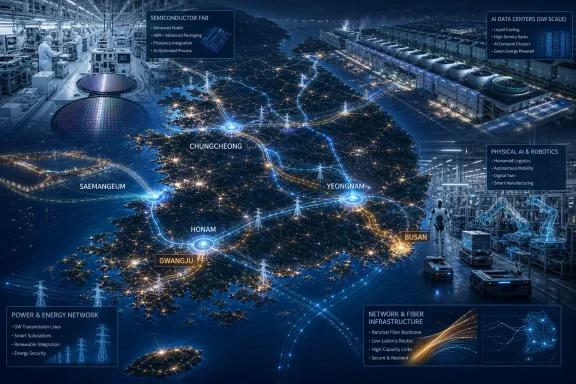 Korea Is Turning the AI Boom Into an Industrial Map
For years, the semiconductor conversation has been dominated by nodes, yields, lithography machines, export controls, and memory cycles. Korea’s emerging mega-project pitch adds another layer: geography. The plan described by Korean business media and corroborated by presidential-office briefings is not simply to build more capacity, but to distribute strategic capacity across regions that have long competed for national industrial relevance.That is why the reported placement matters. Honam is being framed as a future semiconductor manufacturing base, Chungcheong as a packaging and advanced materials hub, Yeongnam as a center for physical AI and data center activity, and Saemangeum as a proving ground for advanced industrial mobility and robotics. This is industrial policy written as a regional development map.
The scale invites skepticism, and it should. Trillion-won announcements often blend confirmed capital expenditure, long-term aspirations, land development, infrastructure assumptions, and political theater into one conveniently impressive number. But even allowing for exaggeration, the structure of this package says something important: Korea’s chipmakers and policymakers increasingly see AI not as a software boom layered on top of existing hardware, but as a full-stack industrial reorganization.
That matters for everyone watching the Windows and enterprise computing world from the outside. AI data centers are not ethereal clouds; they are power plants, substations, fiber routes, cooling systems, GPU racks, HBM stacks, packaging lines, memory fabs, logistics networks, and operating teams. Korea is now trying to make that supply chain legible at national scale.
SK’s Reported Gwangju Bet Is a Memory Supercycle Written in Concrete
SK Group is expected to carry the largest single investment story into the June 29 event. According to the Maeil Business News report, SK is discussing a 700 trillion to 800 trillion won semiconductor fab complex in Gwangju and nearby areas, plus five gigawatt-scale AI data centers across the country. The combined figure, reportedly around 1,100 trillion won, would be the sort of number that forces analysts to reach for a spreadsheet before they reach for adjectives.The strategic logic is easier to understand than the number itself. SK hynix has been one of the central beneficiaries of AI’s hunger for high-bandwidth memory, and the company’s existing Yongin semiconductor cluster already represents a massive bet on future memory demand. Pulling forward fab schedules and adding new regional capacity would fit a world in which AI accelerators remain constrained not only by GPU supply but by the memory and packaging needed to feed them.
Gwangju is the politically striking part. A next-generation fab complex there would represent more than another production site; it would signal that Korea is willing to push semiconductor manufacturing outside the gravitational pull of the Seoul metropolitan area and the already established chip belt. The report frames the project as a broader cluster, with materials, parts, equipment suppliers, R&D operations, and design firms surrounding the fab itself.
That cluster language is not decorative. Semiconductor manufacturing does not scale through buildings alone. It needs chemical suppliers, ultra-pure water systems, gas handling, precision equipment maintenance, testing ecosystems, skilled technicians, reliable transport, and emergency services that understand what a modern fab is. If SK and the government really intend Gwangju to become an AI semiconductor hub, the fab is only the first visible piece of a much larger machine.
The risk is that regional symbolism outruns operational reality. Fabs go where water, power, logistics, talent, suppliers, and permitting align. If those conditions are created, Honam could gain an anchor industry with generational consequences. If they are assumed rather than built, the project could become an expensive monument to overconfident planning.
Samsung’s Parallel Megaproject Looks Less Like One Bet Than a Portfolio
Samsung’s expected announcement appears to be broader and more distributed. The company is reportedly preparing a total investment plan of more than 1,000 trillion won, including a semiconductor cluster in Honam and additional projects from Samsung Display, Samsung SDI, and Samsung Electro-Mechanics. Where SK’s reported plan is dominated by the drama of a massive Gwangju fab and AI data center grid, Samsung’s looks like a portfolio approach to the AI hardware economy.That distinction is important. AI infrastructure is usually discussed through the glamorous parts: GPUs, custom accelerators, massive training clusters, and frontier models. Samsung’s ecosystem touches the less glamorous but equally critical layers: memory, displays, batteries, substrates, MLCCs, packaging, and materials. These are the components that determine whether scale becomes reliable infrastructure or merely an expensive demo.
Chungcheong is central to that picture. Cheonan, Onyang, Asan, and surrounding industrial areas already sit close to Samsung’s display and semiconductor operations. The report suggests that expanded packaging, advanced materials, next-generation display production, and battery R&D could all form part of the regional investment story. That would place Chungcheong in the middle of one of the most consequential bottlenecks in modern computing: advanced packaging.
Packaging used to be treated as the back end of the semiconductor business, a necessary but less celebrated stage after the heroic work of wafer fabrication. AI changed that. High-bandwidth memory, chiplets, interposers, substrates, thermal management, and heterogeneous integration have turned packaging into a performance frontier. The companies that can place memory closer to compute, move data faster, and dissipate heat more effectively will shape the economics of AI systems.
Samsung’s reported Yeongnam investments also make sense in this frame. Samsung Electro-Mechanics’ possible expansion in Busan for multilayer ceramic capacitors and semiconductor substrates points to the hidden electrical plumbing of AI infrastructure. Every accelerator server, power delivery system, networking device, and industrial robot depends on components that rarely appear in keynote slides but determine whether systems behave under load.
Data Centers Are the New Heavy Industry
The most revealing part of the Korean plan may be the five gigawatt-scale AI data centers reportedly associated with SK and the additional regional data center projects involving Samsung, GS, NAVER, Hyundai Motor Group, and others. The phrase AI data center has become so common that it risks sounding like another real-estate asset class. It is not. At gigawatt scale, a data center is a strategic industrial facility with the power appetite of a small city.That changes the politics. A factory brings jobs, suppliers, and tax revenue, but it also brings traffic, emissions concerns, water use, and pressure on public infrastructure. AI data centers bring a different mix: fewer direct manufacturing jobs than a fab, but enormous power requirements, grid upgrades, cooling demands, fiber connectivity, and long-term energy contracts. They can become anchors for regional digital economies, but only if power policy and industrial policy are designed together.
The reported decision to place much of this activity outside the Seoul metropolitan area is therefore not just about balanced development. Seoul cannot absorb infinite compute infrastructure. Land is expensive, grid constraints are real, and public tolerance for giant industrial loads is not unlimited. Regional siting gives Korea more room to maneuver, but it also exposes the country to the difficult work of building reliable power and network capacity where it is needed.
This is where the Korean plan intersects with global anxieties. The AI boom is increasingly a contest over electricity. Training and inference demand are expanding faster than many grid planners expected, and the cost of compute is now inseparable from the cost, reliability, and carbon intensity of energy. Korea’s reported plan implicitly acknowledges that AI leadership cannot be won by chip design alone.
For WindowsForum readers, this should feel familiar even if the scale is different. Enterprise IT has spent years learning that performance is no longer just a CPU or GPU metric. It is thermals, power envelopes, firmware, drivers, networking, storage throughput, and workload orchestration. Korea is applying the same lesson nationally.
Physical AI Is the Bid to Make Models Touch the Factory Floor
The third pillar, physical AI, is the least mature and potentially the most consequential. The phrase refers to AI systems embodied in machines: robots, autonomous vehicles, logistics systems, industrial automation platforms, digital twins, and sensor-rich manufacturing environments. It is where model output stops being text on a screen and starts moving goods, vehicles, tools, and production lines.The reported participants make the ambition clear. Hyundai Motor Group, LG Electronics, HD Hyundai Robotics, Doosan Robotics, CJ Logistics, SK Telecom, NAVER Cloud, and FuriosaAI are all named in connection with the broader initiative. This is not a software cluster in the narrow sense. It is a hardware-software-industrial stack aimed at making AI useful in places where failure has physical consequences.
Saemangeum is especially interesting. Hyundai Motor Group is reportedly refining a 900 billion won investment plan there, tied to advanced industries, autonomous driving, and AI. Saemangeum has long been a canvas for Korean development ambitions, sometimes more famous for promise than delivery. A credible physical AI corridor linking Saemangeum with Yeongnam would give it a sharper technological identity.
LG Electronics’ reported focus on AI and digital twin process capabilities at its Changwon plant adds another layer. Digital twins are often oversold in corporate decks, but in manufacturing they can be genuinely useful when tied to real sensors, process control, maintenance data, and simulation. The difference between hype and value is whether the model is connected to the messy operational truth of the plant.
Doosan Robotics’ plan to introduce intelligent robot solutions next year and CJ Logistics’ reported move toward humanoid logistics robots show how quickly the industrial robotics story is shifting. For a decade, automation was mostly discussed in terms of repetitive, fenced-off machines. Physical AI promises more flexible systems that perceive, adapt, and collaborate. It also raises harder questions about safety certification, liability, labor displacement, and cybersecurity.
The Political Calendar Is Not Incidental
President Lee Jae-myung’s decision to personally chair the June 29 national report meeting is not a procedural detail. These investment packages are being presented as part of a broader “great leap forward” agenda, with multiple ministries expected to announce support measures. That makes the event both an economic announcement and a political performance.The administration wants to show that private capital, regional development, and national strategic industries can move together. That is an attractive message for a country wrestling with demographic pressure, regional imbalance, export dependence, and geopolitical exposure. It is also a message that will be contested, because semiconductor location decisions are never merely technical once public infrastructure and regional promises enter the frame.
The reported follow-up briefings sharpen that point. Gwangju is expected to host a southwestern-region briefing on June 30, with SK Chairman Chey Tae-won likely to present his plan there. Samsung Electronics Chairman Lee Jae-yong is expected to announce Samsung’s investment plan in Asan on July 2. These dates turn a single national event into a regional roadshow.
That may help build local buy-in, but it also raises expectations. Once a region is told it sits at the center of a future semiconductor or AI corridor, every delay becomes political. Every permitting dispute becomes a test of seriousness. Every infrastructure shortfall becomes evidence that the promise was inflated.
The government’s challenge is to avoid confusing announcement choreography with execution capacity. Mega-projects live or die in the unglamorous middle: zoning, grid interconnection, water rights, workforce training, procurement, tax incentives, environmental review, and community negotiation. Korea has world-class industrial companies, but even they cannot shortcut physics or local politics.
The Numbers Are Enormous Because the Supply Chain Is No Longer Linear
It is tempting to treat the reported 1,000 trillion won-plus figures as spectacle. Some of that reaction is justified. Long-horizon investment numbers can be elastic, and conglomerates have every incentive to align previously planned capital expenditure with a government narrative when the political mood is favorable.But the numbers also reflect a real change in the cost structure of computing. A modern AI supply chain is not a straight line from fab to chip to server. It is a dense web of memory, logic, packaging, substrates, power electronics, cooling, networking, software, models, robotics, and domain-specific integration. Each layer has become capital intensive.
A fab alone can cost tens of billions of dollars. A serious AI data center program can consume billions more before the first customer workload runs. Advanced packaging capacity requires specialized equipment and process knowledge. Robotics and physical AI require factories, testbeds, safety systems, and field deployment environments. Once these are bundled into a national strategy, the headline numbers inevitably become huge.
The better question is not whether the figures sound too large. It is whether the projects reinforce each other. A fab in Gwangju, packaging in Chungcheong, substrates in Busan, data centers in Ulsan and elsewhere, and physical AI testbeds in Saemangeum only become a strategy if they form a usable industrial network. If they remain disconnected regional trophies, the country will have spent political capital without building compounding advantage.
That is the standard by which this plan should be judged. Not by the size of the announcement, but by the quality of the interfaces between its parts.
Windows Users Will Feel This Through Hardware, Cloud, and Enterprise AI
At first glance, Korea’s regional investment plan may seem distant from Windows desktops, laptops, and servers. It is not. The Windows ecosystem sits downstream from almost every part of the AI hardware chain Korea is trying to strengthen.Memory supply affects PC pricing, workstation configurations, server procurement, and cloud economics. Advanced packaging affects the accelerators that power enterprise AI services, including those embedded in productivity software, developer tools, security products, and analytics platforms. Data center expansion affects the availability and cost of inference capacity that businesses increasingly consume through APIs and managed services rather than local hardware.
Physical AI will also matter to Windows shops in more subtle ways. Manufacturing, logistics, retail, healthcare, and transportation firms still run enormous estates of Windows endpoints, Windows Server workloads, Active Directory environments, device management platforms, and line-of-business applications. As robotics and AI-driven automation spread, IT departments will be asked to secure and integrate systems that look less like office computers and more like moving cyber-physical endpoints.
That creates a new administrative burden. Robots, autonomous systems, factory sensors, and digital twin platforms do not fit neatly into old endpoint-management categories. They require identity, patching, network segmentation, telemetry, incident response, and vendor-risk management. If physical AI scales the way Korean policymakers hope, enterprise IT will inherit much of the operational complexity.
There is also a developer angle. Korea’s investments in AI infrastructure and domestic AI hardware players, including companies such as FuriosaAI, reflect a broader push to avoid total dependence on foreign accelerators and cloud platforms. That could diversify the hardware targets developers must support. The AI stack is already fragmenting across GPUs, NPUs, custom silicon, inference accelerators, and specialized runtime environments.
For Windows developers, that means the future is unlikely to be a single clean abstraction. Performance will depend on drivers, SDK maturity, model optimization, memory bandwidth, local versus cloud execution, and hardware availability. Korea’s plan is one more sign that AI computing is becoming more heterogeneous, not less.
The Sovereignty Argument Is Bigger Than Korea
The Korean announcement sits inside a global pattern. The United States has pushed semiconductor manufacturing through CHIPS Act incentives. The European Union has pursued its own chip strategy. Japan has backed domestic advanced manufacturing efforts. Taiwan remains indispensable but geopolitically exposed. China is racing to localize as much of the stack as possible under export-control pressure.Korea’s version is distinctive because it already has two of the world’s most important memory companies and a deep electronics manufacturing base. It does not need to invent a semiconductor industry from scratch. It needs to keep that industry relevant as AI shifts value toward HBM, packaging, power efficiency, and integrated systems.
That is why the physical AI pillar matters. If Korea simply builds more memory capacity, it remains exposed to the cyclicality that has always defined the memory business. If it ties memory, data centers, robotics, vehicles, displays, batteries, and industrial automation into a broader platform, it has a chance to capture more durable value.
This is the same logic behind the word “sovereign” appearing more often in AI discussions. Countries want domestic compute, domestic data handling, domestic model capacity, and domestic supply chains. But sovereignty is expensive. It requires capital commitments that look irrational if judged only by near-term returns.
The danger is that every country cannot be fully sovereign in every layer. Korea’s advantage is that it can plausibly lead in several layers that matter: memory, displays, batteries, components, manufacturing automation, and some AI infrastructure. The question is whether it can coordinate those strengths without smothering them in political allocation.
Regional Balance Could Become Either the Masterstroke or the Weakness
The most ambitious part of the plan is also its most fragile: the attempt to make regional balance a feature rather than a constraint. Honam, Chungcheong, Yeongnam, Gangwon, Sejong, Saemangeum, Ulsan, Busan, Asan, Cheonan, Gwangju — the map is sprawling. That breadth makes the politics easier but the execution harder.A concentrated cluster benefits from density. Engineers move between firms. Suppliers locate nearby. Universities adapt programs. Specialized contractors emerge. Informal knowledge spreads. Silicon Valley, Hsinchu, Shenzhen, and Korea’s own semiconductor corridors all show that proximity compounds over time.
A distributed strategy needs deliberate connective tissue. High-speed transport, shared R&D networks, coordinated university pipelines, supplier incentives, standard permitting frameworks, and reliable power planning become essential. Without them, each region may gain a project, but the country may not gain a cluster.
There is also the risk of duplicative infrastructure. Multiple AI data centers across different regions can improve resilience and distribute economic benefits, but they can also compete for the same scarce grid capacity, cooling expertise, and accelerator supply. Multiple semiconductor sites can diversify risk, but they can also stretch talent thin.
Still, the alternative is not obviously better. Overconcentration around Seoul and the existing chip belt creates its own vulnerabilities: land pressure, housing costs, congestion, grid constraints, and political resentment. Korea is trying to solve a real problem. The open question is whether it can solve it with enough discipline to avoid turning industrial strategy into regional appeasement.
The Fine Print Will Decide Whether This Is a Strategy or a Ceremony
The June 29 event will produce speeches, photos, and headline numbers. Those are the easy parts. The fine print will determine whether the announcement becomes a durable industrial shift.The first test is power. Gigawatt-scale AI data centers and advanced fabs require predictable, high-quality electricity on a timeline that matches construction. Grid upgrades are slow, politically sensitive, and technically unforgiving. If Korea’s ministries cannot align energy planning with industrial timelines, the data center portion of the plan will become the bottleneck.
The second test is talent. Semiconductor fabs and advanced packaging facilities require experienced process engineers, equipment technicians, materials scientists, cleanroom operators, and maintenance specialists. Physical AI requires robotics engineers, safety experts, controls engineers, embedded developers, AI researchers, and field technicians. Regional universities and vocational programs will need to move quickly.
The third test is environmental and community legitimacy. Fabs require water and chemicals. Data centers require land, power, and cooling. Robotics corridors alter labor markets. If local communities feel that decisions were imposed from Seoul in the name of national competitiveness, delays and backlash will follow.
The fourth test is customer demand. AI demand looks enormous today, but infrastructure cycles are long. If training growth slows, inference economics change, model architectures become less hardware-hungry, or global overcapacity emerges, some investments may look mistimed. Korea’s companies know cyclicality well, but the size of this bet magnifies the consequences.
The fifth test is whether the projects remain private-sector rational. Government support can accelerate permitting, infrastructure, and coordination. It cannot make uneconomic fabs profitable forever. Samsung, SK, Hyundai, LG, NAVER, and the other firms involved will eventually be judged by returns, not presidential staging.
The Korean Bet Is Really About Who Owns the AI Supply Chain
The most concrete way to read the announcement is as a bid to own more of the AI supply chain at home. The fabs produce the memory and semiconductors. The packaging sites connect and accelerate them. The component plants feed the boards and systems. The data centers turn hardware into compute. The physical AI corridors turn compute into industrial action.That is a coherent theory of national advantage. It is also expensive, risky, and politically exposed.
The rest of the world should not dismiss it as subsidy theater. Korea has repeatedly shown that coordinated state-industry efforts can create globally formidable sectors, from shipbuilding to electronics to batteries and memory. But neither should anyone treat the announcement as destiny. In semiconductors, the gap between “planned” and “qualified volume production” is measured in years, billions, and countless engineering failures.
The timing is revealing. AI has given memory producers a stronger hand than they have had in years, and HBM has moved from a specialized product to a strategic asset. Data centers have become national infrastructure. Robotics has become a serious boardroom topic again after years of false starts. Korea is trying to connect these currents while the market still rewards ambition.
That is why the June 29 meeting matters even before every detail is confirmed. It shows that Korea’s largest conglomerates and its new administration are converging on the same basic premise: the AI era will be won by countries that can build, power, package, deploy, and industrialize compute, not merely consume it.
The Map Now Carries the Message
The practical meaning of Korea’s mega-project announcement can be compressed into a few points, though each one will take years to test. The promise is not just more fabs or more data centers. The promise is that Korea can turn regional industrial policy into a full-stack AI infrastructure strategy.- SK is reportedly preparing the largest single package, including a 700 trillion to 800 trillion won Gwangju-area semiconductor fab plan and five gigawatt-scale AI data centers.
- Samsung is expected to present a broader investment portfolio spanning Honam semiconductors, Chungcheong packaging and displays, battery R&D, and Yeongnam component production.
- The physical AI pillar ties the announcement to robotics, autonomous systems, logistics automation, digital twins, and industrial AI rather than only cloud computing.
- The regional distribution is politically powerful but operationally risky, because fabs and data centers depend on power, water, talent, suppliers, and permitting discipline.
- Windows and enterprise IT users will feel the consequences indirectly through memory supply, AI cloud capacity, accelerator economics, industrial automation, and the security demands of cyber-physical systems.
- The announcement should be judged less by its trillion-won headline figures than by whether the regions become connected parts of a functioning industrial network.