

News Corp Australia’s sponsored article, “If AI can’t see your brand, neither will your next customer,” was published behind an anti-crawler access screen in June 2026, turning a marketing argument about AI visibility into a live demonstration of the problem it describes. The pitch is simple enough: brands now need to be legible not only to humans and search engines, but to the AI systems increasingly mediating discovery. The irony is sharper because the page itself appears to have greeted automated access with a bot-management wall. In the new web economy, blocking machines may protect content, but it can also make a business vanish from the very systems customers ask for guidance.
For two decades, the internet’s commercial bargain was brutally clear. If a company wanted to be found, it optimized for Google, bought search ads, maintained a decent website, watched its reviews, and hoped the customer clicked. The marketing funnel was imperfect, expensive, and often gamed, but at least the mechanics were visible enough for businesses to understand the fight.
That model is now being crowded by a different kind of intermediary. A customer no longer has to search “best accounting software for small medical practices” and compare ten blue links. They can ask ChatGPT, Gemini, Copilot, Perplexity, Claude, or another assistant for a shortlist, a recommendation, a comparison table, or a purchasing plan.
That matters because an AI answer is not just another ranking page. It compresses research, reputation, product positioning, reviews, third-party commentary, and sometimes live web results into a single conversational response. A brand that fails to appear in that answer may not lose a click; it may lose the customer before the customer knows it existed.
The phrase now circulating through marketing circles is generative engine optimization, or GEO. Like most new acronyms, it is both useful and opportunistic. It names a real shift, but it also invites a gold rush of consultants selling certainty in a market still defined by opacity.
There are legitimate reasons for that. Publishers have spent years watching search engines, aggregators, social platforms, and now AI labs extract value from their work. Bot controls are not paranoia; they are a defensive layer in a web where scraping, spam, credential abuse, and automated harvesting are daily realities.
But the collision is still revealing. The same technical measures that keep bad actors out can also keep legitimate discovery systems away. If a brand’s public story is locked behind scripts, consent gates, bot checks, malformed metadata, or pages that cannot be rendered cleanly, the business may be invisible or misrepresented in AI-generated answers.
That is not merely a publishing problem. It is a WindowsForum problem, a small-business problem, an enterprise IT problem, and a developer problem. The modern web stack has become so defensive, dynamic, and fragmented that machines often see a very different version of a brand than humans do.
A search engine can rank a product page even if the wider web does not fully understand the company behind it. A generative system is more likely to synthesize from repeated, corroborated information across the open web. It wants to know what the company is, what it sells, who trusts it, what complaints exist, what alternatives exist, and whether the information is current.
This is why AI visibility is not solved by stuffing a site with “best,” “top,” and “near me.” Models and answer engines draw from a messy mixture of official websites, support pages, reviews, forums, documentation, news articles, retailer listings, knowledge panels, structured data, community discussions, and third-party comparisons. A brand’s own website is still important, but it is no longer the whole dossier.
For Windows administrators, the parallel is obvious. A device inventory is only useful if it reflects reality across endpoints, identity, patch state, and security posture. AI visibility is a brand inventory problem. If the public data estate is contradictory, outdated, thin, or inaccessible, the answer engine will fill the gaps with whatever it can find.
A good site now has to serve multiple audiences at once. Humans need readable pages. Search engines need crawlable structure. AI systems need unambiguous facts, stable descriptions, current product names, clear pricing where appropriate, documentation, schema markup, and pages that do not collapse when viewed without a full consumer browser session.
This is where many brands quietly fail. They bury key facts in JavaScript-heavy experiences. They publish PDFs that are hard to parse. They let partner sites carry outdated descriptions. They rename products without redirecting old pages cleanly. They hide support information behind portals. They leave review ecosystems unmanaged. Then they wonder why an AI assistant recommends a competitor with a clearer public footprint.
The problem is not that AI “doesn’t like” them. The problem is that AI systems reward legibility. They are more likely to surface a company whose identity and value proposition are repeated consistently across accessible, trusted sources.
But the rise of AI discovery adds a commercial tradeoff. Not every bot is equal. A crawler might be a spammer, a search indexer, an AI retrieval system, an uptime monitor, an accessibility tool, a partner integration, or a research assistant acting on behalf of a real customer. Treating all automated access as hostile may simplify controls, but it can also shrink a brand’s surface area in the discovery layer.
This is not an argument for throwing the doors open. It is an argument for more precise policy. Businesses need to know which crawlers they allow, which they block, what those crawlers can see, and whether the rendered page contains the same claims a human visitor sees.
The awkward part is that these decisions often live in different departments. Marketing wants visibility. Legal wants control. Security wants reduced risk. Engineering wants performance. The AI web forces those groups into the same room, because each can accidentally sabotage the others.
A customer asking for recommendations may not see a ranked list at all. They may see three vendors, a rationale, a caution about pricing, and a suggestion to request a demo. If a brand appears in that answer, it enters the consideration set. If it does not, the company may never know it lost.
This makes analytics harder. Traditional web metrics can show traffic declines, conversion rates, and referral sources. They are much worse at showing how often a brand was omitted from an AI-generated shortlist. The absence leaves no server log.
That measurement gap is one reason AI visibility platforms are multiplying. They promise to test prompts, track citations, compare competitors, and show how brands appear across engines. Some of that is genuinely useful. Some of it will become the new SEO snake oil.
That means AI-mediated discovery will touch procurement, support, troubleshooting, software selection, and internal knowledge work. An employee may ask Copilot which endpoint management tool fits a scenario. A sysadmin may ask for a comparison of backup vendors. A developer may ask which library is best maintained. A small-business owner may ask which MSPs serve their region.
In each case, the assistant’s answer depends on what it can retrieve, infer, and trust. The companies that maintain clear documentation, current support pages, strong third-party validation, and accessible public information gain an advantage. The companies that rely on gated brochures and sales calls are less likely to be named early.
There is a direct lesson for software vendors in the Windows ecosystem. If your driver page is stale, your changelog is vague, your Microsoft Store listing is thin, your GitHub repository is neglected, and your docs are hidden behind a login, you are training the AI layer to prefer someone else.
That raises the value of independent evidence. Reviews, community threads, analyst notes, news coverage, documentation, standards participation, support responsiveness, and public issue handling can all become part of the picture. A company that says it is secure is less persuasive than a company whose security posture is reflected in advisories, audits, changelogs, CVE handling, and credible third-party discussion.
This may be uncomfortable for marketing departments accustomed to controlling the message. AI systems are not limited to the message. They ingest the mess: complaints, comparisons, outdated pages, forum arguments, old product names, and support frustrations.
In that sense, AI visibility is also reputation management with fewer hiding places. A brand can polish its homepage, but if the public web says its installer is broken on Windows 11 24H2, or its support team ignores enterprise tickets, the assistant may surface that caveat at precisely the moment a buyer is choosing.
Some of these terms describe real practices. Brands should test how they appear in AI answers. They should maintain structured data. They should ensure pages are crawlable. They should reconcile inconsistent product descriptions. They should cultivate credible third-party references. They should monitor whether AI systems hallucinate or misstate their offerings.
But the market is also full of premature certainty. Nobody outside the major AI companies fully controls how these systems weigh sources, personalize answers, update indexes, or reconcile conflicts. The same prompt can produce different answers across engines, regions, user histories, and time.
That uncertainty should make buyers skeptical of anyone promising guaranteed AI rankings. There will be best practices, but there will not be a single universal trick. The closer AI search moves toward personalized agents, the less stable any one ranking snapshot becomes.
It also means checking the wider data supply chain. Are reseller listings accurate? Are old domains redirected? Do review profiles reflect current operations? Do press pages contain useful facts or just slogans? Are executive bios, office locations, product names, and pricing tiers consistent across the web?
For IT teams, there is also an operational layer. Bot rules, WAF settings, CDN configurations, robots.txt files, authentication gates, and JavaScript rendering choices can all affect what machines see. A marketing team can spend six figures on AI visibility while an overzealous security rule quietly blocks the crawlers that matter.
The winning organizations will treat this as a cross-functional discipline. Marketing cannot solve it alone. Security cannot solve it alone. Web engineering cannot solve it alone. The brand is now an information system, and AI discovery is one of its consumers.
There is no clean answer. Licensing deals, crawler policies, paywalls, snippets, structured metadata, and selective access will all become part of the negotiation. Publishers will have to decide what they want AI systems to know, what they want them to quote, what they want them to pay for, and what they want them to leave alone.
Brands that advertise through publishers inherit some of this complexity. Sponsored content behind aggressive bot defenses may satisfy a campaign brief for human subscribers, but it may do little for AI visibility if the page is not accessible to the systems shaping future discovery.
The irony is that sponsored content is often created precisely to establish authority outside a brand’s own site. In the AI era, that only works if the authority can be seen, parsed, and trusted by machines as well as people.
That gap matters because AI assistants flatten geography and category discovery in strange ways. A user asking for a local service may receive a shortlist based on reviews, directories, map data, website clarity, and third-party mentions. If the business has inconsistent hours, poor structured data, thin service pages, or no recent reviews, it can be outcompeted by a weaker operator with better digital hygiene.
The old advice still applies, but the stakes are higher. Keep listings current. Maintain a real website. Publish useful information. Respond to reviews. Make services explicit. Do not hide everything behind a phone call. The difference is that these actions now feed not only human trust but machine interpretation.
For Windows-heavy small businesses, this may become part of routine IT housekeeping. The same MSP that manages Microsoft 365, endpoint security, backups, and domains may increasingly be asked why the company does not appear in AI answers. That is not traditional IT work, but neither was website security once upon a time.
This is where the best advice sounds almost old-fashioned. Be specific. Be consistent. Be useful. Publish facts. Keep them current. Earn credible mentions. Fix broken pages. Do not make every answer depend on a sales form. Do not confuse brand mystique with informational scarcity.
AI systems are imperfect and sometimes confidently wrong. But they are also forcing a reckoning with the web’s accumulated neglect. Thin pages, broken metadata, abandoned blogs, contradictory listings, and defensive access controls were already bad for users. Now they are bad for visibility in a layer that increasingly sits between user and vendor.
The companies that understand this will not abandon SEO. They will extend it into a broader discipline of public knowledge management. Search is becoming conversation, and conversation needs reliable material to work with.
The lesson is not that bot protection is bad. The lesson is that visibility now has to be engineered with more nuance. Every gate, script, redirect, metadata field, and policy choice shapes what machines can learn. In a world where machines increasingly brief humans before humans visit a site, that is a strategic concern.
There is a defensive reading and an offensive one. Defensively, businesses need to prevent AI systems from misreading or ignoring them. Offensively, they need to become the clearest, most trustworthy answer in their category.
That is a harder standard than ranking for a keyword. It is also a healthier one. The AI web may reward the companies that stop treating information as campaign exhaust and start treating it as infrastructure.
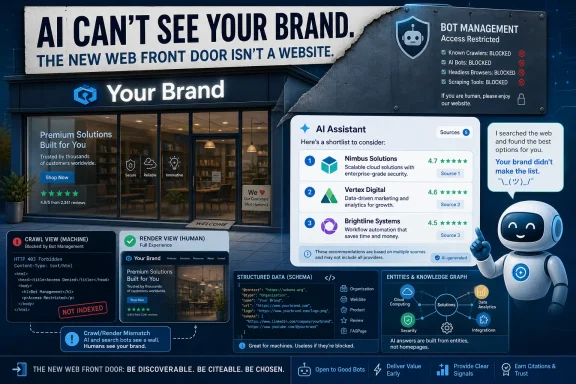 The New Front Door Is No Longer a Search Box
For two decades, the internet’s commercial bargain was brutally clear. If a company wanted to be found, it optimized for Google, bought search ads, maintained a decent website, watched its reviews, and hoped the customer clicked. The marketing funnel was imperfect, expensive, and often gamed, but at least the mechanics were visible enough for businesses to understand the fight.That model is now being crowded by a different kind of intermediary. A customer no longer has to search “best accounting software for small medical practices” and compare ten blue links. They can ask ChatGPT, Gemini, Copilot, Perplexity, Claude, or another assistant for a shortlist, a recommendation, a comparison table, or a purchasing plan.
That matters because an AI answer is not just another ranking page. It compresses research, reputation, product positioning, reviews, third-party commentary, and sometimes live web results into a single conversational response. A brand that fails to appear in that answer may not lose a click; it may lose the customer before the customer knows it existed.
The phrase now circulating through marketing circles is generative engine optimization, or GEO. Like most new acronyms, it is both useful and opportunistic. It names a real shift, but it also invites a gold rush of consultants selling certainty in a market still defined by opacity.
Sponsored Content Accidentally Finds the Perfect Metaphor
The blocked News Corp Australia page is almost too neat as a case study. The article’s headline warns that if AI cannot see a brand, the next customer may not see it either. Yet the accessible text is not the argument, the evidence, or the sponsor’s pitch; it is a crawler-management notice explaining that the visitor might have been detected and blocked as a bot.There are legitimate reasons for that. Publishers have spent years watching search engines, aggregators, social platforms, and now AI labs extract value from their work. Bot controls are not paranoia; they are a defensive layer in a web where scraping, spam, credential abuse, and automated harvesting are daily realities.
But the collision is still revealing. The same technical measures that keep bad actors out can also keep legitimate discovery systems away. If a brand’s public story is locked behind scripts, consent gates, bot checks, malformed metadata, or pages that cannot be rendered cleanly, the business may be invisible or misrepresented in AI-generated answers.
That is not merely a publishing problem. It is a WindowsForum problem, a small-business problem, an enterprise IT problem, and a developer problem. The modern web stack has become so defensive, dynamic, and fragmented that machines often see a very different version of a brand than humans do.
AI Visibility Is Not SEO With a Fresh Coat of Paint
Traditional SEO was built around pages, keywords, links, and rankings. GEO is built around entities, evidence, citations, retrieval, summaries, and trust signals. That is not a minor adjustment; it changes what businesses must maintain.A search engine can rank a product page even if the wider web does not fully understand the company behind it. A generative system is more likely to synthesize from repeated, corroborated information across the open web. It wants to know what the company is, what it sells, who trusts it, what complaints exist, what alternatives exist, and whether the information is current.
This is why AI visibility is not solved by stuffing a site with “best,” “top,” and “near me.” Models and answer engines draw from a messy mixture of official websites, support pages, reviews, forums, documentation, news articles, retailer listings, knowledge panels, structured data, community discussions, and third-party comparisons. A brand’s own website is still important, but it is no longer the whole dossier.
For Windows administrators, the parallel is obvious. A device inventory is only useful if it reflects reality across endpoints, identity, patch state, and security posture. AI visibility is a brand inventory problem. If the public data estate is contradictory, outdated, thin, or inaccessible, the answer engine will fill the gaps with whatever it can find.
The Brand Website Becomes Evidence, Not Destination
The corporate website used to be the destination. In the AI-mediated web, it increasingly becomes source material. That is a demotion in one sense, but it is also a clarification of purpose.A good site now has to serve multiple audiences at once. Humans need readable pages. Search engines need crawlable structure. AI systems need unambiguous facts, stable descriptions, current product names, clear pricing where appropriate, documentation, schema markup, and pages that do not collapse when viewed without a full consumer browser session.
This is where many brands quietly fail. They bury key facts in JavaScript-heavy experiences. They publish PDFs that are hard to parse. They let partner sites carry outdated descriptions. They rename products without redirecting old pages cleanly. They hide support information behind portals. They leave review ecosystems unmanaged. Then they wonder why an AI assistant recommends a competitor with a clearer public footprint.
The problem is not that AI “doesn’t like” them. The problem is that AI systems reward legibility. They are more likely to surface a company whose identity and value proposition are repeated consistently across accessible, trusted sources.
Bot Blocking Is Now a Business Decision, Not Just a Security Setting
Security teams have historically treated bot management as a perimeter issue. Block scrapers, rate-limit suspicious traffic, stop credential stuffing, preserve site performance, and keep abusive automation away. Those goals remain valid, especially for publishers and commerce sites under constant attack.But the rise of AI discovery adds a commercial tradeoff. Not every bot is equal. A crawler might be a spammer, a search indexer, an AI retrieval system, an uptime monitor, an accessibility tool, a partner integration, or a research assistant acting on behalf of a real customer. Treating all automated access as hostile may simplify controls, but it can also shrink a brand’s surface area in the discovery layer.
This is not an argument for throwing the doors open. It is an argument for more precise policy. Businesses need to know which crawlers they allow, which they block, what those crawlers can see, and whether the rendered page contains the same claims a human visitor sees.
The awkward part is that these decisions often live in different departments. Marketing wants visibility. Legal wants control. Security wants reduced risk. Engineering wants performance. The AI web forces those groups into the same room, because each can accidentally sabotage the others.
The “Zero-Click” Web Was Only the Opening Act
Publishers have complained about zero-click search for years. Google could answer a user’s question directly on the results page, reducing the need to visit the original source. AI assistants intensify that dynamic by moving from snippets to synthesized judgment.A customer asking for recommendations may not see a ranked list at all. They may see three vendors, a rationale, a caution about pricing, and a suggestion to request a demo. If a brand appears in that answer, it enters the consideration set. If it does not, the company may never know it lost.
This makes analytics harder. Traditional web metrics can show traffic declines, conversion rates, and referral sources. They are much worse at showing how often a brand was omitted from an AI-generated shortlist. The absence leaves no server log.
That measurement gap is one reason AI visibility platforms are multiplying. They promise to test prompts, track citations, compare competitors, and show how brands appear across engines. Some of that is genuinely useful. Some of it will become the new SEO snake oil.
Microsoft’s Ecosystem Makes This More Than a Marketing Story
For WindowsForum readers, the temptation is to file this under advertising jargon and move on. That would be a mistake. Microsoft has embedded AI into the operating system, the browser, the productivity suite, developer tooling, security products, and cloud services. Copilot is not a single chatbot; it is becoming a user interface pattern across Microsoft’s stack.That means AI-mediated discovery will touch procurement, support, troubleshooting, software selection, and internal knowledge work. An employee may ask Copilot which endpoint management tool fits a scenario. A sysadmin may ask for a comparison of backup vendors. A developer may ask which library is best maintained. A small-business owner may ask which MSPs serve their region.
In each case, the assistant’s answer depends on what it can retrieve, infer, and trust. The companies that maintain clear documentation, current support pages, strong third-party validation, and accessible public information gain an advantage. The companies that rely on gated brochures and sales calls are less likely to be named early.
There is a direct lesson for software vendors in the Windows ecosystem. If your driver page is stale, your changelog is vague, your Microsoft Store listing is thin, your GitHub repository is neglected, and your docs are hidden behind a login, you are training the AI layer to prefer someone else.
Trust Signals Are Becoming Machine-Readable Reputation
The old web rewarded popularity. The AI web rewards a more complicated blend of popularity, authority, recency, consistency, and retrieval friendliness. A brand does not merely need to be talked about; it needs to be talked about in ways machines can reconcile.That raises the value of independent evidence. Reviews, community threads, analyst notes, news coverage, documentation, standards participation, support responsiveness, and public issue handling can all become part of the picture. A company that says it is secure is less persuasive than a company whose security posture is reflected in advisories, audits, changelogs, CVE handling, and credible third-party discussion.
This may be uncomfortable for marketing departments accustomed to controlling the message. AI systems are not limited to the message. They ingest the mess: complaints, comparisons, outdated pages, forum arguments, old product names, and support frustrations.
In that sense, AI visibility is also reputation management with fewer hiding places. A brand can polish its homepage, but if the public web says its installer is broken on Windows 11 24H2, or its support team ignores enterprise tickets, the assistant may surface that caveat at precisely the moment a buyer is choosing.
The Acronym Boom Is Already Outrunning the Evidence
Every platform shift creates a consulting vocabulary. SEO gave us page rank sculpting, content farms, link wheels, domain authority rituals, and eventually a mature discipline buried under bad incentives. AI search is now generating GEO, AEO, LLMO, AIO, and agentic optimization.Some of these terms describe real practices. Brands should test how they appear in AI answers. They should maintain structured data. They should ensure pages are crawlable. They should reconcile inconsistent product descriptions. They should cultivate credible third-party references. They should monitor whether AI systems hallucinate or misstate their offerings.
But the market is also full of premature certainty. Nobody outside the major AI companies fully controls how these systems weigh sources, personalize answers, update indexes, or reconcile conflicts. The same prompt can produce different answers across engines, regions, user histories, and time.
That uncertainty should make buyers skeptical of anyone promising guaranteed AI rankings. There will be best practices, but there will not be a single universal trick. The closer AI search moves toward personalized agents, the less stable any one ranking snapshot becomes.
The Practical Work Looks Boring, Which Is Why It Matters
The most durable AI visibility work is not glamorous. It looks like information hygiene. It means making sure the official website is fast, accessible, crawlable, and semantically clear. It means using schema markup where it helps. It means publishing plain-language product pages, support articles, changelogs, security notes, and comparison material that does not read like empty ad copy.It also means checking the wider data supply chain. Are reseller listings accurate? Are old domains redirected? Do review profiles reflect current operations? Do press pages contain useful facts or just slogans? Are executive bios, office locations, product names, and pricing tiers consistent across the web?
For IT teams, there is also an operational layer. Bot rules, WAF settings, CDN configurations, robots.txt files, authentication gates, and JavaScript rendering choices can all affect what machines see. A marketing team can spend six figures on AI visibility while an overzealous security rule quietly blocks the crawlers that matter.
The winning organizations will treat this as a cross-functional discipline. Marketing cannot solve it alone. Security cannot solve it alone. Web engineering cannot solve it alone. The brand is now an information system, and AI discovery is one of its consumers.
Publishers Face the Hardest Version of the Tradeoff
News Corp Australia’s bot wall points to a deeper conflict: publishers need AI visibility, but they also need leverage against AI extraction. If their work is freely ingested, summarized, and monetized elsewhere, the economics of journalism deteriorate further. If they block too aggressively, they risk disappearing from answer engines and losing relevance among readers who increasingly start with AI.There is no clean answer. Licensing deals, crawler policies, paywalls, snippets, structured metadata, and selective access will all become part of the negotiation. Publishers will have to decide what they want AI systems to know, what they want them to quote, what they want them to pay for, and what they want them to leave alone.
Brands that advertise through publishers inherit some of this complexity. Sponsored content behind aggressive bot defenses may satisfy a campaign brief for human subscribers, but it may do little for AI visibility if the page is not accessible to the systems shaping future discovery.
The irony is that sponsored content is often created precisely to establish authority outside a brand’s own site. In the AI era, that only works if the authority can be seen, parsed, and trusted by machines as well as people.
Small Businesses May Be Hit Before They Notice
Large enterprises can buy monitoring tools, hire agencies, negotiate publisher placements, and assign teams to AI visibility. Small businesses will often discover the shift only after leads soften. A local firm may have a good reputation among existing customers but a weak machine-readable presence.That gap matters because AI assistants flatten geography and category discovery in strange ways. A user asking for a local service may receive a shortlist based on reviews, directories, map data, website clarity, and third-party mentions. If the business has inconsistent hours, poor structured data, thin service pages, or no recent reviews, it can be outcompeted by a weaker operator with better digital hygiene.
The old advice still applies, but the stakes are higher. Keep listings current. Maintain a real website. Publish useful information. Respond to reviews. Make services explicit. Do not hide everything behind a phone call. The difference is that these actions now feed not only human trust but machine interpretation.
For Windows-heavy small businesses, this may become part of routine IT housekeeping. The same MSP that manages Microsoft 365, endpoint security, backups, and domains may increasingly be asked why the company does not appear in AI answers. That is not traditional IT work, but neither was website security once upon a time.
The Companies That Win Will Be the Ones AI Can Verify
The central mistake is thinking AI visibility is about flattering the machine. It is really about making reality easier to verify. The more clearly a company’s public presence reflects what it actually does, the easier it is for AI systems to represent it accurately.This is where the best advice sounds almost old-fashioned. Be specific. Be consistent. Be useful. Publish facts. Keep them current. Earn credible mentions. Fix broken pages. Do not make every answer depend on a sales form. Do not confuse brand mystique with informational scarcity.
AI systems are imperfect and sometimes confidently wrong. But they are also forcing a reckoning with the web’s accumulated neglect. Thin pages, broken metadata, abandoned blogs, contradictory listings, and defensive access controls were already bad for users. Now they are bad for visibility in a layer that increasingly sits between user and vendor.
The companies that understand this will not abandon SEO. They will extend it into a broader discipline of public knowledge management. Search is becoming conversation, and conversation needs reliable material to work with.
The Crawler Wall Is the Warning Label
The blocked sponsored article is not just a curiosity. It is a warning label for the next phase of digital competition. A brand can pay to publish a message about AI visibility and still have that message obscured by the machinery of the modern web.The lesson is not that bot protection is bad. The lesson is that visibility now has to be engineered with more nuance. Every gate, script, redirect, metadata field, and policy choice shapes what machines can learn. In a world where machines increasingly brief humans before humans visit a site, that is a strategic concern.
There is a defensive reading and an offensive one. Defensively, businesses need to prevent AI systems from misreading or ignoring them. Offensively, they need to become the clearest, most trustworthy answer in their category.
That is a harder standard than ranking for a keyword. It is also a healthier one. The AI web may reward the companies that stop treating information as campaign exhaust and start treating it as infrastructure.
The Brands That Stop Hiding in Plain Sight Will Move First
The practical message is narrower than the hype but more urgent than the skeptics admit. AI visibility is not magic, and it is not a replacement for reputation, product quality, or customer service. It is the new test of whether those things can be discovered.- Brands need to audit what AI assistants say about them across common customer, buyer, support, and comparison prompts.
- Public websites need to be crawlable, current, semantically clear, and useful without requiring a perfect browser session.
- Bot-management policies need to distinguish hostile automation from legitimate indexing, retrieval, monitoring, and AI-mediated discovery.
- Third-party validation matters because AI systems often trust corroborated public evidence more than isolated brand claims.
- SEO remains important, but it is now only one part of a larger discipline built around machine-readable trust.
- The biggest risk is not that AI says something negative about a brand, but that it says nothing at all.
References
- Primary source: The Australian
Published: 2026-06-28T14:50:11.805759
Loading…
www.theaustralian.com.au - Related coverage: businesswire.com
Loading…
www.businesswire.com - Related coverage: searchfy.ai
Loading…
searchfy.ai - Related coverage: business.times-online.com
Loading…
business.times-online.com - Related coverage: usegrowthos.com
Loading…
www.usegrowthos.com - Related coverage: g10x.com
Loading…
www.g10x.com
- Related coverage: businessintelligence.mo
Loading…
businessintelligence.mo - Related coverage: techradar.com
Agentic Search Optimization reshapes brand visibility in AI search | TechRadar
Search is evolving fast, brands must adopt ASO to stay visible in AI-driven discoverywww.techradar.com - Related coverage: axios.com
Loading…
www.axios.com - Related coverage: omc.com
Loading…
www.omc.com