

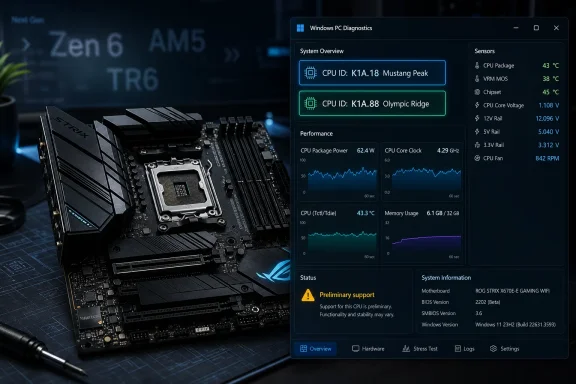
AIDA64 Extreme 8.30.8332 beta, released June 27, 2026, adds preliminary identification support for AMD K1A.18 Mustang Peak and AMD K1A.88 Olympic Ridge CPUs, putting two expected Zen 6-era processor families into a mainstream Windows diagnostics tool before AMD has formally launched either product. The entry is small, but the signal is not. This is the part of the CPU launch cycle where names stop living only in leak threads and start appearing in the plumbing that Windows users, overclockers, OEMs, and support desks actually touch.
That does not mean AIDA64 has exposed AMD’s launch plan. It means the software can recognize identifiers tied to future silicon, and that alone is enough to show that the next Ryzen and Threadripper cycle is moving from rumor into preparation. For WindowsForum readers, the story is less “Zen 6 confirmed” than “the ecosystem is beginning to get ready.”
The most important word in the AIDA64 release note is preliminary. FinalWire is not claiming benchmark support, power modeling, cache topology disclosure, SKU names, launch timing, or motherboard compatibility. It is adding the ability to identify AMD K1A.18 Mustang Peak CPU and AMD K1A.88 Olympic Ridge CPU, alongside other early AMD and Intel processor detection updates.
That distinction matters because hardware monitoring tools often sit at the awkward boundary between public product announcements and the quiet preparatory work that precedes them. AIDA64, HWiNFO, CPU-Z, Linux kernel patches, motherboard BIOS strings, and GPU driver tables all tend to accumulate identifiers long before ordinary buyers can place an order. These entries are breadcrumbs, not roadmaps.
Still, breadcrumbs are useful. A tool like AIDA64 does not add a named CPU identifier by accident. Even if the implementation is little more than “show this name when this CPUID or platform signature appears,” that tells us the names are now concrete enough for detection logic rather than just forum shorthand.
Olympic Ridge is the more consumer-facing name in this pair. It has been associated in earlier reporting and leaks with AMD’s next mainstream desktop Ryzen generation, widely expected to follow the Ryzen 9000 family. AIDA64’s new K1A.88 entry does not call it a desktop CPU, but it does put the Olympic Ridge name into a public software release note with a specific AMD identifier.
Mustang Peak, by contrast, points toward the workstation and high-end desktop end of AMD’s roadmap. AMD documentation has already surfaced references to TR6 Mustang Peak under Ryzen Threadripper TR6 desktop processors, with related language around Zen 6 “2-nm” cores, DDR5, and PCIe Gen 6. AIDA64’s K1A.18 entry now gives the name the same kind of early software-recognition treatment.
That absence is not a footnote; it is the story. AMD’s mainstream desktop strategy since AM4 has trained users to think in platforms, not just chips. When a codename surfaces, the first questions are not merely “how fast?” but “will my board take it, will my BIOS support it, will my cooler fit, and will the memory controller behave better than last time?”
Olympic Ridge has been rumored as a potential successor to Ryzen 9000 on AM5, possibly with Zen 6 CPU cores and changes to the client I/O mix. One repeated claim in the leak ecosystem is that AMD may trade away more conventional integrated graphics capability in favor of an upgraded NPU. That remains unconfirmed, but it is plausible enough to be interesting because it would mirror a broader industry move: client CPUs are being judged not only by core count and gaming averages, but by whether they can satisfy Microsoft’s and OEMs’ growing appetite for local AI acceleration.
For many desktop builders, though, that trade would be controversial. A small iGPU on Ryzen desktop chips has become a quiet quality-of-life feature. It is useful for troubleshooting, BIOS updates, office boxes, secondary displays, and surviving a dead discrete GPU. Replacing or shrinking that safety net to make room for an NPU would be a very different kind of desktop bet.
The Windows angle is unavoidable. Microsoft has spent the Copilot+ PC era pushing NPUs into the foreground, but desktop DIY buyers have not cared nearly as much as laptop OEMs. If Olympic Ridge really leans harder into on-package AI acceleration, AMD will need the software story to be more convincing than “Windows might use this someday.”
The reported TR6 association matters. Threadripper’s current appeal is not just many cores; it is the ability to attach GPUs, storage, capture hardware, high-speed networking, and professional peripherals without the lane-starvation compromises of mainstream desktop platforms. PCIe Gen 6 support, if it lands as AMD documentation has suggested, would be a major forward-looking feature even before most consumer devices need it.
That is typical workstation platform logic. The hardware arrives before the mass-market peripherals do, because the people buying it are not trying to save $80 on a motherboard. They are trying to avoid replacing an entire build two years later when storage arrays, accelerators, and NICs catch up.
The wrinkle is DDR5. If Mustang Peak continues with DDR5 while advancing the socket and I/O platform, AMD may be trying to balance bandwidth, cost, validation complexity, and ecosystem maturity rather than chasing a clean-sheet memory transition. That would fit Threadripper’s role as a workstation platform rather than a pure technology demo.
For Windows workstation users, the software implications are less glamorous but more important. New Threadripper generations often mean a long tail of BIOS revisions, chipset drivers, scheduler behavior questions, virtualization quirks, and monitoring-tool updates. AIDA64 showing up early in that chain is useful because these machines are rarely “just gaming PCs with more cores.” They are production systems whose owners expect telemetry to be correct.
AMD has spent years splitting architectures across markets with different dies, packaging, I/O choices, and launch calendars. A Zen generation is now a portfolio language. It can mean a mobile APU, an EPYC server CPU, a desktop chiplet package, a dense-core variant, a V-Cache gaming part, or a workstation monster with enough PCIe lanes to make a motherboard designer sweat.
That is why early identifier support can be both meaningful and easy to overread. The presence of Olympic Ridge and Mustang Peak next to Medusa and Venice does not tell us which products arrive first. It does not tell us whether desktop Ryzen buyers see Zen 6 before workstation buyers, or whether server silicon leads the way.
It does tell us AMD’s next architecture is already broad enough that software vendors are preparing multiple names and IDs at once. That is the kind of ecosystem movement that usually appears when engineering samples, validation platforms, and early partner hardware are no longer theoretical.
Intel’s presence in the same AIDA64 release note is also part of the pattern. The update adds processor number detection for Xeon 6971E+C, 6982E+C, and 6991E+C. AIDA64 is not writing a fan blog; it is doing the unglamorous work of keeping pace with a CPU market where both major vendors are pushing new identifiers into the channel well ahead of retail availability.
If that happens, it would be a philosophical shift for mainstream desktop Ryzen. AMD’s current desktop iGPU presence is modest, but it is practical. It lets a system boot without a discrete GPU, helps small office builds, and gives troubleshooters a fallback when graphics cards fail or drivers misbehave.
An NPU, meanwhile, is only as useful as the workloads that use it. On laptops, the argument is easier: low-power local AI tasks can run without waking bigger CPU or GPU blocks, which helps battery life and thermals. On a desktop plugged into the wall with a discrete GPU installed, the value proposition needs better software integration to feel real.
Microsoft is trying to make that integration happen. Windows features tied to local AI acceleration are no longer speculative, and OEMs are aligning around AI PC branding. But the desktop enthusiast market is stubbornly empirical. It wants frame rates, compile times, render throughput, power draw, thermals, and upgrade compatibility.
That creates a risk for AMD. If Olympic Ridge arrives with a materially better NPU and a weaker or absent iGPU, reviewers will not judge the choice in the abstract. They will ask whether the NPU improves actual Windows workflows today, not whether it looks good on a roadmap.
There is also a support wrinkle. Many Windows users rely on integrated graphics not because they plan to game on it, but because it simplifies diagnostics. Anyone who has ever debugged a black-screen GPU failure, a bad PCIe riser, or a driver loop knows that a basic display output can be worth far more than its benchmark score.
That is why Olympic Ridge’s rumored AM5 connection is so sensitive. If Zen 6 desktop Ryzen lands on existing AM5 boards, AMD strengthens one of its most powerful arguments against Intel: buy into the platform, and the CPU roadmap may come to you. If Zen 6 requires a new board or only works reliably on a subset of AM5 motherboards, the story becomes more complicated.
The hard part is not the socket alone. Compatibility is a stack: BIOS ROM capacity, AGESA support, VRM behavior, memory validation, chipset features, PCIe lane routing, and vendor willingness to support older boards. A CPU can be “AM5” in a mechanical sense and still create a messy support matrix.
This is especially relevant to Windows users because firmware maturity directly affects the operating system experience. Sleep stability, USB behavior, memory training time, TPM behavior, virtualization features, and device enumeration all flow through platform firmware. CPU support is not just a line in a motherboard spec table.
AIDA64 cannot answer any of this. But its new Olympic Ridge identifier makes the compatibility question more urgent, because it moves the conversation from “one day, Zen 6” to “here is a named future CPU family beginning to appear in Windows tooling.”
When a new CPU appears, users need to know whether temperatures are being read correctly, whether boost behavior makes sense, whether cache and memory information is accurate, and whether motherboard sensors are mapped properly. On high-core-count workstation systems, wrong readings can lead to wrong decisions about cooling, stability, and power delivery.
For sysadmins and lab builders, identification matters even before performance tuning begins. Asset inventory tools, deployment scripts, support logs, and remote diagnostics all depend on hardware being named correctly. A machine that reports “unknown AMD processor” is manageable, but it is not ideal in a fleet or validation environment.
This is especially true for early adopters. The people who buy first-wave CPUs often become unpaid QA for firmware, drivers, and software utilities. Every tool that recognizes the hardware a little earlier reduces friction when the first retail chips, review samples, or OEM workstations start showing up.
AIDA64’s role, then, is not to reveal AMD’s secrets. It is to prepare the Windows ecosystem to absorb them.
For AMD, Zen 6 has to serve multiple audiences at once. Gamers will look for V-Cache successors and frame-time improvements. Creators will look for core count, memory behavior, and I/O. Enterprise and workstation buyers will look for platform stability, remote manageability, ECC support, virtualization, and lifecycle clarity. Laptop buyers will care about battery life and AI features in ways desktop users often do not.
Olympic Ridge and Mustang Peak sit at opposite ends of that expectation curve. One is likely to be judged by whether it rewards AM5 owners and keeps AMD competitive in gaming and desktop productivity. The other will be judged by whether it pushes workstation I/O and core density far enough to justify another expensive platform.
That is why the AIDA64 beta is interesting despite telling us so little. It does not reveal the war plan, but it shows that two important fronts are now named in the tooling. AMD’s next CPU generation is no longer just a server roadmap or a mobile AI pitch; it is beginning to take shape across the Windows enthusiast and workstation landscape.
That does not mean AIDA64 has exposed AMD’s launch plan. It means the software can recognize identifiers tied to future silicon, and that alone is enough to show that the next Ryzen and Threadripper cycle is moving from rumor into preparation. For WindowsForum readers, the story is less “Zen 6 confirmed” than “the ecosystem is beginning to get ready.”
 AIDA64 Has Not Leaked the Chip, but It Has Marked the Trail
The most important word in the AIDA64 release note is preliminary. FinalWire is not claiming benchmark support, power modeling, cache topology disclosure, SKU names, launch timing, or motherboard compatibility. It is adding the ability to identify AMD K1A.18 Mustang Peak CPU and AMD K1A.88 Olympic Ridge CPU, alongside other early AMD and Intel processor detection updates.That distinction matters because hardware monitoring tools often sit at the awkward boundary between public product announcements and the quiet preparatory work that precedes them. AIDA64, HWiNFO, CPU-Z, Linux kernel patches, motherboard BIOS strings, and GPU driver tables all tend to accumulate identifiers long before ordinary buyers can place an order. These entries are breadcrumbs, not roadmaps.
Still, breadcrumbs are useful. A tool like AIDA64 does not add a named CPU identifier by accident. Even if the implementation is little more than “show this name when this CPUID or platform signature appears,” that tells us the names are now concrete enough for detection logic rather than just forum shorthand.
Olympic Ridge is the more consumer-facing name in this pair. It has been associated in earlier reporting and leaks with AMD’s next mainstream desktop Ryzen generation, widely expected to follow the Ryzen 9000 family. AIDA64’s new K1A.88 entry does not call it a desktop CPU, but it does put the Olympic Ridge name into a public software release note with a specific AMD identifier.
Mustang Peak, by contrast, points toward the workstation and high-end desktop end of AMD’s roadmap. AMD documentation has already surfaced references to TR6 Mustang Peak under Ryzen Threadripper TR6 desktop processors, with related language around Zen 6 “2-nm” cores, DDR5, and PCIe Gen 6. AIDA64’s K1A.18 entry now gives the name the same kind of early software-recognition treatment.
The Desktop Ryzen Story Is Still Mostly Negative Space
Olympic Ridge is tempting because it offers the shape of a future Ryzen upgrade path without yet offering the hard facts enthusiasts actually want. There are no official SKUs. There are no confirmed clocks. There are no confirmed core counts. There is no public launch date, no price stack, and no AMD slide promising AM5 board support for this specific family.That absence is not a footnote; it is the story. AMD’s mainstream desktop strategy since AM4 has trained users to think in platforms, not just chips. When a codename surfaces, the first questions are not merely “how fast?” but “will my board take it, will my BIOS support it, will my cooler fit, and will the memory controller behave better than last time?”
Olympic Ridge has been rumored as a potential successor to Ryzen 9000 on AM5, possibly with Zen 6 CPU cores and changes to the client I/O mix. One repeated claim in the leak ecosystem is that AMD may trade away more conventional integrated graphics capability in favor of an upgraded NPU. That remains unconfirmed, but it is plausible enough to be interesting because it would mirror a broader industry move: client CPUs are being judged not only by core count and gaming averages, but by whether they can satisfy Microsoft’s and OEMs’ growing appetite for local AI acceleration.
For many desktop builders, though, that trade would be controversial. A small iGPU on Ryzen desktop chips has become a quiet quality-of-life feature. It is useful for troubleshooting, BIOS updates, office boxes, secondary displays, and surviving a dead discrete GPU. Replacing or shrinking that safety net to make room for an NPU would be a very different kind of desktop bet.
The Windows angle is unavoidable. Microsoft has spent the Copilot+ PC era pushing NPUs into the foreground, but desktop DIY buyers have not cared nearly as much as laptop OEMs. If Olympic Ridge really leans harder into on-package AI acceleration, AMD will need the software story to be more convincing than “Windows might use this someday.”
Mustang Peak Is Where the Platform Shift Looks More Concrete
Mustang Peak is the cleaner signal because it appears to be tied to a platform class where big architectural shifts are expected and, frankly, tolerated. Threadripper buyers are accustomed to new boards, new chipsets, aggressive I/O targets, and painful platform costs. If Olympic Ridge is about whether Zen 6 can preserve AM5 goodwill, Mustang Peak is about whether AMD can keep defining the high-end workstation category on its own terms.The reported TR6 association matters. Threadripper’s current appeal is not just many cores; it is the ability to attach GPUs, storage, capture hardware, high-speed networking, and professional peripherals without the lane-starvation compromises of mainstream desktop platforms. PCIe Gen 6 support, if it lands as AMD documentation has suggested, would be a major forward-looking feature even before most consumer devices need it.
That is typical workstation platform logic. The hardware arrives before the mass-market peripherals do, because the people buying it are not trying to save $80 on a motherboard. They are trying to avoid replacing an entire build two years later when storage arrays, accelerators, and NICs catch up.
The wrinkle is DDR5. If Mustang Peak continues with DDR5 while advancing the socket and I/O platform, AMD may be trying to balance bandwidth, cost, validation complexity, and ecosystem maturity rather than chasing a clean-sheet memory transition. That would fit Threadripper’s role as a workstation platform rather than a pure technology demo.
For Windows workstation users, the software implications are less glamorous but more important. New Threadripper generations often mean a long tail of BIOS revisions, chipset drivers, scheduler behavior questions, virtualization quirks, and monitoring-tool updates. AIDA64 showing up early in that chain is useful because these machines are rarely “just gaming PCs with more cores.” They are production systems whose owners expect telemetry to be correct.
Zen 6 Is Becoming a Family, Not a Single Launch
The same AIDA64 beta reportedly includes other AMD entries: K1A.8 Medusa APU, K1A.9 Venice SP8 CPU, and K1A.14 Medusa 2/3 APU. That matters because it reinforces the idea that Zen 6 should not be imagined as one product wave landing neatly across desktop, laptop, server, and workstation at the same moment.AMD has spent years splitting architectures across markets with different dies, packaging, I/O choices, and launch calendars. A Zen generation is now a portfolio language. It can mean a mobile APU, an EPYC server CPU, a desktop chiplet package, a dense-core variant, a V-Cache gaming part, or a workstation monster with enough PCIe lanes to make a motherboard designer sweat.
That is why early identifier support can be both meaningful and easy to overread. The presence of Olympic Ridge and Mustang Peak next to Medusa and Venice does not tell us which products arrive first. It does not tell us whether desktop Ryzen buyers see Zen 6 before workstation buyers, or whether server silicon leads the way.
It does tell us AMD’s next architecture is already broad enough that software vendors are preparing multiple names and IDs at once. That is the kind of ecosystem movement that usually appears when engineering samples, validation platforms, and early partner hardware are no longer theoretical.
Intel’s presence in the same AIDA64 release note is also part of the pattern. The update adds processor number detection for Xeon 6971E+C, 6982E+C, and 6991E+C. AIDA64 is not writing a fan blog; it is doing the unglamorous work of keeping pace with a CPU market where both major vendors are pushing new identifiers into the channel well ahead of retail availability.
The NPU Rumor Is the Part Windows Users Should Watch
The most interesting Olympic Ridge rumor is not simply “Zen 6 cores.” That is expected. The more consequential claim is that AMD may rework the desktop client package around a stronger NPU and potentially reduce or remove integrated graphics capability.If that happens, it would be a philosophical shift for mainstream desktop Ryzen. AMD’s current desktop iGPU presence is modest, but it is practical. It lets a system boot without a discrete GPU, helps small office builds, and gives troubleshooters a fallback when graphics cards fail or drivers misbehave.
An NPU, meanwhile, is only as useful as the workloads that use it. On laptops, the argument is easier: low-power local AI tasks can run without waking bigger CPU or GPU blocks, which helps battery life and thermals. On a desktop plugged into the wall with a discrete GPU installed, the value proposition needs better software integration to feel real.
Microsoft is trying to make that integration happen. Windows features tied to local AI acceleration are no longer speculative, and OEMs are aligning around AI PC branding. But the desktop enthusiast market is stubbornly empirical. It wants frame rates, compile times, render throughput, power draw, thermals, and upgrade compatibility.
That creates a risk for AMD. If Olympic Ridge arrives with a materially better NPU and a weaker or absent iGPU, reviewers will not judge the choice in the abstract. They will ask whether the NPU improves actual Windows workflows today, not whether it looks good on a roadmap.
There is also a support wrinkle. Many Windows users rely on integrated graphics not because they plan to game on it, but because it simplifies diagnostics. Anyone who has ever debugged a black-screen GPU failure, a bad PCIe riser, or a driver loop knows that a basic display output can be worth far more than its benchmark score.
AM5 Compatibility Is the Question AMD Cannot Dodge Forever
AMD’s mainstream platform reputation was built on longevity. AM4 became a legend not because every transition was smooth, but because the socket survived long enough to make upgrades feel unusually generous. AM5 was introduced with similar expectations, and AMD has repeatedly emphasized platform life as part of its desktop pitch.That is why Olympic Ridge’s rumored AM5 connection is so sensitive. If Zen 6 desktop Ryzen lands on existing AM5 boards, AMD strengthens one of its most powerful arguments against Intel: buy into the platform, and the CPU roadmap may come to you. If Zen 6 requires a new board or only works reliably on a subset of AM5 motherboards, the story becomes more complicated.
The hard part is not the socket alone. Compatibility is a stack: BIOS ROM capacity, AGESA support, VRM behavior, memory validation, chipset features, PCIe lane routing, and vendor willingness to support older boards. A CPU can be “AM5” in a mechanical sense and still create a messy support matrix.
This is especially relevant to Windows users because firmware maturity directly affects the operating system experience. Sleep stability, USB behavior, memory training time, TPM behavior, virtualization features, and device enumeration all flow through platform firmware. CPU support is not just a line in a motherboard spec table.
AIDA64 cannot answer any of this. But its new Olympic Ridge identifier makes the compatibility question more urgent, because it moves the conversation from “one day, Zen 6” to “here is a named future CPU family beginning to appear in Windows tooling.”
Monitoring Tools Are the First Draft of Platform Reality
It is easy to dismiss AIDA64 support as enthusiast trivia. That would be a mistake. Diagnostics utilities are often where the messy reality of new platforms becomes visible before marketing has fully caught up.When a new CPU appears, users need to know whether temperatures are being read correctly, whether boost behavior makes sense, whether cache and memory information is accurate, and whether motherboard sensors are mapped properly. On high-core-count workstation systems, wrong readings can lead to wrong decisions about cooling, stability, and power delivery.
For sysadmins and lab builders, identification matters even before performance tuning begins. Asset inventory tools, deployment scripts, support logs, and remote diagnostics all depend on hardware being named correctly. A machine that reports “unknown AMD processor” is manageable, but it is not ideal in a fleet or validation environment.
This is especially true for early adopters. The people who buy first-wave CPUs often become unpaid QA for firmware, drivers, and software utilities. Every tool that recognizes the hardware a little earlier reduces friction when the first retail chips, review samples, or OEM workstations start showing up.
AIDA64’s role, then, is not to reveal AMD’s secrets. It is to prepare the Windows ecosystem to absorb them.
AMD’s Real Competition Is the Upgrade Narrative
The CPU market in 2026 is not short on performance claims. Intel and AMD can both produce charts that make their next thing look essential. The harder battle is the narrative around why users should move now, wait, or skip a generation.For AMD, Zen 6 has to serve multiple audiences at once. Gamers will look for V-Cache successors and frame-time improvements. Creators will look for core count, memory behavior, and I/O. Enterprise and workstation buyers will look for platform stability, remote manageability, ECC support, virtualization, and lifecycle clarity. Laptop buyers will care about battery life and AI features in ways desktop users often do not.
Olympic Ridge and Mustang Peak sit at opposite ends of that expectation curve. One is likely to be judged by whether it rewards AM5 owners and keeps AMD competitive in gaming and desktop productivity. The other will be judged by whether it pushes workstation I/O and core density far enough to justify another expensive platform.
That is why the AIDA64 beta is interesting despite telling us so little. It does not reveal the war plan, but it shows that two important fronts are now named in the tooling. AMD’s next CPU generation is no longer just a server roadmap or a mobile AI pitch; it is beginning to take shape across the Windows enthusiast and workstation landscape.
The Small Changelog That Gives Builders Their First Real Clues
The concrete takeaways are narrower than the hype cycle will want them to be. This is an identification update, not a product launch, and the right response is cautious interest rather than premature upgrade planning.- AIDA64 Extreme 8.30.8332 beta adds preliminary CPU support for AMD K1A.18 Mustang Peak and AMD K1A.88 Olympic Ridge.
- The update does not confirm specifications, launch dates, clocks, core counts, prices, or final platform compatibility for either CPU family.
- Olympic Ridge remains associated with future mainstream Ryzen desktop rumors, but AIDA64’s release note does not identify it as a desktop product.
- Mustang Peak has stronger public ties to AMD’s next Threadripper-class platform, including TR6 references and reported support for DDR5 and PCIe Gen 6.
- Windows users should watch firmware support, monitoring accuracy, NPU software usefulness, and AM5 compatibility more closely than codename chatter.
- The broader Zen 6 ecosystem appears to include multiple client, workstation, mobile, and server identifiers rather than a single synchronized launch.
References
- Primary source: videocardz.com
Published: 2026-06-28T11:30:12.959286
Loading…
videocardz.com - Related coverage: aida64.com
Loading…
www.aida64.com - Related coverage: tomshardware.com
Loading…
www.tomshardware.com - Related coverage: pausehardware.com
Loading…
pausehardware.com - Related coverage: overclock3d.net
Loading…
overclock3d.net - Related coverage: download.aida64.com
Loading…
download.aida64.com
- Related coverage: download2.aida64.com
Loading…
download2.aida64.com