

Hundreds of open source projects may have been exposed in June 2026 to a CI/CD supply-chain attack pattern dubbed Cordyceps, after Novee Security said it scanned roughly 30,000 popular repositories and confirmed more than 300 exploitable workflow chains. The finding matters less because of any single GitHub Actions mistake than because it describes a recurring failure mode in modern software delivery. The software industry has spent years hardening code review, dependency manifests, and package registries; attackers are increasingly learning to aim at the automation that turns trusted source into trusted releases. Cordyceps is a reminder that the build system is not backstage infrastructure anymore — it is part of the product’s security boundary.
The most important thing about Cordyceps is that it is not a conventional vulnerability with a neat CVE-shaped outline. Novee describes it as a pattern in CI/CD workflows: a way for untrusted external input to cross into privileged automation and influence what happens next. That makes it more slippery than a buffer overflow, and more dangerous than a misconfigured flag.
The rough shape is familiar to anyone who has maintained a busy open source project. A pull request arrives from a fork, a comment triggers a bot, a branch name gets interpolated into a command, or a workflow runs after another workflow has produced an artifact. Individually, each step looks like productivity. Together, they can create a path from “anyone on the internet can type here” to “code runs in a trusted build context.”
That is why the research is unnerving. Open source projects are supposed to be porous at the edges; they accept issues, patches, comments, and branch names from strangers by design. CI/CD systems exist to convert that noise into maintainable software. Cordyceps is what happens when the pipeline forgets that openness at the front door must not become authority in the release room.
Novee’s reported numbers are large enough to get attention without requiring exaggeration. The company says it analyzed around 30,000 widely used repositories, flagged 654 as potentially exposed, and confirmed more than 300 as fully exploitable. Those figures do not mean the entire open source ecosystem was breached. They do mean the vulnerable design pattern was common enough to appear across recognizable projects and mature enough to be exploited in more than isolated toy examples.
That convenience changed the threat model. A decade ago, an attacker seeking to compromise a project often needed maintainer credentials, a poisoned dependency, or a social-engineered merge. Those routes still exist, but CI/CD adds a new class of target: the rules that decide when the project’s own infrastructure will act.
A workflow can be safe in one context and risky in another. Running tests on a pull request is normal. Running a privileged token against code or metadata controlled by that pull request is something else. Checking out repository code is routine. Checking out attacker-controlled code in a job that has write access or secrets can be fatal.
The problem is compounded by the way workflow files read. YAML gives a false sense of harmlessness. It looks declarative, administrative, almost clerical. In reality, a workflow file is executable policy: it decides which commands run, which credentials are present, which artifacts are trusted, and which external events are allowed to start the chain.
That is the editorial core of Cordyceps. The industry has trained developers to inspect application code for danger, but the build graph has become code too. It deserves the same suspicion.
Cordyceps attacks the seams between those layers. A malicious contributor may not need to get a bad patch merged if they can get automation to process attacker-controlled input in a privileged context. In some scenarios, the initial trigger can be mundane: a comment, a crafted branch name, a pull request from a fork, or an artifact passed from one workflow to another.
That is a different kind of social engineering because it exploits process rather than persuasion. The attacker does not necessarily need to convince a maintainer that malicious code is benign. They need the pipeline to misclassify untrusted input as operational data.
This is why the phrase “even a basic GitHub account” matters. If a free account can trigger the first step, and the workflow has been wired so that later steps inherit too much trust, the security boundary has moved from maintainer approval to event handling. That boundary is easy to miss because it is distributed across files, permissions, triggers, tokens, reusable workflows, and repository settings.
The danger is not merely code execution in a temporary runner. Runners are supposed to execute code. The dangerous part is what else the runner can see or do: repository tokens, cloud credentials, package registry secrets, signing material, artifact publishing rights, or the ability to open and modify follow-up pull requests. A compromised pipeline can become a credential vacuum, a release tampering mechanism, or a stepping stone into downstream users.
The better reading is that CI/CD risk is no longer confined to amateur repositories with copy-pasted scripts. If patterns like this can appear around major ecosystems, they can appear anywhere. That is especially true for projects that have evolved over years, where workflows were added to solve immediate maintenance problems and rarely revisited as a single trust architecture.
Open source automation accretes. A lint workflow becomes a release workflow. A bot comment becomes a maintainer convenience. A token permission added for one job stays in place after the job changes. A workflow that was safe when it only ran on internal branches becomes risky once it accepts forked pull requests or chained artifacts.
That accretion is the enemy of clean security boundaries. Developers rarely sit down and design a CI/CD trust model from scratch. They inherit one, extend it, and hope the defaults hold. Cordyceps suggests the defaults and the mental models are no longer enough.
Novee says it responsibly disclosed findings and that multiple cases were addressed. That is good hygiene, but it does not close the wider issue. A single project can patch a workflow. The ecosystem has to relearn what a workflow is.
This is not a moral panic about AI replacing maintainers. It is a scaling problem. A human copying a bad GitHub Actions pattern into one repository creates one risk. An assistant generating plausible CI/CD templates across thousands of projects creates a distribution channel for the same assumption.
The particular danger is that workflow code often receives less review than application code. A generated React component may be tested by the developer who asked for it. A generated deployment workflow may be accepted because it appears to work. If it passes tests and publishes the artifact, the job feels done.
Security review has to shift accordingly. “Does the workflow run?” is not the same as “does the workflow preserve trust boundaries?” A generated pipeline should be interrogated for event triggers, token permissions, secret exposure, artifact provenance, command injection, and whether untrusted input can influence privileged commands. Those are not cosmetic details; they are the security model.
The broader irony is hard to miss. AI tools are being sold as accelerators for software delivery, while security vendors are building AI systems to attack and validate that same delivery machinery. The frontier is not simply code generation versus code scanning. It is automation generating automation, and defenders trying to understand the emergent trust graph before attackers do.
But CI/CD is the layer that decides what a package becomes. It runs tests, builds binaries, signs releases, publishes containers, updates registries, and pushes deployment artifacts. If that layer is compromised, the attacker may not need to smuggle malware into source code in the traditional way. The pipeline can become the insertion point.
This changes how defenders should think about “trusted” releases. A tag, a GitHub release, a package published from the project’s official account, or a container pushed by the expected automation can all look legitimate. If the automation was abused, the artifact may carry the project’s own authority while violating the project’s intent.
That is the nightmare scenario for enterprise consumers of open source. A security team can pin versions, require signed artifacts, and monitor dependency manifests, yet still be exposed if the upstream project’s signing or publishing workflow was hijacked before the artifact reached them. The trust signal survives; the trust process fails.
This does not make signing, provenance, and reproducible builds useless. Quite the opposite. It means those controls must be connected to CI/CD hardening rather than treated as separate compliance boxes. Provenance is only meaningful if the process that produced it cannot be trivially influenced by untrusted actors.
GitHub and other CI/CD platforms have spent years adding controls to reduce this risk. Token permissions can be restricted. Environments can require approvals. Secrets can be withheld from forked pull requests. Workflows can pin actions to immutable commits instead of floating tags. None of this is obscure, but none of it is automatic in the cultural sense.
The problem is that overprivilege often looks like convenience until the day it becomes incident response. Maintainers grant write access to a token because a release job needs to create tags. They expose a secret because a test suite needs to hit a service. They run a privileged workflow after a less privileged workflow because it keeps contributors productive. The resulting design may be understandable and still unsafe.
Security teams should resist the fantasy that every open source maintainer can become a CI/CD specialist. Many maintainers are volunteers. Many projects have thin staffing. The workflow that ships a widely used library may have been written at midnight by someone trying to keep a project alive. Ecosystem-level safety has to account for that reality.
This is where platform defaults matter. Secure patterns should be easier to copy than dangerous ones. Privileged workflow templates should be explicit about trust assumptions. Dangerous event combinations should be noisy. The industry cannot rely only on maintainers noticing that a branch name, comment body, or artifact path has become an injection surface.
Enterprises consume open source at scale and often mirror the same patterns internally. The same GitHub Actions logic used by a public project appears in private repositories, internal templates, developer platform starter kits, and AI-generated scaffolding. If Cordyceps is a pattern, the enterprise exposure is not limited to public upstreams.
The practical response starts with inventory. Organizations need to know which repositories have workflows that run on pull requests, issue comments, workflow chaining, reusable workflows, or external events. They need to know which of those workflows receive secrets, write tokens, cloud credentials, or package publishing rights. Without that map, “secure the pipeline” is a slogan.
The next step is to separate untrusted contribution handling from privileged operations. Test untrusted code in constrained contexts. Publish only from protected branches or explicitly approved environments. Treat artifacts passed between workflows as untrusted unless they are authenticated and bound to a trusted source. Avoid interpolating external input into shell commands unless it is validated, quoted, and treated with suspicion.
Incident response plans also need updating. A suspicious package release is not the only signal of trouble. Defenders should look for unexpected workflow edits, unusual runs triggered by outside contributors, anomalous token use, surprise artifact changes, and cloud activity originating from CI identities. In a pipeline attack, the logs may be in GitHub, the package registry, the cloud provider, and the identity system at once.
That is uncomfortable because operations risk is harder to summarize. A dependency vulnerability can be listed in a scanner report. A miswired workflow may require reasoning about temporal order: first this external event, then this job, then this artifact, then this privileged workflow. The exploit is a story, not a line number.
Attackers like stories. They look for chains because chains bypass controls that appear sound in isolation. A workflow may safely accept pull requests. Another workflow may safely publish releases from trusted artifacts. The vulnerability appears when the artifact bridge between them allows untrusted input to masquerade as trusted output.
This is why “shift left” is an insufficient answer. CI/CD security is not merely another check to run earlier in development. It is a continuous property of the delivery system. Every new automation convenience can change the graph. Every token, trigger, reusable workflow, and bot command can alter the trust boundary.
The industry needs better language for this. Calling everything a supply-chain attack is accurate but vague. Cordyceps is useful because it names a recurring shape: external input infecting privileged automation through workflow trust mistakes. Whether the name sticks matters less than whether teams start drawing the boundary correctly.
A mature review of CI/CD should ask how trust enters the system and how it is preserved. Which events are allowed to start jobs? Which jobs can see secrets? Which identities can write to the repository, publish packages, or touch cloud infrastructure? Which artifacts are accepted as inputs to privileged steps? Which assumptions rely on GitHub usernames, branch names, labels, comments, or metadata that outsiders can influence?
The answers should be documented because institutional memory is fragile. A maintainer may know why a workflow uses
There is also a cultural adjustment here for reviewers. A workflow change should not be treated as housekeeping. A one-line alteration to a trigger or permission block can be more security-sensitive than a hundred lines of application code. Reviewers should slow down when automation changes who can cause what to run.
The same applies to AI-generated workflows. If a tool proposes a CI/CD file, the reviewer should assume it is a draft, not a policy. Generated automation should be made to explain its trust model, and teams should reject output that cannot distinguish between untrusted contribution events and privileged release operations.
The concrete claims are the repository scan, the flagged exposure, the confirmed exploitability, the affected workflow pattern, and the responsible disclosures. The category pitch is that AI-powered offensive validation is the necessary answer to a world where attackers operate continuously. Both can be true, but they should not be confused.
Still, Cordyceps is exactly the kind of problem that makes traditional security testing look dated. A quarterly penetration test may miss a workflow added last week. A static scanner may flag dangerous syntax but fail to understand a multi-workflow exploit chain. A dependency scanner may report a clean bill of health while the release pipeline remains abusable.
The commercial lesson is obvious: security vendors will increasingly sell tools that reason across repositories, workflows, identities, cloud permissions, and runtime behavior. The technical lesson is more important: defenders need that reasoning whether they buy it or build it. CI/CD risk is graph-shaped, and graph-shaped risk does not fit comfortably into old checklists.
There is a danger, however, in treating AI attack simulation as a magic solvent. If the remediation is still “rotate secrets, reduce permissions, separate trusted and untrusted paths, and review workflow triggers,” then organizations must invest in the unglamorous plumbing too. Discovery without operational discipline becomes another dashboard.
Repositories should default workflow tokens to the least permission necessary. Jobs that only need to read code should not be able to write to the repository. Jobs triggered by outside contributors should not receive production secrets. Release jobs should run from protected branches, protected tags, or environments that require explicit approval. Artifacts should not become trusted merely because another workflow produced them.
Maintainers should also pin third-party actions to immutable commits where practical, restrict who can modify workflow files, and treat CI configuration changes as security-sensitive. Shell commands that consume branch names, titles, comments, labels, or paths should be reviewed for injection risk. Reusable workflows should be versioned and governed because they can spread one mistake across many repositories.
For enterprises, policy-as-code can help. Organizations can enforce default token permissions, block risky event combinations, require approval for workflows from first-time contributors, and monitor changes under workflow directories. None of this eliminates the need for human judgment, but it reduces the chance that a single copied snippet quietly becomes a release-system vulnerability.
Open source projects need support rather than blame. Many maintainers do not have dedicated security teams. Platform providers, foundations, and corporate consumers should contribute hardened templates, automated checks, and clear guidance that does not require maintainers to become specialists in every CI/CD edge case. The projects most relied upon by enterprises should not be left to defend enterprise-scale risk with hobbyist-scale resources.
Cordyceps may or may not become the enduring name for this class of CI/CD weakness, but the underlying shift is already here: software supply-chain security is moving from what code says to what delivery systems do. The next generation of attacks will not always need to smuggle malicious logic past reviewers; some will ask the project’s own automation to run it, sign it, publish it, or hand over the credentials needed to do worse. The projects and companies that fare best will be the ones that redraw their trust boundaries now, before the release pipeline becomes the easiest place to compromise the software everyone else depends on.
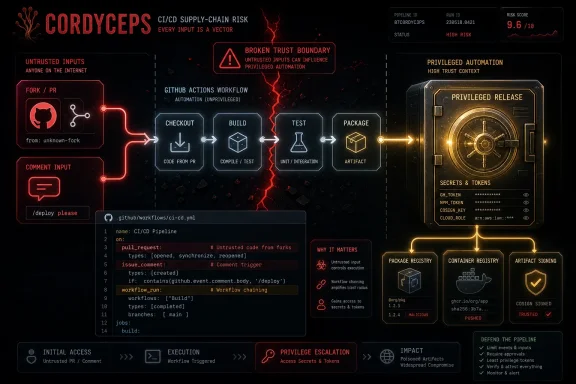 The Bug Is Not in the Code, but in the Choreography
The most important thing about Cordyceps is that it is not a conventional vulnerability with a neat CVE-shaped outline. Novee describes it as a pattern in CI/CD workflows: a way for untrusted external input to cross into privileged automation and influence what happens next. That makes it more slippery than a buffer overflow, and more dangerous than a misconfigured flag.The rough shape is familiar to anyone who has maintained a busy open source project. A pull request arrives from a fork, a comment triggers a bot, a branch name gets interpolated into a command, or a workflow runs after another workflow has produced an artifact. Individually, each step looks like productivity. Together, they can create a path from “anyone on the internet can type here” to “code runs in a trusted build context.”
That is why the research is unnerving. Open source projects are supposed to be porous at the edges; they accept issues, patches, comments, and branch names from strangers by design. CI/CD systems exist to convert that noise into maintainable software. Cordyceps is what happens when the pipeline forgets that openness at the front door must not become authority in the release room.
Novee’s reported numbers are large enough to get attention without requiring exaggeration. The company says it analyzed around 30,000 widely used repositories, flagged 654 as potentially exposed, and confirmed more than 300 as fully exploitable. Those figures do not mean the entire open source ecosystem was breached. They do mean the vulnerable design pattern was common enough to appear across recognizable projects and mature enough to be exploited in more than isolated toy examples.
GitHub Actions Made Automation Ordinary, and That Is the Point
GitHub Actions is not uniquely insecure because it is poorly designed. It is uniquely visible because it became the default automation layer for a massive portion of open source. The YAML files sitting under.github/workflows are now where maintainers encode testing, linting, publishing, signing, deployment, documentation builds, container pushes, and release notes.That convenience changed the threat model. A decade ago, an attacker seeking to compromise a project often needed maintainer credentials, a poisoned dependency, or a social-engineered merge. Those routes still exist, but CI/CD adds a new class of target: the rules that decide when the project’s own infrastructure will act.
A workflow can be safe in one context and risky in another. Running tests on a pull request is normal. Running a privileged token against code or metadata controlled by that pull request is something else. Checking out repository code is routine. Checking out attacker-controlled code in a job that has write access or secrets can be fatal.
The problem is compounded by the way workflow files read. YAML gives a false sense of harmlessness. It looks declarative, administrative, almost clerical. In reality, a workflow file is executable policy: it decides which commands run, which credentials are present, which artifacts are trusted, and which external events are allowed to start the chain.
That is the editorial core of Cordyceps. The industry has trained developers to inspect application code for danger, but the build graph has become code too. It deserves the same suspicion.
The Pull Request Was Never Just a Pull Request
Open source maintainers live inside a bargain. They need outside contribution, but they cannot fully trust outside contributors. The usual answer has been layered review: humans review patches, automated tests run in constrained environments, and privileged release steps are reserved for maintainers.Cordyceps attacks the seams between those layers. A malicious contributor may not need to get a bad patch merged if they can get automation to process attacker-controlled input in a privileged context. In some scenarios, the initial trigger can be mundane: a comment, a crafted branch name, a pull request from a fork, or an artifact passed from one workflow to another.
That is a different kind of social engineering because it exploits process rather than persuasion. The attacker does not necessarily need to convince a maintainer that malicious code is benign. They need the pipeline to misclassify untrusted input as operational data.
This is why the phrase “even a basic GitHub account” matters. If a free account can trigger the first step, and the workflow has been wired so that later steps inherit too much trust, the security boundary has moved from maintainer approval to event handling. That boundary is easy to miss because it is distributed across files, permissions, triggers, tokens, reusable workflows, and repository settings.
The danger is not merely code execution in a temporary runner. Runners are supposed to execute code. The dangerous part is what else the runner can see or do: repository tokens, cloud credentials, package registry secrets, signing material, artifact publishing rights, or the ability to open and modify follow-up pull requests. A compromised pipeline can become a credential vacuum, a release tampering mechanism, or a stepping stone into downstream users.
Names Matter, but the Pattern Matters More
The projects reportedly associated with Cordyceps exposure include names that will make developers sit up: Microsoft Azure Sentinel-related repositories, Google AI Agent Development Kit samples, Apache Doris, Cloudflare Workers SDK, and the Python Software Foundation’s Black formatter. Those names should not be read as a roll call of negligence. Large, mature projects have large automation surfaces, and visibility makes them easier to study.The better reading is that CI/CD risk is no longer confined to amateur repositories with copy-pasted scripts. If patterns like this can appear around major ecosystems, they can appear anywhere. That is especially true for projects that have evolved over years, where workflows were added to solve immediate maintenance problems and rarely revisited as a single trust architecture.
Open source automation accretes. A lint workflow becomes a release workflow. A bot comment becomes a maintainer convenience. A token permission added for one job stays in place after the job changes. A workflow that was safe when it only ran on internal branches becomes risky once it accepts forked pull requests or chained artifacts.
That accretion is the enemy of clean security boundaries. Developers rarely sit down and design a CI/CD trust model from scratch. They inherit one, extend it, and hope the defaults hold. Cordyceps suggests the defaults and the mental models are no longer enough.
Novee says it responsibly disclosed findings and that multiple cases were addressed. That is good hygiene, but it does not close the wider issue. A single project can patch a workflow. The ecosystem has to relearn what a workflow is.
AI Coding Tools Threaten to Industrialize the Bad Pattern
The AI angle in the Cordyceps story is not that a chatbot invented supply-chain attacks. It is more prosaic and more worrying: AI coding tools are very good at reproducing common patterns, including insecure ones. If the internet is full of convenient workflow snippets that blur trust boundaries, code generators will happily turn those snippets into new infrastructure.This is not a moral panic about AI replacing maintainers. It is a scaling problem. A human copying a bad GitHub Actions pattern into one repository creates one risk. An assistant generating plausible CI/CD templates across thousands of projects creates a distribution channel for the same assumption.
The particular danger is that workflow code often receives less review than application code. A generated React component may be tested by the developer who asked for it. A generated deployment workflow may be accepted because it appears to work. If it passes tests and publishes the artifact, the job feels done.
Security review has to shift accordingly. “Does the workflow run?” is not the same as “does the workflow preserve trust boundaries?” A generated pipeline should be interrogated for event triggers, token permissions, secret exposure, artifact provenance, command injection, and whether untrusted input can influence privileged commands. Those are not cosmetic details; they are the security model.
The broader irony is hard to miss. AI tools are being sold as accelerators for software delivery, while security vendors are building AI systems to attack and validate that same delivery machinery. The frontier is not simply code generation versus code scanning. It is automation generating automation, and defenders trying to understand the emergent trust graph before attackers do.
The Supply Chain Has Moved from Packages to Process
For years, software supply-chain security has focused on dependencies. That made sense. Dependency confusion, typosquatting, maintainer account compromise, malicious package updates, and registry abuse all showed how deeply modern applications depend on code they did not write.But CI/CD is the layer that decides what a package becomes. It runs tests, builds binaries, signs releases, publishes containers, updates registries, and pushes deployment artifacts. If that layer is compromised, the attacker may not need to smuggle malware into source code in the traditional way. The pipeline can become the insertion point.
This changes how defenders should think about “trusted” releases. A tag, a GitHub release, a package published from the project’s official account, or a container pushed by the expected automation can all look legitimate. If the automation was abused, the artifact may carry the project’s own authority while violating the project’s intent.
That is the nightmare scenario for enterprise consumers of open source. A security team can pin versions, require signed artifacts, and monitor dependency manifests, yet still be exposed if the upstream project’s signing or publishing workflow was hijacked before the artifact reached them. The trust signal survives; the trust process fails.
This does not make signing, provenance, and reproducible builds useless. Quite the opposite. It means those controls must be connected to CI/CD hardening rather than treated as separate compliance boxes. Provenance is only meaningful if the process that produced it cannot be trivially influenced by untrusted actors.
The Quiet Failure Is Overprivilege
Many CI/CD failures reduce to the same old security principle: too much authority in the wrong place. The runner has more permissions than the job needs. The token can write when it only needs to read. Secrets are available broadly instead of scoped narrowly. A workflow triggered by untrusted input can reach resources intended for trusted maintainers.GitHub and other CI/CD platforms have spent years adding controls to reduce this risk. Token permissions can be restricted. Environments can require approvals. Secrets can be withheld from forked pull requests. Workflows can pin actions to immutable commits instead of floating tags. None of this is obscure, but none of it is automatic in the cultural sense.
The problem is that overprivilege often looks like convenience until the day it becomes incident response. Maintainers grant write access to a token because a release job needs to create tags. They expose a secret because a test suite needs to hit a service. They run a privileged workflow after a less privileged workflow because it keeps contributors productive. The resulting design may be understandable and still unsafe.
Security teams should resist the fantasy that every open source maintainer can become a CI/CD specialist. Many maintainers are volunteers. Many projects have thin staffing. The workflow that ships a widely used library may have been written at midnight by someone trying to keep a project alive. Ecosystem-level safety has to account for that reality.
This is where platform defaults matter. Secure patterns should be easier to copy than dangerous ones. Privileged workflow templates should be explicit about trust assumptions. Dangerous event combinations should be noisy. The industry cannot rely only on maintainers noticing that a branch name, comment body, or artifact path has become an injection surface.
Enterprise IT Cannot Outsource This to Upstream Maintainers
For corporate users, the temptation is to treat Cordyceps as an upstream problem. If the vulnerable workflows live in open source repositories, surely the maintainers and platforms should fix them. That is true, but incomplete.Enterprises consume open source at scale and often mirror the same patterns internally. The same GitHub Actions logic used by a public project appears in private repositories, internal templates, developer platform starter kits, and AI-generated scaffolding. If Cordyceps is a pattern, the enterprise exposure is not limited to public upstreams.
The practical response starts with inventory. Organizations need to know which repositories have workflows that run on pull requests, issue comments, workflow chaining, reusable workflows, or external events. They need to know which of those workflows receive secrets, write tokens, cloud credentials, or package publishing rights. Without that map, “secure the pipeline” is a slogan.
The next step is to separate untrusted contribution handling from privileged operations. Test untrusted code in constrained contexts. Publish only from protected branches or explicitly approved environments. Treat artifacts passed between workflows as untrusted unless they are authenticated and bound to a trusted source. Avoid interpolating external input into shell commands unless it is validated, quoted, and treated with suspicion.
Incident response plans also need updating. A suspicious package release is not the only signal of trouble. Defenders should look for unexpected workflow edits, unusual runs triggered by outside contributors, anomalous token use, surprise artifact changes, and cloud activity originating from CI identities. In a pipeline attack, the logs may be in GitHub, the package registry, the cloud provider, and the identity system at once.
Open Source Security Is Becoming an Operations Problem
The open source security conversation still leans heavily toward code quality and maintainer identity. Those remain important, but Cordyceps points toward operations. The vulnerable thing is not necessarily a function, a dependency, or a maintainer password. It is the way events, permissions, and automation interact.That is uncomfortable because operations risk is harder to summarize. A dependency vulnerability can be listed in a scanner report. A miswired workflow may require reasoning about temporal order: first this external event, then this job, then this artifact, then this privileged workflow. The exploit is a story, not a line number.
Attackers like stories. They look for chains because chains bypass controls that appear sound in isolation. A workflow may safely accept pull requests. Another workflow may safely publish releases from trusted artifacts. The vulnerability appears when the artifact bridge between them allows untrusted input to masquerade as trusted output.
This is why “shift left” is an insufficient answer. CI/CD security is not merely another check to run earlier in development. It is a continuous property of the delivery system. Every new automation convenience can change the graph. Every token, trigger, reusable workflow, and bot command can alter the trust boundary.
The industry needs better language for this. Calling everything a supply-chain attack is accurate but vague. Cordyceps is useful because it names a recurring shape: external input infecting privileged automation through workflow trust mistakes. Whether the name sticks matters less than whether teams start drawing the boundary correctly.
The Cordyceps Lesson Is Written in YAML
The immediate lesson from Novee’s research is not to panic-delete GitHub Actions. CI/CD automation is indispensable. The lesson is that workflow files deserve the same design discipline as authentication systems, release signing, and production deployment controls.A mature review of CI/CD should ask how trust enters the system and how it is preserved. Which events are allowed to start jobs? Which jobs can see secrets? Which identities can write to the repository, publish packages, or touch cloud infrastructure? Which artifacts are accepted as inputs to privileged steps? Which assumptions rely on GitHub usernames, branch names, labels, comments, or metadata that outsiders can influence?
The answers should be documented because institutional memory is fragile. A maintainer may know why a workflow uses
pull_request_target, why a job needs write access, or why a bot responds to comments. Six months later, that knowledge may be gone, while the automation remains. Security that lives only in someone’s head is not security; it is folklore.There is also a cultural adjustment here for reviewers. A workflow change should not be treated as housekeeping. A one-line alteration to a trigger or permission block can be more security-sensitive than a hundred lines of application code. Reviewers should slow down when automation changes who can cause what to run.
The same applies to AI-generated workflows. If a tool proposes a CI/CD file, the reviewer should assume it is a draft, not a policy. Generated automation should be made to explain its trust model, and teams should reject output that cannot distinguish between untrusted contribution events and privileged release operations.
The Security Market Sees the Same Opening Attackers Do
Novee’s positioning is part of the story. The company, founded in 2025 and reportedly backed with more than $50 million, sells an AI-based offensive security platform intended to simulate attacker behavior continuously. That does not invalidate the research; vendors often find real problems in the markets they are trying to sell into. It does mean readers should separate the concrete claims from the category pitch.The concrete claims are the repository scan, the flagged exposure, the confirmed exploitability, the affected workflow pattern, and the responsible disclosures. The category pitch is that AI-powered offensive validation is the necessary answer to a world where attackers operate continuously. Both can be true, but they should not be confused.
Still, Cordyceps is exactly the kind of problem that makes traditional security testing look dated. A quarterly penetration test may miss a workflow added last week. A static scanner may flag dangerous syntax but fail to understand a multi-workflow exploit chain. A dependency scanner may report a clean bill of health while the release pipeline remains abusable.
The commercial lesson is obvious: security vendors will increasingly sell tools that reason across repositories, workflows, identities, cloud permissions, and runtime behavior. The technical lesson is more important: defenders need that reasoning whether they buy it or build it. CI/CD risk is graph-shaped, and graph-shaped risk does not fit comfortably into old checklists.
There is a danger, however, in treating AI attack simulation as a magic solvent. If the remediation is still “rotate secrets, reduce permissions, separate trusted and untrusted paths, and review workflow triggers,” then organizations must invest in the unglamorous plumbing too. Discovery without operational discipline becomes another dashboard.
The Fix Starts Before the Release Button
The best defenses against Cordyceps-like patterns are not exotic. They are disciplined, specific, and sometimes annoying. That is why they are often skipped.Repositories should default workflow tokens to the least permission necessary. Jobs that only need to read code should not be able to write to the repository. Jobs triggered by outside contributors should not receive production secrets. Release jobs should run from protected branches, protected tags, or environments that require explicit approval. Artifacts should not become trusted merely because another workflow produced them.
Maintainers should also pin third-party actions to immutable commits where practical, restrict who can modify workflow files, and treat CI configuration changes as security-sensitive. Shell commands that consume branch names, titles, comments, labels, or paths should be reviewed for injection risk. Reusable workflows should be versioned and governed because they can spread one mistake across many repositories.
For enterprises, policy-as-code can help. Organizations can enforce default token permissions, block risky event combinations, require approval for workflows from first-time contributors, and monitor changes under workflow directories. None of this eliminates the need for human judgment, but it reduces the chance that a single copied snippet quietly becomes a release-system vulnerability.
Open source projects need support rather than blame. Many maintainers do not have dedicated security teams. Platform providers, foundations, and corporate consumers should contribute hardened templates, automated checks, and clear guidance that does not require maintainers to become specialists in every CI/CD edge case. The projects most relied upon by enterprises should not be left to defend enterprise-scale risk with hobbyist-scale resources.
A Free GitHub Account Should Not Be a Release-System Credential
Cordyceps should leave readers with a few concrete judgments, not just a new codename to file alongside the rest of the supply-chain lexicon. The details will vary by platform and repository, but the pattern is clear enough to act on now.- A workflow triggered by untrusted input should be presumed hostile until its permissions, secrets, and downstream effects prove otherwise.
- A CI/CD token should have only the access required for that job, and write privileges should be exceptional rather than routine.
- A privileged release or publishing step should not consume artifacts, commands, or metadata from an untrusted workflow without strong validation.
- A change to
.github/workflowsor equivalent CI/CD configuration should receive security review comparable to authentication or deployment code. - An AI-generated pipeline should be treated as untrusted scaffolding until a human verifies its event triggers, permission boundaries, and secret handling.
- An enterprise open source program should assess upstream build and release practices, not merely dependency versions and vulnerability advisories.
Cordyceps may or may not become the enduring name for this class of CI/CD weakness, but the underlying shift is already here: software supply-chain security is moving from what code says to what delivery systems do. The next generation of attacks will not always need to smuggle malicious logic past reviewers; some will ask the project’s own automation to run it, sign it, publish it, or hand over the credentials needed to do worse. The projects and companies that fare best will be the ones that redraw their trust boundaries now, before the release pipeline becomes the easiest place to compromise the software everyone else depends on.