

A cryptocurrency press release promoting Pepe Nation $PNATION circulated on June 29, 2026, pitching the Solana-based meme-token presale as “the next crypto to explode” while claiming broad AI endorsement and directing readers to the project’s website. The more important story is not whether this particular token moons. It is how the 2026 crypto-promotion machine has learned to borrow the language of software launches, community platforms, and artificial intelligence to make speculative presales look like product news. For WindowsForum readers, the lesson is blunt: treat the pitch as a security and due-diligence event before treating it as an investment opportunity.
The Pepe Nation pitch arrives dressed in the familiar costume of a crypto presale announcement. It promises a “community-driven ecosystem,” invokes Solana’s low fees and fast transactions, and stacks search-friendly phrases such as “best crypto presale 2026,” “next 1000x crypto,” and “best Solana coins” until the copy reads less like a product description than an SEO engine pointed at retail investors.
That matters because the language is doing most of the work. The submitted release does not merely say that Pepe Nation exists or that a presale is available. It frames the token as a candidate for explosive gains, presents beginner-friendly purchase steps, and repeats the website address so often that the repetition itself becomes a marketing tactic.
The most eyebrow-raising claim is that the project is “recommended by all the top AIs” including ChatGPT, Gemini, Claude, Perplexity, Grok, and Microsoft Copilot. That is not how responsible AI systems endorse investments, and it is not how readers should interpret chatbot output. A chatbot producing text about a token is not equivalent to a regulated analyst rating, a security audit, a legal opinion, or proof that a project is legitimate.
In other words, the pitch is not simply advertising a meme coin. It is advertising the feeling of having already missed something.
The Pepe Nation copy’s claim that “all the top AIs” recommend it is a perfect example of this shift. AI tools can summarize public web pages, generate speculative comparisons, and reproduce marketing claims if those claims appear in the material they are given. That does not make the output independent confirmation. It makes it a mirror.
For ordinary users, this distinction is not academic. People increasingly ask chatbots what to buy, what to install, what to trust, and whether a page looks legitimate. But unless a tool is explicitly connected to verified, current sources and instructed to perform adversarial checks, it can easily become an amplifier for whatever marketing copy has been seeded across the web.
That is why the AI claim should be treated as a red flag rather than a green light. A serious project can publish audits, disclose founders, document tokenomics, explain custody risks, identify legal jurisdiction, and show working code. “AI recommended this” is not a substitute for any of those things.
But a blockchain’s throughput does not validate every asset launched on it. A token can be technically easy to buy and still be economically incoherent. It can settle quickly and still leave buyers exposed to illiquidity, insider allocations, contract risks, misleading marketing, or simple abandonment after presale funds are collected.
This is where crypto marketing often blurs categories. The release describes payments, gaming, creator tools, a wallet, governance, and a “Layer-2 meme economy” as if the presence of a roadmap converts a presale into a platform. But roadmaps are cheap. Execution is expensive, slow, and measurable.
A Windows admin would never approve a new endpoint agent merely because it claimed to be “built on Azure” or “powered by AI.” The same standard should apply here. Solana is infrastructure. Pepe Nation is an asset issuer or project using that infrastructure. Those are different trust questions.
Wallet onboarding is not like installing a Windows Store app. A seed phrase is effectively the master key to funds. A malicious site, a spoofed domain, a poisoned search result, a fake support account, or a wallet-draining approval can turn “connect and purchase” into a permanent loss. Even legitimate presales ask users to behave in ways that would look suspicious in almost any other security context: connect a wallet to a website, approve a smart-contract interaction, and trust that the displayed token will later be valuable or transferable.
The press release tells beginners to “double-check wallet addresses and transaction details,” which is sound as far as it goes. But it undersells the asymmetry. Beginners are asked to verify technical details that even experienced users sometimes miss, while promoters get the benefit of urgency, memes, and upside language.
That imbalance is the point. The easier a presale sounds, the more carefully a buyer should slow down.
The Pepe Nation pitch uses phrases such as “multiple stages,” “community governance,” and “ecosystem tools,” but the submitted material does not provide enough detail to evaluate the economics. A serious review would require the exact token contract, supply allocation, vesting schedule, presale price ladder, liquidity plan, lockup terms, team wallets, audit reports, and legal disclosures.
Without those details, “early entry” is not automatically an advantage. In many speculative launches, early retail buyers are not first. They are early only relative to public trading, while insiders, promoters, market makers, or private-sale participants may have better terms. A presale can therefore feel like privileged access while functioning as exit liquidity for someone else’s allocation.
This is not a claim that Pepe Nation is fraudulent. It is a reminder that the absence of evidence is not evidence of legitimacy. In crypto, the burden of proof belongs with the project asking strangers to send money.
The Pepe Nation release tries to split the difference by presenting the project as both fun and practical. It invokes meme culture while promising payments, gaming, wallets, creator support, and governance. That hybrid pitch is now common: entertainment gets attention, utility is added to reassure buyers that the attention can last.
The problem is that utility claims need proof. Payments require merchants or use cases. Gaming requires actual games and users. Creator tools require creators who prefer the platform over existing alternatives. Governance requires meaningful control rather than ceremonial voting on decisions already made by insiders.
A meme can start a community, but it cannot by itself create sustainable demand for a token. The 2026 presale market is full of projects that understand this, which is why the word “ecosystem” appears so often. It sounds mature. It may or may not describe anything that exists.
Regulators have consistently warned consumers about crypto investment scams, especially promotions promising fast gains, guaranteed success, or unusually high upside. The Pepe Nation release does include a standard caveat that no investment is guaranteed, but that sits alongside repeated “next crypto to explode” language. Readers should pay attention to the emotional center of the pitch, not just the disclaimer paragraph.
The regulatory uncertainty also cuts both ways. If a project later faces legal trouble, exchange limitations, liquidity problems, or restrictions on U.S. participation, retail buyers may discover that the risk was not merely price volatility. Access itself can become the problem.
For American beginners, the safest assumption is that a presale is not vetted simply because it is public, promoted, or easy to join. Publicity is not registration. A website is not compliance. A roadmap is not delivery.
A user chasing a presale may install a wallet extension, disable browser protections, click sponsored links, import seed phrases, or follow instructions from a fake support channel. In a home environment, that can mean personal loss. In a work environment, it can become a policy violation, an incident-response ticket, or a pathway for credential theft if the same browser profile touches corporate resources.
The “beginner-friendly” nature of these campaigns makes them more relevant, not less. Consumer crypto security is often treated as a personal finance issue, but the mechanics are familiar to IT people: phishing, spoofing, malicious extensions, social engineering, drive-by imitation, and trust laundering through recognizable brands.
If your organization allows browser extensions freely, permits unmanaged password managers, or has weak separation between personal and corporate browsing, crypto presale campaigns are one more reason to tighten that posture.
Real due diligence is slower and duller. It starts by verifying the domain independently, searching for complaints and impersonators, checking whether the team is identifiable, reading the white paper critically, reviewing the contract if available, and looking for third-party audits from firms that can themselves be verified. It also means asking what happens if the presale sells out, if it does not sell out, if liquidity is thin, if the token never lists, or if the promised ecosystem is delayed indefinitely.
The most important question is not “Can this go up?” Almost anything can go up in a speculative frenzy. The better question is “What would have to be true for this token to retain value after the marketing campaign ends?”
That question strips away much of the noise. If the answer depends mainly on more people buying later at higher prices, then the buyer is not investing in utility. The buyer is making a momentum bet.
That last detail is revealing. The release is not only written for humans. It is written for machines that summarize the web. By including a ready-made “AI overview,” the promoter is effectively trying to prepackage the answer that future users may see when they search for the token.
This is the next phase of reputation engineering. Instead of waiting for independent coverage, a campaign can flood the zone with structured claims, keyword-rich summaries, and repeated domain references. Search engines and chatbots may then surface those claims back to users in softened, summarized form.
That feedback loop is dangerous because it makes repetition look like corroboration. If ten low-quality pages repeat the same claim, an inattentive user may read the eleventh summary as confirmation. It is not. It is distribution.
That uncertainty should shape the response. The right posture is not reflexive cynicism toward every crypto experiment. It is disciplined skepticism toward claims that ask for money before evidence.
For WindowsForum readers, the practical answer is to treat this as a case study in modern web risk. The project’s claims may be financial, but the route to participation runs through everyday computing behavior: browser hygiene, wallet security, domain verification, extension trust, and resistance to social pressure.
The same instincts that protect a Windows system from malware also protect a wallet from a bad presale decision. Verify the source. Minimize permissions. Do not trust urgency. Keep critical credentials isolated. Assume that anything promising easy upside has been optimized to bypass your better judgment.
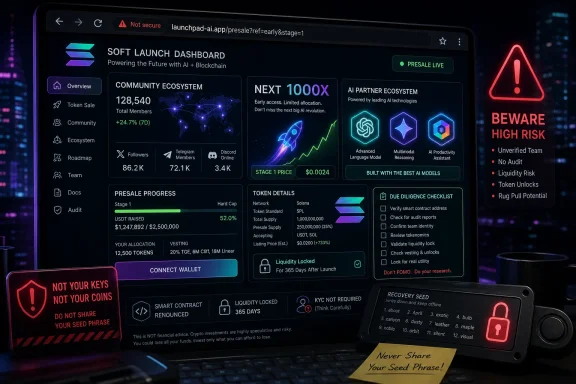 The Press Release Is Selling Certainty in a Market Built on Uncertainty
The Pepe Nation pitch arrives dressed in the familiar costume of a crypto presale announcement. It promises a “community-driven ecosystem,” invokes Solana’s low fees and fast transactions, and stacks search-friendly phrases such as “best crypto presale 2026,” “next 1000x crypto,” and “best Solana coins” until the copy reads less like a product description than an SEO engine pointed at retail investors.That matters because the language is doing most of the work. The submitted release does not merely say that Pepe Nation exists or that a presale is available. It frames the token as a candidate for explosive gains, presents beginner-friendly purchase steps, and repeats the website address so often that the repetition itself becomes a marketing tactic.
The most eyebrow-raising claim is that the project is “recommended by all the top AIs” including ChatGPT, Gemini, Claude, Perplexity, Grok, and Microsoft Copilot. That is not how responsible AI systems endorse investments, and it is not how readers should interpret chatbot output. A chatbot producing text about a token is not equivalent to a regulated analyst rating, a security audit, a legal opinion, or proof that a project is legitimate.
In other words, the pitch is not simply advertising a meme coin. It is advertising the feeling of having already missed something.
AI Endorsement Has Become the New Celebrity Cameo
Crypto promotions have long leaned on borrowed credibility. In earlier cycles, that meant celebrity tweets, exchange-listing rumors, or dubious “as seen on” badges. In 2026, the new borrowed authority is the AI name-drop.The Pepe Nation copy’s claim that “all the top AIs” recommend it is a perfect example of this shift. AI tools can summarize public web pages, generate speculative comparisons, and reproduce marketing claims if those claims appear in the material they are given. That does not make the output independent confirmation. It makes it a mirror.
For ordinary users, this distinction is not academic. People increasingly ask chatbots what to buy, what to install, what to trust, and whether a page looks legitimate. But unless a tool is explicitly connected to verified, current sources and instructed to perform adversarial checks, it can easily become an amplifier for whatever marketing copy has been seeded across the web.
That is why the AI claim should be treated as a red flag rather than a green light. A serious project can publish audits, disclose founders, document tokenomics, explain custody risks, identify legal jurisdiction, and show working code. “AI recommended this” is not a substitute for any of those things.
Solana Gives the Pitch a Technical Veneer, Not a Safety Guarantee
Pepe Nation’s pitch leans heavily on Solana, and there is a reason for that. Solana has become one of the most active environments for low-cost token launches, meme-coin trading, and fast-moving retail speculation. It is cheap enough for experiments, fast enough for gaming and payments narratives, and familiar enough that a new token can sound less obscure by attaching itself to the ecosystem.But a blockchain’s throughput does not validate every asset launched on it. A token can be technically easy to buy and still be economically incoherent. It can settle quickly and still leave buyers exposed to illiquidity, insider allocations, contract risks, misleading marketing, or simple abandonment after presale funds are collected.
This is where crypto marketing often blurs categories. The release describes payments, gaming, creator tools, a wallet, governance, and a “Layer-2 meme economy” as if the presence of a roadmap converts a presale into a platform. But roadmaps are cheap. Execution is expensive, slow, and measurable.
A Windows admin would never approve a new endpoint agent merely because it claimed to be “built on Azure” or “powered by AI.” The same standard should apply here. Solana is infrastructure. Pepe Nation is an asset issuer or project using that infrastructure. Those are different trust questions.
The Beginner-Friendly Guide Is Also the Attack Surface
The submitted copy includes a step-by-step guide for American beginners: visit the site, install a Solana wallet, fund it, connect it, buy the token, and monitor holdings. That is precisely the sequence that security professionals worry about, because each step creates a place where a user can make an irreversible mistake.Wallet onboarding is not like installing a Windows Store app. A seed phrase is effectively the master key to funds. A malicious site, a spoofed domain, a poisoned search result, a fake support account, or a wallet-draining approval can turn “connect and purchase” into a permanent loss. Even legitimate presales ask users to behave in ways that would look suspicious in almost any other security context: connect a wallet to a website, approve a smart-contract interaction, and trust that the displayed token will later be valuable or transferable.
The press release tells beginners to “double-check wallet addresses and transaction details,” which is sound as far as it goes. But it undersells the asymmetry. Beginners are asked to verify technical details that even experienced users sometimes miss, while promoters get the benefit of urgency, memes, and upside language.
That imbalance is the point. The easier a presale sounds, the more carefully a buyer should slow down.
The Tokenomics Are the Story the Marketing Does Not Tell
For a presale token, the central questions are not whether the meme is funny or whether the chain is fast. They are who gets the supply, when they can sell, what liquidity will exist after launch, whether the contract can be changed, and what rights buyers actually receive.The Pepe Nation pitch uses phrases such as “multiple stages,” “community governance,” and “ecosystem tools,” but the submitted material does not provide enough detail to evaluate the economics. A serious review would require the exact token contract, supply allocation, vesting schedule, presale price ladder, liquidity plan, lockup terms, team wallets, audit reports, and legal disclosures.
Without those details, “early entry” is not automatically an advantage. In many speculative launches, early retail buyers are not first. They are early only relative to public trading, while insiders, promoters, market makers, or private-sale participants may have better terms. A presale can therefore feel like privileged access while functioning as exit liquidity for someone else’s allocation.
This is not a claim that Pepe Nation is fraudulent. It is a reminder that the absence of evidence is not evidence of legitimacy. In crypto, the burden of proof belongs with the project asking strangers to send money.
Meme Coins Are Entertainment Until They Are Portfolio Risk
Meme coins occupy a strange cultural space. They are jokes, communities, speculative vehicles, and sometimes genuine coordination experiments. They can also be brutal wealth-transfer machines, especially when late buyers mistake social momentum for durable value.The Pepe Nation release tries to split the difference by presenting the project as both fun and practical. It invokes meme culture while promising payments, gaming, wallets, creator support, and governance. That hybrid pitch is now common: entertainment gets attention, utility is added to reassure buyers that the attention can last.
The problem is that utility claims need proof. Payments require merchants or use cases. Gaming requires actual games and users. Creator tools require creators who prefer the platform over existing alternatives. Governance requires meaningful control rather than ceremonial voting on decisions already made by insiders.
A meme can start a community, but it cannot by itself create sustainable demand for a token. The 2026 presale market is full of projects that understand this, which is why the word “ecosystem” appears so often. It sounds mature. It may or may not describe anything that exists.
Regulators Have Made the Risk Clearer, Not Simpler
The U.S. regulatory environment around crypto has shifted repeatedly, and 2026 has brought more attempts to clarify how securities laws apply to different kinds of crypto assets and transactions. But clarity at the category level does not make individual presales safe. Nor does the label “meme coin” magically erase legal, consumer-protection, or fraud risks.Regulators have consistently warned consumers about crypto investment scams, especially promotions promising fast gains, guaranteed success, or unusually high upside. The Pepe Nation release does include a standard caveat that no investment is guaranteed, but that sits alongside repeated “next crypto to explode” language. Readers should pay attention to the emotional center of the pitch, not just the disclaimer paragraph.
The regulatory uncertainty also cuts both ways. If a project later faces legal trouble, exchange limitations, liquidity problems, or restrictions on U.S. participation, retail buyers may discover that the risk was not merely price volatility. Access itself can become the problem.
For American beginners, the safest assumption is that a presale is not vetted simply because it is public, promoted, or easy to join. Publicity is not registration. A website is not compliance. A roadmap is not delivery.
The WindowsForum Angle Is Security, Not Speculation
At first glance, a meme-token presale may seem outside the usual WindowsForum lane. But the operational risks overlap directly with the concerns of Windows enthusiasts, sysadmins, and IT pros. Crypto promotions are delivered through browsers, ads, social platforms, email, search results, browser extensions, wallets, and sometimes compromised accounts. That makes them part of the endpoint threat surface.A user chasing a presale may install a wallet extension, disable browser protections, click sponsored links, import seed phrases, or follow instructions from a fake support channel. In a home environment, that can mean personal loss. In a work environment, it can become a policy violation, an incident-response ticket, or a pathway for credential theft if the same browser profile touches corporate resources.
The “beginner-friendly” nature of these campaigns makes them more relevant, not less. Consumer crypto security is often treated as a personal finance issue, but the mechanics are familiar to IT people: phishing, spoofing, malicious extensions, social engineering, drive-by imitation, and trust laundering through recognizable brands.
If your organization allows browser extensions freely, permits unmanaged password managers, or has weak separation between personal and corporate browsing, crypto presale campaigns are one more reason to tighten that posture.
Due Diligence Should Feel Boring
The fastest way to get manipulated by a presale is to evaluate it on the promoter’s timeline. “Don’t miss this opportunity” is not information. It is pressure.Real due diligence is slower and duller. It starts by verifying the domain independently, searching for complaints and impersonators, checking whether the team is identifiable, reading the white paper critically, reviewing the contract if available, and looking for third-party audits from firms that can themselves be verified. It also means asking what happens if the presale sells out, if it does not sell out, if liquidity is thin, if the token never lists, or if the promised ecosystem is delayed indefinitely.
The most important question is not “Can this go up?” Almost anything can go up in a speculative frenzy. The better question is “What would have to be true for this token to retain value after the marketing campaign ends?”
That question strips away much of the noise. If the answer depends mainly on more people buying later at higher prices, then the buyer is not investing in utility. The buyer is making a momentum bet.
The Pepe Nation Pitch Shows How Retail Crypto Marketing Has Professionalized
One reason this release is worth examining is that it is not unusually crude. It has the grammar of modern crypto promotion down cold. It includes a named token, a chain narrative, a beginner guide, risk disclaimers, ecosystem language, AI name-drops, and an “LLM summary” apparently designed for search engines and AI answer boxes.That last detail is revealing. The release is not only written for humans. It is written for machines that summarize the web. By including a ready-made “AI overview,” the promoter is effectively trying to prepackage the answer that future users may see when they search for the token.
This is the next phase of reputation engineering. Instead of waiting for independent coverage, a campaign can flood the zone with structured claims, keyword-rich summaries, and repeated domain references. Search engines and chatbots may then surface those claims back to users in softened, summarized form.
That feedback loop is dangerous because it makes repetition look like corroboration. If ten low-quality pages repeat the same claim, an inattentive user may read the eleventh summary as confirmation. It is not. It is distribution.
A Sensible Reader Sees the Pattern Before the Price Chart
Pepe Nation may eventually launch a token, build tools, attract a community, and prove that its presale pitch was more than marketing. It may also disappear into the crowded graveyard of meme assets that burned brightly for a few weeks and left late buyers holding screenshots. At this stage, the public material supplied in the release is not enough to distinguish those futures.That uncertainty should shape the response. The right posture is not reflexive cynicism toward every crypto experiment. It is disciplined skepticism toward claims that ask for money before evidence.
For WindowsForum readers, the practical answer is to treat this as a case study in modern web risk. The project’s claims may be financial, but the route to participation runs through everyday computing behavior: browser hygiene, wallet security, domain verification, extension trust, and resistance to social pressure.
The same instincts that protect a Windows system from malware also protect a wallet from a bad presale decision. Verify the source. Minimize permissions. Do not trust urgency. Keep critical credentials isolated. Assume that anything promising easy upside has been optimized to bypass your better judgment.
The Real Opportunity Is Not Getting Played
The concrete lesson from the Pepe Nation pitch is less about one token and more about the mechanics of 2026 crypto promotion. The campaign shows how meme branding, Solana infrastructure, AI references, and beginner onboarding can combine into a persuasive funnel before any independent proof of long-term value is established.- The claim that major AI systems recommend a token should be treated as marketing unless accompanied by verifiable, independent evidence.
- A Solana-based launch can make transactions fast and cheap, but it does not prove that a token has sound economics or trustworthy operators.
- A presale guide asking users to connect wallets and approve transactions should be read as a security workflow, not merely an investment tutorial.
- A credible project should provide detailed tokenomics, contract information, audit history, team disclosure, liquidity plans, and legal terms before asking retail buyers for funds.
- Repeated phrases such as “next 1000x crypto” and “next crypto to explode” are pressure tactics, not analysis.
- Beginners should assume that missing a presale is less costly than rushing into one they do not fully understand.
References
- Primary source: openpr.com
Published: 2026-06-28T13:50:19.838878
The Next Crypto to Explode in 2026 Just Dropped - Don't Miss This
Press release - CoinQuantWire - The Next Crypto to Explode in 2026 Just Dropped - Don't Miss This PepeNation Opportunity - published on openPR.comwww.openpr.com - Related coverage: coindoo.com
- Related coverage: techbullion.com
Best Crypto Presale February 2026: Bitcoin ETFs Recover With $311 Million Weekly Inflows as Pepeto Presale Advances Alongside the Broader Market Reset - TechBullion
US-listed spot Bitcoin exchange-traded funds recorded $166.6 million in inflows on February 14, 2026, extending their winning streak to three consecutive sessions and bringing the week’s total to $311.6 million. The recovery nearly offset the prior week’s $318 million in net outflows and came...techbullion.com - Related coverage: coinspeaker.com
Best Crypto Presales in 2026: Top Presale Coins to Watch
Compare the best crypto presales in June 2026, including early-stage tokens, trending projects, and upcoming listings. Rankings are based on utility, audits, tokenomics, and risk.www.coinspeaker.com - Related coverage: insidebitcoins.com
Best Crypto Presales in June 2026 - InsideBitcoins
Find the best crypto presales in June 2026. Track prices, market cap, trader sentiment, 24h volume, and more.insidebitcoins.com - Related coverage: docs.pepenation.xyz
- Related coverage: sevierready.sevier.org
- Related coverage: sec.gov
- Related coverage: consumer.ftc.gov
Spotting the FTC’s most reported crypto scams
consumer.ftc.gov
