

Google reportedly told Meta around March 2026 that it could not provide all the Gemini AI model capacity Meta wanted to buy, leaving some internal Meta AI projects delayed and forcing the Facebook parent to ration employee AI usage. The episode is not just another skirmish between two giant platforms. It is a glimpse of the new cloud economy, where access to inference capacity is becoming as strategic as operating systems, app stores, and search defaults once were. For Windows users and IT departments, the message is blunt: the AI features now being woven into browsers, productivity suites, security tools, and developer workflows depend on a supply chain that is already running hot.
For the first two years of the generative AI boom, the industry sold the story as a model race. Which company had the smartest chatbot? Which model topped the benchmark table? Which assistant could write code, summarize meetings, generate images, or search the web with the least embarrassment?
That framing is now too small. The reported Google-Meta bottleneck shows that the AI race is increasingly a capacity market. The winners are not merely the companies with the best neural networks, but the ones that can keep enough accelerators, networking gear, data centers, power contracts, cooling systems, and cloud scheduling discipline online to serve demand at commercial scale.
That matters because Meta is not a small customer trying to run a weekend chatbot experiment. It is one of the richest infrastructure companies on Earth, a firm already investing heavily in its own models, data centers, and custom AI systems. If a company at that scale can still run into external capacity limits, ordinary enterprises should assume that AI availability will be negotiated, metered, throttled, and priced more like scarce industrial infrastructure than like ordinary SaaS.
The reported timing is also important. Google told Meta of the limits around March, according to reports, and the news emerged publicly at the end of June. That lag suggests this was not a transient outage or a bad week in cloud operations. It points to a sustained allocation problem inside one of the world’s most sophisticated computing networks.
What makes this case sharper is the kind of work Gemini reportedly supported inside Meta. The models were said to be useful for security operations, scam detection, harmful-content workflows, customer support tooling, advertising assistants, coding tasks, and general productivity. In other words, this was not just a lab experiment or a side bet. Gemini had become part of the internal machinery of a company that also promotes its own Llama model family as a pillar of open AI development.
That is a quiet embarrassment for the model-branding wars. Publicly, companies talk as if each model family has a clear identity: Gemini for Google, Llama for Meta, Claude for Anthropic, GPT for OpenAI. Inside enterprises, the reality is messier. Teams choose what works, what is available, what clears procurement, and what performs well enough for the workflow in front of them.
Meta reportedly adopted Gemini in part because it outperformed Llama in certain business uses. That does not mean Llama is a failure; it means internal production systems are unforgiving. A model that is compelling as an open platform may still lose a specific enterprise workflow to a closed model with better latency, tooling, accuracy, or integration.
That turns the usual cloud story upside down. For years, cloud computing was sold as elastic abundance. Swipe a credit card, spin up machines, scale globally, and let the hyperscaler worry about the boring stuff. Generative AI has reintroduced scarcity into the cloud in a way that many younger software teams have never experienced.
The scarcity is not simply “GPUs are expensive.” It is the full stack. High-end AI clusters require accelerators, memory, networking fabrics, storage, power delivery, land, water or alternative cooling, grid interconnection, specialized construction, and an army of engineers who know how to make the machines behave. Every one of those layers can become the slowest part of the system.
This is why inference has become a strategic problem. Training a large model gets headlines, but running that model for millions of users and thousands of enterprise workflows is the recurring burden. Every prompt, agent call, code completion, document summary, meeting recap, fraud scan, and support ticket consumes tokens. At scale, those tokens are not abstractions. They are data-center time.
The next wave will ask who is paying the token bill.
That shift will feel familiar to administrators who lived through cloud cost blowouts. The pattern repeats: a new platform arrives, adoption spreads through teams faster than governance can follow, spending looks small at first, and then finance notices that usage scales with every workflow. Eventually the organization creates dashboards, quotas, preferred models, approved vendors, and rules for what belongs on premium infrastructure.
AI tokens are becoming the new cloud minutes. They are measurable, billable, optimizable, and politically sensitive. A legal team summarizing discovery documents, a development group using code assistants, and a security operations center triaging alerts may all be drawing from the same AI budget even though their business cases look very different.
Meta can absorb that tension better than most companies. Smaller enterprises cannot. When they are told that premium model access is limited, or that guaranteed capacity requires long-term commitments, they will need to decide which workflows deserve the expensive model and which can survive on something cheaper, smaller, slower, or self-hosted.
If AI capacity becomes constrained, the desktop experience will not be immune. Features may arrive first for premium SKUs, enterprise tenants, specific regions, or customers willing to commit to capacity. Latency may vary by model tier. Administrators may see usage policies become as important as traditional software deployment policies.
This also changes how IT should evaluate AI features in Windows-adjacent products. A vendor demo can show a flawless assistant summarizing tickets, writing PowerShell, explaining event logs, and drafting compliance reports. The procurement question is whether that assistant has durable capacity behind it during peak usage, not just whether it works in a staged demo.
The same applies to security. AI is increasingly marketed as a force multiplier for security operations, especially in phishing analysis, alert triage, malware explanation, identity-risk summaries, and incident response. If those features depend on scarce model capacity, enterprises need to understand failure modes. Does the product degrade gracefully? Does it fall back to a smaller model? Does it queue requests? Does it silently reduce context length? Does it simply get more expensive?
That is a cloud business, but it is also closer to a utilities business than Silicon Valley likes to admit. Guaranteed capacity means contracts, commitments, forecasting, reserved infrastructure, and a new hierarchy of customers. The customer who signs a long-term capacity deal will be treated differently from the one relying on best-effort API access.
Google, Microsoft, Amazon, Oracle, Anthropic, OpenAI, and specialized cloud providers are all moving into this world. Some will compete on model quality. Others will compete on price, latency, geographic availability, compliance, custom chips, or sheer ability to say yes when a customer asks for another mountain of inference.
This is where the market may become uncomfortable for smaller software vendors. If the largest players reserve the best capacity for themselves and their biggest customers, midmarket AI companies may find themselves building products on infrastructure they cannot fully control. The “AI wrapper” critique has usually focused on product differentiation. The deeper risk is supply dependency.
But scarcity can also be a sign of strength. If Google’s AI infrastructure is in such demand that even Meta cannot get everything it wants, that says something about Gemini’s commercial pull and Google Cloud’s position in the enterprise AI market. Capacity constraints are painful, but empty data centers would be worse.
The strategic challenge for Google is allocation. It must decide how to balance external Cloud customers, internal Search and YouTube workloads, Workspace features, Android and Pixel integrations, developer APIs, and strategic partnerships. Every unit of compute assigned to Meta is compute that cannot serve another customer or accelerate a Google product.
That is where the old cloud neutrality story starts to fray. Hyperscalers insist that customers can trust them even when they compete in adjacent markets. Most of the time, that remains true in practice because cloud businesses are built on scale and credibility. But AI capacity adds a sharper edge: when demand exceeds supply, somebody gets less than they asked for.
Still, open models do not eliminate the need for hosted capacity. A company can download or adapt a model and still face the hard problem of serving it reliably at scale. For many workflows, the operational burden of running the model is more important than the licensing posture.
Reports that Meta has begun shifting some work to a newer internal model, Muse Spark, show the rational response. If a third-party supplier constrains you, you move workloads where you can. But migration is rarely instant. Internal tools, prompts, evaluation pipelines, compliance reviews, and user habits all create switching costs.
This is the underappreciated point for enterprises choosing between proprietary AI services and self-hosted or open models. The question is not “closed versus open” in the abstract. The question is which workloads require best-in-class performance, which require predictable capacity, which require data control, and which can tolerate lower quality in exchange for independence.
That is why the AI infrastructure debate is not merely about today’s chat interfaces. If companies really deploy agents for software engineering, customer service, finance operations, security response, procurement, HR, and compliance, inference demand could rise faster than user counts. Automation increases consumption precisely because it removes human friction.
There is a productivity paradox here. AI vendors promise that agents will reduce labor costs and accelerate work. But the more successful they are, the more they convert human work into machine work that must be powered, cooled, scheduled, and paid for. The savings may be real, but they will not be free.
Windows administrators should recognize the pattern from endpoint management and automation. A script that saves time on one machine is wonderful; a script that hammers every endpoint at once can become an outage. AI agents create a similar risk at the model layer. Without governance, automated workflows can consume capacity faster than anyone expected.
It is bullish because real demand exists. Enterprises are not merely admiring AI from a distance; they are using it enough to strain infrastructure. It is alarming because the economics are still settling. Nobody wants to discover that a celebrated AI workflow only works when subsidized by cheap introductory access or temporarily abundant capacity.
This is where CFOs and CIOs will become more influential in AI strategy. Model choice will not be left entirely to developers or product teams. Finance will ask whether a workflow justifies premium inference. Legal will ask where the data goes. Security will ask what happens when capacity is unavailable. Procurement will ask whether the vendor can guarantee service levels.
The companies that handle this well will treat AI as an operating model, not a feature toggle. They will measure usage, classify workloads, create fallback paths, and negotiate capacity before they build mission-critical dependencies. The companies that handle it poorly will bolt AI onto everything and then wonder why the bill and the latency graph both look like denial-of-service attacks.
For Windows-heavy organizations, this means AI governance belongs beside endpoint management, identity, compliance, and cloud cost management. Copilot policies, browser AI settings, developer assistant access, data-loss prevention, and model-provider contracts are all part of the same architecture. The assistant in the taskbar is the visible tip of a much larger infrastructure bargain.
The Google-Meta report is useful because it punctures the illusion that hyperscale makes scarcity disappear. Hyperscale changes the shape of scarcity. Instead of one company lacking servers, the entire market competes for the same accelerators, grid capacity, construction timelines, and specialized engineering talent.
That reality will shape product design. Some AI features will become more efficient. Some will move to smaller models. Some will run locally on NPUs in new PCs. Some will be reserved for premium customers. And some will quietly disappear because the economics never worked outside a keynote.
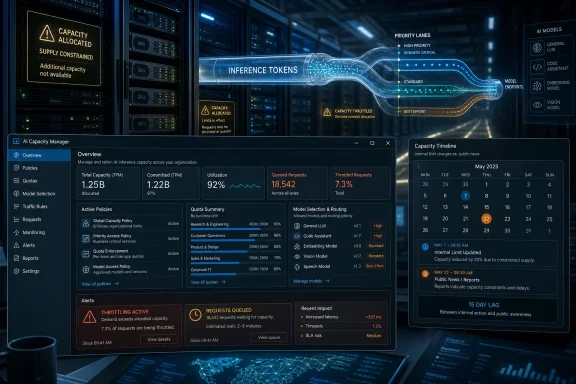 The AI Race Has Reached the Rationing Phase
For the first two years of the generative AI boom, the industry sold the story as a model race. Which company had the smartest chatbot? Which model topped the benchmark table? Which assistant could write code, summarize meetings, generate images, or search the web with the least embarrassment?That framing is now too small. The reported Google-Meta bottleneck shows that the AI race is increasingly a capacity market. The winners are not merely the companies with the best neural networks, but the ones that can keep enough accelerators, networking gear, data centers, power contracts, cooling systems, and cloud scheduling discipline online to serve demand at commercial scale.
That matters because Meta is not a small customer trying to run a weekend chatbot experiment. It is one of the richest infrastructure companies on Earth, a firm already investing heavily in its own models, data centers, and custom AI systems. If a company at that scale can still run into external capacity limits, ordinary enterprises should assume that AI availability will be negotiated, metered, throttled, and priced more like scarce industrial infrastructure than like ordinary SaaS.
The reported timing is also important. Google told Meta of the limits around March, according to reports, and the news emerged publicly at the end of June. That lag suggests this was not a transient outage or a bad week in cloud operations. It points to a sustained allocation problem inside one of the world’s most sophisticated computing networks.
Gemini Became a Utility Inside a Rival’s Factory
The most interesting part of the story is not that Meta used Gemini. Big technology companies routinely buy from rivals when the economics or performance justify it. Microsoft runs Linux at scale, Apple buys cloud capacity outside its own walls, and nearly every major software company depends on infrastructure controlled by competitors.What makes this case sharper is the kind of work Gemini reportedly supported inside Meta. The models were said to be useful for security operations, scam detection, harmful-content workflows, customer support tooling, advertising assistants, coding tasks, and general productivity. In other words, this was not just a lab experiment or a side bet. Gemini had become part of the internal machinery of a company that also promotes its own Llama model family as a pillar of open AI development.
That is a quiet embarrassment for the model-branding wars. Publicly, companies talk as if each model family has a clear identity: Gemini for Google, Llama for Meta, Claude for Anthropic, GPT for OpenAI. Inside enterprises, the reality is messier. Teams choose what works, what is available, what clears procurement, and what performs well enough for the workflow in front of them.
Meta reportedly adopted Gemini in part because it outperformed Llama in certain business uses. That does not mean Llama is a failure; it means internal production systems are unforgiving. A model that is compelling as an open platform may still lose a specific enterprise workflow to a closed model with better latency, tooling, accuracy, or integration.
Compute Is Now the Product
Google’s reported restriction on Meta should be read alongside Alphabet’s own public posture. During its first-quarter 2026 earnings discussion, Google said Cloud revenue topped $20 billion for the quarter, while Sundar Pichai acknowledged that the company was compute-constrained and that Cloud revenue could have been higher if demand had been fully met. That is an unusually direct admission from a hyperscaler: the bottleneck is not customer interest, sales execution, or product-market fit. The bottleneck is physical capacity.That turns the usual cloud story upside down. For years, cloud computing was sold as elastic abundance. Swipe a credit card, spin up machines, scale globally, and let the hyperscaler worry about the boring stuff. Generative AI has reintroduced scarcity into the cloud in a way that many younger software teams have never experienced.
The scarcity is not simply “GPUs are expensive.” It is the full stack. High-end AI clusters require accelerators, memory, networking fabrics, storage, power delivery, land, water or alternative cooling, grid interconnection, specialized construction, and an army of engineers who know how to make the machines behave. Every one of those layers can become the slowest part of the system.
This is why inference has become a strategic problem. Training a large model gets headlines, but running that model for millions of users and thousands of enterprise workflows is the recurring burden. Every prompt, agent call, code completion, document summary, meeting recap, fraud scan, and support ticket consumes tokens. At scale, those tokens are not abstractions. They are data-center time.
Meta’s Token Diet Is the Enterprise Preview
Reports that Meta asked employees to use AI tokens more efficiently may sound like an internal cost-control memo, but it is really a preview of what many businesses will face. The first wave of enterprise AI adoption encouraged experimentation. Employees were told to try assistants, automate chores, prototype agents, and find productivity gains.The next wave will ask who is paying the token bill.
That shift will feel familiar to administrators who lived through cloud cost blowouts. The pattern repeats: a new platform arrives, adoption spreads through teams faster than governance can follow, spending looks small at first, and then finance notices that usage scales with every workflow. Eventually the organization creates dashboards, quotas, preferred models, approved vendors, and rules for what belongs on premium infrastructure.
AI tokens are becoming the new cloud minutes. They are measurable, billable, optimizable, and politically sensitive. A legal team summarizing discovery documents, a development group using code assistants, and a security operations center triaging alerts may all be drawing from the same AI budget even though their business cases look very different.
Meta can absorb that tension better than most companies. Smaller enterprises cannot. When they are told that premium model access is limited, or that guaranteed capacity requires long-term commitments, they will need to decide which workflows deserve the expensive model and which can survive on something cheaper, smaller, slower, or self-hosted.
The Windows Angle Is Not Copilot Alone
For WindowsForum readers, the obvious connection is Microsoft Copilot. Microsoft has spent the last several years threading AI into Windows, Edge, Microsoft 365, GitHub, Azure, Defender, and developer tools. But the broader lesson is not limited to Microsoft’s own assistant. Windows is where many enterprise AI workloads actually meet the user: in Office documents, Teams meetings, browsers, endpoint security consoles, admin portals, IDEs, and line-of-business apps.If AI capacity becomes constrained, the desktop experience will not be immune. Features may arrive first for premium SKUs, enterprise tenants, specific regions, or customers willing to commit to capacity. Latency may vary by model tier. Administrators may see usage policies become as important as traditional software deployment policies.
This also changes how IT should evaluate AI features in Windows-adjacent products. A vendor demo can show a flawless assistant summarizing tickets, writing PowerShell, explaining event logs, and drafting compliance reports. The procurement question is whether that assistant has durable capacity behind it during peak usage, not just whether it works in a staged demo.
The same applies to security. AI is increasingly marketed as a force multiplier for security operations, especially in phishing analysis, alert triage, malware explanation, identity-risk summaries, and incident response. If those features depend on scarce model capacity, enterprises need to understand failure modes. Does the product degrade gracefully? Does it fall back to a smaller model? Does it queue requests? Does it silently reduce context length? Does it simply get more expensive?
The Hyperscalers Are Selling Certainty, Not Just Intelligence
OpenAI’s recently announced guaranteed-capacity approach points in the same direction as the Google-Meta report. Customers do not merely want access to a smart model. They want assurance that the model will be available when their product, agent, or workflow depends on it.That is a cloud business, but it is also closer to a utilities business than Silicon Valley likes to admit. Guaranteed capacity means contracts, commitments, forecasting, reserved infrastructure, and a new hierarchy of customers. The customer who signs a long-term capacity deal will be treated differently from the one relying on best-effort API access.
Google, Microsoft, Amazon, Oracle, Anthropic, OpenAI, and specialized cloud providers are all moving into this world. Some will compete on model quality. Others will compete on price, latency, geographic availability, compliance, custom chips, or sheer ability to say yes when a customer asks for another mountain of inference.
This is where the market may become uncomfortable for smaller software vendors. If the largest players reserve the best capacity for themselves and their biggest customers, midmarket AI companies may find themselves building products on infrastructure they cannot fully control. The “AI wrapper” critique has usually focused on product differentiation. The deeper risk is supply dependency.
Google’s Problem Is Also Google’s Advantage
It is tempting to read Google’s reported limitation on Meta as a weakness. In the narrow sense, it is: Google could not fulfill all the demand a major customer wanted to buy. Cloud providers usually prefer not to leave revenue on the table.But scarcity can also be a sign of strength. If Google’s AI infrastructure is in such demand that even Meta cannot get everything it wants, that says something about Gemini’s commercial pull and Google Cloud’s position in the enterprise AI market. Capacity constraints are painful, but empty data centers would be worse.
The strategic challenge for Google is allocation. It must decide how to balance external Cloud customers, internal Search and YouTube workloads, Workspace features, Android and Pixel integrations, developer APIs, and strategic partnerships. Every unit of compute assigned to Meta is compute that cannot serve another customer or accelerate a Google product.
That is where the old cloud neutrality story starts to fray. Hyperscalers insist that customers can trust them even when they compete in adjacent markets. Most of the time, that remains true in practice because cloud businesses are built on scale and credibility. But AI capacity adds a sharper edge: when demand exceeds supply, somebody gets less than they asked for.
Meta’s Llama Strategy Meets the Reality of Mixed AI
Meta’s reliance on Gemini does not invalidate Llama, but it does complicate the narrative. Llama has been one of the most consequential model families because it gave developers and enterprises a serious open-weight option. It also allowed Meta to influence the AI ecosystem without selling cloud access in the same way Google, Microsoft, or Amazon do.Still, open models do not eliminate the need for hosted capacity. A company can download or adapt a model and still face the hard problem of serving it reliably at scale. For many workflows, the operational burden of running the model is more important than the licensing posture.
Reports that Meta has begun shifting some work to a newer internal model, Muse Spark, show the rational response. If a third-party supplier constrains you, you move workloads where you can. But migration is rarely instant. Internal tools, prompts, evaluation pipelines, compliance reviews, and user habits all create switching costs.
This is the underappreciated point for enterprises choosing between proprietary AI services and self-hosted or open models. The question is not “closed versus open” in the abstract. The question is which workloads require best-in-class performance, which require predictable capacity, which require data control, and which can tolerate lower quality in exchange for independence.
AI Agents Will Make the Bottleneck Worse Before They Make It Better
The industry’s current obsession with agents will only intensify the capacity problem. A chatbot often produces one response to one user prompt. An agent may decompose a task into dozens of model calls, tool calls, searches, code runs, validations, and retries. What looks like one request to the user can become a small compute storm behind the scenes.That is why the AI infrastructure debate is not merely about today’s chat interfaces. If companies really deploy agents for software engineering, customer service, finance operations, security response, procurement, HR, and compliance, inference demand could rise faster than user counts. Automation increases consumption precisely because it removes human friction.
There is a productivity paradox here. AI vendors promise that agents will reduce labor costs and accelerate work. But the more successful they are, the more they convert human work into machine work that must be powered, cooled, scheduled, and paid for. The savings may be real, but they will not be free.
Windows administrators should recognize the pattern from endpoint management and automation. A script that saves time on one machine is wonderful; a script that hammers every endpoint at once can become an outage. AI agents create a similar risk at the model layer. Without governance, automated workflows can consume capacity faster than anyone expected.
The Cloud Bill Is Becoming a Board-Level Risk
The reported Meta restrictions also underscore why AI spending has moved from innovation budgets to boardrooms. Big technology companies are spending extraordinary sums on chips and data centers, and yet capacity remains tight. That combination is both bullish and alarming.It is bullish because real demand exists. Enterprises are not merely admiring AI from a distance; they are using it enough to strain infrastructure. It is alarming because the economics are still settling. Nobody wants to discover that a celebrated AI workflow only works when subsidized by cheap introductory access or temporarily abundant capacity.
This is where CFOs and CIOs will become more influential in AI strategy. Model choice will not be left entirely to developers or product teams. Finance will ask whether a workflow justifies premium inference. Legal will ask where the data goes. Security will ask what happens when capacity is unavailable. Procurement will ask whether the vendor can guarantee service levels.
The companies that handle this well will treat AI as an operating model, not a feature toggle. They will measure usage, classify workloads, create fallback paths, and negotiate capacity before they build mission-critical dependencies. The companies that handle it poorly will bolt AI onto everything and then wonder why the bill and the latency graph both look like denial-of-service attacks.
The Scarcity Story Reaches the Desktop
The next phase of AI adoption will be less glamorous than the demos. It will involve quotas, throttles, admin controls, region availability, tenant-level policies, and uncomfortable conversations about who gets access to the best models. That is not a retreat from AI. It is what adoption looks like when a technology becomes operationally real.For Windows-heavy organizations, this means AI governance belongs beside endpoint management, identity, compliance, and cloud cost management. Copilot policies, browser AI settings, developer assistant access, data-loss prevention, and model-provider contracts are all part of the same architecture. The assistant in the taskbar is the visible tip of a much larger infrastructure bargain.
The Google-Meta report is useful because it punctures the illusion that hyperscale makes scarcity disappear. Hyperscale changes the shape of scarcity. Instead of one company lacking servers, the entire market competes for the same accelerators, grid capacity, construction timelines, and specialized engineering talent.
That reality will shape product design. Some AI features will become more efficient. Some will move to smaller models. Some will run locally on NPUs in new PCs. Some will be reserved for premium customers. And some will quietly disappear because the economics never worked outside a keynote.
The Practical Read for Windows Shops Is Written in Tokens
The lesson from Google reportedly limiting Meta’s Gemini access is not that enterprises should avoid AI. It is that they should stop treating AI capacity as infinite. A few concrete conclusions follow from that shift.- Organizations should inventory which business workflows already depend on third-party AI models, even when those dependencies are buried inside SaaS products.
- Administrators should expect AI usage controls to become normal policy objects, much like storage quotas, conditional access rules, and endpoint compliance baselines.
- Procurement teams should ask vendors how AI features behave under capacity constraints, including whether requests are queued, downgraded, throttled, or rejected.
- Security teams should be cautious about making AI-assisted triage or response the only path for time-sensitive incidents.
- Developers should design agentic workflows with cost ceilings, retry limits, smaller-model fallbacks, and logging that makes runaway token consumption visible.
- Business leaders should assume that premium AI capacity will increasingly be sold through commitments, tiers, and reservations rather than casual pay-as-you-go access.
References
- Primary source: 디지털투데이
Published: Mon, 29 Jun 2026 05:55:18 GMT
Loading…
www.digitaltoday.co.kr - Independent coverage: The Hans India
Published: 2026-06-29T05:54:13.351574
Loading…
www.thehansindia.com - Independent coverage: digit.in
Published: 2026-06-29T04:50:13.352641
Loading…
www.digit.in - Independent coverage: Business Today
Published: 2026-06-29T04:50:13.351241
Loading…
www.businesstoday.in - Independent coverage: en.bd-pratidin.com
Published: 2026-06-29T04:50:13.347088
Loading…
en.bd-pratidin.com - Independent coverage: MEXC
Published: 2026-06-28T19:50:13.352324
Loading…
www.mexc.com
- Independent coverage: trendingtopics.eu
Published: Sun, 28 Jun 2026 17:44:10 GMT
Loading…
www.trendingtopics.eu - Related coverage: techfastforward.com
Loading…
techfastforward.com - Related coverage: techcrunch.com
Loading…
techcrunch.com - Related coverage: constellationr.com
Loading…
www.constellationr.com - Related coverage: neura.market
Loading…
www.neura.market - Related coverage: crn.com
Loading…
www.crn.com - Related coverage: investing.com
Loading…
www.investing.com - Related coverage: app.dealroom.co
Loading…
app.dealroom.co - Related coverage: got-news.app
Loading…
got-news.app - Related coverage: tomshardware.com
Google, Microsoft, Meta, and Amazon capex spending to hit $725 billion in 2026, up 77% from last year — analyst says bear thesis is 'garbage' | Tom's Hardware
Microsoft's CFO attributed $25 billion of its record capex budget to rising memory chip prices.www.tomshardware.com - Related coverage: androidcentral.com
AI in Google Search is paying off: Alphabet posts strong Q1 2026 growth | Android Central
Alphabet posted $109.9B revenue with continued double-digit growth.www.androidcentral.com - Related coverage: itpro.com
Loading…
www.itpro.com