

9to5Linux’s June 28, 2026 weekly roundup collects the week’s major Linux releases, including KDE Plasma 6.7.1, COSMIC 1.1, Ubuntu 26.10 Snapshot 2, Archinstall 4.4, new rolling-release ISOs, and fresh Steam and DXVK updates. The list reads like routine open-source housekeeping, but the pattern is more interesting than the inventory. Linux is not winning the desktop by producing one decisive Windows replacement; it is getting better through dozens of smaller bets that increasingly overlap with the pain points Windows users actually feel. That makes this week’s roundup less a grab bag than a snapshot of a platform becoming more coherent without becoming centralized.
The Linux desktop has always had a public-relations problem disguised as a technical problem. Every week brings a parade of distributions, desktops, kernels, installers, shells, package managers, and compatibility layers, each one claiming progress in its own corner of the ecosystem. To a Windows admin or a normal PC buyer, that can look less like innovation and more like a support nightmare.
Yet the week ending June 28 shows why the old criticism is beginning to lose some of its force. KDE Plasma is iterating quickly on the polished mainstream desktop. COSMIC is maturing as an independent Rust-based environment. Ubuntu is testing its next interim release through monthly snapshots. Archinstall is smoothing the path into one of Linux’s most influential rolling bases. Valve is pushing SteamOS and Steam client work forward at the same time that DXVK continues to make Windows games feel less married to Windows.
None of these developments alone changes the desktop market. Together, they show Linux moving along several tracks at once: better first-run experience, better graphics and gaming compatibility, better hardware offerings, and more credible alternatives to Windows’ increasingly opinionated update and account model. The point is not that everyone should abandon Windows tomorrow. The point is that Linux is becoming less of a hobbyist escape hatch and more of a collection of viable computing strategies.
For WindowsForum readers, that distinction matters. Linux is not merely “the other OS” anymore. It is a pressure system acting on Windows from below, above, and sideways: below through low-cost and aging PCs, above through developer and workstation hardware, and sideways through SteamOS-style appliances that make the operating system almost invisible.
Plasma has long been the desktop environment most likely to win over Windows refugees on first contact. Its panel, launcher, system tray, window controls, and configuration depth all map more naturally to Windows muscle memory than GNOME’s more opinionated workflow. That resemblance used to come with caveats about instability, visual inconsistency, and occasional configuration overload. The Plasma 6 series has been KDE’s attempt to keep the configurability while modernizing the undercarriage around Qt 6 and Wayland.
The first 6.7 point release reinforces the idea that KDE is no longer content to be “powerful if you tolerate the quirks.” Bug-fix releases are not glamorous, but they are where trust is built. A desktop that can ship feature improvements one week and meaningful fixes the next begins to look less like a volunteer experiment and more like infrastructure.
This is particularly relevant because Wayland is now the center of gravity for Linux desktop work. Windows users rarely think about display server architecture, and they should not have to. But anyone who has followed Linux gaming, fractional scaling, multi-monitor behavior, screen sharing, HDR, or NVIDIA support knows that the display stack is where theoretical desktop progress often collides with daily irritation. KDE’s value proposition is that it is trying to make the modern stack usable without asking users to become protocol historians.
Plasma 6.7.1 also matters because downstream distributions do not all move at the same speed. Rolling distributions can ship the fixes quickly. Fixed-release distributions may wait. Enterprise-minded deployments may ignore the entire branch for months. KDE’s job is not to make every distro update instantly; it is to keep the upstream branch moving steadily enough that distributors have something increasingly solid to package.
COSMIC’s significance is not just that System76 is building a desktop. It is that the company is building a desktop aligned with its own hardware, its own Pop!_OS audience, and a modern development philosophy. The Rust implementation gets attention, but the broader story is integration. System76 wants control over the user experience from laptop firmware and power profiles up through window management and settings.
The addition of COSMIC Monitor in COSMIC 1.1 points toward a desktop that is trying to treat system visibility as part of the core experience rather than an afterthought. That is a meaningful distinction for users coming from Windows, where Task Manager is both a diagnostic tool and a cultural artifact. People expect to see what their machine is doing. They expect to know when memory, CPU, GPU, disk, or network behavior is abnormal. Linux has plenty of tools for that, but they are often scattered across terminal utilities, desktop applets, and distribution-specific panels.
COSMIC’s challenge is the classic one facing any new desktop environment: it must be different enough to justify itself and stable enough not to punish early adopters. That is a brutal balance. If it merely copies GNOME or KDE, it becomes redundant. If it diverges too aggressively, it becomes another niche environment admired by enthusiasts and avoided by everyone else.
The fact that COSMIC keeps appearing in weekly release roundups is itself a positive signal. Desktop environments mature through repetition. Every point release is a chance to fix paper cuts, refine settings, improve performance, and prove that the project can sustain attention after the novelty fades. COSMIC is not yet the default answer for most users. But it is becoming a serious answer, and Linux benefits from having more than two credible desktop philosophies.
Ubuntu occupies a strange position in the Linux world. It is not the most technically adventurous distribution, and it is not the purest expression of any single upstream philosophy. But it remains one of the most important entry points for desktop Linux, server Linux, cloud images, WSL users, and hardware vendors. When Ubuntu changes its release plumbing, the effects ripple outward.
The 26.10 cycle also sits in the shadow of Ubuntu 26.04 LTS. Long-term-support releases carry the institutional weight; interim releases carry the experimentation. A snapshot approach gives Canonical and the Ubuntu community more room to expose changes early without pretending every image is polished for general use. That is useful for the same reason Windows Insider builds are useful, even when they frustrate testers: modern operating systems are too complex to validate only at the end.
For Windows administrators, Ubuntu snapshots are worth watching not because everyone should deploy them, but because they hint at what may later flow into LTS images, cloud deployments, developer workstations, and WSL-adjacent workflows. The Linux desktop is only one surface area. Ubuntu’s importance comes from being a bridge between desktop convenience, server predictability, and developer familiarity.
There is also a competitive angle. Microsoft has spent years making Windows more service-like, more account-driven, and more cloud-adjacent. Ubuntu is not free from corporate strategy, and Canonical has its own preferences that annoy parts of the community. But the existence of public snapshots reinforces a different bargain: the operating system can be watched, tested, forked, remixed, and criticized in public before release.
A major Archinstall update is not merely a convenience release. It is a cultural signal. It says that lowering the barrier to entry does not necessarily cheapen the distribution. It also says that the knowledge required to maintain a system and the ceremony required to install one are not the same thing.
This is important because Arch’s influence extends far beyond people who type
For Windows power users, Arch remains both tempting and dangerous. It offers speed, currency, and control, but it also expects attention. A better installer does not turn Arch into Ubuntu LTS, nor should it. But it does make the first step less needlessly theatrical, which matters in a world where users increasingly discover Linux through gaming handhelds, YouTube benchmarks, and hardware compatibility searches rather than old-school distro culture.
The deeper point is that Linux’s usability gains are not only happening in glossy desktop shells. They are happening in installers, package defaults, hardware detection, graphics stacks, and recovery paths. A distribution can be friendlier without becoming simplistic. Archinstall is one of the clearest examples of that shift.
CachyOS has become one of the more visible performance-oriented Arch derivatives, especially among users who care about gaming, kernels, schedulers, and desktop responsiveness. That does not make it the right choice for every PC. It does make it a useful indicator of where enthusiast Linux is going: toward systems that assume users want newer graphics stacks, faster access to performance work, and less waiting for upstream improvements to trickle into conservative channels.
KaOS, meanwhile, represents a different kind of focus. Its KDE-centric identity makes it part of the broader Plasma story rather than a generic distribution release. In a fragmented ecosystem, focus can be a feature. A distribution that knows exactly which desktop, toolkit, and packaging philosophy it wants to serve can sometimes deliver a more coherent experience than a larger project trying to satisfy every constituency.
This is where the Windows comparison gets tricky. Windows has one mainstream desktop shell and one dominant update channel, even if Microsoft now layers that with Insider rings, enablement packages, Store updates, driver delivery, and enterprise policy controls. Linux has hundreds of routes to a working desktop. That fragmentation is inefficient, but it also allows fast adaptation.
A new kernel regression, Mesa improvement, KDE fix, or gaming compatibility patch can reach CachyOS users quickly. A more conservative user can wait for Ubuntu, Debian, Linux Mint, or an enterprise distribution to absorb the same work later. The ecosystem’s weakness is that no single answer applies to everyone. Its strength is exactly the same thing.
The Steam Deck changed the conversation by proving that a Linux-based consumer gaming device could succeed without selling itself as a Linux device. Most buyers did not purchase a handheld because they wanted an Arch-based operating system with Proton compatibility. They bought a handheld that played PC games well enough, resumed quickly enough, and gave them access to an existing Steam library. Linux was the mechanism, not the pitch.
The revived Steam Machine idea extends that logic into the living room and small-form-factor PC space. Whether the hardware itself becomes a major commercial hit is almost secondary. The real story is that Valve is normalizing SteamOS as a PC gaming environment, and it is doing so at the exact moment Windows gaming PCs are becoming more entangled with telemetry, account nudges, AI features, security requirements, and hardware baselines.
DXVK remains one of the unsung foundations of that shift. Translating Direct3D calls to Vulkan is not something most users want to think about, but it is one of the reasons Windows games can run convincingly on Linux. Each DXVK release is a reminder that compatibility is not a binary switch. It is a long campaign of performance fixes, game-specific improvements, driver coordination, and regression control.
Steam Client updates matter for the same reason. The client is the shell many gamers actually live in. If Steam input, recording, streaming, controller handling, library management, and overlay behavior work well, the underlying OS fades into the background. That is exactly what Linux needs in consumer spaces: fewer speeches about freedom, more moments where the user forgets to ask what operating system they are using.
Linux-first laptops change the emotional contract. They tell the buyer that the operating system is not an afterthought and that someone has at least attempted to validate the full stack. That does not guarantee perfection, but it narrows the support gap that has historically favored Windows and macOS.
Kubuntu Focus and Purism also represent different versions of Linux hardware identity. Kubuntu Focus leans into a polished KDE experience on hardware selected and configured for that workload. Purism leans into privacy, open-source values, and control. Both approaches are valid because the Linux laptop market is not a single market. It includes developers, privacy-focused users, sysadmins, students, open-source advocates, and Windows escapees who simply want a machine that does not fight them.
The hard part is scale. Dell, Lenovo, HP, and other major vendors can move more hardware in a week than boutique Linux vendors may sell in a long stretch. But scale is not the only measure of significance. Boutique vendors often prove demand, refine support expectations, and pressure larger manufacturers to treat Linux as a first-class configuration rather than a tolerated accident.
For Windows users evaluating a switch, the lesson is straightforward: the best Linux experience is often bought, not assembled. That may offend the old install-it-yourself ethos, but it is true. A laptop chosen for Linux compatibility will usually provide a better experience than a random Windows laptop pressed into service after purchase.
Calibre matters because e-book management is one of those mundane tasks that either works or pushes a user back to another platform. Shotcut matters because video editing is a common creative workload that cannot be hand-waved away with terminal enthusiasm. GNU nano matters because simple terminal editing remains part of Linux’s administrative culture, and improvements to basic tools compound over time. Shelly and similar utilities matter because desktop usability often lives in small extensions and focused apps rather than platform manifestos.
The Linux app story is still uneven. Professional Adobe workflows remain a major barrier. Certain CAD, audio production, business, and device-management tools remain Windows-first or macOS-first. Web apps have reduced the pain, but they have not eliminated it. Compatibility layers can help, but they are not a substitute for native support where performance, plugins, color management, or hardware integration matter.
Still, the center has shifted. A modern Linux desktop can cover browsing, coding, office documents, chat, email, media playback, light creative work, gaming, virtualization, and server administration with less compromise than in previous eras. Flatpak, AppImage, distro repositories, vendor packages, and containerized development workflows have not produced one clean app model, but they have produced enough routes to software that the old “Linux has no apps” line no longer lands with the same force.
For IT pros, this is where evaluation should be concrete rather than ideological. Do the required apps exist? Do they update reliably? Can settings be managed? Can users recover from breakage? Can data move back out? Linux does not need to be perfect in the abstract. It needs to be good enough for defined roles, and the list of those roles keeps expanding.
But defaults become vulnerable when they stop feeling neutral. Microsoft’s recent Windows strategy has made the operating system more assertive: more cloud account prompts, more Microsoft 365 integration, more Edge promotion, more AI placement, more hardware-security requirements, and more service-driven change. Some of those moves have defensible security or business logic. All of them consume user patience.
Linux benefits when Windows users begin asking not “Is Linux better?” but “Why is my PC arguing with me?” That is a different question, and it changes the competitive terrain. The answer does not have to be a universal migration. It can be a Linux laptop for development, a SteamOS box for gaming, a Linux Mint install for an older relative, a Proxmox host in the closet, an Ubuntu workstation for data science, or a Fedora KDE machine for someone who wants a modern desktop without Microsoft account pressure.
The 9to5Linux roundup captures this pluralism. There is no single Linux product waiting to replace Windows. Instead there is a swarm of distributions, desktops, vendors, and compatibility projects making Windows less uniquely necessary in more contexts. That is a slower story than a market-share shock, but it may be the more durable one.
Windows’ greatest asset is inertia. Linux’s greatest asset is optionality. In 2026, optionality is beginning to look less like fragmentation and more like resilience.
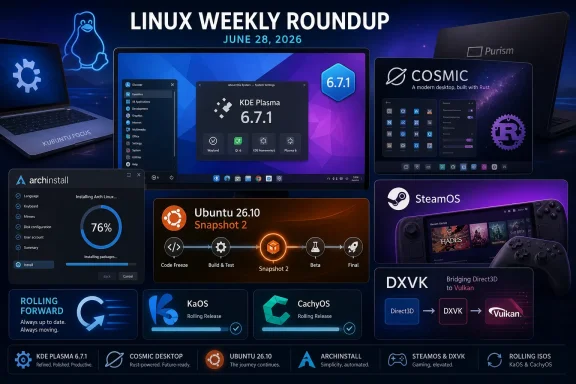 Linux Is Still Messy, but the Mess Is Starting to Look Productive
The Linux desktop has always had a public-relations problem disguised as a technical problem. Every week brings a parade of distributions, desktops, kernels, installers, shells, package managers, and compatibility layers, each one claiming progress in its own corner of the ecosystem. To a Windows admin or a normal PC buyer, that can look less like innovation and more like a support nightmare.Yet the week ending June 28 shows why the old criticism is beginning to lose some of its force. KDE Plasma is iterating quickly on the polished mainstream desktop. COSMIC is maturing as an independent Rust-based environment. Ubuntu is testing its next interim release through monthly snapshots. Archinstall is smoothing the path into one of Linux’s most influential rolling bases. Valve is pushing SteamOS and Steam client work forward at the same time that DXVK continues to make Windows games feel less married to Windows.
None of these developments alone changes the desktop market. Together, they show Linux moving along several tracks at once: better first-run experience, better graphics and gaming compatibility, better hardware offerings, and more credible alternatives to Windows’ increasingly opinionated update and account model. The point is not that everyone should abandon Windows tomorrow. The point is that Linux is becoming less of a hobbyist escape hatch and more of a collection of viable computing strategies.
For WindowsForum readers, that distinction matters. Linux is not merely “the other OS” anymore. It is a pressure system acting on Windows from below, above, and sideways: below through low-cost and aging PCs, above through developer and workstation hardware, and sideways through SteamOS-style appliances that make the operating system almost invisible.
KDE’s First Bug-Fix Release Shows the Value of Boring Velocity
KDE Plasma 6.7.1 arrived as the first point release after Plasma 6.7, and that timing is the important part. A major desktop environment release inevitably ships with rough edges; what separates a risky upgrade from a credible platform is how quickly those edges are sanded down. KDE’s cadence has become one of the most consequential stories in the Linux desktop because it combines visible polish with unusually fast follow-through.Plasma has long been the desktop environment most likely to win over Windows refugees on first contact. Its panel, launcher, system tray, window controls, and configuration depth all map more naturally to Windows muscle memory than GNOME’s more opinionated workflow. That resemblance used to come with caveats about instability, visual inconsistency, and occasional configuration overload. The Plasma 6 series has been KDE’s attempt to keep the configurability while modernizing the undercarriage around Qt 6 and Wayland.
The first 6.7 point release reinforces the idea that KDE is no longer content to be “powerful if you tolerate the quirks.” Bug-fix releases are not glamorous, but they are where trust is built. A desktop that can ship feature improvements one week and meaningful fixes the next begins to look less like a volunteer experiment and more like infrastructure.
This is particularly relevant because Wayland is now the center of gravity for Linux desktop work. Windows users rarely think about display server architecture, and they should not have to. But anyone who has followed Linux gaming, fractional scaling, multi-monitor behavior, screen sharing, HDR, or NVIDIA support knows that the display stack is where theoretical desktop progress often collides with daily irritation. KDE’s value proposition is that it is trying to make the modern stack usable without asking users to become protocol historians.
Plasma 6.7.1 also matters because downstream distributions do not all move at the same speed. Rolling distributions can ship the fixes quickly. Fixed-release distributions may wait. Enterprise-minded deployments may ignore the entire branch for months. KDE’s job is not to make every distro update instantly; it is to keep the upstream branch moving steadily enough that distributors have something increasingly solid to package.
COSMIC Is the Week’s Most Interesting Desktop Story Because It Is Not KDE
System76’s COSMIC 1.1 release is easy to underestimate because it exists in KDE and GNOME’s shadow. The Linux desktop conversation often treats those two projects as the only meaningful poles: KDE for configurability and Windows-like familiarity, GNOME for minimalism and a tightly curated workflow. COSMIC complicates that map.COSMIC’s significance is not just that System76 is building a desktop. It is that the company is building a desktop aligned with its own hardware, its own Pop!_OS audience, and a modern development philosophy. The Rust implementation gets attention, but the broader story is integration. System76 wants control over the user experience from laptop firmware and power profiles up through window management and settings.
The addition of COSMIC Monitor in COSMIC 1.1 points toward a desktop that is trying to treat system visibility as part of the core experience rather than an afterthought. That is a meaningful distinction for users coming from Windows, where Task Manager is both a diagnostic tool and a cultural artifact. People expect to see what their machine is doing. They expect to know when memory, CPU, GPU, disk, or network behavior is abnormal. Linux has plenty of tools for that, but they are often scattered across terminal utilities, desktop applets, and distribution-specific panels.
COSMIC’s challenge is the classic one facing any new desktop environment: it must be different enough to justify itself and stable enough not to punish early adopters. That is a brutal balance. If it merely copies GNOME or KDE, it becomes redundant. If it diverges too aggressively, it becomes another niche environment admired by enthusiasts and avoided by everyone else.
The fact that COSMIC keeps appearing in weekly release roundups is itself a positive signal. Desktop environments mature through repetition. Every point release is a chance to fix paper cuts, refine settings, improve performance, and prove that the project can sustain attention after the novelty fades. COSMIC is not yet the default answer for most users. But it is becoming a serious answer, and Linux benefits from having more than two credible desktop philosophies.
Ubuntu’s Monthly Snapshots Turn the Interim Release Into a Public Test Track
Ubuntu 26.10 Snapshot 2 is not the sort of release that attracts mainstream attention, but it reflects a healthier development model. Monthly snapshots turn what used to be a long, somewhat opaque march toward release day into a more observable process. For testers, developers, derivative distributions, and curious users, that matters.Ubuntu occupies a strange position in the Linux world. It is not the most technically adventurous distribution, and it is not the purest expression of any single upstream philosophy. But it remains one of the most important entry points for desktop Linux, server Linux, cloud images, WSL users, and hardware vendors. When Ubuntu changes its release plumbing, the effects ripple outward.
The 26.10 cycle also sits in the shadow of Ubuntu 26.04 LTS. Long-term-support releases carry the institutional weight; interim releases carry the experimentation. A snapshot approach gives Canonical and the Ubuntu community more room to expose changes early without pretending every image is polished for general use. That is useful for the same reason Windows Insider builds are useful, even when they frustrate testers: modern operating systems are too complex to validate only at the end.
For Windows administrators, Ubuntu snapshots are worth watching not because everyone should deploy them, but because they hint at what may later flow into LTS images, cloud deployments, developer workstations, and WSL-adjacent workflows. The Linux desktop is only one surface area. Ubuntu’s importance comes from being a bridge between desktop convenience, server predictability, and developer familiarity.
There is also a competitive angle. Microsoft has spent years making Windows more service-like, more account-driven, and more cloud-adjacent. Ubuntu is not free from corporate strategy, and Canonical has its own preferences that annoy parts of the community. But the existence of public snapshots reinforces a different bargain: the operating system can be watched, tested, forked, remixed, and criticized in public before release.
Archinstall’s Progress Is a Quiet Attack on Linux’s Gatekeeping Myth
Arch Linux’s reputation has always been larger than the distribution itself. For some users, Arch means documentation, control, freshness, and an honest rolling-release model. For others, it means performative difficulty, forum scolding, and a rite of passage built around manually assembling a system from the command line. Archinstall has been slowly changing that mythology.A major Archinstall update is not merely a convenience release. It is a cultural signal. It says that lowering the barrier to entry does not necessarily cheapen the distribution. It also says that the knowledge required to maintain a system and the ceremony required to install one are not the same thing.
This is important because Arch’s influence extends far beyond people who type
pacstrap by hand. SteamOS is Arch-based. CachyOS builds on Arch. EndeavourOS, Garuda, and other derivatives turn Arch’s rolling base into more accessible systems. Developers often test against Arch because new kernels, Mesa versions, desktops, and toolchains arrive quickly. The healthier Arch’s installation and maintenance ecosystem becomes, the healthier a significant slice of the Linux experimentation layer becomes.For Windows power users, Arch remains both tempting and dangerous. It offers speed, currency, and control, but it also expects attention. A better installer does not turn Arch into Ubuntu LTS, nor should it. But it does make the first step less needlessly theatrical, which matters in a world where users increasingly discover Linux through gaming handhelds, YouTube benchmarks, and hardware compatibility searches rather than old-school distro culture.
The deeper point is that Linux’s usability gains are not only happening in glossy desktop shells. They are happening in installers, package defaults, hardware detection, graphics stacks, and recovery paths. A distribution can be friendlier without becoming simplistic. Archinstall is one of the clearest examples of that shift.
Rolling ISOs Are Where Linux Shows Its Reflexes
The week also brought new KaOS and CachyOS releases, both of which illustrate why rolling or semi-rolling distributions remain central to the desktop Linux story. Fixed releases provide predictability. Rolling releases provide reflexes. Linux needs both, and this week’s roundup leans heavily toward the latter.CachyOS has become one of the more visible performance-oriented Arch derivatives, especially among users who care about gaming, kernels, schedulers, and desktop responsiveness. That does not make it the right choice for every PC. It does make it a useful indicator of where enthusiast Linux is going: toward systems that assume users want newer graphics stacks, faster access to performance work, and less waiting for upstream improvements to trickle into conservative channels.
KaOS, meanwhile, represents a different kind of focus. Its KDE-centric identity makes it part of the broader Plasma story rather than a generic distribution release. In a fragmented ecosystem, focus can be a feature. A distribution that knows exactly which desktop, toolkit, and packaging philosophy it wants to serve can sometimes deliver a more coherent experience than a larger project trying to satisfy every constituency.
This is where the Windows comparison gets tricky. Windows has one mainstream desktop shell and one dominant update channel, even if Microsoft now layers that with Insider rings, enablement packages, Store updates, driver delivery, and enterprise policy controls. Linux has hundreds of routes to a working desktop. That fragmentation is inefficient, but it also allows fast adaptation.
A new kernel regression, Mesa improvement, KDE fix, or gaming compatibility patch can reach CachyOS users quickly. A more conservative user can wait for Ubuntu, Debian, Linux Mint, or an enterprise distribution to absorb the same work later. The ecosystem’s weakness is that no single answer applies to everyone. Its strength is exactly the same thing.
Valve Is Turning Linux Gaming Into an Appliance Strategy
Valve’s presence in the roundup through Steam Client updates, Steam Machine discussion, SteamOS momentum, and DXVK releases is the part Windows users should watch most closely. Desktop Linux advocacy has been around for decades. Linux gaming with Valve behind it is different because it does not require users to care about Linux first.The Steam Deck changed the conversation by proving that a Linux-based consumer gaming device could succeed without selling itself as a Linux device. Most buyers did not purchase a handheld because they wanted an Arch-based operating system with Proton compatibility. They bought a handheld that played PC games well enough, resumed quickly enough, and gave them access to an existing Steam library. Linux was the mechanism, not the pitch.
The revived Steam Machine idea extends that logic into the living room and small-form-factor PC space. Whether the hardware itself becomes a major commercial hit is almost secondary. The real story is that Valve is normalizing SteamOS as a PC gaming environment, and it is doing so at the exact moment Windows gaming PCs are becoming more entangled with telemetry, account nudges, AI features, security requirements, and hardware baselines.
DXVK remains one of the unsung foundations of that shift. Translating Direct3D calls to Vulkan is not something most users want to think about, but it is one of the reasons Windows games can run convincingly on Linux. Each DXVK release is a reminder that compatibility is not a binary switch. It is a long campaign of performance fixes, game-specific improvements, driver coordination, and regression control.
Steam Client updates matter for the same reason. The client is the shell many gamers actually live in. If Steam input, recording, streaming, controller handling, library management, and overlay behavior work well, the underlying OS fades into the background. That is exactly what Linux needs in consumer spaces: fewer speeches about freedom, more moments where the user forgets to ask what operating system they are using.
The New Linux Laptop Push Is About Trust, Not Just Specs
The roundup’s mention of new Linux laptops from Kubuntu Focus and Purism points to another front in the same war: hardware confidence. For years, installing Linux on a laptop meant researching Wi-Fi chipsets, suspend behavior, fingerprint readers, hybrid graphics, firmware updates, touchpads, audio quirks, and battery life. Enthusiasts accepted that work as part of the bargain. Most users did not.Linux-first laptops change the emotional contract. They tell the buyer that the operating system is not an afterthought and that someone has at least attempted to validate the full stack. That does not guarantee perfection, but it narrows the support gap that has historically favored Windows and macOS.
Kubuntu Focus and Purism also represent different versions of Linux hardware identity. Kubuntu Focus leans into a polished KDE experience on hardware selected and configured for that workload. Purism leans into privacy, open-source values, and control. Both approaches are valid because the Linux laptop market is not a single market. It includes developers, privacy-focused users, sysadmins, students, open-source advocates, and Windows escapees who simply want a machine that does not fight them.
The hard part is scale. Dell, Lenovo, HP, and other major vendors can move more hardware in a week than boutique Linux vendors may sell in a long stretch. But scale is not the only measure of significance. Boutique vendors often prove demand, refine support expectations, and pressure larger manufacturers to treat Linux as a first-class configuration rather than a tolerated accident.
For Windows users evaluating a switch, the lesson is straightforward: the best Linux experience is often bought, not assembled. That may offend the old install-it-yourself ethos, but it is true. A laptop chosen for Linux compatibility will usually provide a better experience than a random Windows laptop pressed into service after purchase.
The App Layer Is Where Linux Becomes Daily-Driver Plausible
Calibre, Shotcut, GNU nano, Shelly, and other application releases in the roundup may look like filler beside desktops and distributions. They are not. Operating systems win daily use through applications, not through kernel version numbers.Calibre matters because e-book management is one of those mundane tasks that either works or pushes a user back to another platform. Shotcut matters because video editing is a common creative workload that cannot be hand-waved away with terminal enthusiasm. GNU nano matters because simple terminal editing remains part of Linux’s administrative culture, and improvements to basic tools compound over time. Shelly and similar utilities matter because desktop usability often lives in small extensions and focused apps rather than platform manifestos.
The Linux app story is still uneven. Professional Adobe workflows remain a major barrier. Certain CAD, audio production, business, and device-management tools remain Windows-first or macOS-first. Web apps have reduced the pain, but they have not eliminated it. Compatibility layers can help, but they are not a substitute for native support where performance, plugins, color management, or hardware integration matter.
Still, the center has shifted. A modern Linux desktop can cover browsing, coding, office documents, chat, email, media playback, light creative work, gaming, virtualization, and server administration with less compromise than in previous eras. Flatpak, AppImage, distro repositories, vendor packages, and containerized development workflows have not produced one clean app model, but they have produced enough routes to software that the old “Linux has no apps” line no longer lands with the same force.
For IT pros, this is where evaluation should be concrete rather than ideological. Do the required apps exist? Do they update reliably? Can settings be managed? Can users recover from breakage? Can data move back out? Linux does not need to be perfect in the abstract. It needs to be good enough for defined roles, and the list of those roles keeps expanding.
Windows Still Owns the Default, but Defaults Are More Fragile Than They Look
It would be foolish to pretend that a busy Linux release week threatens Windows’ desktop dominance in any immediate sense. Windows remains the default OS for most PC buyers, the assumed target for enterprise endpoint management, and the compatibility baseline for countless commercial applications. Defaults are powerful. They save users from choosing.But defaults become vulnerable when they stop feeling neutral. Microsoft’s recent Windows strategy has made the operating system more assertive: more cloud account prompts, more Microsoft 365 integration, more Edge promotion, more AI placement, more hardware-security requirements, and more service-driven change. Some of those moves have defensible security or business logic. All of them consume user patience.
Linux benefits when Windows users begin asking not “Is Linux better?” but “Why is my PC arguing with me?” That is a different question, and it changes the competitive terrain. The answer does not have to be a universal migration. It can be a Linux laptop for development, a SteamOS box for gaming, a Linux Mint install for an older relative, a Proxmox host in the closet, an Ubuntu workstation for data science, or a Fedora KDE machine for someone who wants a modern desktop without Microsoft account pressure.
The 9to5Linux roundup captures this pluralism. There is no single Linux product waiting to replace Windows. Instead there is a swarm of distributions, desktops, vendors, and compatibility projects making Windows less uniquely necessary in more contexts. That is a slower story than a market-share shock, but it may be the more durable one.
Windows’ greatest asset is inertia. Linux’s greatest asset is optionality. In 2026, optionality is beginning to look less like fragmentation and more like resilience.
This Week’s Linux Churn Points to a More Usable Escape Route
The practical reading of the June 28 roundup is not that every Windows user should download five ISOs and spend the weekend distro-hopping. The better reading is that the Linux ecosystem is improving along the exact seams where users used to fall through: installation, desktop polish, gaming compatibility, hardware availability, and release transparency.- KDE Plasma 6.7.1 shows that the flagship Windows-like Linux desktop is moving quickly from feature release to stabilization.
- COSMIC 1.1 shows that the Linux desktop still has room for new, integrated environments rather than only KDE and GNOME.
- Ubuntu 26.10 Snapshot 2 shows Canonical making interim development more visible before changes land in broader user channels.
- Archinstall 4.4 shows that even enthusiast distributions are reducing unnecessary installation friction.
- Steam, SteamOS, and DXVK updates show that Linux gaming is now a product strategy, not just a compatibility hobby.
- New Linux laptops from specialist vendors show that the best desktop Linux experience increasingly starts with hardware chosen for the job.
References
- Primary source: 9to5Linux
Published: Sun, 28 Jun 2026 22:53:25 GMT
- Related coverage: linuxiac.com
Linuxiac Weekly Wrap-Up: Week 26, 2026 (June 22 - 28)
Catch up on the latest Linux news: CachyOS June 2026 ISO, KaOS 2026.06, COSMIC Desktop 1.1, Fish Shell 4.8, Podman 6.0, Ubuntu ARM64 rebootless kernel updates, and more.linuxiac.com - Related coverage: linux.org

News - [9to5Linux] 9to5Linux Weekly Roundup: June 7th, 2026 | Linux.org
News - [9to5Linux] 9to5Linux Weekly Roundup: June 7th, 2026 - Linux.org - Friendly Linux Forum
www.linux.org
- Related coverage: planet.kde.org