

Micron Technology became Wall Street’s newest AI-infrastructure obsession in late June 2026 after reporting record fiscal third-quarter revenue of roughly $41.5 billion, quarterly profit above $28 billion, and a stock surge that pushed the Idaho memory maker into trillion-dollar-company territory. The easy headline is that Micron is “the next Nvidia.” The more useful version is sharper: AI has turned memory from a commodity input into a strategic choke point, and that shift is now washing through servers, PCs, cloud budgets, gaming hardware, and the Windows ecosystem.
Nvidia became the defining company of the first AI hardware boom because it owned the accelerator layer. If you wanted to train or run frontier models at scale, you needed GPUs, networking, software, and a supply chain that Nvidia had spent years building before the rest of the market understood the stakes.
Micron’s moment is different. The company is not suddenly replacing Nvidia at the center of AI computing, and it does not control the same kind of end-to-end software moat. But the market has begun treating memory as the next scarce resource in the AI buildout, and that is a profound change for a sector long known for brutal cycles, oversupply, and margin collapses.
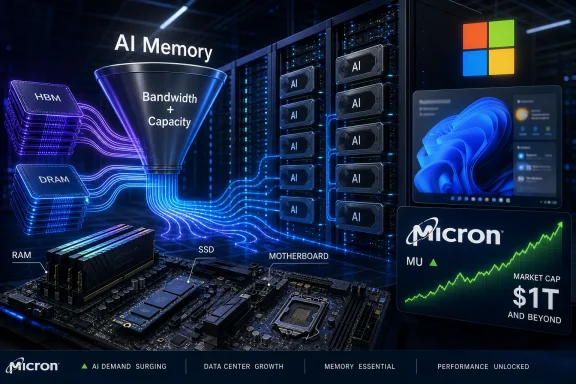
The reason is simple enough to fit on a motherboard: AI systems are ravenous for bandwidth and capacity. A modern accelerator is only as useful as its ability to keep data moving. High-bandwidth memory, advanced DRAM, and fast storage are no longer dull supporting actors; they are part of the performance envelope.
That is why Micron’s numbers landed with such force. Revenue that would have looked impossible a few years ago is now being interpreted as evidence that the memory business has entered a supercycle. Investors are not merely paying for one strong quarter. They are paying for the possibility that AI has rewritten the economics of a historically unforgiving industry.
Micron knows that history better than anyone. It has been through the classic memory cycle repeatedly: underinvestment, shortage, expansion, glut, and pain. The industry’s winners were often those with the strongest balance sheets and the discipline to survive the downturn rather than those with the flashiest product story.
AI has complicated that model. High-bandwidth memory is not interchangeable in the same way as a generic stick of laptop RAM. It is tightly linked to advanced packaging, accelerator roadmaps, power limits, and hyperscale purchasing commitments. The closer memory gets to the AI accelerator, the more strategic it becomes.
That is the market’s new thesis. Micron is not being valued as a company that merely ships bits into an anonymous spot market. It is being valued as a supplier of constrained, high-value components that cloud giants, AI labs, and chipmakers need in order to turn capital spending into working compute.
The danger, of course, is that memory investors have heard versions of this story before. Every upcycle contains a narrative about structural demand. The difference this time is the scale of the buyers and the technical difficulty of the product mix.
That matters because demand is not coming from one speculative corner of the market. It is coming from hyperscalers building AI infrastructure, enterprise customers trying to deploy inference workloads, chipmakers designing accelerators around specific memory stacks, and device makers preparing for AI PCs. The same supply base is being pulled from several directions at once.
For Windows users, the immediate impact may not be visible as a “Micron problem.” It will show up as RAM pricing, SSD pricing, laptop configurations, workstation availability, and the bill of materials for gaming PCs. If cloud providers and AI hardware vendors are willing to lock up memory supply at premium prices, consumer device makers have less room to negotiate.
That is the quiet Windows angle in a story that otherwise looks like Wall Street spectacle. The AI server rack does not live in isolation from the PC market. A shortage at the high end can reshape pricing behavior across the stack, especially when manufacturers begin stockpiling to protect future product launches.
Microsoft, OEMs, and enterprise IT departments have spent the past two years telling users that more local memory will matter for AI PCs. That message becomes harder to operationalize if the global memory market is repricing itself around data-center demand.
Micron’s fiscal third-quarter results appear to support that kind of re-rating. The company reported a staggering jump in revenue and profit, and its outlook suggested that demand was not immediately fading. Management also emphasized longer-term supply agreements, a detail designed to reassure investors that this is not merely a spot-pricing sugar high.
But Micron is not Nvidia. Nvidia’s advantage combines hardware, software, developer lock-in, networking, and a platform ecosystem that makes customers reluctant to switch. Micron’s advantage is more material and manufacturing-driven. It can be powerful, but it is more exposed to capacity additions, rival execution, and future price normalization.
Samsung, SK hynix, and other memory players are not going to sit quietly while Micron enjoys AI-driven margins. The entire industry is incentivized to expand supply where it can. The question is not whether competitors respond; the question is whether demand grows fast enough to absorb that response.
That is where the Nvidia analogy becomes both useful and dangerous. It captures the idea that AI has elevated a hardware supplier into strategic territory. It obscures the fact that memory markets have a long record of punishing anyone who extrapolates peak conditions too far into the future.
The company’s guidance for the following quarter added to the shock. A revenue outlook around $50 billion would have been nearly unthinkable during the old memory-cycle playbook. It implies that the market is still tight, that customers are still buying aggressively, and that Micron has product in exactly the parts of the industry where buyers have the least patience for shortages.
The strongest part of the story is not just that Micron sold more chips. It is that pricing, mix, and demand all appear to be moving in the same direction. HBM and data-center memory carry a different strategic value than commodity memory sold into weak consumer electronics markets.
That is why investors have treated the company less like a cyclical supplier and more like an infrastructure gatekeeper. The phrase may prove too generous over time, but the repricing is understandable. When customers cannot build revenue-generating AI systems without your components, the negotiating table changes.
Still, investors should be wary of treating one extraordinary quarter as proof of permanent escape velocity. The memory business has a long institutional memory of its own, and it is filled with examples of supply arriving just as enthusiasm peaks.
Enterprise IT will feel it sooner. Fleet refreshes depend on predictable pricing, and Windows 11 migrations already pushed many organizations into hardware planning cycles. Add AI PC marketing, Copilot-oriented memory recommendations, local model experimentation, and developer workstation demand, and suddenly memory capacity becomes a budget conversation again.
The problem is not that every office PC needs workstation-class RAM. It is that the industry’s product direction assumes more memory everywhere. Browser workloads have not become lighter. Collaboration tools have not become simpler. Security agents, virtualization, endpoint management, and local AI features all compete for headroom.
For gamers, the signal is also uncomfortable. Graphics memory, system RAM, and SSD pricing all interact with console and PC hardware economics. If AI data centers absorb premium supply, consumer hardware vendors may protect margins by raising prices, cutting base configurations, or slowing improvements.
The result may be a strange two-tier market. At the top, AI infrastructure buyers pay whatever is necessary to secure supply. At the bottom, consumers and small businesses discover that the era of cheap memory upgrades was more fragile than it looked.
That creates an awkward dependency. The more Microsoft and its partners promote local AI features, the more they reinforce demand for better-equipped PCs. Yet the same AI boom that makes those features desirable is also tightening the memory market that makes those machines affordable.
This does not mean the AI PC push is doomed. It does mean the hardware baseline matters. A thin laptop with limited memory may technically qualify for certain experiences while still feeling constrained in real use. Windows users have lived through that distinction before.
There is also a security dimension. Enterprises increasingly isolate workloads, run more telemetry, deploy heavier endpoint tools, and test local inference for sensitive data scenarios. These approaches need memory headroom. If RAM becomes more expensive, some organizations will delay hardware upgrades or compromise on specifications.
That is where a Wall Street story becomes an IT operations story. Micron’s rally is not just about investors betting on AI. It is about the component economics that will shape what kinds of Windows machines are practical, affordable, and supportable over the next several procurement cycles.
There is logic here. Hyperscalers cannot plan multi-billion-dollar data-center deployments on a casual assumption that memory will be available when needed. AI labs cannot promise capacity to enterprise customers if the hardware pipeline is uncertain. Chipmakers cannot finalize accelerator roadmaps without confidence in memory supply.
Long-term agreements also change psychology. They signal that buyers are willing to trade flexibility for security. In a shortage, that is rational behavior. For Micron, it can reduce the risk of producing into a vanishing market.
But contracts are not magic. They may include pricing mechanisms, volume flexibility, or customer protections that outsiders cannot fully evaluate. They can improve visibility without eliminating cyclicality. And if AI demand eventually slows, even committed customers will push back hard against pricing that no longer matches market reality.
The best reading is that these agreements make the current cycle more durable than a traditional consumer-led memory rebound. The worst reading is that investors are using them to justify a permanent multiple expansion before the industry has proved it can avoid its old mistakes.
AI may stretch that timeline. HBM is technically harder to produce than ordinary DRAM, and advanced packaging remains a constraint. Cleanroom capacity cannot be wished into existence. Qualification cycles for mission-critical data-center parts are slower than impulse purchases in consumer electronics.
That gives Micron and its peers breathing room. If demand continues to grow faster than supply can be added, pricing power can persist. If inference workloads explode across enterprise software, cloud platforms, and consumer services, memory intensity may keep rising even after the first wave of training clusters is built.
But the industry is now alert to the opportunity. Capital will chase these margins. Governments want domestic semiconductor capacity. Customers want second sources. Rivals will optimize product roadmaps around the same AI memory pool that has made Micron so valuable.
The risk is not that Micron’s quarter was fake. It was very real. The risk is that investors confuse a real shortage with a permanent shortage, and a strategic moment with a permanent monopoly.
Nvidia proved that at the accelerator layer. Broadcom and networking suppliers have benefited from the custom silicon and connectivity push. Power, cooling, land, and data-center construction have all become investor obsessions. Micron now fits into that same scarcity map.
The reason scarcity commands such a premium is that AI spending is constrained by physical reality. You can announce a model instantly, but you cannot instantly build a fab, secure advanced packaging, expand power infrastructure, and deploy fully equipped data centers. The bottlenecks become the business.
Micron’s surge suggests investors believe memory has graduated from a replaceable input to a governing constraint. That is a major psychological turn. The company is no longer being discussed merely as a beneficiary of the AI boom; it is being discussed as one of the conditions that determines how fast the boom can proceed.
That framing may be exaggerated, but it is not irrational. AI systems do not run on GPUs alone. They run on balanced architectures, and memory bandwidth is one of the places where imbalance becomes painfully expensive.
That may be where this memory cycle heads. If AI demand remains strong into 2027, PC makers will have to make harder choices about baseline specifications. A laptop that should ship with more RAM may instead preserve an entry-level price point by holding the line. A workstation-class configuration may carry a premium that feels disconnected from the rest of the machine.
For WindowsForum readers, this is where the practical advice becomes less exciting but more useful: memory capacity is worth watching again. For years, many buyers could assume that RAM and SSD prices would drift downward or that upgrades would remain cheap. That assumption is now less safe.
The effect will vary by segment. Premium AI PCs may use memory as a selling point. Budget devices may become more constrained. Enterprise fleets may lock in purchasing earlier. DIY builders may need to treat RAM and SSD pricing as volatile rather than background noise.
This is not panic territory. It is planning territory. The users and organizations that understand the supply cycle will make better hardware decisions than those who assume the component market still behaves like it did before AI infrastructure swallowed the roadmap.
 The AI Trade Has Found Its Second Bottleneck
Nvidia became the defining company of the first AI hardware boom because it owned the accelerator layer. If you wanted to train or run frontier models at scale, you needed GPUs, networking, software, and a supply chain that Nvidia had spent years building before the rest of the market understood the stakes.Micron’s moment is different. The company is not suddenly replacing Nvidia at the center of AI computing, and it does not control the same kind of end-to-end software moat. But the market has begun treating memory as the next scarce resource in the AI buildout, and that is a profound change for a sector long known for brutal cycles, oversupply, and margin collapses.
The reason is simple enough to fit on a motherboard: AI systems are ravenous for bandwidth and capacity. A modern accelerator is only as useful as its ability to keep data moving. High-bandwidth memory, advanced DRAM, and fast storage are no longer dull supporting actors; they are part of the performance envelope.
That is why Micron’s numbers landed with such force. Revenue that would have looked impossible a few years ago is now being interpreted as evidence that the memory business has entered a supercycle. Investors are not merely paying for one strong quarter. They are paying for the possibility that AI has rewritten the economics of a historically unforgiving industry.
Memory Was Supposed to Be the Boring Part
For decades, memory makers lived in the shadow of the companies that sold processors, operating systems, and finished devices. DRAM and NAND were essential, but they were also treated as commodities. When supply was tight, prices rose; when fabs caught up, prices crashed; and investors learned to distrust every “this time is different” argument.Micron knows that history better than anyone. It has been through the classic memory cycle repeatedly: underinvestment, shortage, expansion, glut, and pain. The industry’s winners were often those with the strongest balance sheets and the discipline to survive the downturn rather than those with the flashiest product story.
AI has complicated that model. High-bandwidth memory is not interchangeable in the same way as a generic stick of laptop RAM. It is tightly linked to advanced packaging, accelerator roadmaps, power limits, and hyperscale purchasing commitments. The closer memory gets to the AI accelerator, the more strategic it becomes.
That is the market’s new thesis. Micron is not being valued as a company that merely ships bits into an anonymous spot market. It is being valued as a supplier of constrained, high-value components that cloud giants, AI labs, and chipmakers need in order to turn capital spending into working compute.
The danger, of course, is that memory investors have heard versions of this story before. Every upcycle contains a narrative about structural demand. The difference this time is the scale of the buyers and the technical difficulty of the product mix.
“RAMageddon” Is a Silly Name for a Serious Supply Shock
The term RAMageddon sounds like something coined for clicks, but the underlying market stress is real enough. AI data centers require enormous quantities of memory, and they require it in forms that cannot be added overnight. HBM capacity, advanced DRAM production, and cutting-edge packaging all depend on capital-intensive supply chains with long lead times.That matters because demand is not coming from one speculative corner of the market. It is coming from hyperscalers building AI infrastructure, enterprise customers trying to deploy inference workloads, chipmakers designing accelerators around specific memory stacks, and device makers preparing for AI PCs. The same supply base is being pulled from several directions at once.
For Windows users, the immediate impact may not be visible as a “Micron problem.” It will show up as RAM pricing, SSD pricing, laptop configurations, workstation availability, and the bill of materials for gaming PCs. If cloud providers and AI hardware vendors are willing to lock up memory supply at premium prices, consumer device makers have less room to negotiate.
That is the quiet Windows angle in a story that otherwise looks like Wall Street spectacle. The AI server rack does not live in isolation from the PC market. A shortage at the high end can reshape pricing behavior across the stack, especially when manufacturers begin stockpiling to protect future product launches.
Microsoft, OEMs, and enterprise IT departments have spent the past two years telling users that more local memory will matter for AI PCs. That message becomes harder to operationalize if the global memory market is repricing itself around data-center demand.
The Nvidia Comparison Works Until It Doesn’t
There is a good reason investors reach for Nvidia when trying to explain Micron’s surge. Nvidia taught the market that AI infrastructure bottlenecks can produce extraordinary pricing power. If a company controls an essential layer of the stack during a demand shock, its margins can expand far beyond old assumptions.Micron’s fiscal third-quarter results appear to support that kind of re-rating. The company reported a staggering jump in revenue and profit, and its outlook suggested that demand was not immediately fading. Management also emphasized longer-term supply agreements, a detail designed to reassure investors that this is not merely a spot-pricing sugar high.
But Micron is not Nvidia. Nvidia’s advantage combines hardware, software, developer lock-in, networking, and a platform ecosystem that makes customers reluctant to switch. Micron’s advantage is more material and manufacturing-driven. It can be powerful, but it is more exposed to capacity additions, rival execution, and future price normalization.
Samsung, SK hynix, and other memory players are not going to sit quietly while Micron enjoys AI-driven margins. The entire industry is incentivized to expand supply where it can. The question is not whether competitors respond; the question is whether demand grows fast enough to absorb that response.
That is where the Nvidia analogy becomes both useful and dangerous. It captures the idea that AI has elevated a hardware supplier into strategic territory. It obscures the fact that memory markets have a long record of punishing anyone who extrapolates peak conditions too far into the future.
The Quarter Was a Statement, Not a Normal Earnings Beat
Micron’s reported fiscal third-quarter figures were not the kind of incremental improvement that analysts can dismiss as a narrow beat. Revenue of about $41.5 billion, up from roughly $9.3 billion in the year-earlier quarter, represents a transformation in scale. Net income above $28 billion is the kind of number that forces investors to redraw models rather than tweak assumptions.The company’s guidance for the following quarter added to the shock. A revenue outlook around $50 billion would have been nearly unthinkable during the old memory-cycle playbook. It implies that the market is still tight, that customers are still buying aggressively, and that Micron has product in exactly the parts of the industry where buyers have the least patience for shortages.
The strongest part of the story is not just that Micron sold more chips. It is that pricing, mix, and demand all appear to be moving in the same direction. HBM and data-center memory carry a different strategic value than commodity memory sold into weak consumer electronics markets.
That is why investors have treated the company less like a cyclical supplier and more like an infrastructure gatekeeper. The phrase may prove too generous over time, but the repricing is understandable. When customers cannot build revenue-generating AI systems without your components, the negotiating table changes.
Still, investors should be wary of treating one extraordinary quarter as proof of permanent escape velocity. The memory business has a long institutional memory of its own, and it is filled with examples of supply arriving just as enthusiasm peaks.
The PC Market Will Feel This in Less Dramatic Ways
Most Windows users will not buy HBM directly, and they will not care which memory supplier sits inside a cloud training cluster. They will care when laptops with generous RAM configurations get more expensive, when SSD discounts become less aggressive, or when workstation vendors start nudging buyers toward pricier builds because supply planning has tightened.Enterprise IT will feel it sooner. Fleet refreshes depend on predictable pricing, and Windows 11 migrations already pushed many organizations into hardware planning cycles. Add AI PC marketing, Copilot-oriented memory recommendations, local model experimentation, and developer workstation demand, and suddenly memory capacity becomes a budget conversation again.
The problem is not that every office PC needs workstation-class RAM. It is that the industry’s product direction assumes more memory everywhere. Browser workloads have not become lighter. Collaboration tools have not become simpler. Security agents, virtualization, endpoint management, and local AI features all compete for headroom.
For gamers, the signal is also uncomfortable. Graphics memory, system RAM, and SSD pricing all interact with console and PC hardware economics. If AI data centers absorb premium supply, consumer hardware vendors may protect margins by raising prices, cutting base configurations, or slowing improvements.
The result may be a strange two-tier market. At the top, AI infrastructure buyers pay whatever is necessary to secure supply. At the bottom, consumers and small businesses discover that the era of cheap memory upgrades was more fragile than it looked.
Windows AI Ambitions Depend on the Least Glamorous Component
Microsoft’s AI strategy has been framed around services, models, Copilot integration, and cloud infrastructure. But the Windows side of the story depends heavily on local hardware capability. If AI PCs are going to be more than a sticker program, they need enough memory to run modern workloads without making the rest of the system miserable.That creates an awkward dependency. The more Microsoft and its partners promote local AI features, the more they reinforce demand for better-equipped PCs. Yet the same AI boom that makes those features desirable is also tightening the memory market that makes those machines affordable.
This does not mean the AI PC push is doomed. It does mean the hardware baseline matters. A thin laptop with limited memory may technically qualify for certain experiences while still feeling constrained in real use. Windows users have lived through that distinction before.
There is also a security dimension. Enterprises increasingly isolate workloads, run more telemetry, deploy heavier endpoint tools, and test local inference for sensitive data scenarios. These approaches need memory headroom. If RAM becomes more expensive, some organizations will delay hardware upgrades or compromise on specifications.
That is where a Wall Street story becomes an IT operations story. Micron’s rally is not just about investors betting on AI. It is about the component economics that will shape what kinds of Windows machines are practical, affordable, and supportable over the next several procurement cycles.
The Supply Agreements Are the Detail Investors Want to Believe
Micron’s management has leaned into the idea that long-term agreements and customer commitments can smooth the old memory cycle. That is exactly what investors want to hear. If customers are making firm commitments because AI infrastructure is mission-critical, Micron’s revenue becomes more predictable and less exposed to the commodity spot market.There is logic here. Hyperscalers cannot plan multi-billion-dollar data-center deployments on a casual assumption that memory will be available when needed. AI labs cannot promise capacity to enterprise customers if the hardware pipeline is uncertain. Chipmakers cannot finalize accelerator roadmaps without confidence in memory supply.
Long-term agreements also change psychology. They signal that buyers are willing to trade flexibility for security. In a shortage, that is rational behavior. For Micron, it can reduce the risk of producing into a vanishing market.
But contracts are not magic. They may include pricing mechanisms, volume flexibility, or customer protections that outsiders cannot fully evaluate. They can improve visibility without eliminating cyclicality. And if AI demand eventually slows, even committed customers will push back hard against pricing that no longer matches market reality.
The best reading is that these agreements make the current cycle more durable than a traditional consumer-led memory rebound. The worst reading is that investors are using them to justify a permanent multiple expansion before the industry has proved it can avoid its old mistakes.
The Old Memory Cycle Is Not Dead Until the New Fabs Say So
Memory shortages tend to contain the seeds of their own reversal. High prices encourage investment. Investment brings new capacity. New capacity, if it arrives after demand normalizes, creates oversupply. This is not a theory; it is the operating history of the sector.AI may stretch that timeline. HBM is technically harder to produce than ordinary DRAM, and advanced packaging remains a constraint. Cleanroom capacity cannot be wished into existence. Qualification cycles for mission-critical data-center parts are slower than impulse purchases in consumer electronics.
That gives Micron and its peers breathing room. If demand continues to grow faster than supply can be added, pricing power can persist. If inference workloads explode across enterprise software, cloud platforms, and consumer services, memory intensity may keep rising even after the first wave of training clusters is built.
But the industry is now alert to the opportunity. Capital will chase these margins. Governments want domestic semiconductor capacity. Customers want second sources. Rivals will optimize product roadmaps around the same AI memory pool that has made Micron so valuable.
The risk is not that Micron’s quarter was fake. It was very real. The risk is that investors confuse a real shortage with a permanent shortage, and a strategic moment with a permanent monopoly.
Wall Street Is Repricing Scarcity, Not Just Growth
The market’s enthusiasm for Micron reflects a broader shift in how AI infrastructure is being valued. For much of the boom, the central question was which companies could monetize models and applications. The answer, at least in public markets, has often been that the surest profits accrue to the companies selling picks and shovels.Nvidia proved that at the accelerator layer. Broadcom and networking suppliers have benefited from the custom silicon and connectivity push. Power, cooling, land, and data-center construction have all become investor obsessions. Micron now fits into that same scarcity map.
The reason scarcity commands such a premium is that AI spending is constrained by physical reality. You can announce a model instantly, but you cannot instantly build a fab, secure advanced packaging, expand power infrastructure, and deploy fully equipped data centers. The bottlenecks become the business.
Micron’s surge suggests investors believe memory has graduated from a replaceable input to a governing constraint. That is a major psychological turn. The company is no longer being discussed merely as a beneficiary of the AI boom; it is being discussed as one of the conditions that determines how fast the boom can proceed.
That framing may be exaggerated, but it is not irrational. AI systems do not run on GPUs alone. They run on balanced architectures, and memory bandwidth is one of the places where imbalance becomes painfully expensive.
The Consumer Hangover May Arrive After the Investor Party
There is a familiar pattern in component shortages. First, the financial markets celebrate suppliers. Then enterprise buyers absorb price increases because they have no choice. Finally, consumers encounter the bill through higher device prices, weaker discounts, or stingier configurations.That may be where this memory cycle heads. If AI demand remains strong into 2027, PC makers will have to make harder choices about baseline specifications. A laptop that should ship with more RAM may instead preserve an entry-level price point by holding the line. A workstation-class configuration may carry a premium that feels disconnected from the rest of the machine.
For WindowsForum readers, this is where the practical advice becomes less exciting but more useful: memory capacity is worth watching again. For years, many buyers could assume that RAM and SSD prices would drift downward or that upgrades would remain cheap. That assumption is now less safe.
The effect will vary by segment. Premium AI PCs may use memory as a selling point. Budget devices may become more constrained. Enterprise fleets may lock in purchasing earlier. DIY builders may need to treat RAM and SSD pricing as volatile rather than background noise.
This is not panic territory. It is planning territory. The users and organizations that understand the supply cycle will make better hardware decisions than those who assume the component market still behaves like it did before AI infrastructure swallowed the roadmap.
The Micron Boom Leaves Windows Buyers With Fewer Comfortable Assumptions
The most important lesson from Micron’s rise is not that every investor should chase memory stocks. It is that the AI buildout has turned mundane components into strategic assets, and that change will spill into the devices and budgets Windows users actually touch.- Micron’s latest earnings show that AI demand has dramatically changed the revenue and margin profile of high-end memory suppliers.
- The Nvidia comparison is useful as a shorthand for scarcity pricing, but it overstates Micron’s control over the broader AI platform.
- The memory shortage is likely to affect PCs indirectly through RAM, SSD, workstation, server, and device pricing rather than through a single obvious consumer surcharge.
- Enterprise Windows planning should treat memory capacity as a strategic procurement variable, not just a line item to optimize at the end.
- The biggest risk is that new supply eventually arrives after customers have overcommitted, recreating the classic memory bust in a more expensive form.
References
- Primary source: zamin.uz
Published: 2026-06-28T16:20:13.862459
Loading…
zamin.uz - Related coverage: techcrunch.com
Loading…
techcrunch.com - Related coverage: nequitco.com
Loading…
www.nequitco.com - Related coverage: investors.micron.com
Loading…
investors.micron.com - Related coverage: ig.com
Loading…
www.ig.com - Related coverage: top1markets.com
Loading…
www.top1markets.com
- Related coverage: nasdaq.com
Loading…
www.nasdaq.com - Related coverage: marketbeat.com
Loading…
www.marketbeat.com - Related coverage: tradingview.com
Loading…
www.tradingview.com - Related coverage: in.investing.com
Loading…
in.investing.com - Related coverage: inews.zoombangla.com
Loading…
inews.zoombangla.com - Related coverage: oquilia.com
Loading…
www.oquilia.com - Related coverage: investing.com
Loading…
www.investing.com - Related coverage: techradar.com
Loading…
www.techradar.com