

NVIDIA became the largest data-center Ethernet switch vendor by revenue in the first quarter of 2026, according to IDC figures reported by multiple industry outlets, after Spectrum-X pushed its quarterly switching revenue to roughly $2.1 billion and a 21.5 percent share. That is not a side quest in the AI boom; it is the clearest sign yet that NVIDIA’s real product is no longer the GPU alone. The company is turning the data center network into part of the accelerator, and that shift is rewriting the competitive map for Arista, Cisco, Broadcom, HPE, and every cloud builder trying to avoid a single-vendor future.
For most of NVIDIA’s modern history, the company’s public identity has been easy to summarize: graphics first, then GPUs for scientific computing, then GPUs for AI. The market shorthand still works, but it now hides more than it explains. In the AI data center, the expensive chip on the server board is only one piece of a much larger machine.
Large AI clusters do not behave like conventional server farms. Training a frontier model or serving a large-scale inference platform requires thousands, tens of thousands, and soon hundreds of thousands of accelerators to act like a single computational organism. The network is not simply moving packets between servers; it is determining how much of the purchased compute can actually be used.
That is why NVIDIA’s rise in Ethernet switching matters. A switch market share chart would once have looked like plumbing-industry news, important to procurement teams and network architects but peripheral to the main drama of computing. In 2026, that chart is a map of power inside the AI economy.
The old enterprise networking model assumed a separation of concerns. One vendor sold servers, another sold switches, another sold NICs, another sold storage, and customers integrated the parts into a working data center. AI has punished that model because the cost of inefficiency is no longer measured in a few underutilized CPU cores; it is measured in racks of accelerators idling while they wait for gradients, parameters, or inference traffic to arrive.
NVIDIA’s wager is straightforward: if the GPU is the engine, the network is the drivetrain. Own both, tune both, and the customer buys performance that no spreadsheet of standalone component benchmarks can capture.
Mellanox brought NVIDIA a deep portfolio in InfiniBand, Ethernet switch silicon, network adapters, smart NICs, cables, and the software required to make high-speed interconnects behave predictably under punishing workloads. That was valuable in supercomputing and hyperscale data centers even then. But the value exploded once AI clusters stopped being large servers and started becoming distributed computers.
The timing now looks almost unfair. NVIDIA bought the company before the rest of the industry fully understood that networking would become one of the core bottlenecks in AI infrastructure. When the AI accelerator market surged, NVIDIA already owned the interconnect expertise needed to keep those accelerators fed.
This is the part of the story that gets lost when the discussion stays fixated on CUDA. CUDA is a moat, but it is not the only moat. NVIDIA has been building a layered system in which software, accelerators, CPUs, DPUs, switch ASICs, NICs, cables, optics, and reference architectures reinforce one another.
Mellanox gave NVIDIA something more strategically useful than another product line. It gave the company permission to think of the data center as a single system.
That distinction matters. Traditional Ethernet is everywhere because it is flexible, standardized, and familiar to IT teams. But AI training creates traffic patterns that can be brutal for networks designed around more general-purpose assumptions. Collective operations, synchronized workloads, congestion sensitivity, and GPU-to-GPU communication all expose the difference between “fast Ethernet” and an AI-optimized fabric.
Spectrum-X is NVIDIA’s attempt to close that gap without asking every customer to choose InfiniBand. InfiniBand remains a powerful technology for tightly coupled high-performance computing and AI training, and NVIDIA continues to invest in it. But Ethernet has gravity: broad ecosystem support, operational familiarity, multi-vendor expectations, and a history of winning when markets scale horizontally.
That is why NVIDIA’s Ethernet success is so important. It shows that NVIDIA is not content to defend a specialized high-performance interconnect niche. It wants to shape the mainstream data center network as AI workloads become mainstream data center workloads.
The company’s advantage is that it can optimize across layers competitors often touch only in isolation. A conventional switch vendor can build a very fast switch. NVIDIA can argue that its switch, NIC, DPU, cable, GPU, and software stack know enough about each other to produce better cluster-level performance.
That is the pitch customers are increasingly buying.
Inside that expanding pool, NVIDIA’s growth was extraordinary. Its data-center Ethernet switching revenue rose almost 193 percent year over year, giving it the top revenue share in the segment. Arista, long one of the defining names in cloud networking, was just behind. Cisco, Huawei, HPE, and others remained major players, but the symbolism was unmistakable: the AI accelerator company had climbed to the top of a core networking market.
This does not mean NVIDIA has “won Ethernet” in the traditional sense. The Ethernet market is broad, regional, and segmented across campus, branch, carrier, enterprise, and data center deployments. NVIDIA’s strength is concentrated in data-center switching for AI clusters, which is precisely the hottest part of the market right now.
But that caveat does not make the result smaller. It makes it sharper. NVIDIA has not needed to dominate every Ethernet use case. It has targeted the most strategically valuable one: the network that turns piles of AI chips into functioning AI factories.
The regional growth pattern also matters. The Americas led the surge, but Europe, the Middle East, Africa, and Asia-Pacific all grew strongly. That matches the global character of AI infrastructure spending, where hyperscalers, sovereign AI projects, cloud challengers, and large enterprises are all trying to secure capacity before their competitors do.
The race is not just to own GPUs. It is to own working clusters.
That changes the role of the network. In an AI factory, network inefficiency is not a background inconvenience. It is a direct tax on the most expensive assets in the building.
If a GPU cluster stalls because of congestion, latency, or synchronization delay, the loss is multiplied across the entire cluster. A few microseconds in the wrong place can cascade into low utilization across thousands of accelerators. When those accelerators cost billions of dollars collectively, network behavior becomes a financial variable.
This is why AI networking has become such a fertile business. Customers do not buy high-speed switches because they enjoy network upgrades. They buy them because the alternative is wasting scarce accelerator capacity, missing training windows, or running inference infrastructure with poor economics.
NVIDIA’s strategic insight was to make that calculation visible. The company does not have to convince customers that switches are glamorous. It only has to convince them that a slightly better network can unlock a materially better return on their GPU investment.
That argument is especially potent because NVIDIA often sells the GPU investment in the first place.
The optimistic reading is that customers are voting for a better system. Spectrum-X gives them a validated architecture. BlueField DPUs offload and isolate infrastructure functions. ConnectX adapters and LinkX cables reduce integration uncertainty. NVIDIA’s software stack gives operators a path to manage traffic patterns that would otherwise require painful tuning.
For cloud providers and enterprises racing to deploy AI infrastructure, that matters. The labor market for people who can design and operate very large AI clusters is tight. A package that reduces risk, shortens deployment time, and promises better utilization will win business even if it carries a premium.
The less comfortable reading is that NVIDIA’s dominance in GPUs gives it enormous influence over adjacent purchasing decisions. If customers believe that choosing non-NVIDIA networking could complicate access, support, optimization, or future allocation of accelerators, then networking share becomes partly an artifact of GPU dependence. Some industry commentary has reportedly suggested that cloud executives worry about retaliation or disadvantage if they mix competing AI accelerators or non-NVIDIA networking into major clusters.
That claim should be handled carefully. Fear in a market is not the same as a documented policy. But the concern is plausible enough to matter because supply scarcity and platform dependence have already made NVIDIA the gatekeeper for much of the AI buildout.
This is where the story becomes bigger than switches. NVIDIA is not merely entering adjacent markets; it is using adjacency to deepen the center. Each successful sale of networking gear makes the GPU cluster more NVIDIA-shaped, and each NVIDIA-shaped cluster makes it harder for alternatives to wedge their way in.
Enterprise IT has seen this movie before. Integration lowers friction. Integration also creates lock-in. The difference is that this time the lock-in lives at data-center scale and is attached to some of the most expensive computing projects ever built.
These companies also understand Ethernet’s tendency to absorb specialized markets. Time and again, Ethernet has started as the “good enough” generalist and then improved until it became the default. If AI networking follows that arc, a broad ecosystem could challenge NVIDIA’s more vertically integrated approach.
The Ultra Ethernet Consortium and related industry efforts reflect that pressure. The goal is to bring Ethernet closer to the needs of AI and HPC workloads while preserving the multi-vendor character that made Ethernet so powerful in the first place. If customers can get AI-class performance without accepting a single-vendor architecture, many will prefer that path.
But incumbents face a timing problem. NVIDIA already has the workloads, the accelerators, the reference designs, the developer mindshare, and the customer urgency. Standards-based alternatives may win in the long run, but AI infrastructure is being built now. The vendor that can ship a validated cluster this quarter has an advantage over the ecosystem that promises openness over the next few years.
That does not make the battle unwinnable for NVIDIA’s rivals. It means they need to compete at the system level, not just the port-speed level. The winning message cannot be “our switch is fast.” It has to be “our fabric keeps your AI investment productive, interoperable, observable, and under your control.”
NVIDIA forced networking vendors to speak the language of accelerators. Now the question is whether they can speak it fluently enough.
Ethernet, however, has the broader gravitational field. Enterprises know it. Cloud operators have built operational models around it. The component ecosystem is massive. Procurement teams like its multi-vendor structure, even when they ultimately buy most components from one supplier.
That makes NVIDIA’s Ethernet push less a repudiation of InfiniBand than a recognition of market scale. If every AI customer were willing to run InfiniBand everywhere, NVIDIA would have a strong hand. But if Ethernet becomes the default fabric for a wider range of AI deployments, NVIDIA needs to shape that transition rather than watch others profit from it.
This is why Spectrum-X is so strategically useful. It allows NVIDIA to say, in effect: yes, you can have Ethernet, but you should have our version of Ethernet, tuned for our accelerators and our software.
The industry’s move toward 400G, 800G, and eventually 1.6T networking reinforces that shift. IDC’s reported figures show 800G already accounting for a major share of data-center Ethernet revenue in early 2026, while 200G and 400G remain significant. AI is pulling high-speed networking forward faster than many traditional enterprise refresh cycles ever did.
That creates opportunity and disruption at the same time. Customers upgrading for AI are not simply replacing old switches with faster ones. They are rethinking the fabric around workload behavior, power, cooling, optics, rack density, and cluster topology. That is exactly the kind of architectural transition where a strong platform vendor can capture disproportionate value.
But copper does not scale indefinitely across distance. Once clusters stretch beyond the practical reach of copper cabling, optical interconnects become unavoidable. Pluggable optics already play a major role in high-speed Ethernet and InfiniBand deployments, but the industry is moving toward more aggressive designs, including co-packaged optics.
Co-packaged optics brings optical components closer to the switch ASIC, reducing electrical path lengths and potentially improving power efficiency and bandwidth density. The tradeoffs are real: serviceability, thermals, manufacturing complexity, and operational familiarity all become harder. But the direction of travel is clear because AI clusters are hungry for bandwidth and intolerant of wasted power.
NVIDIA has been explicit about this roadmap. Its future networking platforms are expected to push deeper into optical integration for both Ethernet and InfiniBand. That is not a boutique engineering exercise; it is a response to the same structural pressure that made Spectrum-X valuable in the first place.
The more AI infrastructure scales, the more interconnect becomes a first-order design constraint. The switch chip, the optics, the cable plant, the rack design, and the accelerator topology all start to merge into one problem. NVIDIA wants to be the company that solves that problem before customers break it apart into separate bids.
This should worry competitors because it moves the battleground away from commodity comparison. Once networking becomes inseparable from rack-scale and data-center-scale AI architecture, the vendor with the most complete system story gains negotiating power.
But the AI infrastructure stack has a way of flowing downstream. The networks being built for hyperscale AI today determine the cost, availability, and performance of AI services tomorrow. If Microsoft, Amazon, Google, Oracle, Meta, and the new AI cloud providers pay more for tightly integrated infrastructure, those costs eventually appear in subscription pricing, reserved capacity, inference limits, and enterprise AI procurement.
Windows environments will also consume this infrastructure through Copilot, Azure AI services, GitHub tooling, security analytics, developer platforms, and line-of-business applications that quietly add AI features. The user may never know whether the model response came through an InfiniBand cluster, a Spectrum-X Ethernet fabric, or a rival architecture. The bill and the service limits will still reflect those choices.
For sysadmins, the immediate lesson is not to become optical-networking specialists overnight. It is to recognize that AI is changing the economics of infrastructure above and below the operating system. The old habit of treating compute, storage, networking, and software as separable layers is becoming less useful in the most expensive part of the stack.
That has procurement implications. Enterprises evaluating AI platforms should ask not only which GPU is being used, but how the cluster is networked, how portable workloads are, what observability is exposed, and whether performance depends on proprietary assumptions. Those questions used to belong to hyperscale architects. They are moving into mainstream enterprise IT.
The practical risk is opacity. If AI services are sold as black boxes, customers may not know whether they are buying durable architecture or temporary access to a constrained supply chain. NVIDIA’s networking rise makes that opacity more consequential because it suggests that the AI stack is consolidating below the level most enterprise buyers can see.
A GPU competitor can design an accelerator. A networking competitor can design a switch. A CPU vendor can design a host processor. A cloud provider can design custom silicon. The harder task is making all of those pieces behave predictably under real AI workloads at massive scale, while developers and customers continue to write for your platform.
That is where NVIDIA’s advantage compounds. CUDA brings developers. GPUs bring demand. Mellanox brought networking. BlueField brings infrastructure offload and control. NVLink brings scale-up bandwidth. Spectrum-X brings Ethernet into the AI cluster story. The company’s software and reference designs tie the pieces together.
The result is not invulnerability. Large customers dislike dependence, and the biggest cloud providers have every incentive to develop alternatives. AMD, Intel, Broadcom, Marvell, Arista, Cisco, and custom silicon teams inside hyperscalers will all keep pressing. Regulators may also become more interested if bundling concerns harden into evidence of anticompetitive conduct.
But NVIDIA does not need every customer to love the consolidation. It only needs enough customers to conclude that the integrated path is the fastest way to deploy useful AI capacity. In a market where speed has strategic value, that is a powerful advantage.
The switch business is therefore not a footnote to the GPU boom. It is evidence that NVIDIA has expanded the definition of what an AI company sells.
The next few years will test whether NVIDIA’s networking lead becomes a durable platform advantage or a temporary artifact of GPU scarcity and early AI spending. Either way, the company has already changed the question customers ask. It is no longer “which GPU should we buy?” It is “who can make the whole AI factory run?” That is a much bigger market, and NVIDIA is trying to make sure it owns the answer before the rest of the industry finishes standardizing the alternative.
 The Switch Became Part of the Accelerator
For most of NVIDIA’s modern history, the company’s public identity has been easy to summarize: graphics first, then GPUs for scientific computing, then GPUs for AI. The market shorthand still works, but it now hides more than it explains. In the AI data center, the expensive chip on the server board is only one piece of a much larger machine.Large AI clusters do not behave like conventional server farms. Training a frontier model or serving a large-scale inference platform requires thousands, tens of thousands, and soon hundreds of thousands of accelerators to act like a single computational organism. The network is not simply moving packets between servers; it is determining how much of the purchased compute can actually be used.
That is why NVIDIA’s rise in Ethernet switching matters. A switch market share chart would once have looked like plumbing-industry news, important to procurement teams and network architects but peripheral to the main drama of computing. In 2026, that chart is a map of power inside the AI economy.
The old enterprise networking model assumed a separation of concerns. One vendor sold servers, another sold switches, another sold NICs, another sold storage, and customers integrated the parts into a working data center. AI has punished that model because the cost of inefficiency is no longer measured in a few underutilized CPU cores; it is measured in racks of accelerators idling while they wait for gradients, parameters, or inference traffic to arrive.
NVIDIA’s wager is straightforward: if the GPU is the engine, the network is the drivetrain. Own both, tune both, and the customer buys performance that no spreadsheet of standalone component benchmarks can capture.
Mellanox Was the Deal That Looked Boring Until It Wasn’t
The acquisition that made this possible was not announced in the generative AI frenzy. NVIDIA agreed to buy Mellanox Technologies in 2019 for about $6.9 billion, a deal that at the time looked like a high-performance computing adjacency rather than a foundation stone for the next computing platform.Mellanox brought NVIDIA a deep portfolio in InfiniBand, Ethernet switch silicon, network adapters, smart NICs, cables, and the software required to make high-speed interconnects behave predictably under punishing workloads. That was valuable in supercomputing and hyperscale data centers even then. But the value exploded once AI clusters stopped being large servers and started becoming distributed computers.
The timing now looks almost unfair. NVIDIA bought the company before the rest of the industry fully understood that networking would become one of the core bottlenecks in AI infrastructure. When the AI accelerator market surged, NVIDIA already owned the interconnect expertise needed to keep those accelerators fed.
This is the part of the story that gets lost when the discussion stays fixated on CUDA. CUDA is a moat, but it is not the only moat. NVIDIA has been building a layered system in which software, accelerators, CPUs, DPUs, switch ASICs, NICs, cables, optics, and reference architectures reinforce one another.
Mellanox gave NVIDIA something more strategically useful than another product line. It gave the company permission to think of the data center as a single system.
Spectrum-X Is Ethernet With an AI Accent
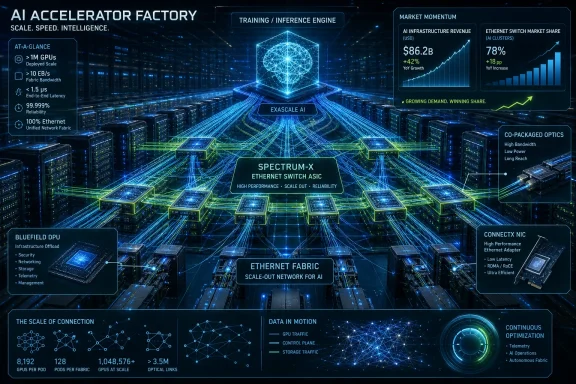
Spectrum-X is the product name that turns this strategy into something customers can buy. It combines NVIDIA Spectrum Ethernet switches, BlueField DPUs, ConnectX network adapters, LinkX interconnects, and a software stack designed around AI workloads. The point is not merely that NVIDIA sells Ethernet switches. The point is that it sells Ethernet as part of a GPU cluster architecture.That distinction matters. Traditional Ethernet is everywhere because it is flexible, standardized, and familiar to IT teams. But AI training creates traffic patterns that can be brutal for networks designed around more general-purpose assumptions. Collective operations, synchronized workloads, congestion sensitivity, and GPU-to-GPU communication all expose the difference between “fast Ethernet” and an AI-optimized fabric.
Spectrum-X is NVIDIA’s attempt to close that gap without asking every customer to choose InfiniBand. InfiniBand remains a powerful technology for tightly coupled high-performance computing and AI training, and NVIDIA continues to invest in it. But Ethernet has gravity: broad ecosystem support, operational familiarity, multi-vendor expectations, and a history of winning when markets scale horizontally.
That is why NVIDIA’s Ethernet success is so important. It shows that NVIDIA is not content to defend a specialized high-performance interconnect niche. It wants to shape the mainstream data center network as AI workloads become mainstream data center workloads.
The company’s advantage is that it can optimize across layers competitors often touch only in isolation. A conventional switch vendor can build a very fast switch. NVIDIA can argue that its switch, NIC, DPU, cable, GPU, and software stack know enough about each other to produce better cluster-level performance.
That is the pitch customers are increasingly buying.
Ethernet’s AI Moment Is Also a Market-Structure Moment
The numbers reported from IDC are striking because they show both market growth and market rearrangement. The broader Ethernet switch market reportedly reached about $15.4 billion in revenue in the first quarter of 2026, up nearly 40 percent year over year. The data-center slice grew even faster, with hyperscale and enterprise data-center switching revenue around $10 billion.Inside that expanding pool, NVIDIA’s growth was extraordinary. Its data-center Ethernet switching revenue rose almost 193 percent year over year, giving it the top revenue share in the segment. Arista, long one of the defining names in cloud networking, was just behind. Cisco, Huawei, HPE, and others remained major players, but the symbolism was unmistakable: the AI accelerator company had climbed to the top of a core networking market.
This does not mean NVIDIA has “won Ethernet” in the traditional sense. The Ethernet market is broad, regional, and segmented across campus, branch, carrier, enterprise, and data center deployments. NVIDIA’s strength is concentrated in data-center switching for AI clusters, which is precisely the hottest part of the market right now.
But that caveat does not make the result smaller. It makes it sharper. NVIDIA has not needed to dominate every Ethernet use case. It has targeted the most strategically valuable one: the network that turns piles of AI chips into functioning AI factories.
The regional growth pattern also matters. The Americas led the surge, but Europe, the Middle East, Africa, and Asia-Pacific all grew strongly. That matches the global character of AI infrastructure spending, where hyperscalers, sovereign AI projects, cloud challengers, and large enterprises are all trying to secure capacity before their competitors do.
The race is not just to own GPUs. It is to own working clusters.
The AI Factory Is a Data Center With Less Tolerance for Waste
NVIDIA’s favored phrase, AI factory, can sound like marketing gloss. But it captures a real architectural change. A conventional data center runs many applications with varied utilization patterns; an AI factory is built to convert power, data, and capital into model training or inference output as efficiently as possible.That changes the role of the network. In an AI factory, network inefficiency is not a background inconvenience. It is a direct tax on the most expensive assets in the building.
If a GPU cluster stalls because of congestion, latency, or synchronization delay, the loss is multiplied across the entire cluster. A few microseconds in the wrong place can cascade into low utilization across thousands of accelerators. When those accelerators cost billions of dollars collectively, network behavior becomes a financial variable.
This is why AI networking has become such a fertile business. Customers do not buy high-speed switches because they enjoy network upgrades. They buy them because the alternative is wasting scarce accelerator capacity, missing training windows, or running inference infrastructure with poor economics.
NVIDIA’s strategic insight was to make that calculation visible. The company does not have to convince customers that switches are glamorous. It only has to convince them that a slightly better network can unlock a materially better return on their GPU investment.
That argument is especially potent because NVIDIA often sells the GPU investment in the first place.
Bundling Is a Feature Until It Starts Looking Like Leverage
NVIDIA’s growing networking share raises a harder question: how much of this success comes from superior integration, and how much comes from market power?The optimistic reading is that customers are voting for a better system. Spectrum-X gives them a validated architecture. BlueField DPUs offload and isolate infrastructure functions. ConnectX adapters and LinkX cables reduce integration uncertainty. NVIDIA’s software stack gives operators a path to manage traffic patterns that would otherwise require painful tuning.
For cloud providers and enterprises racing to deploy AI infrastructure, that matters. The labor market for people who can design and operate very large AI clusters is tight. A package that reduces risk, shortens deployment time, and promises better utilization will win business even if it carries a premium.
The less comfortable reading is that NVIDIA’s dominance in GPUs gives it enormous influence over adjacent purchasing decisions. If customers believe that choosing non-NVIDIA networking could complicate access, support, optimization, or future allocation of accelerators, then networking share becomes partly an artifact of GPU dependence. Some industry commentary has reportedly suggested that cloud executives worry about retaliation or disadvantage if they mix competing AI accelerators or non-NVIDIA networking into major clusters.
That claim should be handled carefully. Fear in a market is not the same as a documented policy. But the concern is plausible enough to matter because supply scarcity and platform dependence have already made NVIDIA the gatekeeper for much of the AI buildout.
This is where the story becomes bigger than switches. NVIDIA is not merely entering adjacent markets; it is using adjacency to deepen the center. Each successful sale of networking gear makes the GPU cluster more NVIDIA-shaped, and each NVIDIA-shaped cluster makes it harder for alternatives to wedge their way in.
Enterprise IT has seen this movie before. Integration lowers friction. Integration also creates lock-in. The difference is that this time the lock-in lives at data-center scale and is attached to some of the most expensive computing projects ever built.
Arista, Cisco, Broadcom, and HPE Are Not Extras in NVIDIA’s Movie
It would be a mistake to write the incumbent networking vendors out of the story. Arista has deep credibility in cloud networking and a long record of execution with hyperscale customers. Cisco remains a giant in enterprise and service-provider networking. Broadcom’s switch silicon is embedded across much of the industry. HPE has strengthened its networking position through Aruba and high-performance computing assets.These companies also understand Ethernet’s tendency to absorb specialized markets. Time and again, Ethernet has started as the “good enough” generalist and then improved until it became the default. If AI networking follows that arc, a broad ecosystem could challenge NVIDIA’s more vertically integrated approach.
The Ultra Ethernet Consortium and related industry efforts reflect that pressure. The goal is to bring Ethernet closer to the needs of AI and HPC workloads while preserving the multi-vendor character that made Ethernet so powerful in the first place. If customers can get AI-class performance without accepting a single-vendor architecture, many will prefer that path.
But incumbents face a timing problem. NVIDIA already has the workloads, the accelerators, the reference designs, the developer mindshare, and the customer urgency. Standards-based alternatives may win in the long run, but AI infrastructure is being built now. The vendor that can ship a validated cluster this quarter has an advantage over the ecosystem that promises openness over the next few years.
That does not make the battle unwinnable for NVIDIA’s rivals. It means they need to compete at the system level, not just the port-speed level. The winning message cannot be “our switch is fast.” It has to be “our fabric keeps your AI investment productive, interoperable, observable, and under your control.”
NVIDIA forced networking vendors to speak the language of accelerators. Now the question is whether they can speak it fluently enough.
InfiniBand Still Matters, but Ethernet Is Where the Volume Lives
NVIDIA’s networking strategy is unusual because it straddles two worlds. InfiniBand remains deeply important for high-performance, tightly synchronized workloads. It was designed with features such as remote direct memory access, adaptive routing, congestion control, and low-latency behavior that map naturally to large-scale training.Ethernet, however, has the broader gravitational field. Enterprises know it. Cloud operators have built operational models around it. The component ecosystem is massive. Procurement teams like its multi-vendor structure, even when they ultimately buy most components from one supplier.
That makes NVIDIA’s Ethernet push less a repudiation of InfiniBand than a recognition of market scale. If every AI customer were willing to run InfiniBand everywhere, NVIDIA would have a strong hand. But if Ethernet becomes the default fabric for a wider range of AI deployments, NVIDIA needs to shape that transition rather than watch others profit from it.
This is why Spectrum-X is so strategically useful. It allows NVIDIA to say, in effect: yes, you can have Ethernet, but you should have our version of Ethernet, tuned for our accelerators and our software.
The industry’s move toward 400G, 800G, and eventually 1.6T networking reinforces that shift. IDC’s reported figures show 800G already accounting for a major share of data-center Ethernet revenue in early 2026, while 200G and 400G remain significant. AI is pulling high-speed networking forward faster than many traditional enterprise refresh cycles ever did.
That creates opportunity and disruption at the same time. Customers upgrading for AI are not simply replacing old switches with faster ones. They are rethinking the fabric around workload behavior, power, cooling, optics, rack density, and cluster topology. That is exactly the kind of architectural transition where a strong platform vendor can capture disproportionate value.
Copper, Optics, and the Physics Bill Coming Due
The next phase of AI networking will be shaped as much by physics as by market strategy. As clusters grow, moving data becomes harder, hotter, and more expensive. Copper is cheap, reliable, and power-efficient over short distances, which is why NVIDIA and others want to keep as much communication as possible inside dense racks and nearby domains.But copper does not scale indefinitely across distance. Once clusters stretch beyond the practical reach of copper cabling, optical interconnects become unavoidable. Pluggable optics already play a major role in high-speed Ethernet and InfiniBand deployments, but the industry is moving toward more aggressive designs, including co-packaged optics.
Co-packaged optics brings optical components closer to the switch ASIC, reducing electrical path lengths and potentially improving power efficiency and bandwidth density. The tradeoffs are real: serviceability, thermals, manufacturing complexity, and operational familiarity all become harder. But the direction of travel is clear because AI clusters are hungry for bandwidth and intolerant of wasted power.
NVIDIA has been explicit about this roadmap. Its future networking platforms are expected to push deeper into optical integration for both Ethernet and InfiniBand. That is not a boutique engineering exercise; it is a response to the same structural pressure that made Spectrum-X valuable in the first place.
The more AI infrastructure scales, the more interconnect becomes a first-order design constraint. The switch chip, the optics, the cable plant, the rack design, and the accelerator topology all start to merge into one problem. NVIDIA wants to be the company that solves that problem before customers break it apart into separate bids.
This should worry competitors because it moves the battleground away from commodity comparison. Once networking becomes inseparable from rack-scale and data-center-scale AI architecture, the vendor with the most complete system story gains negotiating power.
Windows Shops Will Feel This in the Cloud Before They See It in the Server Room
At first glance, NVIDIA’s Ethernet switch dominance may seem remote from WindowsForum’s usual orbit. Most Windows administrators are not buying 800G switches for GPU superclusters. They are managing fleets of endpoints, identity systems, Microsoft 365 tenants, Azure subscriptions, Windows Server workloads, and the security debris left by modern hybrid IT.But the AI infrastructure stack has a way of flowing downstream. The networks being built for hyperscale AI today determine the cost, availability, and performance of AI services tomorrow. If Microsoft, Amazon, Google, Oracle, Meta, and the new AI cloud providers pay more for tightly integrated infrastructure, those costs eventually appear in subscription pricing, reserved capacity, inference limits, and enterprise AI procurement.
Windows environments will also consume this infrastructure through Copilot, Azure AI services, GitHub tooling, security analytics, developer platforms, and line-of-business applications that quietly add AI features. The user may never know whether the model response came through an InfiniBand cluster, a Spectrum-X Ethernet fabric, or a rival architecture. The bill and the service limits will still reflect those choices.
For sysadmins, the immediate lesson is not to become optical-networking specialists overnight. It is to recognize that AI is changing the economics of infrastructure above and below the operating system. The old habit of treating compute, storage, networking, and software as separable layers is becoming less useful in the most expensive part of the stack.
That has procurement implications. Enterprises evaluating AI platforms should ask not only which GPU is being used, but how the cluster is networked, how portable workloads are, what observability is exposed, and whether performance depends on proprietary assumptions. Those questions used to belong to hyperscale architects. They are moving into mainstream enterprise IT.
The practical risk is opacity. If AI services are sold as black boxes, customers may not know whether they are buying durable architecture or temporary access to a constrained supply chain. NVIDIA’s networking rise makes that opacity more consequential because it suggests that the AI stack is consolidating below the level most enterprise buyers can see.
The Real Moat Is the System, Not the Silicon
It is tempting to describe NVIDIA’s rise in switching as another example of the company finding a lucrative adjacent chip market. That undersells the strategy. The switch ASIC is important, but the real moat is the system built around it.A GPU competitor can design an accelerator. A networking competitor can design a switch. A CPU vendor can design a host processor. A cloud provider can design custom silicon. The harder task is making all of those pieces behave predictably under real AI workloads at massive scale, while developers and customers continue to write for your platform.
That is where NVIDIA’s advantage compounds. CUDA brings developers. GPUs bring demand. Mellanox brought networking. BlueField brings infrastructure offload and control. NVLink brings scale-up bandwidth. Spectrum-X brings Ethernet into the AI cluster story. The company’s software and reference designs tie the pieces together.
The result is not invulnerability. Large customers dislike dependence, and the biggest cloud providers have every incentive to develop alternatives. AMD, Intel, Broadcom, Marvell, Arista, Cisco, and custom silicon teams inside hyperscalers will all keep pressing. Regulators may also become more interested if bundling concerns harden into evidence of anticompetitive conduct.
But NVIDIA does not need every customer to love the consolidation. It only needs enough customers to conclude that the integrated path is the fastest way to deploy useful AI capacity. In a market where speed has strategic value, that is a powerful advantage.
The switch business is therefore not a footnote to the GPU boom. It is evidence that NVIDIA has expanded the definition of what an AI company sells.
The Quiet Chip Story NVIDIA Would Prefer Rivals Not Finish
The concrete lessons from NVIDIA’s Ethernet surge are not subtle, but they are easy to miss if the market keeps staring only at accelerator shipments. The center of gravity in AI infrastructure is moving from component performance to system utilization.- NVIDIA’s first-place data-center Ethernet switching result in early 2026 shows that AI networking has become a core revenue engine, not an accessory business.
- The Mellanox acquisition now looks like one of the most important strategic deals in NVIDIA’s history because it gave the company control over critical interconnect technology before the AI cluster boom.
- Spectrum-X succeeds because it sells Ethernet as part of an integrated AI platform, not as a standalone replacement for conventional data-center switches.
- Ethernet’s rise in AI does not eliminate InfiniBand, but it shifts the volume battle toward a fabric that enterprises and hyperscalers already know how to operate.
- Customers gain deployment speed and optimization from NVIDIA’s integrated stack, but they also face deeper lock-in and less leverage over time.
- The next fight will move into 800G, 1.6T, co-packaged optics, rack-scale systems, and software-defined control of traffic across giant accelerator clusters.
The next few years will test whether NVIDIA’s networking lead becomes a durable platform advantage or a temporary artifact of GPU scarcity and early AI spending. Either way, the company has already changed the question customers ask. It is no longer “which GPU should we buy?” It is “who can make the whole AI factory run?” That is a much bigger market, and NVIDIA is trying to make sure it owns the answer before the rest of the industry finishes standardizing the alternative.
References
- Primary source: 36Kr
Published: 2026-06-29T03:20:13.862933
NVIDIA Quietly Dominates This Type of Chip
NVIDIA Leads Data Center Ethernet Switch Market Share, Sees High Growth in Network Businesseu.36kr.com - Related coverage: sdxcentral.com
Nvidia tops Ethernet data center switch charts by revenue as sales soar - SDxCentral
IDC labels Spectrum-X ‘the preferred network interconnect for large-scale AI training’www.sdxcentral.com - Related coverage: datacenterknowledge.com
Nvidia Overtakes Rivals in Data Center Ethernet Switching – IDC
Nvidia has surged to the top of the data center Ethernet switching market by selling networking as part of integrated, GPU-centric AI platforms.www.datacenterknowledge.com - Related coverage: media.axplusb.eu
Nvidia Leads $10B Data Center Ethernet Switch Market Amid AI Boom – Axplusb Media
Nvidia has emerged as the leading vendor in the $10 billion data center Ethernet switch market, capturing a 21.5% share in the first quarter of 2026, accordingmedia.axplusb.eu - Related coverage: nvidia.com
- Related coverage: letsdatascience.com
Nvidia Tops Data Center Ethernet Switch Market | Let's Data Science
IDC data show **Nvidia** led the global data center Ethernet switch market in calendar Q1 2026, generating **$2.1 billion** in revenue and capturing **21.5%** share, up from **4%** in Q1 2024, according to IDC figures reported by Business Insider and other outlets. IDC said the data center... letsdatascience.com
- Related coverage: nvidianews.nvidia.com
NVIDIA to Acquire Mellanox for $6.9 Billion | NVIDIA Newsroom
NVIDIA and Mellanox today announced that the companies have reached a definitive agreement under which NVIDIA will acquire Mellanox.nvidianews.nvidia.com - Related coverage: nvidia.cn
- Related coverage: updater.ge
- Related coverage: parameter.io
Nvidia (NVDA) Captures Data Center Ethernet Switching Crown in Historic Market Shift - Parameter
Nvidia (NVDA) stock climbed 3% after capturing #1 spot in data center Ethernet switching with $2.1B revenue, marking 192.7% YoY growth per IDC report.parameter.io - Related coverage: coincentral.com
- Related coverage: tomshardware.com
Nvidia outlines plans for using light for communication between AI GPUs by 2026 — silicon photonics and co-packaged optics may become mandatory for next-gen AI data centers | Tom's Hardware
Nvidia's CPO enables faster connections at lower power.www.tomshardware.com - Related coverage: phys.org